warning Hyundai Terracan 2003 Manual Online
[x] Cancel search | Manufacturer: HYUNDAI, Model Year: 2003, Model line: Terracan, Model: Hyundai Terracan 2003Pages: 349, PDF Size: 4.56 MB
Page 208 of 349
CONTROLS AND EQUIPMENT
1- 14
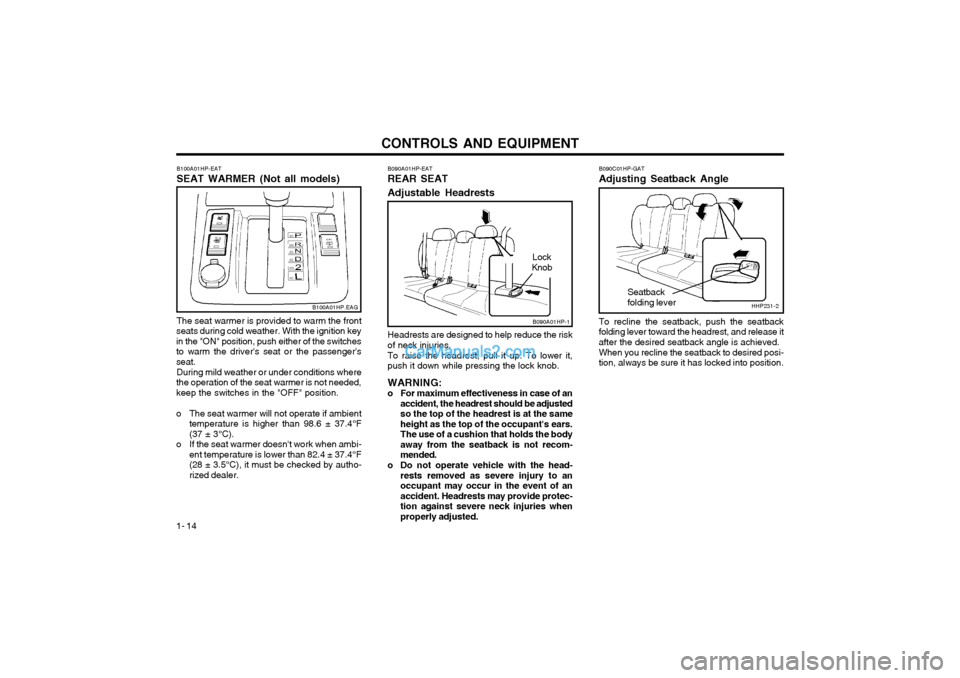
B100A01HP-EAT SEAT WARMER (Not all models) The seat warmer is provided to warm the front
seats during cold weather. With the ignition key in the "ON" position, push either of the switchesto warm the driver's seat or the passenger'sseat.
During mild weather or under conditions where
the operation of the seat warmer is not needed,keep the switches in the "OFF" position.
o The seat warmer will not operate if ambient temperature is higher than 98.6 ± 37.4°F (37 ± 3°C).
o If the seat warmer doesn't work when ambi- ent temperature is lower than 82.4 ± 37.4°F(28 ± 3.5°C), it must be checked by autho-rized dealer.
B100A01HP.EAGHHP231-2
B090A01HP-EAT REAR SEAT Adjustable Headrests Headrests are designed to help reduce the risk of neck injuries. To raise the headrest, pull it up. To lower it, push it down while pressing the lock knob. WARNING:
o For maximum effectiveness in case of an accident, the headrest should be adjusted so the top of the headrest is at the sameheight as the top of the occupant's ears.
The use of a cushion that holds the bodyaway from the seatback is not recom-mended.
o Do not operate vehicle with the head- rests removed as severe injury to anoccupant may occur in the event of anaccident. Headrests may provide protec-tion against severe neck injuries whenproperly adjusted. B090C01HP-GAT Adjusting Seatback Angle To recline the seatback, push the seatback folding lever toward the headrest, and release itafter the desired seatback angle is achieved. When you recline the seatback to desired posi- tion, always be sure it has locked into position.
Seatback folding lever
B090A01HP-1
Lock
Knob
Page 209 of 349
CONTROLS AND EQUIPMENT1- 15
o When you return the seatback to its uprightposition, always be sure it is locked into position by pulling and pushing on the top ofseatback.
WARNING:
o The purpose of the fold-down rear seat back and the fold-up rear seat cushion isto allow you to carry more objects thancould be accommodated. Never allowpassengers to sit on the cargo area whilstthe car is moving. This is not a properseating position and no seat belts areavailable for use when the seat back isfolded down. This could result in serious injury or death in case of an accident or a suddenstop. Objects should not extend higherthan the top of the front seatbacks.This could allow cargo to slide forwardand cause injury or damage during sud-den stops.
o When you return the rear seatback to its upright position after being folded down,be careful not to damage the seatbeltwebbing or buckle. In addition, do notallow the seatbelt webbing or buckle toget caught or pinched in the rear seat.
o Do not allow passengers to fold down and up the seatback and seat cushionwhilst the car is moving.
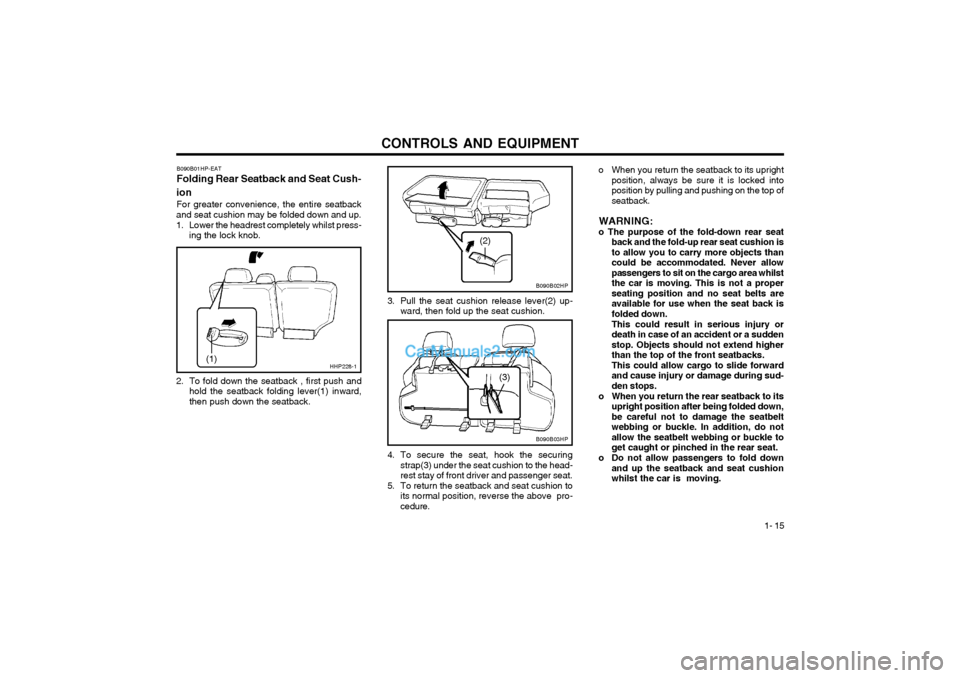
3. Pull the seat cushion release lever(2) up-ward, then fold up the seat cushion.
B090B02HP
(2)
B090B03HP
(3)
4. To secure the seat, hook the securing strap(3) under the seat cushion to the head- rest stay of front driver and passenger seat.
5. To return the seatback and seat cushion to its normal position, reverse the above pro-cedure.
B090B01HP-EAT Folding Rear Seatback and Seat Cush-
ion For greater convenience, the entire seatback
and seat cushion may be folded down and up.
1. Lower the headrest completely whilst press- ing the lock knob.
2. To fold down the seatback , first push and hold the seatback folding lever(1) inward, then push down the seatback.
HHP228-1(1)
Page 210 of 349
CONTROLS AND EQUIPMENT
1- 16 SB090F1-E Seat Belt OccupancyThe seat belts are designed to be used by one seat occupant only. The use of a seat belt bymore than one person increases the levels ofinjury which may be sustained in the event of anaccident.
SB090E1-E Injured PersonsA seat belt should be used when an injured person is being transported. For specific rec-ommendations, the advice of a qualified Medi-cal Practioner should be sought. SE090G1-E Do Not Lie DownTo ensure that the maximum level of protection
may be afforded by the seat belt system, all passengers should be sitting in an upright posi-tion throughout the journey. The seat belt will beunable to afford maximum protection if the frontseats are at or near the fully reclined position.
SB090C1-E Larger ChildrenLarger children should occupy the rear seat
and be restrained at all times. The restraint may take the form of a special safety belt or theoriginal factory fitted seat belt used in conjunc-tion with an approved booster cushion depend-ing upon the size and weight of the child. Underno circumstances should children be allowed totravel standing, kneeling or lying on the seat.
Never allow childen to ride in the front passen-
ger seat.
SB090A1-E SEAT BELT PRECAUTIONS Seat belts should be worn at all times by all
occupants front and rear. The possibility of injury or the severity of injuries suffered in theevent of an accident will be greatly reduced bythe wearing of seat belts.
In addition the following recommendations
should be observed. SB090B1-E
Babies/Small Children
Babies and small children must be restrained
using a restraint system specifically designedfor this purpose. Under no circumstances shoulda child be carried in the vehicle without the useof a suitable restraint which meets the regula-tions in force in the country where the vehicle isin operation.
B140A01B-GAT REAR SEAT WARNING
B080P01HP
For the safety of all passengers, luggage or other cargo should not be piled higher than thetop of the seatback.
SB090O1-E Pregnant WomenThe use of a seat belt is recommended for
pregnant women. The seat belt should be worn as low and snugly as possible across the hips,not across the abdomen. A qualified MedicalPractitioner should be consulted for further in-formation.
Page 211 of 349
CONTROLS AND EQUIPMENT1- 17
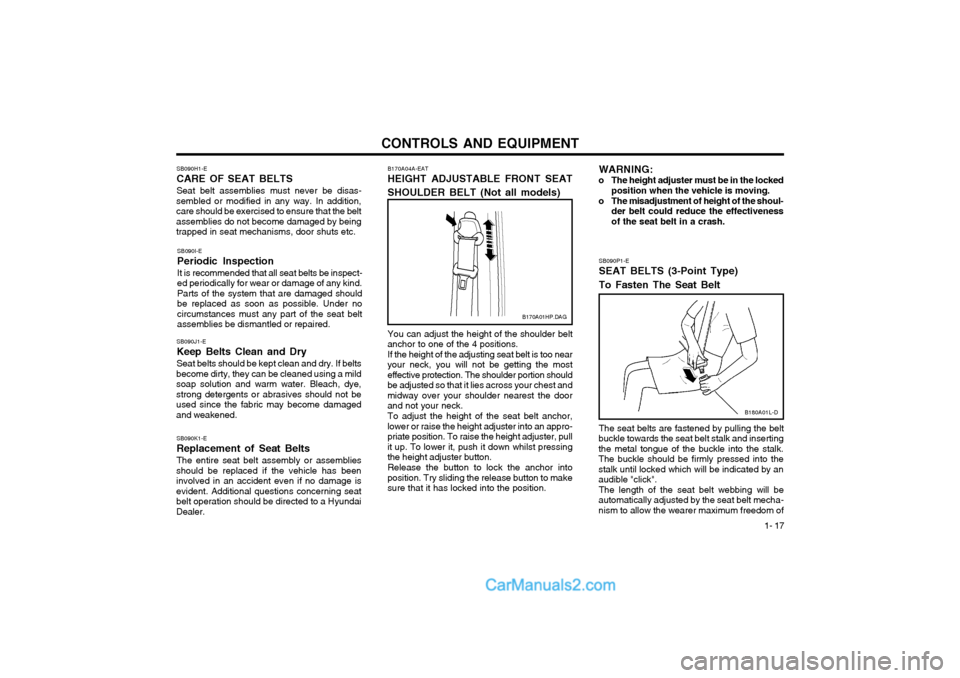
You can adjust the height of the shoulder belt
anchor to one of the 4 positions. If the height of the adjusting seat belt is too near
your neck, you will not be getting the most effective protection. The shoulder portion shouldbe adjusted so that it lies across your chest andmidway over your shoulder nearest the doorand not your neck.
To adjust the height of the seat belt anchor,
lower or raise the height adjuster into an appro-priate position. To raise the height adjuster, pullit up. To lower it, push it down whilst pressingthe height adjuster button.
Release the button to lock the anchor into
position. Try sliding the release button to makesure that it has locked into the position.
SB090J1-E Keep Belts Clean and Dry Seat belts should be kept clean and dry. If belts
become dirty, they can be cleaned using a mild soap solution and warm water. Bleach, dye,strong detergents or abrasives should not beused since the fabric may become damagedand weakened.
SB090K1-E Replacement of Seat BeltsThe entire seat belt assembly or assemblies
should be replaced if the vehicle has been involved in an accident even if no damage isevident. Additional questions concerning seatbelt operation should be directed to a HyundaiDealer. B170A04A-EAT HEIGHT ADJUSTABLE FRONT SEAT
SHOULDER BELT (Not all models)
B170A01HP.DAG
SB090H1-E CARE OF SEAT BELTSSeat belt assemblies must never be disas-
sembled or modified in any way. In addition, care should be exercised to ensure that the beltassemblies do not become damaged by beingtrapped in seat mechanisms, door shuts etc.
SB090I-E Periodic InspectionIt is recommended that all seat belts be inspect- ed periodically for wear or damage of any kind.Parts of the system that are damaged shouldbe replaced as soon as possible. Under nocircumstances must any part of the seat beltassemblies be dismantled or repaired.
WARNING:
o The height adjuster must be in the locked position when the vehicle is moving.
o The misadjustment of height of the shoul- der belt could reduce the effectiveness of the seat belt in a crash.
SB090P1-E SEAT BELTS (3-Point Type) To Fasten The Seat Belt
B180A01L-D
The seat belts are fastened by pulling the belt
buckle towards the seat belt stalk and inserting the metal tongue of the buckle into the stalk.The buckle should be firmly pressed into thestalk until locked which will be indicated by anaudible "click". The length of the seat belt webbing will be
automatically adjusted by the seat belt mecha-nism to allow the wearer maximum freedom of
Page 212 of 349
CONTROLS AND EQUIPMENT
1- 18
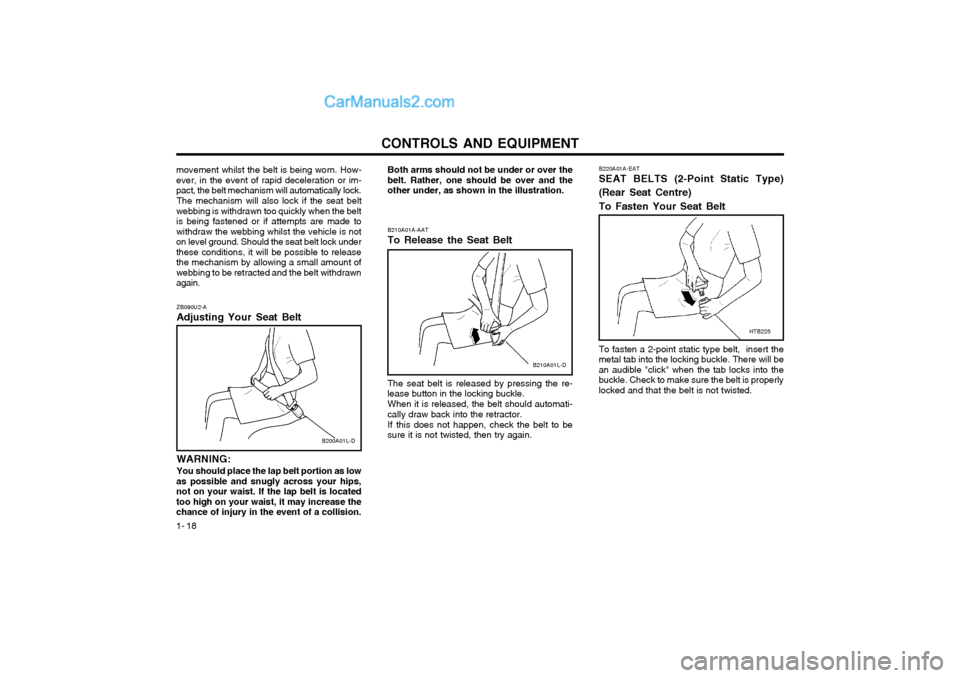
B220A01A-EAT SEAT BELTS (2-Point Static Type) (Rear Seat Centre) To Fasten Your Seat Belt To fasten a 2-point static type belt, insert the metal tab into the locking buckle. There will bean audible "click" when the tab locks into thebuckle. Check to make sure the belt is properlylocked and that the belt is not twisted. HTB225
B210A01A-AAT To Release the Seat Belt The seat belt is released by pressing the re-
lease button in the locking buckle.
When it is released, the belt should automati-
cally draw back into the retractor.
If this does not happen, check the belt to be
sure it is not twisted, then try again.
B210A01L-D
ZB090U2-A Adjusting Your Seat Belt WARNING: You should place the lap belt portion as low
as possible and snugly across your hips, not on your waist. If the lap belt is locatedtoo high on your waist, it may increase thechance of injury in the event of a collision.
B200A01L-D
movement whilst the belt is being worn. How- ever, in the event of rapid deceleration or im-pact, the belt mechanism will automatically lock.
The mechanism will also lock if the seat belt
webbing is withdrawn too quickly when the beltis being fastened or if attempts are made towithdraw the webbing whilst the vehicle is noton level ground. Should the seat belt lock underthese conditions, it will be possible to releasethe mechanism by allowing a small amount ofwebbing to be retracted and the belt withdrawnagain. Both arms should not be under or over thebelt. Rather, one should be over and theother under, as shown in the illustration.
Page 213 of 349
CONTROLS AND EQUIPMENT1- 19
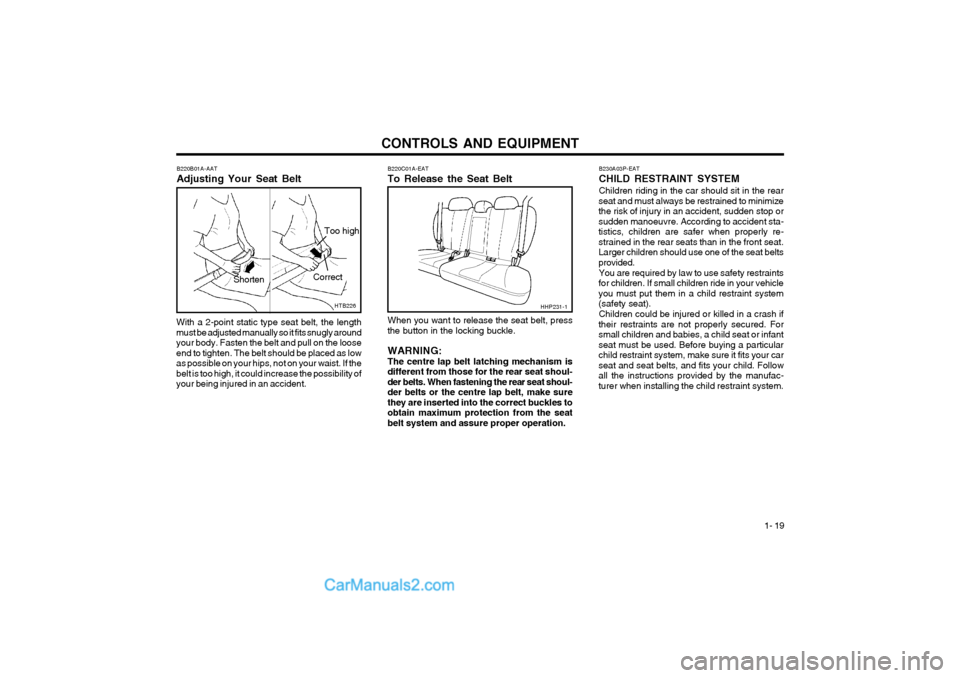
B220C01A-EAT To Release the Seat Belt When you want to release the seat belt, press
the button in the locking buckle.
WARNING: The centre lap belt latching mechanism is
different from those for the rear seat shoul-der belts. When fastening the rear seat shoul-der belts or the centre lap belt, make surethey are inserted into the correct buckles toobtain maximum protection from the seatbelt system and assure proper operation.
HHP231-1
B220B01A-AAT Adjusting Your Seat BeltHTB226
With a 2-point static type seat belt, the length must be adjusted manually so it fits snugly aroundyour body. Fasten the belt and pull on the looseend to tighten. The belt should be placed as lowas possible on your hips, not on your waist. If thebelt is too high, it could increase the possibility ofyour being injured in an accident. Correct
Shorten Too high
B230A03P-EAT CHILD RESTRAINT SYSTEMChildren riding in the car should sit in the rear
seat and must always be restrained to minimize the risk of injury in an accident, sudden stop orsudden manoeuvre. According to accident sta-tistics, children are safer when properly re-strained in the rear seats than in the front seat.Larger children should use one of the seat beltsprovided.
You are required by law to use safety restraints
for children. If small children ride in your vehicleyou must put them in a child restraint system(safety seat).
Children could be injured or killed in a crash if
their restraints are not properly secured. Forsmall children and babies, a child seat or infantseat must be used. Before buying a particularchild restraint system, make sure it fits your carseat and seat belts, and fits your child. Followall the instructions provided by the manufac-turer when installing the child restraint system.
Page 214 of 349
CONTROLS AND EQUIPMENT
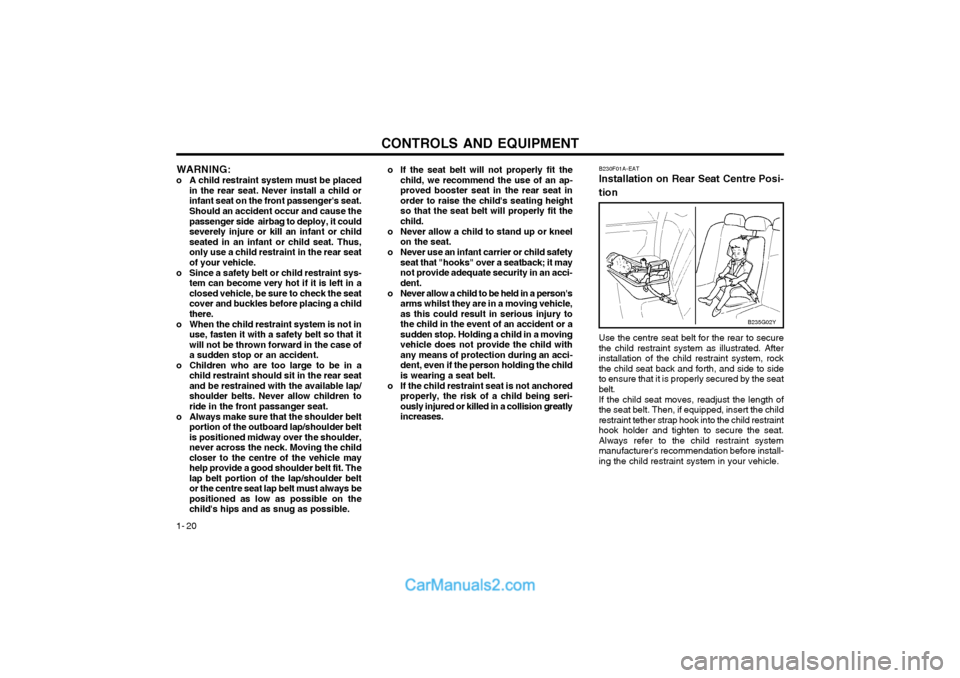
1- 20 B230F01A-EAT Installation on Rear Seat Centre Posi- tion Use the centre seat belt for the rear to secure the child restraint system as illustrated. Afterinstallation of the child restraint system, rockthe child seat back and forth, and side to sideto ensure that it is properly secured by the seatbelt. If the child seat moves, readjust the length of the seat belt. Then, if equipped, insert the childrestraint tether strap hook into the child restrainthook holder and tighten to secure the seat.Always refer to the child restraint systemmanufacturer's recommendation before install-ing the child restraint system in your vehicle.
o If the seat belt will not properly fit the
child, we recommend the use of an ap-proved booster seat in the rear seat inorder to raise the child's seating heightso that the seat belt will properly fit thechild.
o Never allow a child to stand up or kneel on the seat.
o Never use an infant carrier or child safety seat that "hooks" over a seatback; it maynot provide adequate security in an acci-dent.
o Never allow a child to be held in a person's arms whilst they are in a moving vehicle,as this could result in serious injury tothe child in the event of an accident or asudden stop. Holding a child in a movingvehicle does not provide the child withany means of protection during an acci-dent, even if the person holding the childis wearing a seat belt.
o If the child restraint seat is not anchored properly, the risk of a child being seri-ously injured or killed in a collision greatlyincreases.
WARNING:
o A child restraint system must be placed in the rear seat. Never install a child orinfant seat on the front passenger's seat. Should an accident occur and cause the passenger side airbag to deploy, it couldseverely injure or kill an infant or childseated in an infant or child seat. Thus,only use a child restraint in the rear seatof your vehicle.
o Since a safety belt or child restraint sys- tem can become very hot if it is left in aclosed vehicle, be sure to check the seatcover and buckles before placing a childthere.
o When the child restraint system is not in use, fasten it with a safety belt so that itwill not be thrown forward in the case ofa sudden stop or an accident.
o Children who are too large to be in a child restraint should sit in the rear seatand be restrained with the available lap/shoulder belts. Never allow children toride in the front passanger seat.
o Always make sure that the shoulder belt portion of the outboard lap/shoulder beltis positioned midway over the shoulder,never across the neck. Moving the childcloser to the centre of the vehicle mayhelp provide a good shoulder belt fit. Thelap belt portion of the lap/shoulder beltor the centre seat lap belt must always bepositioned as low as possible on thechild's hips and as snug as possible.
B235G02Y
Page 215 of 349
CONTROLS AND EQUIPMENT1- 21
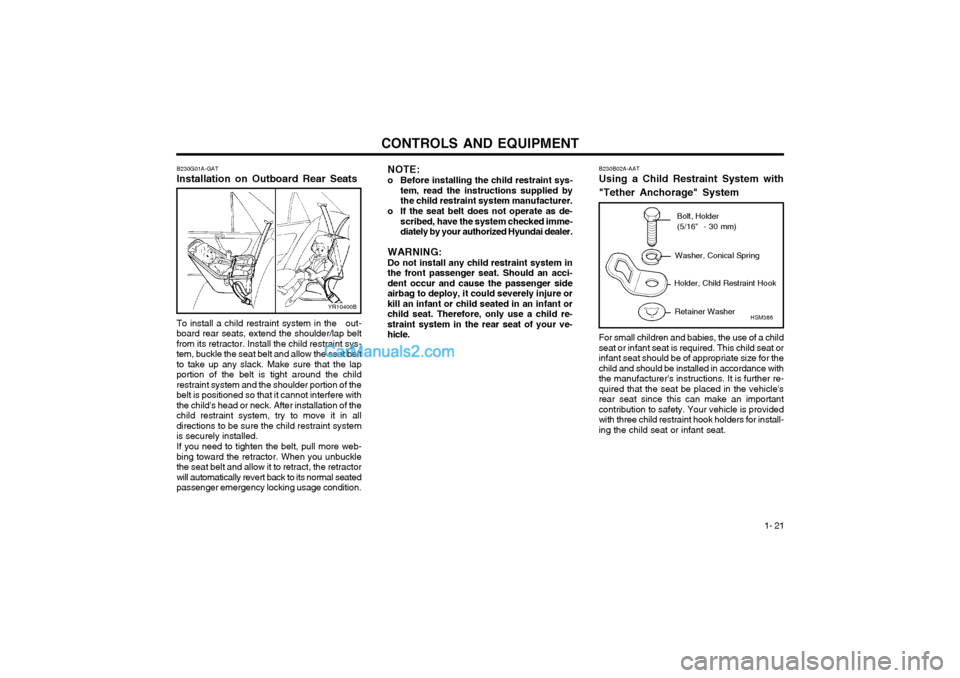
B230G01A-GAT Installation on Outboard Rear Seats To install a child restraint system in the out- board rear seats, extend the shoulder/lap beltfrom its retractor. Install the child restraint sys-tem, buckle the seat belt and allow the seat beltto take up any slack. Make sure that the lapportion of the belt is tight around the childrestraint system and the shoulder portion of thebelt is positioned so that it cannot interfere withthe child's head or neck. After installation of thechild restraint system, try to move it in alldirections to be sure the child restraint systemis securely installed. If you need to tighten the belt, pull more web- bing toward the retractor. When you unbucklethe seat belt and allow it to retract, the retractorwill automatically revert back to its normal seatedpassenger emergency locking usage condition.
NOTE:
o Before installing the child restraint sys- tem, read the instructions supplied bythe child restraint system manufacturer.
o If the seat belt does not operate as de- scribed, have the system checked imme-diately by your authorized Hyundai dealer.
WARNING:Do not install any child restraint system in
the front passenger seat. Should an acci-dent occur and cause the passenger sideairbag to deploy, it could severely injure orkill an infant or child seated in an infant orchild seat. Therefore, only use a child re-straint system in the rear seat of your ve-hicle.
YR10400B B230B02A-AAT Using a Child Restraint System with
"Tether Anchorage" System For small children and babies, the use of a child seat or infant seat is required. This child seat orinfant seat should be of appropriate size for thechild and should be installed in accordance withthe manufacturer's instructions. It is further re-quired that the seat be placed in the vehicle'srear seat since this can make an importantcontribution to safety. Your vehicle is providedwith three child restraint hook holders for install-ing the child seat or infant seat. Bolt, Holder (5/16" - 30 mm)
Washer, Conical Spring
Holder, Child Restraint Hook
Retainer WasherHSM386
Page 217 of 349
CONTROLS AND EQUIPMENT1- 23
NOTE:
At present, this seat is the only one comply-
ing with that provision. In case that other manufacturers will furnish proof of a re-spective certification, Hyundai is going toevaluate this seat carefully and will give arecommendation provided that seat com-plies to the law. Please ask your Hyundaidealer in this respect.
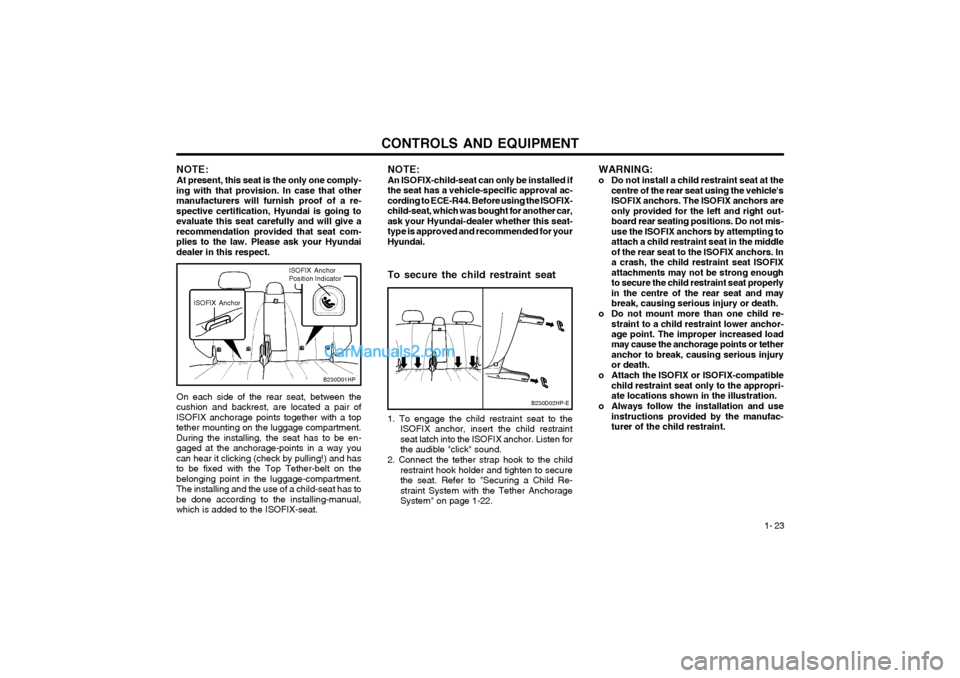
On each side of the rear seat, between the
cushion and backrest, are located a pair ofISOFIX anchorage points together with a toptether mounting on the luggage compartment.During the installing, the seat has to be en-gaged at the anchorage-points in a way youcan hear it clicking (check by pulling!) and hasto be fixed with the Top Tether-belt on thebelonging point in the luggage-compartment.The installing and the use of a child-seat has tobe done according to the installing-manual,which is added to the ISOFIX-seat.
B230D02HP-E
NOTE: An ISOFIX-child-seat can only be installed ifthe seat has a vehicle-specific approval ac-cording to ECE-R44. Before using the ISOFIX-child-seat, which was bought for another car,ask your Hyundai-dealer whether this seat-type is approved and recommended for yourHyundai. To secure the child restraint seat 1. To engage the child restraint seat to the ISOFIX anchor, insert the child restraint seat latch into the ISOFIX anchor. Listen forthe audible "click" sound.
2. Connect the tether strap hook to the child restraint hook holder and tighten to securethe seat. Refer to "Securing a Child Re-straint System with the Tether AnchorageSystem" on page 1-22. WARNING:
o Do not install a child restraint seat at the
centre of the rear seat using the vehicle's ISOFIX anchors. The ISOFIX anchors areonly provided for the left and right out-board rear seating positions. Do not mis-use the ISOFIX anchors by attempting toattach a child restraint seat in the middleof the rear seat to the ISOFIX anchors. Ina crash, the child restraint seat ISOFIXattachments may not be strong enoughto secure the child restraint seat properlyin the centre of the rear seat and maybreak, causing serious injury or death.
o Do not mount more than one child re- straint to a child restraint lower anchor-age point. The improper increased load may cause the anchorage points or tether anchor to break, causing serious injuryor death.
o Attach the ISOFIX or ISOFIX-compatible child restraint seat only to the appropri-ate locations shown in the illustration.
o Always follow the installation and use instructions provided by the manufac-turer of the child restraint.
B230D01HP
ISOFIX Anchor ISOFIX Anchor Position Indicator
Page 218 of 349
CONTROLS AND EQUIPMENT
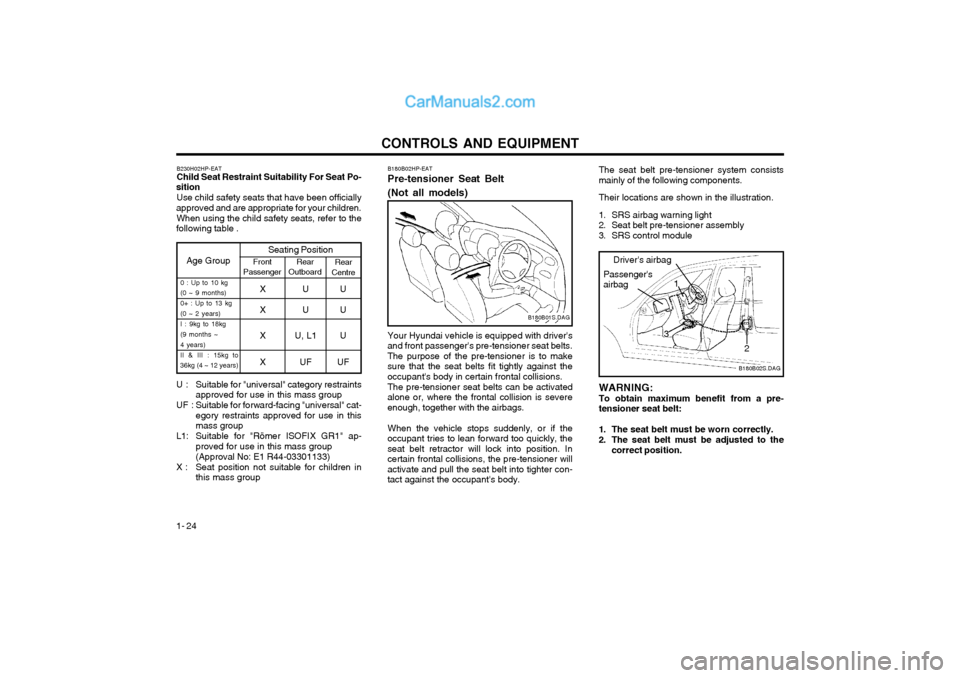
1- 24 The seat belt pre-tensioner system consists mainly of the following components. Their locations are shown in the illustration.
1. SRS airbag warning light
2. Seat belt pre-tensioner assembly
3. SRS control module WARNING: To obtain maximum benefit from a pre-tensioner seat belt:
1. The seat belt must be worn correctly.
2. The seat belt must be adjusted to the
correct position.
Age Group Seating PositionFront
Passenger Rear
Outboard Rear
Centre
0 : Up to 10 kg (0 ~ 9 months) 0+ : Up to 13 kg(0 ~ 2 years)I : 9kg to 18kg(9 months ~4 years) II & III : 15kg to
36kg (4 ~ 12 years)XUU
XUU
X U, L1 U XU FUF
B230H02HP-EAT Child Seat Restraint Suitability For Seat Po-
sition
Use child safety seats that have been officially
approved and are appropriate for your children.
When using the child safety seats, refer to the
following table .
U : Suitable for "universal" category restraints approved for use in this mass group
UF : Suitable for forward-facing "universal" cat- egory restraints approved for use in this mass group
L1: Suitable for "Römer ISOFIX GR1" ap- proved for use in this mass group (Approval No: E1 R44-03301133)
X : Seat position not suitable for children in this mass group Your Hyundai vehicle is equipped with driver's
and front passenger's pre-tensioner seat belts. The purpose of the pre-tensioner is to makesure that the seat belts fit tightly against theoccupant's body in certain frontal collisions.
The pre-tensioner seat belts can be activated
alone or, where the frontal collision is severeenough, together with the airbags.
When the vehicle stops suddenly, or if the
occupant tries to lean forward too quickly, theseat belt retractor will lock into position. Incertain frontal collisions, the pre-tensioner willactivate and pull the seat belt into tighter con-tact against the occupant's body. B180B02HP-EAT Pre-tensioner Seat Belt (Not all models)
B180B01S.DAG
B180B02S.DAG
Driver's airbag
1
Passenger's airbag
3
2