warning Hyundai Terracan 2003 Workshop Manual
[x] Cancel search | Manufacturer: HYUNDAI, Model Year: 2003, Model line: Terracan, Model: Hyundai Terracan 2003Pages: 349, PDF Size: 4.56 MB
Page 125 of 349
WHAT TO DO IN AN EMERGENCY 3-1
3. WHAT TO DO IN ANEMERGENCY
D010A01A-AAT IF THE ENGINE WILL NOT START WARNING: If the engine will not start, do not push or pull the car to start it. This could result in a collision or cause other damage. In addition, push or pull starting may cause the catalytic converter to be overloaded and create a fire hazard. D010B01HP-GAT If Engine Doesn’t Turn Over or Turns Over Slowly
1. If your car has an automatic transmission, be sure the gear selector lever is in "N" or "P" and the emergency brake is set. 2. Check the battery connections to be sure
they are clean and tight.
3. Turn on the interior light. If the light dims or
goes out when you operate the starter, the battery is discharged.
4. Check the starter connections to be sure they are securely tightened.
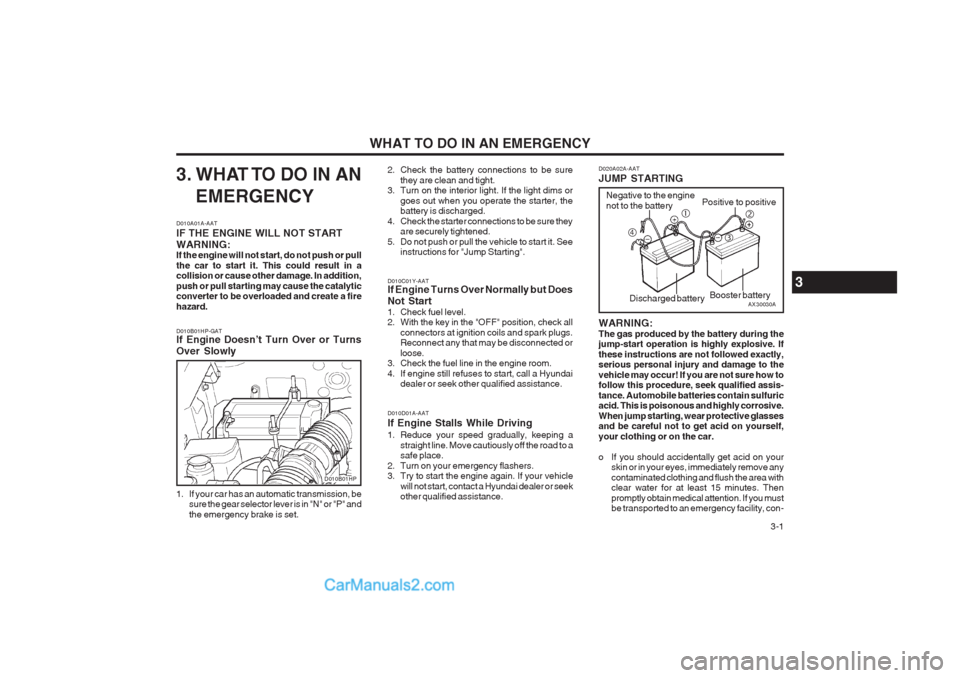
5. Do not push or pull the vehicle to start it. See instructions for "Jump Starting". D020A02A-AAT JUMP STARTING WARNING: The gas produced by the battery during the jump-start operation is highly explosive. If these instructions are not followed exactly, serious personal injury and damage to the vehicle may occur! If you are not sure how to follow this procedure, seek qualified assis- tance. Automobile batteries contain sulfuric acid. This is poisonous and highly corrosive. When jump starting, wear protective glasses and be careful not to get acid on yourself, your clothing or on the car.
o If you should accidentally get acid on your
skin or in your eyes, immediately remove any contaminated clothing and flush the area with clear water for at least 15 minutes. Then promptly obtain medical attention. If you must be transported to an emergency facility, con-
D010C01Y-AAT If Engine Turns Over Normally but Does Not Start
1. Check fuel level.
2. With the key in the "OFF" position, check all
connectors at ignition coils and spark plugs.Reconnect any that may be disconnected or loose.
3. Check the fuel line in the engine room.
4. If engine still refuses to start, call a Hyundai dealer or seek other qualified assistance.
D010D01A-AAT If Engine Stalls While Driving
1. Reduce your speed gradually, keeping a straight line. Move cautiously off the road to a safe place.
2. Turn on your emergency flashers.
3. Try to start the engine again. If your vehicle will not start, contact a Hyundai dealer or seekother qualified assistance.
AX30030A
Negative to the engine not to the battery
Positive to positive
Booster battery
c
e
f d
Discharged battery
D010B01HP
3
Page 126 of 349
WHAT TO DO IN AN EMERGENCY
3-2 tinue to apply water to the affected area with a sponge or cloth.
o The gas produced by the battery during the
jump-start operation is highly explosive. Do not smoke or allow a spark or an open flame in the vicinity.
o The battery being used to provide the jump
start must be 12-volt. If you cannot determine that it is a 12-volt battery, do not attempt to use it for the jump start.
o To jump start a car with a discharged battery,
follow this procedure exactly:
1. If the booster battery is installed in another vehicle, be sure the two vehicles are nottouching.
2. Turn off all unnecessary lights and acces-
sories in both vehicles.
3. Attach the clamps of the jumper cable in the
exact location shown in the illustration. First, attach one clamp of the jumper cable to the positive (+) post or cable of the discharged battery. Then attach the other end of the same cable to the positive (+) post or cable of the booster battery. Next, using the other cable, attach one clamp to the negative (-) post or cable of the booster battery. Then attach the other end of that cable to a solid metal part of the engine away from the battery. Do not connect the cable to any moving part.
4. Start the engine in the car with the booster battery and let it run for a few minutes. This will help to assure that the booster battery is fully charged. During the jumping operation,run the engine in this vehicle at about 2000 rpm.
5. Start the engine in the car with the discharged battery using the normal starting procedure. After the engine starts, leave the jumper cables connected and let the engine run at fast idle or about 2000 rpm for several min- utes.
6. Carefully remove the jumper cables in the reverse order of attachment.
If you do not know why your battery became discharged (because the lights were left on, etc.), have the charging system checked by your Hyundai dealer. visible loss of coolant and no steam, leave theengine running and check to be sure the engine cooling fan is operating. If the fan is not running, turn the engine off.
4. Check to see if the water pump drive belt is
missing. If it is not missing, check to see that it is tight. If the drive belt seems to be satis- factory, check for engine coolant leaking from the radiator, hoses or under the car. (If the air conditioning had been in use, it is normal for cold water to be draining from it when you stop).
WARNING: While the engine is running, keep hands and clothing away from moving parts such as the fan and drive belts to prevent injury.
5. If the water pump drive belt is broken or coolant is leaking out, stop the engine im- mediately and call the nearest Hyundai deal- er for assistance.
WARNING: Do not remove the radiator cap when the engine is hot. This can allow coolant to be blown out of the opening and cause serious burns.
6. If you cannot find the cause of the overheat- ing, wait until the engine temperature has returned to normal. Then, if coolant has been lost, carefully add coolant to the reservoir (Page 6-8) to bring the fluid level in the reser- voir up to the halfway mark.
D030A01HP-AAT IF THE ENGINE OVERHEATS If your temperature gauge indicates overheating, you experience a loss of power, or hear loud pinging or knocking, the engine is probably too hot. If this happens to you, you should:
1. Pull off the road and stop as soon as it is safe
to do so.
2. Place the gear selector lever in "P" (auto- matic), or neutral (manual transmission) and set the parking brake. If the air conditioning is on, turn it off.
3. If engine coolant is running out under the car or steam is coming out from under the hood, stop the engine. Do not open the hood until the engine coolant has stopped running or the steaming has stopped. If there is no
Page 131 of 349
WHAT TO DO IN AN EMERGENCY 3-7
D060F04HP
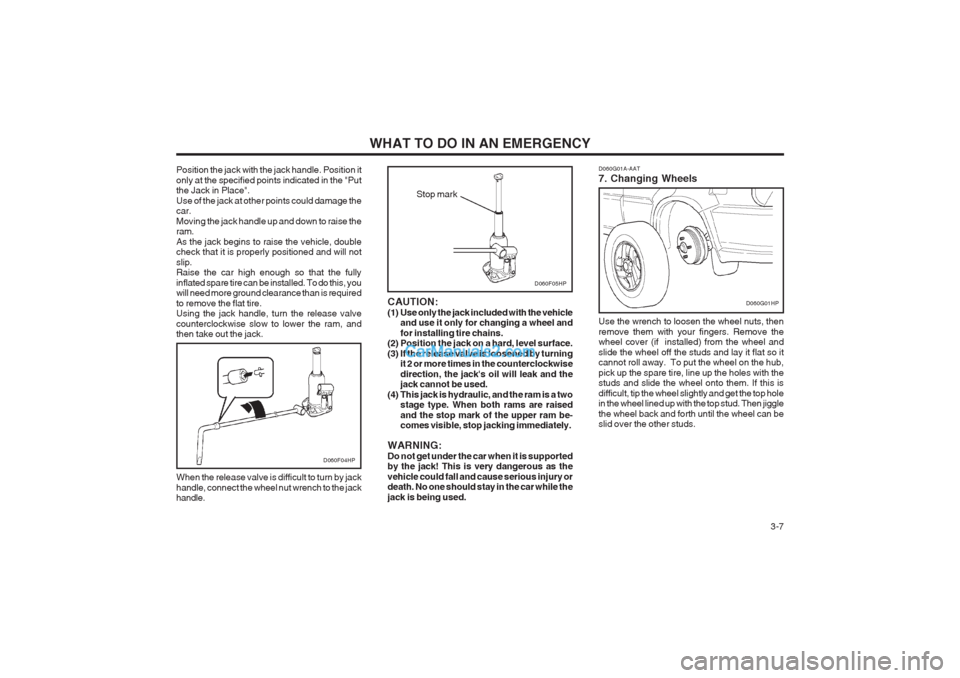
When the release valve is difficult to turn by jack handle, connect the wheel nut wrench to the jack handle. CAUTION:
(1) Use only the jack included with the vehicle
and use it only for changing a wheel andfor installing tire chains.
(2) Position the jack on a hard, level surface.
(3) If the release valve is loosened by turning it 2 or more times in the counterclockwisedirection, the jack's oil will leak and the jack cannot be used.
(4) This jack is hydraulic, and the ram is a two stage type. When both rams are raised and the stop mark of the upper ram be- comes visible, stop jacking immediately.
WARNING: Do not get under the car when it is supported by the jack! This is very dangerous as the vehicle could fall and cause serious injury or death. No one should stay in the car while the jack is being used. D060G01A-AAT 7. Changing Wheels Use the wrench to loosen the wheel nuts, then remove them with your fingers. Remove the wheel cover (if installed) from the wheel and slide the wheel off the studs and lay it flat so it cannot roll away. To put the wheel on the hub, pick up the spare tire, line up the holes with the studs and slide the wheel onto them. If this is difficult, tip the wheel slightly and get the top hole in the wheel lined up with the top stud. Then jiggle the wheel back and forth until the wheel can be slid over the other studs.
D060G01HP
D060F05HP
Position the jack with the jack handle. Position it only at the specified points indicated in the "Put the Jack in Place". Use of the jack at other points could damage the car. Moving the jack handle up and down to raise the ram. As the jack begins to raise the vehicle, double check that it is properly positioned and will not slip. Raise the car high enough so that the fully inflated spare tire can be installed. To do this, you will need more ground clearance than is required to remove the flat tire. Using the jack handle, turn the release valve counterclockwise slow to lower the ram, and then take out the jack.
Stop mark
Page 132 of 349
WHAT TO DO IN AN EMERGENCY
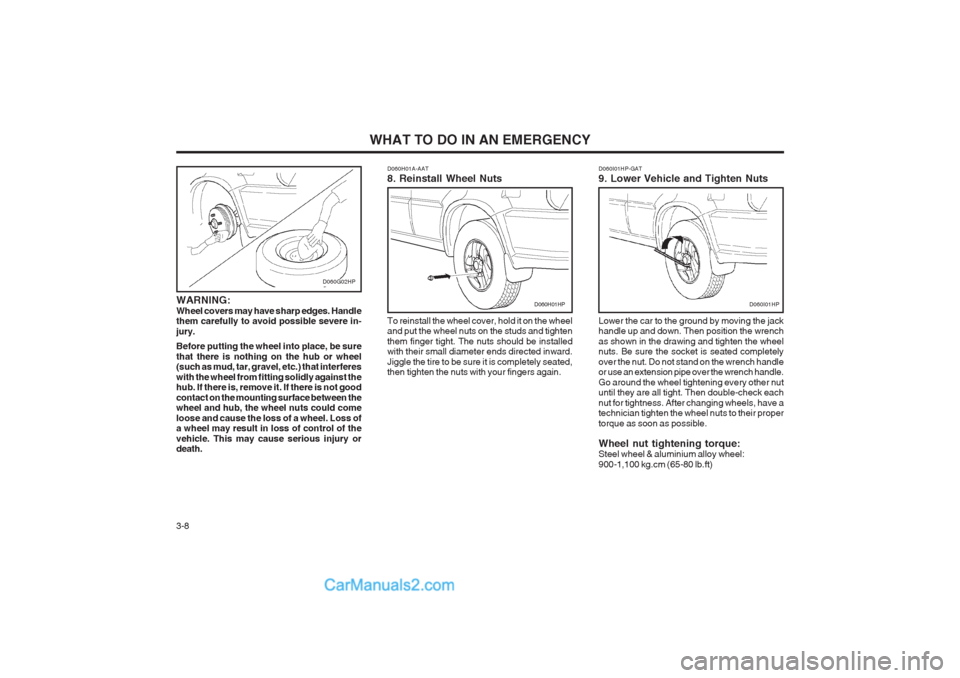
3-8 Lower the car to the ground by moving the jack handle up and down. Then position the wrench as shown in the drawing and tighten the wheel nuts. Be sure the socket is seated completely over the nut. Do not stand on the wrench handle or use an extension pipe over the wrench handle. Go around the wheel tightening every other nut until they are all tight. Then double-check each nut for tightness. After changing wheels, have a technician tighten the wheel nuts to their proper torque as soon as possible. Wheel nut tightening torque: Steel wheel & aluminium alloy wheel: 900-1,100 kg.cm (65-80 lb.ft)
D060I01HP-GAT 9. Lower Vehicle and Tighten Nuts
D060I01HP
D060H01A-AAT 8. Reinstall Wheel Nuts To reinstall the wheel cover, hold it on the wheel and put the wheel nuts on the studs and tighten them finger tight. The nuts should be installed with their small diameter ends directed inward. Jiggle the tire to be sure it is completely seated, then tighten the nuts with your fingers again.
D060H01HPWARNING: Wheel covers may have sharp edges. Handle them carefully to avoid possible severe in- jury. Before putting the wheel into place, be sure that there is nothing on the hub or wheel (such as mud, tar, gravel, etc.) that interferes with the wheel from fitting solidly against the hub. If there is, remove it. If there is not good contact on the mounting surface between the wheel and hub, the wheel nuts could come loose and cause the loss of a wheel. Loss of a wheel may result in loss of control of the vehicle. This may cause serious injury or death.
D060G02HP
Page 153 of 349
DO-IT-YOURSELF MAINTENANCE 6-7
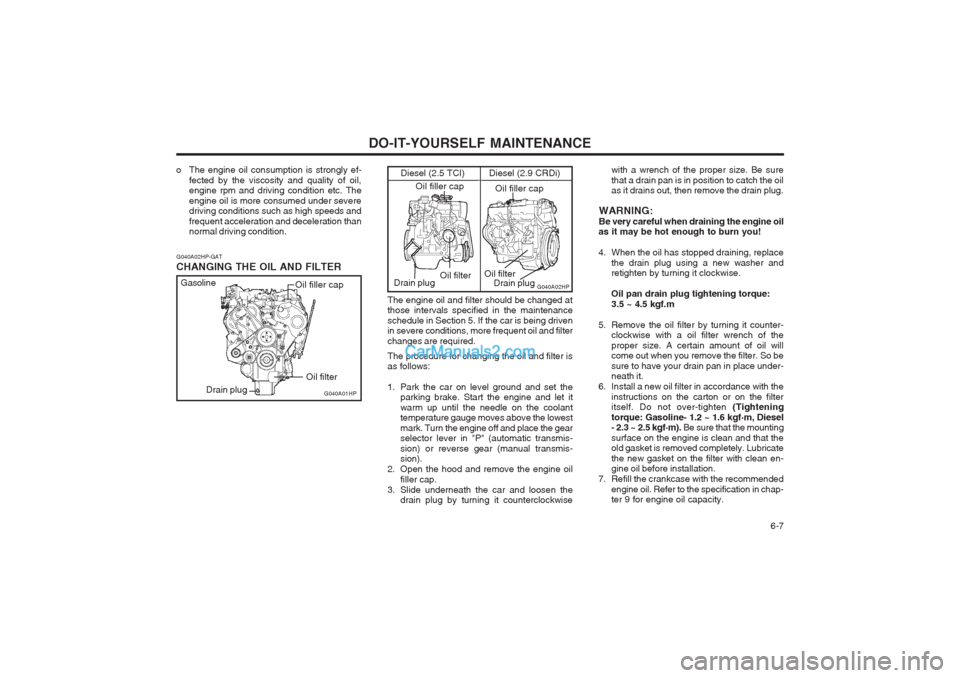
The engine oil and filter should be changed at those intervals specified in the maintenance schedule in Section 5. If the car is being driven in severe conditions, more frequent oil and filter changes are required. The procedure for changing the oil and filter is as follows:
1. Park the car on level ground and set theparking brake. Start the engine and let it warm up until the needle on the coolant temperature gauge moves above the lowest mark. Turn the engine off and place the gear selector lever in "P" (automatic transmis- sion) or reverse gear (manual transmis- sion).
2. Open the hood and remove the engine oil filler cap.
3. Slide underneath the car and loosen the drain plug by turning it counterclockwise with a wrench of the proper size. Be sure that a drain pan is in position to catch the oil as it drains out, then remove the drain plug.
WARNING: Be very careful when draining the engine oil
as it may be hot enough to burn you!
4. When the oil has stopped draining, replace
the drain plug using a new washer and retighten by turning it clockwise. Oil pan drain plug tightening torque: 3.5 ~ 4.5 kgf.m
5. Remove the oil filter by turning it counter- clockwise with a oil filter wrench of theproper size. A certain amount of oil will come out when you remove the filter. So be sure to have your drain pan in place under- neath it.
6. Install a new oil filter in accordance with the instructions on the carton or on the filteritself. Do not over-tighten (Tightening
torque: Gasoline- 1.2 ~ 1.6 kgf .
m, Diesel
- 2.3 ~ 2.5 kgf .
m). Be sure that the mounting
surface on the engine is clean and that theold gasket is removed completely. Lubricate the new gasket on the filter with clean en- gine oil before installation.
7. Refill the crankcase with the recommended engine oil. Refer to the specification in chap-ter 9 for engine oil capacity.
G040A02HP
Diesel (2.9 CRDi)
Diesel (2.5 TCI)
Oil filter
Oil filler cap
Oil filler cap
Drain plug Oil filter
Drain plug
G040A02HP-GAT CHANGING THE OIL AND FILTER
o The engine oil consumption is strongly ef-
fected by the viscosity and quality of oil, engine rpm and driving condition etc. The engine oil is more consumed under severe driving conditions such as high speeds and
frequent acceleration and deceleration than normal driving condition.
G040A01HP
Gasoline
Oil filter
Drain plug Oil filler cap
Page 154 of 349
DO-IT-YOURSELF MAINTENANCE
6-8
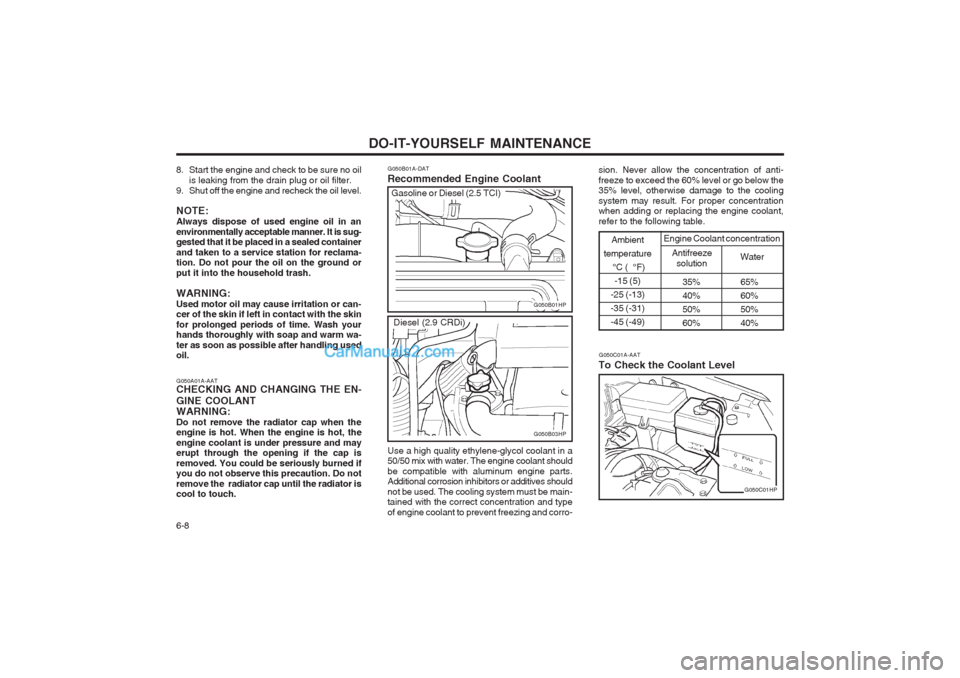
G050B01A-DAT Recommended Engine Coolant
35% 65%
40% 60%
50% 50%
60% 40%
Ambient
temperature °C ( °F)-15 (5)
-25 (-13) -35 (-31)-45 (-49)
Antifreeze solution Water
Engine Coolant concentration
G050B01HP
G050C01A-AAT
To Check the Coolant Level
G050C01HP
Use a high quality ethylene-glycol coolant in a 50/50 mix with water. The engine coolant should be compatible with aluminum engine parts. Additional corrosion inhibitors or additives should not be used. The cooling system must be main- tained with the correct concentration and type of engine coolant to prevent freezing and corro-
Gasoline or Diesel (2.5 TCI)
G050B03HP
Diesel (2.9 CRDi) sion. Never allow the concentration of anti- freeze to exceed the 60% level or go below the 35% level, otherwise damage to the cooling system may result. For proper concentration when adding or replacing the engine coolant, refer to the following table.
8. Start the engine and check to be sure no oil
is leaking from the drain plug or oil filter.
9. Shut off the engine and recheck the oil level. NOTE: Always dispose of used engine oil in anenvironmentally acceptable manner. It is sug- gested that it be placed in a sealed container and taken to a service station for reclama- tion. Do not pour the oil on the ground or put it into the household trash. WARNING: Used motor oil may cause irritation or can- cer of the skin if left in contact with the skin for prolonged periods of time. Wash your hands thoroughly with soap and warm wa- ter as soon as possible after handling used oil. G050A01A-AAT CHECKING AND CHANGING THE EN- GINE COOLANT WARNING: Do not remove the radiator cap when the engine is hot. When the engine is hot, the engine coolant is under pressure and may erupt through the opening if the cap is removed. You could be seriously burned if you do not observe this precaution. Do not remove the radiator cap until the radiator is cool to touch.
Page 155 of 349
DO-IT-YOURSELF MAINTENANCE 6-9
coolant container, add the appropriate quan- tity of coolant to the radiator.
G050D03HP
G050D01HP
G050D02HP
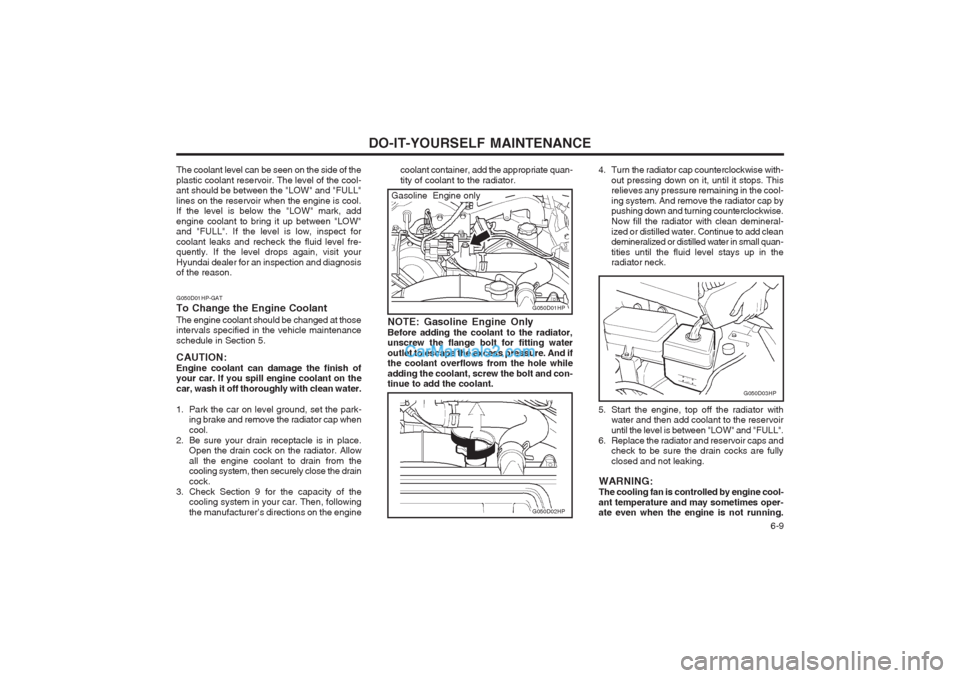
NOTE: Gasoline Engine Only Before adding the coolant to the radiator, unscrew the flange bolt for fitting water outlet to escape the excess pressure. And if the coolant overflows from the hole while adding the coolant, screw the bolt and con- tinue to add the coolant. 4. Turn the radiator cap counterclockwise with-
out pressing down on it, until it stops. Thisrelieves any pressure remaining in the cool- ing system. And remove the radiator cap by pushing down and turning counterclockwise. Now fill the radiator with clean demineral-ized or distilled water. Continue to add clean demineralized or distilled water in small quan- tities until the fluid level stays up in the radiator neck.
5. Start the engine, top off the radiator with water and then add coolant to the reservoir until the level is between "LOW" and "FULL".
6. Replace the radiator and reservoir caps and check to be sure the drain cocks are fullyclosed and not leaking.
WARNING:The cooling fan is controlled by engine cool-
ant temperature and may sometimes oper- ate even when the engine is not running.
Gasoline Engine only
The coolant level can be seen on the side of the plastic coolant reservoir. The level of the cool- ant should be between the "LOW" and "FULL" lines on the reservoir when the engine is cool. If the level is below the "LOW" mark, add engine coolant to bring it up between "LOW" and "FULL". If the level is low, inspect for coolant leaks and recheck the fluid level fre- quently. If the level drops again, visit your Hyundai dealer for an inspection and diagnosis of the reason.
G050D01HP-GAT To Change the Engine CoolantThe engine coolant should be changed at those intervals specified in the vehicle maintenance schedule in Section 5. CAUTION: Engine coolant can damage the finish of your car. If you spill engine coolant on the car, wash it off thoroughly with clean water.
1. Park the car on level ground, set the park-
ing brake and remove the radiator cap when cool.
2. Be sure your drain receptacle is in place. Open the drain cock on the radiator. Allowall the engine coolant to drain from the cooling system, then securely close the drain cock.
3. Check Section 9 for the capacity of the cooling system in your car. Then, followingthe manufacturer’s directions on the engine
Page 156 of 349

DO-IT-YOURSELF MAINTENANCE
6-10
G070A02Y-AAT
CHANGING THE AIR CLEANER FIL- TER
G070A01HP
The replacement of air cleaner filter is per- formed in the following manner.
1. Unsnap the clips around the cover.
2. When this is done, the cover can be lifted off, the old filter removed and the new filterput in its place.
Genuine Hyundai replacement parts are rec- ommended. CAUTION: Operating your vehicle without a proper air cleaner filter in place can result in excessive engine wear.
NOTE:
o When replacing the spark plug, genuine
Hyundai parts are recommended.
o It is recommended that the spark plugs be changed by an authorized Hyundai dealer.
WARNING: It is recommended that the engine be coolor cold when changing the spark plugs. If
G060B01HP-AAT
Replacing the Spark Plugs The spark plugs should be changed at the intervals specified in the vehicle maintenance schedule in Section 5 or whenever engine per- formance indicates they should be changed. Symptoms that suggest poor spark plug perfor- mance include engine misfiring under load, loss of fuel economy, poor acceleration, etc. When spark plugs are replaced, always use spark plugs recommended by Hyundai. The use of other spark plugs can result in loss of performance, radio interference or engine dam- age.
Recommended Spark Plugs: Type
RC10PYPB4 (CHAMPION) PFR5N-11 (NGK)RC10YC(CHAMPION)BKR5ES (NGK)
Remark
Unleaded*
Leaded
*: Platinum coated the engine is hot, you could burn yourself on the insulated connector, the spark plug or the engine itself.
Use extreme caution when working near the blades of the coolant fan so that you are not injured by a rotating fan blade. As the en- gine coolant temperature decreases, the fan will automatically shut off. This is a normal condition. G060A01HP-GAT SPARK PLUGS (Gasoline Engine Only)
SSA6060A
Your engine was originally equipped with plati- num-tipped spark plugs.Platinum-tipped spark plugs will last longer than
conventional type spark plugs and can be iden- tified by blue lines on the ceramic shell. NOTE: Do not clean or regap platinum-tipped spark plugs.
Unleaded: 1.0 ~ 1.1mm (0.039 ~ 0.043 in.) Leaded : 0.7 ~ 0.8mm (0.028 ~ 0.032 in.)
Page 158 of 349
DO-IT-YOURSELF MAINTENANCE
6-12
G110D02HP-GAT
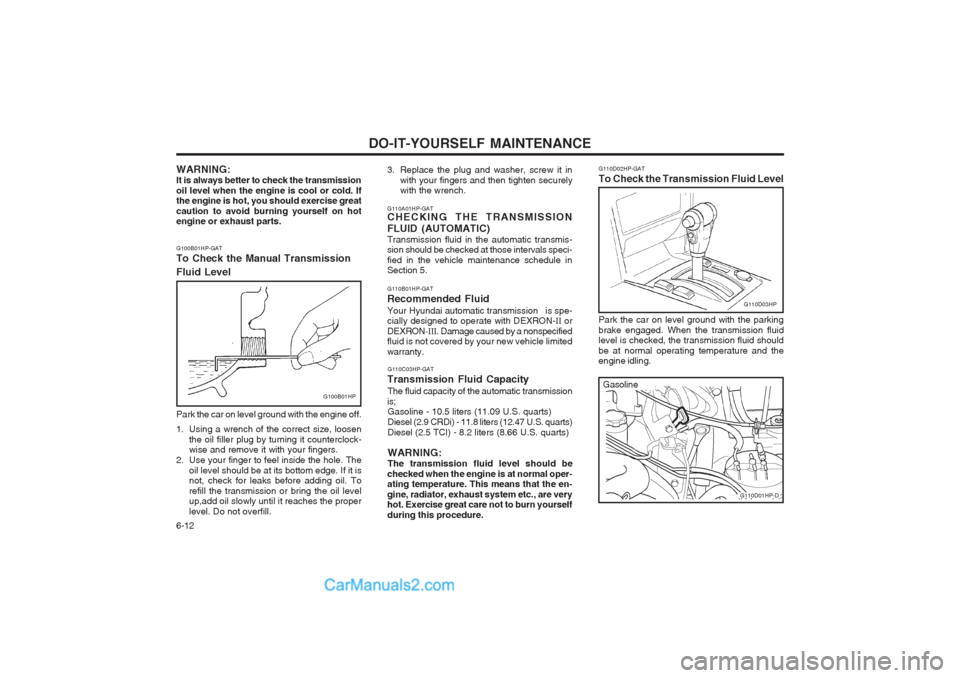
To Check the Transmission Fluid Level
G110D03HP
Park the car on level ground with the parking brake engaged. When the transmission fluid level is checked, the transmission fluid should be at normal operating temperature and the engine idling.
G110C03HP-GAT
Transmission Fluid Capacity The fluid capacity of the automatic transmission
is; Gasoline - 10.5 liters (11.09 U.S. quarts) Diesel (2.9 CRDi) - 11.8 liters (12.47 U.S. quarts)
Diesel (2.5 TCI) - 8.2 liters (8.66 U.S. quarts)
WARNING:The transmission fluid level should be
checked when the engine is at normal oper- ating temperature. This means that the en- gine, radiator, exhaust system etc., are very hot. Exercise great care not to burn yourself during this procedure.
G110A01HP-GAT
CHECKING THE TRANSMISSION FLUID (AUTOMATIC) Transmission fluid in the automatic transmis- sion should be checked at those intervals speci- fied in the vehicle maintenance schedule in Section 5. G110B01HP-GAT Recommended FluidYour Hyundai automatic transmission is spe- cially designed to operate with DEXRON- II or
DEXRON -III. Damage caused by a nonspecified
fluid is not covered by your new vehicle limited warranty.
3. Replace the plug and washer, screw it in
with your fingers and then tighten securely with the wrench.
G110D01HP-D
Gasoline
G100B01HP-GAT To Check the Manual Transmission Fluid LevelG100B01HP
WARNING: It is always better to check the transmissionoil level when the engine is cool or cold. If the engine is hot, you should exercise great caution to avoid burning yourself on hot engine or exhaust parts. Park the car on level ground with the engine off.
1. Using a wrench of the correct size, loosen
the oil filler plug by turning it counterclock- wise and remove it with your fingers.
2. Use your finger to feel inside the hole. The oil level should be at its bottom edge. If it isnot, check for leaks before adding oil. To refill the transmission or bring the oil level up,add oil slowly until it reaches the proper level. Do not overfill.
Page 159 of 349
DO-IT-YOURSELF MAINTENANCE 6-13
G110D03Y
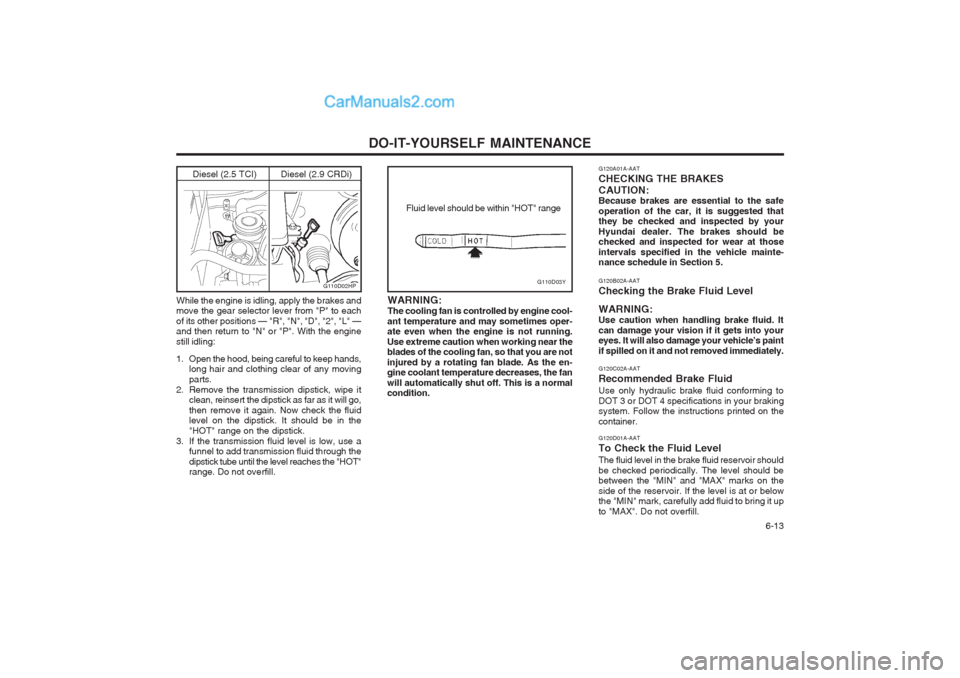
Fluid level should be within "HOT" range
G120A01A-AAT CHECKING THE BRAKESCAUTION: Because brakes are essential to the safe operation of the car, it is suggested that they be checked and inspected by your Hyundai dealer. The brakes should be checked and inspected for wear at those intervals specified in the vehicle mainte- nance schedule in Section 5.
WARNING: The cooling fan is controlled by engine cool-
ant temperature and may sometimes oper- ate even when the engine is not running. Use extreme caution when working near the blades of the cooling fan, so that you are not injured by a rotating fan blade. As the en- gine coolant temperature decreases, the fan will automatically shut off. This is a normal condition. G120B02A-AAT Checking the Brake Fluid Level WARNING: Use caution when handling brake fluid. Itcan damage your vision if it gets into your eyes. It will also damage your vehicle’s paint if spilled on it and not removed immediately. G120C02A-AAT Recommended Brake FluidUse only hydraulic brake fluid conforming to DOT 3 or DOT 4 specifications in your braking system. Follow the instructions printed on the container. G120D01A-AAT To Check the Fluid LevelThe fluid level in the brake fluid reservoir should be checked periodically. The level should be between the "MIN" and "MAX" marks on the side of the reservoir. If the level is at or below the "MIN" mark, carefully add fluid to bring it up to "MAX". Do not overfill.
While the engine is idling, apply the brakes and move the gear selector lever from "P" to each of its other positions — "R", "N", "D", "2", "L" — and then return to "N" or "P". With the engine still idling:
1. Open the hood, being careful to keep hands,
long hair and clothing clear of any moving parts.
2. Remove the transmission dipstick, wipe it clean, reinsert the dipstick as far as it will go,then remove it again. Now check the fluid level on the dipstick. It should be in the "HOT" range on the dipstick.
3. If the transmission fluid level is low, use a funnel to add transmission fluid through thedipstick tube until the level reaches the "HOT" range. Do not overfill.
Diesel (2.9 CRDi)
Diesel (2.5 TCI)
G110D02HP