fuel Hyundai Terracan 2005 User Guide
[x] Cancel search | Manufacturer: HYUNDAI, Model Year: 2005, Model line: Terracan, Model: Hyundai Terracan 2005Pages: 539, PDF Size: 18.03 MB
Page 74 of 539
1FEATURES OF YOUR HYUNDAI
60
Your Hyundai is equipped with dual- diagonal braking systems. This meansyou still have braking on two wheels even if one of the dual systems should fail. With only one of the dual systemsworking, more than normal pedal travel and greater pedal pressure are re- quired to stop the car. Also, the car willnot stop in as short a distance with only half of the brake system working. If the brakes fail while you are driving, shiftto a lower gear for additional engine braking and stop the car as soon as it is safe to do so.
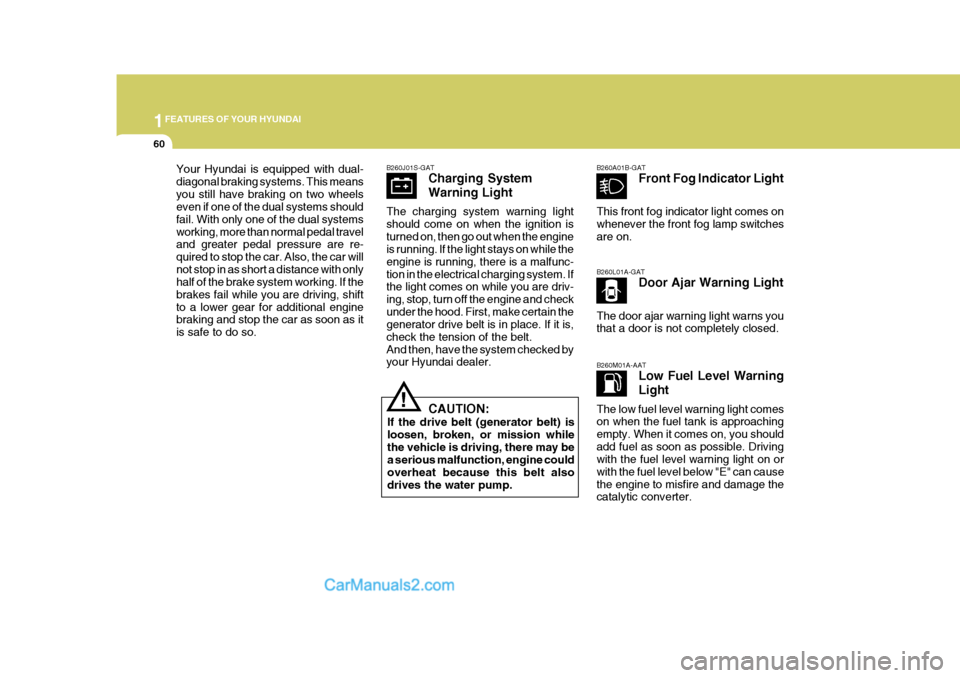
B260J01S-GAT Charging System Warning Light
The charging system warning light should come on when the ignition isturned on, then go out when the engine is running. If the light stays on while the engine is running, there is a malfunc-tion in the electrical charging system. If the light comes on while you are driv- ing, stop, turn off the engine and checkunder the hood. First, make certain the generator drive belt is in place. If it is, check the tension of the belt.And then, have the system checked by your Hyundai dealer.
CAUTION:
If the drive belt (generator belt) is loosen, broken, or mission whilethe vehicle is driving, there may be a serious malfunction, engine could overheat because this belt alsodrives the water pump.
! B260L01A-GAT
Door Ajar Warning Light
The door ajar warning light warns you that a door is not completely closed. B260M01A-AAT Low Fuel Level Warning Light
The low fuel level warning light comes on when the fuel tank is approaching empty. When it comes on, you shouldadd fuel as soon as possible. Driving with the fuel level warning light on or with the fuel level below "E" can causethe engine to misfire and damage the catalytic converter.
B260A01B-GAT
Front Fog Indicator Light
This front fog indicator light comes on whenever the front fog lamp switchesare on.
Page 77 of 539
1
FEATURES OF YOUR HYUNDAI
63
!!
CAUTION:
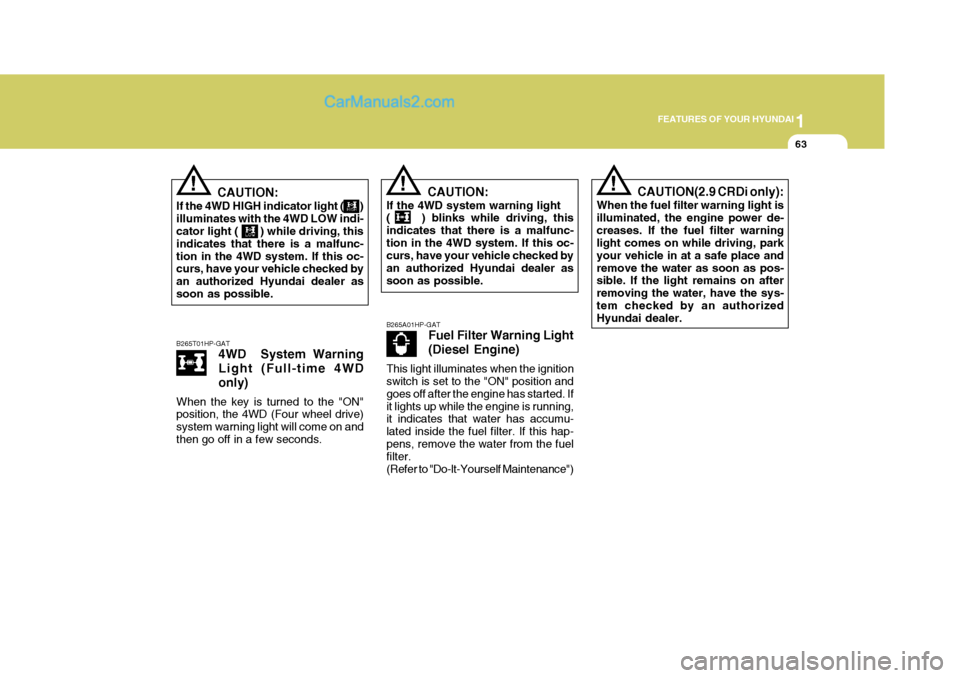
If the 4WD HIGH indicator light ( ) illuminates with the 4WD LOW indi- cator light ( ) while driving, this indicates that there is a malfunc-tion in the 4WD system. If this oc- curs, have your vehicle checked by an authorized Hyundai dealer assoon as possible. B265T01HP-GAT 4WD System Warning Light (Full-time 4WDonly)
When the key is turned to the "ON" position, the 4WD (Four wheel drive) system warning light will come on andthen go off in a few seconds.! CAUTION:
If the 4WD system warning light ( ) blinks while driving, this indicates that there is a malfunc-tion in the 4WD system. If this oc- curs, have your vehicle checked by an authorized Hyundai dealer assoon as possible. B265A01HP-GAT Fuel Filter Warning Light (Diesel Engine)
This light illuminates when the ignition switch is set to the "ON" position and goes off after the engine has started. Ifit lights up while the engine is running, it indicates that water has accumu- lated inside the fuel filter. If this hap-pens, remove the water from the fuel filter. (Refer to "Do-lt-Yourself Maintenance")CAUTION(2.9 CRDi only):
When the fuel filter warning light is illuminated, the engine power de-creases. If the fuel filter warning light comes on while driving, park your vehicle in at a safe place andremove the water as soon as pos- sible. If the light remains on after removing the water, have the sys-tem checked by an authorized Hyundai dealer.
Page 79 of 539
1
FEATURES OF YOUR HYUNDAI
65
B270A01A-GAT BRAKE PAD WEAR WARNING SOUND (If Installed) The front disc brake pads have wear indicators that should make a high-pitched squealing or scraping noise when new pads are needed. The sound may come and go or be heard all thetime when the vehicle is moving. It may also be heard when the brake pedal is pushed down firmly. Exces-sive rotor damage will result if the worn pads are not replaced. See your Hyundai dealer immediately.INSTRUMENT CLUSTER
!
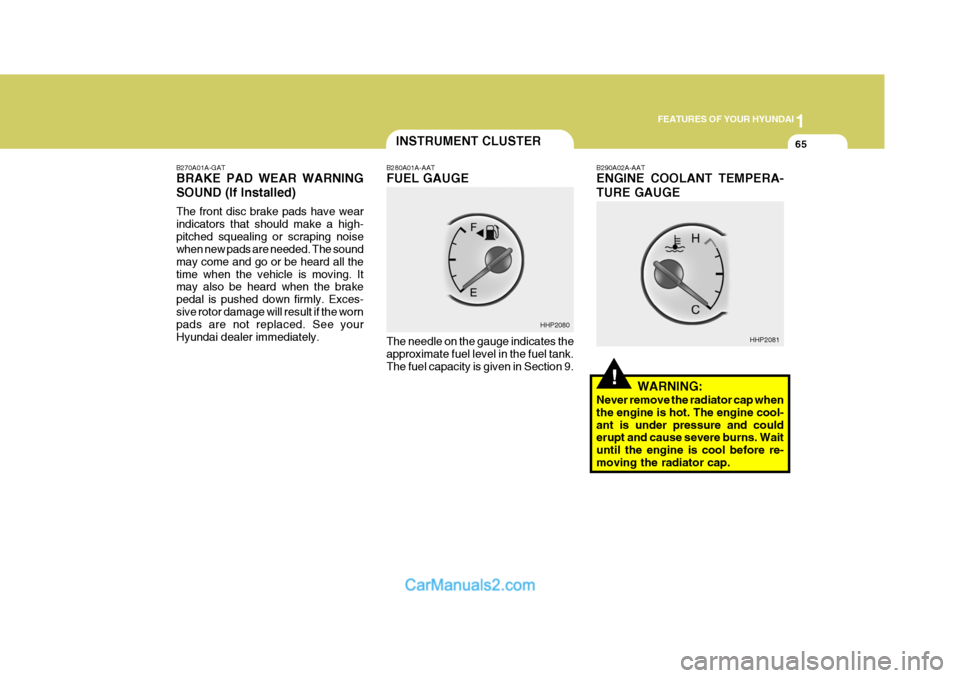
B280A01A-AAT FUEL GAUGE The needle on the gauge indicates the approximate fuel level in the fuel tank. The fuel capacity is given in Section 9. B290A02A-AAT ENGINE COOLANT TEMPERA- TURE GAUGE
WARNING:
Never remove the radiator cap when the engine is hot. The engine cool-ant is under pressure and could erupt and cause severe burns. Wait until the engine is cool before re-moving the radiator cap.
HHP2080
HHP2081
Page 108 of 539
1FEATURES OF YOUR HYUNDAI
94ROOF RACK
B650A01S-AAT Stowage Precautions
1. Do not place objects on the cargo security screen. Such objects may be thrown about inside the vehicle and possibly injure vehicle occu- pants during an accident or whenbraking.
2. For better fuel economy, do not
carry unnecessary weight.
3. Never allow anyone to ride in the luggage compartment. It is designedfor luggage only.
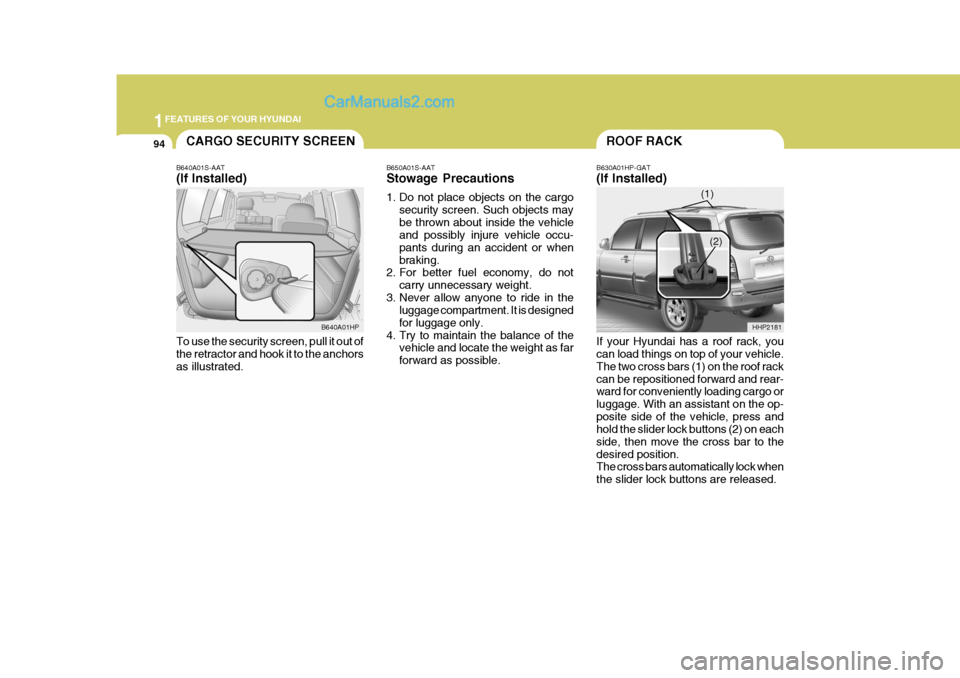
4. Try to maintain the balance of the vehicle and locate the weight as farforward as possible. B630A01HP-GAT (If Installed) If your Hyundai has a roof rack, you can load things on top of your vehicle. The two cross bars (1) on the roof rackcan be repositioned forward and rear- ward for conveniently loading cargo or luggage. With an assistant on the op-posite side of the vehicle, press and hold the slider lock buttons (2) on each side, then move the cross bar to thedesired position. The cross bars automatically lock when the slider lock buttons are released.
HHP2181CARGO SECURITY SCREEN
B640A01S-AAT (If Installed) To use the security screen, pull it out of the retractor and hook it to the anchors as illustrated. B640A01HP
(1)
(2)
Page 110 of 539
1FEATURES OF YOUR HYUNDAI
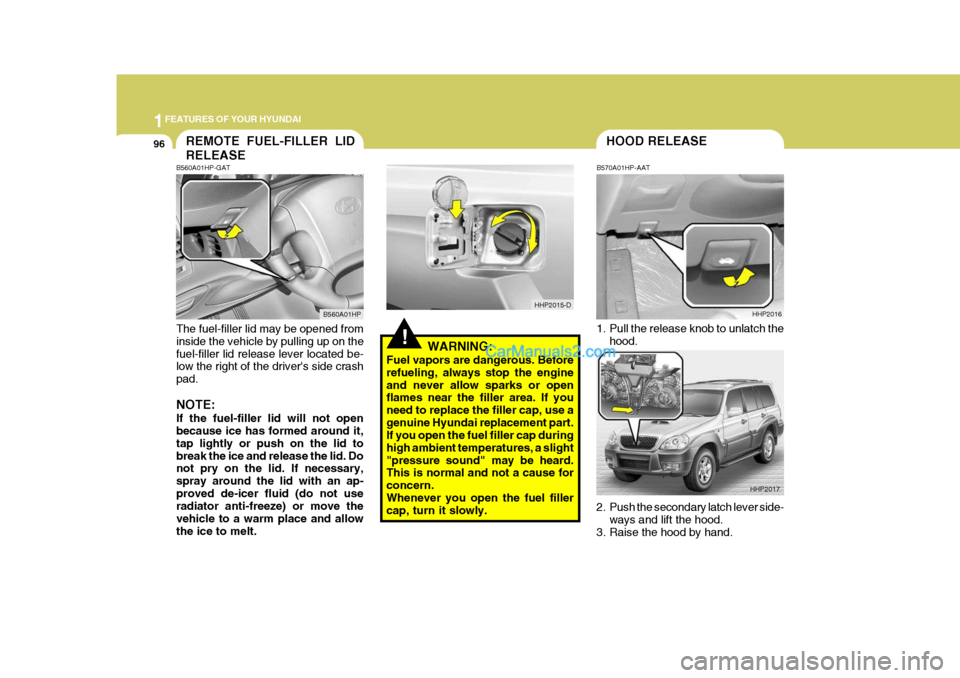
96HOOD RELEASE
2. Push the secondary latch lever side-
ways and lift the hood.
3. Raise the hood by hand.
!WARNING:
Fuel vapors are dangerous. Before refueling, always stop the engineand never allow sparks or open flames near the filler area. If you need to replace the filler cap, use agenuine Hyundai replacement part. If you open the fuel filler cap during high ambient temperatures, a slight"pressure sound" may be heard. This is normal and not a cause for concern.Whenever you open the fuel filler cap, turn it slowly. HHP2015-D
B570A01HP-AAT
1. Pull the release knob to unlatch the
hood. HHP2016
HHP2017
REMOTE FUEL-FILLER LID RELEASE
B560A01HP-GAT The fuel-filler lid may be opened from inside the vehicle by pulling up on the fuel-filler lid release lever located be- low the right of the driver's side crash pad. NOTE: If the fuel-filler lid will not open because ice has formed around it, tap lightly or push on the lid tobreak the ice and release the lid. Do not pry on the lid. If necessary, spray around the lid with an ap-proved de-icer fluid (do not use radiator anti-freeze) or move the vehicle to a warm place and allowthe ice to melt. B560A01HP
Page 158 of 539
2
DRIVING YOUR HYUNDAI
3
!
TO START THE ENGINEBEFORE STARTING THE ENGINE
C020A01A-AAT Before you start the engine, you should always:
1. Look around the vehicle to be sure
there are no flat tires, puddles of oil, water or other indications of possible trouble.
2. After entering the car, check to be sure the parking brake is engaged.
3. Check that all windows, and lights are clean.
4. Check that the interior and exterior
mirrors are clean and in position.
5. Check your seat, seatback and headrest to be sure they are in theirproper positions.
6. Lock all the doors.
7. Fasten your seat belt and be sure
that all other occupants have fas- tened theirs.
8. Turn off all lights and accessories
that are not needed.
9. When you turn the ignition switch to "ON", check that all appropriatewarning lights are operating andthat you have sufficient fuel.
10. Check the operation of warning
lights and all bulbs when key is inthe "ON" position. C030A01HP-GAT Combination Ignition Switch
o If your Hyundai is equipped with a
manual transmission, place the shift lever in neutral and depress the clutch pedal fully.
o If your Hyundai has an automatic transmission, place the shift lever in"P" (park).
o To start the engine, insert the igni- tion key and turn it to the "START"position. Release it as soon as the engine starts. Do not hold the key inthe "START" position for more than 15 seconds.
NOTE: For safety, the engine will not start if the shift lever is not in "P" or "N" Position (Automatic Transmission).
WARNING:
Your vehicle is equipped with tires designed to provide for safe ride and handling capability.Do not use a size and type of tire and wheel that is different from the one that was originally installed onyour vehicle. It can affect the safety and performance of your vehicle, which could lead to handling fail-ure or rollover and serious injury. When replacing the tires, be sure to equip all four tires with the tire andwheel of the same size, type, tread, brand and load-carrying capacity. If you nevertheless decide to equipyour vehicle with any tire/wheel combination not recommended by Hyundai for off-road driving, youshould not use these tires for high- way driving.
Page 163 of 539
2 DRIVING YOUR HYUNDAI
8
Shift
from-to
1-2 2-3 3-4 4-5 C070D02O-AAT Good Driving Practices
o Never take the car out of gear and
coast down a hill. This is extremely hazardous. Always leave the car in gear.
o Don't "ride" the brakes. This can cause them to overheat and mal-function. Instead, when you are driv- ing down a long hill, slow down andshift to a lower gear. When you do this, engine braking will help slow the car.
o Slow down before shifting to a lower gear. This will help avoid over-rev-ving the engine, which can causedamage.
o Slow down when you encounter
cross winds. This gives you muchbetter control of your car.
o Be sure the car is completely stopped
before you attempt to shift into re-verse. The transmission can be damaged if you do not. To shift into reverse, depress the clutch, movethe shift lever to neutral, wait three seconds, then shift to the reverse position.
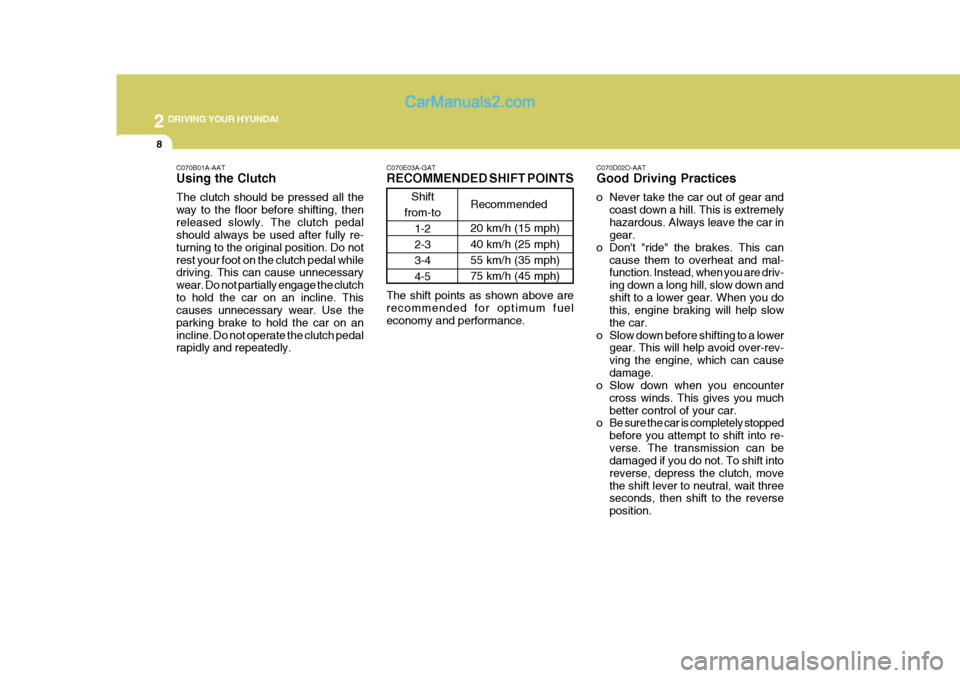
C070E03A-GAT RECOMMENDED SHIFT POINTS
Recommended 20 km/h (15 mph) 40 km/h (25 mph) 55 km/h (35 mph) 75 km/h (45 mph)
The shift points as shown above are recommended for optimum fuel economy and performance.
C070B01A-AAT Using the Clutch The clutch should be pressed all the way to the floor before shifting, thenreleased slowly. The clutch pedal should always be used after fully re- turning to the original position. Do notrest your foot on the clutch pedal while driving. This can cause unnecessary wear. Do not partially engage the clutchto hold the car on an incline. This causes unnecessary wear. Use the parking brake to hold the car on anincline. Do not operate the clutch pedal rapidly and repeatedly.
Page 165 of 539
2 DRIVING YOUR HYUNDAI
10
!
C090B01HP-GAT The function of each position is as follows:
o P (Park): Use to hold the vehicle in place when parked or while starting the engine. Whenever parking the car, apply theparking brake and shift the selector lever to the "P" (Park) position.
CAUTION:
Never place the selector lever in the"P" (Park) position unless the ve- hicle is fully stopped.Failure to observe this caution will cause severe damage to the trans- mission. C090C01A-AAT
o R (Reverse): Use for backing up the vehicle. Bring the car to a complete stop before shifting the selector lever to "R" posi-tion. C090D01HP-GAT
o N (Neutral): In the "N" position, the transmission is in neutral, which means that no gearsare engaged. The engine can be started with the shift lever in "N" position, although this is not recommended ex-cept if the engine stalls while the car is moving.
C090E01HP-GAT
o D (Drive): Use for normal driving. The transmis- sion will automatically shift through a four-gear sequence, giving besteconomy and power. Never down-shift manually to "2" position or "L" position when vehicle speed is more than 96km/h (60 mph).
CAUTION:
Never shift into "R" or "P" positionwhile the vehicle is moving.
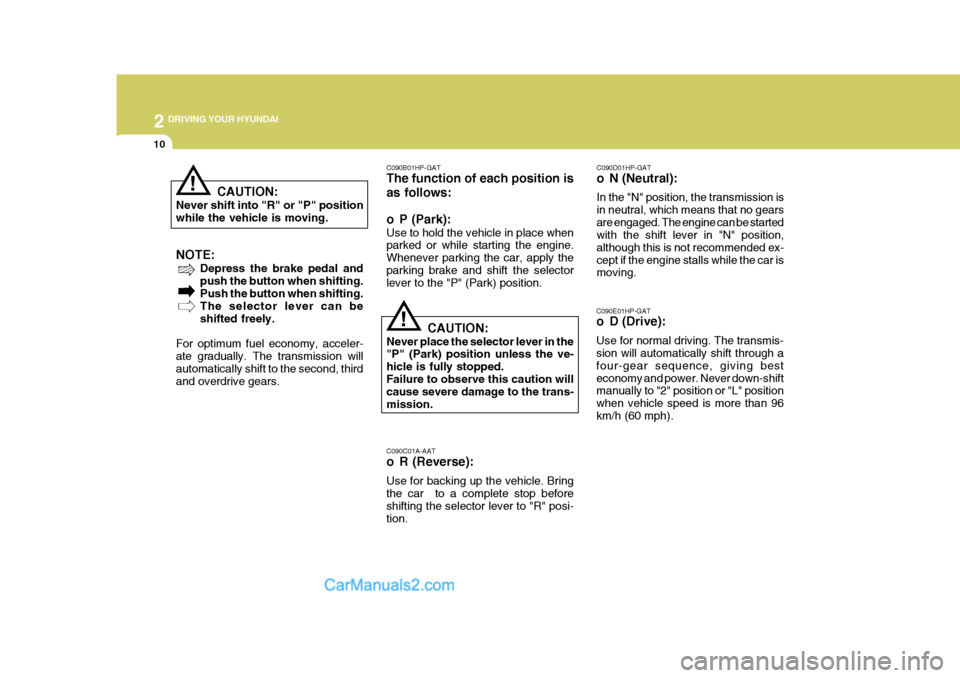
NOTE: Depress the brake pedal andpush the button when shifting. Push the button when shifting. The selector lever can beshifted freely.
For optimum fuel economy, acceler- ate gradually. The transmission will automatically shift to the second, thirdand overdrive gears.
!
Page 167 of 539
2 DRIVING YOUR HYUNDAI
12
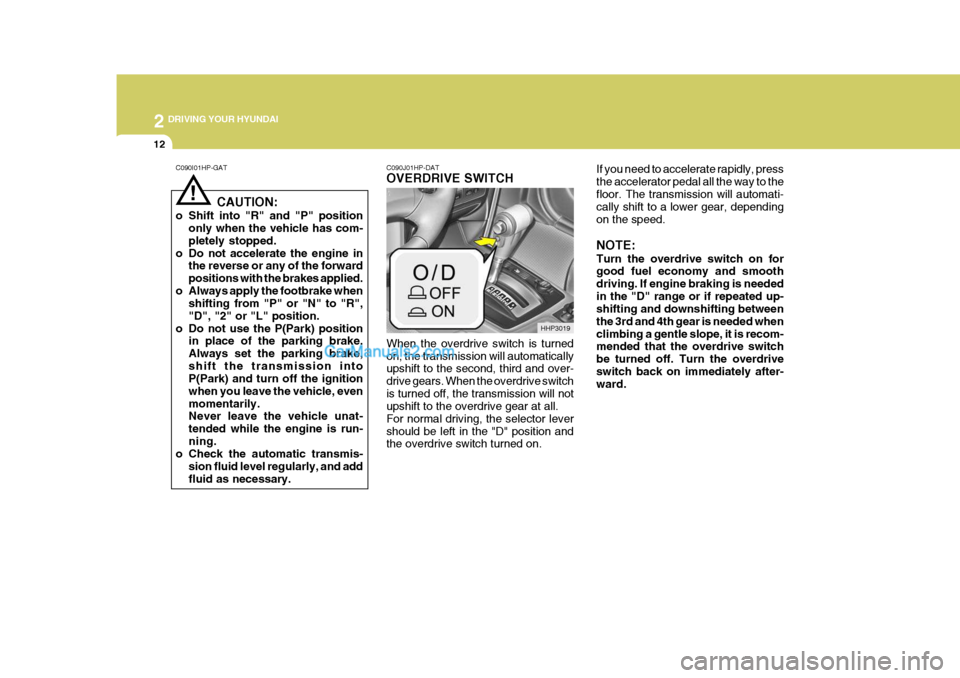
C090J01HP-DAT OVERDRIVE SWITCH When the overdrive switch is turned on, the transmission will automatically upshift to the second, third and over- drive gears. When the overdrive switchis turned off, the transmission will not upshift to the overdrive gear at all. For normal driving, the selector levershould be left in the "D" position and the overdrive switch turned on. If you need to accelerate rapidly, press the accelerator pedal all the way to thefloor. The transmission will automati- cally shift to a lower gear, depending on the speed. NOTE: Turn the overdrive switch on for good fuel economy and smooth driving. If engine braking is neededin the "D" range or if repeated up- shifting and downshifting between the 3rd and 4th gear is needed whenclimbing a gentle slope, it is recom- mended that the overdrive switch be turned off. Turn the overdriveswitch back on immediately after- ward.
HHP3019
!
C090I01HP-GAT
CAUTION:
o Shift into "R" and "P" position only when the vehicle has com- pletely stopped.
o Do not accelerate the engine in the reverse or any of the forwardpositions with the brakes applied.
o Always apply the footbrake when shifting from "P" or "N" to "R","D", "2" or "L" position.
o Do not use the P(Park) position in place of the parking brake.Always set the parking brake,shift the transmission into P(Park) and turn off the ignition when you leave the vehicle, evenmomentarily. Never leave the vehicle unat- tended while the engine is run-ning.
o Check the automatic transmis-
sion fluid level regularly, and addfluid as necessary.
Page 168 of 539
2
DRIVING YOUR HYUNDAI
13
!
C090N03A-AAT Good Driving Practices
o Never move the gear selector lever
from "P" or "N" to any other position with the accelerator pedal de- pressed.
o Never move the gear selector lever into "P" when the vehicle is in mo-tion.
o Be sure the car is completely stopped before you attempt to shift into "R".
o Never take the car out of gear and
coast down a hill. This may be ex- tremely hazardous. Always leave the car in gear when moving.
o Do not "ride" the brakes. This can cause them to overheat and mal-function. Instead, when you are driv- ing down a long hill, slow down andshift to a lower gear. When you do this, engine braking will help slow the car.
o Slow down before shifting to a lower gear. Otherwise, the lower gear maynot be engaged.
o Always use the parking brake. Do not depend on placing the transmis-sion in "P" to keep the car frommoving. o Exercise extreme caution when driv-
ing on a slippery surface. Be espe-cially careful when braking, acceler-ating or shifting gears. On a slippery surface, an abrupt change in ve- hicle speed can cause the drivewheels to lose traction and the ve- hicle to go out of control.
o Turn the overdrive switch on for good fuel economy and smooth driv-ing. If engine braking is needed in the "D" range or if repeated upshift-ing and downshifting between 3rd and 4th gear is needed when climb- ing a gentle slope, it is recommended that the overdrive switch be turned off. Turn the overdrive switch backon immediately afterward.
WARNING:
o Avoid high cornering speeds.
o Do not make quick steering wheel movements, such as sharp lanechanges or fast, sharp turns. o Always wear your seat belts.
In a collision crash, an unbeltedperson is significantly more likelyto die than a person wearing a seat belt.
o The risk of rollover is greatly in- creased if you lose control ofyour vehicle at highway speeds.
o Loss of control often occurs if
two or more wheels drop off theroadway and the driver oversteers to reenter the roadway.
o In the event your vehicle leaves the roadway, do not steer sharply.Instead, slow down before pull-ing back into the travel lanes.
o Never exceed posted speed lim-
its.
o Excessive depressing of the accelerater pedal under the tireslip condition such as movingout of the mud or fresh snow etc, may cause severe damage to the transmission. At this time, takeother way such as towing.