key Hyundai Terracan 2005 Manual Online
[x] Cancel search | Manufacturer: HYUNDAI, Model Year: 2005, Model line: Terracan, Model: Hyundai Terracan 2005Pages: 539, PDF Size: 18.03 MB
Page 383 of 539
1CONTROLS AND EQUIPMENT
78
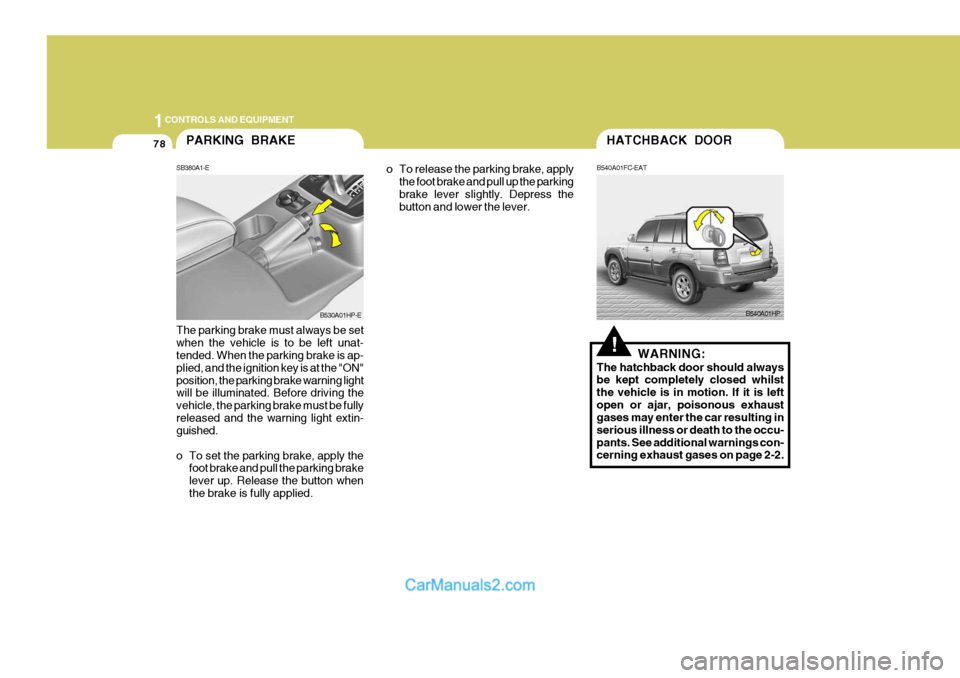
o To release the parking brake, applythe foot brake and pull up the parking brake lever slightly. Depress the button and lower the lever.
The parking brake must always be set when the vehicle is to be left unat- tended. When the parking brake is ap- plied, and the ignition key is at the "ON"position, the parking brake warning light will be illuminated. Before driving the vehicle, the parking brake must be fullyreleased and the warning light extin- guished.
o To set the parking brake, apply the foot brake and pull the parking brake lever up. Release the button whenthe brake is fully applied.PARKING BRAKE
SB380A1-E
B530A01HP-E
!
B540A01HP
HATCHBACK DOOR
B540A01FC-EAT
WARNING:
The hatchback door should always be kept completely closed whilst the vehicle is in motion. If it is leftopen or ajar, poisonous exhaust gases may enter the car resulting in serious illness or death to the occu-pants. See additional warnings con- cerning exhaust gases on page 2-2.
Page 384 of 539
1
CONTROLS AND EQUIPMENT
79
o The hatchback door can be locked or unlocked with a key.
o The hatchback door is opened by pulling the outside handle up, rais- ing the hatchback door manually.
o To close, lower the hatchback door, then press down on it until it isclosed. To be sure the hatchbackdoor is fully closed, always try to pull it up again without using the outside handle.
!
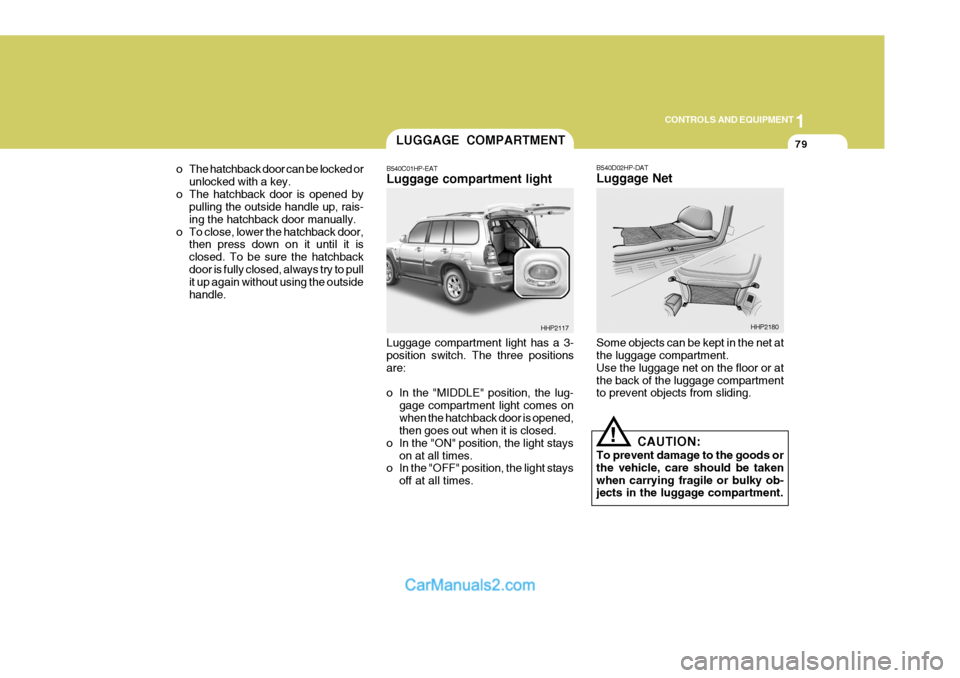
Luggage compartment light has a 3- position switch. The three positions are:
o In the "MIDDLE" position, the lug-
gage compartment light comes on when the hatchback door is opened, then goes out when it is closed.
o In the "ON" position, the light stays on at all times.
o In the "OFF" position, the light stays
off at all times. B540D02HP-DAT Luggage Net Some objects can be kept in the net at the luggage compartment. Use the luggage net on the floor or atthe back of the luggage compartment to prevent objects from sliding.
CAUTION:
To prevent damage to the goods or the vehicle, care should be takenwhen carrying fragile or bulky ob- jects in the luggage compartment.
LUGGAGE COMPARTMENT
B540C01HP-EAT Luggage compartment light
HHP2117HHP2180
Page 413 of 539
1CONTROLS AND EQUIPMENT
108
!
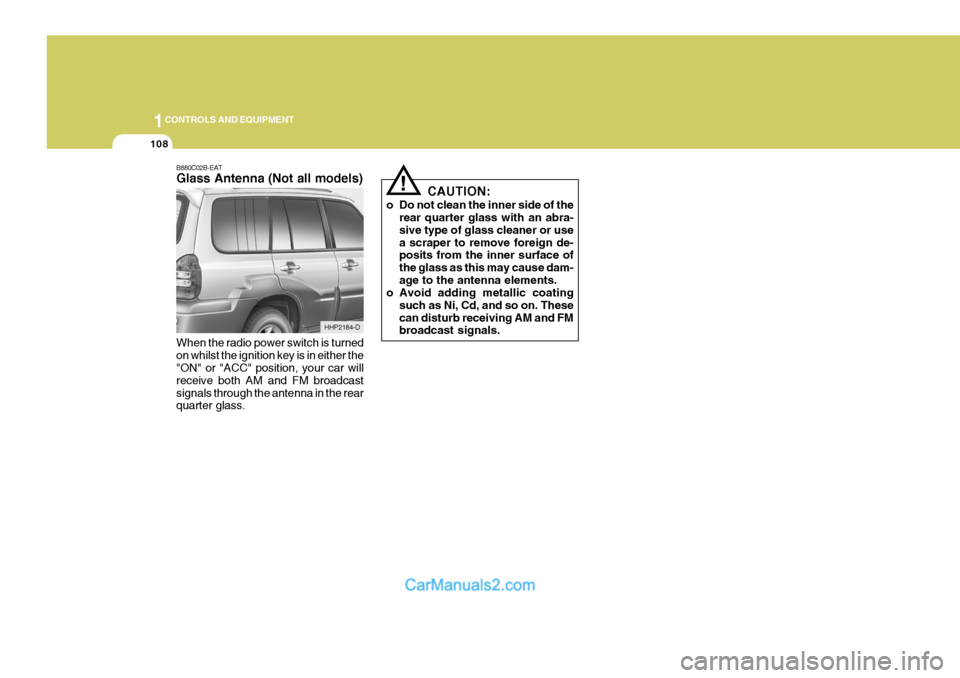
B880C02B-EAT Glass Antenna (Not all models) When the radio power switch is turned on whilst the ignition key is in either the "ON" or "ACC" position, your car will receive both AM and FM broadcastsignals through the antenna in the rear quarter glass. CAUTION:
o Do not clean the inner side of the rear quarter glass with an abra- sive type of glass cleaner or usea scraper to remove foreign de- posits from the inner surface of the glass as this may cause dam-age to the antenna elements.
o Avoid adding metallic coating
such as Ni, Cd, and so on. Thesecan disturb receiving AM and FM broadcast signals.
HHP2184-D
Page 414 of 539
2
Engine Exhaust Can Be Dangerous! ............................ 2-2
Before Starting the Engine ............................................ 2-3
Key Positions ................................................................ 2-4Starting ......................................................................... 2-5
Manual Transmission ................................................... 2-8
Automatic Transmission .............................................. 2-10
Four-Wheel Drive (4WD) ............................................. 2-14
Anti-Lock Brake System (ABS) ................................... 2-21
Limited-Slip Differential ................................................ 2-22
Effective Braking ......................................................... 2-22
Driving for Economy .................................................... 2-23
Smooth Cornering ........................................................ 2-24
Winter Motoring ............................................................ 2-24
Trailer and Vehicle Towi ng .......................................... 2-26
DRIVING YOUR HYUNDAI
2
Page 416 of 539
2
DRIVING YOUR HYUNDAI
3
!WARNING:
Your vehicle is equipped with tyres designed to provide for safe ride and handling capability.Do not use a size and type of tyre and wheel that is different from the one that was originally installed on yourvehicle. It can affect the safety and performance of your vehicle, which could lead to handling failure orrollover and serious injury. When replacing the tyres, be sure to equip all four tyres with the tyre andwheel of the same size, type, tread, brand and load-carrying capacity. If you nevertheless decide to equipyour vehicle with any tyre/wheel com- bination not recommended by Hyundai for off-road driving, youshould not use these tyres for high- way driving.
TO START THE ENGINEBEFORE STARTING THE ENGINE
C020A01A-EAT Before you start the engine, you should always:
1. Look around the vehicle to be sure
there are no flat tyres, puddles of oil or water or other indications of pos- sible trouble.
2. After entering the car, check to be
sure the parking brake is engaged.
3. Check that all windows, and lights
are clean.
4. Check that the interior and exterior mirrors are clean and in position.
5. Check your seat, seatback and headrest to be sure they are in theirproper positions.
6. Close all the doors.
7. Fasten your seat belt and be sure that all other occupants have fas-tened theirs.
8. Turn off all lights and accessories that are not needed.
9. When you turn the ignition switch to "ON" check that all appropriate warning lights are operating and that you have sufficient fuel.
10.Check the operation of warning lights and all bulbs when key is inthe "ON" position. C030A01HP-EAT Cmbination Ignition Switch and Steering Lock
o If your Hyundai is equipped with a
manual transmission, place the shift lever in neutral and depress the clutch pedal fully.
o If your Hyundai has an automatic
transmission, place the shift lever in"P" (park).
o To start the engine, insert the igni- tion key and turn it to the "START"position. Release it as soon as the engine starts. Do not hold the key inthe "START" position for more than 15 seconds.
NOTE: For safety, the engine will not start if the shift lever is not in "P" or "N" position (Automatic Transmission).
Page 417 of 539
2 DRIVING YOUR HYUNDAI
4
!WARNING:
The engine must never be turned off and the key removed from the igni-tion key cylinder whilst the vehicle is in motion since the steering lock will operate and control of the vehiclewill be lost.
"START" The engine is started in this position. It will crank until you release the key.
Ambient temp.
Above 5°F (-15°C) Below 5°F (-15°C) Warm up time
3 min. or longer 6 min. or longer
!WARNING: (Diesel only)
To ensure that sufficient vacuum exists within the brake system dur- ing cold weather start-up condi-tions, it is necessary to run the engine at idle after starting accord- ing to the following table. After starting the engine, do not drive the vehicle until the brake vacuum warning light has turned off.Failure to carry out the above pro- cedure may result in the need to apply greater pedal pressure in or-der to effect the necessary braking effort.
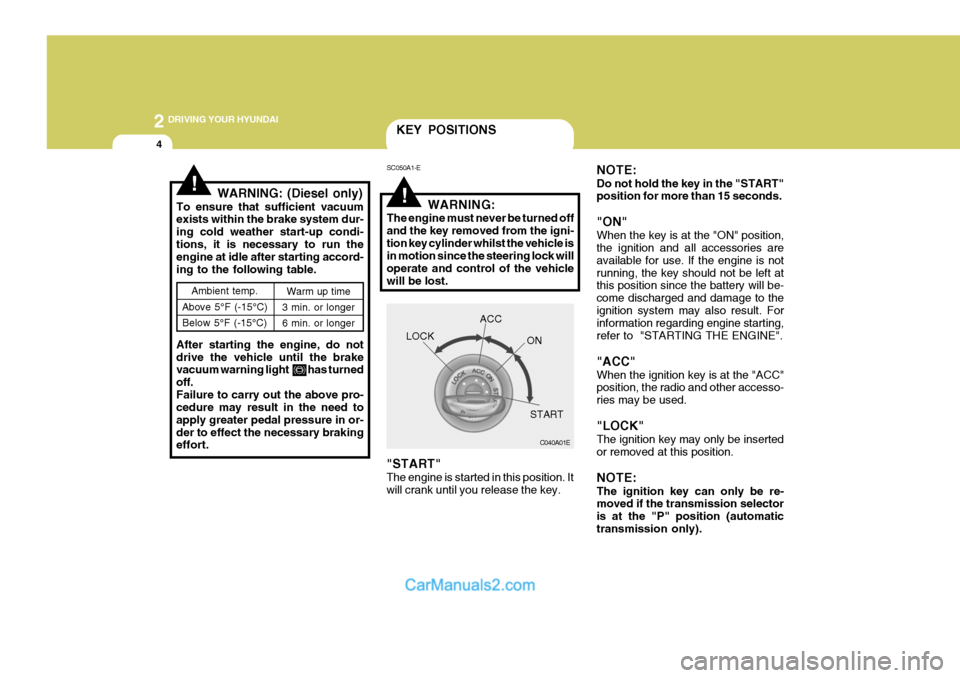
KEY POSITIONS
SC050A1-E
C040A01E
LOCK
ACC
ON
START
NOTE: Do not hold the key in the "START" position for more than 15 seconds. "ON" When the key is at the "ON" position, the ignition and all accessories are available for use. If the engine is notrunning, the key should not be left at this position since the battery will be- come discharged and damage to theignition system may also result. For information regarding engine starting, refer to "STARTING THE ENGINE". "ACC" When the ignition key is at the "ACC" position, the radio and other accesso- ries may be used. "LOCK" The ignition key may only be inserted or removed at this position. NOTE: The ignition key can only be re- moved if the transmission selector is at the "P" position (automatictransmission only).
Page 418 of 539
2
DRIVING YOUR HYUNDAI
5
!
YC030A1-E STEERING WHEEL LOCK When the ignition key is removed, the steering wheel lock will be activated.The lock only engages at one position of the steering wheel and therefore it will be possible to turn the wheel untilthis position is reached. It is not, how- ever, necessary for the lock to be engaged before leaving the vehiclesince in the event of attempted unauthorised removal, the lock will en- gage when attempts are made to steerthe vehicle. Should it be difficult to turn the key from the "LOCK" position, it may befound that rocking the steering wheel to and fro whilst turning the key will assist.
CAUTION:
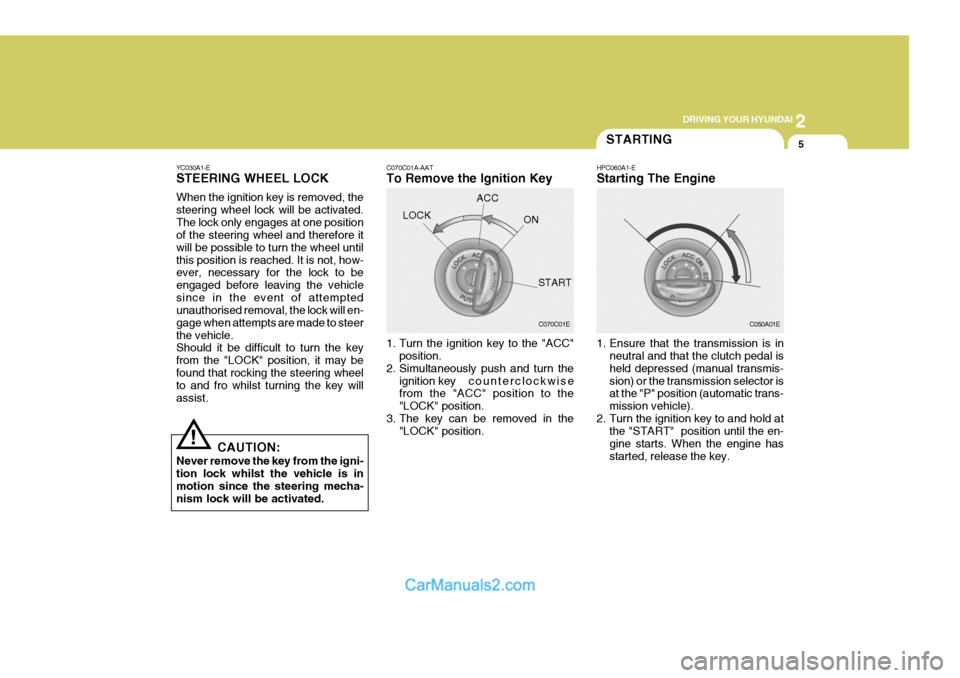
Never remove the key from the igni- tion lock whilst the vehicle is in motion since the steering mecha-nism lock will be activated. C070C01A-AAT To Remove the Ignition Key
1. Turn the ignition key to the "ACC"
position.
2. Simultaneously push and turn the
ignition key counterclockwise
from the "ACC" position to the "LOCK" position.
3. The key can be removed in the "LOCK" position.
LOCK
C070C01E
ACC
ON
START 1. Ensure that the transmission is inneutral and that the clutch pedal is held depressed (manual transmis-sion) or the transmission selector is at the "P" position (automatic trans- mission vehicle).
2. Turn the ignition key to and hold at the "START" position until the en-gine starts. When the engine hasstarted, release the key.
STARTING
HPC060A1-E Starting The Engine
C050A01E
Page 419 of 539
2 DRIVING YOUR HYUNDAI
6
!
!
NOTE: Do not operate the starter for more than 15 seconds continuously or continue to operate the starter afterthe engine has started to avoid dam- aging the starter motor. If the en- gine makes a false start, allow it andthe starter motor to come to rest before attempting to start the en- gine again. Never attempt to startthe engine with the transmission in gear. Do not depress the accelera- tor pedal whilst starting the engine.Allow the engine to idle for 20 sec- onds or so before driving the ve- hicle.
CAUTION:
Do not leave the vehicle unattendedwhilst idling. Never allow the vehicleto idle or warm up in a confined space (i.e. garage) longer than is necessary to move the vehicle intoan open area. C050B01HP-EAT Starting Procedure
1. Insert key, and fasten the seat belt.
2. Apply the parking brake.
3. If your Hyundai is equipped with a
manual transmission, place the shiftlever in neutral and depress theclutch pedal fully. If your Hyundai has an automatic transmission, place the shift lever in "P" (park). NOTE: If the engine were not started within 2 seconds after the preheating is completed, turn the ignition keyonce more to the "LOCK" position during 10 seconds, and then to the "ON" position, in order to preheatagain.
WARNING:
Be sure that the clutch is fully de- pressed when starting a manual tranmission vehicle. Otherwise thereis the potential to cause damage to the vehicle or injury to someone inside or outside the ve-hicle as a result of the forward or backward movement of the vehicle that will occur if the clutch is notdepressed when the vehicle is started.
5. Turn the ignition key to the "START" position and release it when the engine starts.
Amber lamp ON
C050B01HP
Amber lamp OFF
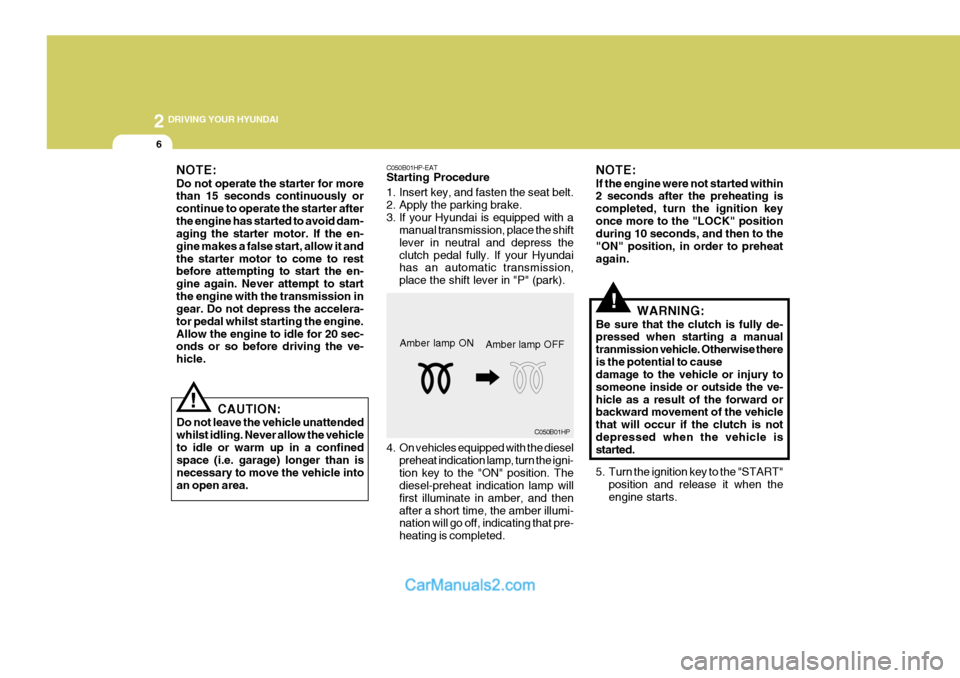
4. On vehicles equipped with the diesel preheat indication lamp, turn the igni- tion key to the "ON" position. The diesel-preheat indication lamp will first illuminate in amber, and thenafter a short time, the amber illumi- nation will go off, indicating that pre- heating is completed.
Page 438 of 539
2
DRIVING YOUR HYUNDAI
25
YC170C1-E Anti-freeze/Corrosion inhibitor The cooling system must always con- tain an Ethylene-Glycol based anti-freeze solution. The system is filled during manufacture with solution of the correct strength which should bechecked before the onset of winter and adjusted or changed as required. NOTE: The anti-freeze solution contains a corrosion inhibitor to prevent deg- radation of the aluminium castingscontained within the engine. There- fore, never, drain the system and refill with water only. In addition, anti-freeze solution must ALWAYS be used in vehicles fittedwith air conditioning, to prevent the heater matrix from freezing and sub- sequently bursting with the refrigera-tion system in use. ZC170D1-E Door Locks Should the door lock mechanism be- come frozen, a proprietary lock de-icershould be used. Alternatively, warm- ing the door key may thaw the door lock. However, the key should behandled carefully to avoid burning the fingers. Never attempt to thaw a frozen doorlock using hot water, since the water will eventually freeze and compound the problem. NOTE: The proper temperature for using the immobilizer key is from -40°F to176°F (-40°C to 80°C). If you heat the immobilizer key over 176°F (80°C) to open the frozen lock, it may causedamage to the transponder in its head.
ZC170E1-E Windscreen Washers & Wipers The windscreen washer bottle should be filled with a solution of water and a proprietary winter screen wash addi- tive. The windscreen wipers shouldnot be used if the blades are frozen to the windscreen or if they are covered with snow, before this is removed. NOTE: Never allow undiluted screen washer fluid additive to spill uponthe paintwork or use engine cool- ant anti-freeze since damage to the paintwork may result.
o When driving in extreme condi-
tions, the windscreen wiper blades may fail to clear the screen properly due to the formation of ice upon the blade edge. It willtherefore be necessary to peri- odically remove such ice to re- store their efficiency.
o If the power operated door mir- rors become frozen, attempts toadjust these may damage themechanism.
Page 446 of 539
3 IN CASE OF EMERGENCY
2
!WARNING:
If the engine refuses to start, no attempt should be made to push or tow start the vehicle. Vehicles with automatic transmission or fuel in-jection will not be able to be started in this manner since no drive is transmitted through the automatictransmission whilst the engine is not running, and in the case of fuel injected derivatives, the fuel pumpwill not operate under tow start conditions. In addition, if the ve- hicle is equipped with an exhaustcatalyst, damage to the catalyst may result if the vehicle is tow started. HPD020B1-E If The Engine Cannot Be Cranked
1. If the vehicle is fitted with manual
transmission, ensure that the clutch pedal is depressed whilst cranking the engine. If the vehicle is fitted with automatic transmission, en-sure that the transmission selector is at the "P" or "N" position.
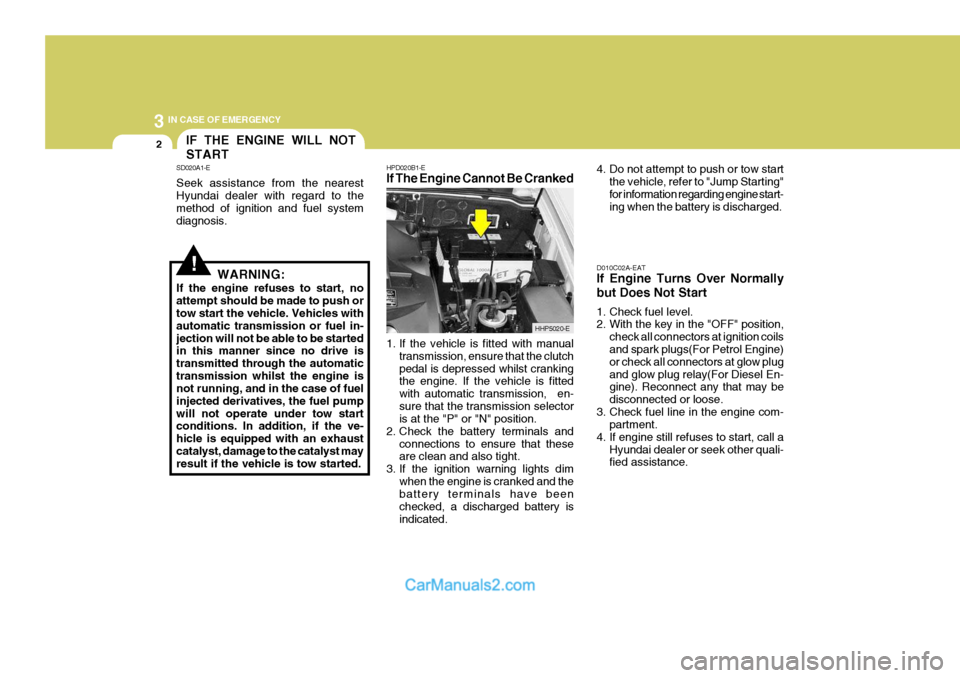
2. Check the battery terminals and
connections to ensure that theseare clean and also tight.
3. If the ignition warning lights dim
when the engine is cranked and thebattery terminals have been checked, a discharged battery isindicated. 4. Do not attempt to push or tow start
the vehicle, refer to "Jump Starting"for information regarding engine start- ing when the battery is discharged.
D010C02A-EAT If Engine Turns Over Normally but Does Not Start
1. Check fuel level.
2. With the key in the "OFF" position, check all connectors at ignition coilsand spark plugs(For Petrol Engine) or check all connectors at glow plugand glow plug relay(For Diesel En- gine). Reconnect any that may be disconnected or loose.
3. Check fuel line in the engine com- partment.
4. If engine still refuses to start, call a Hyundai dealer or seek other quali- fied assistance.
IF THE ENGINE WILL NOT START
SD020A1-E Seek assistance from the nearest Hyundai dealer with regard to the method of ignition and fuel system diagnosis.
HHP5020-E