4WD Hyundai Terracan 2006 User Guide
[x] Cancel search | Manufacturer: HYUNDAI, Model Year: 2006, Model line: Terracan, Model: Hyundai Terracan 2006Pages: 539, PDF Size: 18.11 MB
Page 171 of 539
2 DRIVING YOUR HYUNDAI
16
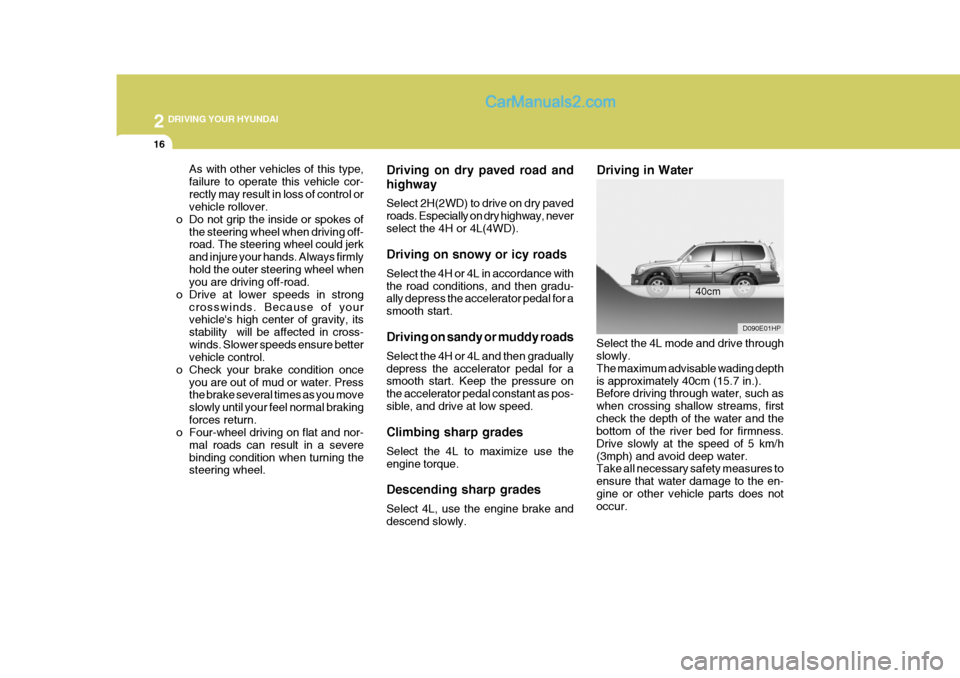
Driving on dry paved road and highway Select 2H(2WD) to drive on dry paved roads. Especially on dry highway, neverselect the 4H or 4L(4WD). Driving on snowy or icy roads Select the 4H or 4L in accordance with the road conditions, and then gradu- ally depress the accelerator pedal for a smooth start. Driving on sandy or muddy roads Select the 4H or 4L and then gradually depress the accelerator pedal for a smooth start. Keep the pressure on the accelerator pedal constant as pos-sible, and drive at low speed. Climbing sharp grades Select the 4L to maximize use the engine torque. Descending sharp grades Select 4L, use the engine brake and descend slowly. Driving in Water
Select the 4L mode and drive throughslowly. The maximum advisable wading depthis approximately 40cm (15.7 in.). Before driving through water, such as when crossing shallow streams, firstcheck the depth of the water and the bottom of the river bed for firmness. Drive slowly at the speed of 5 km/h(3mph) and avoid deep water. Take all necessary safety measures to ensure that water damage to the en-gine or other vehicle parts does not occur. 40cm
D090E01HP
As with other vehicles of this type, failure to operate this vehicle cor-rectly may result in loss of control or vehicle rollover.
o Do not grip the inside or spokes of
the steering wheel when driving off-road. The steering wheel could jerk and injure your hands. Always firmlyhold the outer steering wheel when you are driving off-road.
o Drive at lower speeds in strong crosswinds. Because of yourvehicle's high center of gravity, its stability will be affected in cross-winds. Slower speeds ensure better vehicle control.
o Check your brake condition once you are out of mud or water. Pressthe brake several times as you move slowly until your feel normal brakingforces return.
o Four-wheel driving on flat and nor-
mal roads can result in a severebinding condition when turning the steering wheel.
Page 172 of 539
2
DRIVING YOUR HYUNDAI
17
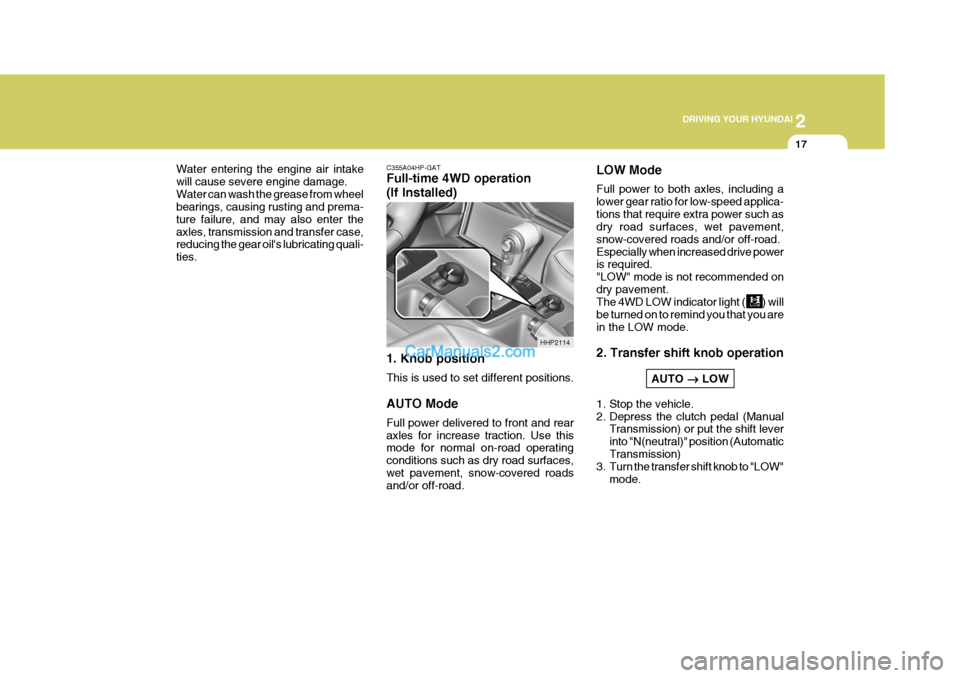
C355A04HP-GAT Full-time 4WD operation (If Installed) 1. Knob position This is used to set different positions. AUTO Mode Full power delivered to front and rear axles for increase traction. Use this mode for normal on-road operating conditions such as dry road surfaces,wet pavement, snow-covered roads and/or off-road.
Water entering the engine air intake will cause severe engine damage.Water can wash the grease from wheel bearings, causing rusting and prema- ture failure, and may also enter theaxles, transmission and transfer case, reducing the gear oil's lubricating quali- ties.
HHP2114LOW Mode Full power to both axles, including a lower gear ratio for low-speed applica-tions that require extra power such as dry road surfaces, wet pavement, snow-covered roads and/or off-road.Especially when increased drive power is required. "LOW" mode is not recommended ondry pavement. The 4WD LOW indicator light ( ) will be turned on to remind you that you arein the LOW mode. 2. Transfer shift knob operation
AUTO
LOW
1. Stop the vehicle.
2. Depress the clutch pedal (Manual Transmission) or put the shift leverinto "N(neutral)" position (AutomaticTransmission)
3. Turn the transfer shift knob to "LOW"
mode.
Page 173 of 539
2 DRIVING YOUR HYUNDAI
18
!
When driving on a snow-covered road or a slippery, muddy surface,make sure that you keep a suffi- cient distance between your ve- hicle and the one ahead of you.
(6) Since the driving torque is always applied to the 4 wheels, the perfor-mance of the full-time 4WD vehicleis greatly affected by the condition of the tires. Be sure to equip it with all four tires of the same size andtype.
o When replacement of any of the
tires or disc wheels is neces-sary, replace all of them.
o Rotate the tires and check the
tire pressure at regular inter-vals. (7)The full-time 4WD vehicle can-
not be towed by an ordinary towtruck. Make sure that the vehicle is towed with its four wheels raised off the ground.
o If the vehicle is towed with its only two wheels raised off theground, the 4WD system could be damaged.
o In unavoidable case, if the ve-
hicle is being towed with all fourwheels on the ground, it should be towed only forward directionwith rope.
WARNING:
Your vehicle is equipped with tiresdesigned to provide for safe rideand handling capability. Do not use a size and type of tire and wheel that is different from theone that was originally installed on your vehicle. It can affect the safety and performance of your vehicle,which could lead to handling fail-ure or rollover and serious injury. When replacing the tires, be sure to equip all four tires with the tire andwheel of the same size, type, tread, brand and load-carrying capacity. If you nevertheless decide to equipyour vehicle with any tire/wheel combination not recommended by Hyundai for off-road driving, youshould not use these tires for high- way driving.
LOW
AUTO
1. Stop the vehicle.
2. Depress the clutch pedal (Manual Transmission) or put the shift lever into "N (neutral)" position (Automatic Transmission).
3. Turn the transfer shift knob to
"AUTO" mode.
Driving 4WD Safely
(1) Be sure to wear the seat belt.
(2) Drive at lower speeds in strong crosswinds. Because of yourvehicle's high center of gravity, its stability will be affected in cross- winds. Slower speeds ensure bet-ter vehicle control.
(3) Check the brake condition after
driving in wet or muddy conditions.Press the brake several times as you move slowly until you feel nor- mal braking forces return.
(4) Do not drive the vehicle through water. (i.e. streams, rivers, lakes,etc.)
(5) The stopping distance of the full- time 4WD vehicle differs very littlefrom that of the 2WD vehicle.
Page 174 of 539
2
DRIVING YOUR HYUNDAI
19
!
Roll tester (Speedometer)
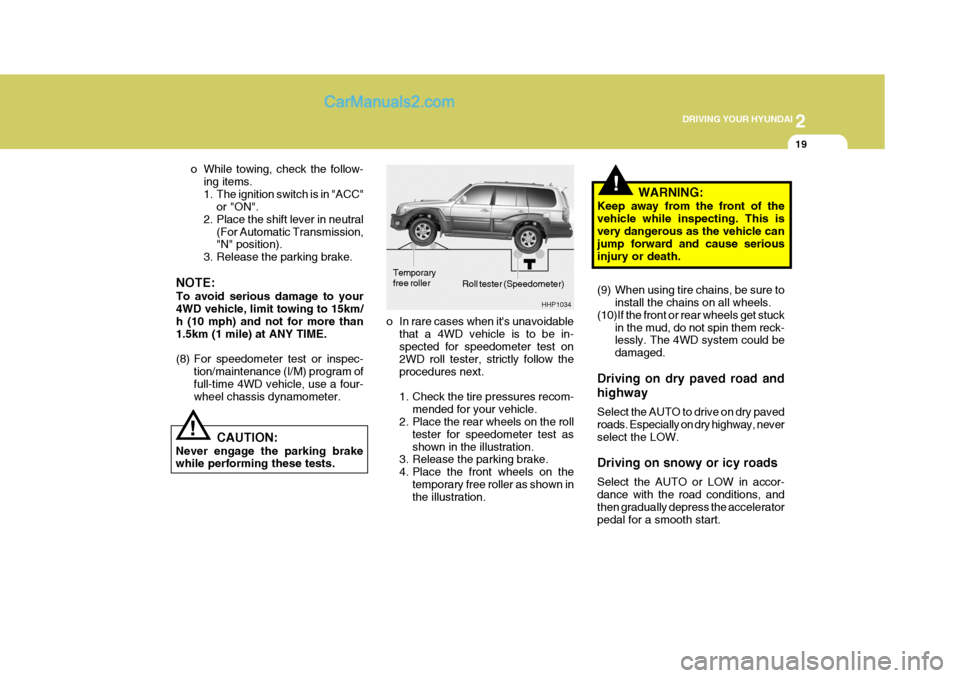
o In rare cases when it's unavoidable that a 4WD vehicle is to be in- spected for speedometer test on 2WD roll tester, strictly follow theprocedures next.
1. Check the tire pressures recom- mended for your vehicle.
2. Place the rear wheels on the roll
tester for speedometer test as shown in the illustration.
3. Release the parking brake.
4. Place the front wheels on the
temporary free roller as shown in the illustration. WARNING:
Keep away from the front of the vehicle while inspecting. This is very dangerous as the vehicle can jump forward and cause seriousinjury or death.
(9) When using tire chains, be sure to install the chains on all wheels.
(10)If the front or rear wheels get stuck in the mud, do not spin them reck- lessly. The 4WD system could be damaged.
Driving on dry paved road and highway Select the AUTO to drive on dry paved roads. Especially on dry highway, neverselect the LOW. Driving on snowy or icy roads Select the AUTO or LOW in accor- dance with the road conditions, and then gradually depress the accelerator pedal for a smooth start.
! CAUTION:
Never engage the parking brake while performing these tests. o While towing, check the follow-
ing items.
1. The ignition switch is in "ACC" or "ON".
2. Place the shift lever in neutral
(For Automatic Transmission, "N" position).
3. Release the parking brake.
NOTE: To avoid serious damage to your 4WD vehicle, limit towing to 15km/ h (10 mph) and not for more than1.5km (1 mile) at ANY TIME.
(8) For speedometer test or inspec- tion/maintenance (I/M) program of full-time 4WD vehicle, use a four- wheel chassis dynamometer. HHP1034
Temporary free roller
Page 175 of 539
2 DRIVING YOUR HYUNDAI
20
Water can wash the grease from wheel bearings, causing rusting and prema-ture failure, and may also enter the axles, transmission and transfer case, reducing the gear oil's lubricating quali-ties.
!
CAUTION:
o While the full-time 4WD vehicle is being raised on a jack, never start the engine or cause the tires to rotate. There is the danger that rotatingtires touching the ground could cause the vehicle to go off the jack and to jump forward.
o If one of the front or rear wheels begins to spin in mud, snow,etc., the vehicle can sometimesbe driven out by depressing the accelerator pedal further; how- ever, avoid running the enginecontinuously at high rpm be- cause doing so could damage the 4WD system.
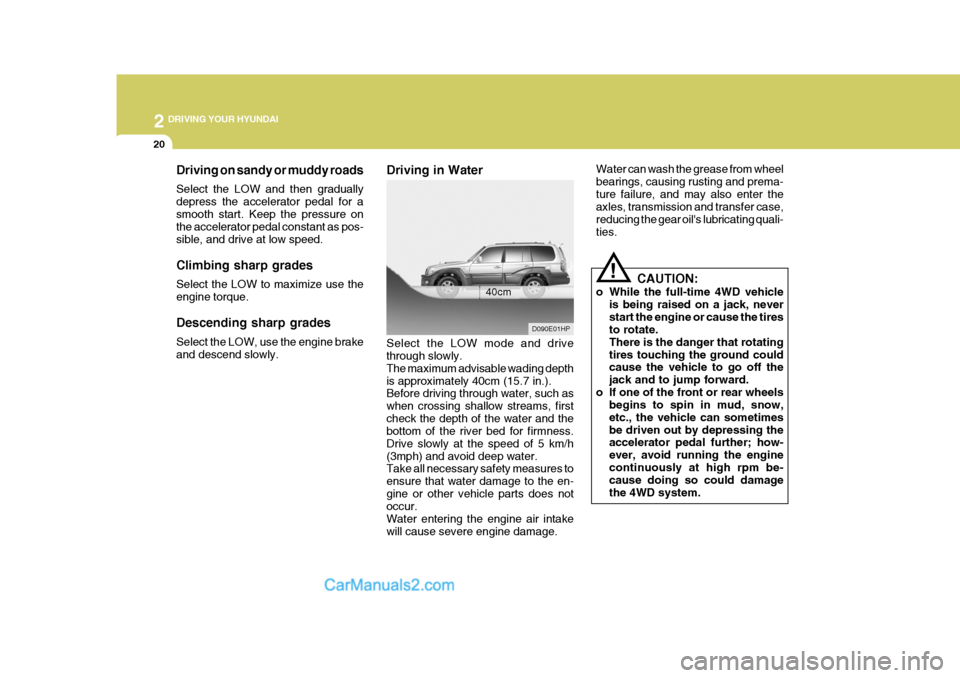
Driving in Water Select the LOW mode and drive through slowly. The maximum advisable wading depthis approximately 40cm (15.7 in.). Before driving through water, such as when crossing shallow streams, firstcheck the depth of the water and the bottom of the river bed for firmness. Drive slowly at the speed of 5 km/h(3mph) and avoid deep water. Take all necessary safety measures to ensure that water damage to the en-gine or other vehicle parts does not occur. Water entering the engine air intakewill cause severe engine damage.
D090E01HP
40cm
Driving on sandy or muddy roads Select the LOW and then gradually depress the accelerator pedal for asmooth start. Keep the pressure on the accelerator pedal constant as pos- sible, and drive at low speed. Climbing sharp grades Select the LOW to maximize use the engine torque. Descending sharp grades Select the LOW, use the engine brake and descend slowly.
Page 201 of 539
3 WHAT TO DO IN AN EMERGENCY
14IF YOUR VEHICLE MUST BE TOWED
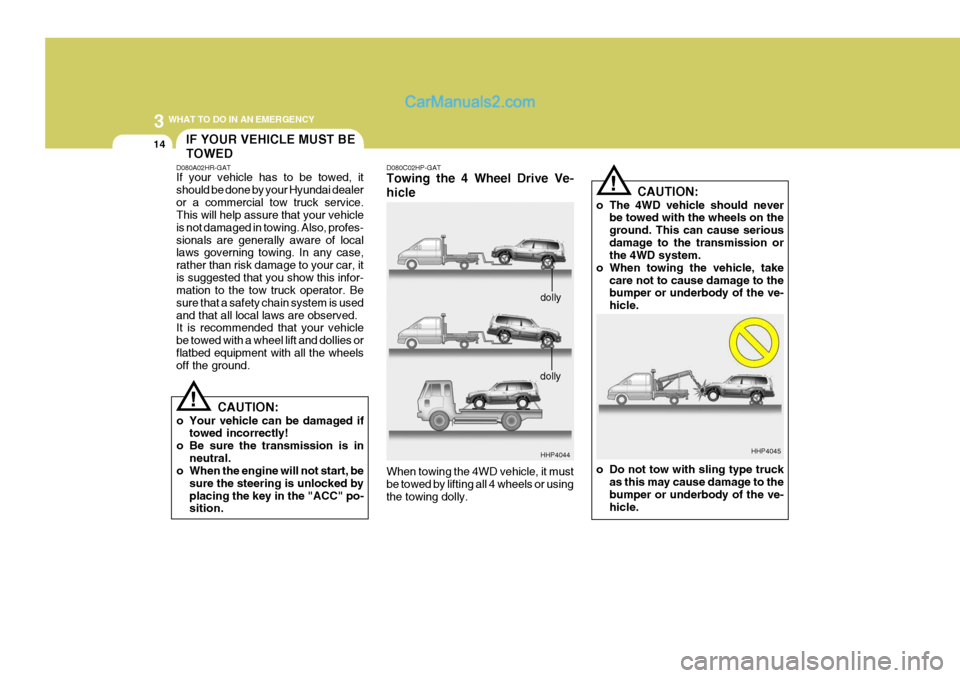
D080A02HR-GAT If your vehicle has to be towed, it should be done by your Hyundai dealeror a commercial tow truck service. This will help assure that your vehicle is not damaged in towing. Also, profes-sionals are generally aware of local laws governing towing. In any case, rather than risk damage to your car, itis suggested that you show this infor- mation to the tow truck operator. Be sure that a safety chain system is usedand that all local laws are observed. It is recommended that your vehicle be towed with a wheel lift and dollies orflatbed equipment with all the wheels off the ground.
! CAUTION:
o Your vehicle can be damaged if towed incorrectly!
o Be sure the transmission is in
neutral.
o When the engine will not start, be
sure the steering is unlocked by placing the key in the "ACC" po- sition. CAUTION:
o The 4WD vehicle should never be towed with the wheels on the ground. This can cause seriousdamage to the transmission or the 4WD system.
o When towing the vehicle, take
care not to cause damage to thebumper or underbody of the ve- hicle.
!
HHP4045
o Do not tow with sling type truck as this may cause damage to the bumper or underbody of the ve- hicle.
D080C02HP-GAT Towing the 4 Wheel Drive Ve- hicle
HHP4044
When towing the 4WD vehicle, it must be towed by lifting all 4 wheels or usingthe towing dolly. dolly
dolly
Page 202 of 539
3
WHAT TO DO IN AN EMERGENCY
15
NOTE:
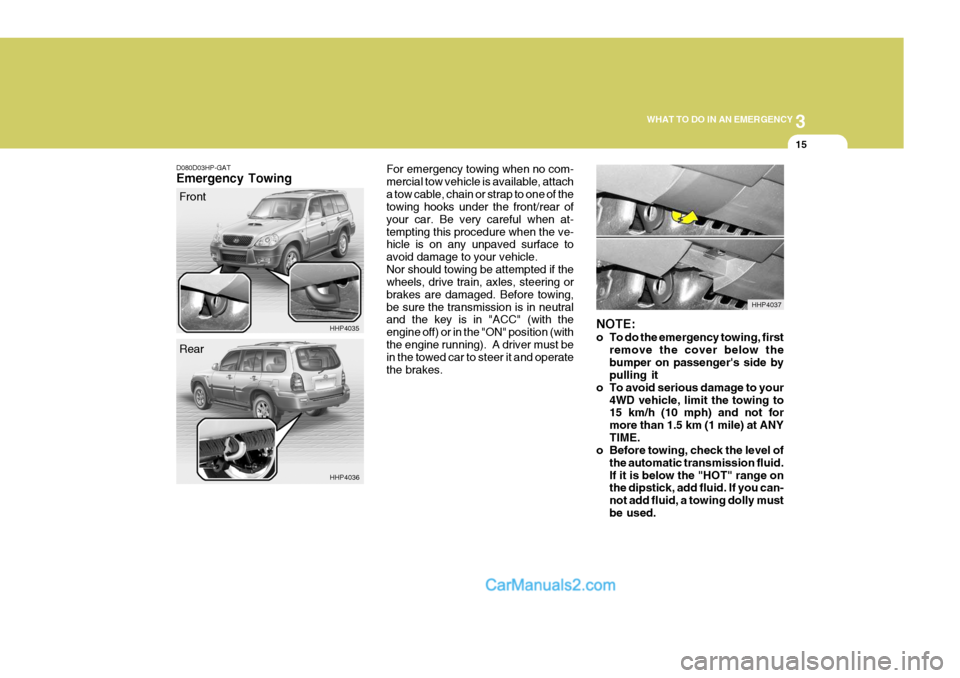
o To do the emergency towing, first
remove the cover below the bumper on passenger's side by pulling it
o To avoid serious damage to your
4WD vehicle, limit the towing to15 km/h (10 mph) and not for more than 1.5 km (1 mile) at ANYTIME.
o Before towing, check the level of
the automatic transmission fluid.If it is below the "HOT" range on the dipstick, add fluid. If you can- not add fluid, a towing dolly mustbe used. HHP4037
For emergency towing when no com-mercial tow vehicle is available, attacha tow cable, chain or strap to one of the towing hooks under the front/rear of your car. Be very careful when at-tempting this procedure when the ve- hicle is on any unpaved surface to avoid damage to your vehicle.Nor should towing be attempted if the wheels, drive train, axles, steering or brakes are damaged. Before towing,be sure the transmission is in neutral and the key is in "ACC" (with the engine off) or in the "ON" position (withthe engine running). A driver must be in the towed car to steer it and operate the brakes.
D080D03HP-GAT Emergency Towing
Front
HHP4035
HHP4036
Rear
Page 290 of 539
![Hyundai Terracan 2006 User Guide 9 VEHICLE SPECIFICATIONS
4
Oil & Grease Standard
API SJ, SL or ABOVE, SAE 5W-20, 5W-30
ILSAC GF-3 or ABOVE SAE 10W-30 [ABOVE -18°C(-0.4°F)] SAE 15W-40 [ABOVE -13°C(8.6°F)]SAE 20W-50 [ABOVE -7°C(](/img/35/19664/w960_19664-289.png "Hyundai Terracan 2006 User Guide 9 VEHICLE SPECIFICATIONS
4
Oil & Grease Standard
API SJ, SL or ABOVE, SAE 5W-20, 5W-30
ILSAC GF-3 or ABOVE SAE 10W-30 [ABOVE -18°C(-0.4°F)] SAE 15W-40 [ABOVE -13°C(8.6°F)]SAE 20W-50 [ABOVE -7°C(")
9 VEHICLE SPECIFICATIONS
4
Oil & Grease Standard
API SJ, SL or ABOVE, SAE 5W-20, 5W-30
ILSAC GF-3 or ABOVE SAE 10W-30 [ABOVE -18°C(-0.4°F)] SAE 15W-40 [ABOVE -13°C(8.6°F)]SAE 20W-50 [ABOVE -7°C(19.4°F)]
API CF-4 or ABOVE, SAE #30 [ABOVE 0°C(32°F)]
ACEA B2 or B3 SAE 20W-40 [ABOVE -10°C(14°F)] SAE 15W-40 [ABOVE -15°C(5°F)]SAE 10W-30 [-20°C ~ 40°C (-4°F ~ 104°F)]SAE 5W-30 [-25°C ~10°C (-13°F ~ 50°F)]SAE 0W-30 [BELOW 10°C(50°F)] *1
API CF-4 or ABOVE, SAE 15W-40 [ABOVE -15°C (5°F)]
ACEA B4 or ABOVE SAE 10W-30 [-20°C ~ 40°C(-4°F ~ 104°F)] SAE 5W-30 [-25°C~40°C (-13°F~104°F)] SAE 0W-30 [BELOW 10°C(50°F)] *1
*1. Restricted by driving condition and dealing areaNormal driving conditionSevere driving condition
LUBRICATION CHART
J080A11HP-GAT Item
Engine Oil Recommends Engine Oil Consumption
Q'ty (liter)
Drain and refill (With oil filter) : 4.3 Drain and refill (With oil filter) : 5.1 Drain and refill (With oil filter) : 2WD : 6.64WD : 6.0 MAX. 1L /1500 Km MAX. 1L /1000 Km
Gasoline Diesel (2.5 TCI) Diesel (2.9 CRDi)
Page 291 of 539
9
VEHICLE SPECIFICATIONS
5
J080A10HP-GAT Item
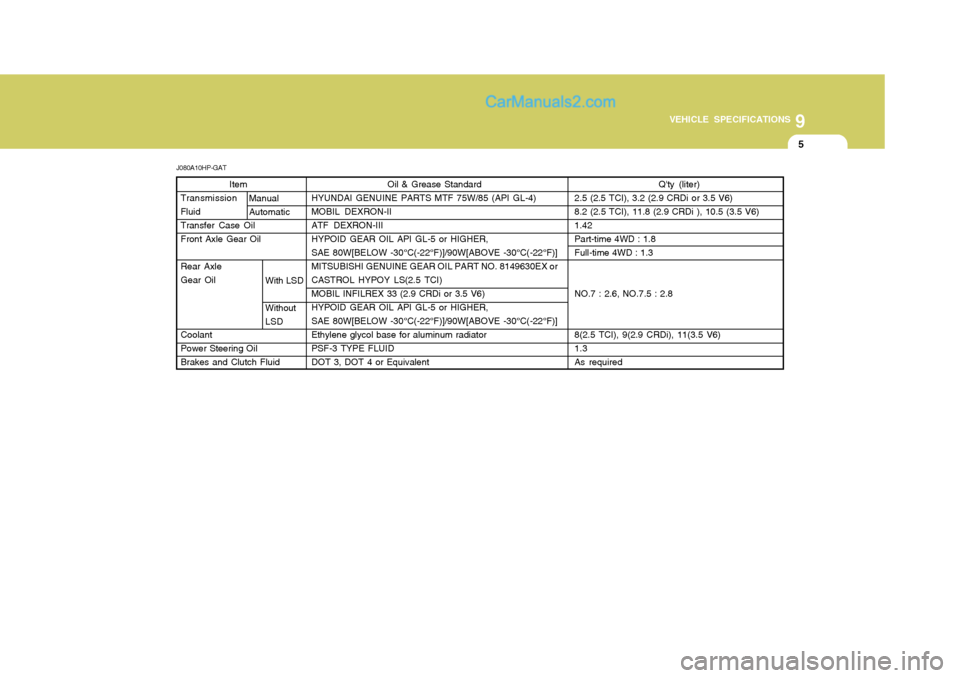
Transmission FluidTransfer Case OilFront Axle Gear Oil Rear Axle Gear Oil Coolant Power Steering OilBrakes and Clutch Fluid Oil & Grease Standard
HYUNDAI GENUINE PARTS MTF 75W/85 (API GL-4)MOBIL DEXRON-IIATF DEXRON-IIIHYPOID GEAR OIL API GL-5 or HIGHER,SAE 80W[BELOW -30°C(-22°F)]/90W[ABOVE -30°C(-22°F)]MITSUBISHI GENUINE GEAR OIL PART NO. 8149630EX orCASTROL HYPOY LS(2.5 TCI)MOBIL INFILREX 33 (2.9 CRDi or 3.5 V6)HYPOID GEAR OIL API GL-5 or HIGHER,SAE 80W[BELOW -30°C(-22°F)]/90W[ABOVE -30°C(-22°F)]Ethylene glycol base for aluminum radiatorPSF-3 TYPE FLUIDDOT 3, DOT 4 or Equivalent
Q'ty (liter)
2.5 (2.5 TCI), 3.2 (2.9 CRDi or 3.5 V6) 8.2 (2.5 TCI), 11.8 (2.9 CRDi ), 10.5 (3.5 V6)1.42Part-time 4WD : 1.8Full-time 4WD : 1.3 NO.7 : 2.6, NO.7.5 : 2.88(2.5 TCI), 9(2.9 CRDi), 11(3.5 V6) 1.3As required
Manual Automatic
With LSD Without LSD
Page 294 of 539
10
INDEX
3
Corrosion protection Cleaning the interior ................................................. 4-6
Protecting your Hyundai from corrosion .................. 4-2
Washing and waxing ................................................ 4-4
Cruise Control ......................................................... 1-100
D Defrosting/Defogging ............................................... 1-109
Door
Locking and unlocking front door with a key .......... 1-11
Drink Holder ............................................................... 1-81
Drive Belts ........................................................ 6-23, 6-27
Driving
Driving for econom y ............................................... 2-23
Smooth cornering ................................................... 2-25
Winter driving ......................................................... 2-25
E Emission Control Syst em ........................................... 7-1
Catalytic converter ................................................... 7-3
EGR System ............................................................ 7-5
Engine Before starting the engine ....................................... 2-3 Compartment (3.5 V6) ............................................. 6-2
Compartment (2.5 TCI) ............................................ 6-3
Compartment (2.9 CRDi) ......................................... 6-4 Coolant ................................................................... 6-11
Coolant temper ature gauge ................................... 1-65If the engine
overheats ............................................. 3-4
Number ..................................................................... 8-2
Oil ............................................................................. 6-6 Starting ..................................................................... 2-5
Engine Exhaust Can Be Dangerous ............................ 2-2
FFan Speed Control ...................................... 1-104, 1-115
Fog Light Switch
Front ....................................................................... 1-75
Rear ....................................................................... 1-75
Four-Wheel Drive (4WD) ............................................ 2-14
Front Seats
Adjustable front seats ............................................ 1-18
Adjustable headrest s .............................................. 1-19
Adjusting seat forward and rear ward..................... 1-18
Adjusting seatback angle .......................................1-19
Front/Rear Window Defroster Sw itch....................... 1-78
Fuel
Capacity ................................................................... 9-2
Diesel ....................................................................... 1-2
Gauge .................................................................... 1-65
Unleaded gasolin e ................................................... 1-2
Fuel Filler Lid Remote release ...................................................... 1-95
Full-time 4WD Operation ............................................ 2-17
Fuses ........................................................................ 6-28