ECU Hyundai Terracan 2006 User Guide
[x] Cancel search | Manufacturer: HYUNDAI, Model Year: 2006, Model line: Terracan, Model: Hyundai Terracan 2006Pages: 539, PDF Size: 18.11 MB
Page 55 of 539
1
FEATURES OF YOUR HYUNDAI
41
!
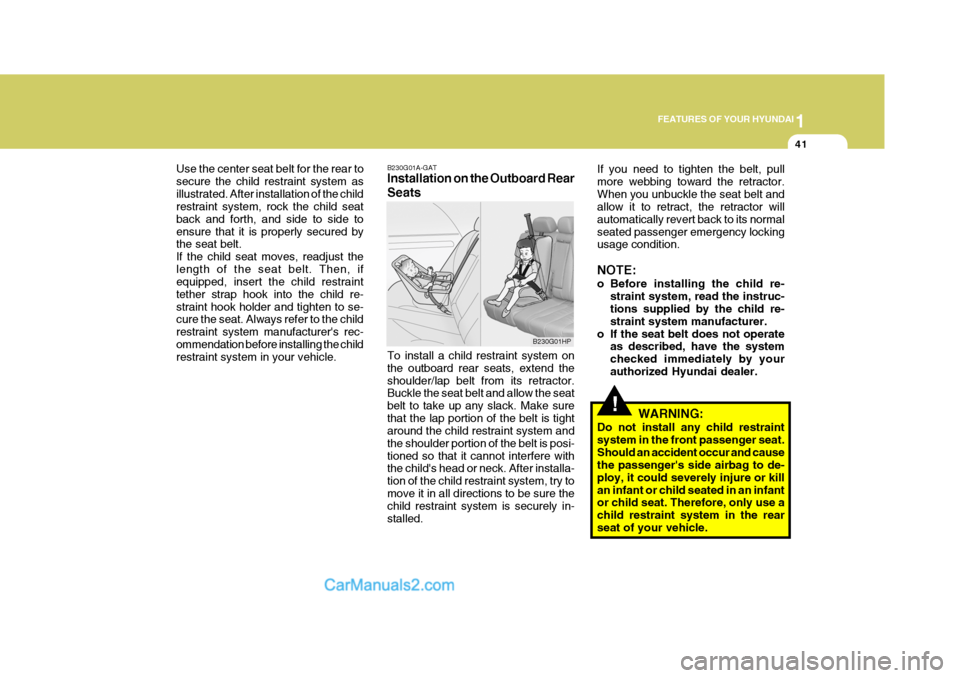
Use the center seat belt for the rear to secure the child restraint system asillustrated. After installation of the child restraint system, rock the child seat back and forth, and side to side toensure that it is properly secured by the seat belt. If the child seat moves, readjust thelength of the seat belt. Then, if equipped, insert the child restraint tether strap hook into the child re-straint hook holder and tighten to se- cure the seat. Always refer to the child restraint system manufacturer's rec-ommendation before installing the child restraint system in your vehicle. B230G01A-GAT Installation on the Outboard Rear Seats To install a child restraint system on the outboard rear seats, extend theshoulder/lap belt from its retractor. Buckle the seat belt and allow the seat belt to take up any slack. Make surethat the lap portion of the belt is tight around the child restraint system and the shoulder portion of the belt is posi-tioned so that it cannot interfere with the child's head or neck. After installa- tion of the child restraint system, try tomove it in all directions to be sure the child restraint system is securely in- stalled.If you need to tighten the belt, pullmore webbing toward the retractor.When you unbuckle the seat belt and allow it to retract, the retractor will automatically revert back to its normalseated passenger emergency locking usage condition. NOTE:
o Before installing the child re-
straint system, read the instruc- tions supplied by the child re- straint system manufacturer.
o If the seat belt does not operate as described, have the systemchecked immediately by yourauthorized Hyundai dealer.
WARNING:
Do not install any child restraintsystem in the front passenger seat.Should an accident occur and cause the passenger's side airbag to de- ploy, it could severely injure or killan infant or child seated in an infant or child seat. Therefore, only use a child restraint system in the rearseat of your vehicle.
B230G01HP
Page 56 of 539
1FEATURES OF YOUR HYUNDAI
42
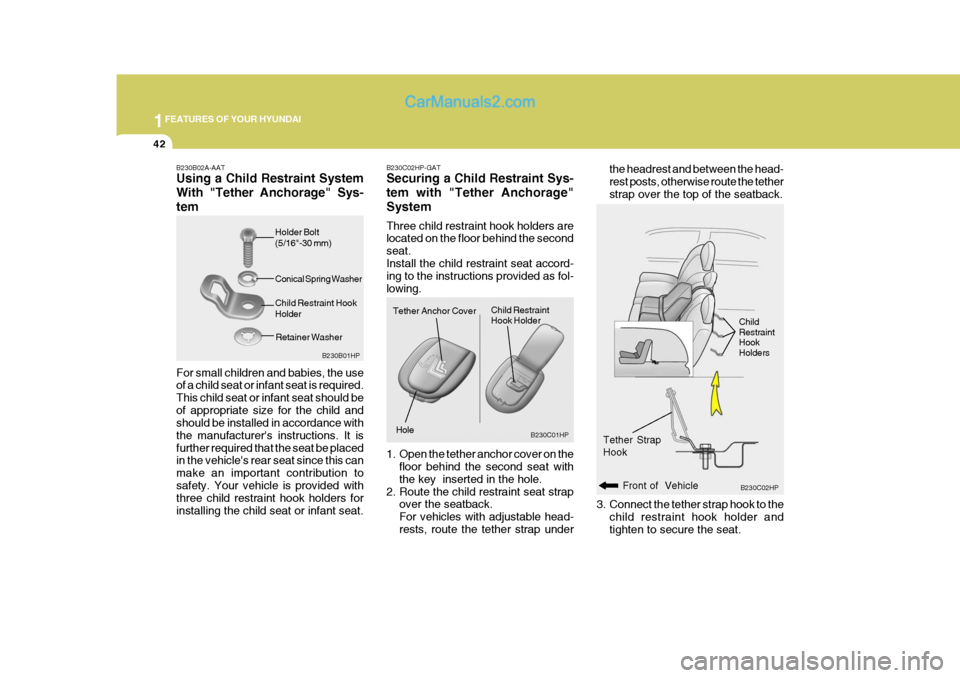
B230C02HP-GAT Securing a Child Restraint Sys- tem with "Tether Anchorage"System Three child restraint hook holders are located on the floor behind the second seat.Install the child restraint seat accord- ing to the instructions provided as fol- lowing.
1. Open the tether anchor cover on the
floor behind the second seat with the key inserted in the hole.
2. Route the child restraint seat strap over the seatback.For vehicles with adjustable head-rests, route the tether strap under B230C01HP
B230C02HP
B230B02A-AAT Using a Child Restraint System With "Tether Anchorage" Sys-tem For small children and babies, the use of a child seat or infant seat is required. This child seat or infant seat should beof appropriate size for the child and should be installed in accordance with the manufacturer's instructions. It isfurther required that the seat be placed in the vehicle's rear seat since this can make an important contribution tosafety. Your vehicle is provided with three child restraint hook holders for installing the child seat or infant seat.
B230B01HP the headrest and between the head-rest posts, otherwise route the tetherstrap over the top of the seatback.
Holder Bolt (5/16"-30 mm) Conical Spring Washer Child Restraint Hook Holder
Tether Anchor Cover
Child Restraint Hook Holder
3. Connect the tether strap hook to the
child restraint hook holder and tighten to secure the seat. Front of Vehicle
Child RestraintHookHolders
Tether Strap Hook
Retainer Washer
Hole
Page 57 of 539
1
FEATURES OF YOUR HYUNDAI
43
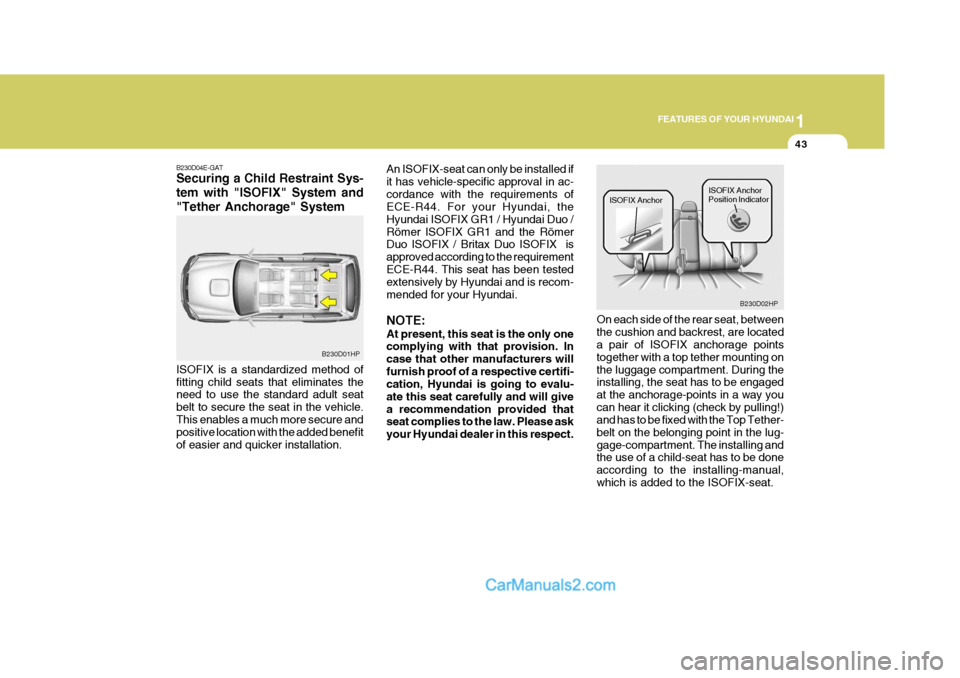
B230D04E-GAT Securing a Child Restraint Sys- tem with "ISOFIX" System and"Tether Anchorage" System ISOFIX is a standardized method of fitting child seats that eliminates the need to use the standard adult seat belt to secure the seat in the vehicle.This enables a much more secure and positive location with the added benefit of easier and quicker installation. An ISOFIX-seat can only be installed ifit has vehicle-specific approval in ac-cordance with the requirements of ECE-R44. For your Hyundai, the Hyundai ISOFIX GR1 / Hyundai Duo /Römer ISOFIX GR1 and the Römer Duo ISOFIX / Britax Duo ISOFIX is approved according to the requirementECE-R44. This seat has been tested extensively by Hyundai and is recom- mended for your Hyundai. NOTE: At present, this seat is the only one complying with that provision. In case that other manufacturers willfurnish proof of a respective certifi- cation, Hyundai is going to evalu- ate this seat carefully and will givea recommendation provided that seat complies to the law. Please ask your Hyundai dealer in this respect.
B230D01HP
On each side of the rear seat, betweenthe cushion and backrest, are located a pair of ISOFIX anchorage points together with a top tether mounting onthe luggage compartment. During the installing, the seat has to be engaged at the anchorage-points in a way youcan hear it clicking (check by pulling!) and has to be fixed with the Top Tether- belt on the belonging point in the lug-gage-compartment. The installing and the use of a child-seat has to be done according to the installing-manual,which is added to the ISOFIX-seat.ISOFIX Anchor
B230D02HP
ISOFIX Anchor Position Indicator
Page 58 of 539
1FEATURES OF YOUR HYUNDAI
44
!
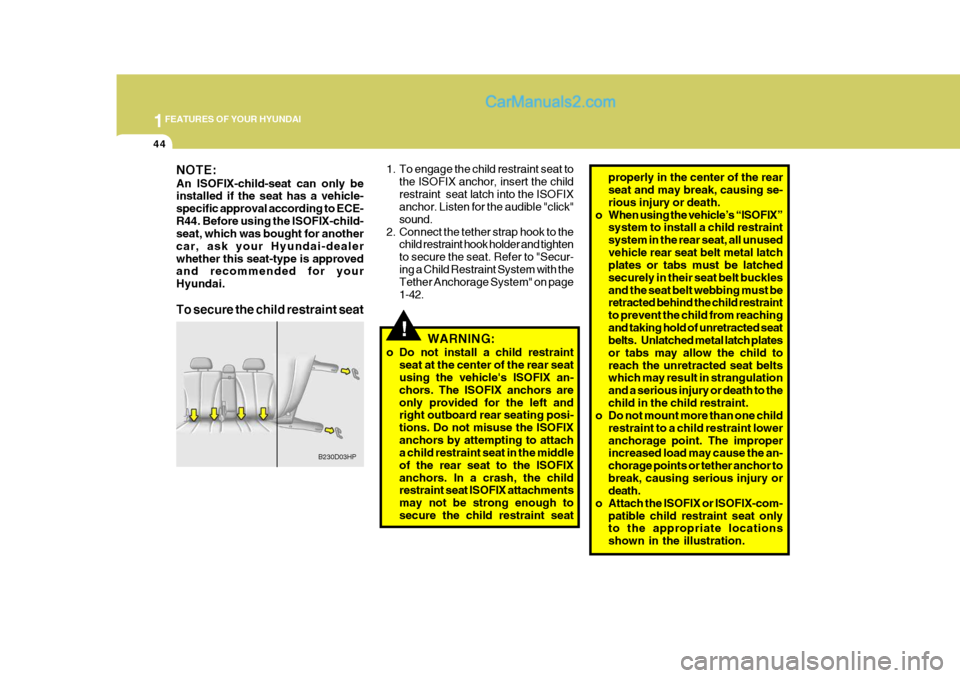
1. To engage the child restraint seat to
the ISOFIX anchor, insert the child restraint seat latch into the ISOFIX anchor. Listen for the audible "click" sound.
2. Connect the tether strap hook to the child restraint hook holder and tightento secure the seat. Refer to "Secur-ing a Child Restraint System with the Tether Anchorage System" on page 1-42.
WARNING:
o Do not install a child restraint seat at the center of the rear seat using the vehicle's ISOFIX an- chors. The ISOFIX anchors areonly provided for the left and right outboard rear seating posi- tions. Do not misuse the ISOFIXanchors by attempting to attach a child restraint seat in the middle of the rear seat to the ISOFIXanchors. In a crash, the child restraint seat ISOFIX attachments may not be strong enough tosecure the child restraint seat properly in the center of the rear seat and may break, causing se- rious injury or death.
o When using the vehicle’s “ISOFIX” system to install a child restraintsystem in the rear seat, all unusedvehicle rear seat belt metal latch plates or tabs must be latched securely in their seat belt bucklesand the seat belt webbing must be retracted behind the child restraint to prevent the child from reachingand taking hold of unretracted seat
belts. Unlatched metal latch plates or tabs may allow the child toreach the unretracted seat belts which may result in strangulation and a serious injury or death to thechild in the child restraint.
o Do not mount more than one child
restraint to a child restraint loweranchorage point. The improper increased load may cause the an- chorage points or tether anchor tobreak, causing serious injury or death.
o Attach the ISOFIX or ISOFIX-com- patible child restraint seat onlyto the appropriate locations shown in the illustration.
NOTE: An ISOFIX-child-seat can only be installed if the seat has a vehicle- specific approval according to ECE-R44. Before using the ISOFIX-child- seat, which was bought for another car, ask your Hyundai-dealerwhether this seat-type is approved and recommended for your Hyundai. To secure the child restraint seat
B230D03HP
Page 107 of 539
1
FEATURES OF YOUR HYUNDAI
93
!
!
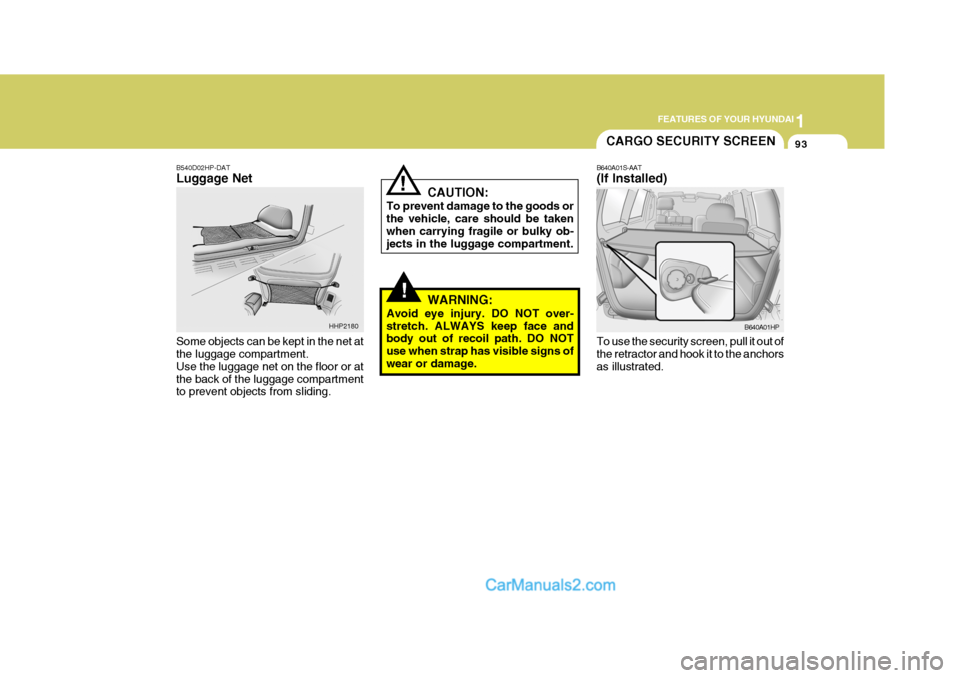
B540D02HP-DAT Luggage Net Some objects can be kept in the net at the luggage compartment. Use the luggage net on the floor or atthe back of the luggage compartment to prevent objects from sliding. CAUTION:
To prevent damage to the goods or the vehicle, care should be taken when carrying fragile or bulky ob- jects in the luggage compartment.
WARNING:
Avoid eye injury. DO NOT over-stretch. ALWAYS keep face and body out of recoil path. DO NOT use when strap has visible signs ofwear or damage.
HHP2180
CARGO SECURITY SCREEN
B640A01S-AAT (If Installed) To use the security screen, pull it out of the retractor and hook it to the anchors as illustrated. B640A01HP
Page 108 of 539
1FEATURES OF YOUR HYUNDAI
94
!
CAUTION:
o The cross bars should be posi- tioned before carrying a load on the roof rack.
o In case the sunroof is equipped, do not position roof rack loadsthat could interfere with opening of the sunroof.
o The following specification is rec- ommended when loading cargoor luggage.
o Loading cargo or luggage above 34 kg (75 lb) on the roof rack maydamage your vehicle. When you carry large objects, never let them hang over the rearor the sides of your vehicle.
o To prevent damage or loss of
cargo as you are driving, checkfrequently to make sure the lug- gage carrier and cargo are still securely fastened.ROOF RACK
34 kg (75 lb)
EVENLY DIS-
TRIBUTED
ROOF RACK
B650A01S-AAT Stowage Precautions
1. Do not place objects on the cargo security screen. Such objects may be thrown about inside the vehicle and possibly injure vehicle occu- pants during an accident or whenbraking.
2. For better fuel economy, do not
carry unnecessary weight.
3. Never allow anyone to ride in the luggage compartment. It is designedfor luggage only.
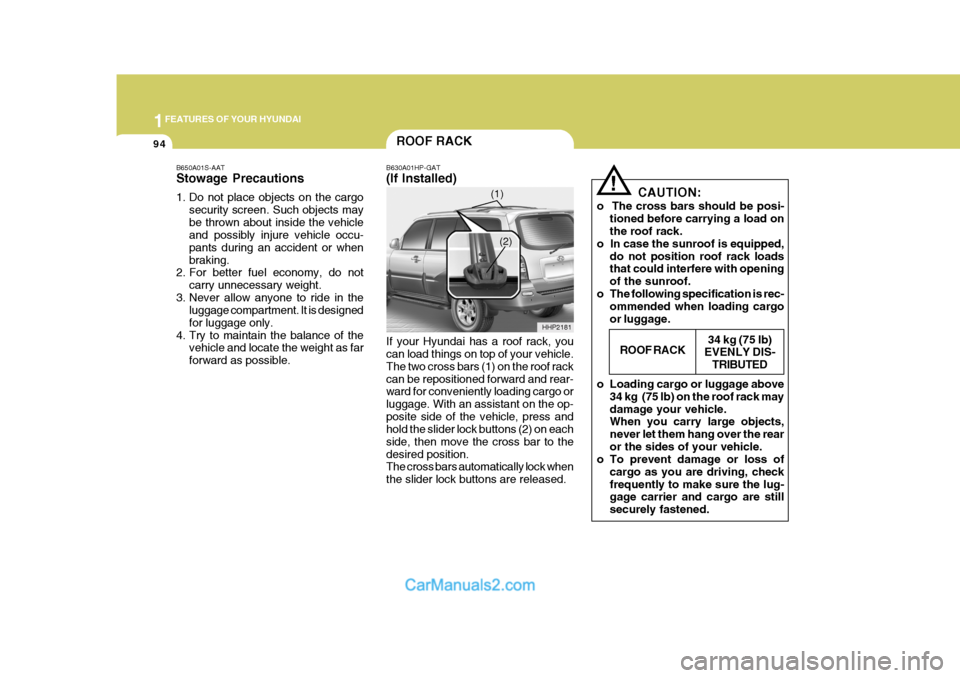
4. Try to maintain the balance of the vehicle and locate the weight as farforward as possible. B630A01HP-GAT (If Installed) If your Hyundai has a roof rack, you can load things on top of your vehicle. The two cross bars (1) on the roof rackcan be repositioned forward and rear- ward for conveniently loading cargo or luggage. With an assistant on the op-posite side of the vehicle, press and hold the slider lock buttons (2) on each side, then move the cross bar to thedesired position. The cross bars automatically lock when the slider lock buttons are released.
HHP2181
(1)
(2)
Page 110 of 539
1FEATURES OF YOUR HYUNDAI
96
!WARNING:
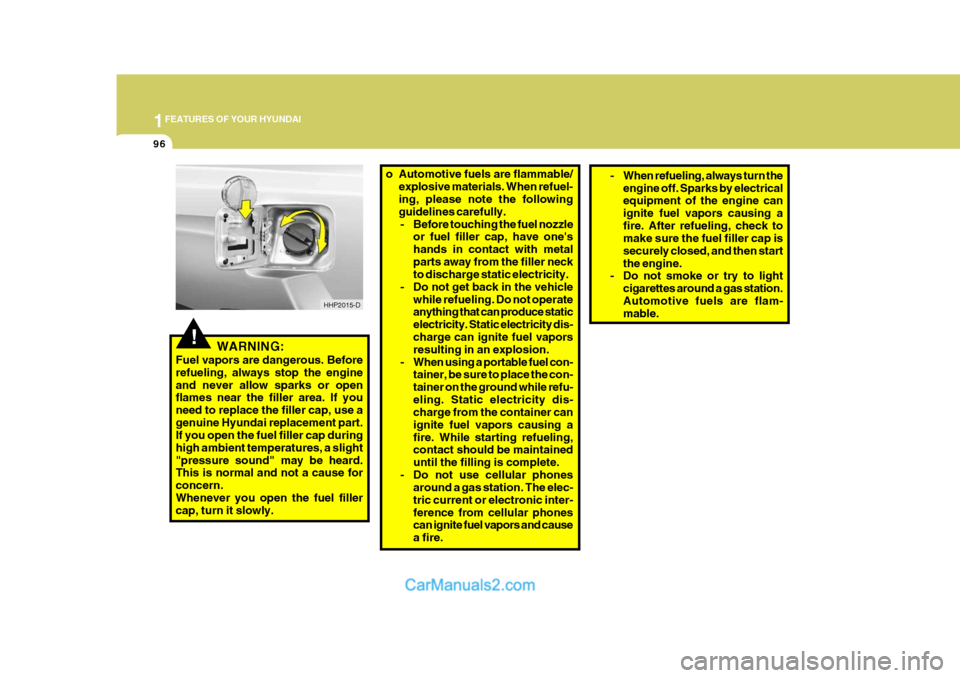
Fuel vapors are dangerous. Before refueling, always stop the engineand never allow sparks or open flames near the filler area. If you need to replace the filler cap, use agenuine Hyundai replacement part. If you open the fuel filler cap during high ambient temperatures, a slight"pressure sound" may be heard. This is normal and not a cause for concern.Whenever you open the fuel filler cap, turn it slowly. HHP2015-D
o Automotive fuels are flammable/
explosive materials. When refuel-ing, please note the following guidelines carefully.- Before touching the fuel nozzle or fuel filler cap, have one'shands in contact with metalparts away from the filler neck to discharge static electricity.
- Do not get back in the vehicle
while refueling. Do not operateanything that can produce static electricity. Static electricity dis- charge can ignite fuel vapors resulting in an explosion.
- When using a portable fuel con- tainer, be sure to place the con-tainer on the ground while refu-eling. Static electricity dis- charge from the container can ignite fuel vapors causing afire. While starting refueling, contact should be maintained until the filling is complete.
- Do not use cellular phones around a gas station. The elec-tric current or electronic inter-ference from cellular phones can ignite fuel vapors and cause a fire. - When refueling, always turn the
engine off. Sparks by electrical equipment of the engine can ignite fuel vapors causing afire. After refueling, check to make sure the fuel filler cap is securely closed, and then startthe engine.
- Do not smoke or try to light
cigarettes around a gas station.Automotive fuels are flam- mable.
Page 183 of 539
2 DRIVING YOUR HYUNDAI
28
C190B01S-AAT Trailer Hitches Select the proper hitch and ball combi- nation, making sure that it's location is compatible with that of the trailer or vehicle being towed.Use a quality non-equalizing hitch which distributes the tongue load uniformly throughout the chassis. The hitch should be bolted securely to the car and installed by a qualifiedtechnician. DO NOT USE A HITCH DESIGNED FOR TEMPORARY IN- STALLATION AND NEVER USE ONETHAT ATTACHES ONLY TO THE BUMPER.TRAILER OR VEHICLE TOWING
!
C190A01HP-GAT If you are considering towing with your car, you should first check with your Province Department of Motor Vehicles to determine their legal requirements.Since laws vary from province to prov- ince the requirements for towing trail- ers, cars, or other types of vehicles orapparatus may differ. Ask your Hyundai dealer for further details before towing.
CAUTION:
Do not do any towing with your carduring its first 2,000 km (1,200 miles) in order to allow the engine to prop-erly break in. Failure to heed this caution may result in serious en- gine or transmission damage.
USE OF LIGHTS
C180A01A-AAT Check your lights regularly for correct operation and always keep them clean. When driving during the day in condi- tions of poor visibility, it is helpful todrive with headlights on low beam. This enables you to be seen, as well as to see.
Page 186 of 539
2
DRIVING YOUR HYUNDAI
31
C190F01HP-GAT Trailer or Vehicle Towing Tips
1. Before towing, check hitch and safety chain connections as well as proper operation of the trailer running lights, brake lights, and turn signals.
2. Always drive your vehicle at a mod- erate speed (Less than 100 km/h).
3. Trailer towing requires more fuel than normal conditions.
4. To maintain engine braking effi-
ciency, do not tow a trailer with thetransmission in fifth gear (manual transmission) or an overdrive gear (automatic transmission).
5. Always secure items in the trailer to prevent load shift while driving.
6. Check the condition and air pres- sure of all tires on the trailer and your car. Low tire pressure can seriously affect the handling. Alsocheck the spare tire.
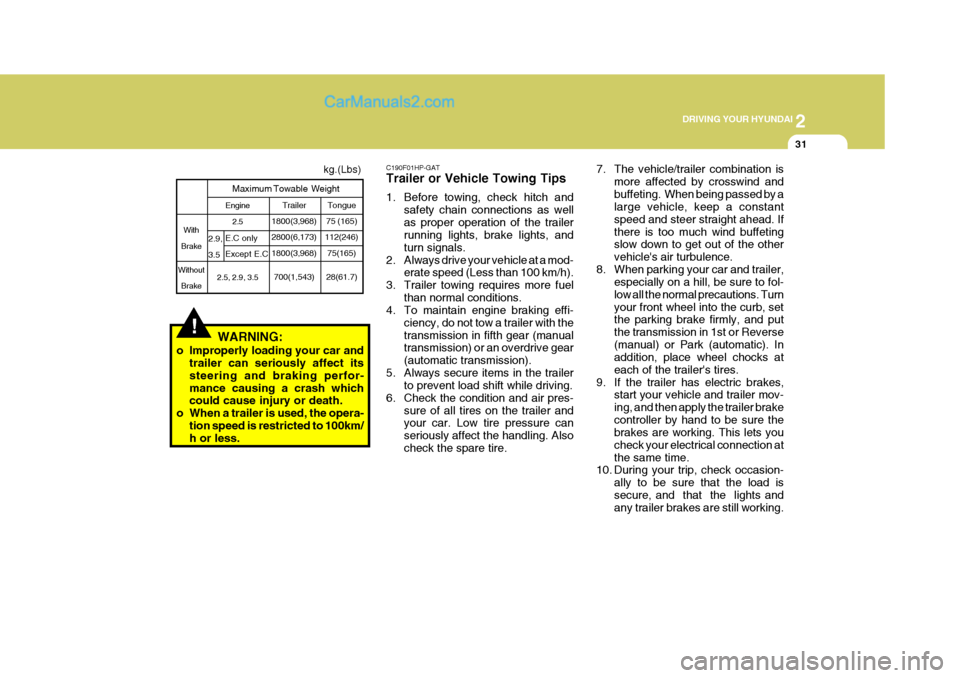
Tongue
75 (165)
112(246)
75(165)
28(61.7)
Engine
2.5
2.5, 2.9, 3.5
!WARNING:
o Improperly loading your car and trailer can seriously affect its steering and braking perfor-mance causing a crash which could cause injury or death.
o When a trailer is used, the opera- tion speed is restricted to 100km/h or less.
With
Brake
Without BrakeE.C only Except E.C
2.9,3.5
Maximum Towable Weight
Trailer
1800(3,968) 2800(6,173) 1800(3,968)
700(1,543)
7. The vehicle/trailer combination is more affected by crosswind and buffeting. When being passed by a large vehicle, keep a constant speed and steer straight ahead. Ifthere is too much wind buffeting slow down to get out of the other vehicle's air turbulence.
8. When parking your car and trailer, especially on a hill, be sure to fol-low all the normal precautions. Turnyour front wheel into the curb, set the parking brake firmly, and put the transmission in 1st or Reverse(manual) or Park (automatic). In addition, place wheel chocks at each of the trailer's tires.
9. If the trailer has electric brakes, start your vehicle and trailer mov-ing, and then apply the trailer brakecontroller by hand to be sure the brakes are working. This lets you check your electrical connection atthe same time.
10. During your trip, check occasion-
ally to be sure that the load issecure, and that the lights and any trailer brakes are still working.
kg.(Lbs)
Page 189 of 539
3 WHAT TO DO IN AN EMERGENCY
2
!
IF THE ENGINE WILL NOT START
D010A01A-AAT D010B01HP-GAT If Engine Doesn’t Turn Over or Turns Over Slowly
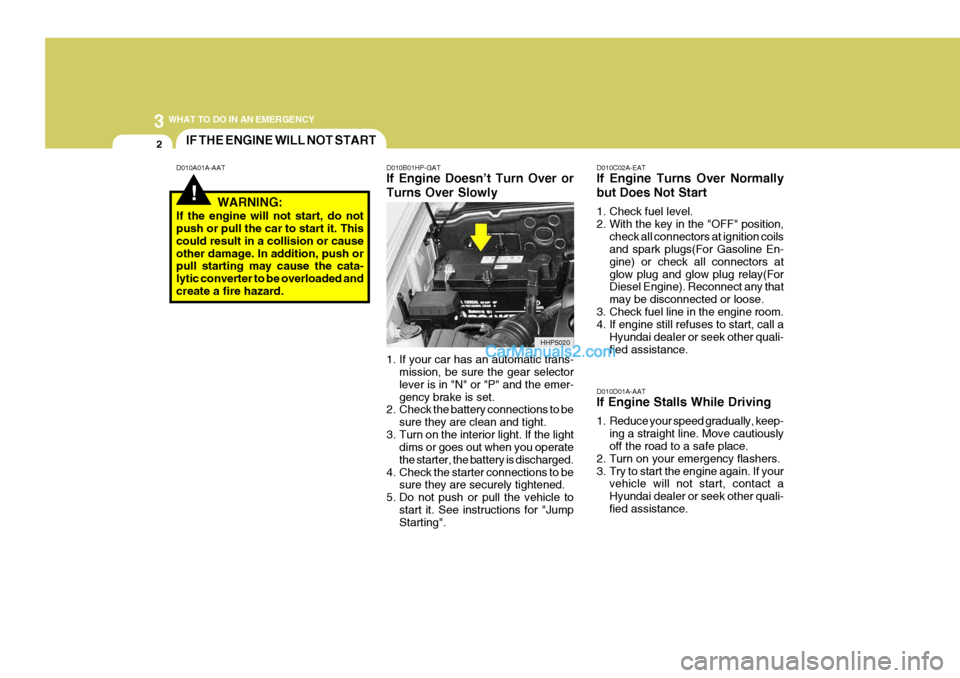
1. If your car has an automatic trans- mission, be sure the gear selector lever is in "N" or "P" and the emer-gency brake is set.
2. Check the battery connections to be
sure they are clean and tight.
3. Turn on the interior light. If the light dims or goes out when you operatethe starter, the battery is discharged.
4. Check the starter connections to be sure they are securely tightened.
5. Do not push or pull the vehicle to start it. See instructions for "Jump Starting". D010C02A-EAT If Engine Turns Over Normally but Does Not Start
1. Check fuel level.
2. With the key in the "OFF" position,
check all connectors at ignition coils and spark plugs(For Gasoline En- gine) or check all connectors atglow plug and glow plug relay(For Diesel Engine). Reconnect any that may be disconnected or loose.
3. Check fuel line in the engine room.
4. If engine still refuses to start, call a
Hyundai dealer or seek other quali- fied assistance.
WARNING:
If the engine will not start, do not push or pull the car to start it. This could result in a collision or causeother damage. In addition, push or pull starting may cause the cata- lytic converter to be overloaded andcreate a fire hazard.
D010D01A-AAT If Engine Stalls While Driving
1. Reduce your speed gradually, keep-ing a straight line. Move cautiously off the road to a safe place.
2. Turn on your emergency flashers.
3. Try to start the engine again. If your vehicle will not start, contact aHyundai dealer or seek other quali-fied assistance.
HHP5020