seats Hyundai Terracan 2006 User Guide
[x] Cancel search | Manufacturer: HYUNDAI, Model Year: 2006, Model line: Terracan, Model: Hyundai Terracan 2006Pages: 539, PDF Size: 18.11 MB
Page 324 of 539
1CONTROLS AND EQUIPMENT
16
!WARNING:
Front seat adjustments must not be undertaken whilst the vehicle is in motion. Loss of control of the ve-hicle may result if seat adjustments are made whilst the vehicle is in motion. ZB060A8-E Front Seat Fore/Aft Adjustment
SEATS
SB070A1-E FRONT SEAT ADJUSTMENT
HHP2026-E
!WARNING:
o Seat adjustment should not be made whilst the vehicle is in mo- tion since loss of control of the vehicle may occur.
o To ensure the seat is locked se- curely, attempt to move the seatforward or rearward without usingthe lock release lever.
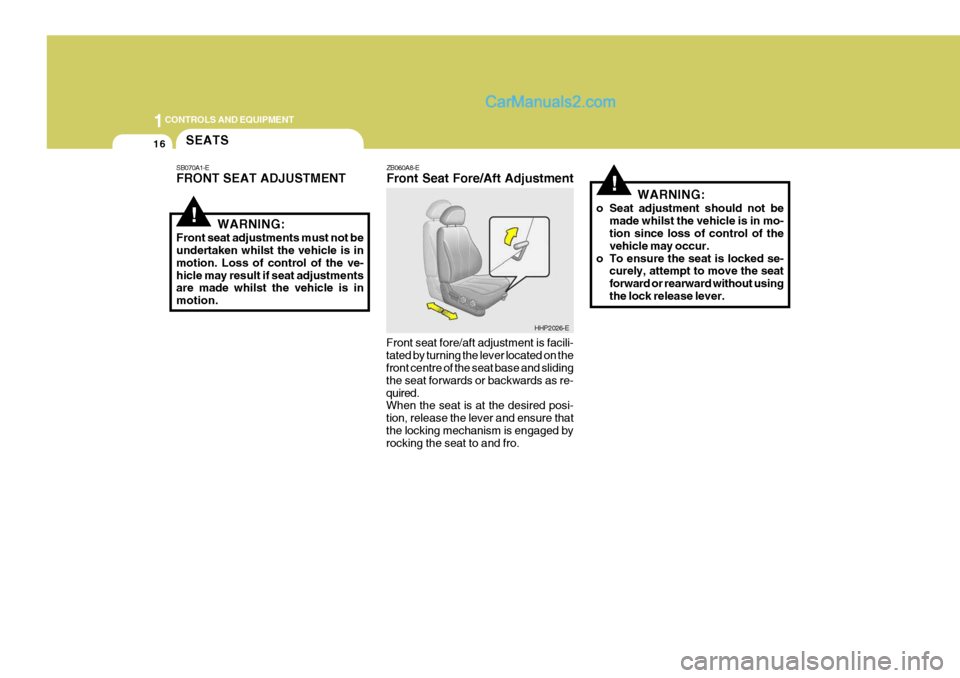
Front seat fore/aft adjustment is facili-tated by turning the lever located on the front centre of the seat base and sliding the seat forwards or backwards as re-quired. When the seat is at the desired posi- tion, release the lever and ensure thatthe locking mechanism is engaged by rocking the seat to and fro.
Page 329 of 539
1
CONTROLS AND EQUIPMENT
21
!
B080G01O-AAT UNDER TRAY
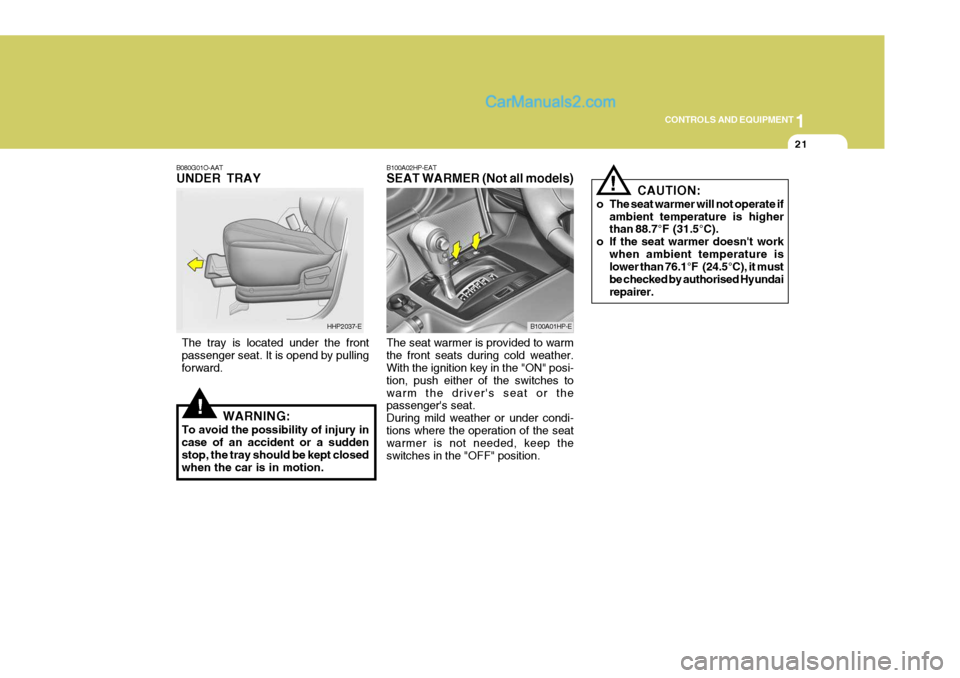
The tray is located under the front passenger seat. It is opend by pulling forward. WARNING:
To avoid the possibility of injury in case of an accident or a suddenstop, the tray should be kept closed when the car is in motion. B100A02HP-EAT SEAT WARMER (Not all models) The seat warmer is provided to warm the front seats during cold weather. With the ignition key in the "ON" posi- tion, push either of the switches towarm the driver's seat or the passenger's seat. During mild weather or under condi-tions where the operation of the seat warmer is not needed, keep the switches in the "OFF" position.
HHP2037-EB100A01HP-E
!
CAUTION:
o The seat warmer will not operate if ambient temperature is higher than 88.7°F (31.5°C).
o If the seat warmer doesn't work when ambient temperature islower than 76.1°F (24.5°C), it must be checked by authorised Hyundairepairer.
Page 334 of 539
1CONTROLS AND EQUIPMENT
26
SB090C1-E Larger Children Larger children should occupy the rear seat and be restrained at all times. Therestraint may take the form of a special safety belt or the original factory fitted seat belt used in conjunction with anapproved booster cushion depending upon the size and weight of the child. Under no circumstances should chil-dren be allowed to travel standing, kneeling or lying on the seat. Never allow childen to ride in the frontpassenger seat. SB090O1-E Pregnant Women The use of a seat belt is recommended for pregnant women. The seat beltshould be worn as low and snugly as possible across the hips, not across the abdomen. A qualified Medical Prac-titioner should be consulted for further information. SB090E1-E Injured Persons A seat belt should be used when an injured person is being transported.For specific recommendations, the advice of a qualified Medical Practioner should be sought. SB090F1-E Seat Belt Occupancy The seat belts are designed to be used by one seat occupant only. The use of a seat belt by more than one personincreases the levels of injury which may be sustained in the event of an accident. SE090G1-E Do Not Lie Down To ensure that the maximum level of protection may be afforded by the seat belt system, all passengers should be sitting in an upright position throughoutthe journey. The seat belt will be un- able to afford maximum protection if the front seats are at or near the fullyreclined position.SB090H1-E CARE OF SEAT BELTS Seat belt assemblies must never be disassembled or modified in any way.In addition, care should be exercised to ensure that the belt assemblies do not become damaged by being trappedin seat mechanisms, door shuts etc. SB090I-E Periodic Inspection It is recommended that all seat belts be inspected periodically for wear or damage of any kind. Parts of the sys-tem that are damaged should be re- placed as soon as possible. Under no circumstances must any part of theseat belt assemblies be dismantled or repaired.
Page 339 of 539
1
CONTROLS AND EQUIPMENT
31
!
B220D04HP
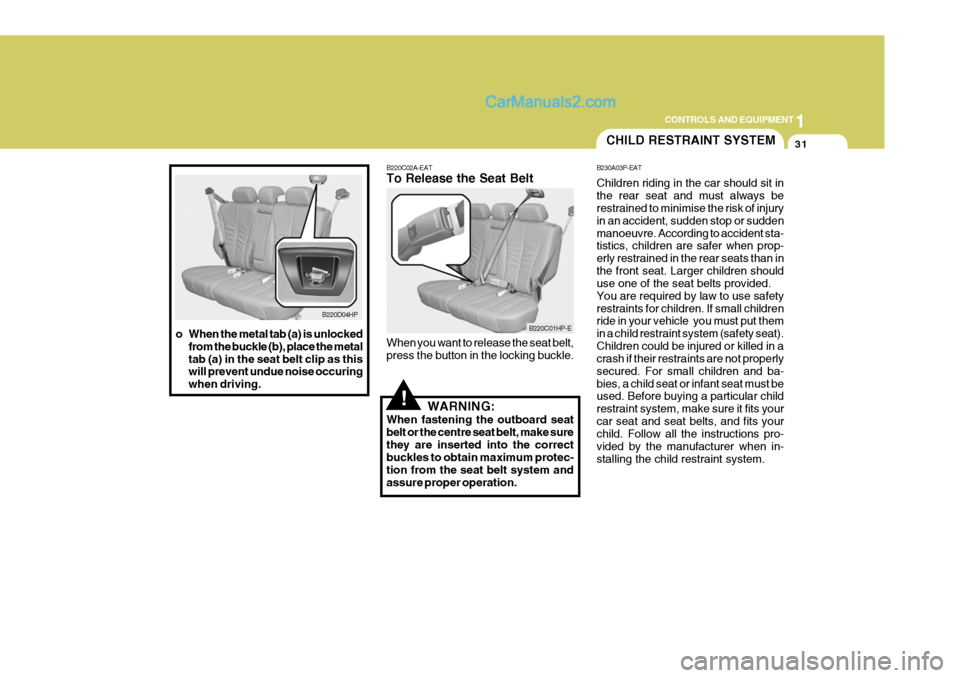
o When the metal tab (a) is unlocked from the buckle (b), place the metal tab (a) in the seat belt clip as this will prevent undue noise occuring when driving. B220C02A-EAT To Release the Seat Belt When you want to release the seat belt, press the button in the locking buckle.
WARNING:
When fastening the outboard seatbelt or the centre seat belt, make surethey are inserted into the correct buckles to obtain maximum protec- tion from the seat belt system andassure proper operation.
B220C01HP-E
CHILD RESTRAINT SYSTEM
B230A03P-EAT Children riding in the car should sit in the rear seat and must always be restrained to minimise the risk of injury in an accident, sudden stop or suddenmanoeuvre. According to accident sta- tistics, children are safer when prop- erly restrained in the rear seats than inthe front seat. Larger children should use one of the seat belts provided. You are required by law to use safetyrestraints for children. If small children ride in your vehicle you must put them in a child restraint system (safety seat).Children could be injured or killed in a crash if their restraints are not properly secured. For small children and ba-bies, a child seat or infant seat must be used. Before buying a particular child restraint system, make sure it fits yourcar seat and seat belts, and fits your child. Follow all the instructions pro- vided by the manufacturer when in-stalling the child restraint system.
Page 341 of 539
1
CONTROLS AND EQUIPMENT
33
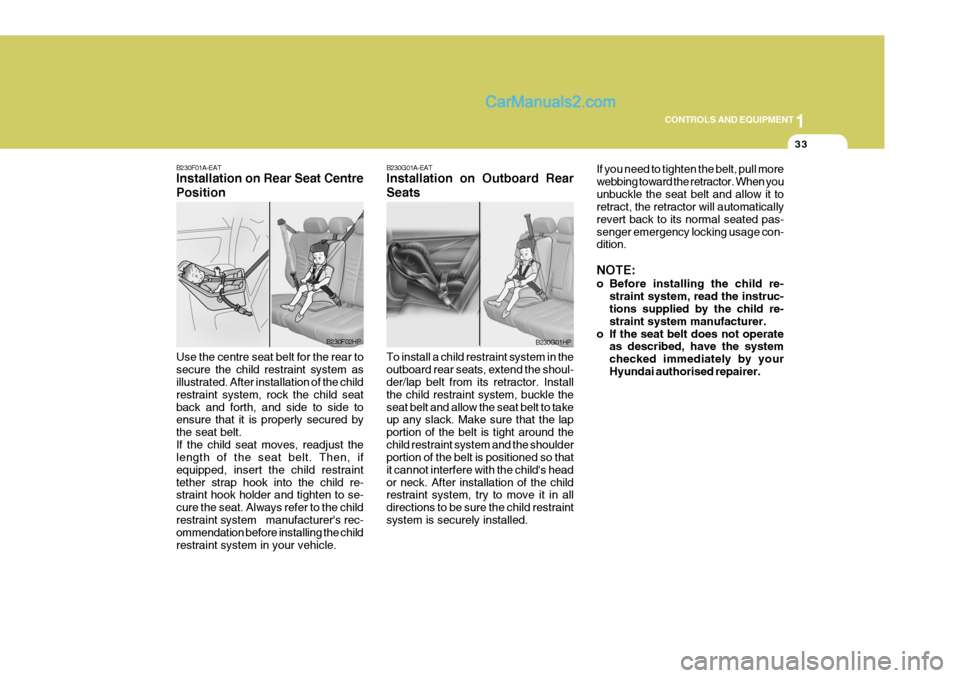
B230F01A-EAT Installation on Rear Seat Centre Position Use the centre seat belt for the rear to secure the child restraint system as illustrated. After installation of the child restraint system, rock the child seatback and forth, and side to side to ensure that it is properly secured by the seat belt.If the child seat moves, readjust the length of the seat belt. Then, if equipped, insert the child restrainttether strap hook into the child re- straint hook holder and tighten to se- cure the seat. Always refer to the childrestraint system manufacturer's rec- ommendation before installing the child restraint system in your vehicle.
B230F02HP
B230G01A-EAT Installation on Outboard Rear Seats To install a child restraint system in the outboard rear seats, extend the shoul- der/lap belt from its retractor. Install the child restraint system, buckle theseat belt and allow the seat belt to take up any slack. Make sure that the lap portion of the belt is tight around thechild restraint system and the shoulder portion of the belt is positioned so that it cannot interfere with the child's heador neck. After installation of the child restraint system, try to move it in all directions to be sure the child restraintsystem is securely installed. If you need to tighten the belt, pull morewebbing toward the retractor. When youunbuckle the seat belt and allow it to retract, the retractor will automatically revert back to its normal seated pas-senger emergency locking usage con- dition. NOTE:
o Before installing the child re-
straint system, read the instruc- tions supplied by the child re- straint system manufacturer.
o If the seat belt does not operate as described, have the systemchecked immediately by yourHyundai authorised repairer.
B230G01HP
Page 343 of 539
1
CONTROLS AND EQUIPMENT
35
B230C02HP
Front of Vehicle
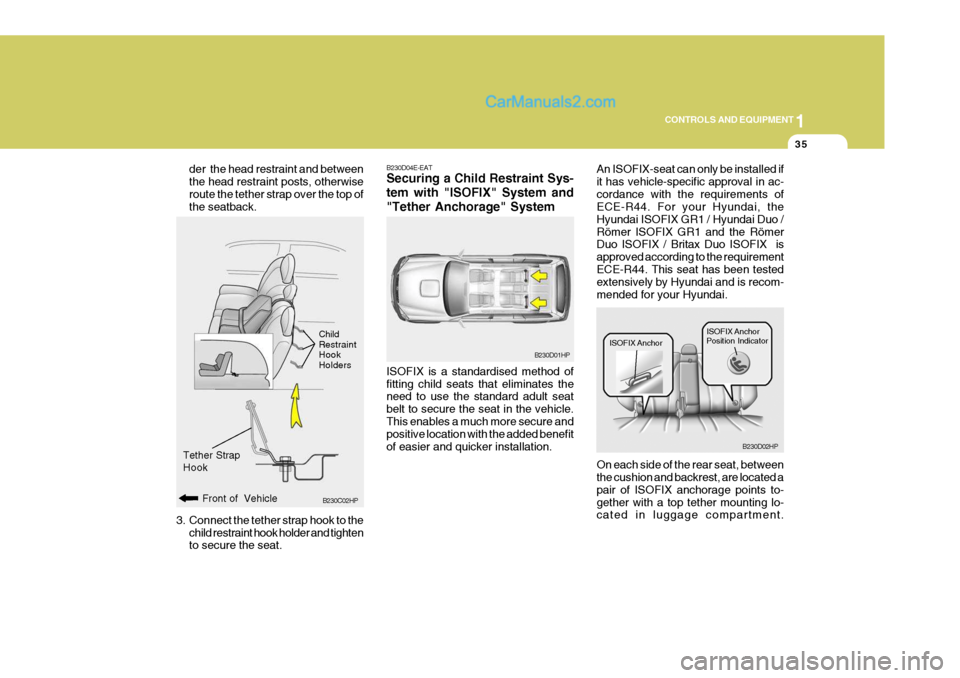
der the head restraint and between the head restraint posts, otherwiseroute the tether strap over the top of the seatback.
3. Connect the tether strap hook to the child restraint hook holder and tightento secure the seat. Child RestraintHookHolders
Tether Strap Hook
B230D04E-EAT Securing a Child Restraint Sys- tem with "ISOFIX" System and"Tether Anchorage" System ISOFIX is a standardised method of fitting child seats that eliminates the need to use the standard adult seat belt to secure the seat in the vehicle.This enables a much more secure and positive location with the added benefit of easier and quicker installation. An ISOFIX-seat can only be installed ifit has vehicle-specific approval in ac-cordance with the requirements of ECE-R44. For your Hyundai, the Hyundai ISOFIX GR1 / Hyundai Duo /Römer ISOFIX GR1 and the Römer Duo ISOFIX / Britax Duo ISOFIX is approved according to the requirementECE-R44. This seat has been tested extensively by Hyundai and is recom- mended for your Hyundai.
B230D01HP
ISOFIX Anchor
B230D02HP
ISOFIX Anchor Position Indicator
On each side of the rear seat, between the cushion and backrest, are located a pair of ISOFIX anchorage points to-gether with a top tether mounting lo- cated in luggage compartment.
Page 344 of 539
1CONTROLS AND EQUIPMENT
36
!
During the installation, the seat has to be engaged at the anchorage-points insuch a way whereby you can hear it clicks (check by pulling!) and has to be fixed with the Top Tether-belt to theappropriate top tether mounting point on the seatback behind rear seats. The installing and the use of a child-seathas to be done according to the instal- lation manual for the ISOFIX seat. NOTE: An ISOFIX-child-seat can only be installed if the seat has a vehicle- specific approval according to ECE-R44. Before using the ISOFIX-child- seat, which was bought for another car, ask your Hyundai authorisedrepairer whether this seat-type is ap- proved and recommended for your Hyundai. To secure the child restraint seat 1. To engage the child restraint seat to
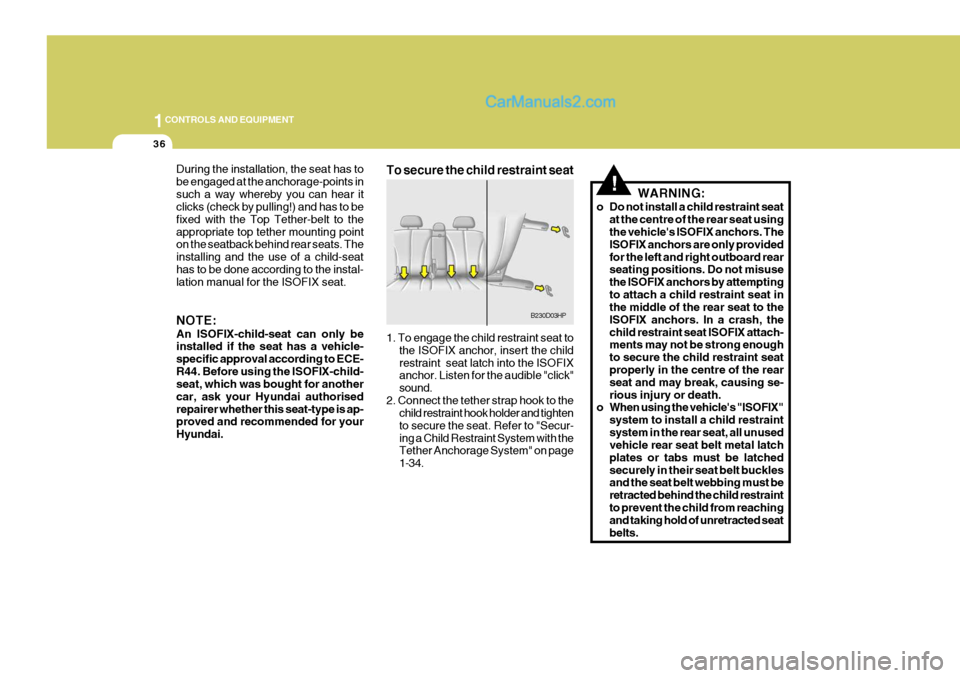
the ISOFIX anchor, insert the child restraint seat latch into the ISOFIX anchor. Listen for the audible "click" sound.
2. Connect the tether strap hook to the child restraint hook holder and tightento secure the seat. Refer to "Secur-ing a Child Restraint System with the Tether Anchorage System" on page 1-34. WARNING:
o Do not install a child restraint seat at the centre of the rear seat using the vehicle's ISOFIX anchors. The ISOFIX anchors are only providedfor the left and right outboard rear seating positions. Do not misuse the ISOFIX anchors by attemptingto attach a child restraint seat in the middle of the rear seat to the ISOFIX anchors. In a crash, thechild restraint seat ISOFIX attach- ments may not be strong enough to secure the child restraint seat properly in the centre of the rear seat and may break, causing se-rious injury or death.
o When using the vehicle's "ISOFIX"
system to install a child restraintsystem in the rear seat, all unused vehicle rear seat belt metal latch plates or tabs must be latchedsecurely in their seat belt buckles and the seat belt webbing must be retracted behind the child restraintto prevent the child from reaching and taking hold of unretracted seat belts.
B230D03HP
Page 345 of 539
1
CONTROLS AND EQUIPMENT
37
Unlatched metal latch plates or tabs may allow the child to reachthe unretracted seat belts which may result in strangulation and a serious injury or death to the childin the child restraint.
o Do not mount more than one child
restraint to a child restraint loweranchorage point. Over-loading may cause the anchorage points or tether anchor to break, causingserious injury or death.
o Attach the ISOFIX or ISOFIX-com-
patible child restraint seat only tothe appropriate locations shown in the illustration.
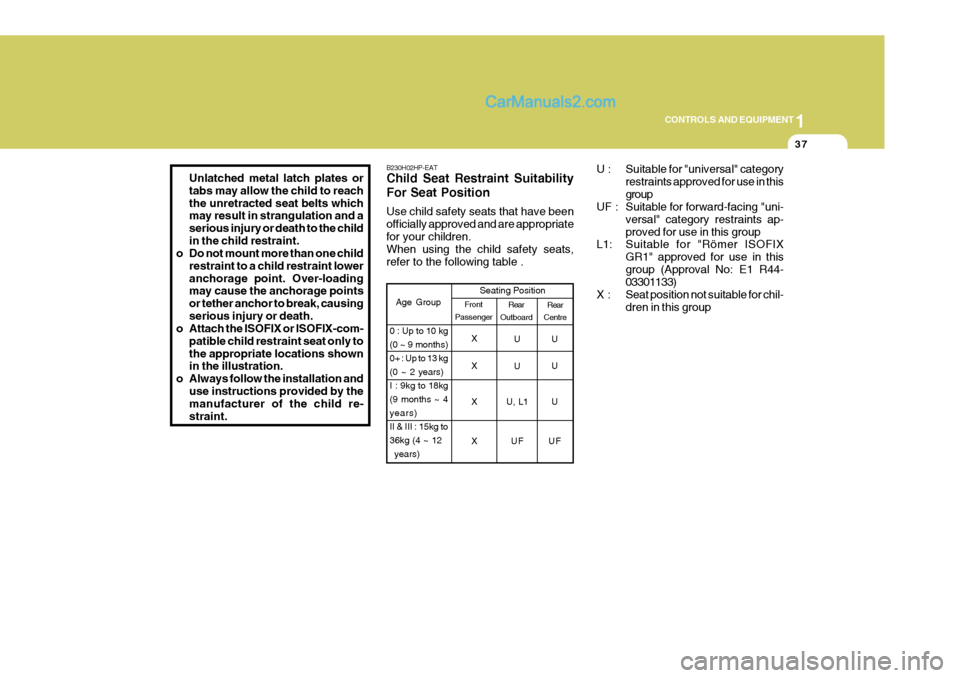
o Always follow the installation and use instructions provided by themanufacturer of the child re- straint. B230H02HP-EAT Child Seat Restraint Suitability For Seat Position Use child safety seats that have been officially approved and are appropriatefor your children. When using the child safety seats, refer to the following table .
U : Suitable for "universal" category
restraints approved for use in thisgroup
UF : Suitable for forward-facing "uni-
versal" category restraints ap-proved for use in this group
L1: Suitable for "Römer ISOFIX
GR1" approved for use in thisgroup (Approval No: E1 R44- 03301133)
X : Seat position not suitable for chil- dren in this group
Rear
Centre
Age Group Seating Position
UU
X UU
Rear
Outboard
Front
Passenger
0 : Up to 10 kg (0 ~ 9 months)0+ : Up to 13 kg(0 ~ 2 years)I : 9kg to 18kg(9 months ~ 4years)II & III : 15kg to36kg (4 ~ 12 years) X
X U, L1 U XU
FUF
Page 536 of 539
10
INDEX
3
Coolant temperature gauge .....................................1-57
If the engine overheats ............................................. 3-4
Number ..................................................................... 8-2
Oil ............................................................................. 6-4 Starting ..................................................................... 2-5
Engine Exhaust Can Be Dangerous! ........................... 2-2
Exhaust Gas Warning .................................................. 7-2
F Fan Speed Control ................. .........................1-91, 1-102
Fog Light Switch
Front ....................................................................... 1-62
Rear ........................................................................ 1-62
Four-Wheel Drive(4WD) ............................................. 2-14
Front Door Edge Warning Light ................................. 1-85
Front Seats Adjustable head restraints ...................................... 1-17
Adjusting seatback angle ....................................... 1-17
Driver's seat lumbar support control .......................1-18
Seat adjust ment ..................................................... 1-16
Seat cushion height adjustment ............................. 1-19
Seat fore/aft adjustment ......................................... 1-16
Fuel
Capacity ................................................................... 9-2
Gauge ..................................................................... 1-57
Recommendations .................................................... 1-2
Fuel-Filler Flap
Remote release ...................................................... 1-82
Full-time 4WD Operation ............................................ 2-17
Fusible Links ............................................................. 6-25G
Glove Box ................................................................. 1-73
H Hatchback Door ......................................................... 1-78
Hazard Warning System ............................................ 1-65
Headlight Aiming Adjustment..................................... 6-33
Headlight Bulbs Replacement ....................................6-31
Headlight Leveling Device S ystem ............................1-86
Heated Front/Rear Window .. ......................................1-65
Heating and Cooling Control ......................................1-90
Heating and Ventilation
Air flow control ............................................. 1-92, 1-103
Air intake control ......................................... 1-92, 1-102
Defrosting/Defogging ............................................... 1-96
Fan speed control ........................................ 1-91, 1-102
Temperature control ................................................ 1-94
High-Mounted Rear Stop Light ...................................1-82
Horn ........................................................................... 1-85
I Ignition Switch ............................................................. 2-4
Illuminated ignition switch ......................................... 1-8
Immobiliser System ..................................................... 1-5
Indicator and Warning Lights ..................................... 1-50
Instrument Cluster and Indicator Lights ..................... 1-46
Interior Light ............................................................... 1-72
Interior Rearview Mirror .............................................. 1-77
Intermittent Wi pe Facility ........................................... 1-64