stop start Hyundai Terracan 2007 User Guide
[x] Cancel search | Manufacturer: HYUNDAI, Model Year: 2007, Model line: Terracan, Model: Hyundai Terracan 2007Pages: 291, PDF Size: 12.79 MB
Page 163 of 291
2
DRIVING YOUR HYUNDAI
7
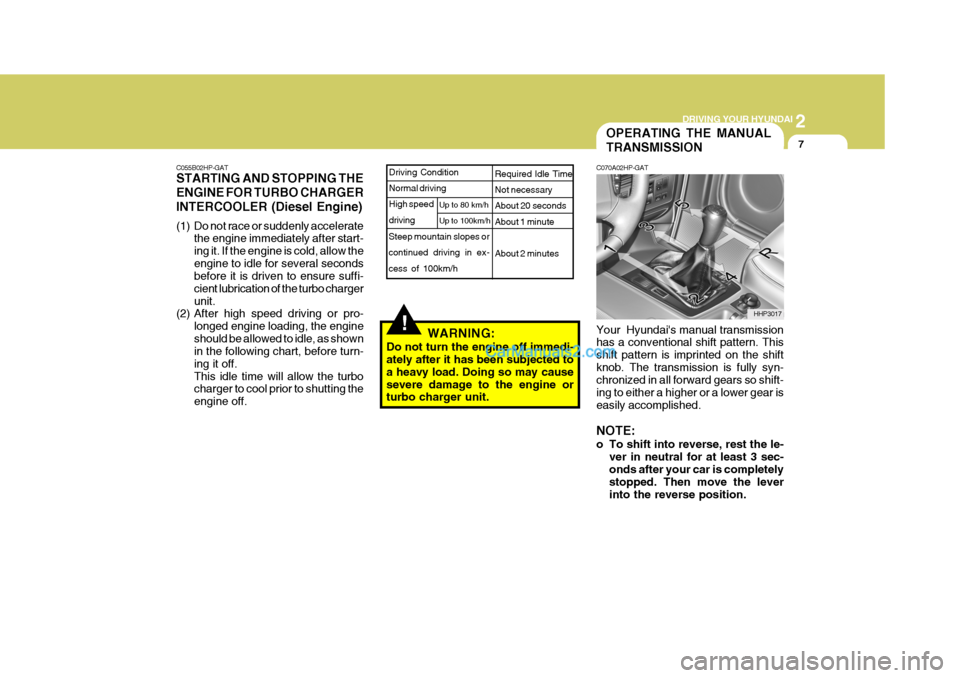
C055B02HP-GAT STARTING AND STOPPING THE ENGINE FOR TURBO CHARGERINTERCOOLER (Diesel Engine)
(1) Do not race or suddenly accelerate the engine immediately after start- ing it. If the engine is cold, allow theengine to idle for several seconds before it is driven to ensure suffi- cient lubrication of the turbo chargerunit.
(2) After high speed driving or pro-
longed engine loading, the engineshould be allowed to idle, as shown in the following chart, before turn- ing it off.This idle time will allow the turbo charger to cool prior to shutting the engine off.OPERATING THE MANUAL TRANSMISSION
!WARNING:
Do not turn the engine off immedi- ately after it has been subjected to a heavy load. Doing so may causesevere damage to the engine or turbo charger unit. Steep mountain slopes or continued driving in ex- cess of 100km/h
Required Idle Time Not necessary About 20 secondsAbout 1 minute About 2 minutes
Driving Condition Normal driving High speed driving
Up to 80 km/h Up to 100km/hC070A02HP-GAT Your Hyundai's manual transmission has a conventional shift pattern. This shift pattern is imprinted on the shiftknob. The transmission is fully syn- chronized in all forward gears so shift- ing to either a higher or a lower gear iseasily accomplished. NOTE:
o To shift into reverse, rest the le-
ver in neutral for at least 3 sec- onds after your car is completely stopped. Then move the leverinto the reverse position.
HHP3017
Page 166 of 291
2 DRIVING YOUR HYUNDAI
10
!
C090B01HP-GAT The function of each position is as follows:
o P (Park): Use to hold the vehicle in place when parked or while starting the engine. Whenever parking the car, apply theparking brake and shift the selector lever to the "P" (Park) position.
CAUTION:
Never place the selector lever in the"P" (Park) position unless the ve- hicle is fully stopped.Failure to observe this caution will cause severe damage to the trans- mission. C090C01A-AAT
o R (Reverse): Use for backing up the vehicle. Bring the car to a complete stop before shifting the selector lever to "R" posi-tion. C090D01HP-GAT
o N (Neutral): In the "N" position, the transmission is in neutral, which means that no gearsare engaged. The engine can be started with the shift lever in "N" position, although this is not recommended ex-cept if the engine stalls while the car is moving.
C090E01HP-GAT
o D (Drive): Use for normal driving. The transmis- sion will automatically shift through a four-gear sequence, giving besteconomy and power. Never down-shift manually to "2" position or "L" position when vehicle speed is more than 96km/h (60 mph).
CAUTION:
Never shift into "R" or "P" positionwhile the vehicle is moving.
NOTE: Depress the brake pedal andpush the button when shifting. Push the button when shifting. The selector lever can beshifted freely.
For optimum fuel economy, acceler- ate gradually. The transmission will automatically shift to the second, thirdand overdrive gears.
!
Page 167 of 291
2
DRIVING YOUR HYUNDAI
11
!
C090F01A-AAT
o 2 (Second gear): Use for driving on slippery road hill climbing or engine braking downhill."2" automatically shifts between 1st and 2nd gears. This means that no shift-up to 3rd gearis performed. However, the shift-up to 3rd gear is done when the car speed exceeds a certain value to prevent theengine from over-running. Manually move the selector to "D" returning to normal driving condition.
C090G01HP-GAT
o L (Low gear): Use for driving up a very steep grade or for engine braking when descendingsteep hills. When downshifting to "L", the transmission will temporarily re- main in second gear until the vehiclehas slowed enough for low gear to engage. Do not exceed 50 km/h (30 mph) in low gear."L" engages 1st gear only. However, shift-up to 2nd is performed when the vehicle exceeds a certain speed, andas the speed increases, shift-up to 3rd gear occurs to prevent over-running the engine. C090H02HP-DAT
CAUTION:
o P (Park): Use this range to park the vehicle. This range is also used when en- gine is started and warmed up.
o N (Neutral): The engine can be started in this range, but the use of "P" range isrecommended for safer start up. NOTE:
o For smooth operation, depress
the brake pedal when shifting from NEUTRAL or PARK to a for-ward or reverse gear.
o The ignition key must be in the
"ON" position and the brake pedalfully depressed in order to move the shift lever from the "P" (Park) position to any of the other posi-tions.
o It is always possible to shift from
"R", "N", "D", "2", "L" positionsto "P" position. However, the vehicle must be fully stopped to avoid transmission damage.!
C090I01HP-GAT
CAUTION:
o Shift into "R" and "P" position only when the vehicle has com- pletely stopped.
o Do not accelerate the engine in
the reverse or any of the forwardpositions with the brakes applied.
o Always apply the footbrake when
shifting from "P" or "N" to "R","D", "2" or "L" position.
Page 178 of 291
2 DRIVING YOUR HYUNDAI
22
!
C130A01HP-GAT
WARNING:
Nothing should be carried on top of the cargo area cover behind the rear seat. If there were an accident or a sudden stop, such objectscould move forward and cause dam- age to the vehicle or injure the oc- cupants.
o After being parked, check to be sure the parking brake is not engaged and that the parking brake indicator light is out before driving away.
o Driving through water may get the brakes wet. They can also get wetwhen the car is washed. Wet brakes can be dangerous! Your car will notstop as quickly if the brakes are wet. Wet brakes cause the car to pull to one side. To dry the brakes, applythe brakes lightly until the braking action returns to normal, taking care to keep the car under control at alltimes. If the braking action does not return to normal, stop as soon as it is safe to do so and call your Hyundaidealer for assistance.
GOOD BRAKING PRAC- TICES
LIMITED-SLIP DIFFEREN- TIAL (LSD)
D190A01HP-GAT (If Installed) A limited-slip differential, if equipped, is for the rear wheel differential only.The features of this limited-slip differ- ential are described below: Just as with a conventional differential,the wheel on one side is allowed to turn at a different speed from the wheel on the other side when the vehicle iscornering. The difference between the limited-slip differential and a conven- tional differential is that if the wheel onone side of the vehicle loses traction, a greater amount of torque is applied to the rear wheel on the other side toimprove traction. CAUTION:
o Never start the engine with the gearshift lever placed in the for-ward or reverse while one of therear wheels is jacked up and the other in contact with the ground; doing so may cause the vehicleto jump forward.
o Use only recommended oil for
LSD in the rear axle.See page 9-5 for the recom- mended oil descriptions.
!
Page 179 of 291
2
DRIVING YOUR HYUNDAI
23
o Don't coast down hills with the car out of gear. This is extremely haz- ardous. Keep the car in gear at all times, use the brakes to slow down, then shift to a lower gear so thatengine braking will help you main- tain a safe speed.
o Don't "ride" the brake pedal. Rest- ing your foot on the brake pedalwhile driving can be dangerous be- cause it can result in the brakesoverheating and losing their effec- tiveness. It also increases the wear of thebrake components.
o If a tire goes flat while you are
driving, apply the brakes gently andkeep the car pointed straight ahead while you slow down. When you are moving slowly enough for it to besafe to do so, pull off the road and stop in a safe place.
o If your car is equipped with an auto- matic transmission, don't let yourcar creep forward. To avoid creep- ing forward, keep your foot firmly onthe brake pedal when the car is stopped.
o Use caution when parking on a hill. Engage the parking brake and place the gear selector lever in "P" (auto- matic transmission) or in first orreverse gear (manual transmission). If your car is facing downhill, turn the front wheels into the curb to helpkeep the car from rolling. If your car is facing uphill, turn the front wheels away from the curb to help keep thecar from rolling. If there is no curb or if it is required by other conditions to keep the car from rolling, block thewheels.
o Under some conditions your park-
ing brake can freeze in the engagedposition. This is most likely to hap- pen when there is an accumulation of snow or ice around or near therear brakes or if the brakes are wet. If there is a risk that the parking brake may freeze, apply it only tem-porarily while you put the gear se- lector lever in "P" (automatic) or in first or reverse gear (manual trans-mission) and block the rear wheels so the car cannot roll. Then release the parking brake.
o Do not hold the vehicle on the up- grade with the accelerator pedal.This can cause the transmission tooverheat. Always use the brake pedal or parking brake.DRIVING FOR ECONOMY
C140A02A-AAT You can save fuel and get more miles from your car if you follow these sug- gestions:
o Drive smoothly. Accelerate at a moderate rate. Don't make "jack- rabbit" starts or full-throttle shiftsand maintain a steady cruising speed. Don't race between stop- lights. Try to adjust your speed tothat of the other traffic so you don't have to change speeds unneces- sarily. Avoid heavy traffic wheneverpossible. Always maintain a safe distance from other vehicles so you can avoid unnecessary braking. Thisalso reduces brake wear.
o Drive at a moderate speed. The
faster you drive, the more fuel yourcar uses. Driving at a moderate speed, especially on the highway, is one of the most effective ways toreduce fuel consumption.
Page 188 of 291
2 DRIVING YOUR HYUNDAI
32
!
CAUTION:
If overheating should occur when towing, (temperature gauge readsnear red zone), taking the following action may reduce or eliminate the problem.
1. Turn off the air conditioner.
2. Reduce highway speed.
3. Select a lower gear when going uphill.
4. While in stop and go traffic, place
the gear selector in park or neu- tral and idle the engine at a higher speed.
11. Avoid jerky starts, sudden accel-
eration or sudden stops.
12. Avoid sharp turns and rapid lane changes.
13. Avoid holding the brake pedal down too long or too frequently. This could cause the brakes to over- heat, resulting in reduced brakingefficiency.
14. When going down a hill, shift into a
lower gear and use the engine brak-ing effect. When ascending a long grade, downshift the transmission to a lower gear and reduce speedto reduce chances of engine over- loading and/or overheating.
15. If you have to stop while going uphill, do not hold the vehicle inplace by pressing on the accelera- tor. This can cause the automatictransmission to overheat. Use the parking brake or footbrake.
NOTE: When towing, check transmission fluid more frequently.
Page 192 of 291
3 WHAT TO DO IN AN EMERGENCY
4IF THE ENGINE OVERHEATS
!
5. Start the engine in the car with the
discharged battery using the nor- mal starting procedure. After the engine starts, leave the jumper cables connected and let the enginerun at fast idle or about 2000 rpm for several minutes.
6. Carefully remove the jumper cables in the reverse order of attachment.
If you do not know why your battery became discharged (because the lights were left on, etc.), have the charging system checked by your Hyundaidealer. D030A02HP-AAT If your temperature gauge indicates overheating, you experience a loss of power, or hear loud pinging or knock- ing, the engine is probably too hot. Ifthis happens to you, you should:
1. Pull off the road and stop as soon as
it is safe to do so.
2. Place the gear selector lever in "P"
(automatic), or neutral (manual transmission) and set the parking brake. If the air conditioning is on, turn it off.
3. If engine coolant is running out un- der the car or steam is coming outfrom under the hood, stop the en-gine. Do not open the hood until the engine coolant has stopped running or the steaming has stopped. If thereis no visible loss of coolant and no steam, leave the engine running and check to be sure the enginecooling fan is operating. If the fan is not running, turn the engine off. 4. Check to see if the water pump drive
belt is missing. If it is not missing, check to see that it is tight. If the drive belt seems to be satisfactory, check for engine coolant leakingfrom the radiator, hoses or under the car. (If the air conditioning had been in use, it is normal for coldwater to be draining from it when you stop).
WARNING:
While the engine is running, keephands and clothing away from mov- ing parts such as the fan and drivebelts to prevent injury.
Page 253 of 291
6 DO-IT-YOURSELF MAINTENANCE
30
To check the power steering fluid level, be sure the ignition is "OFF", thencheck to make certain that the power steering fluid level is between the "MAX" and "MIN" level markings onthe fluid reservoir. NOTE: Grinding noise from the power steer- ing pump may be heard immedi- ately after the engine is started inextremely cold conditions (below - 20°C). If the noise stops during warm up, there is no abnormal function inthe system. If is due to a power steering fluid characteristic in ex- tremely cold conditions. Recommended Fluid Use PSF-3 type fluid. NOTE: Do not start the engine when the power steering oil reservoir is empty.
FUEL FILTER
G240A01A-AAT
POWER STEERING HOSES
It is suggested that you check the
power steering hose connections for fluid leakage at regular intervals. The power steering hoses should be re-placed if there is severe surface crack- ing, pulling, scuffing or worn spots. Deterioration of the hose could causepremature failure. G350A02HP-GAT
Bleeding the Fuel System (For Diesel Engine (2.5 TCI))
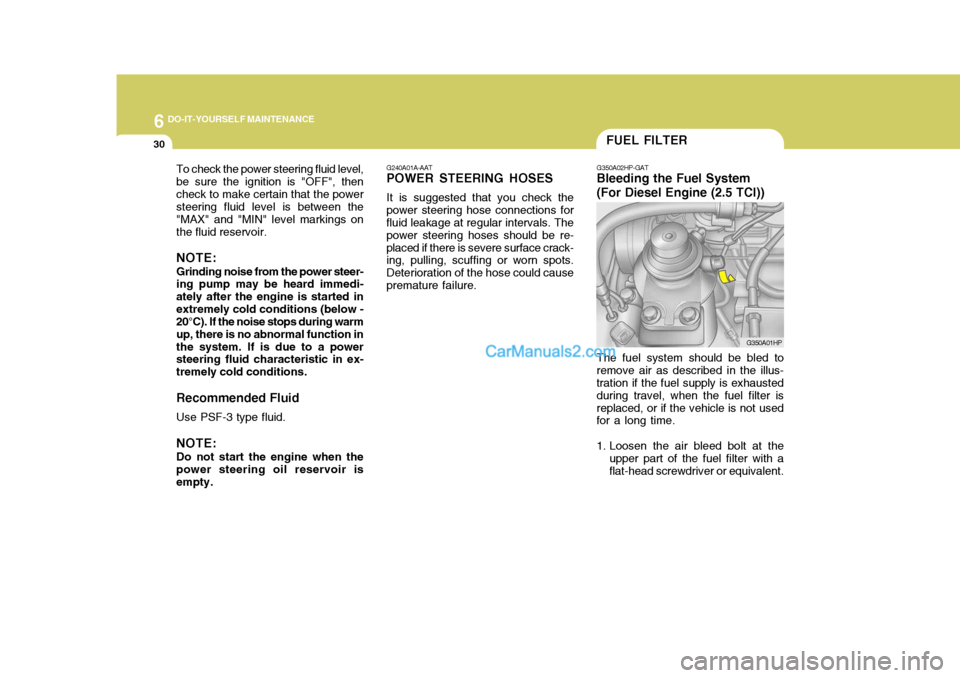
The fuel system should be bled to
remove air as described in the illus- tration if the fuel supply is exhausted during travel, when the fuel filter isreplaced, or if the vehicle is not used for a long time.
1. Loosen the air bleed bolt at the upper part of the fuel filter with a flat-head screwdriver or equivalent. G350A01HP
Page 266 of 291
6
DO-IT-YOURSELF MAINTENANCE
43
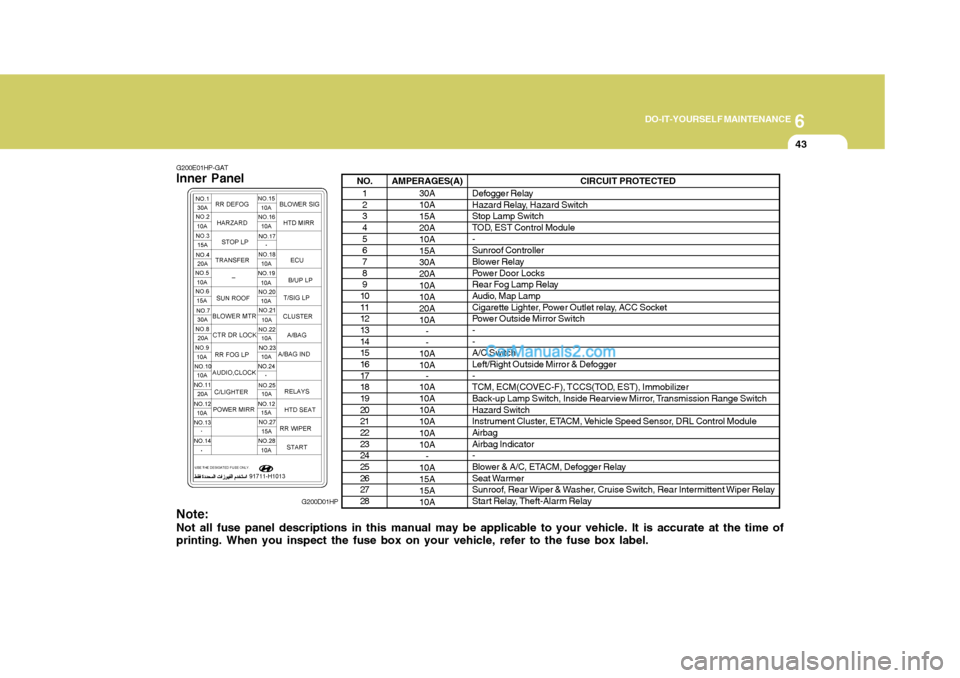
NO. 1 2 34 5 67 8 9
10 11 1213 14 1516 17 1819 20 2122 23 2425 26 2728 AMPERAGES(A)
30A 10A 15A 20A10A15A30A20A 10A 10A20A10A- -
10A 10A -
10A10A10A10A 10A 10A
-
10A15A15A 10A CIRCUIT PROTECTED
Defogger Relay
Hazard Relay, Hazard Switch Stop Lamp Switch
TOD, EST Control Module - Sunroof Controller
Blower Relay
Power Door Locks
Rear Fog Lamp Relay
Audio, Map Lamp
Cigarette Lighter, Power Outlet relay, ACC Socket
Power Outside Mirror Switch- - A/C Switch
Left/Right Outside Mirror & Defogger -
TCM, ECM(COVEC-F), TCCS(TOD, EST), Immobilizer
Back-up Lamp Switch, Inside Rearview Mirror, Transmission Range Switch Hazard Switch
Instrument Cluster, ETACM, Vehicle Speed Sensor, DRL Control ModuleAirbag Airbag Indicator -
Blower & A/C, ETACM, Defogger Relay
Seat Warmer
Sunroof, Rear Wiper & Washer, Cruise Switch, Rear Intermittent Wiper Relay
Start Relay, Theft-Alarm Relay
G200E01HP-GAT
Inner Panel
Note: Not all fuse panel descriptions in this manual may be applicable to your vehicle. It is accurate at the time of printing. When you inspect the fuse box on your vehicle, refer to the fuse box label. G200D01HP
Page 269 of 291
7
EMISSION CONTROL SYSTEMS
3
!
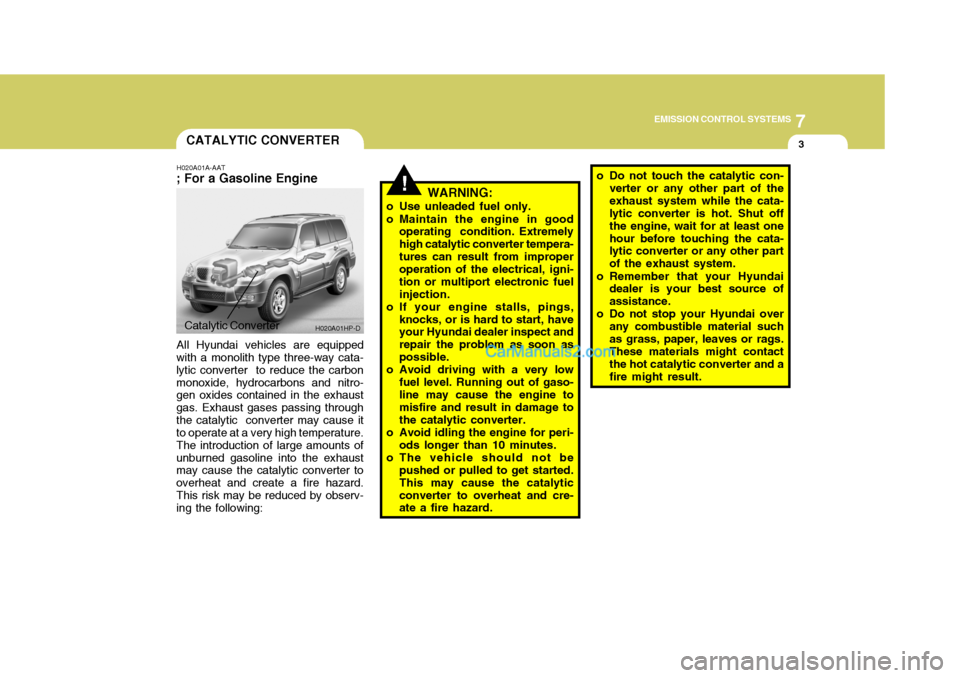
CATALYTIC CONVERTER
H020A01A-AAT
; For a Gasoline Engine
All Hyundai vehicles are equipped
with a monolith type three-way cata- lytic converter to reduce the carbonmonoxide, hydrocarbons and nitro- gen oxides contained in the exhaust gas. Exhaust gases passing throughthe catalytic converter may cause it to operate at a very high temperature. The introduction of large amounts ofunburned gasoline into the exhaust may cause the catalytic converter to overheat and create a fire hazard.This risk may be reduced by observ- ing the following: WARNING:
o Use unleaded fuel only.
o Maintain the engine in good operating condition. Extremely high catalytic converter tempera-tures can result from improper operation of the electrical, igni- tion or multiport electronic fuelinjection.
o If your engine stalls, pings, knocks, or is hard to start, have your Hyundai dealer inspect and repair the problem as soon aspossible.
o Avoid driving with a very low
fuel level. Running out of gaso-line may cause the engine to misfire and result in damage to the catalytic converter.
o Avoid idling the engine for peri-
ods longer than 10 minutes.
o The vehicle should not be pushed or pulled to get started.This may cause the catalyticconverter to overheat and cre- ate a fire hazard.
Catalytic Converter
o Do not touch the catalytic con-
verter or any other part of the exhaust system while the cata- lytic converter is hot. Shut off the engine, wait for at least onehour before touching the cata- lytic converter or any other part of the exhaust system.
o Remember that your Hyundai dealer is your best source ofassistance.
o Do not stop your Hyundai over any combustible material suchas grass, paper, leaves or rags. These materials might contact the hot catalytic converter and afire might result.
H020A01HP-D