belt Hyundai Tiburon 2003 User Guide
[x] Cancel search | Manufacturer: HYUNDAI, Model Year: 2003, Model line: Tiburon, Model: Hyundai Tiburon 2003Pages: 169, PDF Size: 3.04 MB
Page 24 of 169
FEATURES OF YOUR HYUNDAI
1- 16
B230D01GK-AAT
Securing the Child Restraint Seat with
the "ISOFIX" System
B230F01GK
Some child seat manufacturers make child re-
straint seats that are labeled as ISOFIX or
ISOFIX-compatible child restraint seats. These
seats include two rigid or webbing mounted
attachments that connect to two ISOFIX an-
chors at specific seating positions in your ve-
hicle. This type of child restraint seat eliminates
the need to use seat belts to attach the child
seat for forward-facing child restraint seats.
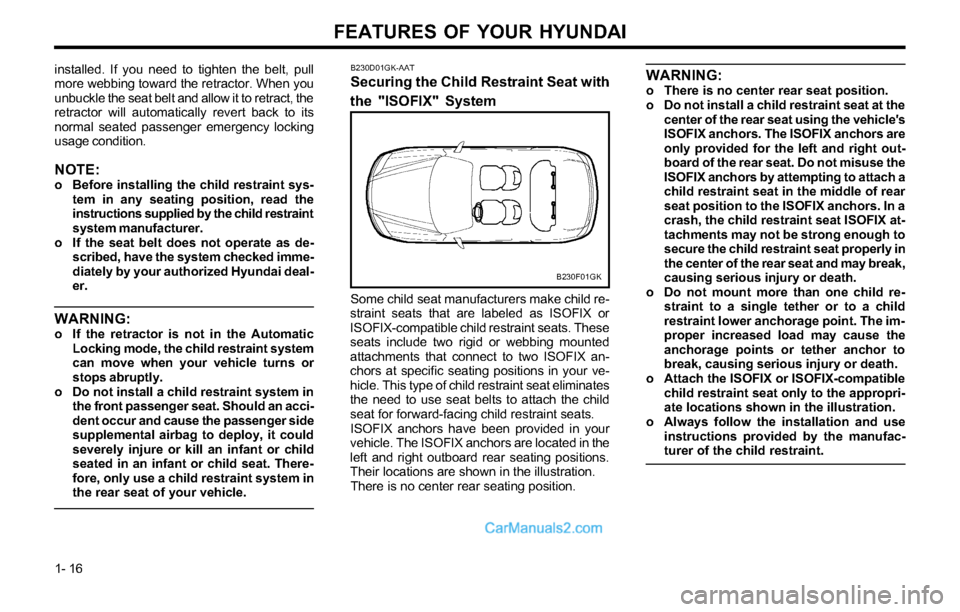
ISOFIX anchors have been provided in your
vehicle. The ISOFIX anchors are located in the
left and right outboard rear seating positions.
Their locations are shown in the illustration.
There is no center rear seating position.
WARNING:o There is no center rear seat position.
o Do not install a child restraint seat at the
center of the rear seat using the vehicle's
ISOFIX anchors. The ISOFIX anchors are
only provided for the left and right out-
board of the rear seat. Do not misuse the
ISOFIX anchors by attempting to attach a
child restraint seat in the middle of rear
seat position to the ISOFIX anchors. In a
crash, the child restraint seat ISOFIX at-
tachments may not be strong enough to
secure the child restraint seat properly in
the center of the rear seat and may break,
causing serious injury or death.
o Do not mount more than one child re-
straint to a single tether or to a child
restraint lower anchorage point. The im-
proper increased load may cause the
anchorage points or tether anchor to
break, causing serious injury or death.
o Attach the ISOFIX or ISOFIX-compatible
child restraint seat only to the appropri-
ate locations shown in the illustration.
o Always follow the installation and use
instructions provided by the manufac-
turer of the child restraint.
installed. If you need to tighten the belt, pull
more webbing toward the retractor. When you
unbuckle the seat belt and allow it to retract, the
retractor will automatically revert back to its
normal seated passenger emergency locking
usage condition.
NOTE:o Before installing the child restraint sys-
tem in any seating position, read the
instructions supplied by the child restraint
system manufacturer.
o If the seat belt does not operate as de-
scribed, have the system checked imme-
diately by your authorized Hyundai deal-
er.
WARNING:o If the retractor is not in the Automatic
Locking mode, the child restraint system
can move when your vehicle turns or
stops abruptly.
o Do not install a child restraint system in
the front passenger seat. Should an acci-
dent occur and cause the passenger side
supplemental airbag to deploy, it could
severely injure or kill an infant or child
seated in an infant or child seat. There-
fore, only use a child restraint system in
the rear seat of your vehicle.
Page 25 of 169
FEATURES OF YOUR HYUNDAI
1- 17
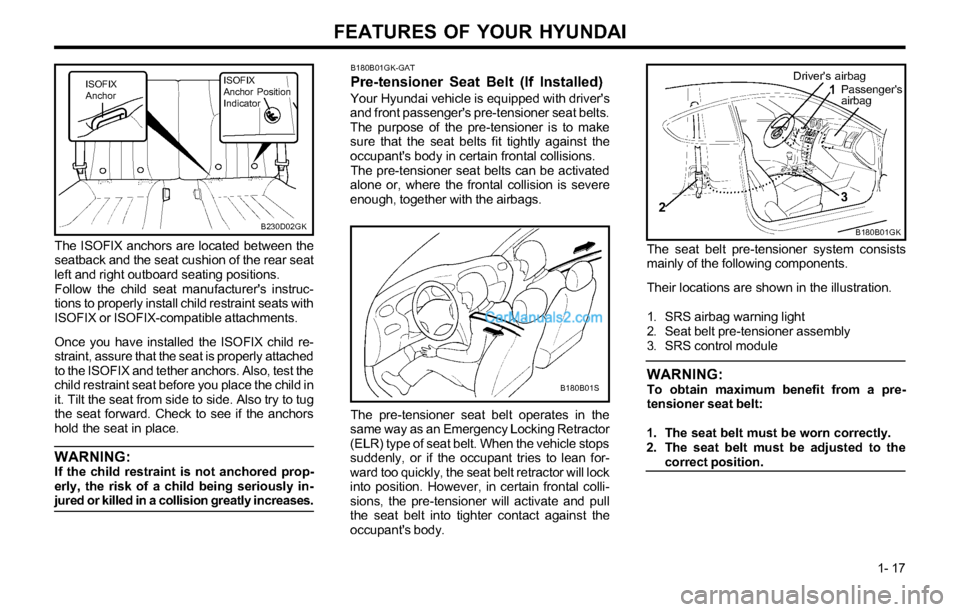
The ISOFIX anchors are located between the
seatback and the seat cushion of the rear seat
left and right outboard seating positions.
Follow the child seat manufacturer's instruc-
tions to properly install child restraint seats with
ISOFIX or ISOFIX-compatible attachments.
Once you have installed the ISOFIX child re-
straint, assure that the seat is properly attached
to the ISOFIX and tether anchors. Also, test the
child restraint seat before you place the child in
it. Tilt the seat from side to side. Also try to tug
the seat forward. Check to see if the anchors
hold the seat in place.
WARNING:If the child restraint is not anchored prop-
erly, the risk of a child being seriously in-
jured or killed in a collision greatly increases.
B230D02GK
B180B01GK-GAT
Pre-tensioner Seat Belt (If Installed)
Your Hyundai vehicle is equipped with driver's
and front passenger's pre-tensioner seat belts.
The purpose of the pre-tensioner is to make
sure that the seat belts fit tightly against the
occupant's body in certain frontal collisions.
The pre-tensioner seat belts can be activated
alone or, where the frontal collision is severe
enough, together with the airbags.
B180B01S
The pre-tensioner seat belt operates in the
same way as an Emergency Locking Retractor
(ELR) type of seat belt. When the vehicle stops
suddenly, or if the occupant tries to lean for-
ward too quickly, the seat belt retractor will lock
into position. However, in certain frontal colli-
sions, the pre-tensioner will activate and pull
the seat belt into tighter contact against the
occupant's body.
B180B01GK
Driver's airbag1
23Passenger's
airbag
The seat belt pre-tensioner system consists
mainly of the following components.
Their locations are shown in the illustration.
1. SRS airbag warning light
2. Seat belt pre-tensioner assembly
3. SRS control module
WARNING:To obtain maximum benefit from a pre-
tensioner seat belt:
1. The seat belt must be worn correctly.
2. The seat belt must be adjusted to the
correct position.
ISOFIX
AnchorISOFIX
Anchor Position
Indicator
Page 26 of 169
FEATURES OF YOUR HYUNDAI
1- 18
B240A01GK-GAT
SUPPLEMENTAL RESTRAINT
(AIRBAG) SYSTEM (SRS) (If Installed)
Your Hyundai is equipped with a Supplemental
Restraint (Airbag) System. The indications of
the system's presence are the letters "SRS AIR
BAG" embossed on the ornament in the steer-
ing wheel and the passenger's side front panel
pad above the glove box.
The Hyundai SRS consists of airbags installed
under the pad covers in the center of the
steering wheel and the passenger's side front
panel above the glove box. The purpose of the
SRS is to provide the vehicle's driver and/or the
front passenger with additional protection than
that offered by the seat belt system alone, in
case of a frontal impact of sufficient severity.
NOTE:o Both the driver's and front passenger's
pre-tensioner seat belts will be activated
in certain frontal collisions. The pre-
tensioner seat belts can be activated alone
or, where the frontal collision is severe
enough, together with the airbags.
o When the pre-tensioner seat belts are
activated, a loud noise may be heard and
fine dust, which may appear to be smoke,
may be visible in the passenger compart-
ment. These are normal operating condi-
tions and are not hazardous.
o Although it is harmless, the fine dust
may cause skin irritation and should not
be breathed for prolonged periods. Wash
your hands and face thoroughly after an
accident in which the pre-tensioner seat
belts were activated.
CAUTION:o The control module that activates the
SRS airbag controls the pre-tensioner
seat belt also.
o If there is some malfunction in the pre-
tensioner seat belt circuit, the warning
light will illuminate even if there is no
malfunction in the SRS airbag system. If
the SRS airbag warning light does not
illuminate or illuminates continuously
when the ignition key is turned to "ON",
or if it remains illuminated after blinking
for approximately 6 seconds, or if it illu-
minates while the vehicle is being driven,please have an authorized Hyundai deal-
er inspect the pre-tensioner seat belt or
SRS airbag system as soon as possible.
WARNING:o Pre-tensioners are designed to operate
only one time. After activation, pre-
tensioner seat belts must be replaced.
All seat belts, of any type, should always
be replaced after they have been worn
during a collision.
o The pre-tensioner seat belt assembly
mechanisms become hot during activa-
tion. Do not touch the pre-tensioner seat
belt assemblies for several minutes after
they have been activated.
o Do not attempt to inspect or replace the
pre-tensioner seat belts yourself. This
must be done by an authorized Hyundai
dealer.
o Do not strike the pre-tensioner seat belt
assemblies.
o Do not attempt to service or repair the
pre-tensioner seat belt system in any
manner.
o Improper handling of the pre-tensioner
seat belt assemblies, and failure to heed
the warnings to not strike, modify, in-
spect, replace, service or repair the pre-
tensioner seat belt assemblies may lead
to improper operation or inadvertent ac-
tivation and serious injury.
o Always wear the seat belts when driving
or riding in a motor vehicle.
B240A01GK
Page 27 of 169
FEATURES OF YOUR HYUNDAI
1- 19
NOTE:Be sure to read information about the SRS
on the labels provided on the backside of
the sun visor and in the glove box.
WARNING:o As its name implies, the SRS is designed
to work with, and be supplemental to, the
driver's and the passenger's three point
seat belt systems and is not a substitute
for them. Therefore, your seat belts must
be worn at all times while the vehicle is in
motion. The airbags deploy only in cer-
tain frontal impact conditions severe
enough to cause significant injury to the
vehicle occupants.
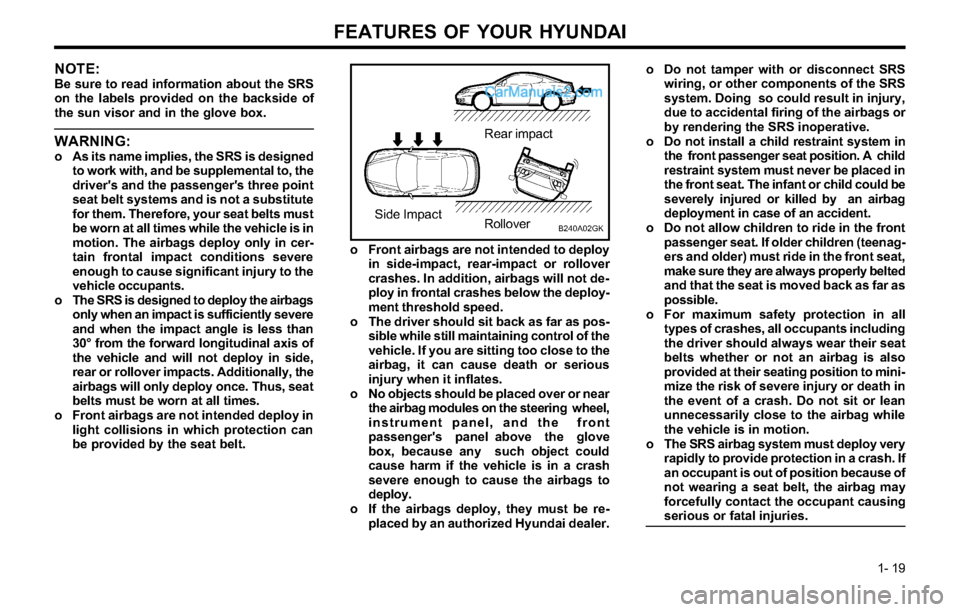
o The SRS is designed to deploy the airbags
only when an impact is sufficiently severe
and when the impact angle is less than
30° from the forward longitudinal axis of
the vehicle and will not deploy in side,
rear or rollover impacts. Additionally, the
airbags will only deploy once. Thus, seat
belts must be worn at all times.
o Front airbags are not intended deploy in
light collisions in which protection can
be provided by the seat belt.
o Front airbags are not intended to deploy
in side-impact, rear-impact or rollover
crashes. In addition, airbags will not de-
ploy in frontal crashes below the deploy-
ment threshold speed.
o The driver should sit back as far as pos-
sible while still maintaining control of the
vehicle. If you are sitting too close to the
airbag, it can cause death or serious
injury when it inflates.
o No objects should be placed over or near
the airbag modules on the steering wheel,
instrument panel, and the front
passenger's panel above the glove
box, because any such object could
cause harm if the vehicle is in a crash
severe enough to cause the airbags to
deploy.
o If the airbags deploy, they must be re-
placed by an authorized Hyundai dealer.
B240A02GK
Rear impact
Side Impact
Rollovero Do not tamper with or disconnect SRS
wiring, or other components of the SRS
system. Doing so could result in injury,
due to accidental firing of the airbags or
by rendering the SRS inoperative.
o Do not install a child restraint system in
the front passenger seat position. A child
restraint system must never be placed in
the front seat. The infant or child could be
severely injured or killed by an airbag
deployment in case of an accident.
o Do not allow children to ride in the front
passenger seat. If older children (teenag-
ers and older) must ride in the front seat,
make sure they are always properly belted
and that the seat is moved back as far as
possible.
o For maximum safety protection in all
types of crashes, all occupants including
the driver should always wear their seat
belts whether or not an airbag is also
provided at their seating position to mini-
mize the risk of severe injury or death in
the event of a crash. Do not sit or lean
unnecessarily close to the airbag while
the vehicle is in motion.
o The SRS airbag system must deploy very
rapidly to provide protection in a crash. If
an occupant is out of position because of
not wearing a seat belt, the airbag may
forcefully contact the occupant causing
serious or fatal injuries.
Page 29 of 169
FEATURES OF YOUR HYUNDAI
1- 21
WARNING:o When the SRS is activated, there may be
a loud noise and fine dust will be re-
leased throughout the vehicle. These
conditions are normal and are not haz-
ardous. However, the fine dust generat-
ed during airbag deployment may cause
skin irritation. Be sure to wash your hands
and face thoroughly with lukewarm wa-
ter and a mild soap after an accident in
which the airbags were deployed.
o The SRS can function only when the
ignition key is in the "ON" position. If the
SRS SRI does not come on or illumi-
nates continuously when the ignition key
is turned to "ON", or continuously re-
mains on after flashing for about 6 sec-
onds when the ignition key is turned to
the "ON" position, or after the engine is
started, or comes on while driving, the
SRS is not working properly. If this oc-
curs, have your vehicle immediately in-
spected by your Hyundai dealer.
o Before you replace a fuse or disconnect
a battery terminal, turn the ignition key to
the "LOCK" position or remove the igni-
tion key. Never remove or replace the air
bag related fuse(s) when the ignition key
is in the "ON" position. Failure to heed
this warning will cause the SRS SRI to
illuminate.
FUA1115A
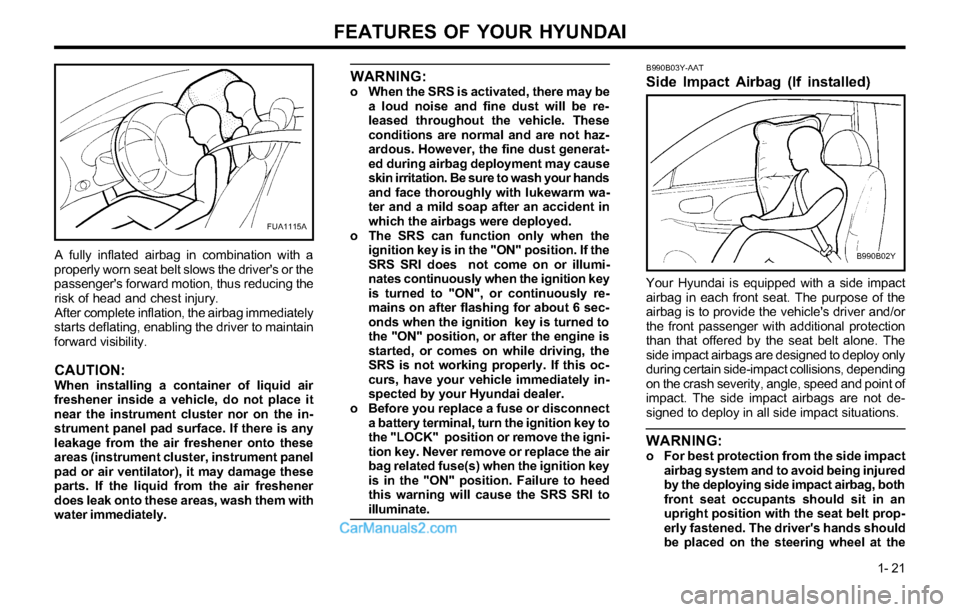
A fully inflated airbag in combination with a
properly worn seat belt slows the driver's or the
passenger's forward motion, thus reducing the
risk of head and chest injury.
After complete inflation, the airbag immediately
starts deflating, enabling the driver to maintain
forward visibility.
CAUTION:When installing a container of liquid air
freshener inside a vehicle, do not place it
near the instrument cluster nor on the in-
strument panel pad surface. If there is any
leakage from the air freshener onto these
areas (instrument cluster, instrument panel
pad or air ventilator), it may damage these
parts. If the liquid from the air freshener
does leak onto these areas, wash them with
water immediately.Your Hyundai is equipped with a side impact
airbag in each front seat. The purpose of the
airbag is to provide the vehicle's driver and/or
the front passenger with additional protection
than that offered by the seat belt alone. The
side impact airbags are designed to deploy only
during certain side-impact collisions, depending
on the crash severity, angle, speed and point of
impact. The side impact airbags are not de-
signed to deploy in all side impact situations.
WARNING:o For best protection from the side impact
airbag system and to avoid being injured
by the deploying side impact airbag, both
front seat occupants should sit in an
upright position with the seat belt prop-
erly fastened. The driver's hands should
be placed on the steering wheel at the
B990B03Y-AAT
Side Impact Airbag (If installed)
B990B02Y
Page 33 of 169
FEATURES OF YOUR HYUNDAI
1- 25
HGK026B B260A01GK-AAT
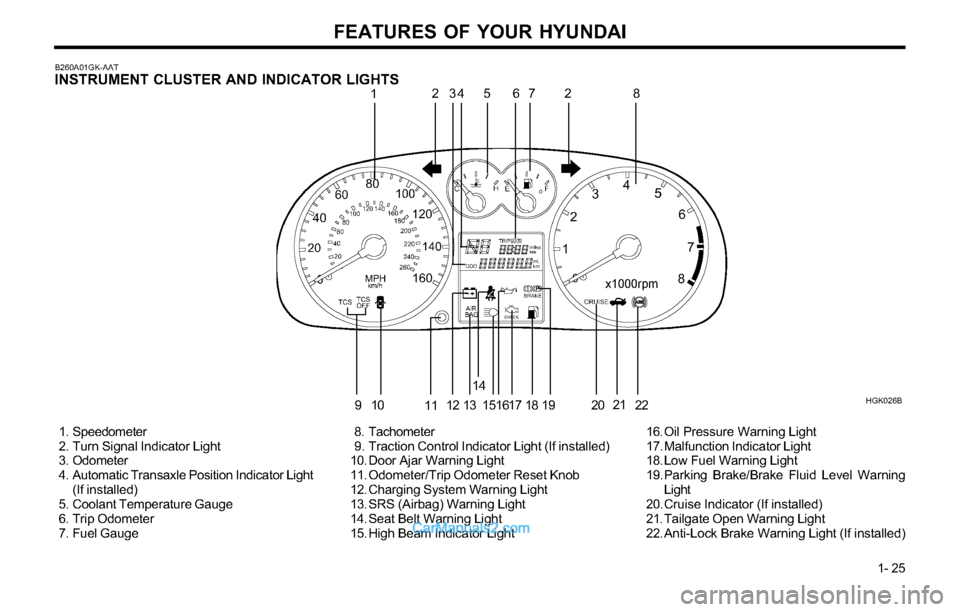
INSTRUMENT CLUSTER AND INDICATOR LIGHTS1234 5 678
910
1112 1314
151617 18 19 2021
1. Speedometer
2. Turn Signal Indicator Light
3. Odometer
4. Automatic Transaxle Position Indicator Light
(If installed)
5. Coolant Temperature Gauge
6. Trip Odometer
7. Fuel Gauge 8. Tachometer
9. Traction Control Indicator Light (If installed)
10. Door Ajar Warning Light
11. Odometer/Trip Odometer Reset Knob
12. Charging System Warning Light
13. SRS (Airbag) Warning Light
14. Seat Belt Warning Light
15. High Beam Indicator Light16. Oil Pressure Warning Light
17. Malfunction Indicator Light
18. Low Fuel Warning Light
19. Parking Brake/Brake Fluid Level Warning
Light
20. Cruise Indicator (If installed)
21. Tailgate Open Warning Light
22. Anti-Lock Brake Warning Light (If installed) 2
22
Page 35 of 169
FEATURES OF YOUR HYUNDAI
1- 27
B260M01A-AATLow Fuel Level Warning Light
The low fuel level warning light comes on when
the fuel tank is approaching empty. When it
comes on, you should add fuel as soon as
possible. Driving with the fuel level warning light
on or with the fuel level below "E" can cause the
engine to misfire and damage the catalytic
converter.
B260J01A-AATCharging System Warning Light
The charging system warning light should come
on when the ignition is turned on, then go out
when the engine is running. If the light stays on
while the engine is running, there is a malfunc-
tion in the electrical charging system. If the light
comes on while you are driving, stop, turn off
the engine and check under the hood. First,
make certain the generator drive belt is in
place. If it is, check the tension of the belt. Do
this as shown on page 6-13 by pushing down
on the center of the belt. And then have the
system checked by your Hyundai dealer.
B260K01F-AATTail Gate Open Warning Light
This light remains on unless the tail gate is
completely closed.
B260L01Y-AATDoor Ajar Warning Light
and Chime
The door ajar warning light warns you that a
door is not completely closed and the chime
warns you that driver's side front door is not
completely closed.
NOTE:To remind you not to lock the key inside the
car, the warning light comes on whenever
the key is in the "LOCK" position and a door
is open. The warning chime only sounds
whenever the key is in the "LOCK" position
and the driver's side front door is open. The
chime sounds and the light remains on until
the key is removed from the ignition.
B260H01GK-AAT
Parking Brake/Brake Fluid
Level Warning Light
WARNING:
If you suspect brake trouble, have your
brakes checked by a Hyundai dealer as soon
as possible. Driving your car with a problem
in either the brake electrical system or brake
hydraulic system is dangerous, and could
result in a serious injury or death.
Warning Light Operation
The parking brake/brake fluid level warning light
should come on when the parking brake is ap-
plied and the ignition switch is turned to "ON" or
"START". After the engine is started, the light
should go out in three seconds.
If the parking brake is not applied, the warning
light should come on when the ignition switch is
turned to "ON" or "START", then go out in three
seconds. If the light comes on at any other time,
you should slow the vehicle and bring it to a
complete stop in a safe location off the roadway.
The brake warning light indicates that the brake
fluid level in the brake master cylinder is low and
hydraulic brake fluid conforming to DOT 3 or
DOT 4 specifications should be added. After
adding fluid, if no other trouble is found, the car
should be immediately and carefully driven to a
Hyundai dealer for inspection. If further trouble is
experienced, the vehicle should not be driven at
all but taken to a dealer by a professional towing
service or some other safe method.Your Hyundai is equipped with dual-diagonal
braking systems. This means you still have brak-
ing on two wheels even if one of the dual systems
should fail. With only one of the dual systems
working, more than normal pedal travel and
greater pedal pressure are required to stop the
car. Also, the car will not stop in as short a
distance with only half of the brake system work-
ing. If the brakes fail while you are driving, shift to
a lower gear for additional engine braking and
stop the car as soon as it is safe to do so.
Page 36 of 169
FEATURES OF YOUR HYUNDAI
1- 28
B260E01A-AATSeat Belt Reminder Light
And Chime
The seat belt reminder light comes on for about
6 seconds when the ignition key is turned from
the "OFF" position to "ON" or "START". If the
driver's seat belt is not fastened, the warning
chime will sound at the same time.
B270A01A-AAT
BRAKE PAD WEAR WARNING
SOUND
The front disc brake pads have wear indicators
that should make a high-pitched squealing or
scraping noise when new pads are needed.
The sound may come and go or be heard all the
time when the vehicle is moving. It may also be
heard when the brake pedal is pushed down
firmly. Excessive rotor damage will result if the
worn pads are not replaced. See your Hyundai
dealer immediately.
B260Q01E-GAT
Cruise Indicator (If Installed)
The cruise indicator light in the instrument clus-
ter is illuminated when the cruise control main
switch on the end of the barrel is pushed.
The indicator light does not illuminate when the
cruise control main switch is pushed a second
time.
Information about the use of cruise control is
beginning on page 1-44.
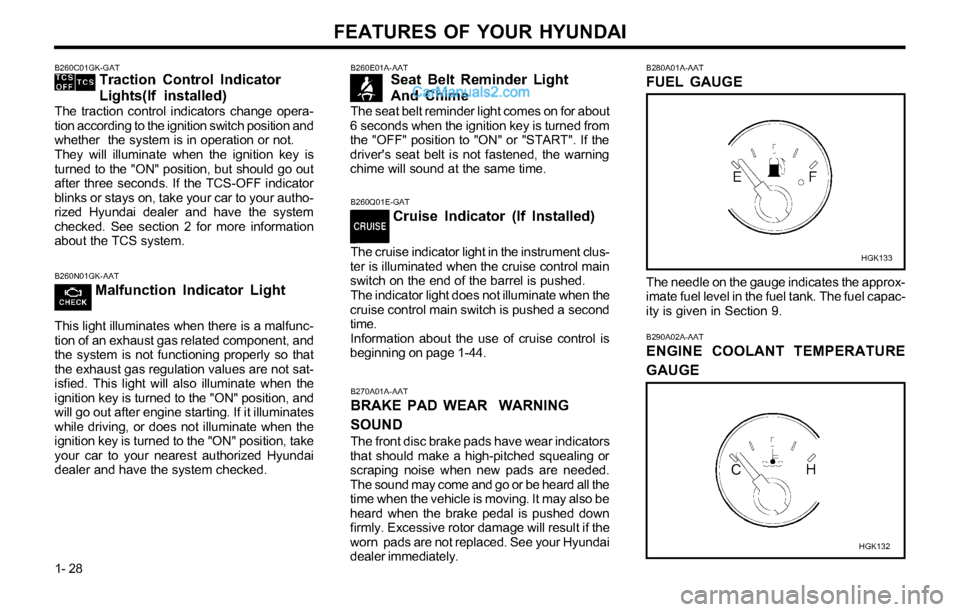
B280A01A-AAT
FUEL GAUGE
The needle on the gauge indicates the approx-
imate fuel level in the fuel tank. The fuel capac-
ity is given in Section 9.
HGK133
B290A02A-AAT
ENGINE COOLANT TEMPERATURE
GAUGE
HGK132
B260C01GK-GATTraction Control Indicator
Lights(If installed)
The traction control indicators change opera-
tion according to the ignition switch position and
whether the system is in operation or not.
They will illuminate when the ignition key is
turned to the "ON" position, but should go out
after three seconds. If the TCS-OFF indicator
blinks or stays on, take your car to your autho-
rized Hyundai dealer and have the system
checked. See section 2 for more information
about the TCS system.
B260N01GK-AAT
Malfunction Indicator Light
This light illuminates when there is a malfunc-
tion of an exhaust gas related component, and
the system is not functioning properly so that
the exhaust gas regulation values are not sat-
isfied. This light will also illuminate when the
ignition key is turned to the "ON" position, and
will go out after engine starting. If it illuminates
while driving, or does not illuminate when the
ignition key is turned to the "ON" position, take
your car to your nearest authorized Hyundai
dealer and have the system checked.
Page 37 of 169
FEATURES OF YOUR HYUNDAI
1- 29
B300A01A-AAT
SPEEDOMETER
HGK130B
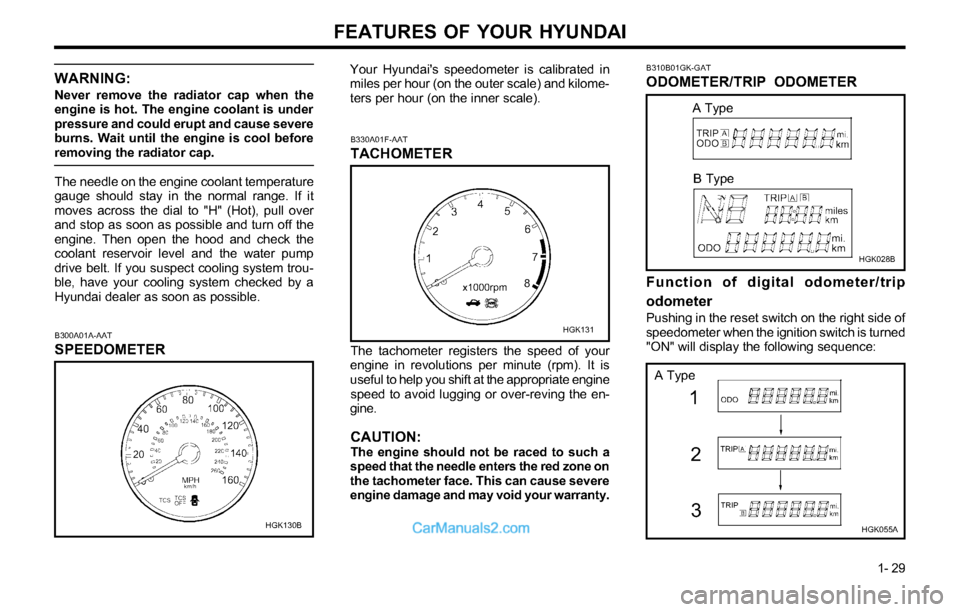
Your Hyundai's speedometer is calibrated in
miles per hour (on the outer scale) and kilome-
ters per hour (on the inner scale).
B330A01F-AAT
TACHOMETER
The tachometer registers the speed of your
engine in revolutions per minute (rpm). It is
useful to help you shift at the appropriate engine
speed to avoid lugging or over-reving the en-
gine.
CAUTION:The engine should not be raced to such a
speed that the needle enters the red zone on
the tachometer face. This can cause severe
engine damage and may void your warranty.
HGK131
WARNING:
Never remove the radiator cap when the
engine is hot. The engine coolant is under
pressure and could erupt and cause severe
burns. Wait until the engine is cool before
removing the radiator cap.
The needle on the engine coolant temperature
gauge should stay in the normal range. If it
moves across the dial to "H" (Hot), pull over
and stop as soon as possible and turn off the
engine. Then open the hood and check the
coolant reservoir level and the water pump
drive belt. If you suspect cooling system trou-
ble, have your cooling system checked by a
Hyundai dealer as soon as possible.
B310B01GK-GAT
ODOMETER/TRIP ODOMETER
HGK028B
Function of digital odometer/trip
odometer
Pushing in the reset switch on the right side of
speedometer when the ignition switch is turned
"ON" will display the following sequence:
HGK055A
1
3 2
A Type
B Type
A Type
Page 97 of 169
DRIVING YOUR HYUNDAI
2- 2
C020A01A-AATBEFORE STARTING THE ENGINE
Before you start the engine, you should always:
1. Look around the vehicle to be sure there are
no flat tires, puddles of oil, water or other
indications of possible trouble.
2. After entering the car, check to be sure the
parking brake is engaged.
3. Check that all windows, and lights are clean.
4. Check that the interior and exterior mirrors
are clean and in position.
5. Check your seat, seatback and headrest to
be sure they are in their proper positions.
6. Lock all the doors.
7. Fasten your seat belt and be sure that all
other occupants have fastened theirs.
8. Turn off all lights and accessories that are
not needed.
9. When you turn the ignition switch to “ON”,
check that all appropriate warning lights are
operating and that you have sufficient fuel.
10. Check the operation of warning lights and all
bulbs when key is in the “ON” position.o To start the engine, insert the ignition key
and turn it to the "START" position. Release
it as soon as the engine starts. Do not hold
the key in the "START" position for more
than 15 seconds.
NOTE:o For safety, the engine will not start if the
clutch pedal is not depressed fully (Man-
ual transaxle) or the shift lever is not in
“P” or “N” Position (Automatic transaxle).
o The ignition key cannot be turned from
"ACC" position to "LOCK" position un-
less the shift lever is in the "P" (Park)
position or the negative battery terminal
is disconnected from the battery. To re-
move the key, always confirm that the
shift lever is securely positioned in "P"
(Park) (For Automatic transaxle)
o For additional information about start-
ing, see page 2-3.
C040A01A-AAT
KEY POSITIONS
WARNING:
The engine should not be turned off or the
key removed from the ignition key cylinder
while the vehicle is in motion. The steering
wheel is locked by removing the key.
C030A01A-AATCOMBINATION IGNITION SWITCH
To Start the Engine
o If your Hyundai is equipped with a manual
transaxle, place the shift lever in neutral and
depress the clutch pedal fully.
o If your Hyundai has an automatic transaxle,
place the shift lever in "P" (park).
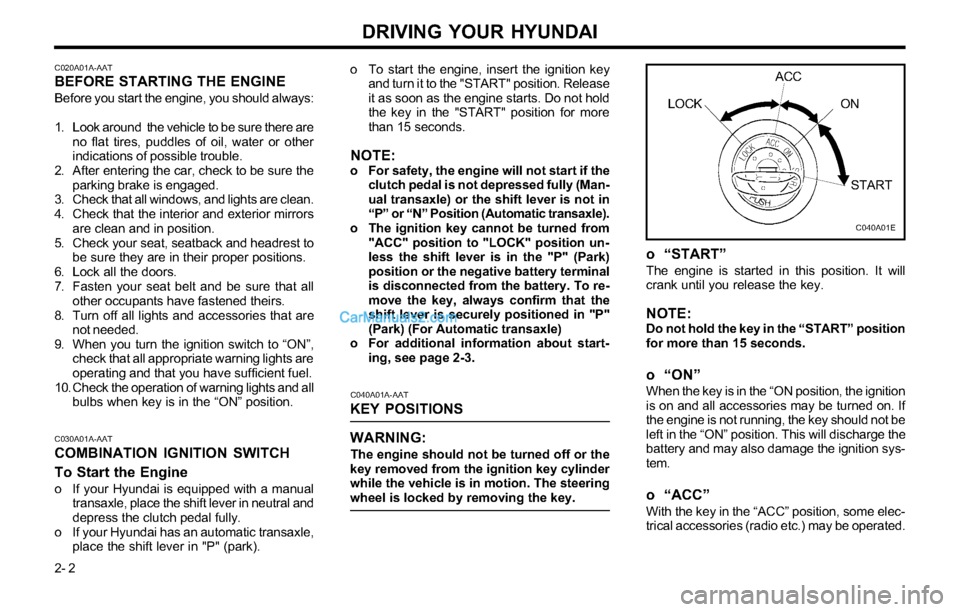
o “START”The engine is started in this position. It will
crank until you release the key.
NOTE:Do not hold the key in the “START” position
for more than 15 seconds.
o “ON”When the key is in the “ON position, the ignition
is on and all accessories may be turned on. If
the engine is not running, the key should not be
left in the “ON” position. This will discharge the
battery and may also damage the ignition sys-
tem.
o “ACC”
With the key in the “ACC” position, some elec-
trical accessories (radio etc.) may be operated.
C040A01E
LOCKACC
ON
START