change time Hyundai Tiburon 2003 User Guide
[x] Cancel search | Manufacturer: HYUNDAI, Model Year: 2003, Model line: Tiburon, Model: Hyundai Tiburon 2003Pages: 169, PDF Size: 3.04 MB
Page 110 of 169
DRIVING YOUR HYUNDAI
2- 15 9. If the trailer has electric brakes, start your
vehicle and trailer moving, and then apply
the trailer brake controller by hand to be
sure the brakes are working. This lets you
check your electrical connection at the same
time.
10. During your trip, occasionally check to be
sure that the load is secure, and that the
lights and any trailer brakes are still working.
11. Avoid jerky starts, sudden acceleration or
sudden stops.
12. Avoid sharp turns and rapid lane changes.
13. Avoid holding the brake pedal down too long
or too frequently. This could cause the brakes
to overheat, resulting in reduced braking
efficiency.
14. When going down a hill, shift into a lower
gear and use the engine braking effect.
When ascending a long grade, downshift the
transaxle to a lower gear and reduce speed
to reduce chances of engine overloading
and/or overheating.
15. If you have to stop while going uphill, do not
hold the vehicle in place by pressing on the
accelerator. This can cause the automatic
transaxle to overheat. Use the parking brake
or footbrake.
NOTE:When towing check transaxle fluid more
frequently.
C190F01S-AATTrailer or Vehicle Towing Tips
1. Before towing, check hitch and safety chain
connections as well as proper operation of
the trailer running lights, brake lights, and
turn signals.
2. Always drive your vehicle at a moderate
speed. (Less than 60 mph)
3. Trailer towing requires more fuel than nor-
mal conditions.
4. To maintain engine braking efficiency and
electrical charging performance, do not use
fifth gear (manual transaxle) or overdrive
(automatic transaxle).
5. Always secure items in the trailer to prevent
load shift while driving.
6. Check the condition and air pressure of all
tires on the trailer and your car. Low tire
pressure can seriously affect the handling.
Also check the spare tire.
7. The vehicle/trailer combination is more af-
fected by crosswind and buffeting.
When being passed by a large vehicle, keep
a constant speed and steer straight ahead.
If there is too much wind buffeting slow
down to get out of the other vehicle's air
turbulence.
8. When parking your car and trailer, especial-
ly on a hill, be sure to follow all the normal
precautions. Turn your front wheel into the
curb, set the parking brake firmly, and put
the transaxle in 1st or Reverse (manual) or
Park (automatic). In addition, place wheel
chocks at each of the trailer's tires.
CAUTION:If overheating should occur when towing,
(the temperature gauge reads near red zone),
taking the following action may reduce or
eliminate the problem.
1. Turn off the air conditioner.
2. Reduce highway speed.
3. Select a lower gear when going uphill.
4. While in stop and go traffic, place the gear
selector in park or neutral and idle the en-
gine at a higher speed.
Page 115 of 169
WHAT TO DO IN AN EMERGENCY
3-5
3. Change the flat tire.
4. Reinstall the wheel cap by fitting the boss of
the wheel cap in the groove of the wheel,
hitting the center of the wheel cap with your
hand.
D060C01A-AAT
2. Block the Wheel
Block the wheel that is diagonally opposite from
the flat to keep the vehicle from rolling when the
car is raised on the jack.
Flat tire
HGK192D060D02A-AAT
3. Loosen Wheel Nuts
The wheel nuts should be loosened slightly
before raising the car. To loosen the nuts, turn
the wrench handle counterclockwise. When
doing this, be sure that the socket is seated
completely over the nut so it cannot slip off. For
maximum leverage, position the wrench so the
handle is to the left as shown in the drawing.
Then, while holding the wrench near the end of
the handle, push down on it with steady pres-
sure. Do not remove the nuts at this time. Just
loosen them about one-half turn.
Remove the spare tire and remove the jack and
tool bag from the trunk.
D060B02GK-AAT
1. Obtain Spare Tire and Tool
HGK189
HGK191
HGK193
The jack is located behind the right side of
luggage trim. Remove the jack cover by un-
screwing the bolts. Turn the jack end counter-
clockwise to lower the jack height by using a
screw driver or wrench bar and remove it from
the bracket.
Page 137 of 169
DO-IT-YOURSELF MAINTENANCE
6-6
35% 65%
40% 60%
50% 50%
60% 40%
Ambient
temperature
°C ( °F)
-15 (5)
-25 (-13)
-35 (-31)
-45 (-49)
Antifreeze
solutionWater Engine Coolant concentration
G050C01A-AAT
To Check the Coolant Level
The coolant level can be seen on the side of the
plastic coolant reservoir. The level of the cool-
ant should be between the "LOW" and "FULL"
lines on the reservoir when the engine is cold.
If the level is below the "LOW" mark, add
engine coolant to bring it up between "LOW"
and "FULL". If the level is low, inspect for
coolant leaks and recheck the fluid level fre-
quently. If the level drops again, visit your
Hyundai dealer for an inspection and diagnosis
of the reason.
G050D02A-AATTo Change the Engine Coolant
The engine coolant should be changed at those
intervals specified in the vehicle maintenance
schedule in Section 5.
CAUTION:Engine coolant can damage the finish of
your car. If you spill engine coolant on the
car, wash it off thoroughly with clean water.
1. Park the car on level ground, set the park-
ing brake and remove the radiator cap when
cool.
2. Be sure your drain receptacle is in place.
Open the drain cock on the radiator. Allow
all the engine coolant to drain from the
cooling system, then securely close the drain
cock.
3. Check Section 9 for the capacity of the
cooling system in your car. Then, following
the manufacturer’s directions on the engine
coolant container, add the appropriate quan-
tity of coolant to the radiator.
4. Turn the radiator cap counterclockwise with-
out pressing down on it, until it stops. This
relieves any pressure remaining in the cool-
ing system. And remove the radiator cap by
pushing down and turning counterclockwise.
Now fill the radiator with clean demineral-
ized or distilled water. Continue to add clean
demineralized or distilled water in small quan-
tities until the fluid level stays up in the
radiator neck.5. Replace the radiator and reservoir caps and
check to be sure the drain cocks are fully
closed and not leaking.
WARNING:The cooling fan is controlled by engine cool-
ant temperature and may sometimes oper-
ate even when the engine is not running.
Use extreme caution when working near the
blades of the coolant fan so that you are not
injured by a rotating fan blade. As the en-
gine coolant temperature decreases, the fan
will automatically shut off. This is a normal
condition.
G060A01GK-AATSPARK PLUGS
YN60100A
V6 DOHC
Your engine was originally equipped with plati-
num-tipped spark plugs. Platinum-tipped spark
plugs will last longer than conventional type
Page 138 of 169
DO-IT-YOURSELF MAINTENANCE
6-7
WARNING:It is recommended that the engine be cool
or cold when changing the spark plugs. If
the engine is hot, you could burn yourself
on the insulated connector, the spark plug
or the engine itself.
4. When preparing to remove the old spark
plug, guide the socket down over the spark
plug, being careful not to damage the ce-
ramic insulator.
5. To remove the old spark plug, turn the
wrench handle in a counterclockwise direc-
tion.
6. To install the new spark plug, guide the
socket down over the spark plug, being
careful not to damage the ceramic insulator.
G060C02GK
G060B01GK-AAT
Replacing the Spark PlugsThe spark plugs should be changed at the
intervals specified in the vehicle maintenance
schedule in Section 5 or whenever engine per-
formance indicates they should be changed.
Symptoms that suggest poor spark plug perfor-
mance include engine misfiring under load, loss
of fuel economy, poor acceleration, etc. When
spark plugs are replaced, always use spark
plugs recommended by Hyundai. The use of
other spark plugs can result in loss of perfor-
mance, radio interference or engine damage.
NOTE:When replacing the spark plug, always use
the genuine parts recommended.
Recommended Spark Plugs:
Type
RC10YC4(CHAMPION)
BKR5ES-11(NGK)
RC10PYPB4(CHAMPION)
PFR5N-11(NGK)Remark
G060C01GK-GETChanging the Spark Plugs
G060C01GK
You will find it easier to change spark plugs if
the engine is cold. Always change one spark
plug at a time. This helps avoid getting the wires
mixed up.
1. Remove the center (2.0 L) cover on the
engine rocker cover.
NOTE:It is recommended that the spark plugs (For
2.7L Engines) should be changed by an
authorized Hyundai dealer.
2. Using a clean cloth, remove any dirt that has
accumulated around the base of the spark
plug so it cannot fall into the cylinder when
the spark plug is removed.
3. To remove the spark plug cable, pull straight
up on the insulated connector, not the cable.
Pulling on the cable may damage the carbon
core conductor.
2.0L
2.7L
spark plugs and can be identified by blue lines
on the ceramic shell.
NOTE:Do not clean or regap platinum-tipped spark
plugs.
Page 139 of 169
DO-IT-YOURSELF MAINTENANCE
6-8
G070A01GK-AATCHANGING THE AIR CLEANER FIL-
TER
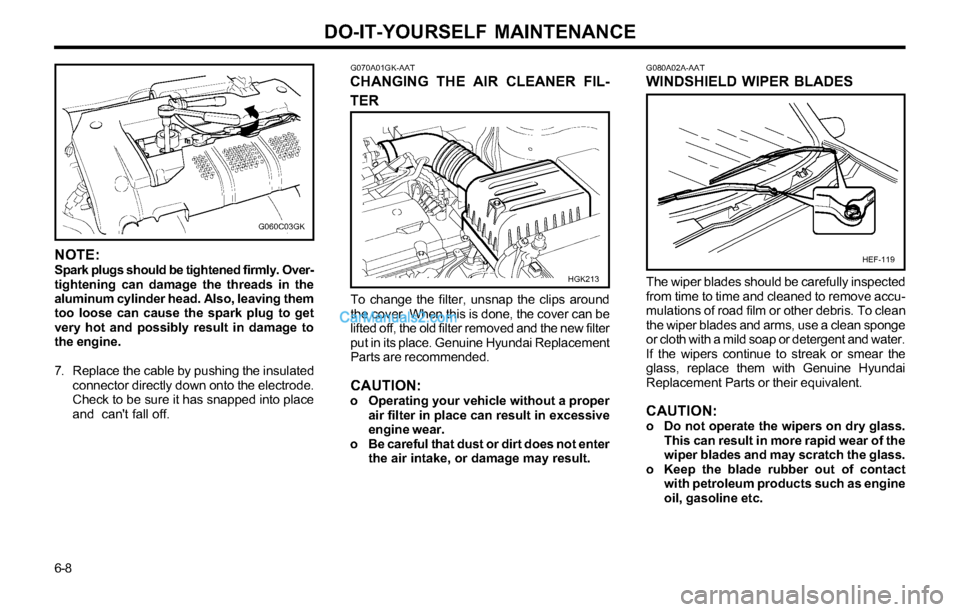
To change the filter, unsnap the clips around
the cover. When this is done, the cover can be
lifted off, the old filter removed and the new filter
put in its place. Genuine Hyundai Replacement
Parts are recommended.
CAUTION:o Operating your vehicle without a proper
air filter in place can result in excessive
engine wear.
o Be careful that dust or dirt does not enter
the air intake, or damage may result.
HGK213
NOTE:Spark plugs should be tightened firmly. Over-
tightening can damage the threads in the
aluminum cylinder head. Also, leaving them
too loose can cause the spark plug to get
very hot and possibly result in damage to
the engine.
7. Replace the cable by pushing the insulated
connector directly down onto the electrode.
Check to be sure it has snapped into place
and can't fall off.
G060C03GKG080A02A-AAT
WINDSHIELD WIPER BLADES
HEF-119
The wiper blades should be carefully inspected
from time to time and cleaned to remove accu-
mulations of road film or other debris. To clean
the wiper blades and arms, use a clean sponge
or cloth with a mild soap or detergent and water.
If the wipers continue to streak or smear the
glass, replace them with Genuine Hyundai
Replacement Parts or their equivalent.
CAUTION:o Do not operate the wipers on dry glass.
This can result in more rapid wear of the
wiper blades and may scratch the glass.
o Keep the blade rubber out of contact
with petroleum products such as engine
oil, gasoline etc.
Page 144 of 169
DO-IT-YOURSELF MAINTENANCE
6-13
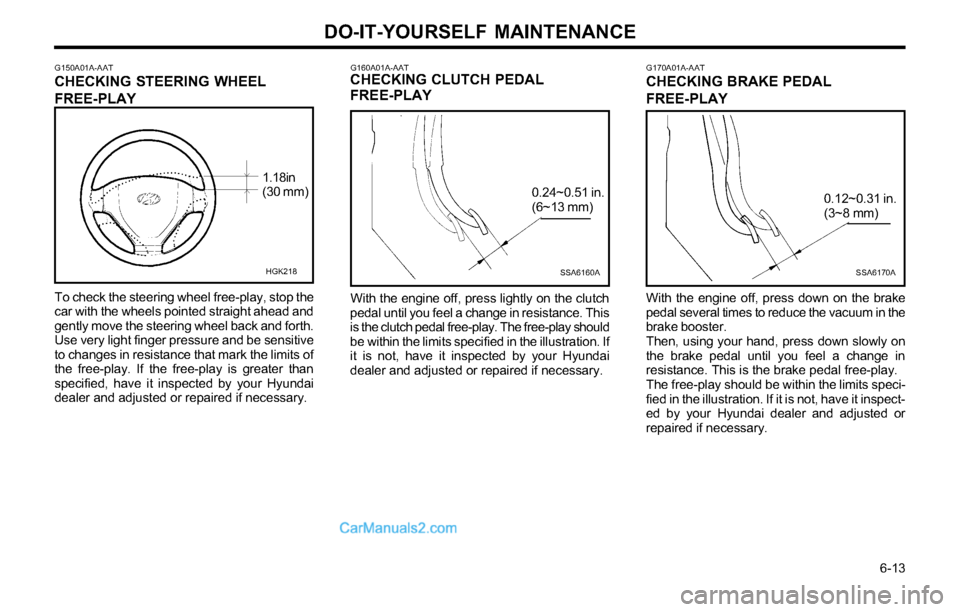
G160A01A-AATCHECKING CLUTCH PEDAL
FREE-PLAY
SSA6160A
0.24~0.51 in.
(6~13 mm)
With the engine off, press lightly on the clutch
pedal until you feel a change in resistance. This
is the clutch pedal free-play. The free-play should
be within the limits specified in the illustration. If
it is not, have it inspected by your Hyundai
dealer and adjusted or repaired if necessary.
G170A01A-AATCHECKING BRAKE PEDAL
FREE-PLAY
SSA6170A
0.12~0.31 in.
(3~8 mm)
With the engine off, press down on the brake
pedal several times to reduce the vacuum in the
brake booster.
Then, using your hand, press down slowly on
the brake pedal until you feel a change in
resistance. This is the brake pedal free-play.
The free-play should be within the limits speci-
fied in the illustration. If it is not, have it inspect-
ed by your Hyundai dealer and adjusted or
repaired if necessary.
G150A01A-AATCHECKING STEERING WHEEL
FREE-PLAY
To check the steering wheel free-play, stop the
car with the wheels pointed straight ahead and
gently move the steering wheel back and forth.
Use very light finger pressure and be sensitive
to changes in resistance that mark the limits of
the free-play. If the free-play is greater than
specified, have it inspected by your Hyundai
dealer and adjusted or repaired if necessary.1.18in
(30 mm)
HGK218