steering Hyundai Tiburon 2003 Owner's Guide
[x] Cancel search | Manufacturer: HYUNDAI, Model Year: 2003, Model line: Tiburon, Model: Hyundai Tiburon 2003Pages: 169, PDF Size: 3.04 MB
Page 132 of 169
DO-IT-YOURSELF MAINTENANCE
6-1
6
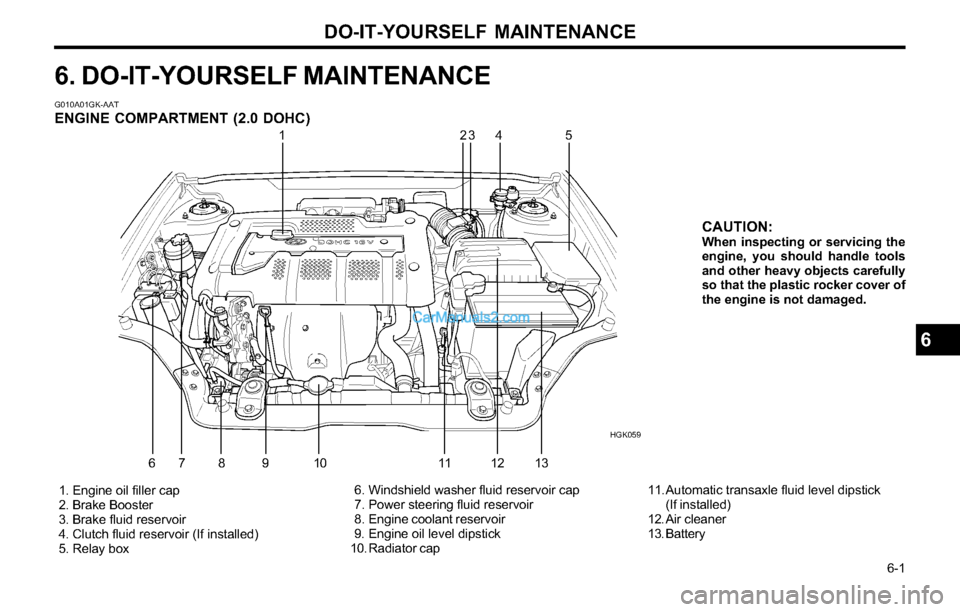
G010A01GK-AATENGINE COMPARTMENT (2.0 DOHC)
1. Engine oil filler cap
2. Brake Booster
3. Brake fluid reservoir
4. Clutch fluid reservoir (If installed)
5. Relay box 6. Windshield washer fluid reservoir cap
7. Power steering fluid reservoir
8. Engine coolant reservoir
9. Engine oil level dipstick
10. Radiator cap11. Automatic transaxle fluid level dipstick
(If installed)
12. Air cleaner
13. Battery 1
2
6345
78 9 10 11 1213
6. DO-IT-YOURSELF MAINTENANCE
CAUTION:When inspecting or servicing the
engine, you should handle tools
and other heavy objects carefully
so that the plastic rocker cover of
the engine is not damaged.
HGK059
Page 133 of 169
DO-IT-YOURSELF MAINTENANCE
6-2
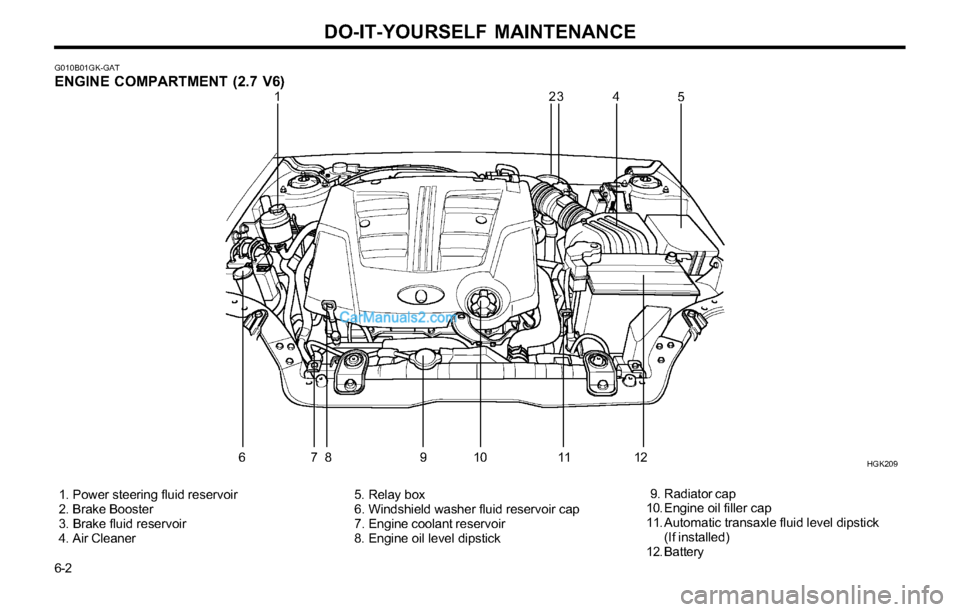
G010B01GK-GATENGINE COMPARTMENT (2.7 V6)
1. Power steering fluid reservoir
2. Brake Booster
3. Brake fluid reservoir
4. Air Cleaner 5. Relay box
6. Windshield washer fluid reservoir cap
7. Engine coolant reservoir
8. Engine oil level dipstick 9. Radiator cap
10. Engine oil filler cap
11. Automatic transaxle fluid level dipstick
(If installed)
12. Battery
1
HGK209
2
634
5
78 9 10 11 12
Page 134 of 169
DO-IT-YOURSELF MAINTENANCE
6-3
G020A01A-AATGENERAL CHECKS
Engine Compartment
The following should be checked regularly:
o Engine oil level and condition
o Transaxle fluid level and condition
o Brake fluid level
o Clutch fluid level
o Engine coolant level
o Windshield washer fluid level
o Accessory drive belt condition
o Engine coolant hose condition
o Fluid leaks (on or below components)
o Power steering fluid level
o Battery condition
G020B01A-AAT
Vehicle Exterior
The following should be checked monthly:
o Overall appearance and condition
o Wheel condition and wheel nut torque
o Air filter condition
o Exhaust system condition
o Light condition and operation
o Windshield glass condition
o Wiper blade condition
o Paint condition and body corrosion
o Fluid leaks
o Door and hood lock condition
o Tire pressure and condition (including spare
tire)
G020C01A-AATVehicle Interior
The following should be checked each time
when the vehicle is driven:
o Lights operation
o Windshield wiper operation
o Horn operation
o Defroster, heating system operation (and air
conditioning, if installed)
o Steering operation and condition
o Mirror condition and operation
o Turn signal operation
o Accelerator pedal operation
o Brake operation, including parking brake
o Manual transaxle operation, including clutch
operation
o Automatic transaxle operation, including
"Park" mechanism operation
o Seat control condition and operation
o Seat belt condition and operation
o Sunvisor operation
If you notice anything that does not operate
correctly or appears to be functioning incorrect-
ly, inspect it carefully and seek assistance from
your Hyundai dealer if service is needed.
G030A01A-AATCHECKING THE ENGINE OIL
Engine oil is essential to the performance and
service of the engine. It is suggested that you
check the oil level at least once a week in
normal use and more often if you are on a trip
or driving in severe conditions.
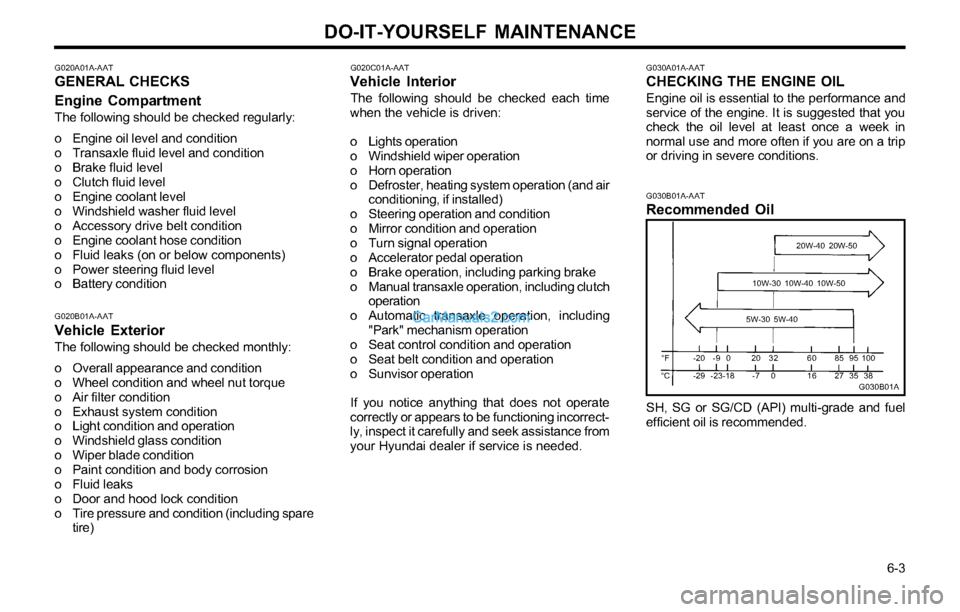
G030B01A-AATRecommended Oil
SH, SG or SG/CD (API) multi-grade and fuel
efficient oil is recommended.
G030B01A °F
°C20W-40 20W-50
10W-30 10W-40 10W-50
5W-30 5W-40
-20
-29-9
-230
-1820
-732
060
1685
2795
35100
38
Page 144 of 169
DO-IT-YOURSELF MAINTENANCE
6-13
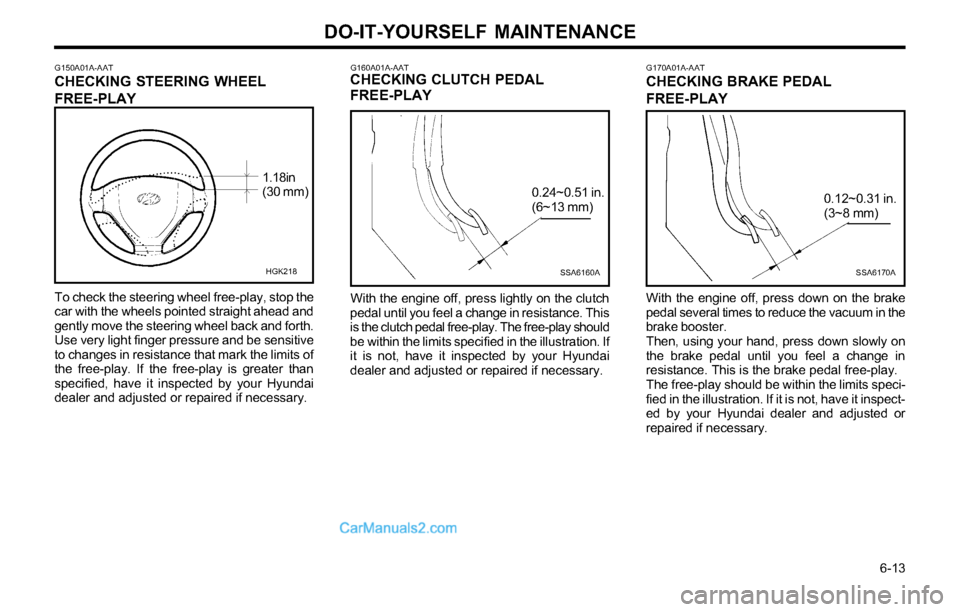
G160A01A-AATCHECKING CLUTCH PEDAL
FREE-PLAY
SSA6160A
0.24~0.51 in.
(6~13 mm)
With the engine off, press lightly on the clutch
pedal until you feel a change in resistance. This
is the clutch pedal free-play. The free-play should
be within the limits specified in the illustration. If
it is not, have it inspected by your Hyundai
dealer and adjusted or repaired if necessary.
G170A01A-AATCHECKING BRAKE PEDAL
FREE-PLAY
SSA6170A
0.12~0.31 in.
(3~8 mm)
With the engine off, press down on the brake
pedal several times to reduce the vacuum in the
brake booster.
Then, using your hand, press down slowly on
the brake pedal until you feel a change in
resistance. This is the brake pedal free-play.
The free-play should be within the limits speci-
fied in the illustration. If it is not, have it inspect-
ed by your Hyundai dealer and adjusted or
repaired if necessary.
G150A01A-AATCHECKING STEERING WHEEL
FREE-PLAY
To check the steering wheel free-play, stop the
car with the wheels pointed straight ahead and
gently move the steering wheel back and forth.
Use very light finger pressure and be sensitive
to changes in resistance that mark the limits of
the free-play. If the free-play is greater than
specified, have it inspected by your Hyundai
dealer and adjusted or repaired if necessary.1.18in
(30 mm)
HGK218
Page 145 of 169
DO-IT-YOURSELF MAINTENANCE
6-14
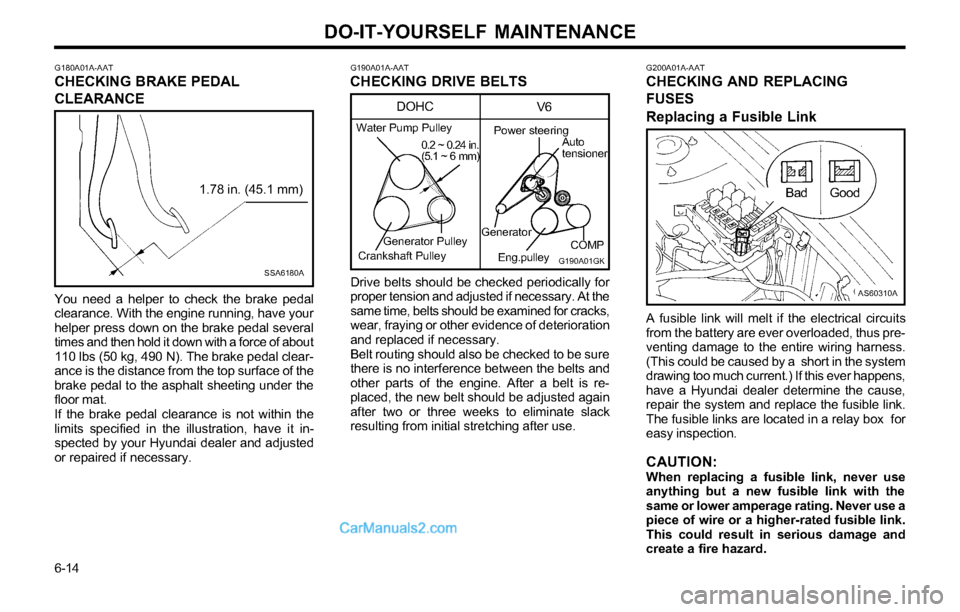
G190A01A-AATCHECKING DRIVE BELTSG200A01A-AATCHECKING AND REPLACING
FUSES
Replacing a Fusible Link
Drive belts should be checked periodically for
proper tension and adjusted if necessary. At the
same time, belts should be examined for cracks,
wear, fraying or other evidence of deterioration
and replaced if necessary.
Belt routing should also be checked to be sure
there is no interference between the belts and
other parts of the engine. After a belt is re-
placed, the new belt should be adjusted again
after two or three weeks to eliminate slack
resulting from initial stretching after use.A fusible link will melt if the electrical circuits
from the battery are ever overloaded, thus pre-
venting damage to the entire wiring harness.
(This could be caused by a short in the system
drawing too much current.) If this ever happens,
have a Hyundai dealer determine the cause,
repair the system and replace the fusible link.
The fusible links are located in a relay box for
easy inspection.
CAUTION:When replacing a fusible link, never use
anything but a new fusible link with the
same or lower amperage rating. Never use a
piece of wire or a higher-rated fusible link.
This could result in serious damage and
create a fire hazard.
G190A01GK
Water Pump Pulley
Generator Pulley
Crankshaft Pulley0.2 ~ 0.24 in.
(5.1 ~ 6 mm)
GoodBad
AS60310A G180A01A-AAT
CHECKING BRAKE PEDAL
CLEARANCE
SSA6180A
1.78 in. (45.1 mm)
You need a helper to check the brake pedal
clearance. With the engine running, have your
helper press down on the brake pedal several
times and then hold it down with a force of about
110 lbs (50 kg, 490 N). The brake pedal clear-
ance is the distance from the top surface of the
brake pedal to the asphalt sheeting under the
floor mat.
If the brake pedal clearance is not within the
limits specified in the illustration, have it in-
spected by your Hyundai dealer and adjusted
or repaired if necessary.
DOHC
V6
Power steering
Auto
tensioner
Generator
Eng.pulleyCOMP
Page 147 of 169
DO-IT-YOURSELF MAINTENANCE
6-16o Charge batteries only in a well ventilated
area.
o Do not permit flames, sparks or smoking in
the area.
o Keep children away from the area.
G220B01A-AATChecking Engine Cooling Fan
The engine cooling fan should come on auto-
matically if the engine coolant temperature is
high.
G220C01A-AAT
Checking Condenser Cooling Fan
The condenser coolant fan should come on
automatically whenever the air conditioning is
in operation.
G210B02A-AAT
Checking the BatteryKeep the battery clean. Any evidence of corro-
sion around the battery posts or terminals should
be removed using a solution of household bak-
ing soda and warm water. After the battery
terminals are dry, cover them with a light coat-
ing of grease.
PROPOSITION 65 WARNING:Battery posts, terminals, and related acces-
sories contain lead and lead compounds,
chemicals known to the state of California
to cause cancer and reproductive harm.
Wash hands after handling.
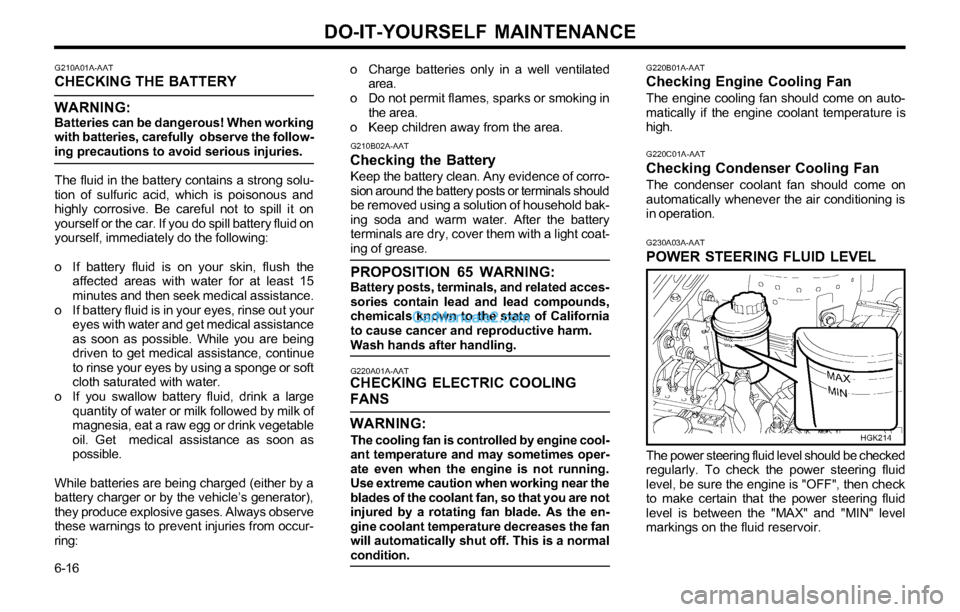
G230A03A-AATPOWER STEERING FLUID LEVEL
The power steering fluid level should be checked
regularly. To check the power steering fluid
level, be sure the engine is "OFF", then check
to make certain that the power steering fluid
level is between the "MAX" and "MIN" level
markings on the fluid reservoir.
HGK214 G220A01A-AAT
CHECKING ELECTRIC COOLING
FANS
WARNING:
The cooling fan is controlled by engine cool-
ant temperature and may sometimes oper-
ate even when the engine is not running.
Use extreme caution when working near the
blades of the coolant fan, so that you are not
injured by a rotating fan blade. As the en-
gine coolant temperature decreases the fan
will automatically shut off. This is a normal
condition.
G210A01A-AATCHECKING THE BATTERY
WARNING:
Batteries can be dangerous! When working
with batteries, carefully observe the follow-
ing precautions to avoid serious injuries.
The fluid in the battery contains a strong solu-
tion of sulfuric acid, which is poisonous and
highly corrosive. Be careful not to spill it on
yourself or the car. If you do spill battery fluid on
yourself, immediately do the following:
o If battery fluid is on your skin, flush the
affected areas with water for at least 15
minutes and then seek medical assistance.
o If battery fluid is in your eyes, rinse out your
eyes with water and get medical assistance
as soon as possible. While you are being
driven to get medical assistance, continue
to rinse your eyes by using a sponge or soft
cloth saturated with water.
o If you swallow battery fluid, drink a large
quantity of water or milk followed by milk of
magnesia, eat a raw egg or drink vegetable
oil. Get medical assistance as soon as
possible.
While batteries are being charged (either by a
battery charger or by the vehicle’s generator),
they produce explosive gases. Always observe
these warnings to prevent injuries from occur-
ring:
Page 148 of 169
DO-IT-YOURSELF MAINTENANCE
6-17 manual used by dealership technicians and
while it is highly technical it can be useful in
obtaining a better understanding of your car
and how it works.
G260A02A-AATREPLACING HEADLIGHT BULBS
Before attempting to replace a headlight bulb,
be sure the switch is turned to the "OFF"
position.
The next paragraph shows how to reach head-
light bulbs so they may be changed. Be sure to
replace the burned-out bulb with one of the
same number and wattage rating.
CAUTION:Keep the lamps out of contact with petro-
leum products such as oil, gasoline etc.
NOTE:Grinding noise from the power steering
pump may be heard immediately after the
engine is started in extremely cold condi-
tions (below - 4°F). If the noise stops during
warm up, there is no abnormal function in
the system. It is due to a power steering
fluid characteristic in extremely cold condi-
tions.
Recommended Fluid
Use PSF-3 type fluid
NOTE:Do not start the engine when the power
steering oil reservoir is empty.
G240A01A-AAT
POWER STEERING HOSES
It is suggested that you check the power steer-
ing hose connections for fluid leakage at regular
intervals. The power steering hoses should be
replaced if there is severe surface cracking,
scuffing or worn spots. Deterioration of the
hose could cause premature failure.
G250A01A-AAT
FOR MORE INFORMATION ABOUT
YOUR HYUNDAI
If you desire additional information about main-
taining and servicing your Hyundai, you may
purchase a factory Shop Manual at your Hyundai
dealer's parts department. This is the same
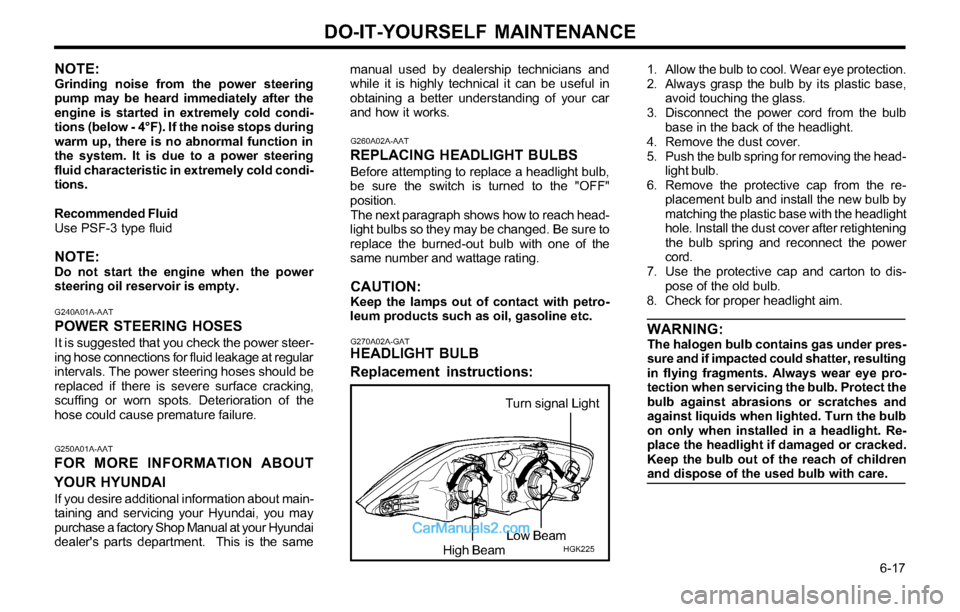
G270A02A-GATHEADLIGHT BULB
Replacement instructions:
HGK225
1. Allow the bulb to cool. Wear eye protection.
2. Always grasp the bulb by its plastic base,
avoid touching the glass.
3. Disconnect the power cord from the bulb
base in the back of the headlight.
4. Remove the dust cover.
5. Push the bulb spring for removing the head-
light bulb.
6. Remove the protective cap from the re-
placement bulb and install the new bulb by
matching the plastic base with the headlight
hole. Install the dust cover after retightening
the bulb spring and reconnect the power
cord.
7. Use the protective cap and carton to dis-
pose of the old bulb.
8. Check for proper headlight aim.
WARNING:The halogen bulb contains gas under pres-
sure and if impacted could shatter, resulting
in flying fragments. Always wear eye pro-
tection when servicing the bulb. Protect the
bulb against abrasions or scratches and
against liquids when lighted. Turn the bulb
on only when installed in a headlight. Re-
place the headlight if damaged or cracked.
Keep the bulb out of the reach of children
and dispose of the used bulb with care.
High BeamLow Beam Turn signal Light
Page 157 of 169
CONSUMER INFORMATION & REPORTING SAFETY DEFECTS
8-3
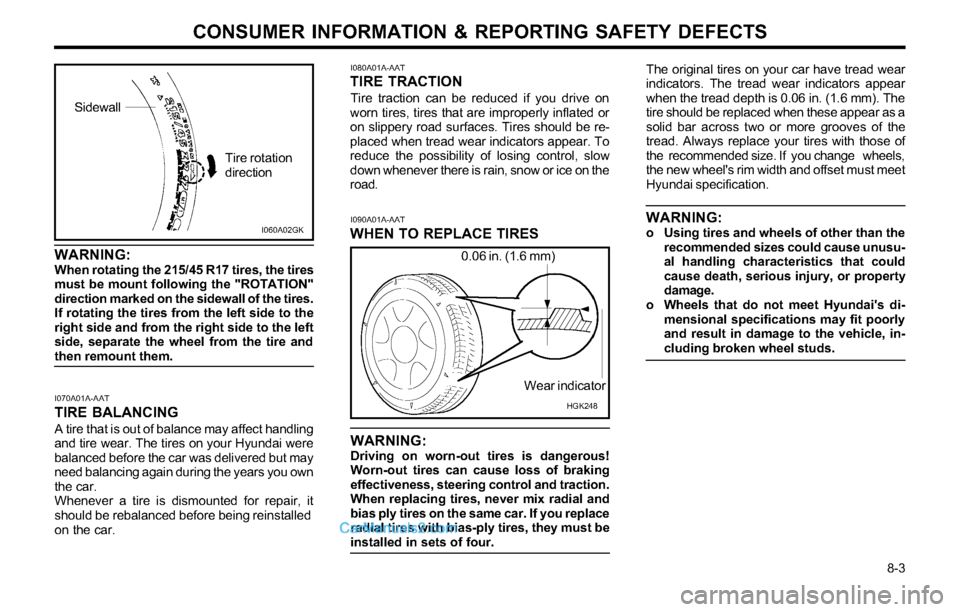
I090A01A-AAT
WHEN TO REPLACE TIRES
WARNING:
Driving on worn-out tires is dangerous!
Worn-out tires can cause loss of braking
effectiveness, steering control and traction.
When replacing tires, never mix radial and
bias ply tires on the same car. If you replace
radial tires with bias-ply tires, they must be
installed in sets of four.
I060A02GK
WARNING:When rotating the 215/45 R17 tires, the tires
must be mount following the "ROTATION"
direction marked on the sidewall of the tires.
If rotating the tires from the left side to the
right side and from the right side to the left
side, separate the wheel from the tire and
then remount them.Sidewall
Tire rotation
direction
I070A01A-AAT
TIRE BALANCING
A tire that is out of balance may affect handling
and tire wear. The tires on your Hyundai were
balanced before the car was delivered but may
need balancing again during the years you own
the car.
Whenever a tire is dismounted for repair, it
should be rebalanced before being reinstalled
on the car.
I080A01A-AATTIRE TRACTION
Tire traction can be reduced if you drive on
worn tires, tires that are improperly inflated or
on slippery road surfaces. Tires should be re-
placed when tread wear indicators appear. To
reduce the possibility of losing control, slow
down whenever there is rain, snow or ice on the
road.
The original tires on your car have tread wear
indicators. The tread wear indicators appear
when the tread depth is 0.06 in. (1.6 mm). The
tire should be replaced when these appear as a
solid bar across two or more grooves of the
tread. Always replace your tires with those of
the recommended size. If you change wheels,
the new wheel's rim width and offset must meet
Hyundai specification.
WARNING:o Using tires and wheels of other than the
recommended sizes could cause unusu-
al handling characteristics that could
cause death, serious injury, or property
damage.
o Wheels that do not meet Hyundai's di-
mensional specifications may fit poorly
and result in damage to the vehicle, in-
cluding broken wheel studs.
Wear indicator 0.06 in. (1.6 mm)
HGK248
Page 161 of 169
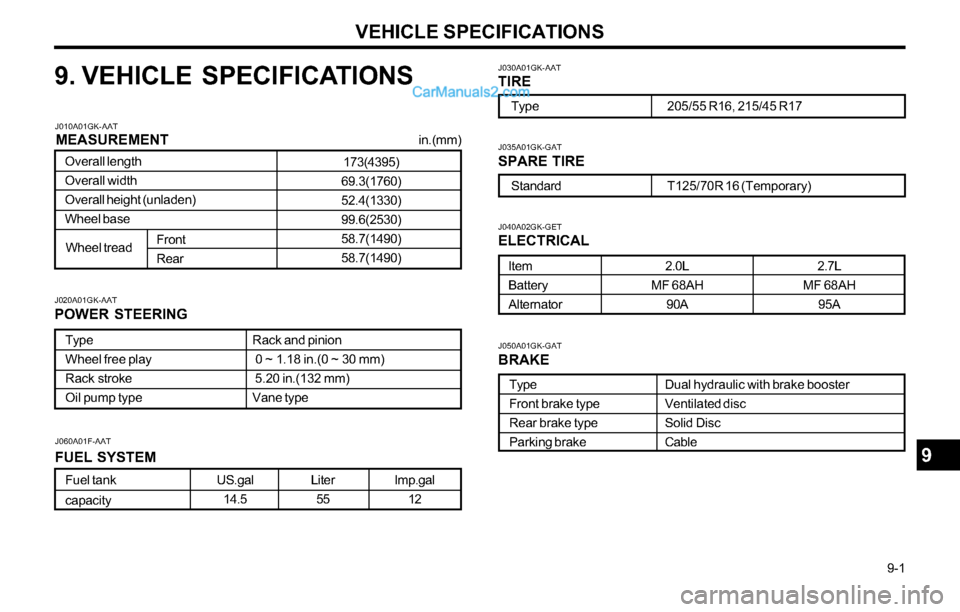
VEHICLE SPECIFICATIONS
9-1 Liter
55
9
J030A01GK-AATTIRE
Dual hydraulic with brake booster
Ventilated disc
Solid Disc
Cable
9. VEHICLE SPECIFICATIONS
J010A01GK-AATMEASUREMENT
J060A01F-AAT
FUEL SYSTEM
Type
Wheel free play
Rack stroke
Oil pump typeRack and pinion
0 ~ 1.18 in.(0 ~ 30 mm)
5.20 in.(132 mm)
Vane type
205/55 R16, 215/45 R17 Type
Overall length
Overall width
Overall height (unladen)
Wheel base
Front
Rear
173(4395)
69.3(1760)
52.4(1330)
99.6(2530)
58.7(1490)
58.7(1490) Wheel tread in.(mm)
J020A01GK-AATPOWER STEERING
Fuel tank
capacityUS.gal
14.5Imp.gal
12
J050A01GK-GATBRAKE
Type
Front brake type
Rear brake type
Parking brake
J035A01GK-GATSPARE TIRE
T125/70R 16 (Temporary) Standard
J040A02GK-GETELECTRICAL
Item
Battery
Alternator2.0L
MF 68AH
90A2.7L
MF 68AH
95A
Page 163 of 169
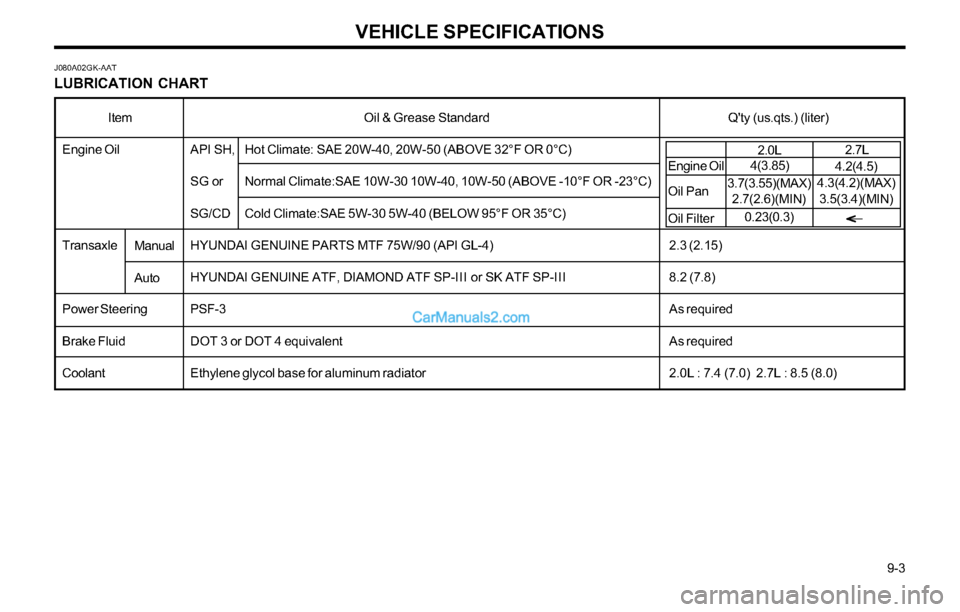
VEHICLE SPECIFICATIONS
9-3 4.2(4.5)
J080A02GK-AAT
LUBRICATION CHART
Oil & Grease Standard
API SH, Hot Climate: SAE 20W-40, 20W-50 (ABOVE 32°F OR 0°C)
SG or Normal Climate:SAE 10W-30 10W-40, 10W-50 (ABOVE -10°F OR -23°C)
SG/CD Cold Climate:SAE 5W-30 5W-40 (BELOW 95°F OR 35°C)
HYUNDAI GENUINE PARTS MTF 75W/90 (API GL-4)
HYUNDAI GENUINE ATF, DIAMOND ATF SP-III or SK ATF SP-III
PSF-3
DOT 3 or DOT 4 equivalent
Ethylene glycol base for aluminum radiatorItem
Engine Oil
Transaxle
Power Steering
Brake Fluid
CoolantQ'ty (us.qts.) (liter)
2.3 (2.15)
8.2 (7.8)
As required
As required
2.0L : 7.4 (7.0) 2.7L : 8.5 (8.0)
Manual
Auto
Engine Oil
Oil Pan
Oil Filter2.0L2.7L
3.7(3.55)(MAX)
2.7(2.6)(MIN)
0.23(0.3)4(3.85)
4.3(4.2)(MAX)
3.5(3.4)(MIN)