engine Hyundai Tiburon 2003 Workshop Manual
[x] Cancel search | Manufacturer: HYUNDAI, Model Year: 2003, Model line: Tiburon, Model: Hyundai Tiburon 2003Pages: 169, PDF Size: 3.04 MB
Page 143 of 169
DO-IT-YOURSELF MAINTENANCE
6-12
G140B01A-AATChecking the Air Conditioning Opera-
tion
1. Start the engine and let it run at a fast idle for
several minutes with the air conditioning set
at the maximum cold setting.
2. If the air coming out of the in-dash vents is
not cold, have the air conditioning system
inspected by your Hyundai dealer.
CAUTION:Running the air conditioning system for
extended periods of time with a low refriger-
ant level may damage the compressor.
G140C01A-AAT
LubricationTo lubricate the compressor and the seals in
the system, the air conditioning should be run
for at least 10 minutes each week. This is
particularly important during cool weather when
the air conditioning system is not otherwise in
use.
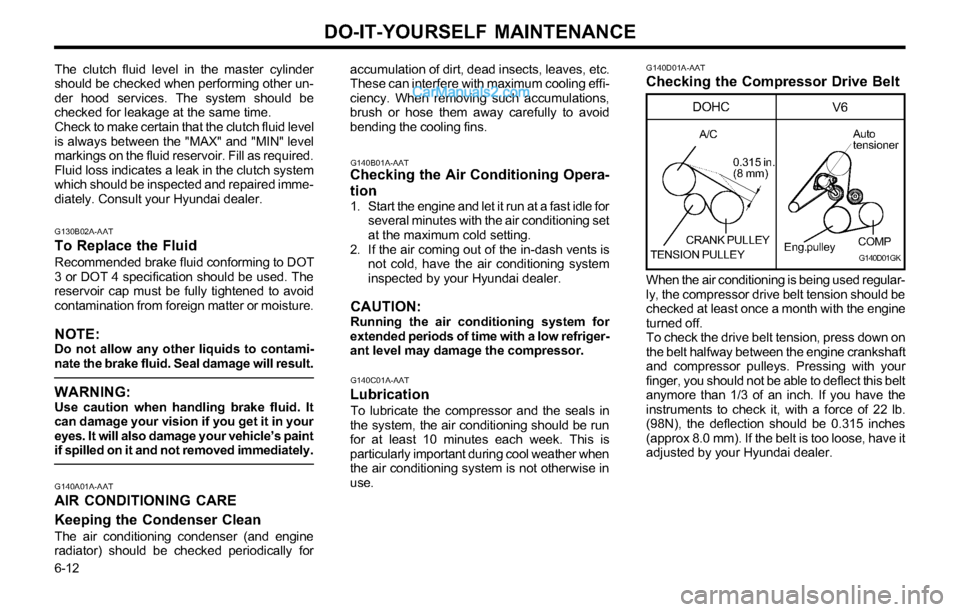
G140D01A-AATChecking the Compressor Drive Belt
When the air conditioning is being used regular-
ly, the compressor drive belt tension should be
checked at least once a month with the engine
turned off.
To check the drive belt tension, press down on
the belt halfway between the engine crankshaft
and compressor pulleys. Pressing with your
finger, you should not be able to deflect this belt
anymore than 1/3 of an inch. If you have the
instruments to check it, with a force of 22 lb.
(98N), the deflection should be 0.315 inches
(approx 8.0 mm). If the belt is too loose, have it
adjusted by your Hyundai dealer. accumulation of dirt, dead insects, leaves, etc.
These can interfere with maximum cooling effi-
ciency. When removing such accumulations,
brush or hose them away carefully to avoid
bending the cooling fins.
G140D01GK
A/C
CRANK PULLEY
TENSION PULLEYG130B02A-AAT
To Replace the Fluid
Recommended brake fluid conforming to DOT
3 or DOT 4 specification should be used. The
reservoir cap must be fully tightened to avoid
contamination from foreign matter or moisture.
NOTE:Do not allow any other liquids to contami-
nate the brake fluid. Seal damage will result.
WARNING:Use caution when handling brake fluid. It
can damage your vision if you get it in your
eyes. It will also damage your vehicle’s paint
if spilled on it and not removed immediately.
G140A01A-AATAIR CONDITIONING CARE
Keeping the Condenser Clean
The air conditioning condenser (and engine
radiator) should be checked periodically for
The clutch fluid level in the master cylinder
should be checked when performing other un-
der hood services. The system should be
checked for leakage at the same time.
Check to make certain that the clutch fluid level
is always between the "MAX" and "MIN" level
markings on the fluid reservoir. Fill as required.
Fluid loss indicates a leak in the clutch system
which should be inspected and repaired imme-
diately. Consult your Hyundai dealer.
DOHC
V6
Auto
tensioner
Eng.pulleyCOMP 0.315 in.
(8 mm)
Page 144 of 169
DO-IT-YOURSELF MAINTENANCE
6-13
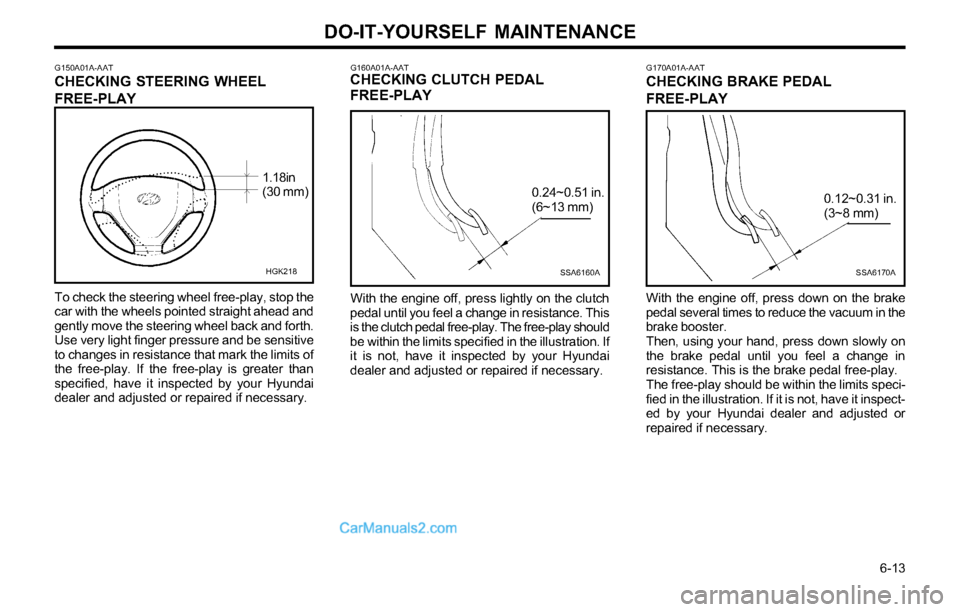
G160A01A-AATCHECKING CLUTCH PEDAL
FREE-PLAY
SSA6160A
0.24~0.51 in.
(6~13 mm)
With the engine off, press lightly on the clutch
pedal until you feel a change in resistance. This
is the clutch pedal free-play. The free-play should
be within the limits specified in the illustration. If
it is not, have it inspected by your Hyundai
dealer and adjusted or repaired if necessary.
G170A01A-AATCHECKING BRAKE PEDAL
FREE-PLAY
SSA6170A
0.12~0.31 in.
(3~8 mm)
With the engine off, press down on the brake
pedal several times to reduce the vacuum in the
brake booster.
Then, using your hand, press down slowly on
the brake pedal until you feel a change in
resistance. This is the brake pedal free-play.
The free-play should be within the limits speci-
fied in the illustration. If it is not, have it inspect-
ed by your Hyundai dealer and adjusted or
repaired if necessary.
G150A01A-AATCHECKING STEERING WHEEL
FREE-PLAY
To check the steering wheel free-play, stop the
car with the wheels pointed straight ahead and
gently move the steering wheel back and forth.
Use very light finger pressure and be sensitive
to changes in resistance that mark the limits of
the free-play. If the free-play is greater than
specified, have it inspected by your Hyundai
dealer and adjusted or repaired if necessary.1.18in
(30 mm)
HGK218
Page 145 of 169
DO-IT-YOURSELF MAINTENANCE
6-14
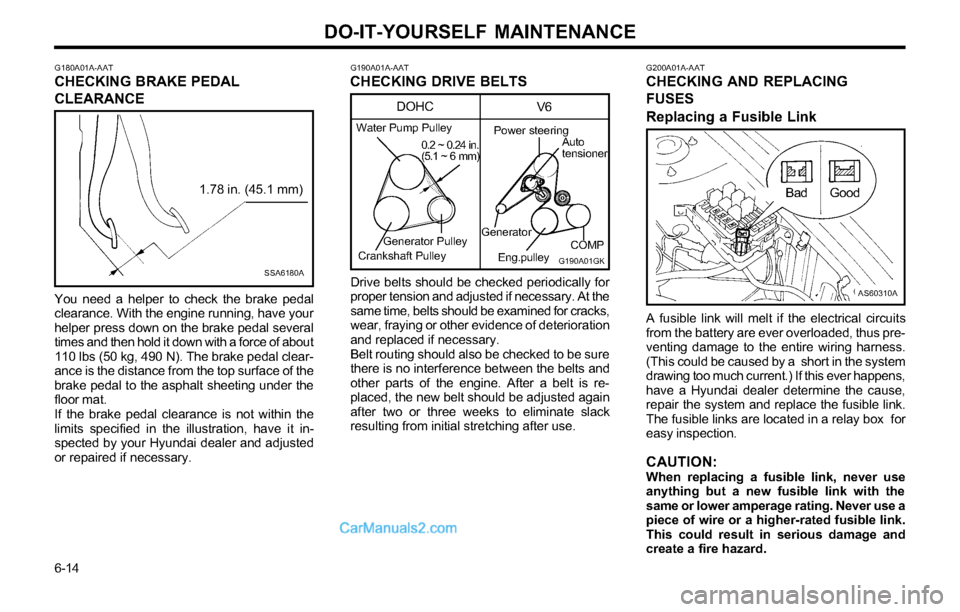
G190A01A-AATCHECKING DRIVE BELTSG200A01A-AATCHECKING AND REPLACING
FUSES
Replacing a Fusible Link
Drive belts should be checked periodically for
proper tension and adjusted if necessary. At the
same time, belts should be examined for cracks,
wear, fraying or other evidence of deterioration
and replaced if necessary.
Belt routing should also be checked to be sure
there is no interference between the belts and
other parts of the engine. After a belt is re-
placed, the new belt should be adjusted again
after two or three weeks to eliminate slack
resulting from initial stretching after use.A fusible link will melt if the electrical circuits
from the battery are ever overloaded, thus pre-
venting damage to the entire wiring harness.
(This could be caused by a short in the system
drawing too much current.) If this ever happens,
have a Hyundai dealer determine the cause,
repair the system and replace the fusible link.
The fusible links are located in a relay box for
easy inspection.
CAUTION:When replacing a fusible link, never use
anything but a new fusible link with the
same or lower amperage rating. Never use a
piece of wire or a higher-rated fusible link.
This could result in serious damage and
create a fire hazard.
G190A01GK
Water Pump Pulley
Generator Pulley
Crankshaft Pulley0.2 ~ 0.24 in.
(5.1 ~ 6 mm)
GoodBad
AS60310A G180A01A-AAT
CHECKING BRAKE PEDAL
CLEARANCE
SSA6180A
1.78 in. (45.1 mm)
You need a helper to check the brake pedal
clearance. With the engine running, have your
helper press down on the brake pedal several
times and then hold it down with a force of about
110 lbs (50 kg, 490 N). The brake pedal clear-
ance is the distance from the top surface of the
brake pedal to the asphalt sheeting under the
floor mat.
If the brake pedal clearance is not within the
limits specified in the illustration, have it in-
spected by your Hyundai dealer and adjusted
or repaired if necessary.
DOHC
V6
Power steering
Auto
tensioner
Generator
Eng.pulleyCOMP
Page 147 of 169
DO-IT-YOURSELF MAINTENANCE
6-16o Charge batteries only in a well ventilated
area.
o Do not permit flames, sparks or smoking in
the area.
o Keep children away from the area.
G220B01A-AATChecking Engine Cooling Fan
The engine cooling fan should come on auto-
matically if the engine coolant temperature is
high.
G220C01A-AAT
Checking Condenser Cooling Fan
The condenser coolant fan should come on
automatically whenever the air conditioning is
in operation.
G210B02A-AAT
Checking the BatteryKeep the battery clean. Any evidence of corro-
sion around the battery posts or terminals should
be removed using a solution of household bak-
ing soda and warm water. After the battery
terminals are dry, cover them with a light coat-
ing of grease.
PROPOSITION 65 WARNING:Battery posts, terminals, and related acces-
sories contain lead and lead compounds,
chemicals known to the state of California
to cause cancer and reproductive harm.
Wash hands after handling.
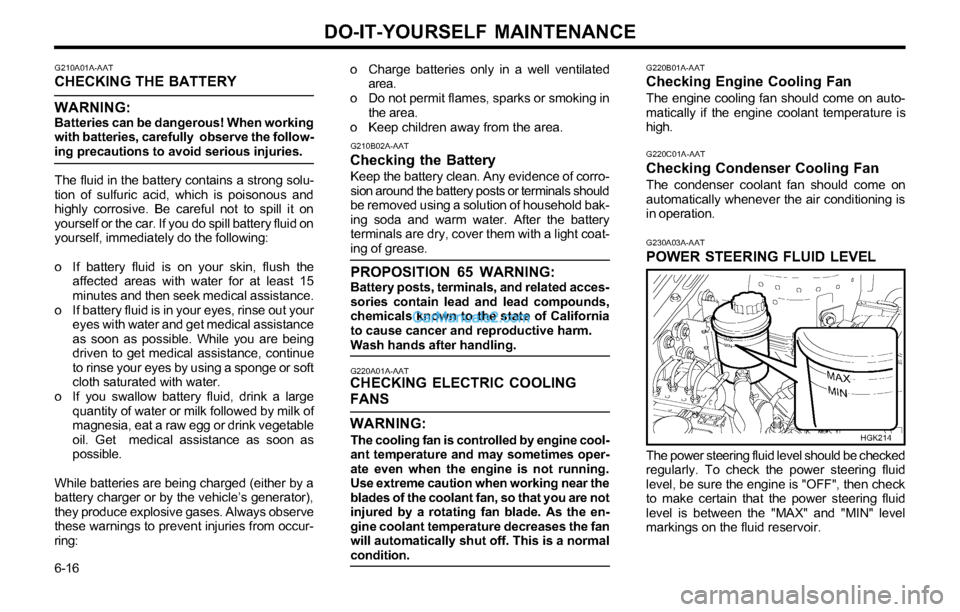
G230A03A-AATPOWER STEERING FLUID LEVEL
The power steering fluid level should be checked
regularly. To check the power steering fluid
level, be sure the engine is "OFF", then check
to make certain that the power steering fluid
level is between the "MAX" and "MIN" level
markings on the fluid reservoir.
HGK214 G220A01A-AAT
CHECKING ELECTRIC COOLING
FANS
WARNING:
The cooling fan is controlled by engine cool-
ant temperature and may sometimes oper-
ate even when the engine is not running.
Use extreme caution when working near the
blades of the coolant fan, so that you are not
injured by a rotating fan blade. As the en-
gine coolant temperature decreases the fan
will automatically shut off. This is a normal
condition.
G210A01A-AATCHECKING THE BATTERY
WARNING:
Batteries can be dangerous! When working
with batteries, carefully observe the follow-
ing precautions to avoid serious injuries.
The fluid in the battery contains a strong solu-
tion of sulfuric acid, which is poisonous and
highly corrosive. Be careful not to spill it on
yourself or the car. If you do spill battery fluid on
yourself, immediately do the following:
o If battery fluid is on your skin, flush the
affected areas with water for at least 15
minutes and then seek medical assistance.
o If battery fluid is in your eyes, rinse out your
eyes with water and get medical assistance
as soon as possible. While you are being
driven to get medical assistance, continue
to rinse your eyes by using a sponge or soft
cloth saturated with water.
o If you swallow battery fluid, drink a large
quantity of water or milk followed by milk of
magnesia, eat a raw egg or drink vegetable
oil. Get medical assistance as soon as
possible.
While batteries are being charged (either by a
battery charger or by the vehicle’s generator),
they produce explosive gases. Always observe
these warnings to prevent injuries from occur-
ring:
Page 148 of 169
DO-IT-YOURSELF MAINTENANCE
6-17 manual used by dealership technicians and
while it is highly technical it can be useful in
obtaining a better understanding of your car
and how it works.
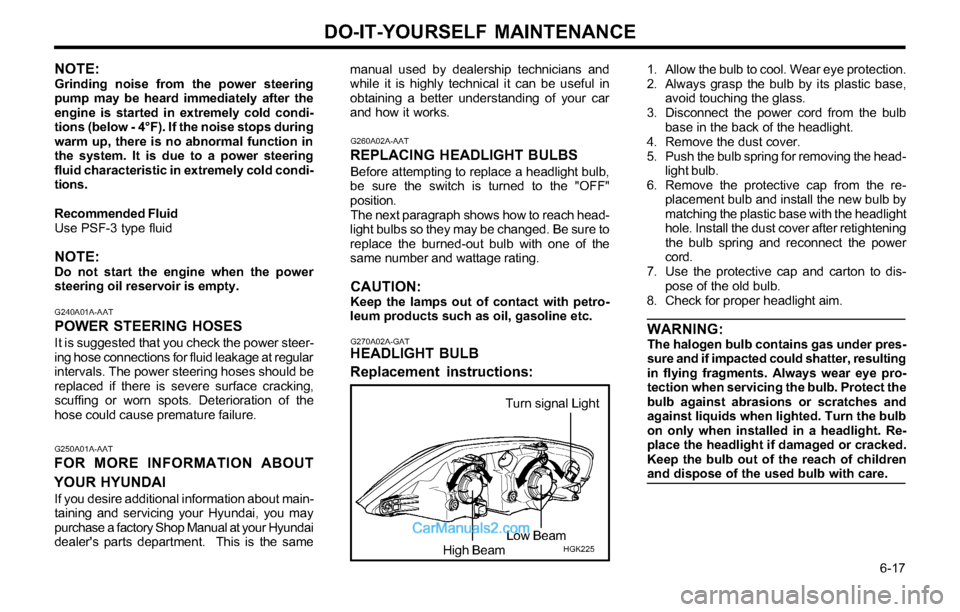
G260A02A-AATREPLACING HEADLIGHT BULBS
Before attempting to replace a headlight bulb,
be sure the switch is turned to the "OFF"
position.
The next paragraph shows how to reach head-
light bulbs so they may be changed. Be sure to
replace the burned-out bulb with one of the
same number and wattage rating.
CAUTION:Keep the lamps out of contact with petro-
leum products such as oil, gasoline etc.
NOTE:Grinding noise from the power steering
pump may be heard immediately after the
engine is started in extremely cold condi-
tions (below - 4°F). If the noise stops during
warm up, there is no abnormal function in
the system. It is due to a power steering
fluid characteristic in extremely cold condi-
tions.
Recommended Fluid
Use PSF-3 type fluid
NOTE:Do not start the engine when the power
steering oil reservoir is empty.
G240A01A-AAT
POWER STEERING HOSES
It is suggested that you check the power steer-
ing hose connections for fluid leakage at regular
intervals. The power steering hoses should be
replaced if there is severe surface cracking,
scuffing or worn spots. Deterioration of the
hose could cause premature failure.
G250A01A-AAT
FOR MORE INFORMATION ABOUT
YOUR HYUNDAI
If you desire additional information about main-
taining and servicing your Hyundai, you may
purchase a factory Shop Manual at your Hyundai
dealer's parts department. This is the same
G270A02A-GATHEADLIGHT BULB
Replacement instructions:
HGK225
1. Allow the bulb to cool. Wear eye protection.
2. Always grasp the bulb by its plastic base,
avoid touching the glass.
3. Disconnect the power cord from the bulb
base in the back of the headlight.
4. Remove the dust cover.
5. Push the bulb spring for removing the head-
light bulb.
6. Remove the protective cap from the re-
placement bulb and install the new bulb by
matching the plastic base with the headlight
hole. Install the dust cover after retightening
the bulb spring and reconnect the power
cord.
7. Use the protective cap and carton to dis-
pose of the old bulb.
8. Check for proper headlight aim.
WARNING:The halogen bulb contains gas under pres-
sure and if impacted could shatter, resulting
in flying fragments. Always wear eye pro-
tection when servicing the bulb. Protect the
bulb against abrasions or scratches and
against liquids when lighted. Turn the bulb
on only when installed in a headlight. Re-
place the headlight if damaged or cracked.
Keep the bulb out of the reach of children
and dispose of the used bulb with care.
High BeamLow Beam Turn signal Light
Page 149 of 169
DO-IT-YOURSELF MAINTENANCE
6-18
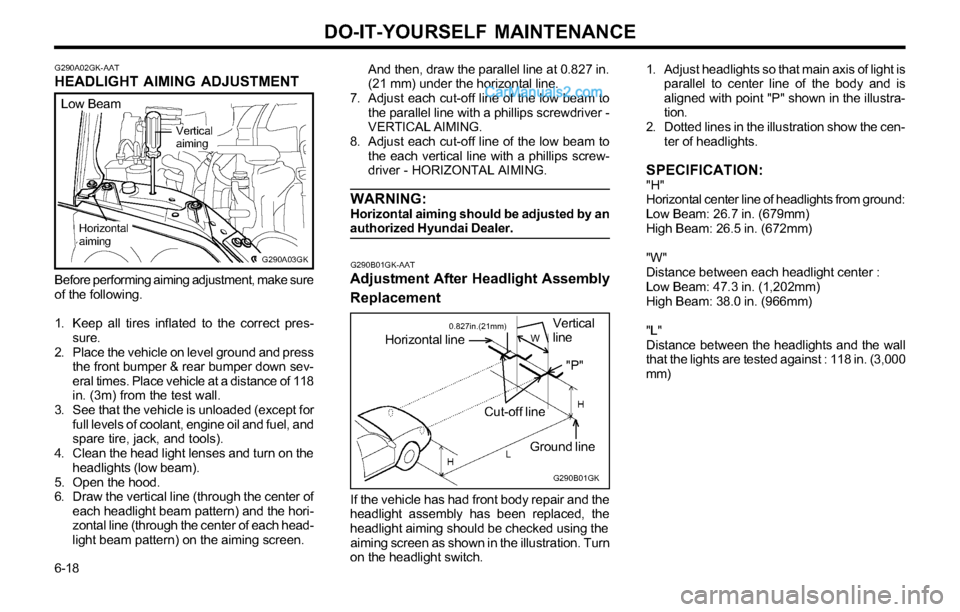
G290A02GK-AATHEADLIGHT AIMING ADJUSTMENT
Before performing aiming adjustment, make sure
of the following.
1. Keep all tires inflated to the correct pres-
sure.
2. Place the vehicle on level ground and press
the front bumper & rear bumper down sev-
eral times. Place vehicle at a distance of 118
in. (3m) from the test wall.
3. See that the vehicle is unloaded (except for
full levels of coolant, engine oil and fuel, and
spare tire, jack, and tools).
4. Clean the head light lenses and turn on the
headlights (low beam).
5. Open the hood.
6. Draw the vertical line (through the center of
each headlight beam pattern) and the hori-
zontal line (through the center of each head-
light beam pattern) on the aiming screen.And then, draw the parallel line at 0.827 in.
(21 mm) under the horizontal line.
7. Adjust each cut-off line of the low beam to
the parallel line with a phillips screwdriver -
VERTICAL AIMING.
8. Adjust each cut-off line of the low beam to
the each vertical line with a phillips screw-
driver - HORIZONTAL AIMING.
WARNING:Horizontal aiming should be adjusted by an
authorized Hyundai Dealer.
G290B01GK-AATAdjustment After Headlight Assembly
Replacement
G290B01GK
Vertical
line
Cut-off line
Ground line Horizontal line
LW
H
H
"P"
0.827in.(21mm)
If the vehicle has had front body repair and the
headlight assembly has been replaced, the
headlight aiming should be checked using the
aiming screen as shown in the illustration. Turn
on the headlight switch.
Horizontal
aiming
G290A03GK
Vertical
aiming
Low Beam1. Adjust headlights so that main axis of light is
parallel to center line of the body and is
aligned with point "P" shown in the illustra-
tion.
2. Dotted lines in the illustration show the cen-
ter of headlights.
SPECIFICATION:"H"
Horizontal center line of headlights from ground:
Low Beam: 26.7 in. (679mm)
High Beam: 26.5 in. (672mm)
"W"
Distance between each headlight center :
Low Beam: 47.3 in. (1,202mm)
High Beam: 38.0 in. (966mm)
"L"
Distance between the headlights and the wall
that the lights are tested against : 118 in. (3,000
mm)
Page 151 of 169
DO-IT-YOURSELF MAINTENANCE
6-20
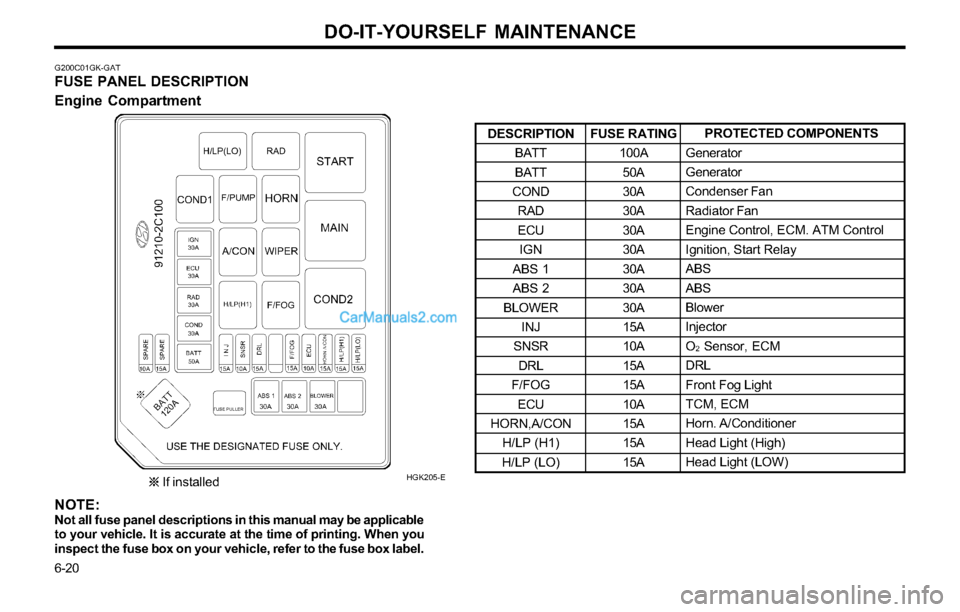
G200C01GK-GATFUSE PANEL DESCRIPTION
Engine Compartment
HGK205-E
PROTECTED COMPONENTS
Generator
Generator
Condenser Fan
Radiator Fan
Engine Control, ECM. ATM Control
Ignition, Start Relay
ABS
ABS
Blower
Injector
O
2 Sensor, ECM
DRL
Front Fog Light
TCM, ECM
Horn. A/Conditioner
Head Light (High)
Head Light (LOW) FUSE RATING
100A
50A
30A
30A
30A
30A
30A
30A
30A
15A
10A
15A
15A
10A
15A
15A
15A DESCRIPTION
BATT
BATT
COND
RAD
ECU
IGN
ABS 1
ABS 2
BLOWER
INJ
SNSR
DRL
F/FOG
ECU
HORN,A/CON
H/LP (H1)
H/LP (LO)
NOTE:Not all fuse panel descriptions in this manual may be applicable
to your vehicle. It is accurate at the time of printing. When you
inspect the fuse box on your vehicle, refer to the fuse box label.
If installed
Page 153 of 169
EMISSION CONTROL SYSTEMS
7-1
7. EMISSION CON-
TROL SYSTEMSH010B01A-AAT1. Crankcase Emission Control
System
The Positive Crankcase Ventilation System is
employed to prevent air pollution caused by
blow-by gases being emitted from the crank-
case. This system supplies fresh filtered air to
the crankcase through the air intake hose.
Inside the crankcase, the fresh air mixes with
blow-by gases, which then pass through the
PCV valve and into the induction system.
H010C01S-AAT2. Evaporative Emission Control (In-
cluding ORVR: Onboard Refueling
Vapor Recovery) System
The Evaporative Emission Control System is
designed to prevent fuel vapors from escaping
into the atmosphere.
(The ORVR system is designed to allow the
vapors from the fuel tank to be loaded into
a canister while refueling at the gas station,
preventing the escape of fuel vapors into
the atmosphere.)
Canister
Fuel vapors generated inside the fuel tank are
absorbed and stored in the onboard canister.
When the engine is running, the fuel vapors
absorbed in the canister are drawn into the
induction system through the purge control so-
lenoid valve.
Purge Control Solenoid Valve (PCSV)
The purge control solenoid valve is controlled
by the Engine Control Module (ECM); when the
engine coolant temperature is low during idling,
the PCSV closes so that evaporated fuel is not
taken into the engine. After the engine warms-
up during ordinary driving, the PCSV opens to
introduce evaporated fuel to the engine.
H010D01A-AAT
3. Exhaust Emission Control System
The Exhaust Emission Control System is a
highly effective system which controls exhaust
emissions while maintaining good vehicle per-
formance.
H010A01GK-AAT
EMISSION CONTROL SYSTEM
Your Hyundai is equipped with an emission
control system to meet all requirements of the
U.S. Environmental Protection Agency or Cali-
fornia Air Resources Board.
There are three emission control systems which
are as follows.
1) Crankcase Emission Control System
2) Evaporative Emission Control System
3) Exhaust Emission Control System
In order to ensure the proper function of the
emission control systems, it is recommended
that you have your car inspected and main-
tained by an authorized Hyundai dealer in ac-
cordance with the maintenance schedule in this
manual.
Caution for Inspection and Maintenance Test
(Vehicle with Traction Control System)
o To prevent the vehicle from misfiring
during dynamometer testing, disconnect
the ABS connector located inside of the
wheel guard (driver side).
o For more information, see shop manual
(BR Group, Wheel Speed Sensor).
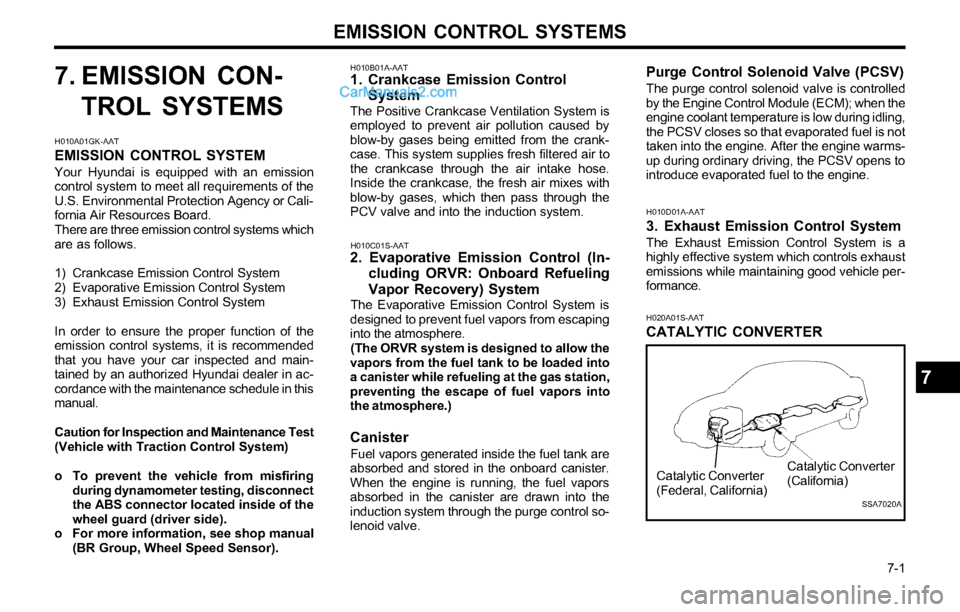
H020A01S-AAT
CATALYTIC CONVERTER
Catalytic Converter
(California)
SSA7020A
Catalytic Converter
(Federal, California)
7
Page 154 of 169
7-2
EMISSION CONTROL SYSTEMS
All Hyundai vehicles are equipped with one or
two monolith type three-way catalytic convert-
ers to reduce the carbon monoxide, hydrocar-
bons and nitrogen oxides contained in the ex-
haust gas. Exhaust gases passing through the
catalytic converter cause it to operate at a very
high temperature. The introduction of large
amounts of unburned gasoline into the exhaust
may cause the catalytic converter to overheat
and create a fire hazard. This risk may be
reduced by observing the following:
WARNING:o Use unleaded fuel only.
o Maintain the engine in good operating
condition. Extremely high catalytic con-
verter temperatures can result from im-
proper operation of the electrical, igni-
tion or multiport electronic fuel injection.
o If your engine stalls, pings, knocks, or is
hard to start, have your Hyundai dealer
inspect and repair the problem as soon
as possible.
o Avoid driving with a very low fuel level.
Running out of gasoline may cause the
engine to misfire and result in damage to
the catalytic converter.
o Avoid idling the engine for periods longer
than 10 minutes.
o The vehicle should not be pushed or
pulled to get started. This may cause the
catalytic converter to overheat and cre-
ate a fire hazard.o Do not touch the catalytic converter or
any other part of the exhaust system
while the catalytic converter is hot. Shut
off the engine, wait for at least one hour
before touching the catalytic converter
or any other part of the exhaust system.
o Remember that your Hyundai dealer is
your best source of assistance.
o Do not stop your Hyundai over any com-
bustible material such as grass, paper,
leaves or rags. These materials might
contact the hot catalytic converter and a
fire might result.
Page 155 of 169
CONSUMER INFORMATION & REPORTING SAFETY DEFECTS
8-1
8. CONSUMER
INFORMATION &
REPORTING SAFE-
TY DEFECTS
I010A01A-AAT
VEHICLE IDENTIFICATION
NUMBER (VIN)
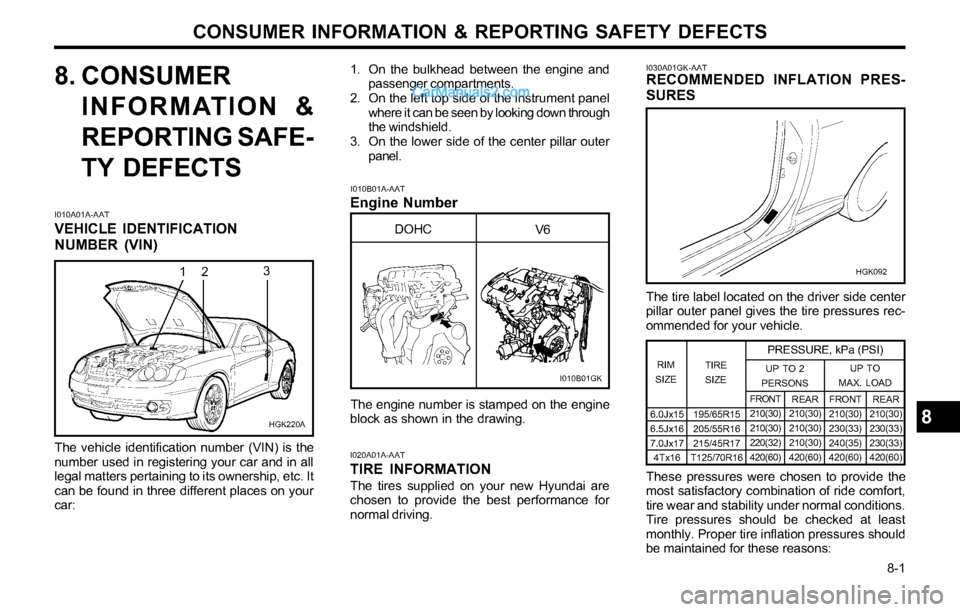
The vehicle identification number (VIN) is the
number used in registering your car and in all
legal matters pertaining to its ownership, etc. It
can be found in three different places on your
car:1. On the bulkhead between the engine and
passenger compartments.
2. On the left top side of the instrument panel
where it can be seen by looking down through
the windshield.
3. On the lower side of the center pillar outer
panel.
I010B01A-AATEngine Number
The engine number is stamped on the engine
block as shown in the drawing.
I020A01A-AAT
TIRE INFORMATION
The tires supplied on your new Hyundai are
chosen to provide the best performance for
normal driving.
I030A01GK-AATRECOMMENDED INFLATION PRES-
SURES
The tire label located on the driver side center
pillar outer panel gives the tire pressures rec-
ommended for your vehicle.
HGK220A
123
8
I010B01GK
DOHC
V6
HGK092
6.0Jx15
6.5Jx16
7.0Jx17
4Tx16TIRE
SIZE RIM
SIZE
PRESSURE, kPa (PSI)
195/65R15
205/55R16
215/45R17
T125/70R16REAR
210(30)
210(30)
210(30)
420(60)FRONT
210(30)
230(33)
240(35)
420(60) UP TO 2
PERSONSUP TO
MAX. LOAD
REAR
210(30)
230(33)
230(33)
420(60) FRONT
210(30)
210(30)
220(32)
420(60)
These pressures were chosen to provide the
most satisfactory combination of ride comfort,
tire wear and stability under normal conditions.
Tire pressures should be checked at least
monthly. Proper tire inflation pressures should
be maintained for these reasons: