weight Hyundai Tiburon 2003 Owner's Manual
[x] Cancel search | Manufacturer: HYUNDAI, Model Year: 2003, Model line: Tiburon, Model: Hyundai Tiburon 2003Pages: 169, PDF Size: 3.04 MB
Page 9 of 169
FEATURES OF YOUR HYUNDAI
1- 1
1. FEATURES OF
YOUR HYUNDAI
B010A03A-AAT
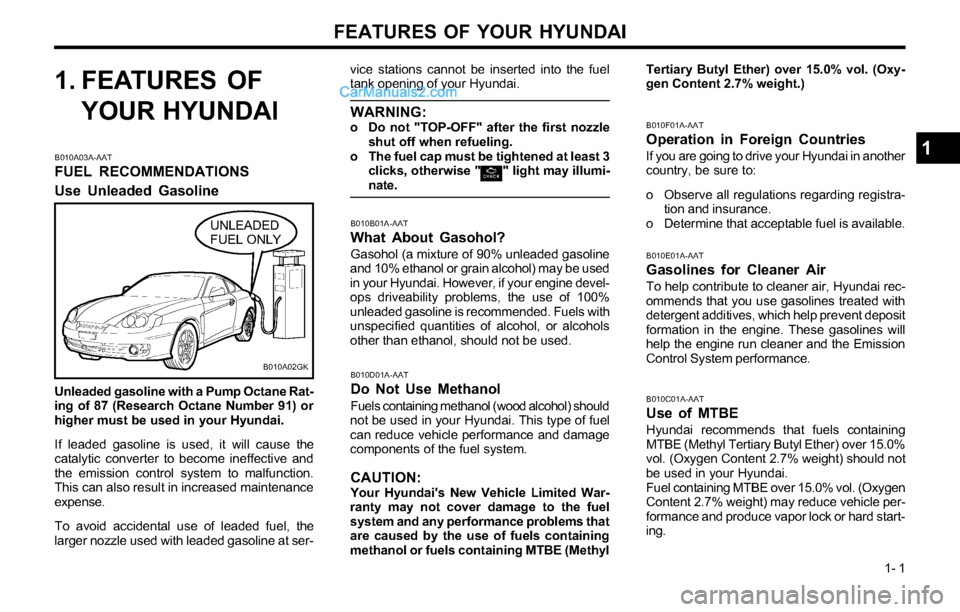
FUEL RECOMMENDATIONS
Use Unleaded Gasoline
vice stations cannot be inserted into the fuel
tank opening of your Hyundai.
WARNING:o Do not "TOP-OFF" after the first nozzle
shut off when refueling.
o The fuel cap must be tightened at least 3
clicks, otherwise " " light may illumi-
nate.
Unleaded gasoline with a Pump Octane Rat-
ing of 87 (Research Octane Number 91) or
higher must be used in your Hyundai.
If leaded gasoline is used, it will cause the
catalytic converter to become ineffective and
the emission control system to malfunction.
This can also result in increased maintenance
expense.
To avoid accidental use of leaded fuel, the
larger nozzle used with leaded gasoline at ser-UNLEADED
FUEL ONLY
B010B01A-AAT
What About Gasohol?
Gasohol (a mixture of 90% unleaded gasoline
and 10% ethanol or grain alcohol) may be used
in your Hyundai. However, if your engine devel-
ops driveability problems, the use of 100%
unleaded gasoline is recommended. Fuels with
unspecified quantities of alcohol, or alcohols
other than ethanol, should not be used.
B010D01A-AAT
Do Not Use Methanol
Fuels containing methanol (wood alcohol) should
not be used in your Hyundai. This type of fuel
can reduce vehicle performance and damage
components of the fuel system.
CAUTION:Your Hyundai's New Vehicle Limited War-
ranty may not cover damage to the fuel
system and any performance problems that
are caused by the use of fuels containing
methanol or fuels containing MTBE (Methyl
B010F01A-AAT
Operation in Foreign Countries
If you are going to drive your Hyundai in another
country, be sure to:
o Observe all regulations regarding registra-
tion and insurance.
o Determine that acceptable fuel is available.
B010E01A-AAT
Gasolines for Cleaner Air
To help contribute to cleaner air, Hyundai rec-
ommends that you use gasolines treated with
detergent additives, which help prevent deposit
formation in the engine. These gasolines will
help the engine run cleaner and the Emission
Control System performance.
B010A02GK
Tertiary Butyl Ether) over 15.0% vol. (Oxy-
gen Content 2.7% weight.)
B010C01A-AAT
Use of MTBE
Hyundai recommends that fuels containing
MTBE (Methyl Tertiary Butyl Ether) over 15.0%
vol. (Oxygen Content 2.7% weight) should not
be used in your Hyundai.
Fuel containing MTBE over 15.0% vol. (Oxygen
Content 2.7% weight) may reduce vehicle per-
formance and produce vapor lock or hard start-
ing.
1
Page 15 of 169
FEATURES OF YOUR HYUNDAI
1- 7
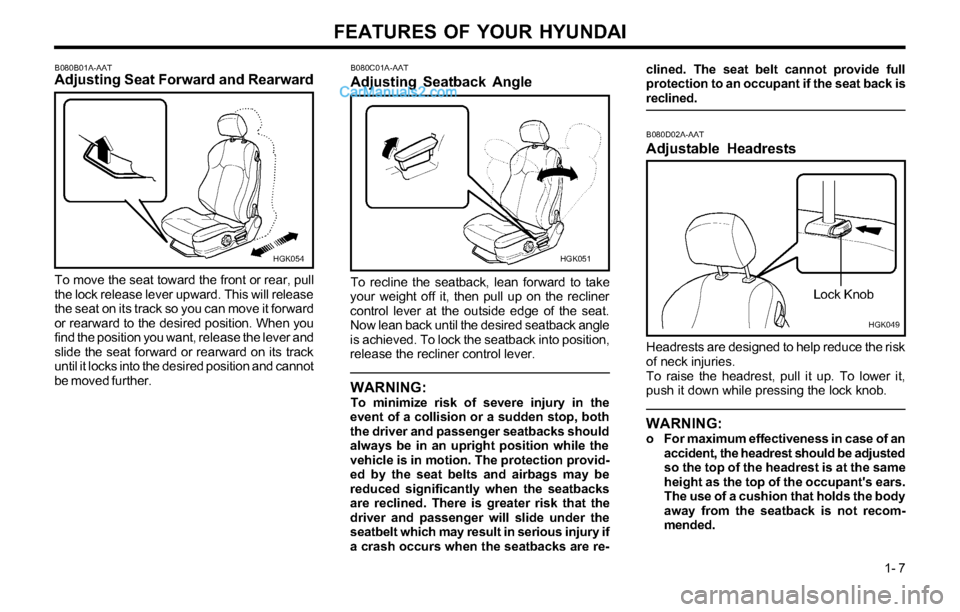
B080B01A-AATAdjusting Seat Forward and Rearward
To move the seat toward the front or rear, pull
the lock release lever upward. This will release
the seat on its track so you can move it forward
or rearward to the desired position. When you
find the position you want, release the lever and
slide the seat forward or rearward on its track
until it locks into the desired position and cannot
be moved further.
HGK054
B080C01A-AAT
Adjusting Seatback Angle
To recline the seatback, lean forward to take
your weight off it, then pull up on the recliner
control lever at the outside edge of the seat.
Now lean back until the desired seatback angle
is achieved. To lock the seatback into position,
release the recliner control lever.
WARNING:To minimize risk of severe injury in the
event of a collision or a sudden stop, both
the driver and passenger seatbacks should
always be in an upright position while the
vehicle is in motion. The protection provid-
ed by the seat belts and airbags may be
reduced significantly when the seatbacks
are reclined. There is greater risk that the
driver and passenger will slide under the
seatbelt which may result in serious injury if
a crash occurs when the seatbacks are re-
HGK051
clined. The seat belt cannot provide full
protection to an occupant if the seat back is
reclined.
B080D02A-AAT
Adjustable Headrests
Headrests are designed to help reduce the risk
of neck injuries.
To raise the headrest, pull it up. To lower it,
push it down while pressing the lock knob.
WARNING:o For maximum effectiveness in case of an
accident, the headrest should be adjusted
so the top of the headrest is at the same
height as the top of the occupant's ears.
The use of a cushion that holds the body
away from the seatback is not recom-
mended.
HGK049
Lock Knob
Page 18 of 169
FEATURES OF YOUR HYUNDAI
1- 10
B150C02A-AAT
Larger Children
Children who are too large for child restraint
systems should occupy the rear seat and use
the available lap/shoulder belts. The lap portion
should be fastened snug on the hips and as low
as possible. Check belt fit periodically. A child's
squirming could put the belt out of position.
Children are afforded the most safety in the
event of an accident when they are restrained
by a proper restraint system in the rear seat. If
a larger child (over age 13) must be seated in
the front seat, the child should be securely
restrained by the available lap/shoulder belt
and the seat should be placed in the rearmost
position. Children under the age of 13 should be
restrained securely in the rear seat. NEVER
place a rear facing child seat in the front seat of
a vehicle.
B150D01A-AAT
Pregnant Women
The use of a seat belt is recommended for
pregnant women to lessen the chance of injury
in an accident. When a seat belt is used, the lap
belt portion should be placed as low and snugly
as possible on the hips, not across the abdo-
men. For specific recommendations, consult a
physician.
B150B01F-AAT
Infant or Small Child
All 50 states have child restraint laws. You
should be aware of the specific requirements in
your state. Child and/or infant safety seats must
be properly placed and installed in the rear
seat. Information about the use of these re-
straints begins on page 1-14.
WARNING:Every person in your vehicle needs to be
properly restrained at all times, including
infants and children. In a collision, an unre-
strained child can become a "missile" in-
side the car. The force required to hold a
child on your lap could be so great that you
could not hold the child. Any child riding in
the vehicle should always be in a proper
restraint in the rear seat of the vehicle.
NOTE:Small children are best protected from in-
jury in an accident when properly restrained
in the rear seat by a child restraint system
that meets the requirements of the Federal
Motor Vehicle Safety Standards. Before buy-
ing any child restraint system, make sure
that it has a label certifying that it meets
Motor Vehicle Safety Standard 213. The re-
straint must be appropriate for your child's
height and weight. Check the label on the
child restraint for this information. See page
1-14.
WARNING:The purpose of the fold-down rear seatbacks
is to allow you to carry longer objects than
could otherwise be accommodated. Do not
allow passengers to sit on top of the folded
down seat back while the car is moving as
this is not a proper seating position and no
seat belts are available for use. This could
result in injury in case of an accident or
sudden stop. Objects carried on the folded
down seatback should not extend higher
than the top of the front seats. This could
allow cargo to slide forward and cause in-
jury or damage during sudden stops.
B150A01F-AAT
SEAT BELT PRECAUTIONS
WARNING:
All occupants of the vehicle must wear their
seat belts at all times. Note that this vehicle
is equipped with a Supplemental Restraint
(Airbag) System as discussed beginning on
page 1-18. The seat belts must be used in
conjunction with the supplemental airbag
system. State laws may require that some or
all occupants of the vehicle use seat belts.
The possibility of increased injury or sever-
ity of injury in an accident will be increased
if this elementary safety precaution is not
observed. In addition, the following recom-
mendations are made:
Page 106 of 169
DRIVING YOUR HYUNDAI
2- 11 o Remember, your Hyundai does not require
extended warm-up. As soon as the engine is
running smoothly, you can drive away. In
very cold weather, however, give your en-
gine a slightly longer warm-up period.
o Don't "lug" or "over-rev" the engine. Lugging
is driving too slowly in too high a gear
resulting in the engine bucking. If this hap-
pens, shift to a lower gear. Over-revving is
racing the engine beyond its safe limit. This
can be avoided by shifting at the recom-
mended speeds.
o Use your air conditioning sparingly. The air
conditioning system is operated by engine
power so your fuel economy is reduced
when you use it.
C150A01A-AAT
SMOOTH CORNERING
Avoid braking or gear changing in corners,
especially when roads are wet. Ideally, corners
should always be taken under gentle accelera-
tion. If you follow these suggestions, tire wear
will be held to a minimum.
C160A01A-AAT
WINTER DRIVING
The more severe weather conditions of winter
result in greater wear and other problems. To
minimize the problems of winter driving, you
should follow these suggestions: o Take care of your tires. Keep them inflated
to the recommended pressure. Incorrect in-
flation, either too much or too little, results in
unnecessary tire wear. Check the tire pres-
sures at least once a month.
o Be sure that the wheels are aligned correct-
ly. Improper alignment can result from hitting
curbs or driving too fast over irregular sur-
faces. Poor alignment causes faster tire
wear and may also result in other problems
as well as greater fuel consumption.
o Keep your car in good condition. For better
fuel economy and reduced maintenance
costs, maintain your car in accordance with
the maintenance schedule in Section 5. If
you drive your car in severe conditions,
more frequent maintenance is required (see
Section 5 for details).
o Keep your car clean. For maximum service,
your Hyundai should be kept clean and free
of corrosive materials. It is especially impor-
tant that mud, dirt, ice, etc. not be allowed to
accumulate on the underside of the car. This
extra weight can result in increased fuel
consumption and also contribute to corro-
sion.
o Travel lightly. Don't carry unnecessary weight
in your car. Weight reduces fuel economy.
o Don't let the engine idle longer than neces-
sary. If you are waiting (and not in traffic),
turn off your engine and restart only when
you're ready to go.
C160C01A-AATUse High Quality Ethylene Glycol
Coolant
Your Hyundai is delivered with high quality
ethylene glycol coolant in the cooling system. It
is the only type of coolant that should be used
because it helps prevent corrosion in the cool-
ing system, lubricates the water pump and
prevents freezing. Be sure to replace or replen-
ish your coolant in accordance with the main-
C160B01A-AATSnowy or Icy Conditions
To drive your vehicle in deep snow, it may be
necessary to use snow tires or to install tire
chains on your tires. If snow tires are needed,
it is necessary to select tires equivalent in size
and type to the original equipment tires. Failure
to do so may adversely affect the safety and
handling of your car. Speeding, rapid accelera-
tion, sudden brake applications, and sharp turns
are potentially very hazardous practices.
During deceleration, use engine braking to the
fullest extent. Sudden brake applications on
snowy or icy roads may cause skids to occur.
You need to keep sufficient distance between
the vehicle in front and your vehicle. Also, apply
the brake gently. It should be noted that install-
ing tire chains on the tire will provide a greater
driving force, but will not prevent side skids.
NOTE:Tire chains are not legal in all states. Check
state laws before fitting tire chains.
Page 107 of 169
DRIVING YOUR HYUNDAI
2- 12
C160K01A-AAT
Carry Emergency EquipmentDepending on the severity of the weather where
you drive your car, you should carry appropri-
ate emergency equipment. Some of the items
you may want to carry include tire chains, tow
straps or chains, flashlight, emergency flares,
sand, a shovel, jumper cables, a window
scraper, gloves, ground cloth, coveralls, a blan-
ket, etc.
C160J01A-AAT
Don’t Let Ice and Snow Accumulate
Underneath
Under some conditions, snow and ice can build
up under the fenders and interfere with the
steering. When driving in severe winter condi-
tions where this may happen, you should peri-
odically check underneath the car to be sure
the movement of the front wheels and the
steering components is not obstructed. transaxle) and block the rear wheels so the car
cannot roll. Then release the parking brake.
C160D01F-AATCheck Battery and Cables
Winter puts additional burdens on the battery
system. Visually inspect the battery and cables
as described in Section 6 (See page 6-16). The
level of charge in your battery can be checked
by your Hyundai dealer or a service station.
C160E01A-AATChange to "Winter Weight" Oil if
Necessary
In some climates it is recommended that a
lower viscosity "winter weight" oil be used dur-
ing cold weather. See Section 9 for recommen-
dations. If you aren’t sure what weight oil you
should use, consult your Hyundai dealer. tenance schedule in Section 5. Before winter,
have your coolant tested to assure that its
freezing point is sufficient for the temperatures
anticipated during the winter.
C160H01A-AATUse Approved Anti-Freeze in Window
Washer System
To keep the water in the window washer sys-
tem from freezing, add an approved anti-freeze
solution in accordance with instructions on the
container. Window washer anti-freeze is avail-
able from Hyundai dealers and most auto parts
outlets. Do not use engine coolant or other
types of anti-freeze as these may damage the
finish.
C160F01F-AATCheck Spark Plugs and Ignition
System
Inspect your spark plugs as described in Sec-
tion 6 (See page 6-6) and replace them if
necessary. Also check all ignition wiring and
components to be sure they are not cracked,
worn or damaged in any way.
C160G01A-AATTo Keep Locks from Freezing
To keep the locks from freezing, squirt an
approved de-icer fluid or glycerine into the key
opening. If a lock is covered with ice, squirt it
with an approved de-icing fluid to remove the
ice. If the lock is frozen internally, you may be
able to thaw it out by using a heated key.
Handle the heated key with care to avoid burn-
ing the fingers.
C160I01A-AAT
Don’t Let Your Parking Brake Freeze
Under some conditions your parking brake can
freeze in the engaged position. This is most
likely to happen when there is an accumulation
of snow or ice around or near the rear brakes or
if the brakes are wet. If there is a risk the
parking brake may freeze, apply it only tempo-
rarily while you put the gear selector lever in
"P" (automatic) or in first or reverse gear (manual
Page 109 of 169
DRIVING YOUR HYUNDAI
2- 14
Gross axle weight Gross vehicle weightSSA2200D
Lbs. (kg)
Maximum Towable Weight
Trailer
1000 (453)Tongue
100 (45)
CAUTION:The following specifications are recommend-
ed when towing a trailer. The loaded trailer
weight cannot safely exceed the values in
the chart below.
WARNING:Improperly loading your car and trailer can
seriously affect its steering and braking per-
formance causing a crash which could cause
serious injury or death.
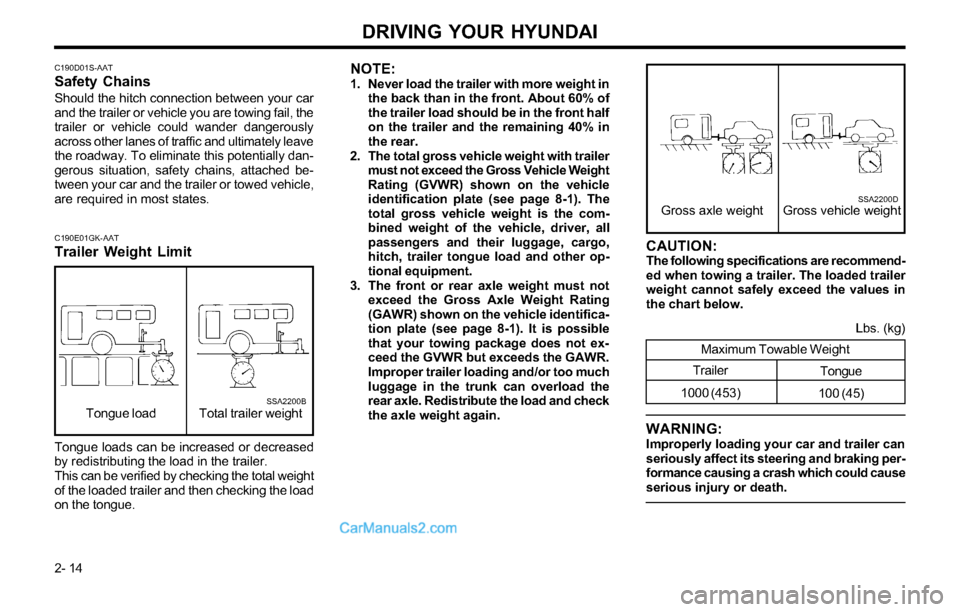
C190E01GK-AATTrailer Weight Limit
Tongue load Total trailer weightSSA2200B C190D01S-AAT
Safety Chains
Should the hitch connection between your car
and the trailer or vehicle you are towing fail, the
trailer or vehicle could wander dangerously
across other lanes of traffic and ultimately leave
the roadway. To eliminate this potentially dan-
gerous situation, safety chains, attached be-
tween your car and the trailer or towed vehicle,
are required in most states.
Tongue loads can be increased or decreased
by redistributing the load in the trailer.
This can be verified by checking the total weight
of the loaded trailer and then checking the load
on the tongue.
NOTE:1. Never load the trailer with more weight in
the back than in the front. About 60% of
the trailer load should be in the front half
on the trailer and the remaining 40% in
the rear.
2. The total gross vehicle weight with trailer
must not exceed the Gross Vehicle Weight
Rating (GVWR) shown on the vehicle
identification plate (see page 8-1). The
total gross vehicle weight is the com-
bined weight of the vehicle, driver, all
passengers and their luggage, cargo,
hitch, trailer tongue load and other op-
tional equipment.
3. The front or rear axle weight must not
exceed the Gross Axle Weight Rating
(GAWR) shown on the vehicle identifica-
tion plate (see page 8-1). It is possible
that your towing package does not ex-
ceed the GVWR but exceeds the GAWR.
Improper trailer loading and/or too much
luggage in the trunk can overload the
rear axle. Redistribute the load and check
the axle weight again.