seats Hyundai Tiburon 2006 User Guide
[x] Cancel search | Manufacturer: HYUNDAI, Model Year: 2006, Model line: Tiburon, Model: Hyundai Tiburon 2006Pages: 266, PDF Size: 10.94 MB
Page 37 of 266
1
FEATURES OF YOUR HYUNDAI
25
!
HGK261
B230G02O-AATChild Restraint System Installation on
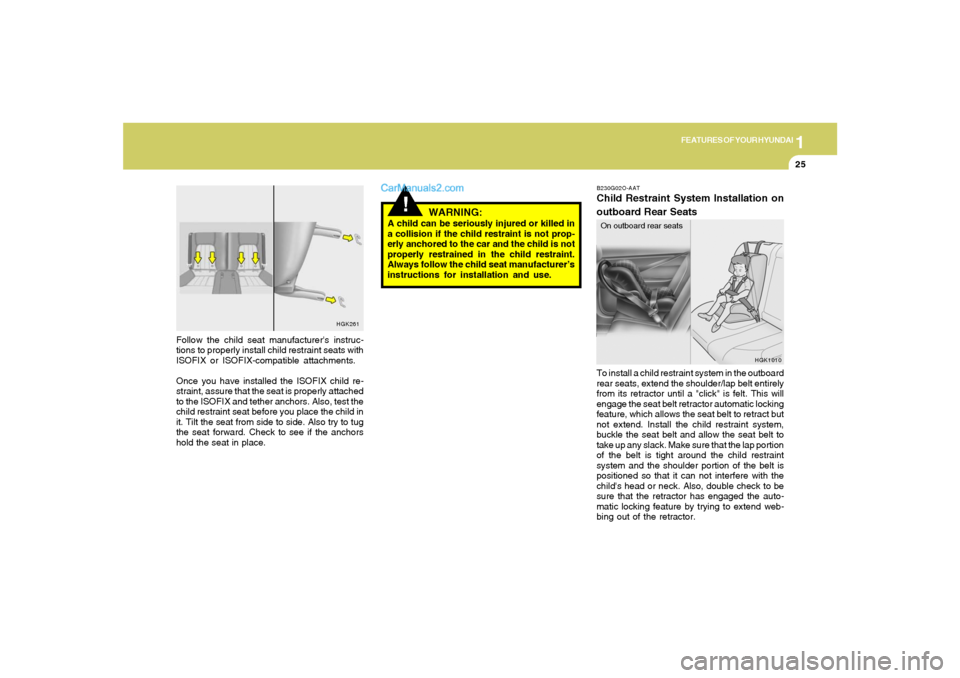
outboard Rear SeatsTo install a child restraint system in the outboard
rear seats, extend the shoulder/lap belt entirely
from its retractor until a "click" is felt. This will
engage the seat belt retractor automatic locking
feature, which allows the seat belt to retract but
not extend. Install the child restraint system,
buckle the seat belt and allow the seat belt to
take up any slack. Make sure that the lap portion
of the belt is tight around the child restraint
system and the shoulder portion of the belt is
positioned so that it can not interfere with the
child's head or neck. Also, double check to be
sure that the retractor has engaged the auto-
matic locking feature by trying to extend web-
bing out of the retractor.On outboard rear seats
HGK1010
Follow the child seat manufacturer's instruc-
tions to properly install child restraint seats with
ISOFIX or ISOFIX-compatible attachments.
Once you have installed the ISOFIX child re-
straint, assure that the seat is properly attached
to the ISOFIX and tether anchors. Also, test the
child restraint seat before you place the child in
it. Tilt the seat from side to side. Also try to tug
the seat forward. Check to see if the anchors
hold the seat in place.
WARNING:
A child can be seriously injured or killed in
a collision if the child restraint is not prop-
erly anchored to the car and the child is not
properly restrained in the child restraint.
Always follow the child seat manufacturer’s
instructions for installation and use.
Page 41 of 266
1
FEATURES OF YOUR HYUNDAI
29
!
NOTE:o Be sure to read information about the
SRS on the labels provided on the front
of the sun visor and in the glove box.
o If you are considering modification of
your vehicle due to a disability, please
contact the Hyundai Customer Assis-
tance Center at 1-800-633-5151.
WARNING:
Always use seat belts and child restraints –
every trip, every time, everyone! Airbags
inflate with considerable force and in the
blink of an eye. Seat belts help keep occu-
pants in proper position to obtain maxi-
mum benefit from the airbag. Always fol-
low the precautions about seat belts, airbags
and occupant safety contained in this
manual.
To reduce the chance of serious or fatal
injuries and receive the maximum safety
benefit from your restraint system:
o Never place a child in any child or booster
seat in the front seat (see child restraints
1-21).
o ABC – Always Buckle Children in the
back seat. It is the safest place for
children of any age to ride
o Front and side impact airbags can injure
occupants improperly positioned in the
front seats
!
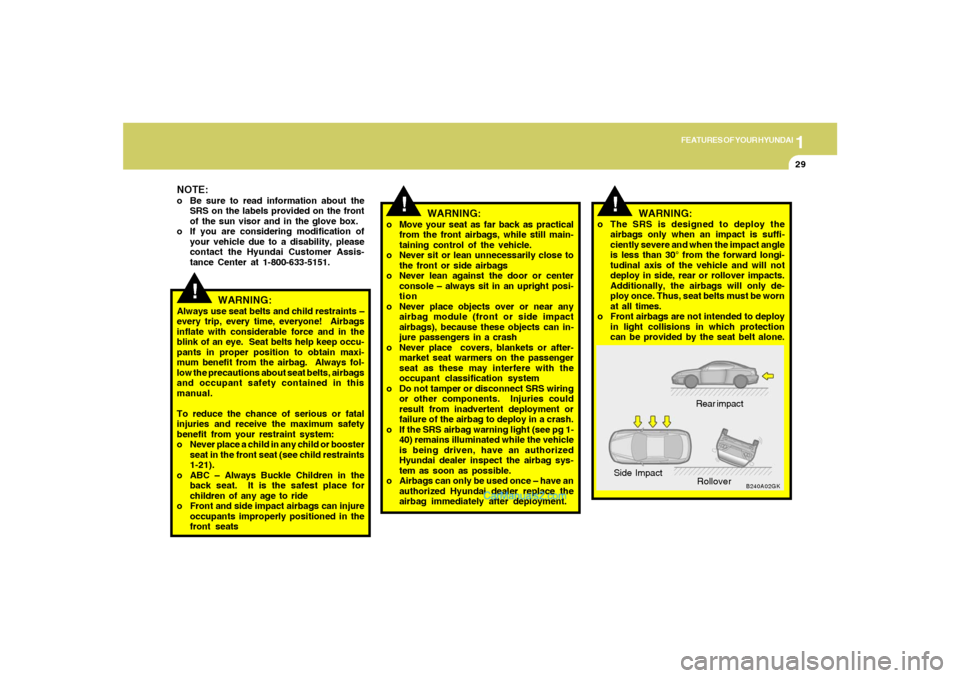
o The SRS is designed to deploy the
airbags only when an impact is suffi-
ciently severe and when the impact angle
is less than 30° from the forward longi-
tudinal axis of the vehicle and will not
deploy in side, rear or rollover impacts.
Additionally, the airbags will only de-
ploy once. Thus, seat belts must be worn
at all times.
o Front airbags are not intended to deploy
in light collisions in which protection
can be provided by the seat belt alone.
WARNING:
Rear impact
B240A02GK
Side Impact
Rollover
!
WARNING:
o Move your seat as far back as practical
from the front airbags, while still main-
taining control of the vehicle.
o Never sit or lean unnecessarily close to
the front or side airbags
o Never lean against the door or center
console – always sit in an upright posi-
tion
o Never place objects over or near any
airbag module (front or side impact
airbags), because these objects can in-
jure passengers in a crash
o Never place covers, blankets or after-
market seat warmers on the passenger
seat as these may interfere with the
occupant classification system
o Do not tamper or disconnect SRS wiring
or other components. Injuries could
result from inadvertent deployment or
failure of the airbag to deploy in a crash.
o If the SRS airbag warning light (see pg 1-
40) remains illuminated while the vehicle
is being driven, have an authorized
Hyundai dealer inspect the airbag sys-
tem as soon as possible.
o Airbags can only be used once – have an
authorized Hyundai dealer replace the
airbag immediately after deployment.
Page 47 of 266
1
FEATURES OF YOUR HYUNDAI
35
B240D02JM-AATAdditional Safety PrecautionsoNever let passengers ride in the cargo
area (trunk) or on top of a folded-down
back seat. All occupants should sit upright,
fully back in their seats with their seat belts
on and their feet on the floor.
oPassengers should not move out of or
change seats while the vehicle is mov-
ing. A passenger who is not wearing a seat
belt during a crash or emergency stop can
be thrown against the inside of the vehicle,
against other occupants, or out of the ve-
hicle.
oEach seat belt is designed to restrain one
occupant. If more than one person uses the
same seat belt, they could be seriously
injured or killed in a collision.
oDo not use any accessories on seat
belts. Devices claiming to improve occu-
pant comfort or reposition the seat belt can
reduce the protection provided by the seat
belt and increase the chance of serious
injury in a crash.
oPassengers should not place hard or
sharp objects between themselves and
the airbags. Carrying hard or sharp objects
on your lap or in your mouth can result in
injuries if an airbag inflates.oKeep occupants away from the airbag
covers. All occupants should sit upright, fully
back in their seats with their seat belts on and
their feet on the floor. If occupants are too
close to the airbag covers, they could be
injured if the airbags inflate.
oDo not attach or place objects on or near
the airbag covers. Any object attached to
or placed on the front or side impact airbag
covers could interfere with the proper opera-
tion of the airbags.
oDo not modify the front seats. Modifica-
tion of the front seats could interfere with the
operation of the supplemental restraint sys-
tem sensing components or side impact
airbags.
oDo not place items under the front seats.
Placing items under the front seats could
interfere with the operation of the supple-
mental restraint system sensing compo-
nents and wiring harnesses.
oNever hold an infant or child on your lap.
The infant or child could be seriously injured
or killed in the event of a crash. All infants and
children should be properly restrained in
appropriate child safety seats or seat belts
in the rear seat.
WARNING:
o Sitting improperly or out of position can
cause occupants to be shifted too close
to a deploying airbag, strike the interior
structure or be thrown from the vehicle
resulting in serious injury or death.
o Always sit upright with the seatback in
an upright position, centered on the
seat cushion with your seat belt on, legs
comfortably extended and your feet on
the floor.Adding Equipment to or Modifying Your
Airbag-Equipped Vehicle.If you modify your vehicle by changing your
vehicle's frame, bumper system, front end or
side sheet metal or ride height, this may affect
the operation of your vehicle's airbag system.
!
Page 165 of 266
2
DRIVING YOUR HYUNDAI
26
!
!
WARNING:
Items you carry inside your vehicle
can strike and injure people in a
sudden stop or turn, or in a crash.
o Put things in the cargo area of
your vehicle. Try to spread the
weight evenly.
o Never stack items, like suitcases,
inside the vehicle above the tops
of the seats.
o Do not leave an unsecured child
restraint in your vehicle.
o When you carry something inside
the vehicle, secure it.
o Do not drive with a seat folded
down unless necessary. NOTE:
o Overloading your vehicle may
cause damage. Repairs would not
be covered by your warranty. Do
not overload your vehicle.
o Using heavier suspension com-
ponents to get added durability
might not change your weight rat-
ings. Ask your dealer to help you
load your vehicle the right way.
The label will help you decide how much
cargo and installed equipment your
vehicle can carry.
If you carry items inside your vehicle –
like suitcases, tools, packages, or any-
thing else – they more as fast as the
vehicle goes. If you have to stop or turn
quickly, or if there is a crash, the items
will keep going and can cause an injury
if they strikes the driver or a passenger. WARNING:
o Overloading your vehicle can
cause heat buildup in your
vehicle's tires and possible tire
failure that could lead to a crash.
o Overloading your vehicle can
cause increased stopping dis-
tances that could lead to a crash.
o A crash resulting from poor han-
dling vehicle damage, tire failure,
or increased stopping distances
could result in serious injury or
death.
Page 245 of 266
8
CONSUMER INFORMATION, REPORTING SAFETY DEFECTS & BINDING ARBITRATION OF WARRANTY CLAIMS
7
6. Maximum load rating
This number indicates the maximum
load in kilograms and pounds that
can be carried by the tire. When
replacing the tires on the vehicle,
always use a tire that has the same
load rating as the factory installed
tire.
7. Uniform Tire Quality Grading
(UTQG):
Tire manufacturers are required to
grade tires based on three perfor-
mance factors: treadwear, traction
and temperature resistance. For more
information, see Uniform Tire Qual-
ity Grading on page 8-14.
I030D01JM-AATTIRE TERMINOLOGY AND DEFINI-
TIONS
Air Pressure: The amount of air inside
the tire pressing outward on the tire. Air
pressure is expressed in pounds per
square inch (psi) or kilopascal (kPa).
Accessory Weight: This means the
combined weight of optional accesso-
ries. Some examples of optional ac-
cessories are, automatic transmission,
power seats, and air conditioning.
Aspect Ratio: The relationship of a
tire's height to its width.
Belt: A rubber coated layer of cords that
is located between the plies and the
tread. Cords may be made from steel or
other reinforcing materials.
Bead: The tire bead contains steel
wires wrapped by steel cords that hold
the tire onto the rim.
Bias Ply Tire: A pneumatic tire in which
the plies are laid at alternate angles
less than 90 degrees to the centerline of
the tread.Cold Tire Pressure: The amount of air
pressure in a tire, measured in pounds
per square inch (psi) or kilopascals
(kPa) before a tire has built up heat from
driving.
Curb Weight: This means the weight of
a motor vehicle with standard and op-
tional equipment including the maxi-
mum capacity of fuel, oil and coolant,
but without passengers and cargo.
DOT Markings: A code molded into the
sidewall of a tire signifying that the tire
is in compliance with the U.S. Depart-
ment of Transportation motor vehicle
safety standards. The DOT code in-
cludes the Tire Identification Number
(TIN), an alphanumeric designator which
can also identify the tire manufacturer,
production plant, brand and date of
production.
GVWR: Gross Vehicle Weight Rating
GAWR FRT: Gross Axle Weight Rating
for the front Axle.
GAWR RR: Gross Axle Weight Rating
for the rear axle.
Page 261 of 266
10
INDEX
3
D
Defrosting/Defogging........................................................................1-79
Door
Central door lock............................................................................ 1-6
Door locks...................................................................................... 1-4
Front door edge warning light ......................................................1-61
Locking, unlocking front door with a key ...................................... 1-5
Drink Holder ......................................................................................1-54
Drive Belts.............................................................................. 6-18, 6-21
Driving
Economical driving .......................................................................2-15
Smooth cornering.........................................................................2-16
Winter driving...............................................................................2-16
E
Electronic Stability Program (ESP) ...................................................2-13
Emissions Control Systems ............................................................... 7-1
Engine
Before starting the engine .............................................................. 2-3
Compartment................................................................................. 6-2
Coolant........................................................................................... 6-7
Coolant temperature gauge .........................................................1-42
If the engine overheats .................................................................. 3-4
Number........................................................................................... 8-2
Oil ................................................................................................... 6-5
Starting........................................................................................... 2-5
Engine Exhaust Can Be Dangerous .................................................. 2-2F
Floor mat Anchor ..............................................................................1-66
Front Fog Light Switch ......................................................................1-51
Front Seats
Adjustable front seats ..................................................................1-10
Adjustable headrests...................................................................1-12
Adjusting seatback angle .............................................................1-11
Adjusting seat forward and rearward ..........................................1-11
Lumbar support control ...............................................................1-13
Seat cushion height adjustment ..................................................1-13
Fuel
Capacity......................................................................................... 9-2
Gauge...........................................................................................1-42
Recommendations......................................................................... 1-2
Fuel Filler Lid
Remote release............................................................................1-62
Fuses
Fuse Panel Description ...............................................................6-38
G
General Everyday Checks................................................................. 6-4
Glove box ..........................................................................................1-58
H
Hazard Warning System ..................................................................1-52
Headlight Aiming Adjustment ............................................................6-26
Headlight Bulb....................................................................................6-28
Page 262 of 266
10
INDEX
4
Heating and cooling control
Rotary Type.................................................................................1-71
Automatic Type ............................................................................1-80
High-mounted Rear Stop light ...........................................................1-61
Hood Release....................................................................................1-61
Horn.................................................................................................1-66
I
Ignition Switch ...................................................................................... 2-3
Instrument Cluster and Indicator Lights...........................................1-36
Intermittent Wiper..............................................................................1-50
J
Jump Starting...................................................................................... 3-3
K
Keys................................................................................................... 1-3
If you lose your keys ...................................................................3-14
Positions......................................................................................... 2-3
L
Lubrication Chart................................................................................. 9-4
Luggage Net ......................................................................................1-66M
Maintenance Intervals
Explanation of scheduled maintenance items ............................... 5-7
Maintenance under severe usage conditions............................... 5-6
Scheduled maintenance................................................................ 5-4
Service requirements.................................................................... 5-2
Map Light...........................................................................................1-57
Mirror
Day-night inside rearview ............................................................1-59
Outside rear view .........................................................................1-58
O
Odometer..........................................................................................1-43
P
Parking Brake....................................................................................1-60
Power Steering Fluid Level ...............................................................6-26
Power Window.................................................................................... 1-9
Pre-tensioner Seat Belt .....................................................................1-26
R
Radio (H250, H260, H280, J290).................... 1-90, 1-95, 1-104, 1-115
Rear Seats
Before folding the rear seats .......................................................1-14
Fold down.....................................................................................1-15
Rear seat entry ............................................................................1-14
Rear seat positions......................................................................1-13
Rear Window Defroster Switch ........................................................1-52
Reporting Safety Defects .................................................................
8-16