belt Hyundai Tiburon 2006 Owner's Guide
[x] Cancel search | Manufacturer: HYUNDAI, Model Year: 2006, Model line: Tiburon, Model: Hyundai Tiburon 2006Pages: 266, PDF Size: 10.94 MB
Page 40 of 266
1FEATURES OF YOUR HYUNDAI28
SUPPLEMENTAL RESTRAINT
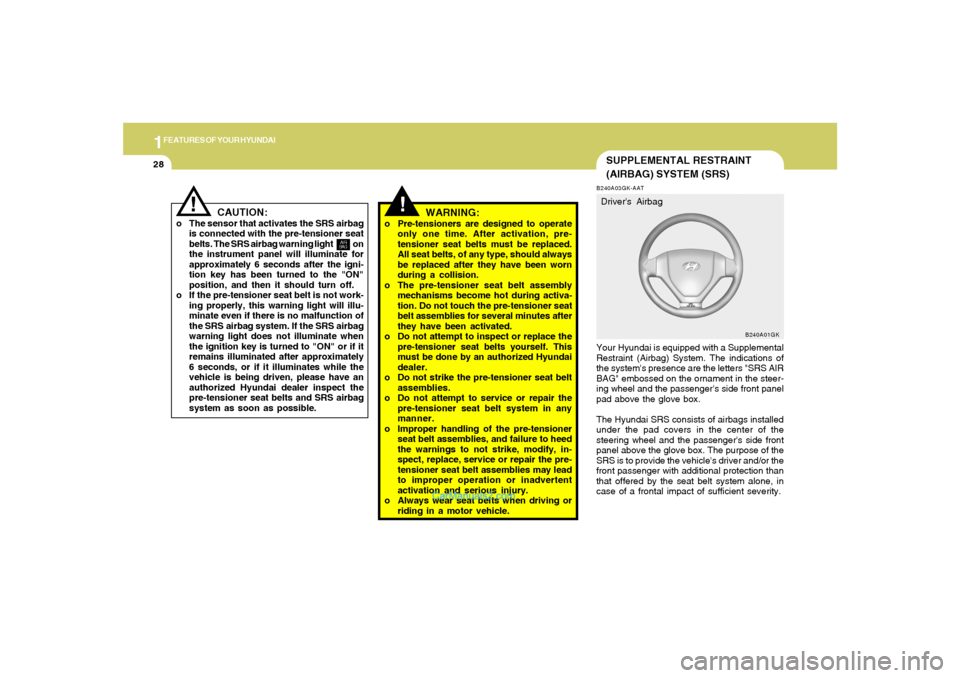
(AIRBAG) SYSTEM (SRS)B240A03GK-AATYour Hyundai is equipped with a Supplemental
Restraint (Airbag) System. The indications of
the system's presence are the letters "SRS AIR
BAG" embossed on the ornament in the steer-
ing wheel and the passenger's side front panel
pad above the glove box.
The Hyundai SRS consists of airbags installed
under the pad covers in the center of the
steering wheel and the passenger's side front
panel above the glove box. The purpose of the
SRS is to provide the vehicle's driver and/or the
front passenger with additional protection than
that offered by the seat belt system alone, in
case of a frontal impact of sufficient severity.
B240A01GK
Driver's Airbag
!
WARNING:
o Pre-tensioners are designed to operate
only one time. After activation, pre-
tensioner seat belts must be replaced.
All seat belts, of any type, should always
be replaced after they have been worn
during a collision.
o The pre-tensioner seat belt assembly
mechanisms become hot during activa-
tion. Do not touch the pre-tensioner seat
belt assemblies for several minutes after
they have been activated.
o Do not attempt to inspect or replace the
pre-tensioner seat belts yourself. This
must be done by an authorized Hyundai
dealer.
o Do not strike the pre-tensioner seat belt
assemblies.
o Do not attempt to service or repair the
pre-tensioner seat belt system in any
manner.
o Improper handling of the pre-tensioner
seat belt assemblies, and failure to heed
the warnings to not strike, modify, in-
spect, replace, service or repair the pre-
tensioner seat belt assemblies may lead
to improper operation or inadvertent
activation and serious injury.
o Always wear seat belts when driving or
riding in a motor vehicle.
CAUTION:
o The sensor that activates the SRS airbag
is connected with the pre-tensioner seat
belts. The SRS airbag warning light on
the instrument panel will illuminate for
approximately 6 seconds after the igni-
tion key has been turned to the "ON"
position, and then it should turn off.
o If the pre-tensioner seat belt is not work-
ing properly, this warning light will illu-
minate even if there is no malfunction of
the SRS airbag system. If the SRS airbag
warning light does not illuminate when
the ignition key is turned to "ON" or if it
remains illuminated after approximately
6 seconds, or if it illuminates while the
vehicle is being driven, please have an
authorized Hyundai dealer inspect the
pre-tensioner seat belts and SRS airbag
system as soon as possible.
!
AIR
BAG
Page 41 of 266
1
FEATURES OF YOUR HYUNDAI
29
!
NOTE:o Be sure to read information about the
SRS on the labels provided on the front
of the sun visor and in the glove box.
o If you are considering modification of
your vehicle due to a disability, please
contact the Hyundai Customer Assis-
tance Center at 1-800-633-5151.
WARNING:
Always use seat belts and child restraints –
every trip, every time, everyone! Airbags
inflate with considerable force and in the
blink of an eye. Seat belts help keep occu-
pants in proper position to obtain maxi-
mum benefit from the airbag. Always fol-
low the precautions about seat belts, airbags
and occupant safety contained in this
manual.
To reduce the chance of serious or fatal
injuries and receive the maximum safety
benefit from your restraint system:
o Never place a child in any child or booster
seat in the front seat (see child restraints
1-21).
o ABC – Always Buckle Children in the
back seat. It is the safest place for
children of any age to ride
o Front and side impact airbags can injure
occupants improperly positioned in the
front seats
!
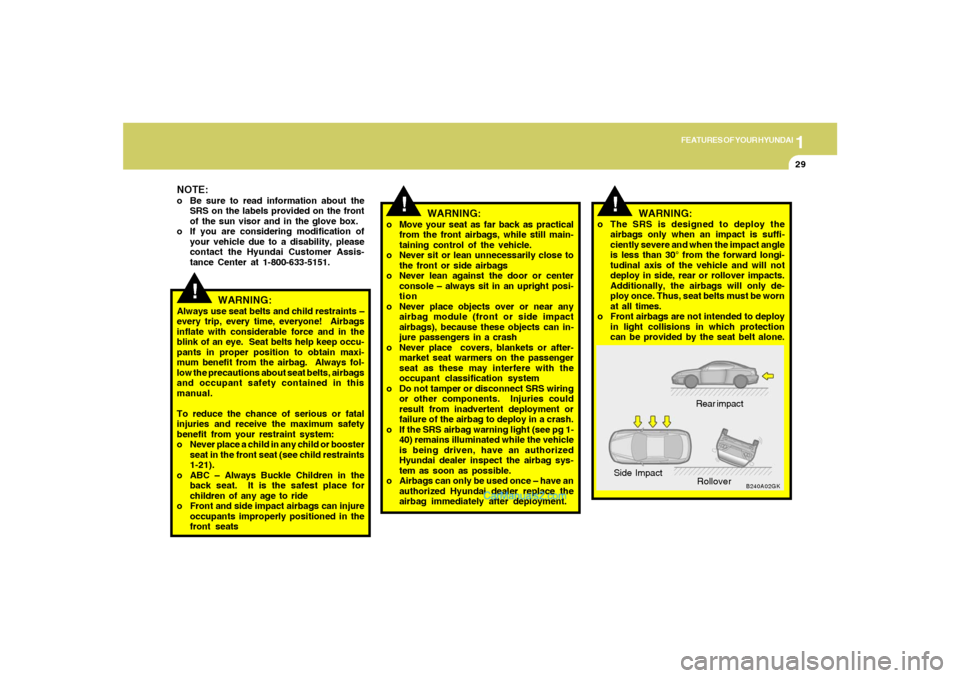
o The SRS is designed to deploy the
airbags only when an impact is suffi-
ciently severe and when the impact angle
is less than 30° from the forward longi-
tudinal axis of the vehicle and will not
deploy in side, rear or rollover impacts.
Additionally, the airbags will only de-
ploy once. Thus, seat belts must be worn
at all times.
o Front airbags are not intended to deploy
in light collisions in which protection
can be provided by the seat belt alone.
WARNING:
Rear impact
B240A02GK
Side Impact
Rollover
!
WARNING:
o Move your seat as far back as practical
from the front airbags, while still main-
taining control of the vehicle.
o Never sit or lean unnecessarily close to
the front or side airbags
o Never lean against the door or center
console – always sit in an upright posi-
tion
o Never place objects over or near any
airbag module (front or side impact
airbags), because these objects can in-
jure passengers in a crash
o Never place covers, blankets or after-
market seat warmers on the passenger
seat as these may interfere with the
occupant classification system
o Do not tamper or disconnect SRS wiring
or other components. Injuries could
result from inadvertent deployment or
failure of the airbag to deploy in a crash.
o If the SRS airbag warning light (see pg 1-
40) remains illuminated while the vehicle
is being driven, have an authorized
Hyundai dealer inspect the airbag sys-
tem as soon as possible.
o Airbags can only be used once – have an
authorized Hyundai dealer replace the
airbag immediately after deployment.
Page 42 of 266
1FEATURES OF YOUR HYUNDAI30
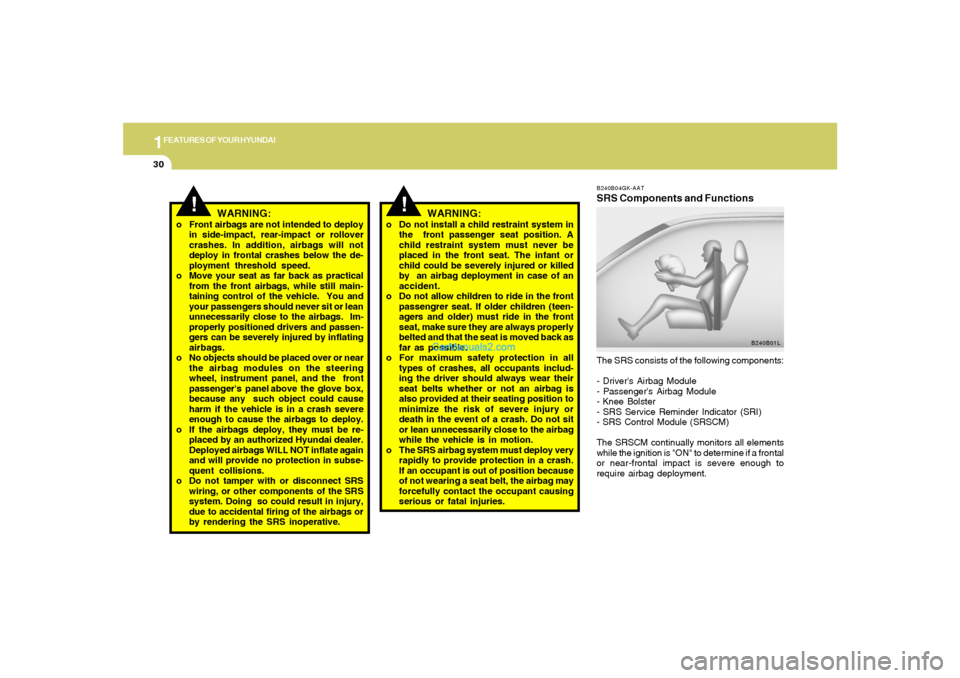
B240B04GK-AATSRS Components and FunctionsThe SRS consists of the following components:
- Driver's Airbag Module
- Passenger's Airbag Module
- Knee Bolster
- SRS Service Reminder Indicator (SRI)
- SRS Control Module (SRSCM)
The SRSCM continually monitors all elements
while the ignition is "ON" to determine if a frontal
or near-frontal impact is severe enough to
require airbag deployment.
B240B01L
o Front airbags are not intended to deploy
in side-impact, rear-impact or rollover
crashes. In addition, airbags will not
deploy in frontal crashes below the de-
ployment threshold speed.
o Move your seat as far back as practical
from the front airbags, while still main-
taining control of the vehicle. You and
your passengers should never sit or lean
unnecessarily close to the airbags. Im-
properly positioned drivers and passen-
gers can be severely injured by inflating
airbags.
o No objects should be placed over or near
the airbag modules on the steering
wheel, instrument panel, and the front
passenger's panel above the glove box,
because any such object could cause
harm if the vehicle is in a crash severe
enough to cause the airbags to deploy.
o If the airbags deploy, they must be re-
placed by an authorized Hyundai dealer.
Deployed airbags WILL NOT inflate again
and will provide no protection in subse-
quent collisions.
o Do not tamper with or disconnect SRS
wiring, or other components of the SRS
system. Doing so could result in injury,
due to accidental firing of the airbags or
by rendering the SRS inoperative.
!
WARNING:
!
o Do not install a child restraint system in
the front passenger seat position. A
child restraint system must never be
placed in the front seat. The infant or
child could be severely injured or killed
by an airbag deployment in case of an
accident.
o Do not allow children to ride in the front
passengrer seat. If older children (teen-
agers and older) must ride in the front
seat, make sure they are always properly
belted and that the seat is moved back as
far as possible.
o For maximum safety protection in all
types of crashes, all occupants includ-
ing the driver should always wear their
seat belts whether or not an airbag is
also provided at their seating position to
minimize the risk of severe injury or
death in the event of a crash. Do not sit
or lean unnecessarily close to the airbag
while the vehicle is in motion.
o The SRS airbag system must deploy very
rapidly to provide protection in a crash.
If an occupant is out of position because
of not wearing a seat belt, the airbag may
forcefully contact the occupant causing
serious or fatal injuries.
WARNING:
Page 43 of 266
1
FEATURES OF YOUR HYUNDAI
31
A fully inflated airbag in combination with a
properly worn seat belt slows the driver's or the
passenger's forward motion, thus reducing the
risk of head and chest injury.
After complete inflation, the airbag immediately
starts deflating, enabling the driver to maintain
forward visibility.
B240B03L
B240B02L
The SRS service reminder indicator (SRI) on
the instrument panel will illuminate for about 6
seconds after the ignition key is turned to the
"ON" position or after the engine is started, after
which the SRI should go out.
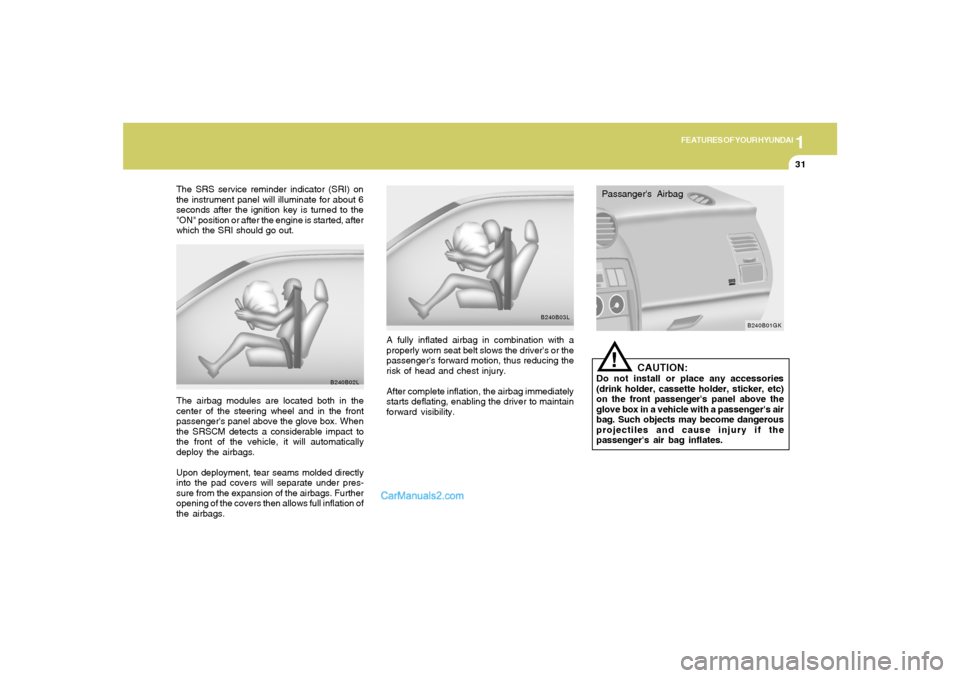
The airbag modules are located both in the
center of the steering wheel and in the front
passenger's panel above the glove box. When
the SRSCM detects a considerable impact to
the front of the vehicle, it will automatically
deploy the airbags.
Upon deployment, tear seams molded directly
into the pad covers will separate under pres-
sure from the expansion of the airbags. Further
opening of the covers then allows full inflation of
the airbags.
Passanger's Airbag
B240B01GK
!
CAUTION:
Do not install or place any accessories
(drink holder, cassette holder, sticker, etc)
on the front passenger's panel above the
glove box in a vehicle with a passenger's air
bag. Such objects may become dangerous
projectiles and cause injury if the
passenger's air bag inflates.
Page 44 of 266
1FEATURES OF YOUR HYUNDAI32
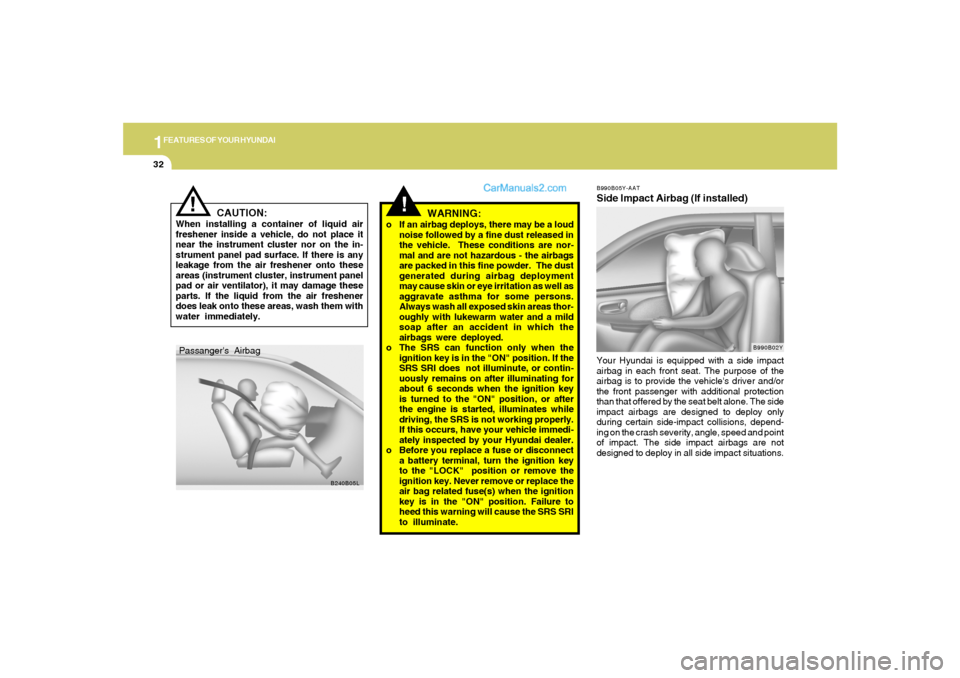
B990B05Y-AATSide Impact Airbag (If installed)Your Hyundai is equipped with a side impact
airbag in each front seat. The purpose of the
airbag is to provide the vehicle's driver and/or
the front passenger with additional protection
than that offered by the seat belt alone. The side
impact airbags are designed to deploy only
during certain side-impact collisions, depend-
ing on the crash severity, angle, speed and point
of impact. The side impact airbags are not
designed to deploy in all side impact situations.
B990B02Y
CAUTION:
When installing a container of liquid air
freshener inside a vehicle, do not place it
near the instrument cluster nor on the in-
strument panel pad surface. If there is any
leakage from the air freshener onto these
areas (instrument cluster, instrument panel
pad or air ventilator), it may damage these
parts. If the liquid from the air freshener
does leak onto these areas, wash them with
water immediately.
!
!
B240B05L
WARNING:
o If an airbag deploys, there may be a loud
noise followed by a fine dust released in
the vehicle. These conditions are nor-
mal and are not hazardous - the airbags
are packed in this fine powder. The dust
generated during airbag deployment
may cause skin or eye irritation as well as
aggravate asthma for some persons.
Always wash all exposed skin areas thor-
oughly with lukewarm water and a mild
soap after an accident in which the
airbags were deployed.
o The SRS can function only when the
ignition key is in the "ON" position. If the
SRS SRI does not illuminute, or contin-
uously remains on after illuminating for
about 6 seconds when the ignition key
is turned to the "ON" position, or after
the engine is started, illuminates while
driving, the SRS is not working properly.
If this occurs, have your vehicle immedi-
ately inspected by your Hyundai dealer.
o Before you replace a fuse or disconnect
a battery terminal, turn the ignition key
to the "LOCK" position or remove the
ignition key. Never remove or replace the
air bag related fuse(s) when the ignition
key is in the "ON" position. Failure to
heed this warning will cause the SRS SRI
to illuminate. Passanger's Airbag
Page 45 of 266
1
FEATURES OF YOUR HYUNDAI
33
!
o Do not install any accessories on the
side or near the side impact airbag.
o Do not place any objects over the airbag
or between the airbag and yourself.
o Do not place any objects (an umbrella,
bag, etc.) between the front door and the
front seat. Such objects may become
dangerous projectiles and cause injury
if the supplemental side impact airbag
inflates.
o To prevent unexpected deployment of
the side impact airbag that may result in
personal injury,avoid impact to the side
airbag sensor when the ignition key is
on.
WARNING:
!
WARNING:
o The side impact airbag is supplemental
to the driver's and the passenger's seat
belt systems and is not a substitute for
them. Therefore your seat belts must be
worn at all times while the vehicle is in
motion. The airbags deploy only in cer-
tain side impact conditions severe
enough to cause significant injury to the
vehicle occupants.
o For best protection from the side impact
airbag system and to avoid being injured
by the deploying side impact airbag,
both front seat occupants should sit in
an upright position with the seat belt
properly fastened. The driver's hands
should be placed on the steering wheel
at the 9:00 and 3:00 o'clock positions.
The passenger's arms and hands should
be placed on their laps.
o Do not use any accessory seat covers.
o Use of seat covers could prevent or
reduce the effectiveness of the system.
B240C04A-AATSRS Careo The SRS is virtually maintenance free and
there are no parts you can safely service by
yourself. If the SRS SRI (Service Reminder
Indicator) does not illuminate, or continu-
ously remains on, have your vehicle imme-
diately inspected by your Hyundai dealer.
o Any work on the SRS system, such as
removing, installing, repairing, or any work
on the steering wheel must be performed by
a qualified Hyundai technician. Improper
handling of the airbag system may result in
serious personal injury.
Page 47 of 266
1
FEATURES OF YOUR HYUNDAI
35
B240D02JM-AATAdditional Safety PrecautionsoNever let passengers ride in the cargo
area (trunk) or on top of a folded-down
back seat. All occupants should sit upright,
fully back in their seats with their seat belts
on and their feet on the floor.
oPassengers should not move out of or
change seats while the vehicle is mov-
ing. A passenger who is not wearing a seat
belt during a crash or emergency stop can
be thrown against the inside of the vehicle,
against other occupants, or out of the ve-
hicle.
oEach seat belt is designed to restrain one
occupant. If more than one person uses the
same seat belt, they could be seriously
injured or killed in a collision.
oDo not use any accessories on seat
belts. Devices claiming to improve occu-
pant comfort or reposition the seat belt can
reduce the protection provided by the seat
belt and increase the chance of serious
injury in a crash.
oPassengers should not place hard or
sharp objects between themselves and
the airbags. Carrying hard or sharp objects
on your lap or in your mouth can result in
injuries if an airbag inflates.oKeep occupants away from the airbag
covers. All occupants should sit upright, fully
back in their seats with their seat belts on and
their feet on the floor. If occupants are too
close to the airbag covers, they could be
injured if the airbags inflate.
oDo not attach or place objects on or near
the airbag covers. Any object attached to
or placed on the front or side impact airbag
covers could interfere with the proper opera-
tion of the airbags.
oDo not modify the front seats. Modifica-
tion of the front seats could interfere with the
operation of the supplemental restraint sys-
tem sensing components or side impact
airbags.
oDo not place items under the front seats.
Placing items under the front seats could
interfere with the operation of the supple-
mental restraint system sensing compo-
nents and wiring harnesses.
oNever hold an infant or child on your lap.
The infant or child could be seriously injured
or killed in the event of a crash. All infants and
children should be properly restrained in
appropriate child safety seats or seat belts
in the rear seat.
WARNING:
o Sitting improperly or out of position can
cause occupants to be shifted too close
to a deploying airbag, strike the interior
structure or be thrown from the vehicle
resulting in serious injury or death.
o Always sit upright with the seatback in
an upright position, centered on the
seat cushion with your seat belt on, legs
comfortably extended and your feet on
the floor.Adding Equipment to or Modifying Your
Airbag-Equipped Vehicle.If you modify your vehicle by changing your
vehicle's frame, bumper system, front end or
side sheet metal or ride height, this may affect
the operation of your vehicle's airbag system.
!
Page 49 of 266
1
FEATURES OF YOUR HYUNDAI
37
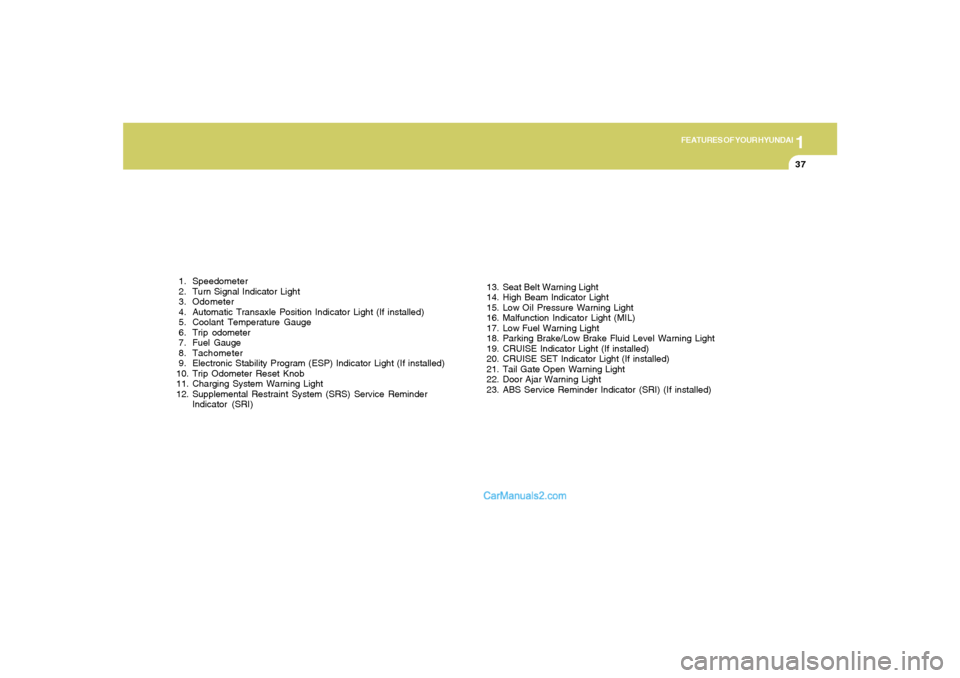
1. Speedometer
2. Turn Signal Indicator Light
3. Odometer
4. Automatic Transaxle Position Indicator Light (If installed)
5. Coolant Temperature Gauge
6. Trip odometer
7. Fuel Gauge
8. Tachometer
9. Electronic Stability Program (ESP) Indicator Light (If installed)
10. Trip Odometer Reset Knob
11. Charging System Warning Light
12. Supplemental Restraint System (SRS) Service Reminder
Indicator (SRI)13. Seat Belt Warning Light
14. High Beam Indicator Light
15. Low Oil Pressure Warning Light
16. Malfunction Indicator Light (MIL)
17. Low Fuel Warning Light
18. Parking Brake/Low Brake Fluid Level Warning Light
19. CRUISE Indicator Light (If installed)
20. CRUISE SET Indicator Light (If installed)
21. Tail Gate Open Warning Light
22. Door Ajar Warning Light
23. ABS Service Reminder Indicator (SRI) (If installed)
Page 51 of 266
1
FEATURES OF YOUR HYUNDAI
39
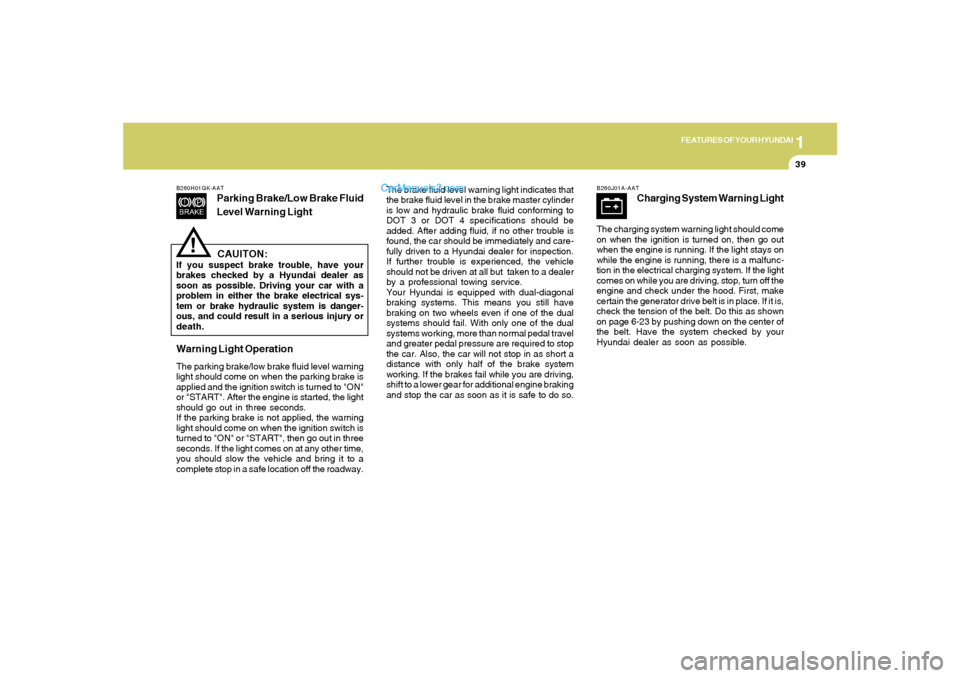
B260H01GK-AAT
Parking Brake/Low Brake Fluid
Level Warning Light
CAUITON:
If you suspect brake trouble, have your
brakes checked by a Hyundai dealer as
soon as possible. Driving your car with a
problem in either the brake electrical sys-
tem or brake hydraulic system is danger-
ous, and could result in a serious injury or
death.Warning Light OperationThe parking brake/low brake fluid level warning
light should come on when the parking brake is
applied and the ignition switch is turned to "ON"
or "START". After the engine is started, the light
should go out in three seconds.
If the parking brake is not applied, the warning
light should come on when the ignition switch is
turned to "ON" or "START", then go out in three
seconds. If the light comes on at any other time,
you should slow the vehicle and bring it to a
complete stop in a safe location off the roadway.The brake fluid level warning light indicates that
the brake fluid level in the brake master cylinder
is low and hydraulic brake fluid conforming to
DOT 3 or DOT 4 specifications should be
added. After adding fluid, if no other trouble is
found, the car should be immediately and care-
fully driven to a Hyundai dealer for inspection.
If further trouble is experienced, the vehicle
should not be driven at all but taken to a dealer
by a professional towing service.
Your Hyundai is equipped with dual-diagonal
braking systems. This means you still have
braking on two wheels even if one of the dual
systems should fail. With only one of the dual
systems working, more than normal pedal travel
and greater pedal pressure are required to stop
the car. Also, the car will not stop in as short a
distance with only half of the brake system
working. If the brakes fail while you are driving,
shift to a lower gear for additional engine braking
and stop the car as soon as it is safe to do so.
!
B260J01A-AAT
Charging System Warning Light
The charging system warning light should come
on when the ignition is turned on, then go out
when the engine is running. If the light stays on
while the engine is running, there is a malfunc-
tion in the electrical charging system. If the light
comes on while you are driving, stop, turn off the
engine and check under the hood. First, make
certain the generator drive belt is in place. If it is,
check the tension of the belt. Do this as shown
on page 6-23 by pushing down on the center of
the belt. Have the system checked by your
Hyundai dealer as soon as possible.
Page 52 of 266
1FEATURES OF YOUR HYUNDAI40
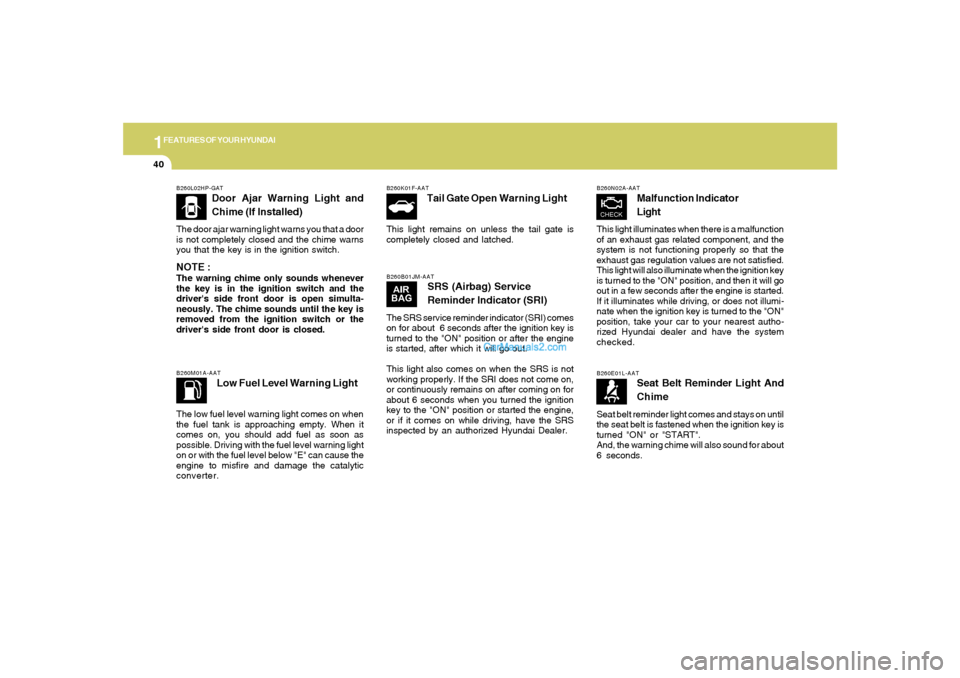
B260E01L-AAT
Seat Belt Reminder Light And
Chime
Seat belt reminder light comes and stays on until
the seat belt is fastened when the ignition key is
turned "ON" or "START".
And, the warning chime will also sound for about
6 seconds.
B260K01F-AAT
Tail Gate Open Warning Light
This light remains on unless the tail gate is
completely closed and latched.
B260M01A-AAT
Low Fuel Level Warning Light
The low fuel level warning light comes on when
the fuel tank is approaching empty. When it
comes on, you should add fuel as soon as
possible. Driving with the fuel level warning light
on or with the fuel level below "E" can cause the
engine to misfire and damage the catalytic
converter.B260L02HP-GAT
Door Ajar Warning Light and
Chime (If Installed)
The door ajar warning light warns you that a door
is not completely closed and the chime warns
you that the key is in the ignition switch.NOTE :The warning chime only sounds whenever
the key is in the ignition switch and the
driver's side front door is open simulta-
neously. The chime sounds until the key is
removed from the ignition switch or the
driver's side front door is closed.
B260B01JM-AAT
SRS (Airbag) Service
Reminder Indicator (SRI)
The SRS service reminder indicator (SRI) comes
on for about 6 seconds after the ignition key is
turned to the "ON" position or after the engine
is started, after which it will go out.
This light also comes on when the SRS is not
working properly. If the SRI does not come on,
or continuously remains on after coming on for
about 6 seconds when you turned the ignition
key to the "ON" position or started the engine,
or if it comes on while driving, have the SRS
inspected by an authorized Hyundai Dealer.
B260N02A-AAT
Malfunction Indicator
Light
This light illuminates when there is a malfunction
of an exhaust gas related component, and the
system is not functioning properly so that the
exhaust gas regulation values are not satisfied.
This light will also illuminate when the ignition key
is turned to the "ON" position, and then it will go
out in a few seconds after the engine is started.
If it illuminates while driving, or does not illumi-
nate when the ignition key is turned to the "ON"
position, take your car to your nearest autho-
rized Hyundai dealer and have the system
checked.