ESP Hyundai Tiburon 2006 Owner's Manual
[x] Cancel search | Manufacturer: HYUNDAI, Model Year: 2006, Model line: Tiburon, Model: Hyundai Tiburon 2006Pages: 266, PDF Size: 10.94 MB
Page 2 of 266
A010A02A-AAT
WARRANTIES FOR YOUR HYUNDAI VEHICLE
Please consult your Owner's Handbook & Warranty Information booklet for your vehicle's specific
warranty coverage.A020A01A-AAT
RESPONSIBILITY FOR MAINTENANCE
The maintenance requirements for your new Hyundai are found in Section 5. As the owner, it is your responsibility
to see that all maintenance operations specified by the manufacturer are carried out at the appropriate intervals.
When the vehicle is used in severe driving conditions, more frequent maintenance is required for some operations.
Maintenance requirements for severe operating conditions are also included in Section 5.
Page 6 of 266
A110A01A-AAT
VEHICLE DATA COLLECTION AND EVENT DATA RECORDERS
Your Hyundai vehicle is equipped with many high technology, electronically controlled systems that help to ensure
your vehicle operates properly and provides the performance that you expect. These systems utilize computers
to monitor the operation of various systems and components and help to control their operation. These
computerized system operations are wide-ranging and involve components to reduce emissions, to continuously
evaluate the readiness of the airbag and seat belt pretensioner systems, to determine when the airbag and seat
belt pre-tensioner systems should be deployed and then to activate the deployment, and if equipped, to operate
anti-lock braking, traction control and electrical stability control to assist the driver to control the vehicle in difficult
driving situations. These systems electronically store information that is useful to service technicians when they
need to diagnose and repair these systems. Additional information is stored only when a crash occurs that results
in the deployment of the airbags or seat belt pre-tensioners. This type of data storage is done by devices called
event data recorders(EDR).
After a crash event, the airbag and seat belt pre-tensioner computer system, known as the Supplemental
Restraint System Control Module (SRSCM) or Airbag Control Unit (ACU), may record some information about
the condition of the vehicle and how it was being operated. This information consists of data related to seat belt
usage and if there was diagnostic information in the airbag or seat belt systems at the time that a crash occurred,
and if the ACU sensed that a crash of sufficient severity occurred to require seat belt pre-tensioner or airbag
deployment.
To retrieve this information, special equipment is needed and access to the vehicle or the device that stores the
data is required. Hyundai will not access information about a crash event or share it with others except:
o in response to an official request of police or similar government office, or
o with the consent of the vehicle owner or, if the vehicle is leased, with the consent of the lessee, or
o as part of Hyundai’s defense of litigation, or
o as required by law.
Page 11 of 266
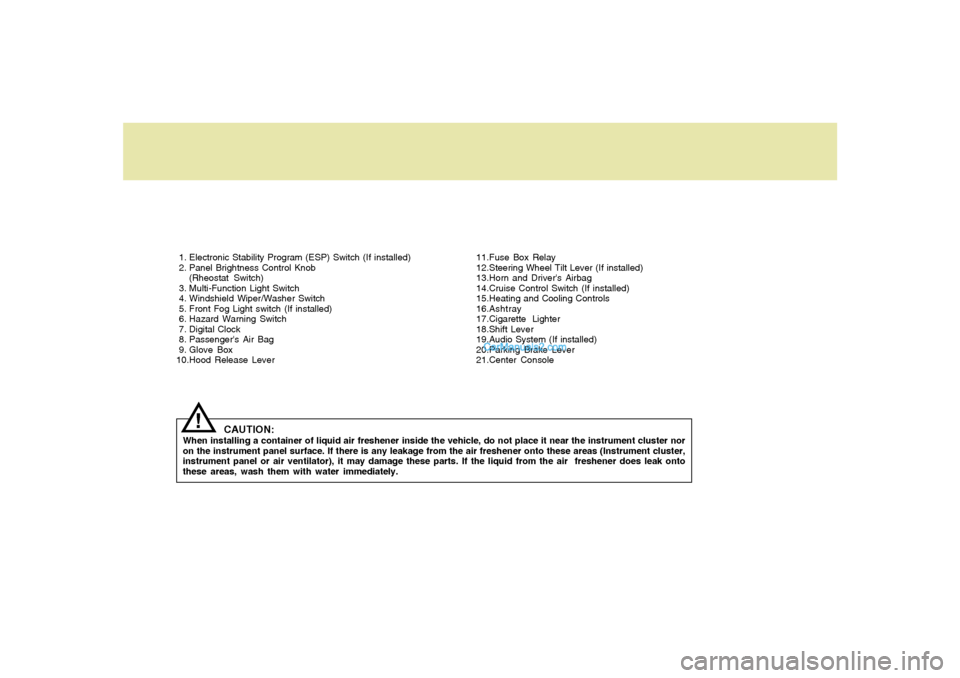
1. Electronic Stability Program (ESP) Switch (If installed)
2. Panel Brightness Control Knob
(Rheostat Switch)
3. Multi-Function Light Switch
4. Windshield Wiper/Washer Switch
5. Front Fog Light switch (If installed)
6. Hazard Warning Switch
7. Digital Clock
8. Passenger's Air Bag
9. Glove Box
10.Hood Release Lever11.Fuse Box Relay
12.Steering Wheel Tilt Lever (If installed)
13.Horn and Driver's Airbag
14.Cruise Control Switch (If installed)
15.Heating and Cooling Controls
16.Ashtray
17.Cigarette Lighter
18.Shift Lever
19.Audio System (If installed)
20.Parking Brake Lever
21.Center Console
CAUTION:
When installing a container of liquid air freshener inside the vehicle, do not place it near the instrument cluster nor
on the instrument panel surface. If there is any leakage from the air freshener onto these areas (Instrument cluster,
instrument panel or air ventilator), it may damage these parts. If the liquid from the air freshener does leak onto
these areas, wash them with water immediately.
!
Page 12 of 266
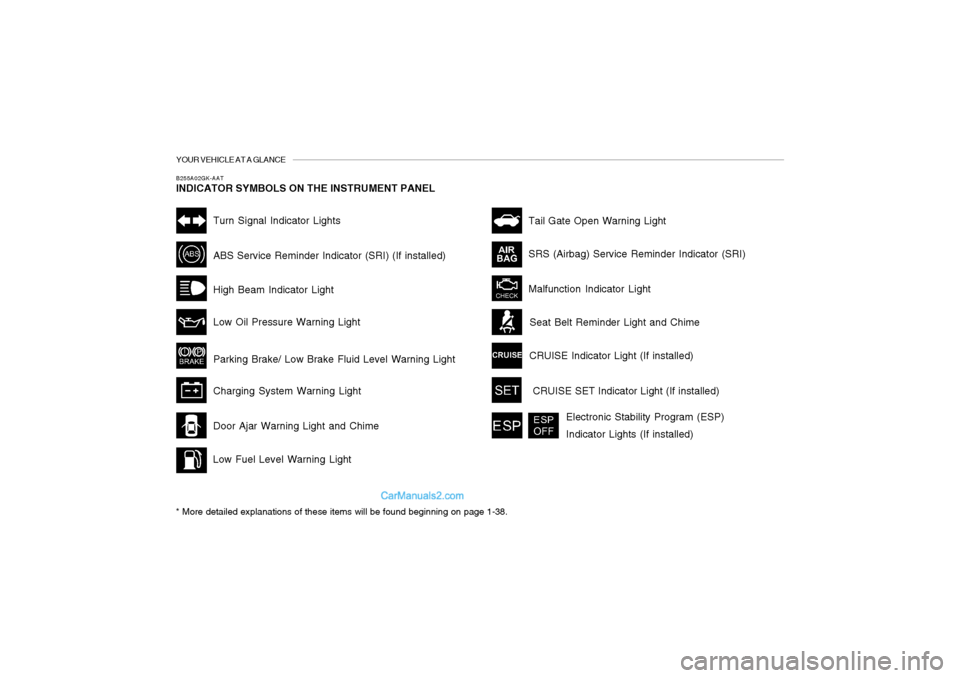
YOUR VEHICLE AT A GLANCEB255A02GK-AATINDICATOR SYMBOLS ON THE INSTRUMENT PANEL* More detailed explanations of these items will be found beginning on page 1-38.
Malfunction Indicator LightSRS (Airbag) Service Reminder Indicator (SRI) Tail Gate Open Warning Light
Low Fuel Level Warning LightDoor Ajar Warning Light and ChimeABS Service Reminder Indicator (SRI) (If installed)Turn Signal Indicator LightsHigh Beam Indicator Light
Low Oil Pressure Warning Light
Parking Brake/ Low Brake Fluid Level Warning Light
Charging System Warning LightCRUISE Indicator Light (If installed)
Seat Belt Reminder Light and Chime
CRUISE SET Indicator Light (If installed)
Electronic Stability Program (ESP)
Indicator Lights (If installed)
Page 16 of 266
1FEATURES OF YOUR HYUNDAI4
WARNING:
o Unlocked doors can be dangerous. Be-
fore you drive away (especially if there
are children in the car), be sure that all the
doors are securely closed and locked so
that the doors cannot be inadvertently
opened from the inside. This helps en-
sure that the doors will not be opened
accidentally. Also, when combined with
the proper use of seat belts, locking the
doors helps keep occupants from being
ejected from the car in case of an acci-
dent.
o Before opening the door, always look for
and avoid oncoming traffic.
o In case of accident, the door is unlocked
automatically (If installed).
!DOORB040A02Y-AATDOOR LOCKS
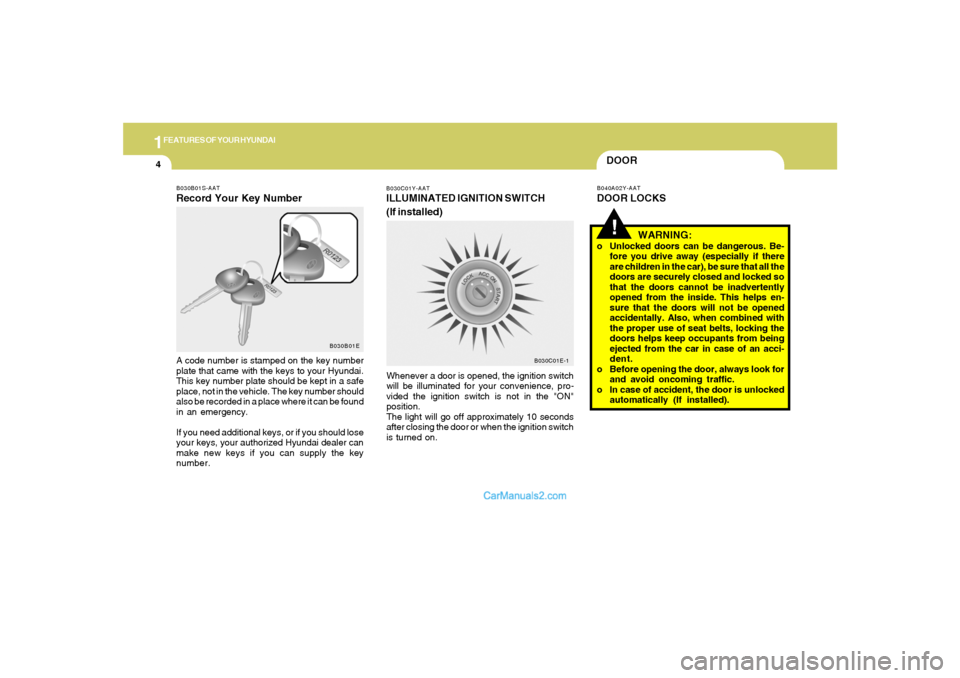
B030C01Y-AATILLUMINATED IGNITION SWITCH
(If installed)Whenever a door is opened, the ignition switch
will be illuminated for your convenience, pro-
vided the ignition switch is not in the "ON"
position.
The light will go off approximately 10 seconds
after closing the door or when the ignition switch
is turned on.
B030C01E-1
B030B01S-AATRecord Your Key NumberA code number is stamped on the key number
plate that came with the keys to your Hyundai.
This key number plate should be kept in a safe
place, not in the vehicle. The key number should
also be recorded in a place where it can be found
in an emergency.
If you need additional keys, or if you should lose
your keys, your authorized Hyundai dealer can
make new keys if you can supply the key
number.
B030B01E
Page 20 of 266
1FEATURES OF YOUR HYUNDAI8
!
B070F02A-AATKEYLESS ENTRY SYSTEM (If installed)
NOTE:This device complies with Part 15 of the
FCC rules. Operation is subject to the fol-
lowing two conditions:
(1) This device may not cause harmful in-
terference, and (2) this device must accept
any interference received, including inter-
ference that may cause undesired opera-
tion.
WARNING:
Changes or modifications not expressly
approved by the party responsible for com-
pliance could void the user's authority to
operate the equipment.Locking doors1. Close all doors.
2. Push the "LOCK" button on the transmitter.
3. At the same time all doors lock, the turn signal
lights will blink once to indicate that the
system is armed.Unlocking doors1. Push the "UNLOCK" button on the transmitter.
2. At the same time all doors unlock, the turn
signal lights will blink twice to indicate that the
system is disarmed.
NOTE:The transmitter will not work if any of fol-
lowing occur:
- The ignition key is in ignition switch.
- You exceed the operating distance limit
(10 m).
- The battery in the transmitter is weak.
- Other vehicles or objects may be block-
ing the signal.
- The weather is extremely cold.
- The transmitter is close to a radio trans-
mitter such as a radio station or an
airport which can interfere with normal
operation of the transmitter.
When the transmitter does not work cor-
rectly, open and close the door with the
ignition key. If you have a problem with the
transmitter, contact an authorized Hyundai
Dealer.NOTE:Keep the transmitter away from water or
any liquid. If the keyless entry system is
inoperative due to exposure to water or
liquids, it will not be covered by your manu-
facturer vehicle warranty.
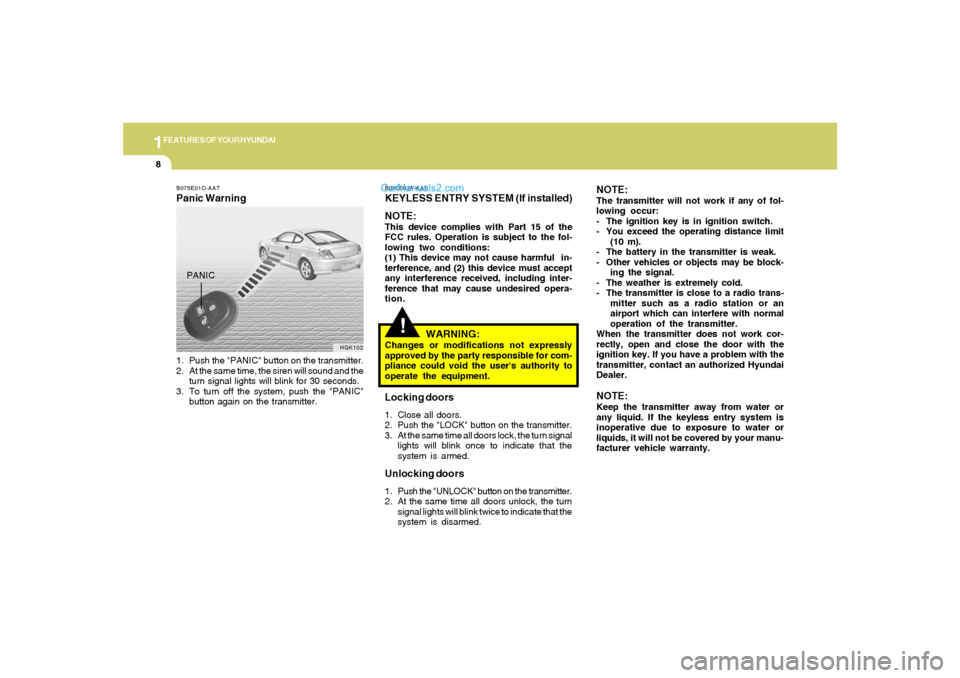
B075E01O-AATPanic Warning1. Push the "PANIC" button on the transmitter.
2. At the same time, the siren will sound and the
turn signal lights will blink for 30 seconds.
3. To turn off the system, push the "PANIC"
button again on the transmitter.
HGK102
PANIC
Page 21 of 266
1
FEATURES OF YOUR HYUNDAI
9
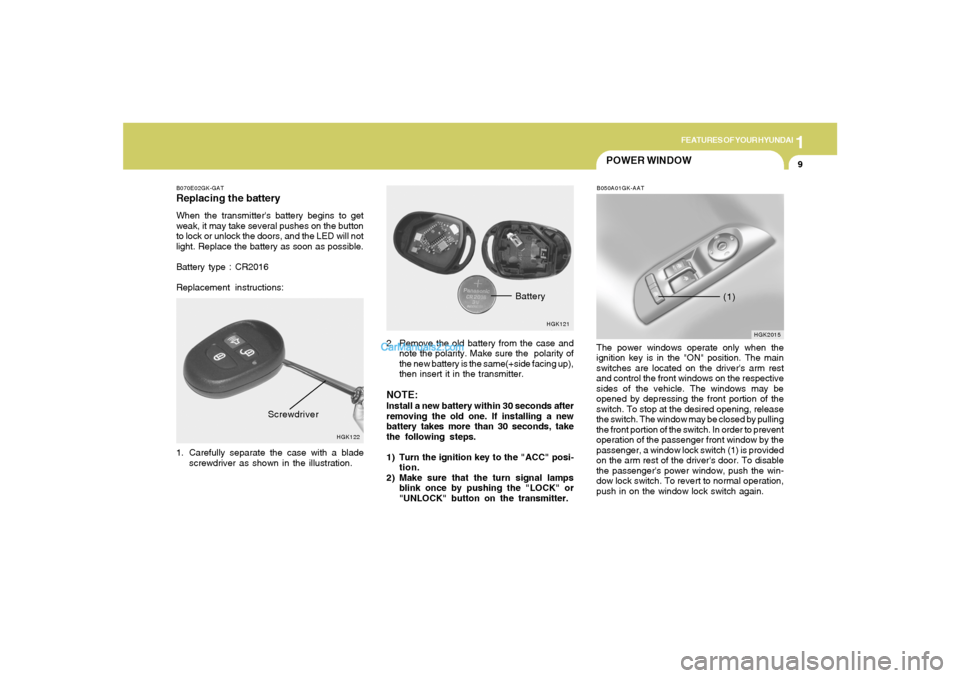
B070E02GK-GATReplacing the batteryWhen the transmitter's battery begins to get
weak, it may take several pushes on the button
to lock or unlock the doors, and the LED will not
light. Replace the battery as soon as possible.
Battery type : CR2016
Replacement instructions:
1. Carefully separate the case with a blade
screwdriver as shown in the illustration.
HGK122
Screwdriver
2. Remove the old battery from the case and
note the polarity. Make sure the polarity of
the new battery is the same(+side facing up),
then insert it in the transmitter.NOTE:Install a new battery within 30 seconds after
removing the old one. If installing a new
battery takes more than 30 seconds, take
the following steps.
1) Turn the ignition key to the "ACC" posi-
tion.
2) Make sure that the turn signal lamps
blink once by pushing the "LOCK" or
"UNLOCK" button on the transmitter.
HGK121
Battery
POWER WINDOWB050A01GK-AATThe power windows operate only when the
ignition key is in the "ON" position. The main
switches are located on the driver's arm rest
and control the front windows on the respective
sides of the vehicle. The windows may be
opened by depressing the front portion of the
switch. To stop at the desired opening, release
the switch. The window may be closed by pulling
the front portion of the switch. In order to prevent
operation of the passenger front window by the
passenger, a window lock switch (1) is provided
on the arm rest of the driver's door. To disable
the passenger's power window, push the win-
dow lock switch. To revert to normal operation,
push in on the window lock switch again.
HGK2015
(1)
Page 34 of 266
1FEATURES OF YOUR HYUNDAI22
!
o Never allow two children, or any two
persons, to use the same seat belt.
o Children often squirm and reposition
themselves improperly. Never let a child
ride with the shoulder belt under their
arm or behind their back. Always prop-
erly position and secure children in rear
seat.
o Never allow a child to stand-up or kneel
on the seat or floorboard of a moving
vehicle. During a collision or sudden
stop, the child can be violently thrown
against the vehicles interior, resulting in
serious injury.
o Never use an infant carrier or a child
safety seat that "hooks" over a seatback,
it may not provide adequate security in
an accident.
o Seat belts can become very hot, espe-
cially when the car is parked in direct
sunlight. Always check seat belt buck-
les before fastening them over a child.
o Always store or secure a child seat, even
when it is not in use. During a collision
or sudden stop, the child seat could be
thrown inside the vehicle.
WARNING:
B230B02GK-GATUsing a Child Restraint SystemFor small children and babies, the use of a child
seat or infant seat is required. This child seat or
infant seat should be of appropriate size for the
child and should be installed in accordance with
the manufacturer's instructions. It is further
required that the seat be placed in the vehicle's
rear seat since this can make an important
contribution to safety. Your vehicle is provided
with two child restraint hook holders for insta
lling the child seat or infant seat.
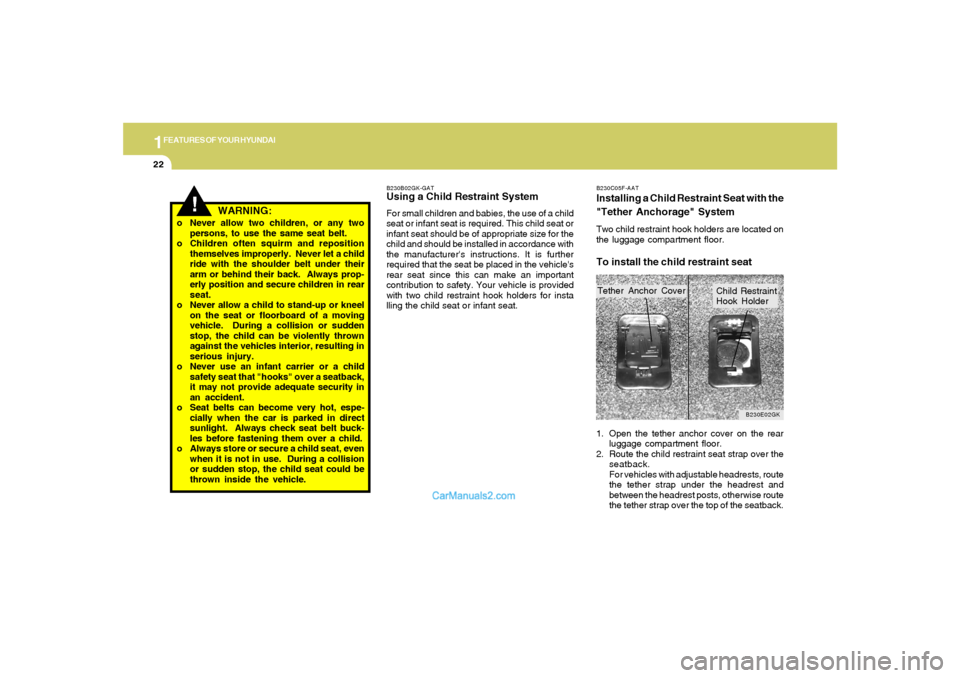
B230C05F-AATInstalling a Child Restraint Seat with the
"Tether Anchorage" SystemTwo child restraint hook holders are located on
the luggage compartment floor.To install the child restraint seat
B230E02GK
Tether Anchor Cover
Child Restraint
Hook Holder1. Open the tether anchor cover on the rear
luggage compartment floor.
2. Route the child restraint seat strap over the
seatback.
For vehicles with adjustable headrests, route
the tether strap under the headrest and
between the headrest posts, otherwise route
the tether strap over the top of the seatback.
Page 49 of 266
1
FEATURES OF YOUR HYUNDAI
37
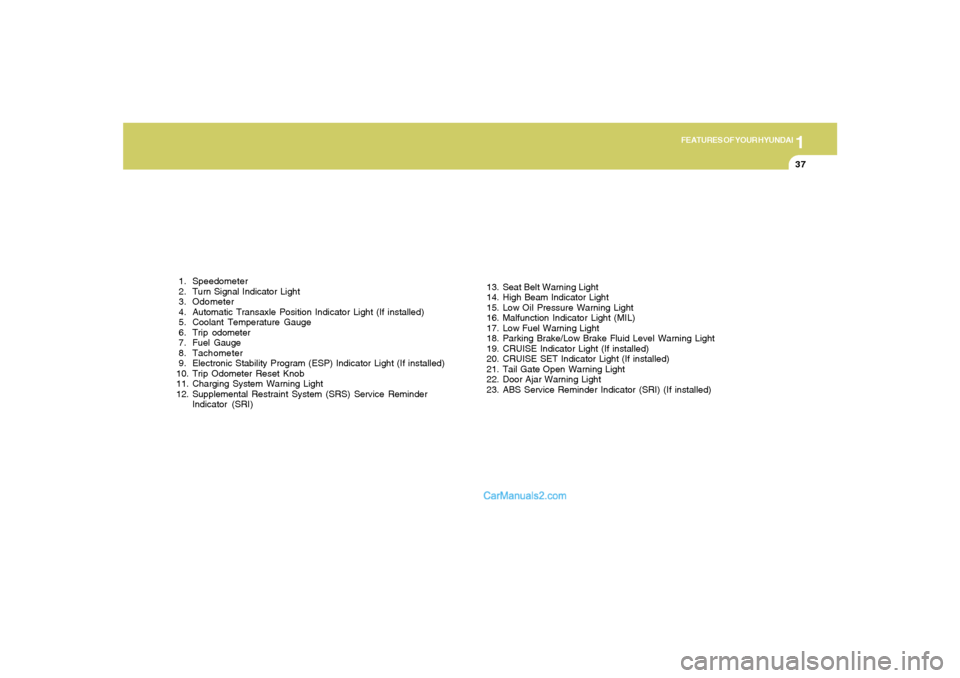
1. Speedometer
2. Turn Signal Indicator Light
3. Odometer
4. Automatic Transaxle Position Indicator Light (If installed)
5. Coolant Temperature Gauge
6. Trip odometer
7. Fuel Gauge
8. Tachometer
9. Electronic Stability Program (ESP) Indicator Light (If installed)
10. Trip Odometer Reset Knob
11. Charging System Warning Light
12. Supplemental Restraint System (SRS) Service Reminder
Indicator (SRI)13. Seat Belt Warning Light
14. High Beam Indicator Light
15. Low Oil Pressure Warning Light
16. Malfunction Indicator Light (MIL)
17. Low Fuel Warning Light
18. Parking Brake/Low Brake Fluid Level Warning Light
19. CRUISE Indicator Light (If installed)
20. CRUISE SET Indicator Light (If installed)
21. Tail Gate Open Warning Light
22. Door Ajar Warning Light
23. ABS Service Reminder Indicator (SRI) (If installed)
Page 53 of 266
1
FEATURES OF YOUR HYUNDAI
41
B260Q01E-GAT
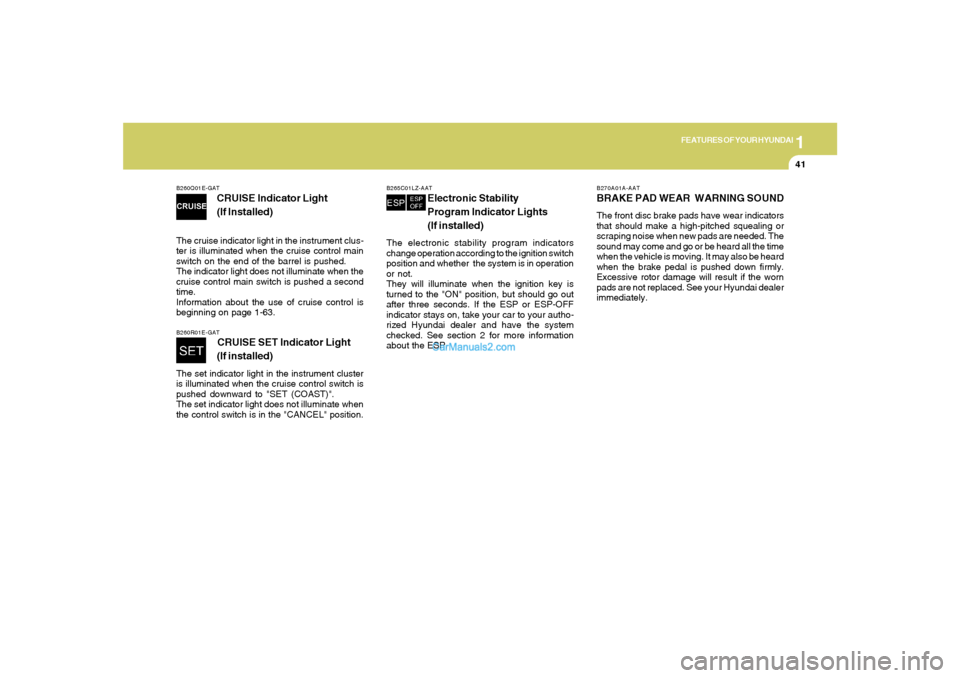
CRUISE Indicator Light
(If Installed)
The cruise indicator light in the instrument clus-
ter is illuminated when the cruise control main
switch on the end of the barrel is pushed.
The indicator light does not illuminate when the
cruise control main switch is pushed a second
time.
Information about the use of cruise control is
beginning on page 1-63.
B270A01A-AATBRAKE PAD WEAR WARNING SOUNDThe front disc brake pads have wear indicators
that should make a high-pitched squealing or
scraping noise when new pads are needed. The
sound may come and go or be heard all the time
when the vehicle is moving. It may also be heard
when the brake pedal is pushed down firmly.
Excessive rotor damage will result if the worn
pads are not replaced. See your Hyundai dealer
immediately.
B260R01E-GAT
CRUISE SET Indicator Light
(If installed)
The set indicator light in the instrument cluster
is illuminated when the cruise control switch is
pushed downward to "SET (COAST)".
The set indicator light does not illuminate when
the control switch is in the "CANCEL" position.
B265C01LZ-AAT
Electronic Stability
Program Indicator Lights
(If installed)
The electronic stability program indicators
change operation according to the ignition switch
position and whether the system is in operation
or not.
They will illuminate when the ignition key is
turned to the "ON" position, but should go out
after three seconds. If the ESP or ESP-OFF
indicator stays on, take your car to your autho-
rized Hyundai dealer and have the system
checked. See section 2 for more information
about the ESP.