warning lights Hyundai Tiburon 2008 User Guide
[x] Cancel search | Manufacturer: HYUNDAI, Model Year: 2008, Model line: Tiburon, Model: Hyundai Tiburon 2008Pages: 268, PDF Size: 9.93 MB
Page 84 of 268
1FEATURES OF YOUR HYUNDAI72
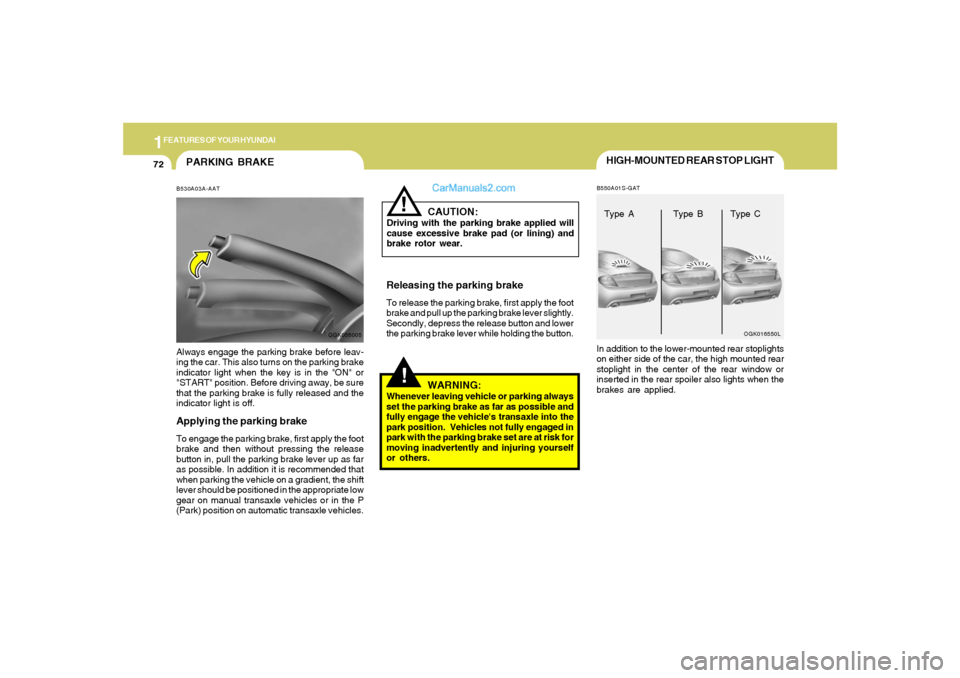
HIGH-MOUNTED REAR STOP LIGHTB550A01S-GATIn addition to the lower-mounted rear stoplights
on either side of the car, the high mounted rear
stoplight in the center of the rear window or
inserted in the rear spoiler also lights when the
brakes are applied.
OGK016550L
Type A Type B Type C
PARKING BRAKEB530A03A-AATAlways engage the parking brake before leav-
ing the car. This also turns on the parking brake
indicator light when the key is in the "ON" or
"START" position. Before driving away, be sure
that the parking brake is fully released and the
indicator light is off.Applying the parking brakeTo engage the parking brake, first apply the foot
brake and then without pressing the release
button in, pull the parking brake lever up as far
as possible. In addition it is recommended that
when parking the vehicle on a gradient, the shift
lever should be positioned in the appropriate low
gear on manual transaxle vehicles or in the P
(Park) position on automatic transaxle vehicles.
OGK056005
!
CAUTION:
Driving with the parking brake applied will
cause excessive brake pad (or lining) and
brake rotor wear.Releasing the parking brakeTo release the parking brake, first apply the foot
brake and pull up the parking brake lever slightly.
Secondly, depress the release button and lower
the parking brake lever while holding the button.
!
WARNING:
Whenever leaving vehicle or parking always
set the parking brake as far as possible and
fully engage the vehicle's transaxle into the
park position. Vehicles not fully engaged in
park with the parking brake set are at risk for
moving inadvertently and injuring yourself
or others.
Page 142 of 268
2
DRIVING YOUR HYUNDAI
3
BEFORE STARTING THE ENGINEC020A02A-AATBefore you start the engine, you should always:
1. Look around the vehicle to be sure there are
no flat tires, puddles of oil, water or other
indications of possible trouble.
2. After entering the car, check to be sure the
parking brake is engaged.
3. Check that all windows, and lights are clean.
4. Check that the interior and exterior mirrors
are clean and in position.
5. Check your seat, seatback and headrest to
be sure they are in their proper positions.
6. Close all the doors.
7. Fasten your seat belt and be sure that all
other occupants have fastened theirs.
8. Turn off all lights and accessories that are
not needed.
9. When you turn the ignition switch to "ON",
check that all appropriate warning lights are
operating and that you have sufficient fuel.
10.Check the operation of warning lights and all
bulbs when key is in the "ON" position.
TO START THE ENGINEC030A01A-AATCombination Ignition Switcho If your Hyundai is equipped with a manual
transaxle, place the shift lever in neutral and
depress the clutch pedal fully.
o If your Hyundai has an automatic transaxle,
place the shift lever in "P" (park).
o To start the engine, insert the ignition key and
turn it to the "START" position. Release it as
soon as the engine starts. Do not hold the
key in the "START" position for more than 15
seconds.NOTE:o For safety, the engine will not start if the
clutch pedal is not depressed fully
(Manual transaxle) or the shift lever is
not in "P" or "N" Position (Automatic
transaxle).
o The ignition key cannot be turned from
"ACC" position to "LOCK" position un-
less the shift lever is in the "P" (Park)
position or the negative battery terminal
is disconnected from the battery. To
remove the key, always confirm that the
shift lever is securely positioned in "P"
(Park) (For Automatic transaxle)
!
WARNING:
o All passengers must be properly belted
whenever the vehicle is moving. Refer to
pages: 1-16 through 1-20 for more infor-
mation on their proper use.
o Always check the surrounding areas near
your vehicle for people, especially chil-
dren, before putting a car into 'drive.'
o Always wear appropriate shoes when
operating your vehicle.
Unsuitable shoes (high heels, ski boots,
etc.) may interfere with your ability to
use the brake and accelerator pedal, and
the clutch (if installed).
Page 144 of 268
2
DRIVING YOUR HYUNDAI
5
STARTING!
C050A01A-AAT
WARNING:
Never run the engine in a closed or poorly
ventilated area any longer than is needed to
move your car in or out of the area. The
carbon monoxide gas emitted is odorless
and can cause serious injury or death.
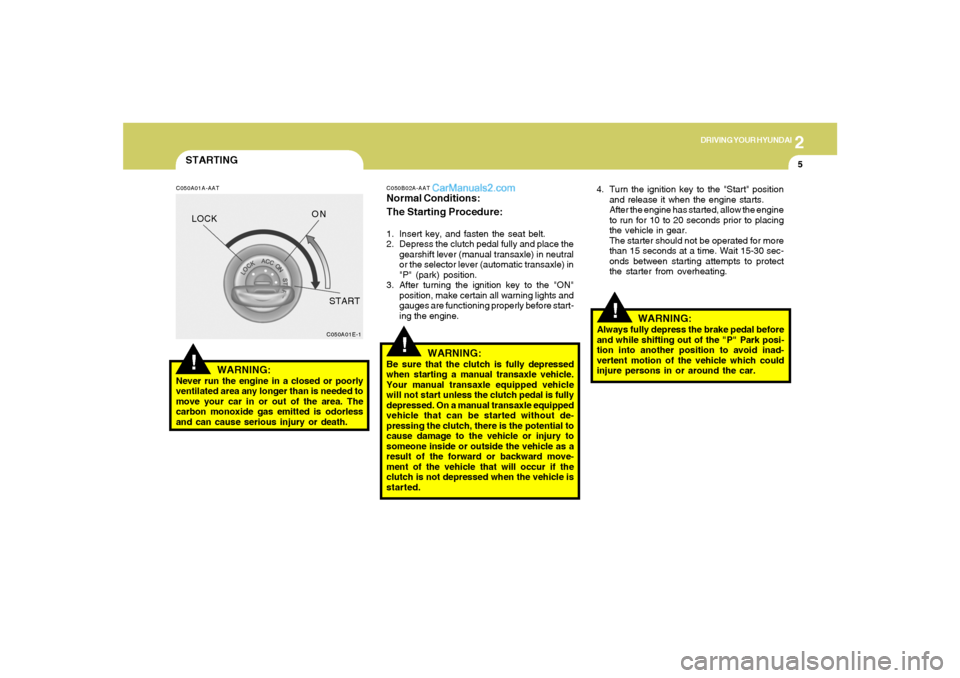
C050A01E-1
LOCKON
START
C050B02A-AATNormal Conditions:
The Starting Procedure:1. Insert key, and fasten the seat belt.
2. Depress the clutch pedal fully and place the
gearshift lever (manual transaxle) in neutral
or the selector lever (automatic transaxle) in
"P" (park) position.
3. After turning the ignition key to the "ON"
position, make certain all warning lights and
gauges are functioning properly before start-
ing the engine.
WARNING:
Be sure that the clutch is fully depressed
when starting a manual transaxle vehicle.
Your manual transaxle equipped vehicle
will not start unless the clutch pedal is fully
depressed. On a manual transaxle equipped
vehicle that can be started without de-
pressing the clutch, there is the potential to
cause damage to the vehicle or injury to
someone inside or outside the vehicle as a
result of the forward or backward move-
ment of the vehicle that will occur if the
clutch is not depressed when the vehicle is
started.
!
4. Turn the ignition key to the "Start" position
and release it when the engine starts.
After the engine has started, allow the engine
to run for 10 to 20 seconds prior to placing
the vehicle in gear.
The starter should not be operated for more
than 15 seconds at a time. Wait 15-30 sec-
onds between starting attempts to protect
the starter from overheating.
!
WARNING:
Always fully depress the brake pedal before
and while shifting out of the "P" Park posi-
tion into another position to avoid inad-
vertent motion of the vehicle which could
injure persons in or around the car.
Page 160 of 268
2
DRIVING YOUR HYUNDAI
21
(automatic). In addition, place wheel chocks
at each of the trailer's tires.
9. If the trailer has electric brakes, start your
vehicle and trailer moving, and then apply the
trailer brake controller by hand to be sure the
brakes are working. This lets you check
your electrical connection at the same time.
10.During your trip, occasionally check to be
sure that the load is secure, and that the
lights and any trailer brakes are still working.
11.Avoid jerky starts, sudden acceleration or
sudden stops.
12.Avoid sharp turns and rapid lane changes.
13.Avoid holding the brake pedal down too long
or too frequently. This could cause the brakes
to overheat, resulting in reduced braking
efficiency.
14.When going down a hill, shift into a lower gear
and use the engine braking effect.
When ascending a long grade, downshift the
transaxle to a lower gear and reduce speed
to reduce chances of engine overloading
and/or overheating.
15.If you have to stop while going uphill, do not
hold the vehicle in place by pressing on the
accelerator. This can cause the automatic
transaxle to overheat. Use the parking brake
or footbrake.
NOTE:When towing check transaxle fluid more
frequently.
CAUTION:
The following specifications are recom-
mended when towing a trailer. The loaded
trailer weight cannot safely exceed the val-
ues in the chart below.
!!
WARNING:
o Improperly loading your vehicle and
trailer can seriously affect its steering
and braking performance causing a
crash which could cause serious injury
or death.
o Towing a trailer affected vehicle han-
dling and braking.
o Drive more slowly when towing a trailer
and allow more distance when braking.
o Be careful when driving in slippery and
windy conditions.
o Be careful when turning and while driv-
ing up and down hills.Lbs. (kg)
Maximum Towable Weight
Trailer
1000 (453)Tongue
100 (45)
C190F01S-AATTrailer or Vehicle Towing Tips1. Before towing, check hitch and safety chain
connections as well as proper operation of
the trailer running lights, brake lights, and
turn signals.
2. Always drive your vehicle at a moderate
speed. (Less than 60 mph)
3. Trailer towing requires more fuel than normal
conditions.
4. To maintain engine braking efficiency and
electrical charging performance, do not use
fifth gear (manual transaxle) or overdrive
(automatic transaxle).
5. Always secure items in the trailer to prevent
load shift while driving.
6. Check the condition and air pressure of all
tires on the trailer and your car. Low tire
pressure can seriously affect the handling.
Also check the spare tire.
7. The vehicle/trailer combination is more af-
fected by crosswind and buffeting.
When being passed by a large vehicle, keep
a constant speed and steer straight ahead.
If there is too much wind buffeting, slow down
to get out of the other vehicle's air turbulence.
8. When parking your car and trailer, especially
on a hill, be sure to follow all the normal
precautions. Turn your front wheel into the
curb, set the parking brake firmly, and put the
transaxle in 1st or Reverse (manual) or Park
Page 169 of 268
3
WHAT TO DO IN AN EMERGENCY
3
JUMP STARTING
!
o To jump start a car with a discharged battery,
follow this procedure exactly:
1. If the booster battery is installed in another
vehicle, be sure the two vehicles are not
touching.
2. Turn off all unnecessary lights and acces-
sories in both vehicles.
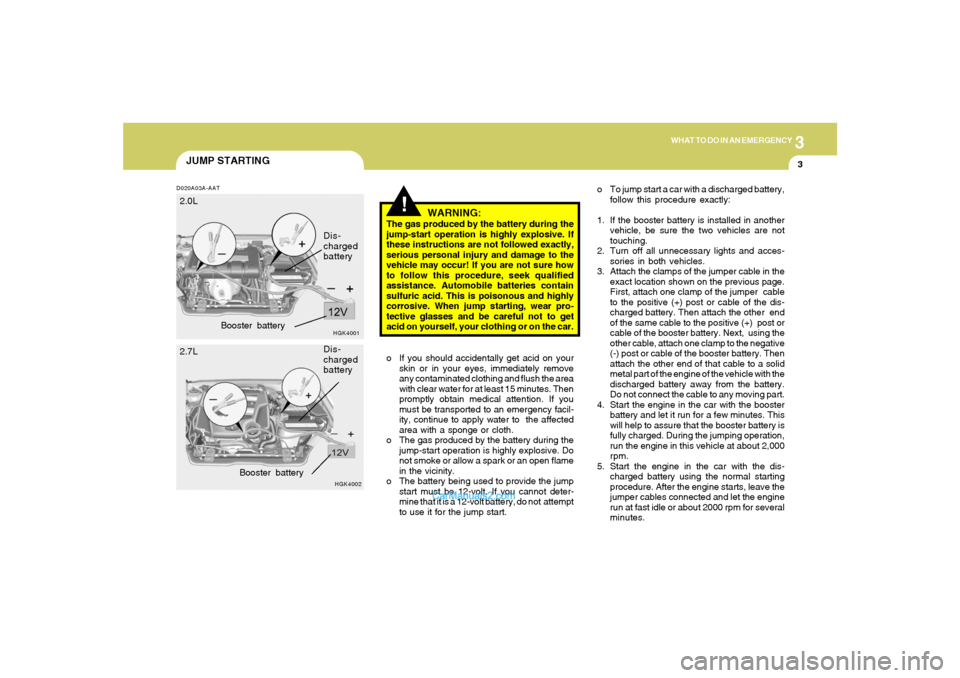
3. Attach the clamps of the jumper cable in the
exact location shown on the previous page.
First, attach one clamp of the jumper cable
to the positive (+) post or cable of the dis-
charged battery. Then attach the other end
of the same cable to the positive (+) post or
cable of the booster battery. Next, using the
other cable, attach one clamp to the negative
(-) post or cable of the booster battery. Then
attach the other end of that cable to a solid
metal part of the engine of the vehicle with the
discharged battery away from the battery.
Do not connect the cable to any moving part.
4. Start the engine in the car with the booster
battery and let it run for a few minutes. This
will help to assure that the booster battery is
fully charged. During the jumping operation,
run the engine in this vehicle at about 2,000
rpm.
5. Start the engine in the car with the dis-
charged battery using the normal starting
procedure. After the engine starts, leave the
jumper cables connected and let the engine
run at fast idle or about 2000 rpm for several
minutes.
D020A03A-AAT
WARNING:
The gas produced by the battery during the
jump-start operation is highly explosive. If
these instructions are not followed exactly,
serious personal injury and damage to the
vehicle may occur! If you are not sure how
to follow this procedure, seek qualified
assistance. Automobile batteries contain
sulfuric acid. This is poisonous and highly
corrosive. When jump starting, wear pro-
tective glasses and be careful not to get
acid on yourself, your clothing or on the car.
o If you should accidentally get acid on your
skin or in your eyes, immediately remove
any contaminated clothing and flush the area
with clear water for at least 15 minutes. Then
promptly obtain medical attention. If you
must be transported to an emergency facil-
ity, continue to apply water to the affected
area with a sponge or cloth.
o The gas produced by the battery during the
jump-start operation is highly explosive. Do
not smoke or allow a spark or an open flame
in the vicinity.
o The battery being used to provide the jump
start must be 12-volt. If you cannot deter-
mine that it is a 12-volt battery, do not attempt
to use it for the jump start.
2.0L
HGK4001
HGK4002Dis-
charged
battery
2.7LBooster batteryDis-
charged
battery
Booster battery
Page 170 of 268
34WHAT TO DO IN AN EMERGENCY
IF THE ENGINE OVERHEATS
!!
WARNING:
While the engine is running, keep hair,
hands, and clothing away from moving
parts such as the fan and drive belts to
prevent injury.
5. If the water pump drive belt is broken or
engine coolant is leaking out, stop the engine
immediately and call the nearest Hyundai
dealer for assistance.
WARNING:
Do not remove the radiator cap when the
engine is hot. This can allow coolant to be
blown out of the opening and cause seri-
ous burns.
D030A02A-AATIf your temperature gauge indicates overheat-
ing, you experience a loss of power, or hear loud
pinging or knocking and the engine is probably
too hot. If this happens and, you should:
1. Pull off the road and stop as soon as it is safe
to do so.
2. Place the gear selector lever in "P" (auto-
matic), or neutral (manual transaxle) and set
the parking brake. If the air conditioning is on,
turn it off.
3. If engine coolant is running out under the car
or steam is coming out from the hood, stop
the engine. Do not open the hood until the
engine coolant has stopped running or the
steaming has stopped. If there is no visible
loss of engine coolant and no steam, leave
the engine running and check to be sure the
engine cooling fan is operating. If the fan is
not running, turn the engine off.
4. Check to see if the water pump drive belt is
missing. If it is not missing, check to see that
it is tight. If the drive belt seems to be
satisfactory, check for engine coolant leak-
ing from the radiator, hoses or under the car.
(If the air conditioning had been in use, it is
normal for cold water to be draining from it
when you stop). 6. Carefully remove the jumper cables in the
reverse order of attachment.
If you do not know why your battery became
discharged (because the lights were left on,
etc.), have the charging system checked by
your Hyundai dealer.
Page 223 of 268
6
DO-IT-YOURSELF MAINTENANCE
23
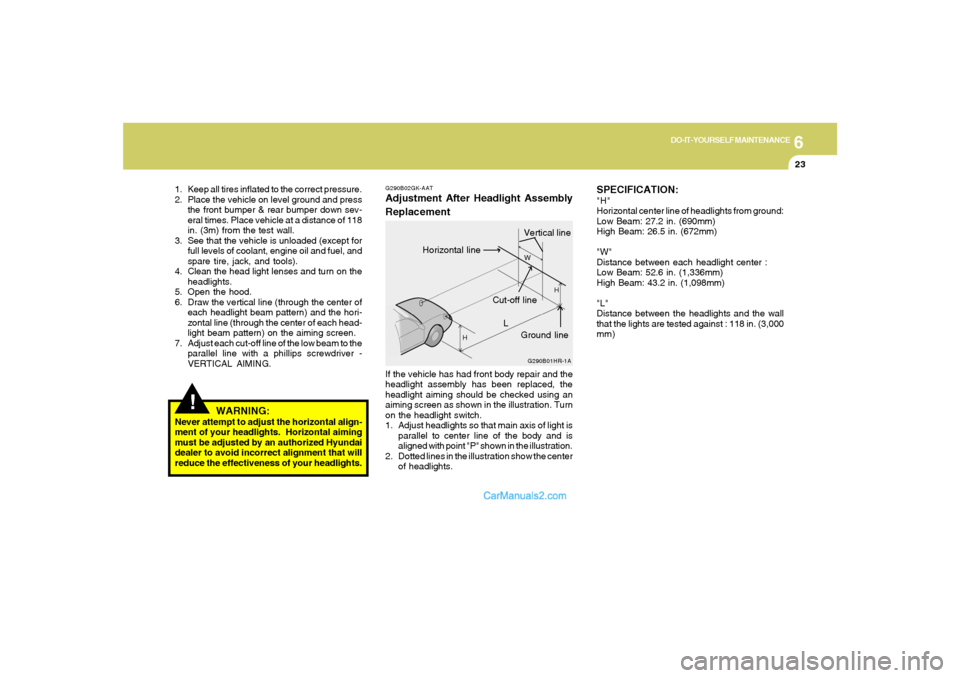
G290B02GK-AATAdjustment After Headlight Assembly
ReplacementIf the vehicle has had front body repair and the
headlight assembly has been replaced, the
headlight aiming should be checked using an
aiming screen as shown in the illustration. Turn
on the headlight switch.
1. Adjust headlights so that main axis of light is
parallel to center line of the body and is
aligned with point "P" shown in the illustration.
2. Dotted lines in the illustration show the center
of headlights.
G290B01HR-1A
L
W
H
H
Cut-off line
Ground line
Horizontal lineVertical line
!
1. Keep all tires inflated to the correct pressure.
2. Place the vehicle on level ground and press
the front bumper & rear bumper down sev-
eral times. Place vehicle at a distance of 118
in. (3m) from the test wall.
3. See that the vehicle is unloaded (except for
full levels of coolant, engine oil and fuel, and
spare tire, jack, and tools).
4. Clean the head light lenses and turn on the
headlights.
5. Open the hood.
6. Draw the vertical line (through the center of
each headlight beam pattern) and the hori-
zontal line (through the center of each head-
light beam pattern) on the aiming screen.
7. Adjust each cut-off line of the low beam to the
parallel line with a phillips screwdriver -
VERTICAL AIMING.
WARNING:
Never attempt to adjust the horizontal align-
ment of your headlights. Horizontal aiming
must be adjusted by an authorized Hyundai
dealer to avoid incorrect alignment that will
reduce the effectiveness of your headlights.
SPECIFICATION:"H"
Horizontal center line of headlights from ground:
Low Beam: 27.2 in. (690mm)
High Beam: 26.5 in. (672mm)
"W"
Distance between each headlight center :
Low Beam: 52.6 in. (1,336mm)
High Beam: 43.2 in. (1,098mm)
"L"
Distance between the headlights and the wall
that the lights are tested against : 118 in. (3,000
mm)
Page 233 of 268
6
DO-IT-YOURSELF MAINTENANCE
33
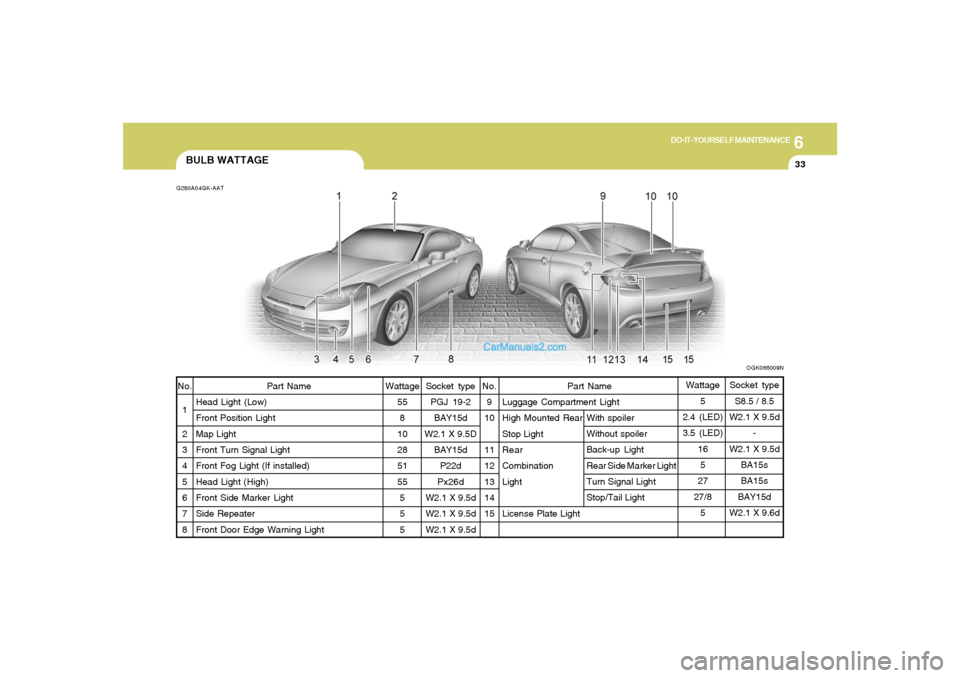
Part Name
Luggage Compartment Light
High Mounted Rear
Stop Light
Rear
Combination
Light
License Plate Light
BULB WATTAGEG280A04GK-AATNo.
1
2
3
4
5
6
7
8Part Name
Head Light (Low)
Front Position Light
Map Light
Front Turn Signal Light
Front Fog Light (If installed)
Head Light (High)
Front Side Marker Light
Side Repeater
Front Door Edge Warning LightWattage
55
8
10
28
51
55
5
5
5No.
9
10
11
12
13
14
15Wattage
5
2.4 (LED)
3.5 (LED)
16
5
27
27/8
5
OGK066009N
Socket type
PGJ 19-2
BAY15d
W2.1 X 9.5D
BAY15d
P22d
Px26d
W2.1 X 9.5d
W2.1 X 9.5d
W2.1 X 9.5dWith spoiler
Without spoiler
Back-up Light
Rear Side Marker Light
Turn Signal Light
Stop/Tail LightSocket type
S8.5 / 8.5
W2.1 X 9.5d
-
W2.1 X 9.5d
BA15s
BA15s
BAY15d
W2.1 X 9.6d
Page 264 of 268
10
INDEX
3
Driving
Economical driving .......................................................................2-15
Smooth cornering.........................................................................2-16
Winter driving...............................................................................2-16
E
Electronic Stability Control (ESC) .....................................................2-12
Emissions Control Systems ............................................................... 7-1
Engine
Before starting the engine .............................................................. 2-3
Compartment................................................................................. 6-2
Coolant........................................................................................... 6-7
Coolant temperature gauge .........................................................1-53
If the engine overheats .................................................................. 3-4
Number........................................................................................... 8-2
Oil ................................................................................................... 6-5
Starting........................................................................................... 2-5
Engine Exhaust Can Be Dangerous .................................................. 2-2
F
Floor mat Anchor ..............................................................................1-79
Front Fog Light Switch ......................................................................1-63
Front Seats
Adjustable front seats ..................................................................1-10
Adjustable headrests...................................................................1-12
Adjusting seatback angle .............................................................1-11
Adjusting seat forward and rearward..........................................1-11
Lumbar support control ...............................................................1-13
Seat cushion height adjustment..................................................1-13Fuel
Capacity......................................................................................... 9-2
Gauge...........................................................................................1-52
Recommendations......................................................................... 1-2
Fuel Filler Lid
Remote release............................................................................1-74
Fuses
Fuse Panel Description ...............................................................6-32
G
General Everyday Checks................................................................. 6-4
Glove box ..........................................................................................1-69
H
Hazard Warning System ..................................................................1-63
Headlight Aiming Adjustment ............................................................6-23
Headlight Bulb....................................................................................6-24
Heating and cooling control
Rotary Type.................................................................................1-84
Automatic Type ............................................................................1-94
High-mounted Rear Stop light ...........................................................
1-72
Hood Release....................................................................................1-73
Horn.................................................................................................1-78
I
Ignition Switch ...................................................................................... 2-3
Instrument Cluster and Indicator Lights...........................................1-46
Intermittent Wiper..............................................................................1-61
Page 266 of 268
10
INDEX
5
Tires
All season tires............................................................................... 8-9
Balancing......................................................................................8-11
Chains..........................................................................................8-10
Changing a flat tire .......................................................................3-11
If you have a flat tire .....................................................................3-11
Information...................................................................................... 8-2
Pressure......................................................................................... 8-3
Replacement................................................................................8-12
Rotation........................................................................................8-10
Sidewall labeling............................................................................. 8-5
Snow tires....................................................................................... 8-9
Spare tire........................................................................................ 3-9
Summer tires.................................................................................. 8-9
Terminology and definitions........................................................... 8-7
Traction........................................................................................8-11
Towing
A trailer (or vehicle)......................................................................2-19
Emergency...................................................................................3-18
If your vehicle must be towed ......................................................3-16
Transaxle
Automatic........................................................................................ 2-8
Automatic transaxle fluid checking ..............................................6-13
Manual............................................................................................ 2-6
Manual transaxle oil checking.....................................................6-11
Trip Computer...................................................................................1-55
Trip Odometer...................................................................................1-54V
Vehicle Identification Number (VIN) ................................................... 8-2
Vehicle Load Limit .............................................................................2-22
Vehicle Specification........................................................................... 9-1
Ventilation
Center ventilator...........................................................................1-84
Side ventilator...............................................................................1-84
W
Warning Lights..................................................................................1-48
Warranties for Your Hyundai ............................................................8-13
Windshield Wiper and Washer ..........................................................1-60
Windshield Wiper Blades.................................................................... 6-9