page 1 HYUNDAI TUCSON 2006 Owner's Manual
[x] Cancel search | Manufacturer: HYUNDAI, Model Year: 2006, Model line: TUCSON, Model: HYUNDAI TUCSON 2006Pages: 289, PDF Size: 11.55 MB
Page 241 of 289
6
DO-IT-YOURSELF MAINTENANCE
22
G200B02L
!
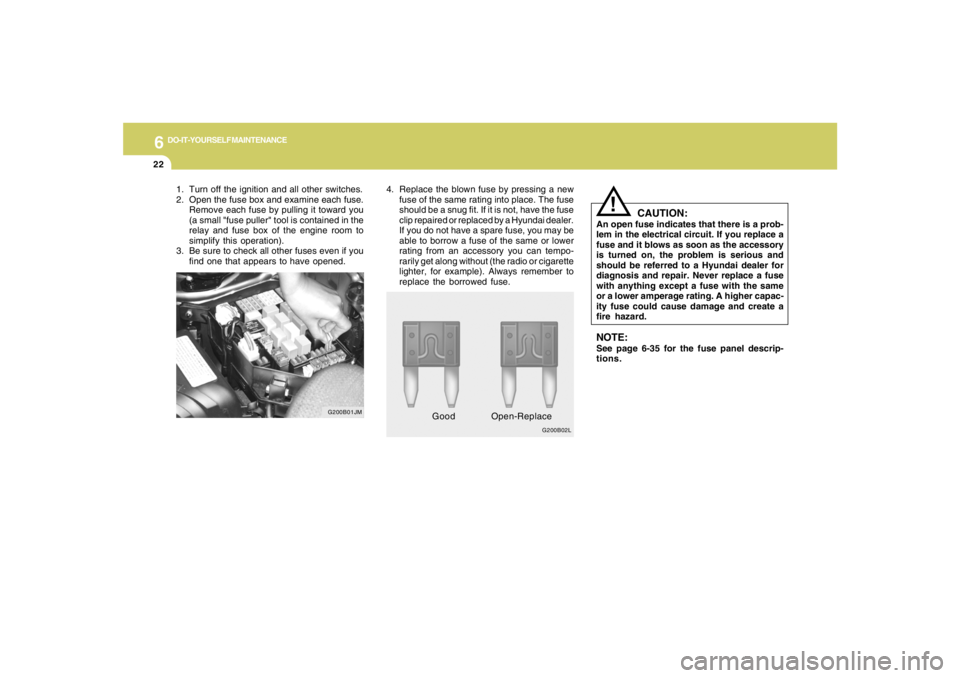
4. Replace the blown fuse by pressing a new
fuse of the same rating into place. The fuse
should be a snug fit. If it is not, have the fuse
clip repaired or replaced by a Hyundai dealer.
If you do not have a spare fuse, you may be
able to borrow a fuse of the same or lower
rating from an accessory you can tempo-
rarily get along without (the radio or cigarette
lighter, for example). Always remember to
replace the borrowed fuse.
CAUTION:
An open fuse indicates that there is a prob-
lem in the electrical circuit. If you replace a
fuse and it blows as soon as the accessory
is turned on, the problem is serious and
should be referred to a Hyundai dealer for
diagnosis and repair. Never replace a fuse
with anything except a fuse with the same
or a lower amperage rating. A higher capac-
ity fuse could cause damage and create a
fire hazard.NOTE:See page 6-35 for the fuse panel descrip-
tions.
GoodOpen-Replace 1. Turn off the ignition and all other switches.
2. Open the fuse box and examine each fuse.
Remove each fuse by pulling it toward you
(a small "fuse puller" tool is contained in the
relay and fuse box of the engine room to
simplify this operation).
3. Be sure to check all other fuses even if you
find one that appears to have opened.
G200B01JM
Page 246 of 289
6
DO-IT-YOURSELF MAINTENANCE
27
REPLACEMENT OF LIGHT BULBS!
G260A02A-AATBefore attempting to replace a light bulb, be sure
the switch is turned to the "OFF" position.
The next paragraph shows how to reach the
light bulbs so they may be changed. Be sure to
replace the burned-out bulb with one of the
same number and wattage rating.
See page 6-34 for the wattage description.
CAUTION:
o Keep the lamps out of contact with pe-
troleum products, such as oil, gasoline,
etc.
o After heavy, driving rain or washing,
headlight and taillight lenses could ap-
pear frosty. This condition is caused by
the temperature difference between the
lamp inside and outside. This is similar
to the condensation on your windows
inside your vehicle during the rain and
doesn’t indicate a problem with your
vehicle. If the water leaks into the lamp
bulb circuitry, have the vehicle checked
by an Authorized Hyundai Dealer.
HJM5013 G270A02O-AAT
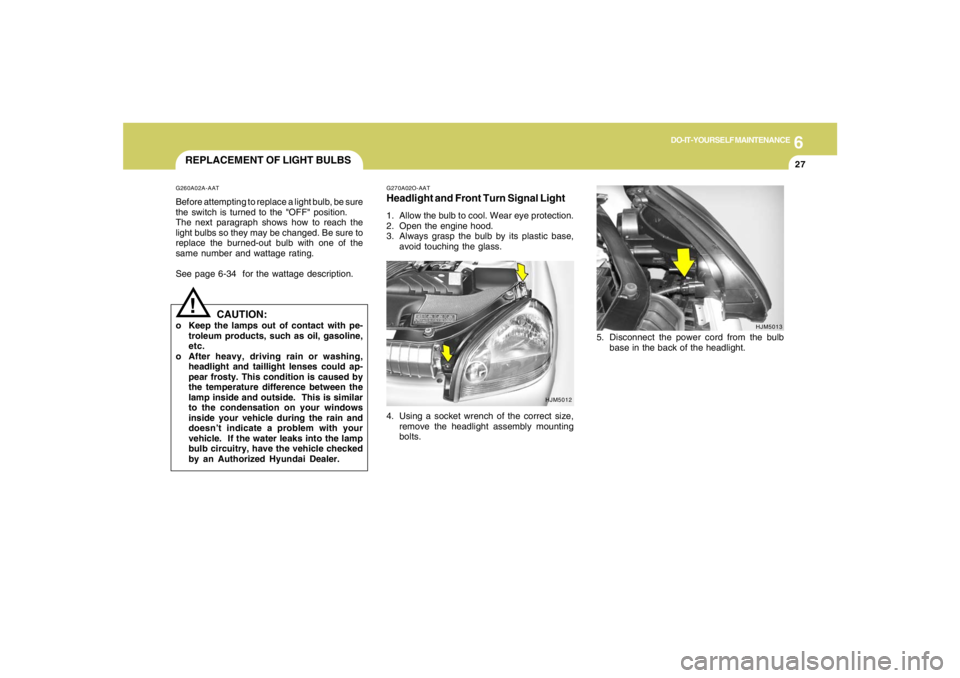
Headlight and Front Turn Signal Light1. Allow the bulb to cool. Wear eye protection.
2. Open the engine hood.
3. Always grasp the bulb by its plastic base,
avoid touching the glass.
4. Using a socket wrench of the correct size,
remove the headlight assembly mounting
bolts.
HJM5012
5. Disconnect the power cord from the bulb
base in the back of the headlight.
Page 264 of 289
8
CONSUMER INFORMATION, REPORTING SAFETY DEFECTS & BINDING ARBITRATION OF WARRANTY CLAIMS4
!
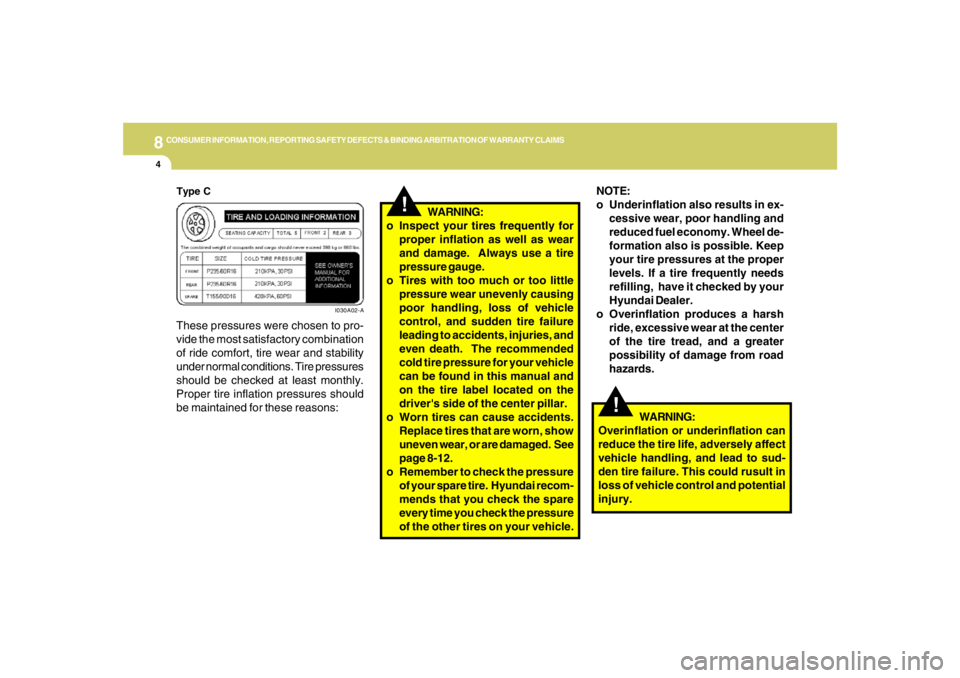
These pressures were chosen to pro-
vide the most satisfactory combination
of ride comfort, tire wear and stability
under normal conditions. Tire pressures
should be checked at least monthly.
Proper tire inflation pressures should
be maintained for these reasons:
!
WARNING:
Overinflation or underinflation can
reduce the tire life, adversely affect
vehicle handling, and lead to sud-
den tire failure. This could rusult in
loss of vehicle control and potential
injury.
Type C
I030A02-A
NOTE:
o Underinflation also results in ex-
cessive wear, poor handling and
reduced fuel economy. Wheel de-
formation also is possible. Keep
your tire pressures at the proper
levels. If a tire frequently needs
refilling, have it checked by your
Hyundai Dealer.
o Overinflation produces a harsh
ride, excessive wear at the center
of the tire tread, and a greater
possibility of damage from road
hazards. WARNING:
o Inspect your tires frequently for
proper inflation as well as wear
and damage. Always use a tire
pressure gauge.
o Tires with too much or too little
pressure wear unevenly causing
poor handling, loss of vehicle
control, and sudden tire failure
leading to accidents, injuries, and
even death. The recommended
cold tire pressure for your vehicle
can be found in this manual and
on the tire label located on the
driver's side of the center pillar.
o Worn tires can cause accidents.
Replace tires that are worn, show
uneven wear, or are damaged. See
page 8-12.
o Remember to check the pressure
of your spare tire. Hyundai recom-
mends that you check the spare
every time you check the pressure
of the other tires on your vehicle.
Page 267 of 289

8
CONSUMER INFORMATION, REPORTING SAFETY DEFECTS & BINDING ARBITRATION OF WARRANTY CLAIMS
7
o Four numbers represent the week
and year the tire was built. For
example, the numbers 3105 means
the 31st week of 2005.
4. Tire ply composition and material
The number of layers or plies of
rubbercoated fabric in the tire. Tire
manufacturers also must indicate
the materials in the tire, which in-
clude steel, nylon, polyester, and
others. The letter "R" means radial
ply construction; the letter "D" means
diagonal or bias ply construction;
and the letter "B" means belted-bias
ply construction.
5. Maximum permissible inflation
pressure
This number is the greatest amount
of air pressure that should be put in
the tire. Do not exceed the maximum
permissible inflation pressure. Refer
to the Tire and Loading Information
label for recommended inflation pres-
sure.
I030D01JM-AATTIRE TERMINOLOGY AND DEFINI-
TIONS
Air Pressure: The amount of air inside
the tire pressing outward on the tire. Air
pressure is expressed in pounds per
square inch (psi) or kilopascal (kPa).
Accessory Weight: This means the
combined weight of optional accesso-
ries. Some examples of optional ac-
cessories are, automatic transmission,
power seats, and air conditioning.
Aspect Ratio: The relationship of a
tire's height to its width.
Belt: A rubber coated layer of cords that
is located between the plies and the
tread. Cords may be made from steel or
other reinforcing materials.
Bead: The tire bead contains steel
wires wrapped by steel cords that hold
the tire onto the rim.
Bias Ply Tire: A pneumatic tire in which
the plies are laid at alternate angles
less than 90 degrees to the centerline of
the tread. 6. Maximum load rating
This number indicates the maximum
load in kilograms and pounds that
can be carried by the tire. When
replacing the tires on the vehicle,
always use a tire that has the same
load rating as the factory installed
tire.
7. Uniform Tire Quality Grading
(UTQG):
Tire manufacturers are required to
grade tires based on three perfor-
mance factors: treadwear, traction
and temperature resistance. For more
information, see Uniform Tire Qual-
ity Grading on page 8-14.
Page 273 of 289
8
CONSUMER INFORMATION, REPORTING SAFETY DEFECTS & BINDING ARBITRATION OF WARRANTY CLAIMS
13
!
I090B02JM-AATTIRE MAINTENANCE
In addition to proper inflation, correct
wheel alignment helps to decrease tire
wear. If you find a tire is worn unevenly,
have your dealer check the wheel align-
ment.
When you have new tires installed,
make sure they are balanced. This will
increase vehicle ride comfort and tire
life. Additionally, a tire shoud always be
rebalanced if it is removed from the
wheel.
!
WARNING:
Your vehicle is equipped with tires
designed to provide for safe ride and
handling capability.
Do not use a size and type of tire and
wheel that is different from the one
that is originally installed on your
vehicle. It can affect the safety and
performance of your vehicle, which
could lead to handling failure or
rollover and serious injury.
When replacing the tires, be sure to
equip all four tires with the tire and
wheel of the same size, type, tread,
brand and load-carrying capacity. If
you nevertheless decide to equip
your vehicle with any tire/wheel com-
bination not recommended by
Hyundai for off-road driving, you
should not use these tires for high-
way driving.WARNING:
o Underinflated or overinflated tires
can cause poor handling, loss of
vehicle control, and sudden tire
failure leading to accidents, inju-
ries, and even death. Always check
tires are properly inflated before
driving. Refer to pages 2-28 and 8-
3 for proper tire pressures and
further information.
o Driving on tires with no or insuffi-
cient tread is dangerous. Worn-
out tires can result in loss of ve-
hicle control, collisions, and in-
jury and even death. Worn-out
tires should be replaced as soon
as possible and should never be
used for driving. Always check
tire tread before driving your car.
Refer to this page for further infor-
mation and tread limits.
Page 289 of 289

Seoul KoreaPrinting: MAR. 28, 2006
Publication No.: A2EO-EU63M
Printed in Korea
SERVICE STATION INFORMATION
FUEL:UNLEADED gasoline only
Pump Octane Rating of 87 (Research Octane Number 91) or higher.FUEL TANK CAPACITYUS.gal (Imp.gal., liter) 2.7L: 17 (14.3, 65), 2.0L: 15 (12.8, 58)TIRE PRESSURE:See the label on the driver's side of the center pillar outer panel.OTHER TIRE INFORMATION:See pages 8-3 through 8-14.HOOD RELEASE:Pull handle under left side of dash.ENGINE OIL:API grade SJ, SL or ABOVE / ILSAC grade GF-3 or ABOVE and fuel
efficient oil. Use SAE 5W-20, 5W-30 or 10W-30 if normal temperatures
are above 0°F (-18°C). For other viscosity recommendations, see page 6-
5 or 9-4.
MANUAL TRANSAXLE:HYUNDAI GENUINE PARTS MTF 75W/85 (API GL-4) Oil level
should be up to filler-bolt hole in housing beside differential.AUTOMATIC TRANSAXLE:Apply the parking brake, with the engine running, shift the selector lever
through all ranges and return to “N” (Neutral) position. Then check the level
of fluid on the dipstick. Use only HYUNDAI GENUINE ATF SP III,
DIAMOND ATF SP III, SK ATF SP III or other brands meeting the SP III
specification approved by Hyundai Motor Co..QUICK INDEXo Car will not start ....................................................................... 3-2
o Flat tire ..................................................................................... 3-6
o Warning light/chime comes on ...................................... 1-48 ~ 1-52
o Engine overheats....................................................................... 3-4
o Towing of your vehicle ........................................................... 3-16
o Starting the engine ..................................................................... 2-4
o Driving tips for first 1,200 miles (2,000 km) ............................ 1-3
o Scheduled maintenance ............................................................ 5-4
o Reporting safety defects ......................................................... 8-17