maintenance HYUNDAI TUCSON 2006 Workshop Manual
[x] Cancel search | Manufacturer: HYUNDAI, Model Year: 2006, Model line: TUCSON, Model: HYUNDAI TUCSON 2006Pages: 289, PDF Size: 11.55 MB
Page 251 of 289
6
DO-IT-YOURSELF MAINTENANCE
32
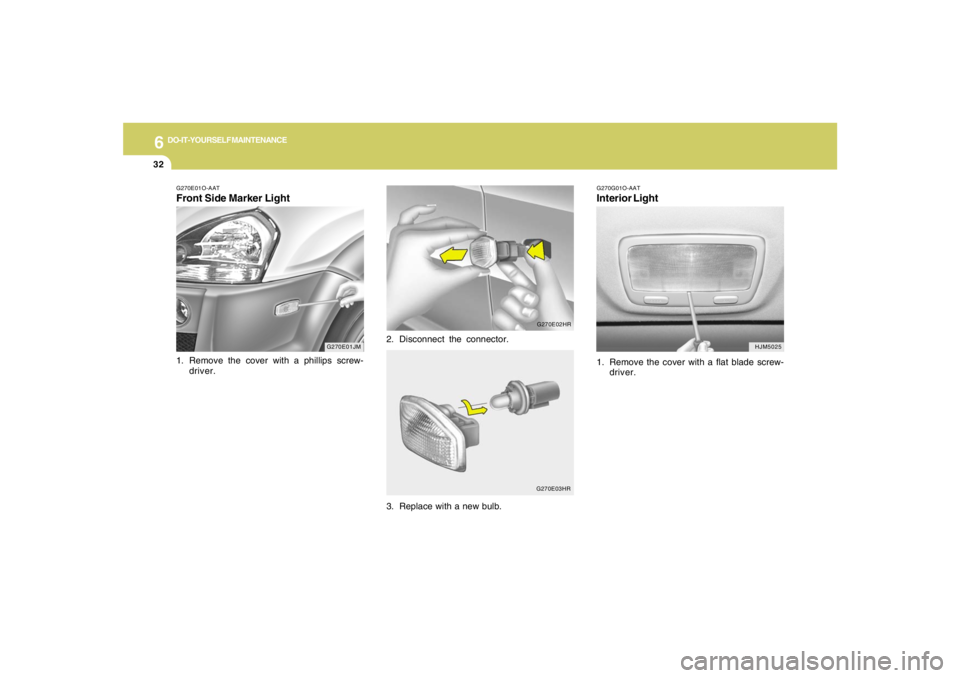
G270G01O-AATInterior Light1. Remove the cover with a flat blade screw-
driver.
HJM5025
G270E01JM G270E01O-AAT
Front Side Marker Light1. Remove the cover with a phillips screw-
driver.2. Disconnect the connector.
3. Replace with a new bulb.
G270E02HRG270E03HR
Page 252 of 289
6
DO-IT-YOURSELF MAINTENANCE
33
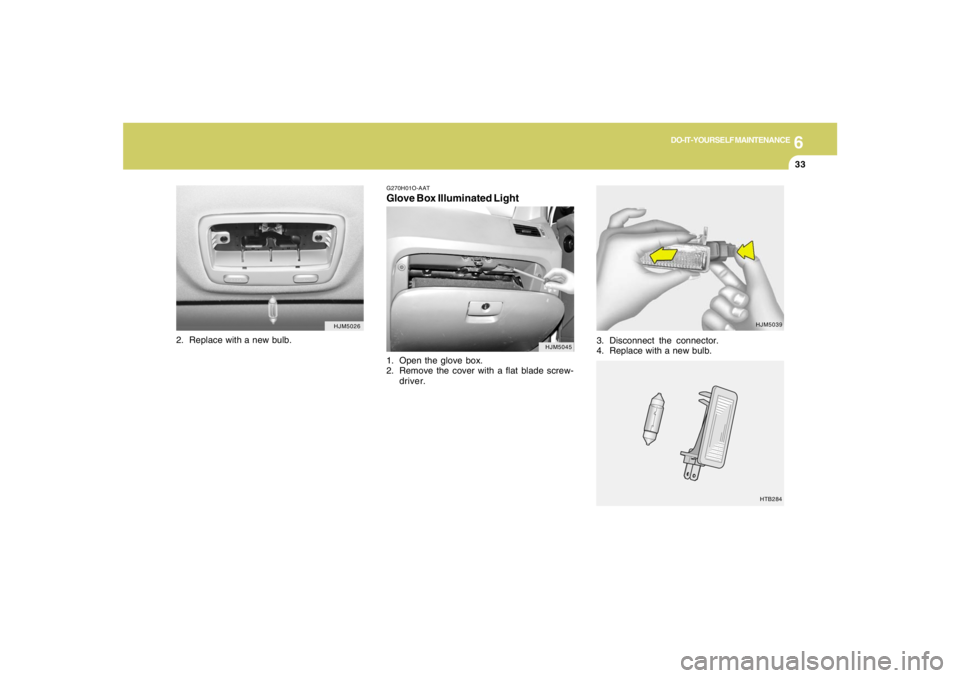
G270H01O-AATGlove Box Illuminated Light1. Open the glove box.
2. Remove the cover with a flat blade screw-
driver.
HJM5026
HJM5045
2. Replace with a new bulb.
3. Disconnect the connector.
4. Replace with a new bulb.
HJM5039
HTB284
Page 253 of 289
6
DO-IT-YOURSELF MAINTENANCE
34
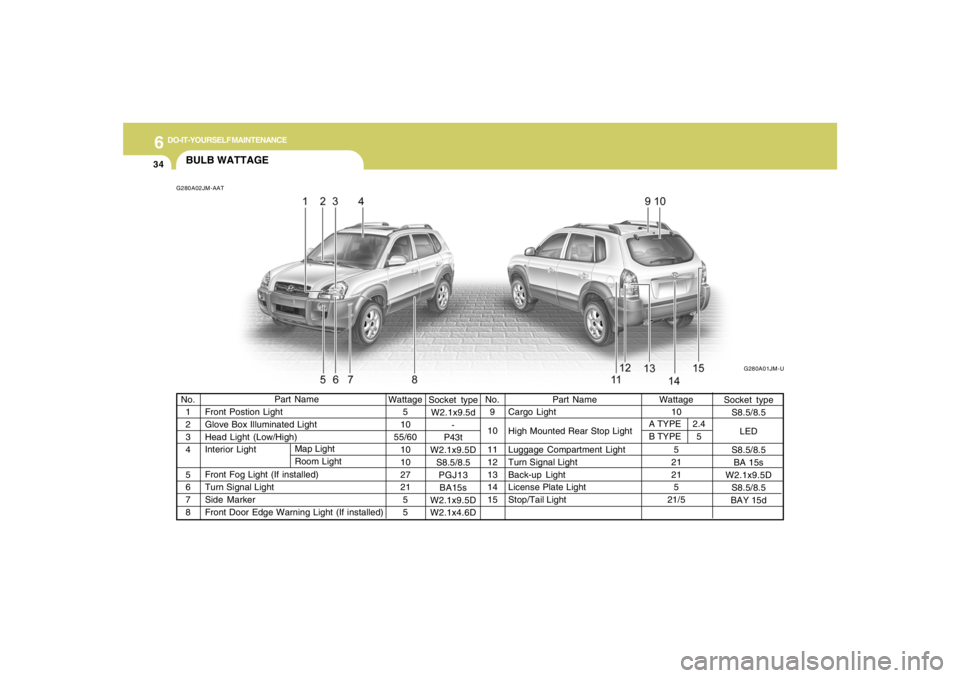
BULB WATTAGEG280A02JM-AAT
G280A01JM-U
Part Name
Front Postion Light
Glove Box Illuminated Light
Head Light (Low/High)
Interior Light
Front Fog Light (If installed)
Turn Signal Light
Side Marker
Front Door Edge Warning Light (If installed) No.
1
2
3
4
5
6
7
8Wattage
5
10
55/60
10
10
27
21
5
5Wattage
10
5
21
21
5
21/5 No.
9
10
11
12
13
14
15
Part Name
Cargo Light
High Mounted Rear Stop Light
Luggage Compartment Light
Turn Signal Light
Back-up Light
License Plate Light
Stop/Tail Light Map Light
Room Light
A TYPE
B TYPE2.4
5
Socket type
S8.5/8.5
LED
S8.5/8.5
BA 15s
W2.1x9.5D
S8.5/8.5
BAY 15d Socket type
W2.1x9.5d
-
P43t
W2.1x9.5D
S8.5/8.5
PGJ13
BA15s
W2.1x9.5D
W2.1x4.6D
Page 254 of 289
6
DO-IT-YOURSELF MAINTENANCE
35
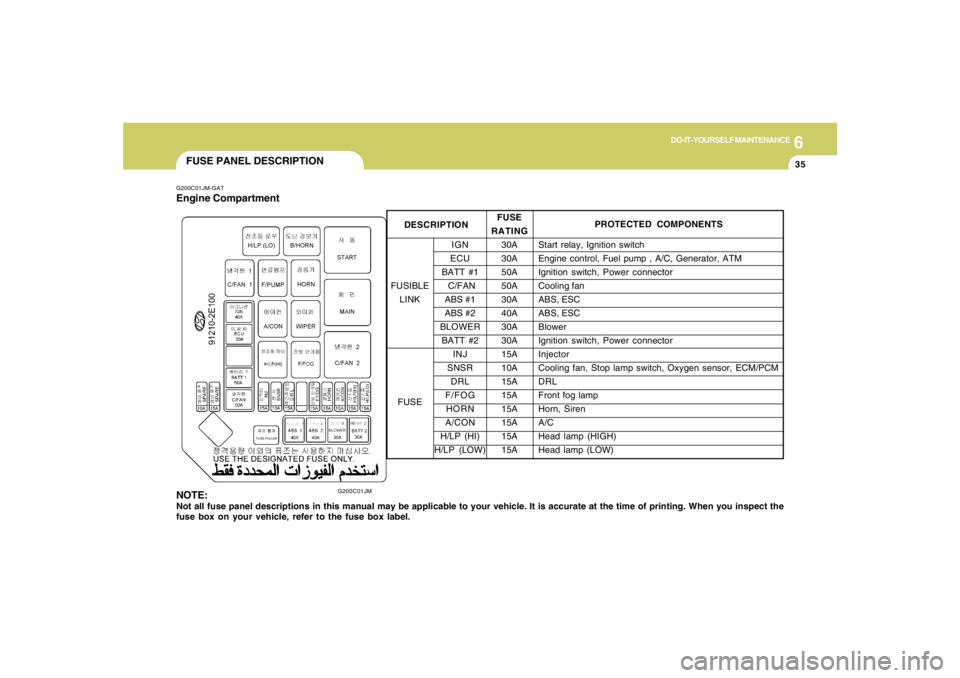
FUSE PANEL DESCRIPTIONG200C01JM-GATEngine Compartment
G200C01JM
NOTE:Not all fuse panel descriptions in this manual may be applicable to your vehicle. It is accurate at the time of printing. When you inspect the
fuse box on your vehicle, refer to the fuse box label.FUSE
RATING
30A
30A
50A
50A
30A
40A
30A
30A
15A
10A
15A
15A
15A
15A
15A
15APROTECTED COMPONENTS
Start relay, Ignition switch
Engine control, Fuel pump , A/C, Generator, ATM
Ignition switch, Power connector
Cooling fan
ABS, ESC
ABS, ESC
Blower
Ignition switch, Power connector
Injector
Cooling fan, Stop lamp switch, Oxygen sensor, ECM/PCM
DRL
Front fog lamp
Horn, Siren
A/C
Head lamp (HIGH)
Head lamp (LOW)
IGN
ECU
BATT #1
C/FAN
ABS #1
ABS #2
BLOWER
BATT #2
INJ
SNSR
DRL
F/FOG
HORN
A/CON
H/LP (HI)
H/LP (LOW) FUSIBLE
LINK
FUSE
DESCRIPTION
Page 255 of 289
6
DO-IT-YOURSELF MAINTENANCE
36
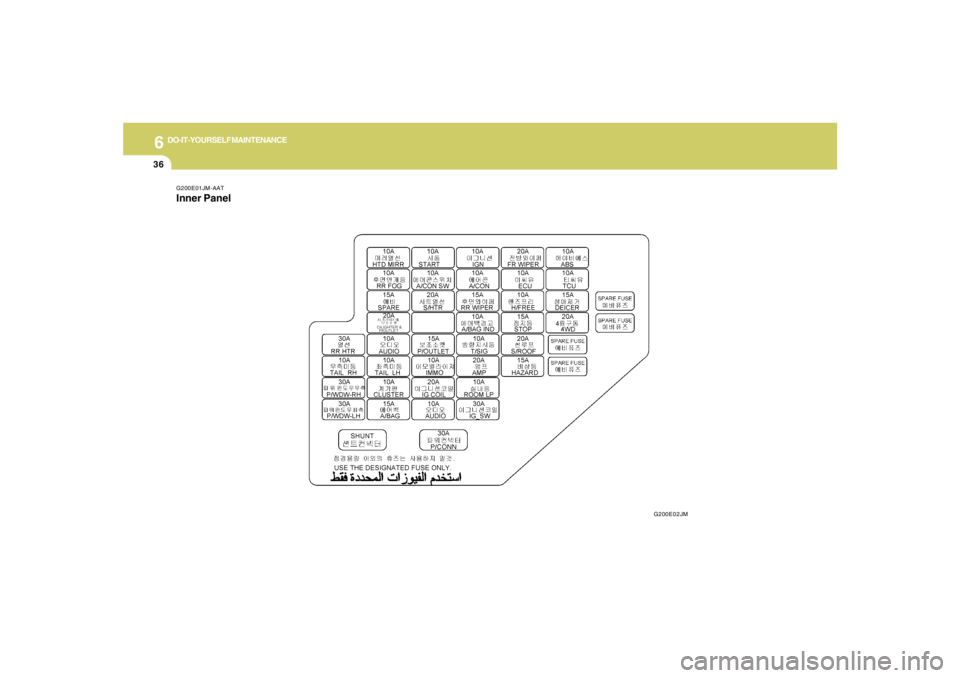
G200E01JM-AATInner Panel
G200E02JM
Page 256 of 289

6
DO-IT-YOURSELF MAINTENANCE
37
FUSE
P/WDW-LH
P/WDW-RH
TAIL RH
RR HTR
A/BAG
CLUSTER
TAIL LH
AUDIO
C/LIGHTER
& P/OUTLET
SPARE
RR FOG
HTD MIRR
AUDIO
IG COIL
IMMO
P/OUTLET
S/HTR
A/CON SW
STARTPROTECTED COMPONENTS
Left power window
Right power window
Right rear combination lamp, Glove box lllumination
Rear defogger
SRS control
Instrument cluster, ETACM/TACM
Left head lamp, Left rear combination lamp, License lamp
Digital clock, Audio, Power outside mirror folding module, Power outside mirror & mirror folding switch
Cigarette lighter
(SPARE)
Rear fog lamp
Left/Right power outsider mirror & mirror folding motor, Rear defogger switch
Audio
Ignition coil (2.7 L)
Immobilizer control module (2.7 L)
Rear power outlet
(Not used)
Seat warmer
A/C control module (Manual A/C)
Theft alarm relay, Transaxle range switch, lgnition lock switch
FUSE
RATING
30A
30A
10A
30A
15A
10A
10A
10A
20A
15A
10A
10A
10A
20A
10A
15A
10A
20A
10A
10A
Page 257 of 289
6
DO-IT-YOURSELF MAINTENANCE
38
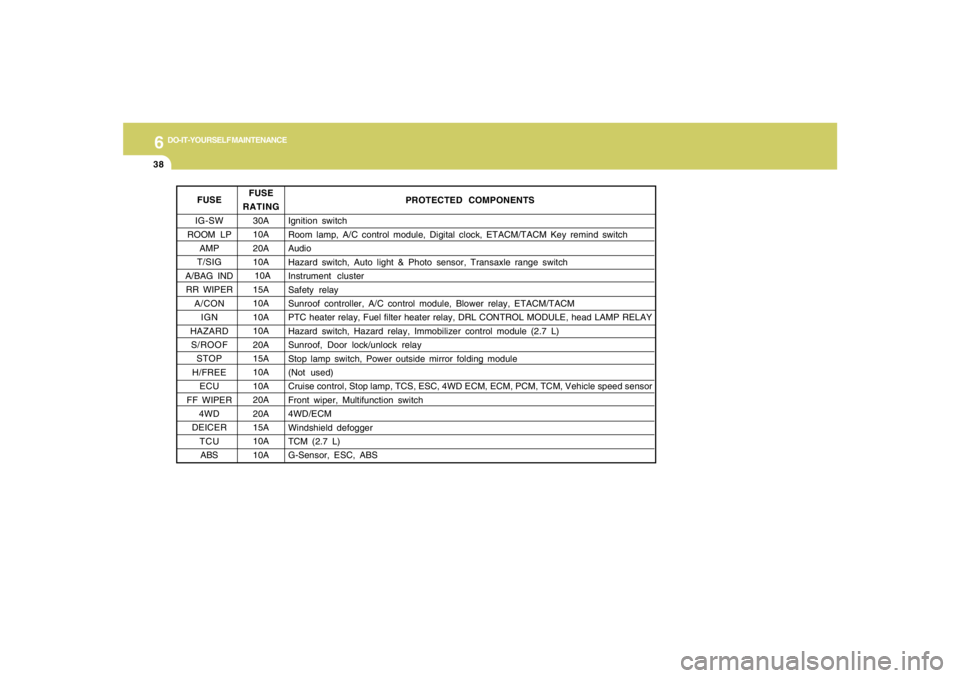
FUSE
IG-SW
ROOM LP
AMP
T/SIG
A/BAG IND
RR WIPER
A/CON
IGN
HAZARD
S/ROOF
STOP
H/FREE
ECU
FF WIPER
4WD
DEICER
TCU
ABS
PROTECTED COMPONENTS
Ignition switch
Room lamp, A/C control module, Digital clock, ETACM/TACM Key remind switch
Audio
Hazard switch, Auto light & Photo sensor, Transaxle range switch
Instrument cluster
Safety relay
Sunroof controller, A/C control module, Blower relay, ETACM/TACM
PTC heater relay, Fuel filter heater relay, DRL CONTROL MODULE, head LAMP RELAY
Hazard switch, Hazard relay, Immobilizer control module (2.7 L)
Sunroof, Door lock/unlock relay
Stop lamp switch, Power outside mirror folding module
(Not used)
Cruise control, Stop lamp, TCS, ESC, 4WD ECM, ECM, PCM, TCM, Vehicle speed sensor
Front wiper, Multifunction switch
4WD/ECM
Windshield defogger
TCM (2.7 L)
G-Sensor, ESC, ABS FUSE
RATING
30A
10A
20A
10A
10A
15A
10A
10A
10A
20A
15A
10A
10A
20A
20A
15A
10A
10A
Page 259 of 289
7
EMISSION CONTROL SYSTEMS2
EMISSION CONTROL SYSTEM
H010D01A-AAT3. Exhaust Emission Control SystemThe Exhaust Emission Control System is a
highly effective system which controls exhaust
emissions while maintaining good vehicle
performace.
H010B01A-AAT1. Crankcase Emission Control
SystemThe positive crankcase ventilation system is
employed to prevent air pollution caused by
blow-by gases being emitted from the crank-
case. This system supplies filtered air to the
crankcase through the air intake hose. Inside
the crankcase, the fresh air mixes with blow-by
gases, which then pass through the PCV valve
and into the induction system.
H010A02O-AATYour Hyundai is equipped with an emission
control system to meet all requirements of the
U.S. Environmental Protection Agency or Cali-
fornia Air Resources Board.
There are three emission control systems which
are as follows.
(1) Crankcase emission control system
(2) Evaporative emission control system
(3) Exhaust emission control system
In order to assure the proper function of the
emission control systems, it is recommended
that you have your car inspected and main-
tained by an authorized Hyundai dealer in ac-
cordance with the maintenance schedule in this
manual.
Caution for the Inspection and Maintenance
Test (V6 Vehicle with Traction Control Sys-
tem)
o To prevent the vehicle from misfiring
during dynamometer testing, discon-
nect the ABS connector in the engine
compartment. (2.7 V6 only)
o For more information, see shop manual
(Wheel Speed Sensor).
o After dynamometer testing is completed,
erase the ABS/TCS DTC (Diagnotic
Trouble Code) with a GST (Generic Scan
Tool) or Hi-Scan Pro.
CanisterFuel vapors generated inside the fuel tank are
absorbed and stored in the canister. When the
engine is running, the fuel vapors absorbed in
the canister are drawn into the induction system
through the purge control solenoid valve.Purge Control Solenoid Valve (PCSV)The purge control solenoid valve is controlled
by the Engine Control Module (ECM); when the
engine coolant temperature is low during idling,
the PCSV closes so that evaporated fuel is not
taken into the engine. After the engine warms-
up during ordinary driving, the PCSV opens to
introduce evaporated fuel to the engine.
H010C01S-AAT2. Evaporative Emission Control (Includ-
ing ORVR: Onboard Refueling Vapor
Recovery) SystemThe Evaporative Emission Control System is
designed to prevent fuel vapors from escaping
into the atmosphere.
(The ORVR system is designed to allow the
vapors from the fuel tank to be loaded into a
canister while refueling at the gas station, pre-
venting the escape of fuel vapors into the
atmosphere.)
jmhma-7.p653/9/2005, 2:52 PM 2
Page 261 of 289
Vehicle Identification Number (VIN) .............................. 8-2
Engine Number ............................................................. 8-2
Tire Information ............................................................. 8-2
Recommended Inflation Pressures ............................... 8-3
Tire Sidewall Labeling ................................................... 8-6
Tire Terminology and Definitions ................................... 8-7
Snow Tires..................................................................8-10
Tire Chains ..................................................................8-10
Tire Rotation................................................................8-11
Tire Balancing.............................................................8-11
Tire Traction................................................................8-11
When to Replace Tires ...............................................8-12
Tire Maintenance........................................................8-13
Spare Tire and Tools ...................................................8-14
Warranties for Your Hyundai Vehicle..........................8-14
Consumer Information.................................................8-14
Reporting Safety Defects............................................8-17
Binding Arbitration of Warranty Claims (U.S.A Only) .. 8-17
CONSUMER INFORMATION, REPORTING
SAFETY DEFECTS & BINDING
ARBITRATION OF WARRANTY CLAIMS
8
8
Page 273 of 289
8
CONSUMER INFORMATION, REPORTING SAFETY DEFECTS & BINDING ARBITRATION OF WARRANTY CLAIMS
13
!
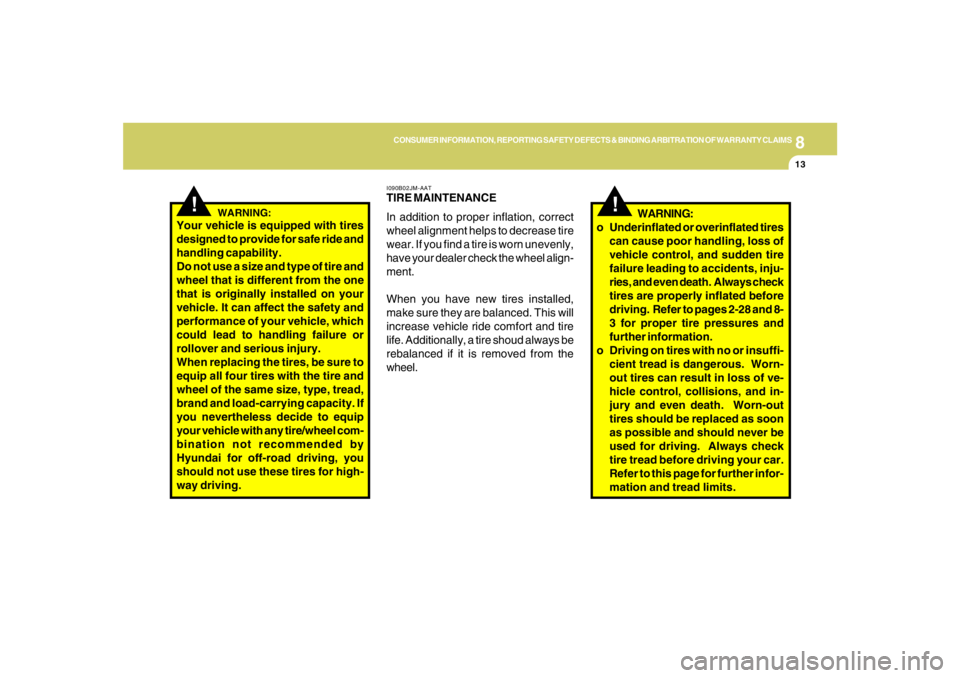
I090B02JM-AATTIRE MAINTENANCE
In addition to proper inflation, correct
wheel alignment helps to decrease tire
wear. If you find a tire is worn unevenly,
have your dealer check the wheel align-
ment.
When you have new tires installed,
make sure they are balanced. This will
increase vehicle ride comfort and tire
life. Additionally, a tire shoud always be
rebalanced if it is removed from the
wheel.
!
WARNING:
Your vehicle is equipped with tires
designed to provide for safe ride and
handling capability.
Do not use a size and type of tire and
wheel that is different from the one
that is originally installed on your
vehicle. It can affect the safety and
performance of your vehicle, which
could lead to handling failure or
rollover and serious injury.
When replacing the tires, be sure to
equip all four tires with the tire and
wheel of the same size, type, tread,
brand and load-carrying capacity. If
you nevertheless decide to equip
your vehicle with any tire/wheel com-
bination not recommended by
Hyundai for off-road driving, you
should not use these tires for high-
way driving.WARNING:
o Underinflated or overinflated tires
can cause poor handling, loss of
vehicle control, and sudden tire
failure leading to accidents, inju-
ries, and even death. Always check
tires are properly inflated before
driving. Refer to pages 2-28 and 8-
3 for proper tire pressures and
further information.
o Driving on tires with no or insuffi-
cient tread is dangerous. Worn-
out tires can result in loss of ve-
hicle control, collisions, and in-
jury and even death. Worn-out
tires should be replaced as soon
as possible and should never be
used for driving. Always check
tire tread before driving your car.
Refer to this page for further infor-
mation and tread limits.