engine HYUNDAI TUCSON 2006 Owners Manual
[x] Cancel search | Manufacturer: HYUNDAI, Model Year: 2006, Model line: TUCSON, Model: HYUNDAI TUCSON 2006Pages: 289, PDF Size: 11.55 MB
Page 7 of 289

A040A01A-AAT
FOREWORD
Thank you for choosing Hyundai. We are pleased to welcome you to the growing number of discriminating people who
drive Hyundais. The advanced engineering and high-quality construction of each Hyundai we build is something of which
we're very proud.
Your Owner's Manual will introduce you to the features and operation of your new Hyundai. It is suggested that you read
it carefully because the information it contains can contribute greatly to the satisfaction you receive from your new car.
The manufacturer also recommends that all service and maintenance on your car be performed by an authorized Hyundai
dealer. Hyundai dealers are prepared to provide high-quality service, maintenance and any other assistance that may
be required.A050A04A-AAT
HYUNDAI MOTOR COMPANY
Note: Because future owners will also need the information included in this manual, if you sell this Hyundai, please leave
the manual in the vehicle for their use. Thank you.
CAUTION:
Severe engine and transaxle damage may result from the use of poor quality fuels and lubricants that do not
meet Hyundai specifications. You must always use high quality fuels and lubricants that meet the specifica-
tions listed on Page 9-4 in the Vehicle Specifications section of the Owner's Manual and which also appear
in the Service Station Information on the back cover of the Owner's Manual.
Copyright 2006 Hyundai Motor Company. All rights reserved. No part of this publication may be reproduced, stored in
any retrieval system or transmitted in any form or by any means without the prior written permission of Hyundai Motor
Company.
!
Page 8 of 289
A100A03A-AATGuide to Hyundai Genuine Parts1. What are Hyundai Genuine Parts?
Hyundai Genuine Parts are the same parts
used by Hyundai Motor Company to manu-
facture vehicles. They are designed and
tested for the optimum safety, performance,
and reliability to our customers.
2. Why should you use genuine parts?
Hyundai Genuine Parts are engineered and
built to meet rigid manufacturing require-
ments. Using imitation, counterfeit or used
salvage parts is not covered under the
Hyundai New Vehicle Limited Warranty or
any other Hyundai warranty. In addition, any
damage to or failure of Genuine Hyundai
Parts caused by the installation or failure ofan imitation, counterfeit or used salvage part
is not covered by any Hyundai Warranty.
3. How can you tell if you are purchasing
Hyundai Genuine Parts?
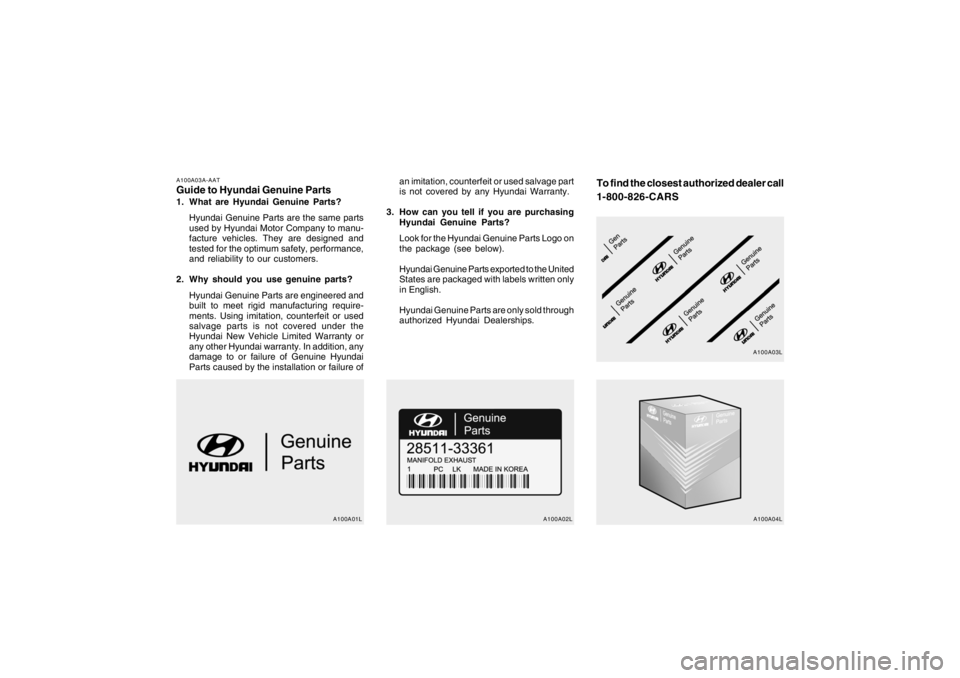
Look for the Hyundai Genuine Parts Logo on
the package (see below).
Hyundai Genuine Parts exported to the United
States are packaged with labels written only
in English.
Hyundai Genuine Parts are only sold through
authorized Hyundai Dealerships.
To find the closest authorized dealer call
1-800-826-CARS
A100A01L A100A02L A100A04LA100A03L
Page 14 of 289
1FEATURES OF YOUR HYUNDAI2
!
B010A01JM
FUEL RECOMMENDATIONS
CAUTION:
Your Hyundai's New Vehicle Limited War-
ranty may not cover damage to the fuel
system and any performance problems that
are caused by the use of fuels containing
methanol or fuels containing MTBE (Methyl
Tertiary Butyl Ether) over 15.0% vol. (Oxy-
gen Content 2.7% weight.)
B010B01A-AATWhat About Gasohol?Gasohol (a mixture of 90% unleaded gasoline
and 10% ethanol or grain alcohol) may be used
in your Hyundai. However, if your engine devel-
ops driveability problems, the use of 100%
unleaded gasoline is recommended. Fuels with
unspecified quantities of alcohol, or alcohols
other than ethanol, should not be used.
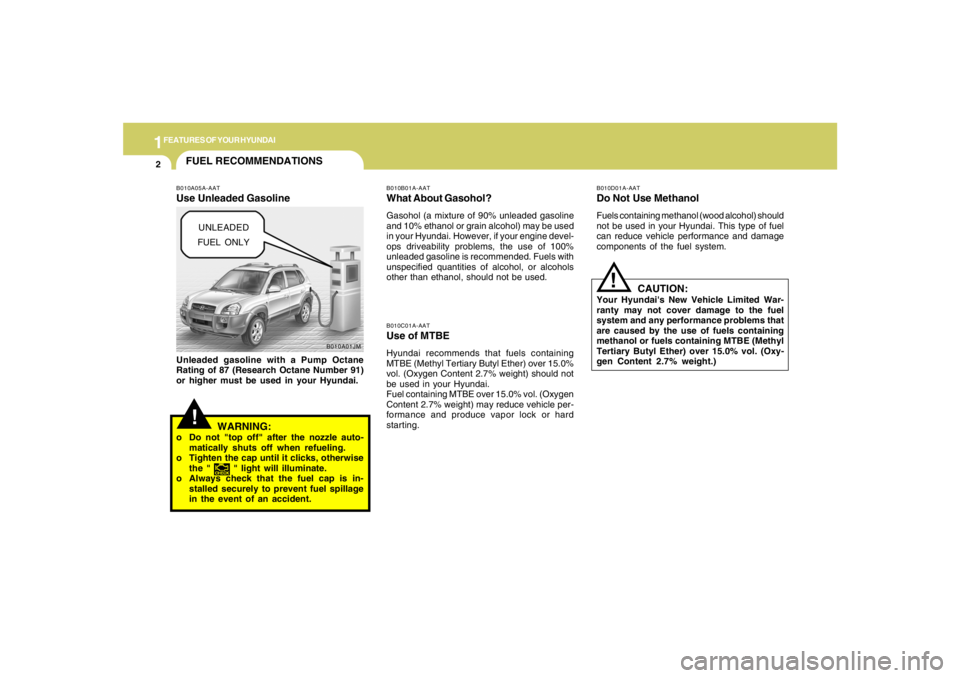
B010A05A-AATUse Unleaded GasolineUnleaded gasoline with a Pump Octane
Rating of 87 (Research Octane Number 91)
or higher must be used in your Hyundai.
B010C01A-AATUse of MTBEHyundai recommends that fuels containing
MTBE (Methyl Tertiary Butyl Ether) over 15.0%
vol. (Oxygen Content 2.7% weight) should not
be used in your Hyundai.
Fuel containing MTBE over 15.0% vol. (Oxygen
Content 2.7% weight) may reduce vehicle per-
formance and produce vapor lock or hard
starting.
B010D01A-AATDo Not Use MethanolFuels containing methanol (wood alcohol) should
not be used in your Hyundai. This type of fuel
can reduce vehicle performance and damage
components of the fuel system.
!
UNLEADED
FUEL ONLY
WARNING:
o Do not "top off" after the nozzle auto-
matically shuts off when refueling.
o Tighten the cap until it clicks, otherwise
the "
" light will illuminate.
o Always check that the fuel cap is in-
stalled securely to prevent fuel spillage
in the event of an accident.
Page 15 of 289
1
FEATURES OF YOUR HYUNDAI
3
KEYS
BREAKING IN YOUR NEW HYUNDAI
B010F01A-AATOperation in Foreign CountriesIf you are going to drive your Hyundai in another
country, be sure to:
o Observe all regulations regarding registra-
tion and insurance.
o Determine that acceptable fuel is available.B010E01A-AATGasolines for Cleaner AirTo help contribute to cleaner air, Hyundai rec-
ommends that you use gasolines treated with
detergent additives, which help prevent deposit
formation in the engine. These gasolines will
help the engine run cleaner and enhance per-
formance of the Emission Control System.
B020A01S-AATDuring the First 1,200 Miles (2,000 Km)No formal "break-in" procedure is required with
your new Hyundai. However, you can contrib-
ute to the economical operation and durability of
your Hyundai by observing the following recom-
mendations during the first 1,200 miles (2,000
km).
o Don't drive faster than 55 MPH (88 km/h).
o While driving, keep your engine speed (rpm,
or revolutions per minute) between 2,000
rpm and 4,000 rpm.
o Use moderate acceleration. Don't start
quickly or depress the accelerator pedal
fully.
o For the first 200 miles (300 km), try to avoid
hard stops.
o Don't lug the engine (in other words, don't
drive so slowly in too high a gear that the
engine "bucks"-shift to a lower gear).
o Whether going fast or slow, vary your speed
from time to time.
o Don't let the engine idle longer than 3 minutes
at one time.
o Don't tow a trailer during the first 1,200 miles
(2,000 km) of operation.
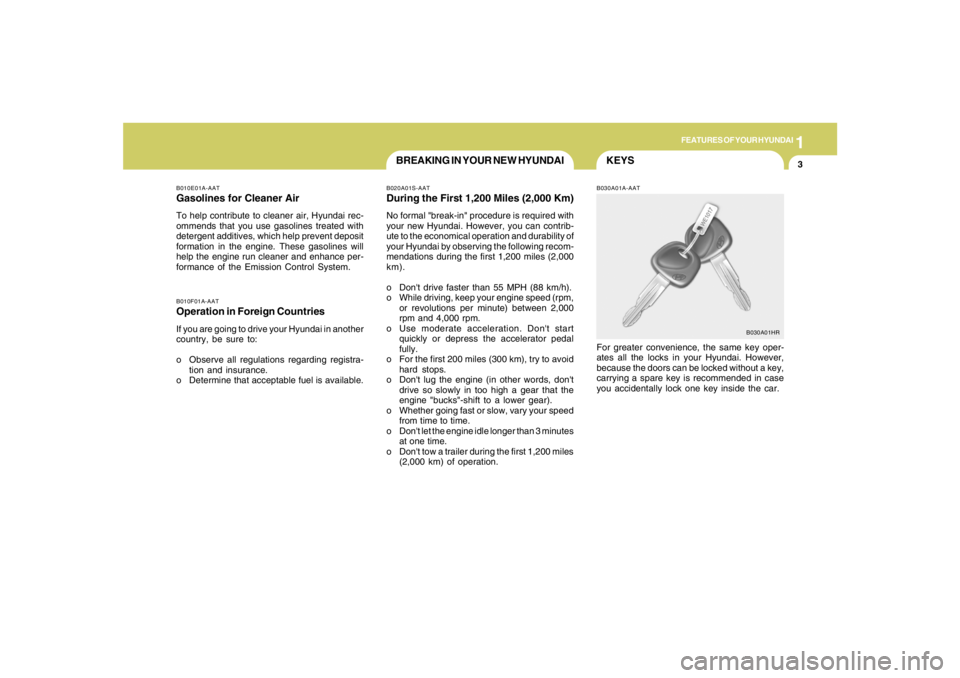
B030A01A-AATFor greater convenience, the same key oper-
ates all the locks in your Hyundai. However,
because the doors can be locked without a key,
carrying a spare key is recommended in case
you accidentally lock one key inside the car.
B030A01HR
Page 20 of 289
1FEATURES OF YOUR HYUNDAI8
B070B01JM
UNLOCK LOCK
THEFT-ALARM SYSTEMB075B01O-AATArmed StagePark the car and stop the engine. Arm the
system as described below.B070A01A-AAT(If installed)This system is designed to provide protection
from unauthorized entry into the car. This sys-
tem is operated in three stages : the first is the
"Armed" stage, the second is the "Alarm" stage
and the third is the "Disarmed" stage. If trig-
gered, the system provides an audible alarm
with blinking of the turn signal lights.
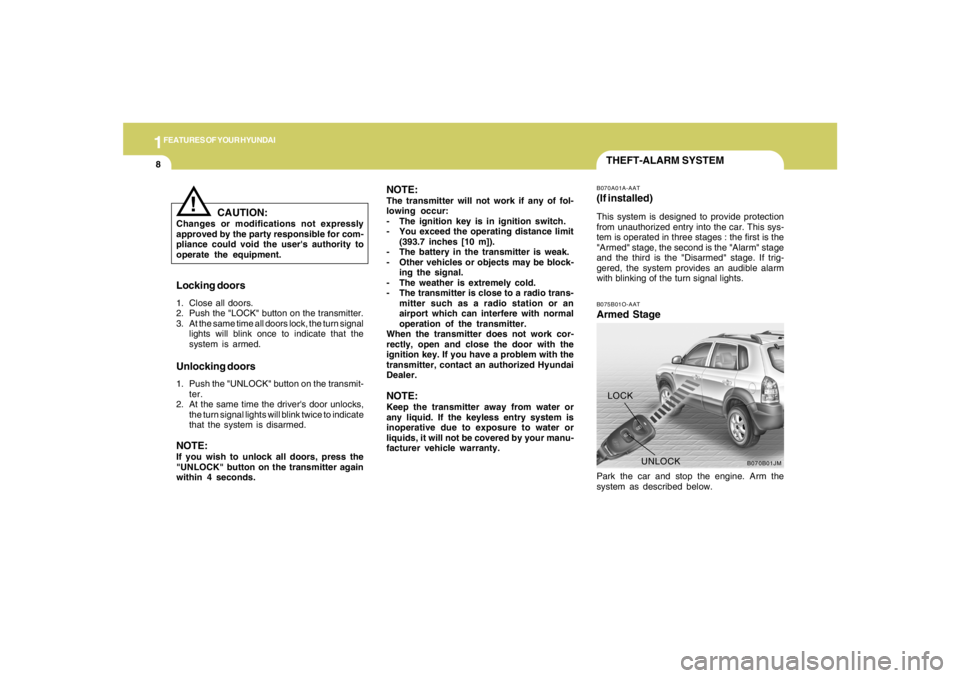
Locking doors1. Close all doors.
2. Push the "LOCK" button on the transmitter.
3. At the same time all doors lock, the turn signal
lights will blink once to indicate that the
system is armed.Unlocking doors1. Push the "UNLOCK" button on the transmit-
ter.
2. At the same time the driver's door unlocks,
the turn signal lights will blink twice to indicate
that the system is disarmed.NOTE:If you wish to unlock all doors, press the
"UNLOCK" button on the transmitter again
within 4 seconds.
CAUTION:
Changes or modifications not expressly
approved by the party responsible for com-
pliance could void the user's authority to
operate the equipment.
!
NOTE:The transmitter will not work if any of fol-
lowing occur:
- The ignition key is in ignition switch.
- You exceed the operating distance limit
(393.7 inches [10 m]).
- The battery in the transmitter is weak.
- Other vehicles or objects may be block-
ing the signal.
- The weather is extremely cold.
- The transmitter is close to a radio trans-
mitter such as a radio station or an
airport which can interfere with normal
operation of the transmitter.
When the transmitter does not work cor-
rectly, open and close the door with the
ignition key. If you have a problem with the
transmitter, contact an authorized Hyundai
Dealer.NOTE:Keep the transmitter away from water or
any liquid. If the keyless entry system is
inoperative due to exposure to water or
liquids, it will not be covered by your manu-
facturer vehicle warranty.
Page 21 of 289

1
FEATURES OF YOUR HYUNDAI
9
1) Remove the ignition key from the ignition
switch.
2) Make sure that the hood and tail gate are
closed and latched.
3) Lock the doors using the transmitter of the
keyless entry system.
After completion of the steps above, the turn
signal lights will blink once to indicate that the
system is armed.
NOTE:o If any door, the tail gate or engine hood
remains open, the system will not be
armed. If this happens, rearm the system
as described above.
o If the "LOCK" button is pressed once
more within 4 seconds after pushing the
"LOCK" button on the transmitter, the
siren will sound once to indicate that the
system is armed.
CAUTION:
Do not arm the system until all passengers
have left the car. If the system is armed while
a passenger(s) remains in the car, the alarm
may be activated when the remaining
passenger(s) leaves the car.
!
B075C01JM-AATAlarm StageThe alarm will be activated if any of the following
occurs while the car is parked and the system
is armed.
1) A front or rear door is opened without using
the transmitter or the ignition key.
2) The tail gate is opened without using the
transmitter or the ignition key.
3) The hood is opened.
The siren will sound and the turn signal lights will
blink continuously for about 30 seconds (This
will repeat 3 times). To turn off the system,
unlock the door or tail gate using the transmitter
or the ignition key.
CAUTION:
Avoid trying to start the engine while the
system is armed.
!
B075D01JM-AATDisarmed StageThe system will be disarmed by using the
transmitter or the ignition key.
The driver's door is unlocked by depressing
once the "UNLOCK" button on the transmitter.
If you wish to unlock all doors, press the "UN-
LOCK" button on the transmitter again within 4
seconds.
Whenever the step above is completed, the turn
signal lights will blink twice to indicate that the
system is disarmed.NOTE :The system will rearm if a door, tailgate, or
hood is not opened within 30 seconds.
Page 48 of 289
1FEATURES OF YOUR HYUNDAI36
!
WARNING:
The SRSCM continually monitors all elements
while the ignition is "ON" to determine if a frontal
or near-frontal impact is severe enough to
require airbag deployment or pre-tensioner seat
belt deployment.
The SRS service reminder indicator (SRI) on
the instrument panel will illuminate for about 6
seconds after the ignition key is turned to the
"ON" position or after the engine is started, after
which the SRI should go out.
The airbag modules are located both in the
center of the steering wheel and in the front
passenger's panel above the glove box. When
the SRSCM detects a sufficiently severe impact
to the front of the vehicle, it will automatically
deploy the front airbags.
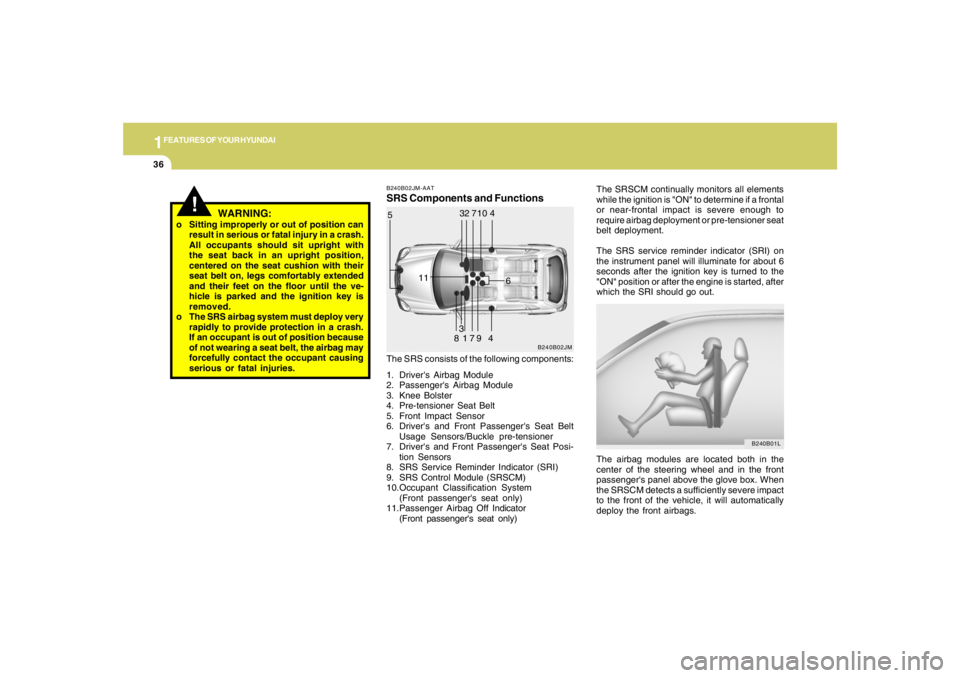
B240B02JM-AATSRS Components and FunctionsThe SRS consists of the following components:
1. Driver's Airbag Module
2. Passenger's Airbag Module
3. Knee Bolster
4. Pre-tensioner Seat Belt
5. Front Impact Sensor
6. Driver's and Front Passenger's Seat Belt
Usage Sensors/Buckle pre-tensioner
7. Driver's and Front Passenger's Seat Posi-
tion Sensors
8. SRS Service Reminder Indicator (SRI)
9. SRS Control Module (SRSCM)
10.Occupant Classification System
(Front passenger's seat only)
11.Passenger Airbag Off Indicator
(Front passenger's seat only)
B240B02JM
11
12710
79 5
6
4
3
4
83
B240B01L
o Sitting improperly or out of position can
result in serious or fatal injury in a crash.
All occupants should sit upright with
the seat back in an upright position,
centered on the seat cushion with their
seat belt on, legs comfortably extended
and their feet on the floor until the ve-
hicle is parked and the ignition key is
removed.
o The SRS airbag system must deploy very
rapidly to provide protection in a crash.
If an occupant is out of position because
of not wearing a seat belt, the airbag may
forcefully contact the occupant causing
serious or fatal injuries.
Page 50 of 289
1FEATURES OF YOUR HYUNDAI38
!
WARNING:
o If an airbag deploys, there may be a loud
noise followed by a fine dust released in
the vehicle. These conditions are nor-
mal and are not hazardous - the airbags
are packed in this fine powder. The dust
generated during airbag deployment
may cause skin or eye irritation as well as
aggravate asthma for some persons.
Always wash all exposed skin areas thor-
oughly with lukewarm water and a mild
soap after an accident in which the
airbags were deployed.Passenger's Airbag
B240B05L
!
o The SRS can function only when the
ignition key is in the "ON" position. If the
SRS SRI does not illuminate or contin-
uously remains on after illuminating for
about 6 seconds when the ignition key
is turned to the "ON" position, or after
the engine is started, illuminates while
driving, the SRS is not working properly.
If this occurs, have your vehicle immedi-
ately inspected by your Hyundai dealer.
o Before you replace a fuse or disconnect
a battery terminal, turn the ignition key
to the "LOCK" position or remove the
ignition key. Never remove or replace the
air bag related fuse(s) when the ignition
key is in the "ON" position. Failure to
heed this warning will cause the SRS SRI
to illuminate.
WARNING:
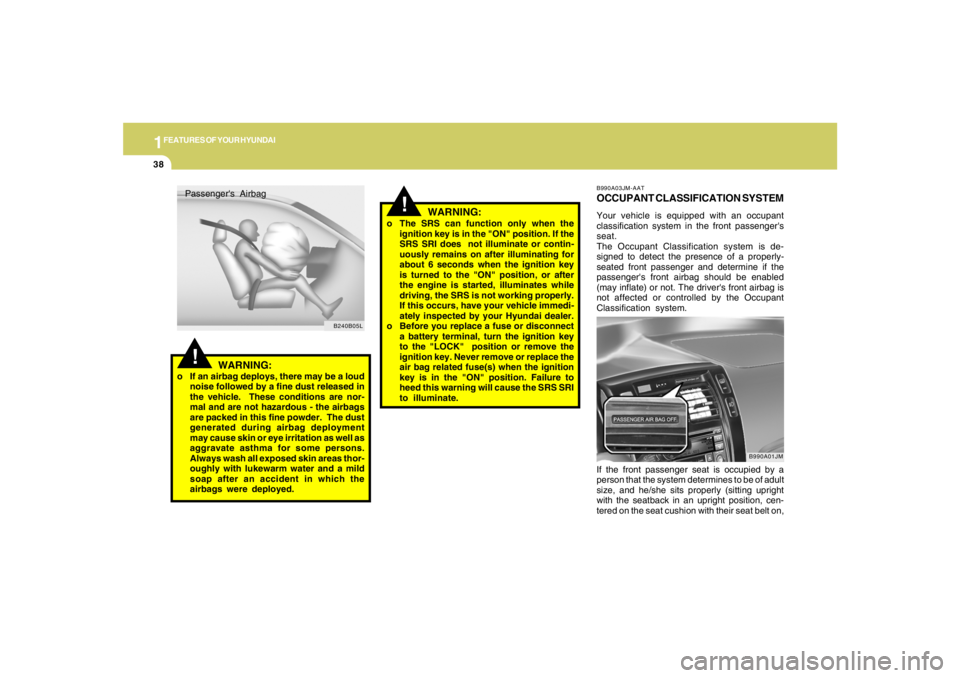
B990A03JM-AATOCCUPANT CLASSIFICATION SYSTEMYour vehicle is equipped with an occupant
classification system in the front passenger's
seat.
The Occupant Classification system is de-
signed to detect the presence of a properly-
seated front passenger and determine if the
passenger's front airbag should be enabled
(may inflate) or not. The driver's front airbag is
not affected or controlled by the Occupant
Classification system.
If the front passenger seat is occupied by a
person that the system determines to be of adult
size, and he/she sits properly (sitting upright
with the seatback in an upright position, cen-
tered on the seat cushion with their seat belt on,
B990A01JM
Page 52 of 289
1FEATURES OF YOUR HYUNDAI40
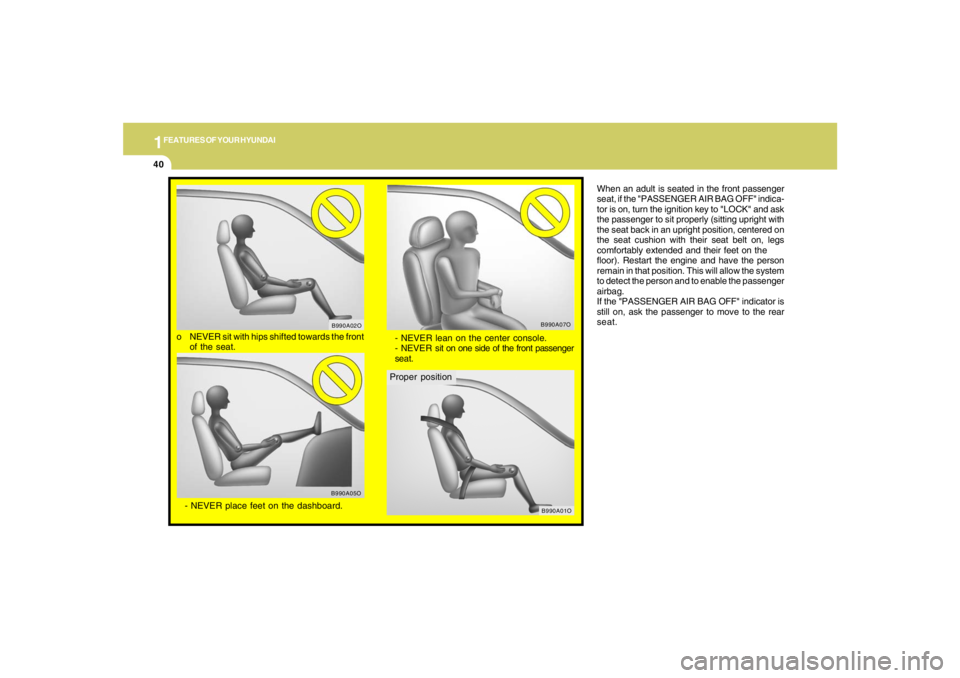
When an adult is seated in the front passenger
seat, if the "PASSENGER AIR BAG OFF" indica-
tor is on, turn the ignition key to "LOCK" and ask
the passenger to sit properly (sitting upright with
the seat back in an upright position, centered on
the seat cushion with their seat belt on, legs
comfortably extended and their feet on the
floor). Restart the engine and have the person
remain in that position. This will allow the system
to detect the person and to enable the passenger
airbag.
If the "PASSENGER AIR BAG OFF" indicator is
still on, ask the passenger to move to the rear
seat.
- NEVER place feet on the dashboard.
B990A07O
B990A05O
- NEVER lean on the center console.
- NEVER
sit on one side of the front passenger
seat.
o NEVER sit with hips shifted towards the front
of the seat.
B990A02O
Proper position
B990A01O
Page 53 of 289
1
FEATURES OF YOUR HYUNDAI
41
!
!
NOTE:The "PASSENGER AIR BAG OFF" indicator
illuminates for about 4 seconds after the
ignition key is turned to the "ON" position
or after the engine is started. If the front
passenger seat is occupied, the occupant
classification sensor will then classify the
front passenger after several more sec-
onds.
CAUTION:
If the occupant classification system is not
working properly, the SRS airbag warning
light on the instrument panel will
illuminate because the passenger's front
airbags are connected with the occupant
classification system. If there is a malfunc-
tion of the occupant classification system,
the "PASSENGER AIR BAG OFF" indicator
will illuminate and the passenger's front
airbags will not inflate in frontal impact
crashes even if there is adult occupant in
the front passenger's seat. If the SRS airbag
warning light does not illuminate when the
ignition key is turned to the "ON" position,
remains illuminated after approximately 6
seconds when the ignition key is turned to
the "ON" position, or if it illuminates while
the vehicle is being driven, have an autho-
rized Hyundai dealer inspect the occupant
classification system and the SRS airbag
system as soon as possible.
!
WARNING:
o Even though your vehicle is equipped
with the occupation classification sys-
tem, never install a child restraint system
in the front passenger's seat. A deploy-
ing airbag can forcefully strike a child
resulting in serious injuries or death.
Any child under 13 years of age should
ride in the rear seat. Children too large
for child restraints should use the avail-
able lap/shoulder belts. No matter what
type of crash, children of all ages are
safer when restrained in the rear seat.
o If the "PASSENGER AIR BAG OFF" indi-
cator is illuminated when the front
passenger's seat is occupied by an adult
and he/she sits properly (sitting upright
with the seatback in an upright position,
centered on the seat cushion with their
seat belt on, legs comfortably extended
and their feet on the floor), have that
person sit in the rear seat.
o Do not modify or replace the front pas-
senger seat. Don't place anything on or
attach anything such as a blanket or
after market seat heater to the front
passenger seat. This can adversely af-
fect the occupant classification system.
WARNING:
Do not allow an adult passenger to ride in
the front seat when the “PASSENGER
AIRBAG OFF” indicator is illuminated, be-
cause the airbag will not deploy in the event
of a crash. If the "PASSENGER AIR BAG
OFF" indicator remains illuminated after
the passenger repositions themselves prop-
erly and the car is restarted, Hyundai recom-
mends that passenger move to the rear seat
because the passenger's front airbag will
not deploy.
Front seat passengers must stay properly
seated to avoid serious injury from a de-
ploying airbag. For more information see
page 1-38.