traction control HYUNDAI TUCSON 2009 User Guide
[x] Cancel search | Manufacturer: HYUNDAI, Model Year: 2009, Model line: TUCSON, Model: HYUNDAI TUCSON 2009Pages: 273, PDF Size: 10.29 MB
Page 150 of 273
2
DRIVING YOUR HYUNDAI
15
!
CAUTION:
Driving with varying tire or wheel size
may cause the ESC system to malfunc-
tion. When replacing tires, make sure
they are the same size as your original
tires.
!
ELECTRONIC STABILITY
CONTROL (ESC) SYSTEMC310A03JM-AAT(If installed)
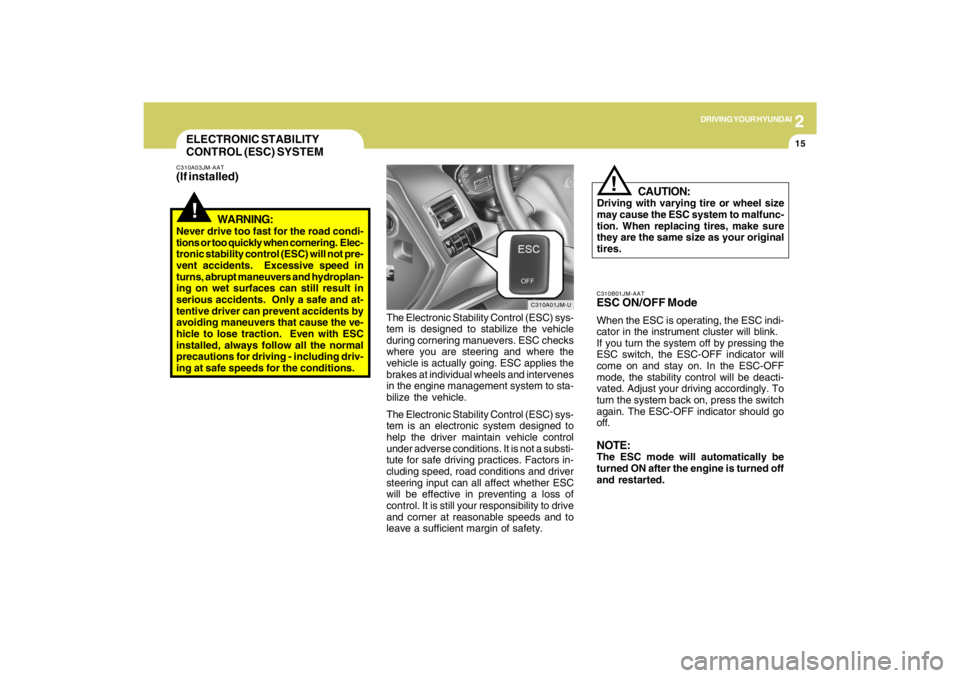
C310A01JM-U
The Electronic Stability Control (ESC) sys-
tem is designed to stabilize the vehicle
during cornering manuevers. ESC checks
where you are steering and where the
vehicle is actually going. ESC applies the
brakes at individual wheels and intervenes
in the engine management system to sta-
bilize the vehicle.
The Electronic Stability Control (ESC) sys-
tem is an electronic system designed to
help the driver maintain vehicle control
under adverse conditions. It is not a substi-
tute for safe driving practices. Factors in-
cluding speed, road conditions and driver
steering input can all affect whether ESC
will be effective in preventing a loss of
control. It is still your responsibility to drive
and corner at reasonable speeds and to
leave a sufficient margin of safety.
WARNING:
Never drive too fast for the road condi-
tions or too quickly when cornering. Elec-
tronic stability control (ESC) will not pre-
vent accidents. Excessive speed in
turns, abrupt maneuvers and hydroplan-
ing on wet surfaces can still result in
serious accidents. Only a safe and at-
tentive driver can prevent accidents by
avoiding maneuvers that cause the ve-
hicle to lose traction. Even with ESC
installed, always follow all the normal
precautions for driving - including driv-
ing at safe speeds for the conditions.
C310B01JM-AATESC ON/OFF ModeWhen the ESC is operating, the ESC indi-
cator in the instrument cluster will blink.
If you turn the system off by pressing the
ESC switch, the ESC-OFF indicator will
come on and stay on. In the ESC-OFF
mode, the stability control will be deacti-
vated. Adjust your driving accordingly. To
turn the system back on, press the switch
again. The ESC-OFF indicator should go
off.NOTE:The ESC mode will automatically be
turned ON after the engine is turned off
and restarted.
Page 151 of 273
2
DRIVING YOUR HYUNDAI
16
C310D01JM-AATIndicators and WarningThe indicators should illuminate when the
ignition key is turned to ON or START but
should go out after three seconds.
If the indicators do not illuminate, or the
ESC or ESC-OFF indicator does not go out
after 3 seconds, have the vehicle checked
by an authorized dealer.
Should there be any unusual conditions in
the device while driving, ESC-OFF indica-
tor illuminates as a warning.
If ESC-OFF indicator illuminates, pull your
car to a safe place and stop the engine.
Then, start the engine again to check if the
ESC-OFF indicator goes out.
If the indicator remains lit even after the
engine has been started, have your car
checked by an authorized Hyundai dealer.
FULL-TIME 4WD OPERATIONC350A02JM-AAT(If installed)Engine power can be delivered to all
wheels. Full-time 4WD is useful when good
traction is required, such as, when driving
on slippery, wet or snow-covered roads
and when moving out of mud. Your vehicle
is not designed for challenging off-road
use. Full-time 4WD vehicles are designed
primarily to improve traction and perfor-
mance on paved roads and highways in
wet and/or slippery conditions. Occasional
off-road use such as established unpaved
roads and trails is considered normal use.
It is always important when traveling off-
highway that the driver carefully reduce
their speed to a level that does not exceed
the safe operating speed for those condi-
tions. In general, off-road conditions pro-
vide less traction and braking effective-
ness than on road conditions. These fac-
tors must be carefully considered when
driving off-road. Keeping the vehicle in
contact with the driving surface and under
control in these conditions is always the
driver's responsibility for the safety of him/
herself and his or her passengers.
!
WARNING:
This vehicle is designed primarily for on
road use. Driving the vehicle in challeng-
ing off-road conditions may result in
damage to the vehicle. Driving in condi-
tions that exceed the vehicle's intended
design or the driver's experience level
may result in severe injury or death.Driving 4WD Safely(1)As always, be sure to wear the seat belt.
(2)Do not drive in challenging off-road
conditions or areas that exceed the
vehicle's basic design intent or the
driver's experience level.
(3)Drive at lower speeds in strong cross-
winds. Because of your vehicle's higher
center of gravity, its stability will be
affected in crosswinds. Slower speeds
ensure better vehicle control.
(4)Check the brake condition after driving
in wet or muddy conditions. Press the
brake several times as you move slowly
until you feel normal braking forces
return.
(5)Do not drive the vehicle through water.
(i.e. streams, rivers, lakes, etc.)
Page 160 of 273
2
DRIVING YOUR HYUNDAI
25
!
HIGHER SPEED MOTORINGC170A02A-AATPre-Trip Inspections1. Tires:
Adjust the tire inflation pressures to speci-
fication. Low tire inflation pressures will
result in overheating and possible failure
of the tires.
Avoid using worn or damaged tires which
may result in reduced traction or tire fail-
ure.NOTE:Never exceed the maximum tire infla-
tion pressure shown on the tires.
WARNING:
o Underinflated or overinflated tires can
cause poor handling, loss of vehicle
control, and sudden tire failure lead-
ing to accidents, injuries, and even
death. Always check tires are prop-
erly inflated before driving. Refer to
pages 2-29 and 8-3 for proper tire
pressures and further information.
o Driving on tires with no or insufficient
tread is dangerous. Worn-out tires
can result in loss of vehicle control,
collisions, injury, and even death.
Worn-out tires should be replaced as
soon as possible and should never be
used for driving. Always check tire
tread before driving your car. Refer to
8-11 for further information and tread
limits.
USE OF LIGHTSC180A01A-AATCheck your lights regularly for correct op-
eration and always keep them clean. When
driving during the day in conditions of poor
visibility, it is helpful to drive with head-
lights on low beam. This enables you to be
seen as well as to see.
2. Fuel, engine coolant and engine oil:
High speed travel consumes more fuel
than urban motoring. Do not forget to check
both engine coolant and engine oil.
3. Drive belt:
A loose or damaged drive belt may result
in overheating of the engine.
Page 244 of 273

7
EMISSION CONTROL SYSTEMS2
EMISSION CONTROL SYSTEM
H010D01A-AAT3. Exhaust Emission Control
SystemThe Exhaust Emission Control System is a
highly effective system which controls ex-
haust emissions while maintaining good
vehicle performace.
H010B01A-AAT1. Crankcase Emission Control
SystemThe positive crankcase ventilation system
is employed to prevent air pollution caused
by blow-by gases being emitted from the
crankcase. This system supplies filtered
air to the crankcase through the air intake
hose. Inside the crankcase, the fresh air
mixes with blow-by gases, which then pass
through the PCV valve and into the induc-
tion system.
H010A02O-AATYour Hyundai is equipped with an emis-
sion control system to meet all require-
ments of the U.S. Environmental Protec-
tion Agency or California Air Resources
Board.
There are three emission control systems
which are as follows.
(1) Crankcase emission control system
(2) Evaporative emission control system
(3) Exhaust emission control system
In order to assure the proper function of the
emission control systems, it is recom-
mended that you have your car inspected
and maintained by an authorized Hyundai
dealer in accordance with the maintenance
schedule in this manual.
Caution for the Inspection and Mainte-
nance Test (V6 Vehicle with Traction
Control System)
o To prevent the vehicle from misfiring
during dynamometer testing, discon-
nect the ABS connector in the engine
compartment. (2.7 V6 only)
o For more information, see shop manual
(Wheel Speed Sensor).
o After dynamometer testing is com-
pleted, erase the ABS/TCS DTC
(Diagnotic Trouble Code) with a GST
(Generic Scan Tool) or Hi-Scan Pro.
CanisterFuel vapors generated inside the fuel tank
are absorbed and stored in the canister.
When the engine is running, the fuel va-
pors absorbed in the canister are drawn
into the induction system through the purge
control solenoid valve.Purge Control Solenoid Valve (PCSV)The purge control solenoid valve is con-
trolled by the Engine Control Module
(ECM); when the engine coolant tempera-
ture is low during idling, the PCSV closes
so that evaporated fuel is not taken into the
engine. After the engine warms-up during
ordinary driving, the PCSV opens to intro-
duce evaporated fuel to the engine.
H010C01S-AAT2. Evaporative Emission Control (In-
cluding ORVR: Onboard Refuel-
ing Vapor Recovery) SystemThe Evaporative Emission Control Sys-
tem is designed to prevent fuel vapors from
escaping into the atmosphere.
(The ORVR system is designed to allow
the vapors from the fuel tank to be loaded
into a canister while refueling at the gas
station, preventing the escape of fuel va-
pors into the atmosphere.)
Page 256 of 273

8
CONSUMER INFORMATION, REPORTING SAFETY DEFECTS & BINDING ARBITRATION OF WARRANTY CLAIMS
11
HEF-241 I060A01O-AAT
TIRE ROTATION
Tires should be rotated every 7,500
miles (12,000 km). If you notice that
tires are wearing unevenly between ro-
tations, have the car checked by a
Hyundai dealer so the cause may be
corrected.
After rotating, adjust the tire pressures
and be sure to check wheel nut torque.
I080A01A-AATTIRE TRACTION
Tire traction can be reduced if you drive
on worn tires, tires that are improperly
inflated or on slippery road surfaces.
Tires should be replaced when tread
wear indicators appear. To reduce the
possibility of losing control, slow down
whenever there is rain, snow or ice on
the road.
I070A01A-AATTIRE BALANCING
A tire that is out of balance may affect
handling and tire wear. The tires on your
Hyundai were balanced before the car
was delivered but may need balancing
again during the years you own the car.
Whenever a tire is dismounted for re-
pair, it should be rebalanced before
being reinstalled on the car.
!
CAUTION:
Do not mix bias-ply and radial-ply
under any circumstances. This may
cause dangerous handling charac-
teristics.
Page 257 of 273

8
CONSUMER INFORMATION, REPORTING SAFETY DEFECTS & BINDING ARBITRATION OF WARRANTY CLAIMS
12
!
!
WARNING:
To reduce the chance or serious or
fatal injuries from an accident caused
by tire failure or loss of vehicle con-
trol:
o Replace tires that are worn, show
uneven wear, or are damaged.
Worn tires can cause loss of brak-
ing effectiveness, steering con-
trol, and traction.
o Do not drive your vehicle with too
little or too much pressure in your
tires. This can lead to uneven
wear and tire failure.
o When replacing tires, never mix
radial and bias-ply tires on the
same car. You must replace all
tires (including the spare) if mov-
ing from radial to bias-ply tires.
HJM5031 I090A04JM-AAT
WHEN TO REPLACE TIRES
The original tires on your car have tread
wear indicators . The location of tread
wear indicators is shown by the "TWI"
or " " marks, etc., The tread wear
indicators appear when the tread depth
is 0.06 in. (1.6 mm). The tire should be
replaced when these appear as a solid
bar across two or more grooves of the
tread. Always replace your tires with
those of the recommended size. If you
change wheels, the new wheel's rim
width and offset must meet Hyundai
specification.
TWI indicator 0.06 in. (1.6 mm)
o Using tires and wheel other than
the recommended sizes could
cause unusual handling charac-
teristics and poor vehicle control,
resulting in a serious accident.
o Wheels that do not meet Hyundai's
specifications may fit poorly and
result in damage to the vehicle or
unusual handling and poor ve-
hicle control.WARNING:
Page 260 of 273
8
CONSUMER INFORMATION, REPORTING SAFETY DEFECTS & BINDING ARBITRATION OF WARRANTY CLAIMS
15
I130B04A-AATTire Quality Grading
Department of Transportation quality
grades - All passenger vehicle tires
must conform to Federal Safety Stan-
dards in addition to these grades. These
quality grades are molded on the
sidewall.
Treadwear - The treadwear grade is a
comparative rating based on the wear
rate of the tire when tested under con-
trolled conditions on a specified gov-
ernment test course. For example, a
tire graded 150 would wear one and a
half (1 - 1/2) times as well on the
government course as a tire graded
100. The relative performance of tires
depends upon the actual conditions of
their use, however, and may depart
significantly from the norm due to varia-
tions in driving habits, service prac-
tices and differences in road character-
istics and climate.
Traction AA, A, B, C - The traction
grades, from highest to lowest, are AA,
A, B, and C. Those grades represent
the tire's ability to stop on wet pave-
ment as measured under controlled
conditions on specified government test
surfaces of asphalt and concrete. A tire
marked C may have poor traction per-
formance.
!
WARNING:
The traction grade assigned to this
tire is based on straight-ahead brak-
ing traction tests, and does not in-
clude acceleration, cornering, hy-
droplaning, or peak traction charac-
teristics.
CONSUMER INFORMATIONI130A01A-AATThis consumer information has been pre-
pared in accordance with regulations is-
sued by the National Highway Traffic Safety
Administration of the U.S. Department of
Transportation. It provides the purchasers
and/or prospective purchasers of Hyundai
automobiles with information on uniform
tire quality grading. Your Hyundai dealer
will help answer any questions you may
have as you read this information.
Page 261 of 273
8
CONSUMER INFORMATION, REPORTING SAFETY DEFECTS & BINDING ARBITRATION OF WARRANTY CLAIMS
16
I130D04A-AATHyundai motor vehicles are designed and
manufactured to meet or exceed all appli-
cable safety standards.
For your safety, however, we strongly urge
you to read and follow all directions in this
Owner's Manual, particularly the informa-
tion under the headings "NOTE", "CAU-
TION" and "WARNING".
If, after reading this manual, you have any
questions regarding the operation of your
vehicle, please contact your nearest
Hyundai Motor America Regional Office
as listed below:
Eastern Region : Connecticut, Delaware,
Maine, Maryland, Massachusetts, New
Hampshire, New Jersey, New York,
Pennsylvanina, Rhode Island, Vermont,
Virginia, West Virginia.
Eastern Region
1100 Cranbury South River Road
Jamesburg, NJ 08831
(800) 633-5151
!
WARNING:
The temperature grade for this tire is
established for a tire that is properly
inflated and not overloaded. Exces-
sive speed, underinflation, or exces-
sive loading, either separately or in
combination, can cause heat buildup
and possible tire failure.
Uniform Tire Quality Grading - Qual-
ity grades can be found on the tire
sidewall between the tread shoulder
and the maximum section width.
For example :
Treadwear 200 Traction AA Tempera-
ture A Temperature A, B, C - The tempera-
ture grades are A (the highest), B, and
C, representing the tire's resistance to
the generation of heat and
its ability to dissipate heat when tested
under controlled conditions on a speci-
fied indoor laboratory test wheel. Sus-
tained high temperature can cause the
material of the tire to degenerate and
reduce tire life, and excessive tempera-
ture can lead to sudden tire failure. The
grade C corresponds to a level of perfor-
mance which all passenger car tires
must meet under the Federal Motor
Vehicle Safety Standard No. 109.
Grades B and A represent higher levels
of performance on the laboratory test
wheel than the minimum required by
law.
Page 269 of 273

10
INDEX
2
A
Air bag ...............................................................................................1-34
Air Cleaner Filter ...............................................................................6-10
Air Conditioning
Care..............................................................................................6-16
Operation.......................................................................... 1-100, 6-16
Switch........................................................................................1-100
Antenna..........................................................................................1-111
Ashtray..............................................................................................1-68
Audio System.................................................................................1-113
B
Battery...............................................................................................6-23
Binding Arbitration (U.S.A Only) .......................................................8-18
Brake
Anti-lock brake system ................................................................2-13
Traction control system (TCS) ...................................................2-13
Checking the brakes ....................................................................6-14
Electronic Stability Control (ESC) .....................................................2-15
Fluid ..............................................................................................6-11
Pedal clearance...........................................................................6-20
Pedal free-play.............................................................................6-19
Practices......................................................................................2-19
Breaking-In your New Hyundai .......................................................... 1-3
Bulb Replacement.............................................................................6-27
C
California Perchlorate Notice ............................................................5-10
Care of Disc ...................................................................................1-123
Catalytic Converter ............................................................................. 7-3
Child-Protector Rear Door Lock ......................................................... 1-7Child Restraint System.....................................................................1-26
Installing a Child Restraint Seat with the
"Tether Anchorage" System .....................................................1-27
Securing the Child Restraint Seat with the "ISOFIX" System ....1-29
Cigarette Lighter................................................................................1-66
Clock.................................................................................................1-66
Clutch
Checking fluid...............................................................................6-15
Pedal free-play.............................................................................6-19
Combination Light
Auto light.......................................................................................1-60
Headlight flasher..........................................................................1-60
Headlight switch...........................................................................1-59
High-beam switch........................................................................1-60
Lane change signal ......................................................................1-59
Parking light auto off .....................................................................1-60
Turn signal operation...................................................................1-59
Consumer Information......................................................................8-15
Cooling Fans.....................................................................................6-24
Corrosion protection
Cleaning the interior....................................................................... 4-5
Protecting your Hyundai from corrosion....................................... 4-2
Washing and waxing...................................................................... 4-3
Cruise Control...................................................................................1-88
D
Defrosting / Defogging ...................................................................1-101
Door
Central door lock............................................................................ 1-7
Door locks...................................................................................... 1-4
Front door edge warning light ......................................................1-87
Drink Holder ......................................................................................1-68
Page 272 of 273

10
INDEX
5
T
Tachometer.......................................................................................1-55
Tail Gate............................................................................................1-78
Tail gate window...........................................................................1-79
Theft-Alarm System............................................................................ 1-9
Ticket Holder.....................................................................................1-87
Tires
Balancing......................................................................................8-11
Chains..........................................................................................8-10
Changing a flat tire .......................................................................3-11
If you have a flat tire .....................................................................3-10
Information...................................................................................... 8-2
Maintenance.................................................................................8-13
Pressure......................................................................................... 8-3
Replacement................................................................................8-12
Rotation........................................................................................8-11
Sidewall Labeling............................................................................ 8-6
Snow tires.....................................................................................8-10
Spare tire........................................................................................ 3-8
Terminology and Definition ............................................................ 8-7
Traction........................................................................................8-11
Towing
A trailer (or vehicle)......................................................................2-26
Emergency...................................................................................3-18
If your car must be towed ............................................................3-16
Traction Control System ...................................................................2-13
Transaxle
Automatic........................................................................................ 2-9
Automatic transaxle fluid checking ..............................................6-12
Manual............................................................................................ 2-7
Manual transaxle oil checking.....................................................6-11
Trip Computer...................................................................................1-56V
Vehicle Identification Number............................................................. 8-2
Vechcle Load Limit ............................................................................2-29
Vehicle Specifications
Engine ............................................................................................. 9-3
Lubrication chart.................................................................. 9-4 ~ 9-5
Measurement................................................................................. 9-2
W
Warning and Indicator Lights ............................................................1-50
Windows
Power...........................................................................................1-12
Windshield Wiper and Washer ..........................................................1-62
Rear Window wiper and washer switch......................................1-63
Windshield Wiper Blade De-icer .......................................................1-64
Windshield Wiper Blades..................................................................6-10
Winter Driving ....................................................................................2-23