lock HYUNDAI TUCSON 2009 Owner's Manual
[x] Cancel search | Manufacturer: HYUNDAI, Model Year: 2009, Model line: TUCSON, Model: HYUNDAI TUCSON 2009Pages: 273, PDF Size: 10.29 MB
Page 34 of 273
1
FEATURES OF YOUR HYUNDAI
23
!
NOTE:Although the combination retractor pro-
vides the same level of protection for
seated passengers in either emergency
or automatic locking modes, it is recom-
mended that seated passengers use the
emergency locking feature for improved
convenience. The automatic locking
function is intended to facilitate child
restraint installation. To convert from
the automatic locking feature to the
emergency locking operation mode, al-
low the unbuckled seat belt to fully re-
tract.
WARNING:
o For maximum restraint system pro-
tection, the seat belts must always be
used whenever the car is moving.
o Seat belts are most effective when
seatbacks are in the upright position.
o Children age 12 and younger must
always be properly restrained in the
rear seat. Never allow children to ride
in the front passenger seat. If a child
over 13 must be seated in the front
seat, he/she must be properly belted
and the seat should be moved as far
back as possible.
o Never wear the shoulder belt under
your arm or behind your back. An
improperly positioned shoulder belt
can cause serious injuries in a crash.
The shoulder belt should be positioned
midway over your shoulder across
your collarbone.
o Avoid wearing twisted seat belts. A
twisted belt can't do its job as well. In
a collision, it could even cut into you.
Be sure the belt webbing is straight
and not twisted.
o Be careful not to damage the belt
webbing or hardware. If the belt web-
bing or hardware is damaged, replace
it.
!
WARNING:
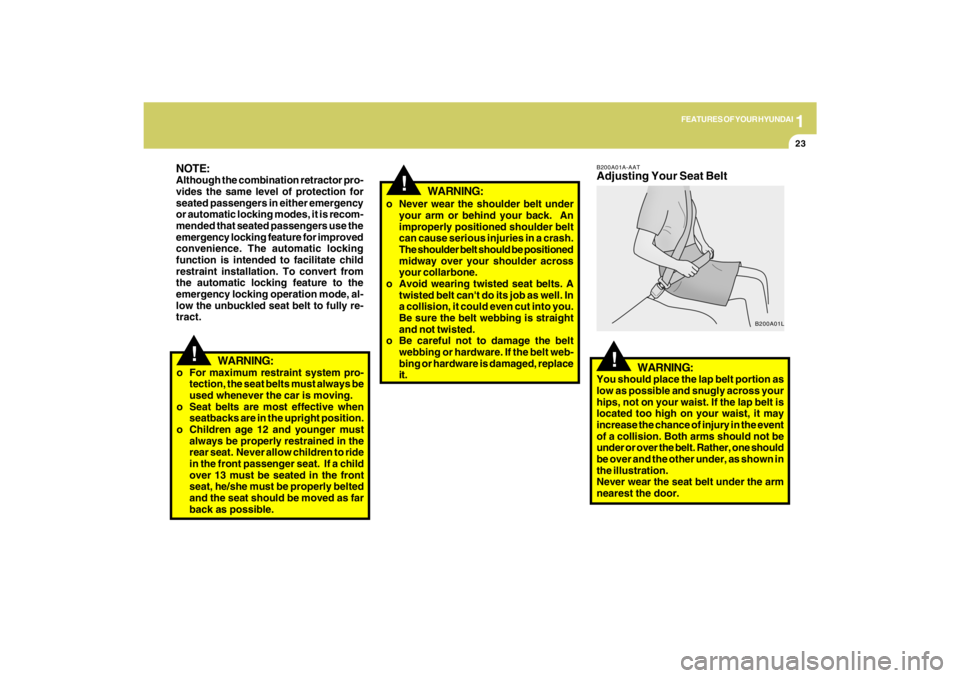
You should place the lap belt portion as
low as possible and snugly across your
hips, not on your waist. If the lap belt is
located too high on your waist, it may
increase the chance of injury in the event
of a collision. Both arms should not be
under or over the belt. Rather, one should
be over and the other under, as shown in
the illustration.
Never wear the seat belt under the arm
nearest the door.
!
B200A01A-AATAdjusting Your Seat Belt
B200A01L
WARNING:
Page 35 of 273
1FEATURES OF YOUR HYUNDAI24
!
WARNING:
o Never let anyone ride in the rear cen-
ter seat without fastening all metal
tabs and buckles as described in this
section. This seat belt is designed to
function as a typical 3-point restraint
(lap/shoulder belt). Using only the
shoulder portion or lap portion of the
belt can result in serious or fatal inju-
ries in the event of a collision or sud-
den stop.
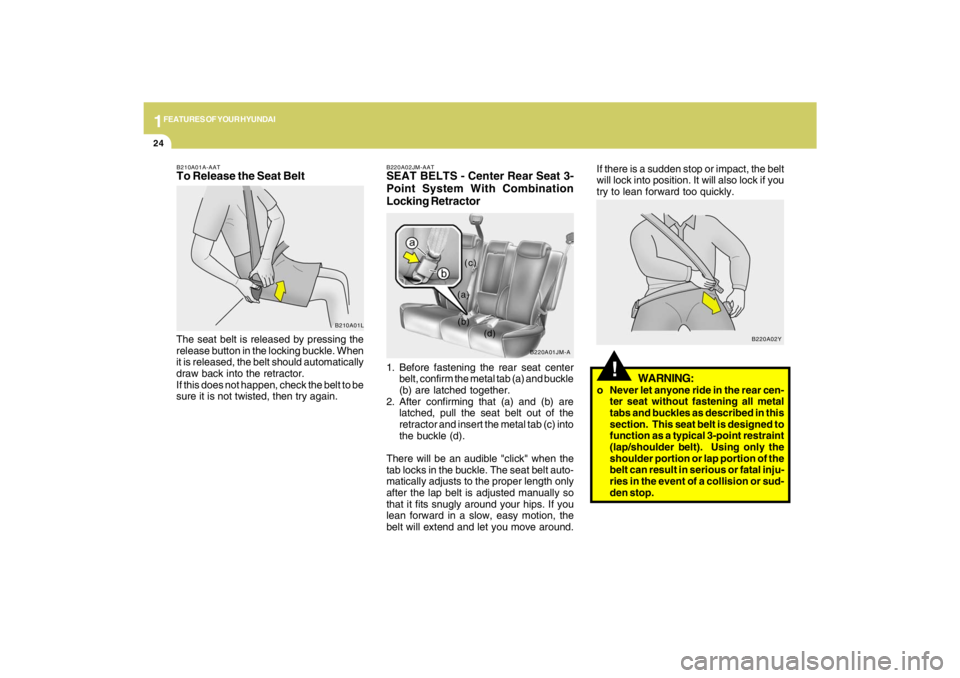
B220A02JM-AATSEAT BELTS - Center Rear Seat 3-
Point System With Combination
Locking Retractor1. Before fastening the rear seat center
belt, confirm the metal tab (a) and buckle
(b) are latched together.
2. After confirming that (a) and (b) are
latched, pull the seat belt out of the
retractor and insert the metal tab (c) into
the buckle (d).
There will be an audible "click" when the
tab locks in the buckle. The seat belt auto-
matically adjusts to the proper length only
after the lap belt is adjusted manually so
that it fits snugly around your hips. If you
lean forward in a slow, easy motion, the
belt will extend and let you move around.If there is a sudden stop or impact, the belt
will lock into position. It will also lock if you
try to lean forward too quickly.
(d)
B220A02Y
B220A01JM-A
(c)
The seat belt is released by pressing the
release button in the locking buckle. When
it is released, the belt should automatically
draw back into the retractor.
If this does not happen, check the belt to be
sure it is not twisted, then try again.B210A01A-AATTo Release the Seat Belt
B210A01L
(a)
(b)
Page 36 of 273
1
FEATURES OF YOUR HYUNDAI
25
!
WARNING:
!
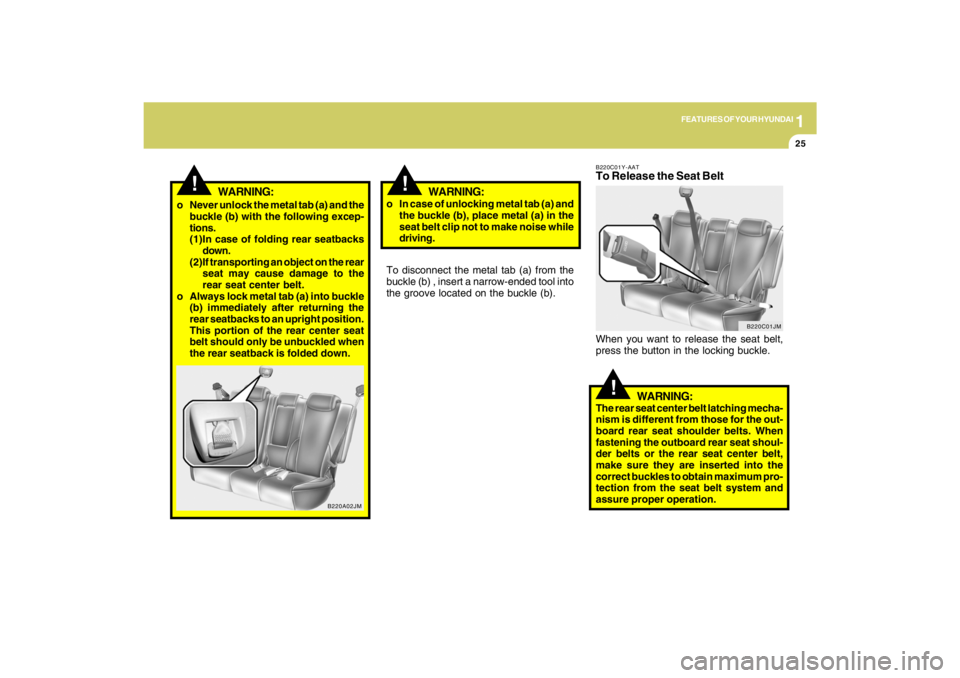
o Never unlock the metal tab (a) and the
buckle (b) with the following excep-
tions.
(1)In case of folding rear seatbacks
down.
(2)If transporting an object on the rear
seat may cause damage to the
rear seat center belt.
o Always lock metal tab (a) into buckle
(b) immediately after returning the
rear seatbacks to an upright position.
This portion of the rear center seat
belt should only be unbuckled when
the rear seatback is folded down.
WARNING:
!
B220C01Y-AATTo Release the Seat BeltWhen you want to release the seat belt,
press the button in the locking buckle.
WARNING:
The rear seat center belt latching mecha-
nism is different from those for the out-
board rear seat shoulder belts. When
fastening the outboard rear seat shoul-
der belts or the rear seat center belt,
make sure they are inserted into the
correct buckles to obtain maximum pro-
tection from the seat belt system and
assure proper operation.
B220C01JM
B220A02JM
o In case of unlocking metal tab (a) and
the buckle (b), place metal (a) in the
seat belt clip not to make noise while
driving.
To disconnect the metal tab (a) from the
buckle (b) , insert a narrow-ended tool into
the groove located on the buckle (b).
Page 38 of 273
1
FEATURES OF YOUR HYUNDAI
27
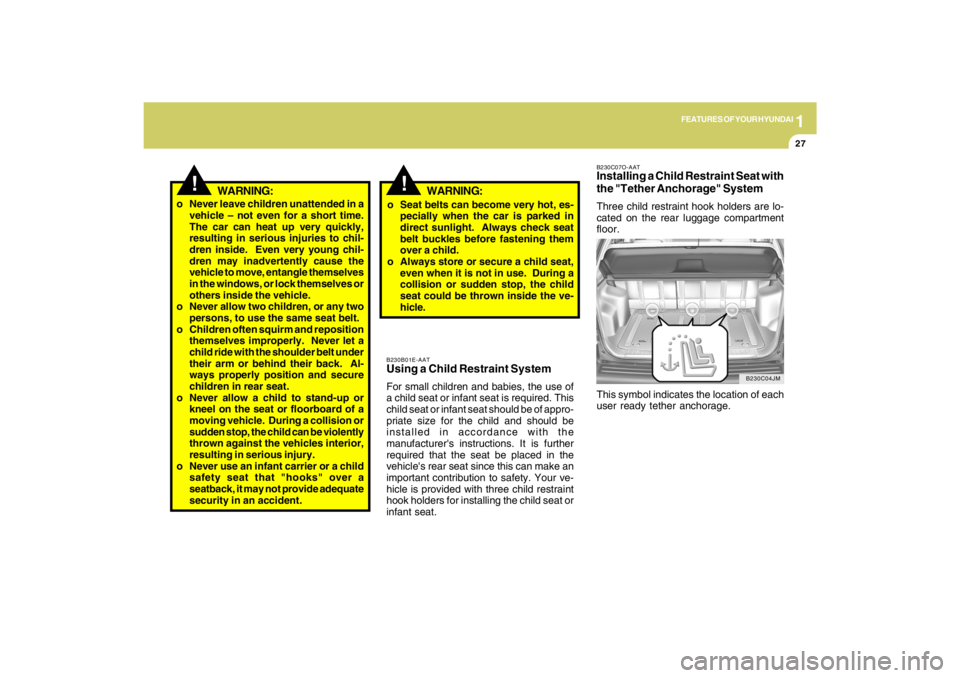
B230C07O-AATInstalling a Child Restraint Seat with
the "Tether Anchorage" SystemThree child restraint hook holders are lo-
cated on the rear luggage compartment
floor.
This symbol indicates the location of each
user ready tether anchorage.
B230C04JM B230B01E-AAT
Using a Child Restraint SystemFor small children and babies, the use of
a child seat or infant seat is required. This
child seat or infant seat should be of appro-
priate size for the child and should be
installed in accordance with the
manufacturer's instructions. It is further
required that the seat be placed in the
vehicle's rear seat since this can make an
important contribution to safety. Your ve-
hicle is provided with three child restraint
hook holders for installing the child seat or
infant seat.
!
o Never leave children unattended in a
vehicle – not even for a short time.
The car can heat up very quickly,
resulting in serious injuries to chil-
dren inside. Even very young chil-
dren may inadvertently cause the
vehicle to move, entangle themselves
in the windows, or lock themselves or
others inside the vehicle.
o Never allow two children, or any two
persons, to use the same seat belt.
o Children often squirm and reposition
themselves improperly. Never let a
child ride with the shoulder belt under
their arm or behind their back. Al-
ways properly position and secure
children in rear seat.
o Never allow a child to stand-up or
kneel on the seat or floorboard of a
moving vehicle. During a collision or
sudden stop, the child can be violently
thrown against the vehicles interior,
resulting in serious injury.
o Never use an infant carrier or a child
safety seat that "hooks" over a
seatback, it may not provide adequate
security in an accident.
WARNING:
!
WARNING:
o Seat belts can become very hot, es-
pecially when the car is parked in
direct sunlight. Always check seat
belt buckles before fastening them
over a child.
o Always store or secure a child seat,
even when it is not in use. During a
collision or sudden stop, the child
seat could be thrown inside the ve-
hicle.
Page 41 of 273
1FEATURES OF YOUR HYUNDAI30
!
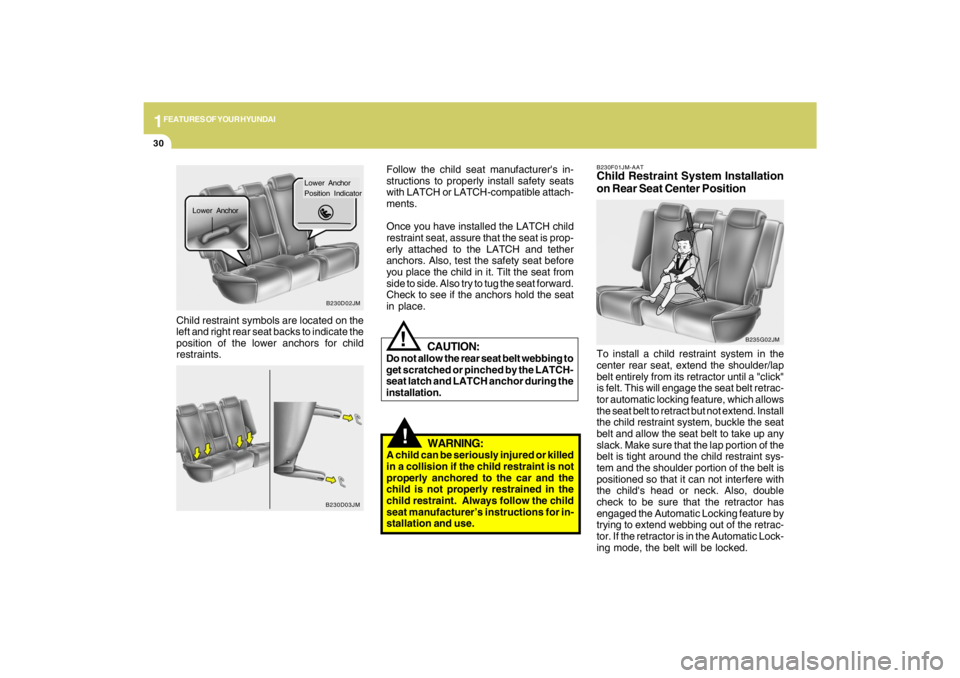
Child restraint symbols are located on the
left and right rear seat backs to indicate the
position of the lower anchors for child
restraints.Follow the child seat manufacturer's in-
structions to properly install safety seats
with LATCH or LATCH-compatible attach-
ments.
Once you have installed the LATCH child
restraint seat, assure that the seat is prop-
erly attached to the LATCH and tether
anchors. Also, test the safety seat before
you place the child in it. Tilt the seat from
side to side. Also try to tug the seat forward.
Check to see if the anchors hold the seat
in place.
Lower Anchor
Position Indicator
Lower Anchor
B230D02JMB230D03JM
WARNING:
A child can be seriously injured or killed
in a collision if the child restraint is not
properly anchored to the car and the
child is not properly restrained in the
child restraint. Always follow the child
seat manufacturer’s instructions for in-
stallation and use.
B230F01JM-AATChild Restraint System Installation
on Rear Seat Center PositionTo install a child restraint system in the
center rear seat, extend the shoulder/lap
belt entirely from its retractor until a "click"
is felt. This will engage the seat belt retrac-
tor automatic locking feature, which allows
the seat belt to retract but not extend. Install
the child restraint system, buckle the seat
belt and allow the seat belt to take up any
slack. Make sure that the lap portion of the
belt is tight around the child restraint sys-
tem and the shoulder portion of the belt is
positioned so that it can not interfere with
the child's head or neck. Also, double
check to be sure that the retractor has
engaged the Automatic Locking feature by
trying to extend webbing out of the retrac-
tor. If the retractor is in the Automatic Lock-
ing mode, the belt will be locked.
B235G02JM
CAUTION:
Do not allow the rear seat belt webbing to
get scratched or pinched by the LATCH-
seat latch and LATCH anchor during the
installation.
!
Page 42 of 273
1
FEATURES OF YOUR HYUNDAI
31
!
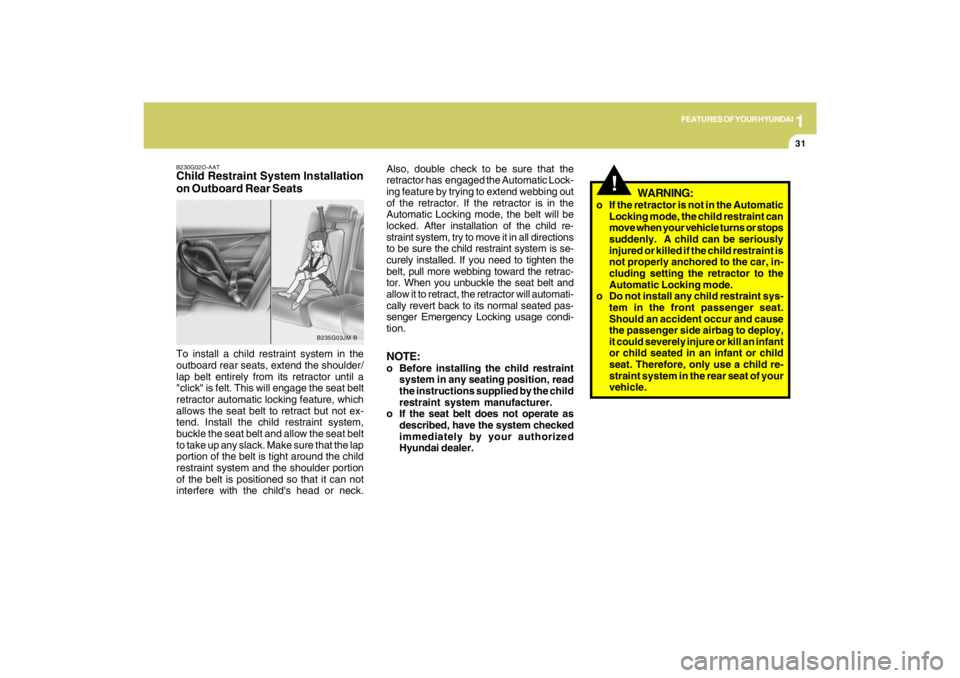
B230G02O-AATChild Restraint System Installation
on Outboard Rear Seats
WARNING:
o If the retractor is not in the Automatic
Locking mode, the child restraint can
move when your vehicle turns or stops
suddenly. A child can be seriously
injured or killed if the child restraint is
not properly anchored to the car, in-
cluding setting the retractor to the
Automatic Locking mode.
o Do not install any child restraint sys-
tem in the front passenger seat.
Should an accident occur and cause
the passenger side airbag to deploy,
it could severely injure or kill an infant
or child seated in an infant or child
seat. Therefore, only use a child re-
straint system in the rear seat of your
vehicle. To install a child restraint system in the
outboard rear seats, extend the shoulder/
lap belt entirely from its retractor until a
"click" is felt. This will engage the seat belt
retractor automatic locking feature, which
allows the seat belt to retract but not ex-
tend. Install the child restraint system,
buckle the seat belt and allow the seat belt
to take up any slack. Make sure that the lap
portion of the belt is tight around the child
restraint system and the shoulder portion
of the belt is positioned so that it can not
interfere with the child's head or neck.Also, double check to be sure that the
retractor has engaged the Automatic Lock-
ing feature by trying to extend webbing out
of the retractor. If the retractor is in the
Automatic Locking mode, the belt will be
locked. After installation of the child re-
straint system, try to move it in all directions
to be sure the child restraint system is se-
curely installed. If you need to tighten the
belt, pull more webbing toward the retrac-
tor. When you unbuckle the seat belt and
allow it to retract, the retractor will automati-
cally revert back to its normal seated pas-
senger Emergency Locking usage condi-
tion.
NOTE:o Before installing the child restraint
system in any seating position, read
the instructions supplied by the child
restraint system manufacturer.
o If the seat belt does not operate as
described, have the system checked
immediately by your authorized
Hyundai dealer.
B235G03JM-B
Page 50 of 273
1
FEATURES OF YOUR HYUNDAI
39
!
WARNING:
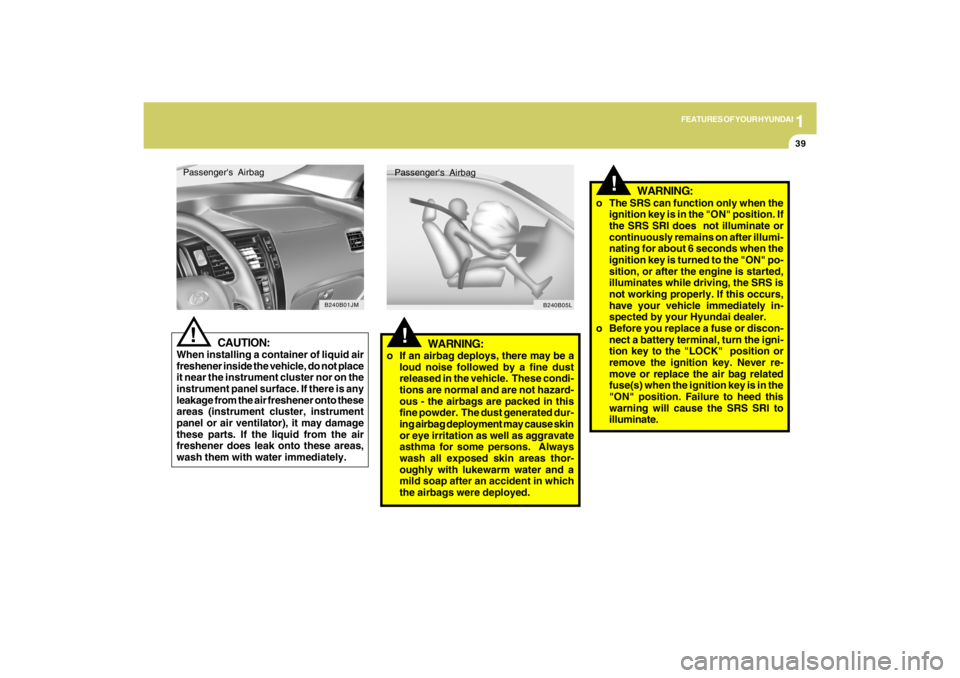
o If an airbag deploys, there may be a
loud noise followed by a fine dust
released in the vehicle. These condi-
tions are normal and are not hazard-
ous - the airbags are packed in this
fine powder. The dust generated dur-
ing airbag deployment may cause skin
or eye irritation as well as aggravate
asthma for some persons. Always
wash all exposed skin areas thor-
oughly with lukewarm water and a
mild soap after an accident in which
the airbags were deployed.Passenger's Airbag
B240B05L
!
o The SRS can function only when the
ignition key is in the "ON" position. If
the SRS SRI does not illuminate or
continuously remains on after illumi-
nating for about 6 seconds when the
ignition key is turned to the "ON" po-
sition, or after the engine is started,
illuminates while driving, the SRS is
not working properly. If this occurs,
have your vehicle immediately in-
spected by your Hyundai dealer.
o Before you replace a fuse or discon-
nect a battery terminal, turn the igni-
tion key to the "LOCK" position or
remove the ignition key. Never re-
move or replace the air bag related
fuse(s) when the ignition key is in the
"ON" position. Failure to heed this
warning will cause the SRS SRI to
illuminate.
WARNING:
CAUTION:
When installing a container of liquid air
freshener inside the vehicle, do not place
it near the instrument cluster nor on the
instrument panel surface. If there is any
leakage from the air freshener onto these
areas (instrument cluster, instrument
panel or air ventilator), it may damage
these parts. If the liquid from the air
freshener does leak onto these areas,
wash them with water immediately.
!Passenger's Airbag
B240B01JM
Page 54 of 273
1
FEATURES OF YOUR HYUNDAI
43
!
!
NOTE:The PASSENGER AIR BAG "OFF" indi-
cator illuminates for about 4 seconds
after the ignition key is turned to the
"ON" position or after the engine is
started. If the front passenger seat is
occupied, the occupant classification
sensor will then classify the front pas-
senger after several more seconds.
CAUTION:
If the occupant classification system is
not working properly, the SRS airbag
warning light on the instrument panel
will illuminate because the passenger's
front airbags are connected with the
occupant classification system. If there
is a malfunction of the occupant classi-
fication system, the PASSENGER AIR
BAG "OFF" indicator will illuminate and
the passenger's front airbags will not
inflate in frontal impact crashes even if
there is adult occupant in the front
passenger's seat. If the SRS airbag warn-
ing light does not illuminate when the
ignition key is turned to the "ON" posi-
tion, remains illuminated after approxi-
mately 6 seconds when the ignition key
is turned to the "ON" position, or if it
illuminates while the vehicle is being
driven, have an authorized Hyundai
dealer inspect the occupant classifica-
tion system and the SRS airbag system
as soon as possible.
WARNING:
Do not allow an adult passenger to ride
in the front seat when the PASSENGER
AIRBAG "OFF" indicator is illuminated,
because the airbag will not deploy in the
event of a crash. If the PASSENGER AIR
BAG "OFF" indicator remains illumi-
nated after the passenger repositions
themselves properly and the car is re-
started, Hyundai recommends that pas-
senger move to the rear seat because
the passenger's front airbag will not de-
ploy.
Front seat passengers must stay prop-
erly seated to avoid serious injury from
a deploying airbag. For more informa-
tion see page 1-38. When an adult is seated in the front passen-
ger seat, if the PASSENGER AIR BAG "OFF"
indicator is on, turn the ignition key to "LOCK"
and ask the passenger to sit properly (sitting
upright with the seat back in an upright
position, centered on the seat cushion with
their seat belt on, legs comfortably extended
and their feet on the floor). Restart the
engine and have the person remain in that
position. This will allow the system to detect
the person and to enable the passenger
airbag. If the PASSENGER AIR BAG "OFF"
indicator is still on, ask the passenger to
move to the rear seat.
!
WARNING:
o Even though your vehicle is equipped
with the occupation classification sys-
tem, never install a child restraint
system in the front passenger's seat.
A deploying airbag can forcefully
strike a child resulting in serious inju-
ries or death. Any child under 13
years of age should ride in the rear
seat. Children too large for child re-
straints should use the available lap/
shoulder belts. No matter what type
of crash, children of all ages are safer
when restrained in the rear seat.
o If the PASSENGER AIR BAG "OFF"
indicator is illuminated when the front
passenger's seat is occupied by an
adult and he/she sits properly (sitting
upright with the seatback in an upright
position, centered on the seat cush-
ion with their seat belt on, legs com-
fortably extended and their feet on the
floor), have that person sit in the rear
seat.
o Do not modify or replace the front
passenger seat. Don't place anything
on or attach anything such as a blan-
ket or after market seat heater to the
front passenger seat. This can ad-
versely affect the occupant classifi-
cation system.
Page 56 of 273
1
FEATURES OF YOUR HYUNDAI
45
!
WARNING:
WARNING:
o The side impact airbag is supplemen-
tal to the driver's and the passenger's
seat belt systems and is not a substi-
tute for them. Your seat belts must be
worn at all times while the vehicle is in
motion. The airbags deploy only in
certain side impact conditions severe
enough to cause significant injury to
the vehicle occupants.
!
HTB072
Side airbag
sensor
o For best protection from the side im-
pact airbag system and to avoid being
injured by the deploying side impact
airbag, both front seat occupants
should sit in an upright position with
the seat belt properly fastened. The
driver's hands should be placed on
the steering wheel at the 9:00 and
3:00 o'clock positions. The
passenger's arms and hands should
be placed on their laps.
o Do not use any accessory seat covers.
o Use of seat covers could reduce or pre-
vent the effectiveness of the system.
o Do not install any accessories on or
near the side impact airbag.
o Do not place any objects over the airbag
or between the airbag and yourself.
o Do not place any objects (an umbrella,
bag, etc.) between the front door and
the front seat. Such objects may be-
come dangerous projectiles and
cause injury if the supplemental side
impact air bag inflates.
o To prevent unexpected deployment of
the side impact air bag that may result
in personal injury, avoid impact to the
side airbag sensor when the ignition
key is on.
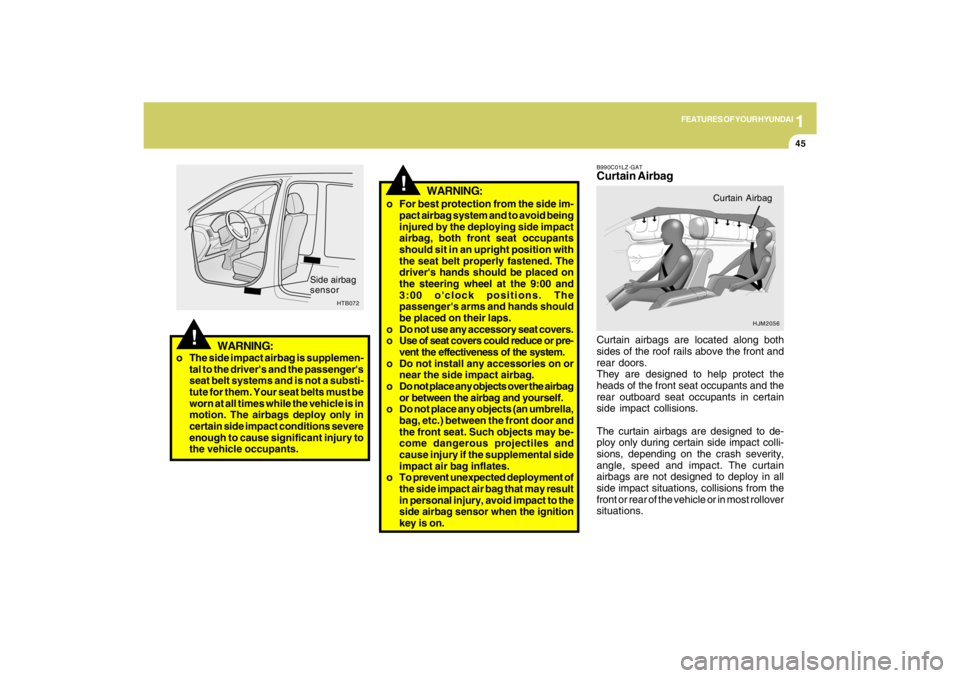
B990C01LZ-GATCurtain AirbagCurtain airbags are located along both
sides of the roof rails above the front and
rear doors.
They are designed to help protect the
heads of the front seat occupants and the
rear outboard seat occupants in certain
side impact collisions.
The curtain airbags are designed to de-
ploy only during certain side impact colli-
sions, depending on the crash severity,
angle, speed and impact. The curtain
airbags are not designed to deploy in all
side impact situations, collisions from the
front or rear of the vehicle or in most rollover
situations.
HJM2056
Curtain Airbag
Page 60 of 273

1
FEATURES OF YOUR HYUNDAI
49
1. Tachometer
2. Turn Signal Indicator Light
3. Seat Belt Warning Light
4. Supplemental Restraint (AirBag) System
Service Reminder Indicator (SRI)
5. Speedometer
6. Parking Brake/Low Brake Fluid Level Warning Light
7. Low Oil Pressure Warning Light
8. High Beam Indicator Light
9. Engine Temperature Warning Light
10. Fuel Gauge
11. Tail Gate Open Warning Light
12. Traction Control Indicator Light (If installed)/
Electronic Stability Control (ESC) Indicator Light
(If installed)13. ABS Service Reminder Indicator (If installed)
14. Immobilizer Warning Light (If installed)
15. Door Ajar Warning Light
16. Automatic Transaxle Position Indicator Light (If installed)
17. Odometer/ Trip odmeter
18. Trip Computer (If installed)
19. Malfunction Indicator Light (MIL)
20. Charging System Warning Light
21. Low Tire Pressure Telltale (If installed)
22. 4WD System Warning Light (If installed)
23. TPMS (Tire Pressure Monitoring System) Malfunction Indicator
(If installed)
24. 4WD Lock Indicator Light
25. Cruise Indicator (If installed)
26. Low Fuel Warning Light