glove box HYUNDAI TUCSON 2009 Owners Manual
[x] Cancel search | Manufacturer: HYUNDAI, Model Year: 2009, Model line: TUCSON, Model: HYUNDAI TUCSON 2009Pages: 273, PDF Size: 10.29 MB
Page 10 of 273

F9
1. Panel Brightness Control Knob (Rheostat Switch)
2. 4WD Lock Switch (If installed)
3. Traction Control System (TCS) Switch (If installed) /
Electronic Stability Control (ESC) Switch (If installed)
4. Instrument Cluster
5. Multi-Function Light Switch (If installed)
6. Front Window Defroster (If installed) / Aux Outlet (If
installed)
7. Hazard Warning Light Switch
8. Digital Clock
9. Windshield Wiper/Washer Switch10. Rear Defroster and Outside Rearview Mirror Heater Switch
(If installed)
11. Front Fog Light Switch (If installed)
12. Passenger's Airbag
13. Hood Release Lever
14. Horn and Driver's Airbag
15. Small Article Tray / Ashtray (If installed)
16. Cruise Control Switch (If installed)
17. Heating/Air Conditioning Control Panel (If installed)
18. Shift Lever (If installed)
19. Glove Box
CAUTION:
When installing a container of liquid air freshener inside the vehicle, do not place it near the instrument cluster
nor on the instrument panel surface. If there is any leakage from the air freshener onto these areas
(Instrument cluster, instrument panel or air ventilator), it may damage these parts. If the liquid from the air
freshener does leak onto these areas, wash them with water immediately.
!
Page 45 of 273
1FEATURES OF YOUR HYUNDAI34
ADVANCED SUPPLEMENTAL
RESTRAINT (AIRBAG) SYSTEM
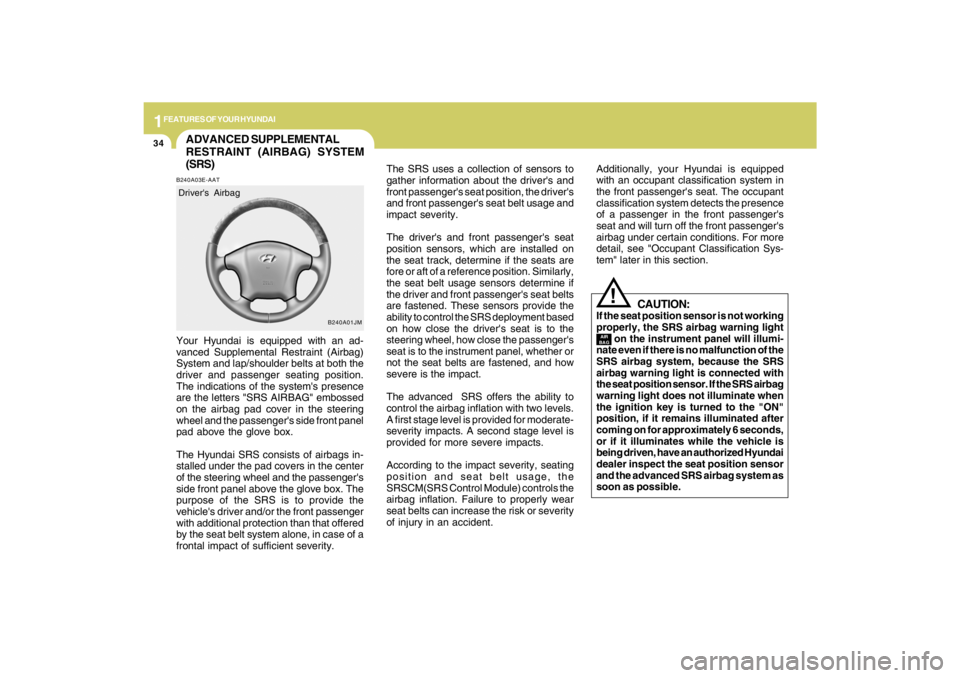
(SRS)B240A03E-AATYour Hyundai is equipped with an ad-
vanced Supplemental Restraint (Airbag)
System and lap/shoulder belts at both the
driver and passenger seating position.
The indications of the system's presence
are the letters "SRS AIRBAG" embossed
on the airbag pad cover in the steering
wheel and the passenger's side front panel
pad above the glove box.
The Hyundai SRS consists of airbags in-
stalled under the pad covers in the center
of the steering wheel and the passenger's
side front panel above the glove box. The
purpose of the SRS is to provide the
vehicle's driver and/or the front passenger
with additional protection than that offered
by the seat belt system alone, in case of a
frontal impact of sufficient severity.
B240A01JM
Driver's Airbag
The SRS uses a collection of sensors to
gather information about the driver's and
front passenger's seat position, the driver's
and front passenger's seat belt usage and
impact severity.
The driver's and front passenger's seat
position sensors, which are installed on
the seat track, determine if the seats are
fore or aft of a reference position. Similarly,
the seat belt usage sensors determine if
the driver and front passenger's seat belts
are fastened. These sensors provide the
ability to control the SRS deployment based
on how close the driver's seat is to the
steering wheel, how close the passenger's
seat is to the instrument panel, whether or
not the seat belts are fastened, and how
severe is the impact.
The advanced SRS offers the ability to
control the airbag inflation with two levels.
A first stage level is provided for moderate-
severity impacts. A second stage level is
provided for more severe impacts.
According to the impact severity, seating
position and seat belt usage, the
SRSCM(SRS Control Module) controls the
airbag inflation. Failure to properly wear
seat belts can increase the risk or severity
of injury in an accident.
CAUTION:
If the seat position sensor is not working
properly, the SRS airbag warning light
on the instrument panel will illumi-
nate even if there is no malfunction of the
SRS airbag system, because the SRS
airbag warning light is connected with
the seat position sensor. If the SRS airbag
warning light does not illuminate when
the ignition key is turned to the "ON"
position, if it remains illuminated after
coming on for approximately 6 seconds,
or if it illuminates while the vehicle is
being driven, have an authorized Hyundai
dealer inspect the seat position sensor
and the advanced SRS airbag system as
soon as possible.
!AIR
BAGAdditionally, your Hyundai is equipped
with an occupant classification system in
the front passenger's seat. The occupant
classification system detects the presence
of a passenger in the front passenger's
seat and will turn off the front passenger's
airbag under certain conditions. For more
detail, see "Occupant Classification Sys-
tem" later in this section.
Page 47 of 273
1FEATURES OF YOUR HYUNDAI36
B240A02JM
!
Rear impact
Side Impact
Rollover
WARNING:
o Airbags can only be used once – have
an authorized Hyundai dealer replace
the airbag immediately after deploy-
ment.
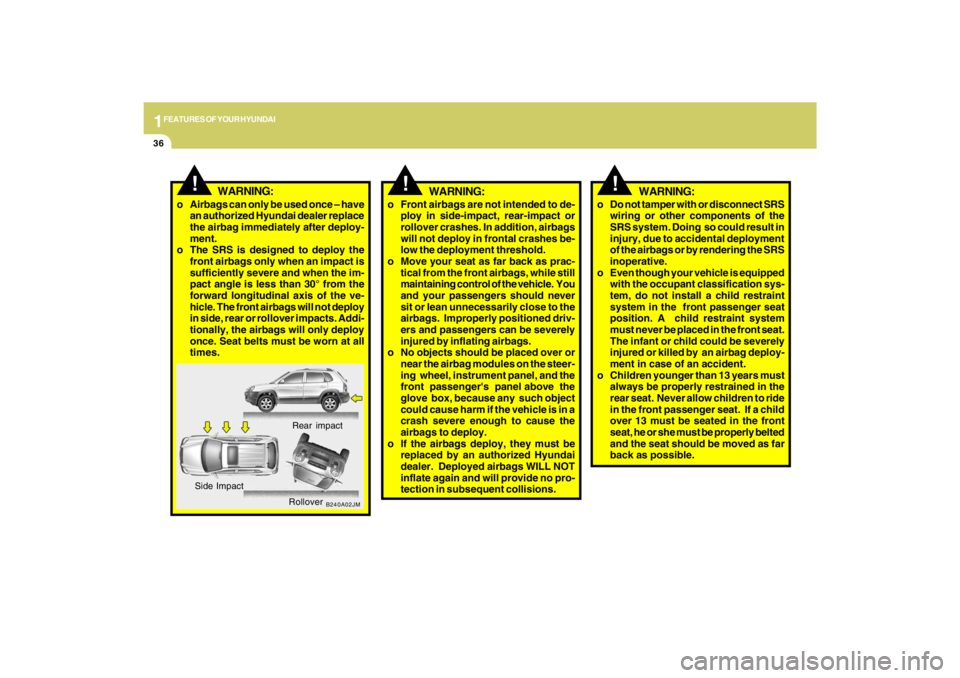
o The SRS is designed to deploy the
front airbags only when an impact is
sufficiently severe and when the im-
pact angle is less than 30° from the
forward longitudinal axis of the ve-
hicle. The front airbags will not deploy
in side, rear or rollover impacts. Addi-
tionally, the airbags will only deploy
once. Seat belts must be worn at all
times.
!
WARNING:
o Front airbags are not intended to de-
ploy in side-impact, rear-impact or
rollover crashes. In addition, airbags
will not deploy in frontal crashes be-
low the deployment threshold.
o Move your seat as far back as prac-
tical from the front airbags, while still
maintaining control of the vehicle. You
and your passengers should never
sit or lean unnecessarily close to the
airbags. Improperly positioned driv-
ers and passengers can be severely
injured by inflating airbags.
o No objects should be placed over or
near the airbag modules on the steer-
ing wheel, instrument panel, and the
front passenger's panel above the
glove box, because any such object
could cause harm if the vehicle is in a
crash severe enough to cause the
airbags to deploy.
o If the airbags deploy, they must be
replaced by an authorized Hyundai
dealer. Deployed airbags WILL NOT
inflate again and will provide no pro-
tection in subsequent collisions.
o Do not tamper with or disconnect SRS
wiring or other components of the
SRS system. Doing so could result in
injury, due to accidental deployment
of the airbags or by rendering the SRS
inoperative.
o Even though your vehicle is equipped
with the occupant classification sys-
tem, do not install a child restraint
system in the front passenger seat
position. A child restraint system
must never be placed in the front seat.
The infant or child could be severely
injured or killed by an airbag deploy-
ment in case of an accident.
o Children younger than 13 years must
always be properly restrained in the
rear seat. Never allow children to ride
in the front passenger seat. If a child
over 13 must be seated in the front
seat, he or she must be properly belted
and the seat should be moved as far
back as possible.
!
WARNING:
Page 49 of 273
1FEATURES OF YOUR HYUNDAI38
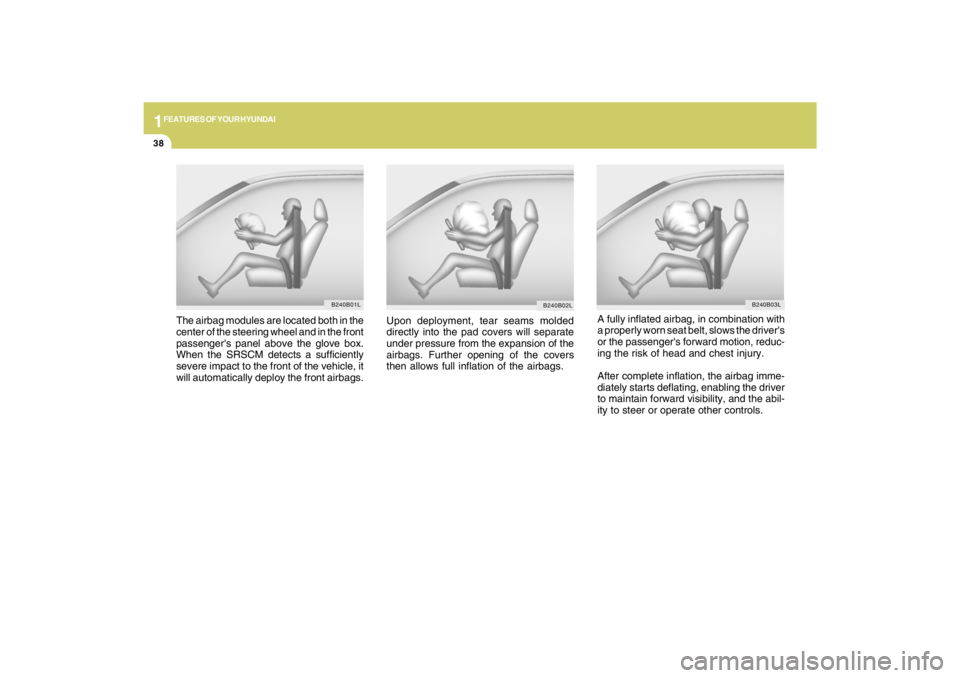
A fully inflated airbag, in combination with
a properly worn seat belt, slows the driver's
or the passenger's forward motion, reduc-
ing the risk of head and chest injury.
After complete inflation, the airbag imme-
diately starts deflating, enabling the driver
to maintain forward visibility, and the abil-
ity to steer or operate other controls.
B240B03L
Upon deployment, tear seams molded
directly into the pad covers will separate
under pressure from the expansion of the
airbags. Further opening of the covers
then allows full inflation of the airbags.
B240B02L
The airbag modules are located both in the
center of the steering wheel and in the front
passenger's panel above the glove box.
When the SRSCM detects a sufficiently
severe impact to the front of the vehicle, it
will automatically deploy the front airbags.
B240B01L
Page 57 of 273
1FEATURES OF YOUR HYUNDAI46
!
o If components of the airbag system
must be discarded, or if the vehicle
must be scrapped, certain safety pre-
cautions must be observed. Your
Hyundai dealer knows these precau-
tions and can give you the necessary
information. Failure to follow these
precautions and procedures could
increase the risk of personal injury.
o If your car was flooded and has soaked
carpeting or water on the floor, don't
try to start the engine; have the car
towed to an authorized Hyundai dealer.
o Do not replace the bumper or the
bumper guard with the one other than
the Hyundai genuine parts. Otherwise,
it can adversely affect SRS perfor-
mance and lead to an increased risk
of injury.
WARNING:
o For cleaning the airbag pad covers,
use only a soft, dry cloth or one which
has been moistened with plain water.
Solvents or cleaners could adversely
affect the airbag covers and proper
deployment of the system.
o No objects should be placed over or
near the airbag modules on the steer-
ing wheel, instrument panel, and the
front passenger's panel above the
glove box, because any such object
could cause harm if the vehicle is in a
crash severe enough to cause the
airbags to inflate.
o If the airbags inflate, they must be
replaced by an authorized Hyundai
dealer.
o Do not tamper with or disconnect SRS
wiring, or other components of the
SRS system. Doing so could result in
injury, due to accidental inflation of
the airbags or by rendering the SRS
inoperative.
!
WARNING:
!
WARNING:
o Do not install a child restraint system
in the front passenger seat position.
A child restraint system must never
be placed in the front seat. The infant
or child could be severely injured or
killed by an airbag deployment in
case of an accident.
o Modification to SRS components or
wir-ing, including the addition of any
kind of badges to the pad covers or
modifications to the body structure,
can adversely affect SRS perfor-
mance and lead to possible injury.B240C02JM-AATSRS Careo The SRS is virtually maintenance free
and there are no parts you can safely
service by yourself. If the SRS SRI (Ser-
vice Reminder Indicator) does not illu-
minate, or continuously remains on,
have your vehicle immediately in-
spected by your Hyundai dealer.
o Any work on the SRS system, such as
removing, installing, repairing, or any
work on the steering wheel must be
performed by a qualified Hyundai tech-
nician. Improper handling of the airbag
system may result in serious personal
injury.
Page 83 of 273
1FEATURES OF YOUR HYUNDAI72
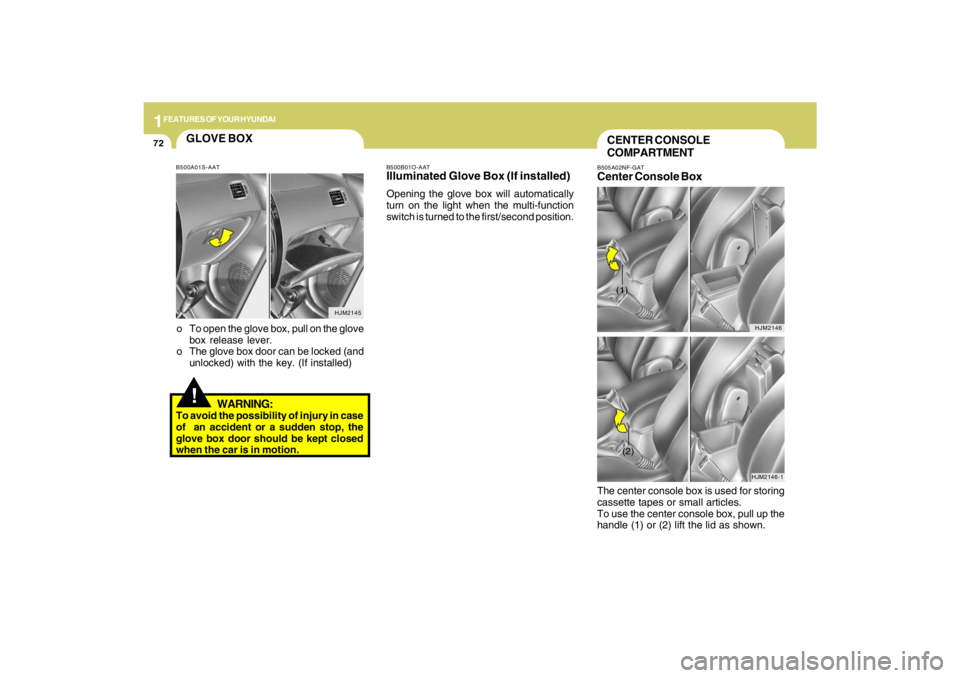
The center console box is used for storing
cassette tapes or small articles.
To use the center console box, pull up the
handle (1) or (2) lift the lid as shown.CENTER CONSOLE
COMPARTMENTB505A02NF-GATCenter Console Box
HJM2146
HJM2146-1
(1)(2)
HJM2145
GLOVE BOX!
o To open the glove box, pull on the glove
box release lever.
o The glove box door can be locked (and
unlocked) with the key. (If installed)
WARNING:
To avoid the possibility of injury in case
of an accident or a sudden stop, the
glove box door should be kept closed
when the car is in motion.
B500B01O-AATIlluminated Glove Box (If installed)Opening the glove box will automatically
turn on the light when the multi-function
switch is turned to the first/second position.
B500A01S-AAT
Page 119 of 273
1FEATURES OF YOUR HYUNDAI
108
CLIMATE CONTROL AIR FILTER
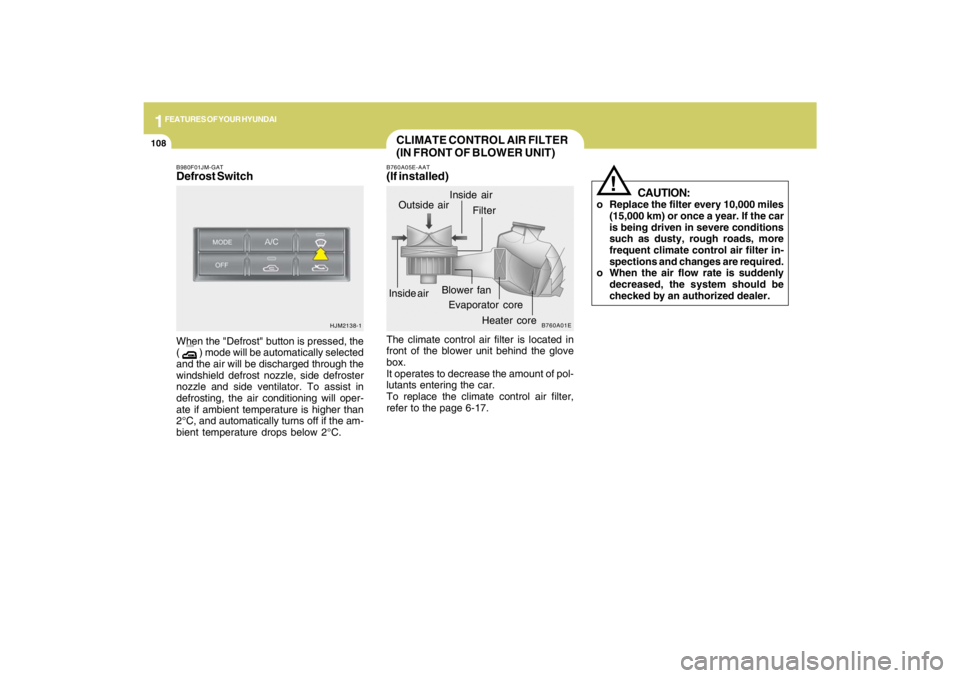
(IN FRONT OF BLOWER UNIT)B760A05E-AAT(If installed)The climate control air filter is located in
front of the blower unit behind the glove
box.
It operates to decrease the amount of pol-
lutants entering the car.
To replace the climate control air filter,
refer to the page 6-17.
CAUTION:
o Replace the filter every 10,000 miles
(15,000 km) or once a year. If the car
is being driven in severe conditions
such as dusty, rough roads, more
frequent climate control air filter in-
spections and changes are required.
o When the air flow rate is suddenly
decreased, the system should be
checked by an authorized dealer.
!
B760A01E
Evaporator coreFilter
Heater core Outside air
Inside airInside airBlower fan
B980F01JM-GATDefrost SwitchWhen the "Defrost" button is pressed, the
(
) mode will be automatically selected
and the air will be discharged through the
windshield defrost nozzle, side defroster
nozzle and side ventilator. To assist in
defrosting, the air conditioning will oper-
ate if ambient temperature is higher than
2°C, and automatically turns off if the am-
bient temperature drops below 2°C.
HJM2138-1
Page 197 of 273

5
VEHICLE MAINTENANCE REQUIREMENTS
3
F020A02Y-AATSCHEDULED MAINTENANCE
REQUIREMENTSo Inspection should be performed any
time a malfunction is experienced or
suspected.
o Receipts for all emission control system
services should be retained to demon-
strate compliance with conditions of the
emissions system warranty.
o After 120 months or 150,000 miles
(240,000 km), continue to follow the
prescribed maintenance intervals.
o For severe usage maintenance require-
ments, see page 5-6 of this section.
F010D02A-AATGeneral ChecksThese are the regular checks you should
perform when you drive your Hyundai or
you fill the fuel tank. A list of these items will
be found on page 6-4.F010E01A-AATDo-It-Yourself MaintenanceIf you are mechanically inclined, own a few
tools that are required and want to take the
time to do so, you can inspect and service
a number of items. For more information
about doing it yourself, see Section 6.
F010F01A-AATA Few Tipso Whenever you have your Hyundai ser-
viced, keep copies of the service records
in your glovebox. This will help ensure
that you can document that the required
procedures have been performed to
keep your warranties in effect. This is
especially important when service is
not performed by an authorized
Hyundai dealer.
o If you choose to do your own mainte-
nance and repairs, you may find it
helpful to have an official Hyundai Shop
Manual. A copy of this publication may
be purchased at your Hyundai dealer's
parts department.
Page 221 of 273
6
DO-IT-YOURSELF MAINTENANCE
17
G190A01GK
DOHC CVVT V6
Water Pump Pulley
0.2~0.24 in.
(5~6 mm)
Power steering
COMP
Auto
tensioner
Alternator Pulley
Crankshaft PulleyAlternator
Eng.pulley
G140D02A-AATChecking the Compressor Drive Belt
G140C01A-AATLubricationTo lubricate the compressor and the seals
in the system, the air conditioning should
be run for at least 10 minutes each week.
This is particularly important during cool
weather when the air conditioning system
is not otherwise in use.
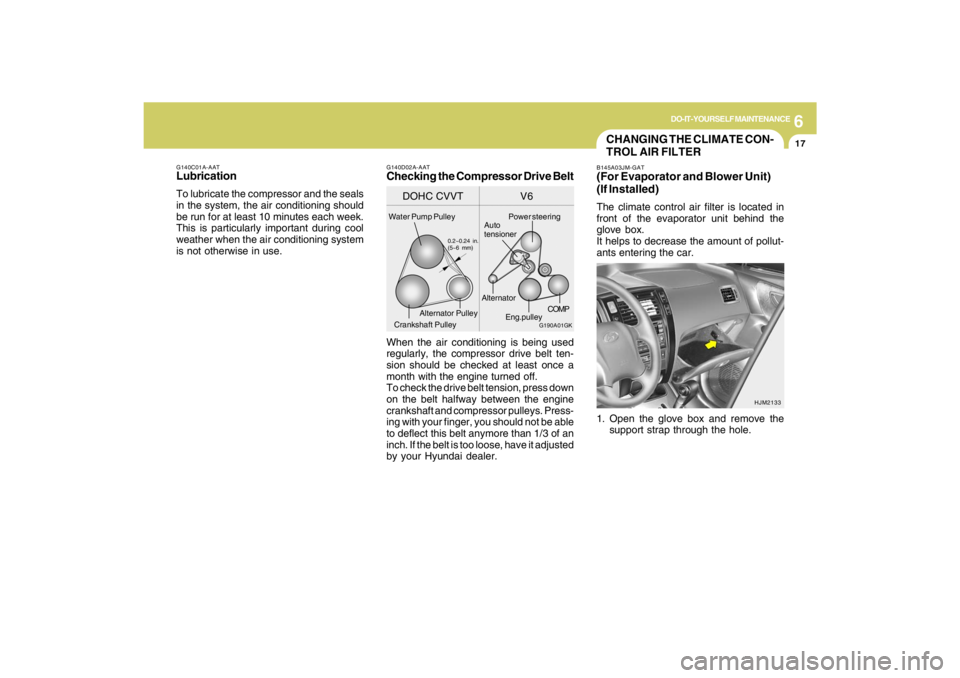
When the air conditioning is being used
regularly, the compressor drive belt ten-
sion should be checked at least once a
month with the engine turned off.
To check the drive belt tension, press down
on the belt halfway between the engine
crankshaft and compressor pulleys. Press-
ing with your finger, you should not be able
to deflect this belt anymore than 1/3 of an
inch. If the belt is too loose, have it adjusted
by your Hyundai dealer.
CHANGING THE CLIMATE CON-
TROL AIR FILTERB145A03JM-GAT(For Evaporator and Blower Unit)
(If Installed)The climate control air filter is located in
front of the evaporator unit behind the
glove box.
It helps to decrease the amount of pollut-
ants entering the car.
1. Open the glove box and remove the
support strap through the hole.
HJM2133
Page 222 of 273
6
DO-IT-YOURSELF MAINTENANCE
18
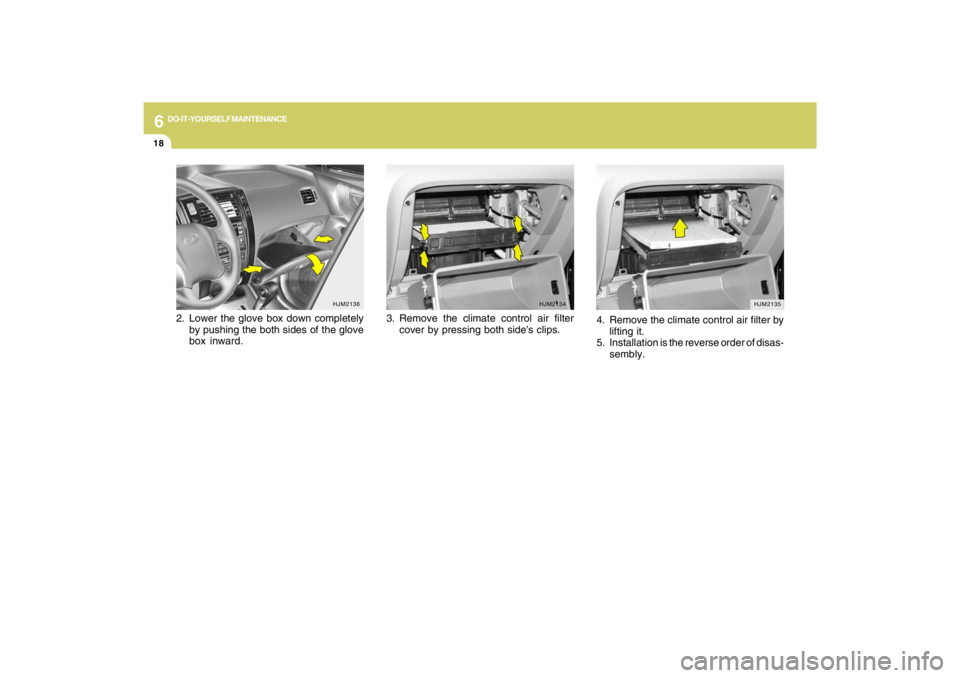
3. Remove the climate control air filter
cover by pressing both side's clips.
HJM2135
4. Remove the climate control air filter by
lifting it.
5. Installation is the reverse order of disas-
sembly.
2. Lower the glove box down completely
by pushing the both sides of the glove
box inward.
HJM2136 HJM2134