tow HYUNDAI TUCSON 2009 Owners Manual
[x] Cancel search | Manufacturer: HYUNDAI, Model Year: 2009, Model line: TUCSON, Model: HYUNDAI TUCSON 2009Pages: 273, PDF Size: 10.29 MB
Page 14 of 273
1
FEATURES OF YOUR HYUNDAI
3
KEYS
BREAKING IN YOUR NEW
HYUNDAI
B010F01A-AATOperation in Foreign CountriesIf you are going to drive your Hyundai in
another country, be sure to:
o Observe all regulations regarding reg-
istration and insurance.
o Determine that acceptable fuel is avail-
able.B010E01A-AATGasolines for Cleaner AirTo help contribute to cleaner air, Hyundai
recommends that you use gasolines
treated with detergent additives, which
help prevent deposit formation in the en-
gine. These gasolines will help the engine
run cleaner and enhance performance of
the Emission Control System.
B020A01S-AATDuring the First 1,200 Miles (2,000
Km)No formal "break-in" procedure is required
with your new Hyundai. However, you can
contribute to the economical operation
and durability of your Hyundai by observ-
ing the following recommendations dur-
ing the first 1,200 miles (2,000 km).
o Don't drive faster than 55 MPH (88 km/
h).
o While driving, keep your engine speed
(rpm, or revolutions per minute) be-
tween 2,000 rpm and 4,000 rpm.
o Use moderate acceleration. Don't start
quickly or depress the accelerator pedal
fully.
o For the first 200 miles (300 km), try to
avoid hard stops.
o Don't lug the engine (in other words,
don't drive so slowly in too high a gear
that the engine "bucks"-shift to a lower
gear).
o Whether going fast or slow, vary your
speed from time to time.
o Don't let the engine idle longer than 3
minutes at one time.
o Don't tow a trailer during the first 1,200
miles (2,000 km) of operation.
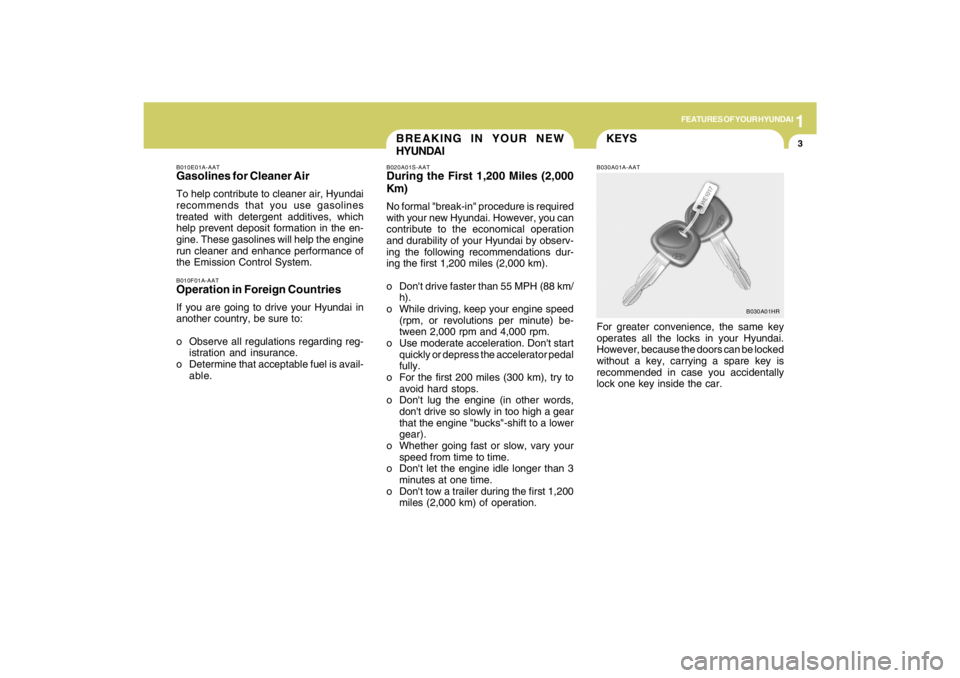
B030A01A-AATFor greater convenience, the same key
operates all the locks in your Hyundai.
However, because the doors can be locked
without a key, carrying a spare key is
recommended in case you accidentally
lock one key inside the car.
B030A01HR
Page 16 of 273
1
FEATURES OF YOUR HYUNDAI
5
UNLOCK
LOCK
HJM2007 B040B02JM-AAT
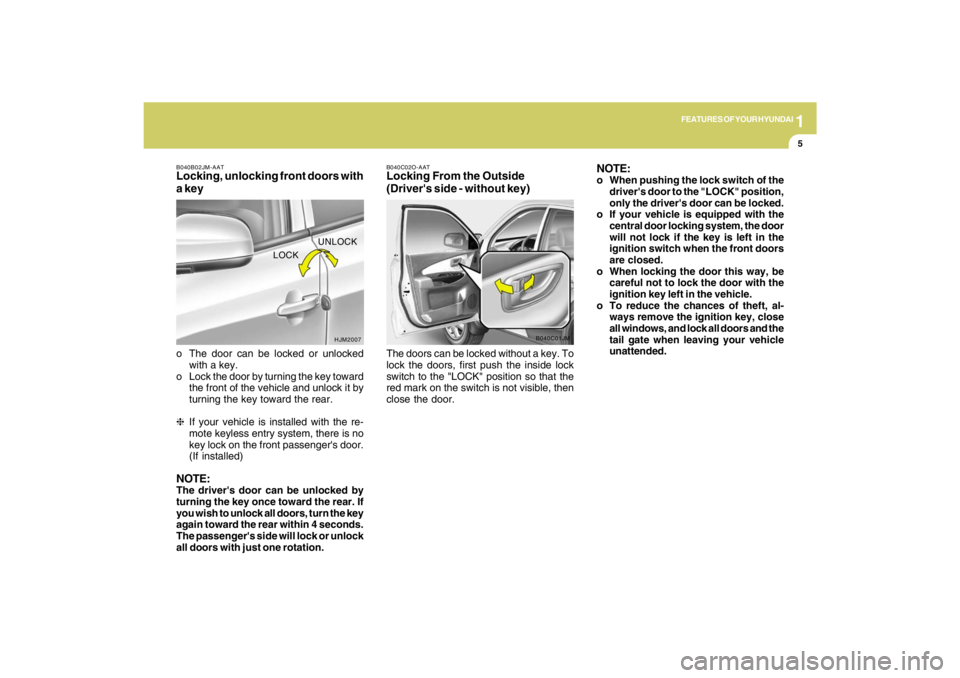
Locking, unlocking front doors with
a keyo The door can be locked or unlocked
with a key.
o Lock the door by turning the key toward
the front of the vehicle and unlock it by
turning the key toward the rear.
❈If your vehicle is installed with the re-
mote keyless entry system, there is no
key lock on the front passenger's door.
(If installed)NOTE:The driver's door can be unlocked by
turning the key once toward the rear. If
you wish to unlock all doors, turn the key
again toward the rear within 4 seconds.
The passenger's side will lock or unlock
all doors with just one rotation.
B040C01JM B040C02O-AAT
Locking From the Outside
(Driver's side - without key)The doors can be locked without a key. To
lock the doors, first push the inside lock
switch to the "LOCK" position so that the
red mark on the switch is not visible, then
close the door.
NOTE:o When pushing the lock switch of the
driver's door to the "LOCK" position,
only the driver's door can be locked.
o If your vehicle is equipped with the
central door locking system, the door
will not lock if the key is left in the
ignition switch when the front doors
are closed.
o When locking the door this way, be
careful not to lock the door with the
ignition key left in the vehicle.
o To reduce the chances of theft, al-
ways remove the ignition key, close
all windows, and lock all doors and the
tail gate when leaving your vehicle
unattended.
Page 18 of 273
1
FEATURES OF YOUR HYUNDAI
7
B045D01JM-AATLocking From the Inside
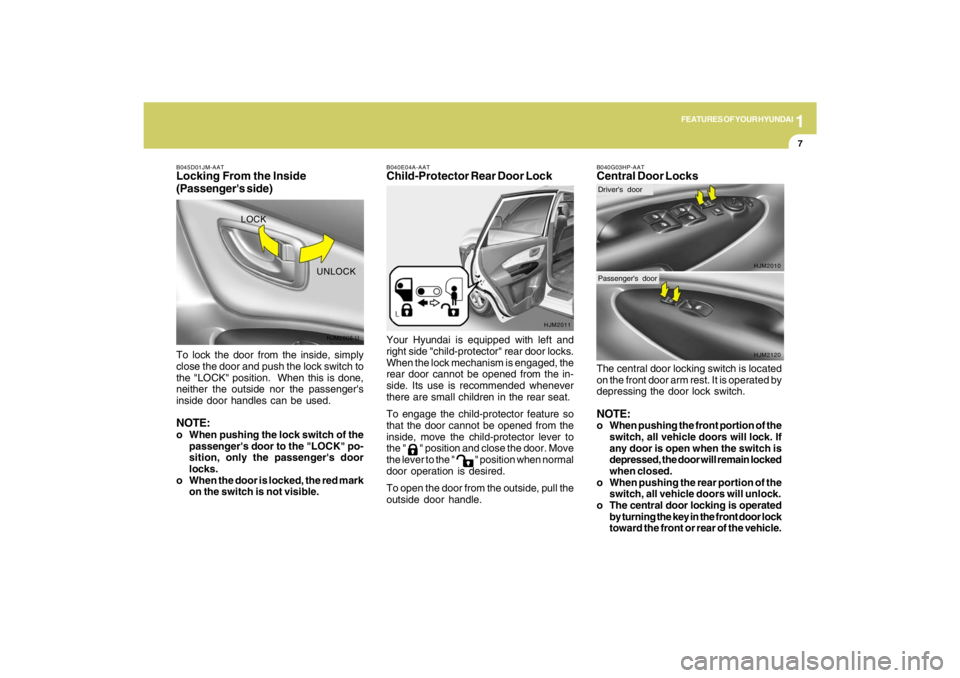
(Passenger's side)To lock the door from the inside, simply
close the door and push the lock switch to
the "LOCK" position. When this is done,
neither the outside nor the passenger's
inside door handles can be used.NOTE:o When pushing the lock switch of the
passenger's door to the "LOCK" po-
sition, only the passenger's door
locks.
o When the door is locked, the red mark
on the switch is not visible.
HJM2008-UUNLOCK LOCK
B040E04A-AATChild-Protector Rear Door LockYour Hyundai is equipped with left and
right side "child-protector" rear door locks.
When the lock mechanism is engaged, the
rear door cannot be opened from the in-
side. Its use is recommended whenever
there are small children in the rear seat.
To engage the child-protector feature so
that the door cannot be opened from the
inside, move the child-protector lever to
the "
" position and close the door. Move
the lever to the "
" position when normal
door operation is desired.
To open the door from the outside, pull the
outside door handle.
HJM2011
B040G03HP-AATCentral Door LocksThe central door locking switch is located
on the front door arm rest. It is operated by
depressing the door lock switch.NOTE:o When pushing the front portion of the
switch, all vehicle doors will lock. If
any door is open when the switch is
depressed, the door will remain locked
when closed.
o When pushing the rear portion of the
switch, all vehicle doors will unlock.
o The central door locking is operated
by turning the key in the front door lock
toward the front or rear of the vehicle.
HJM2010HJM2120
Driver's doorPassenger's door
Page 24 of 273
1
FEATURES OF YOUR HYUNDAI
13
OJM019002
!
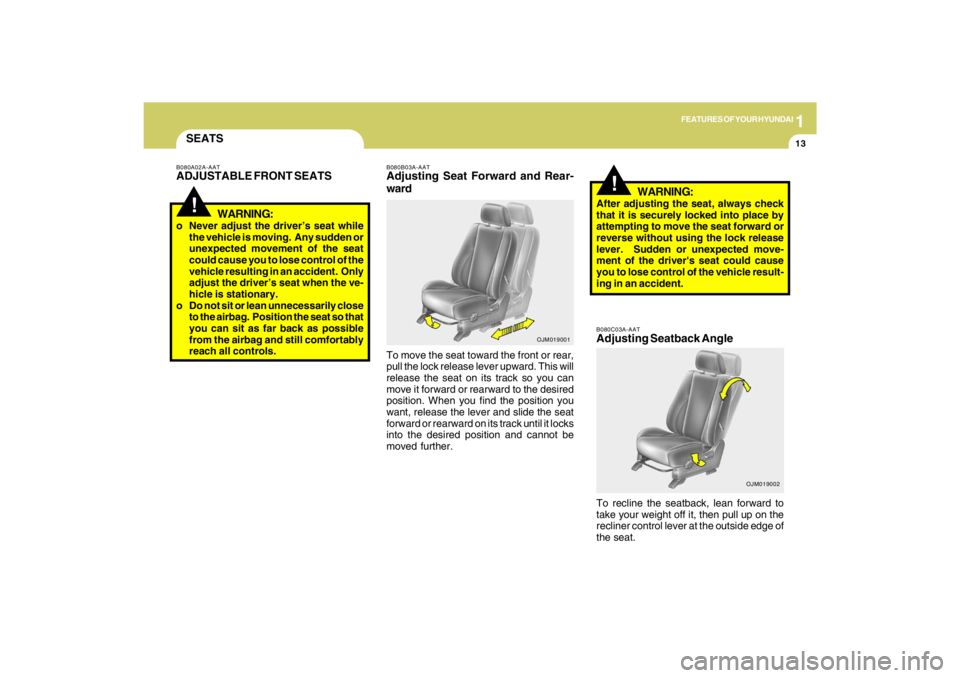
B080B03A-AATAdjusting Seat Forward and Rear-
wardTo move the seat toward the front or rear,
pull the lock release lever upward. This will
release the seat on its track so you can
move it forward or rearward to the desired
position. When you find the position you
want, release the lever and slide the seat
forward or rearward on its track until it locks
into the desired position and cannot be
moved further.
B080C03A-AATAdjusting Seatback AngleTo recline the seatback, lean forward to
take your weight off it, then pull up on the
recliner control lever at the outside edge of
the seat.
WARNING:
After adjusting the seat, always check
that it is securely locked into place by
attempting to move the seat forward or
reverse without using the lock release
lever. Sudden or unexpected move-
ment of the driver's seat could cause
you to lose control of the vehicle result-
ing in an accident.
OJM019001
SEATSB080A02A-AATADJUSTABLE FRONT SEATS
!
WARNING:
o Never adjust the driver’s seat while
the vehicle is moving. Any sudden or
unexpected movement of the seat
could cause you to lose control of the
vehicle resulting in an accident. Only
adjust the driver’s seat when the ve-
hicle is stationary.
o Do not sit or lean unnecessarily close
to the airbag. Position the seat so that
you can sit as far back as possible
from the airbag and still comfortably
reach all controls.
Page 27 of 273
1FEATURES OF YOUR HYUNDAI16
!
WARNING:
It is recommended that the seat heater
not be used when elderly people or people
who are ill occupy the seat. Also, do not
use the seat warmer if the occupant is
sleeping.
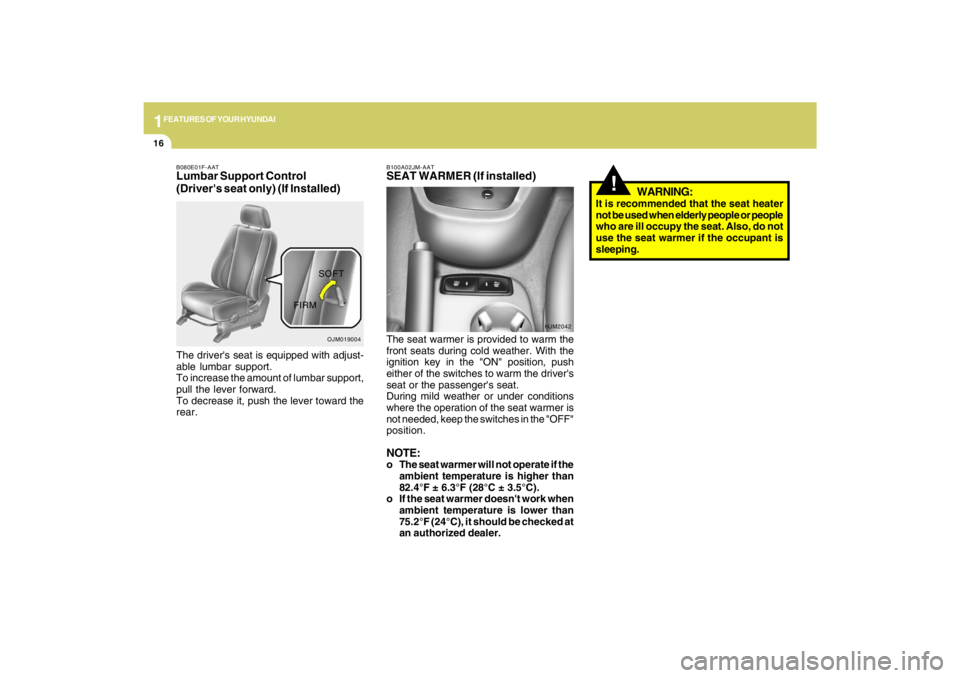
B100A02JM-AATSEAT WARMER (If installed)
HJM2042
The seat warmer is provided to warm the
front seats during cold weather. With the
ignition key in the "ON" position, push
either of the switches to warm the driver's
seat or the passenger's seat.
During mild weather or under conditions
where the operation of the seat warmer is
not needed, keep the switches in the "OFF"
position.NOTE:o The seat warmer will not operate if the
ambient temperature is higher than
82.4°F ± 6.3°F (28°C ± 3.5°C).
o If the seat warmer doesn't work when
ambient temperature is lower than
75.2°F (24°C), it should be checked at
an authorized dealer.
B080E01F-AATLumbar Support Control
(Driver's seat only) (If Installed)The driver's seat is equipped with adjust-
able lumbar support.
To increase the amount of lumbar support,
pull the lever forward.
To decrease it, push the lever toward the
rear.
SOFTOJM019004
FIRM
Page 42 of 273
1
FEATURES OF YOUR HYUNDAI
31
!
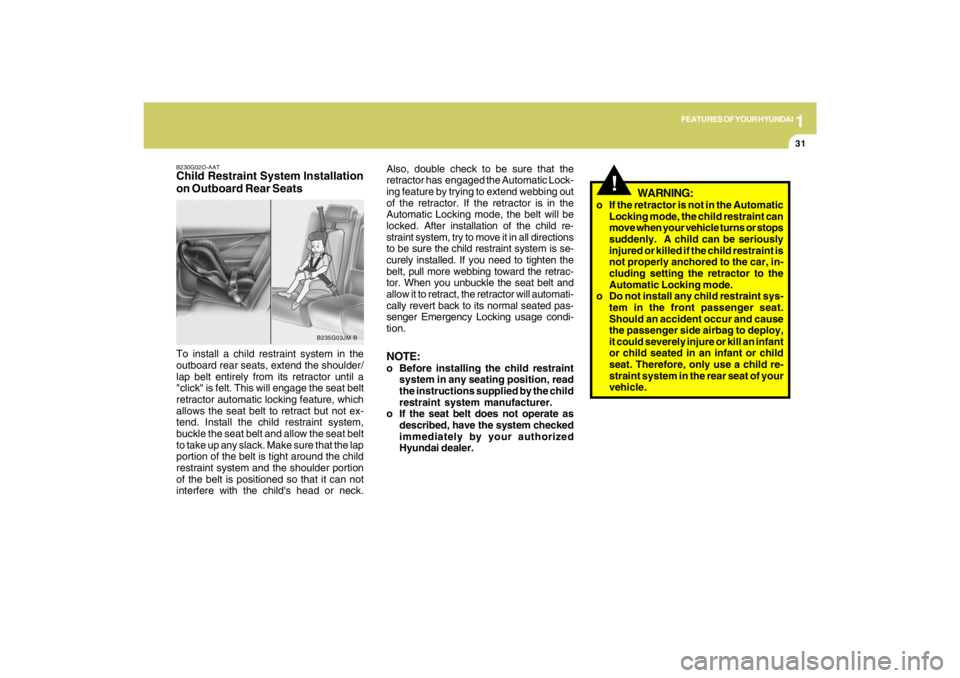
B230G02O-AATChild Restraint System Installation
on Outboard Rear Seats
WARNING:
o If the retractor is not in the Automatic
Locking mode, the child restraint can
move when your vehicle turns or stops
suddenly. A child can be seriously
injured or killed if the child restraint is
not properly anchored to the car, in-
cluding setting the retractor to the
Automatic Locking mode.
o Do not install any child restraint sys-
tem in the front passenger seat.
Should an accident occur and cause
the passenger side airbag to deploy,
it could severely injure or kill an infant
or child seated in an infant or child
seat. Therefore, only use a child re-
straint system in the rear seat of your
vehicle. To install a child restraint system in the
outboard rear seats, extend the shoulder/
lap belt entirely from its retractor until a
"click" is felt. This will engage the seat belt
retractor automatic locking feature, which
allows the seat belt to retract but not ex-
tend. Install the child restraint system,
buckle the seat belt and allow the seat belt
to take up any slack. Make sure that the lap
portion of the belt is tight around the child
restraint system and the shoulder portion
of the belt is positioned so that it can not
interfere with the child's head or neck.Also, double check to be sure that the
retractor has engaged the Automatic Lock-
ing feature by trying to extend webbing out
of the retractor. If the retractor is in the
Automatic Locking mode, the belt will be
locked. After installation of the child re-
straint system, try to move it in all directions
to be sure the child restraint system is se-
curely installed. If you need to tighten the
belt, pull more webbing toward the retrac-
tor. When you unbuckle the seat belt and
allow it to retract, the retractor will automati-
cally revert back to its normal seated pas-
senger Emergency Locking usage condi-
tion.
NOTE:o Before installing the child restraint
system in any seating position, read
the instructions supplied by the child
restraint system manufacturer.
o If the seat belt does not operate as
described, have the system checked
immediately by your authorized
Hyundai dealer.
B235G03JM-B
Page 52 of 273
1
FEATURES OF YOUR HYUNDAI
41
!
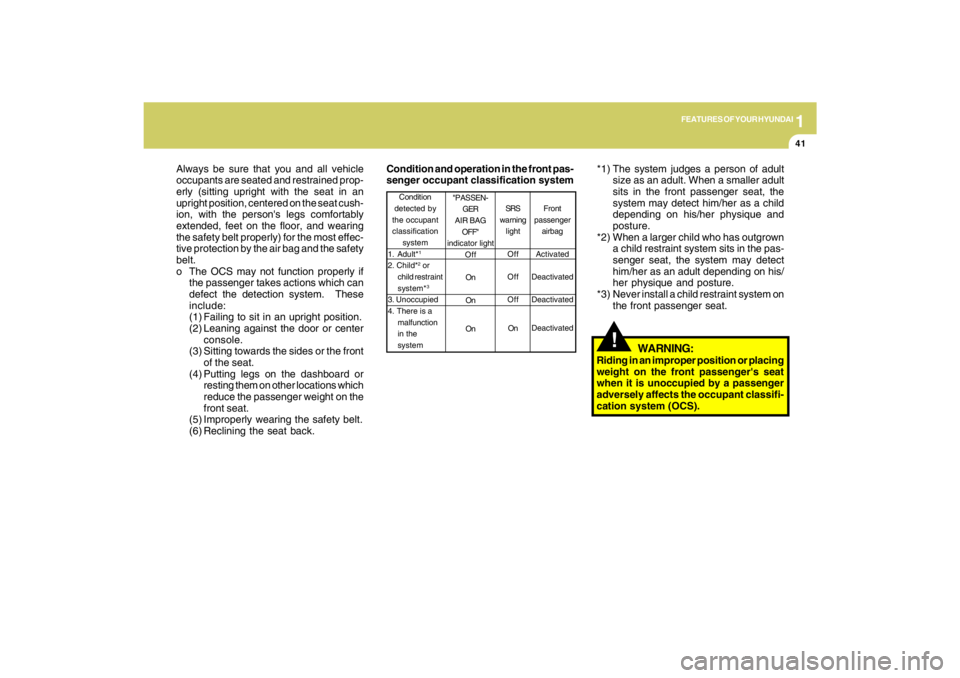
*1) The system judges a person of adult
size as an adult. When a smaller adult
sits in the front passenger seat, the
system may detect him/her as a child
depending on his/her physique and
posture.
*2) When a larger child who has outgrown
a child restraint system sits in the pas-
senger seat, the system may detect
him/her as an adult depending on his/
her physique and posture.
*3) Never install a child restraint system on
the front passenger seat.
WARNING:
Riding in an improper position or placing
weight on the front passenger's seat
when it is unoccupied by a passenger
adversely affects the occupant classifi-
cation system (OCS).
Front
passenger
airbag
Activated
Deactivated
Deactivated
Deactivated Condition
detected by
the occupant
classification
system
1. Adult*
1
2. Child*
2 or
child restraint
system*3
3. Unoccupied
4. There is a
malfunction
in the
systemSRS
warning
light
Off
Off
Off
On
"PASSEN-
GER
AIR BAG
OFF"
indicator light
Off
On
On
On
Condition and operation in the front pas-
senger occupant classification system Always be sure that you and all vehicle
occupants are seated and restrained prop-
erly (sitting upright with the seat in an
upright position, centered on the seat cush-
ion, with the person's legs comfortably
extended, feet on the floor, and wearing
the safety belt properly) for the most effec-
tive protection by the air bag and the safety
belt.
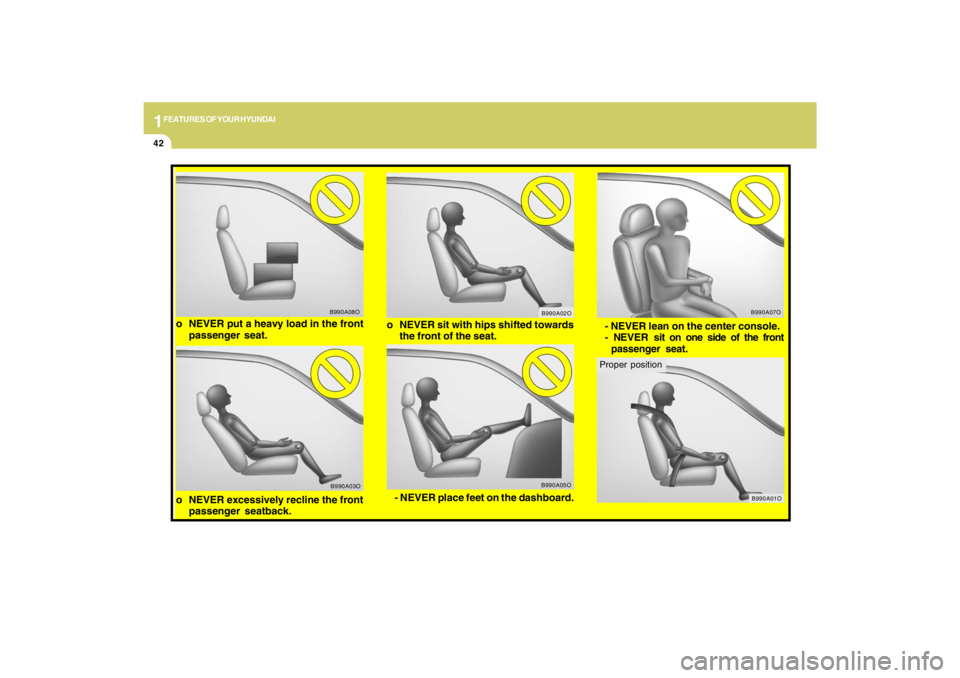
o The OCS may not function properly if
the passenger takes actions which can
defect the detection system. These
include:
(1) Failing to sit in an upright position.
(2) Leaning against the door or center
console.
(3) Sitting towards the sides or the front
of the seat.
(4) Putting legs on the dashboard or
resting them on other locations which
reduce the passenger weight on the
front seat.
(5) Improperly wearing the safety belt.
(6) Reclining the seat back.
Page 53 of 273
1FEATURES OF YOUR HYUNDAI42
o NEVER excessively recline the front
passenger seatback.
B990A03O
o NEVER put a heavy load in the front
passenger seat.
B990A08O
- NEVER place feet on the dashboard.
B990A07O
B990A05O
- NEVER lean on the center console.
- NEVER
sit on one side of the front
passenger seat.
o NEVER sit with hips shifted towards
the front of the seat.
B990A02O
Proper position
B990A01O
Page 57 of 273
1FEATURES OF YOUR HYUNDAI46
!
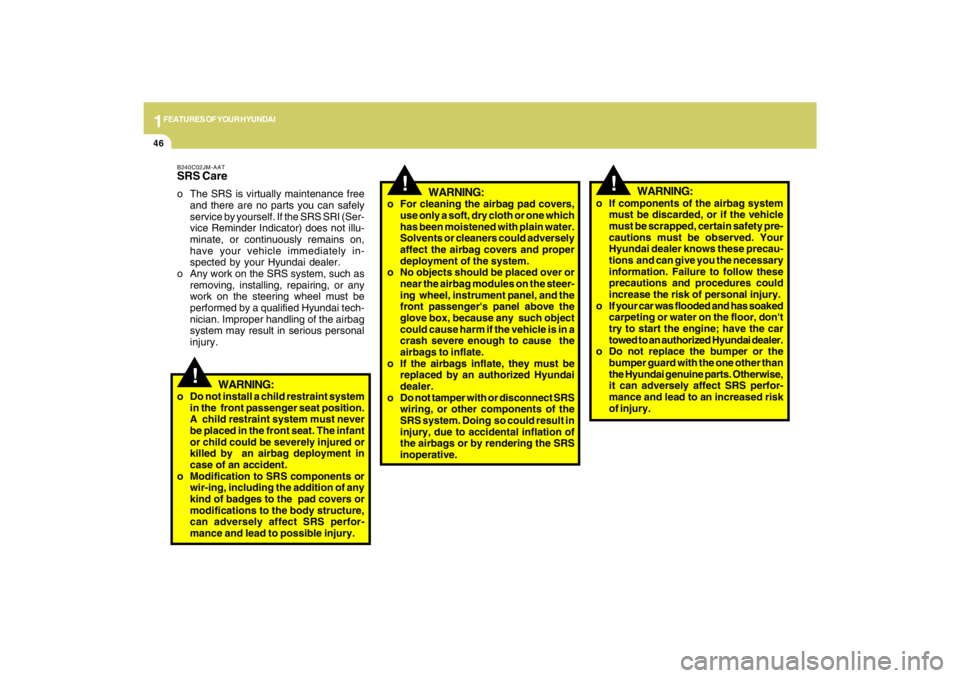
o If components of the airbag system
must be discarded, or if the vehicle
must be scrapped, certain safety pre-
cautions must be observed. Your
Hyundai dealer knows these precau-
tions and can give you the necessary
information. Failure to follow these
precautions and procedures could
increase the risk of personal injury.
o If your car was flooded and has soaked
carpeting or water on the floor, don't
try to start the engine; have the car
towed to an authorized Hyundai dealer.
o Do not replace the bumper or the
bumper guard with the one other than
the Hyundai genuine parts. Otherwise,
it can adversely affect SRS perfor-
mance and lead to an increased risk
of injury.
WARNING:
o For cleaning the airbag pad covers,
use only a soft, dry cloth or one which
has been moistened with plain water.
Solvents or cleaners could adversely
affect the airbag covers and proper
deployment of the system.
o No objects should be placed over or
near the airbag modules on the steer-
ing wheel, instrument panel, and the
front passenger's panel above the
glove box, because any such object
could cause harm if the vehicle is in a
crash severe enough to cause the
airbags to inflate.
o If the airbags inflate, they must be
replaced by an authorized Hyundai
dealer.
o Do not tamper with or disconnect SRS
wiring, or other components of the
SRS system. Doing so could result in
injury, due to accidental inflation of
the airbags or by rendering the SRS
inoperative.
!
WARNING:
!
WARNING:
o Do not install a child restraint system
in the front passenger seat position.
A child restraint system must never
be placed in the front seat. The infant
or child could be severely injured or
killed by an airbag deployment in
case of an accident.
o Modification to SRS components or
wir-ing, including the addition of any
kind of badges to the pad covers or
modifications to the body structure,
can adversely affect SRS perfor-
mance and lead to possible injury.B240C02JM-AATSRS Careo The SRS is virtually maintenance free
and there are no parts you can safely
service by yourself. If the SRS SRI (Ser-
vice Reminder Indicator) does not illu-
minate, or continuously remains on,
have your vehicle immediately in-
spected by your Hyundai dealer.
o Any work on the SRS system, such as
removing, installing, repairing, or any
work on the steering wheel must be
performed by a qualified Hyundai tech-
nician. Improper handling of the airbag
system may result in serious personal
injury.
Page 62 of 273
1
FEATURES OF YOUR HYUNDAI
51
!
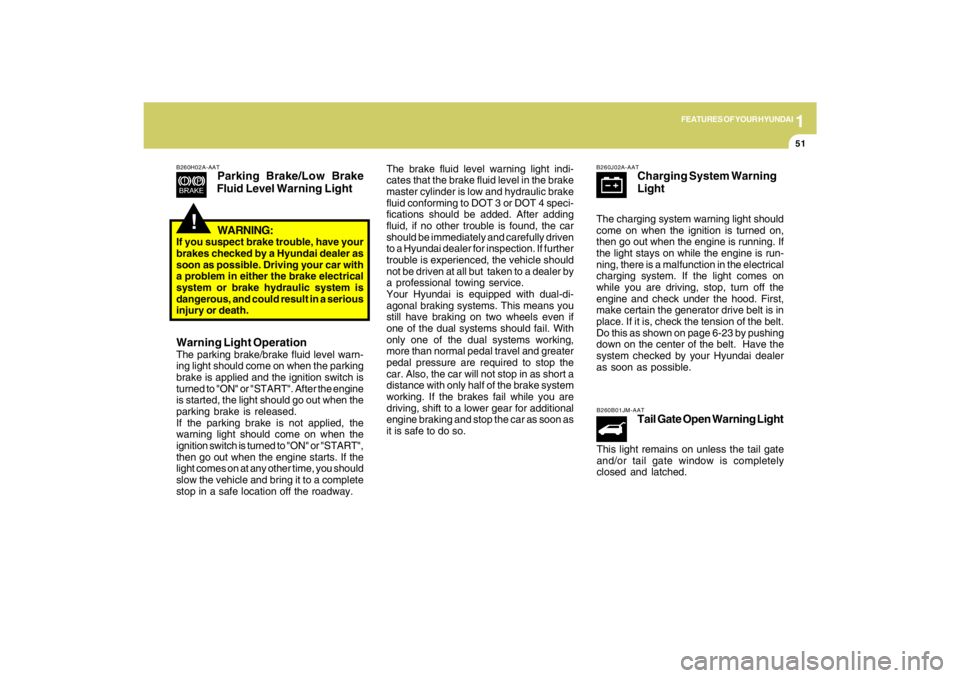
B260H02A-AAT
Parking Brake/Low Brake
Fluid Level Warning Light
The brake fluid level warning light indi-
cates that the brake fluid level in the brake
master cylinder is low and hydraulic brake
fluid conforming to DOT 3 or DOT 4 speci-
fications should be added. After adding
fluid, if no other trouble is found, the car
should be immediately and carefully driven
to a Hyundai dealer for inspection. If further
trouble is experienced, the vehicle should
not be driven at all but taken to a dealer by
a professional towing service.
Your Hyundai is equipped with dual-di-
agonal braking systems. This means you
still have braking on two wheels even if
one of the dual systems should fail. With
only one of the dual systems working,
more than normal pedal travel and greater
pedal pressure are required to stop the
car. Also, the car will not stop in as short a
distance with only half of the brake system
working. If the brakes fail while you are
driving, shift to a lower gear for additional
engine braking and stop the car as soon as
it is safe to do so.
WARNING:
If you suspect brake trouble, have your
brakes checked by a Hyundai dealer as
soon as possible. Driving your car with
a problem in either the brake electrical
system or brake hydraulic system is
dangerous, and could result in a serious
injury or death.Warning Light OperationThe parking brake/brake fluid level warn-
ing light should come on when the parking
brake is applied and the ignition switch is
turned to "ON" or "START". After the engine
is started, the light should go out when the
parking brake is released.
If the parking brake is not applied, the
warning light should come on when the
ignition switch is turned to "ON" or "START",
then go out when the engine starts. If the
light comes on at any other time, you should
slow the vehicle and bring it to a complete
stop in a safe location off the roadway.
B260J02A-AAT
Charging System Warning
Light
The charging system warning light should
come on when the ignition is turned on,
then go out when the engine is running. If
the light stays on while the engine is run-
ning, there is a malfunction in the electrical
charging system. If the light comes on
while you are driving, stop, turn off the
engine and check under the hood. First,
make certain the generator drive belt is in
place. If it is, check the tension of the belt.
Do this as shown on page 6-23 by pushing
down on the center of the belt. Have the
system checked by your Hyundai dealer
as soon as possible.B260B01JM-AAT
Tail Gate Open Warning Light
This light remains on unless the tail gate
and/or tail gate window is completely
closed and latched.