wiring HYUNDAI TUCSON 2009 Owners Manual
[x] Cancel search | Manufacturer: HYUNDAI, Model Year: 2009, Model line: TUCSON, Model: HYUNDAI TUCSON 2009Pages: 273, PDF Size: 10.29 MB
Page 46 of 273
1
FEATURES OF YOUR HYUNDAI
35
!
!
WARNING:
Always use seat belts and child restraints
– every trip, every time, everyone!
Airbags inflate with considerable force
and in the blink of an eye. Seat belts help
keep occupants in proper position to
obtain maximum benefit from the airbag.
Even with advanced airbags, improp-
erly and unbelted occupants can be se-
verely injured when the airbag inflates.
Always follow the precautions about seat
belts, airbags and occupant safety con-
tained in this manual.
To reduce the chance of serious or fatal
injuries and receive the maximum safety
benefit from your restraint system:
o Never place a child in any child or
booster seat in the front seat (see
child restraints 1-26).
o ABC – Always Buckle Children in the
back seat. It is the safest place for
children of any age to ride.
o Front and side impact airbags can
injure occupants improperly posi-
tioned in the front seats.
o Move your seat as far back as prac-
tical from the front airbags, while still
maintaining control of the vehicle.
!
WARNING:
o Modification to the seat structure can
adversely affect the seat position
sensor and cause the airbag to de-
ploy at a different level than should be
provided.
o Do not place any objects underneath
the front seats which could damage
the seat position sensor or interfere
with the occupant classification sys-
tem.
o Do not place any objects that may
cause magnetic fields near the front
seats. These may cause a malfunc-
tion of the seat position sensor.NOTE:o Be sure to read information about the
SRS on the labels provided on the
backside of the sun visor.
o Advanced airbags are combined with
pre-tensioner seat belts to help pro-
vide enhanced occupant protection
in frontal crashes. Front airbags are
not intended to deploy in light colli-
sions in which protection can be pro-
vided by the pre-tensioner seat belt.
o If you are considering modification of
your vehicle due to a disability, please
contact the Hyundai Customer As-
sistance Center at 1-800-633-5151.o Never sit or lean unnecessarily close
to the front or side airbags.
o Never lean against the door or center
console – always sit in an upright
position.
o Do not allow an adult passenger to
ride in the front seat when the “Pas-
senger Airbag OFF” indicator is illu-
minated, because the airbag will not
deploy in the event of a moderate or
severe frontal crash.
o Never place objects over or near any
airbag module (front or side impact
airbags), because these objects can
injure passengers in a crash.
o Never place covers, blankets or af-
termarket seat warmers on the pas-
senger seat as these may interfere
with the occupant classification sys-
tem.
o Do not tamper or disconnect SRS
wiring or other components. Injuries
could result from inadvertent deploy-
ment or failure of the airbag to deploy
in a crash.
o If the SRS airbag warning light (see pg
1-50) remains illuminated while the
vehicle is being driven, have an au-
thorized Hyundai dealer inspect the
airbag system as soon as possible.
WARNING:
Page 47 of 273
1FEATURES OF YOUR HYUNDAI36
B240A02JM
!
Rear impact
Side Impact
Rollover
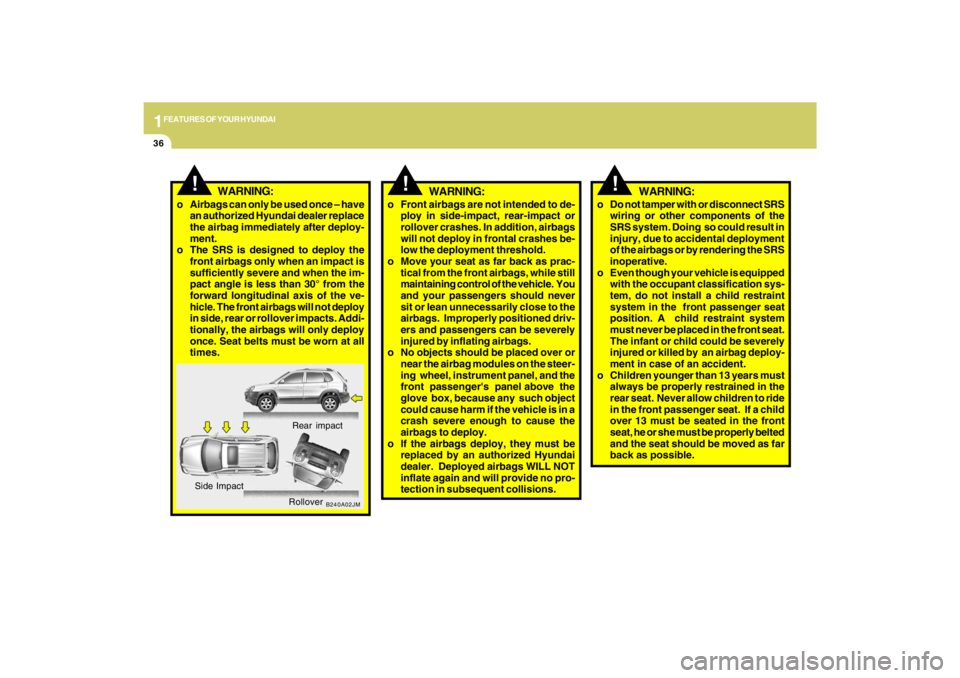
WARNING:
o Airbags can only be used once – have
an authorized Hyundai dealer replace
the airbag immediately after deploy-
ment.
o The SRS is designed to deploy the
front airbags only when an impact is
sufficiently severe and when the im-
pact angle is less than 30° from the
forward longitudinal axis of the ve-
hicle. The front airbags will not deploy
in side, rear or rollover impacts. Addi-
tionally, the airbags will only deploy
once. Seat belts must be worn at all
times.
!
WARNING:
o Front airbags are not intended to de-
ploy in side-impact, rear-impact or
rollover crashes. In addition, airbags
will not deploy in frontal crashes be-
low the deployment threshold.
o Move your seat as far back as prac-
tical from the front airbags, while still
maintaining control of the vehicle. You
and your passengers should never
sit or lean unnecessarily close to the
airbags. Improperly positioned driv-
ers and passengers can be severely
injured by inflating airbags.
o No objects should be placed over or
near the airbag modules on the steer-
ing wheel, instrument panel, and the
front passenger's panel above the
glove box, because any such object
could cause harm if the vehicle is in a
crash severe enough to cause the
airbags to deploy.
o If the airbags deploy, they must be
replaced by an authorized Hyundai
dealer. Deployed airbags WILL NOT
inflate again and will provide no pro-
tection in subsequent collisions.
o Do not tamper with or disconnect SRS
wiring or other components of the
SRS system. Doing so could result in
injury, due to accidental deployment
of the airbags or by rendering the SRS
inoperative.
o Even though your vehicle is equipped
with the occupant classification sys-
tem, do not install a child restraint
system in the front passenger seat
position. A child restraint system
must never be placed in the front seat.
The infant or child could be severely
injured or killed by an airbag deploy-
ment in case of an accident.
o Children younger than 13 years must
always be properly restrained in the
rear seat. Never allow children to ride
in the front passenger seat. If a child
over 13 must be seated in the front
seat, he or she must be properly belted
and the seat should be moved as far
back as possible.
!
WARNING:
Page 57 of 273
1FEATURES OF YOUR HYUNDAI46
!
o If components of the airbag system
must be discarded, or if the vehicle
must be scrapped, certain safety pre-
cautions must be observed. Your
Hyundai dealer knows these precau-
tions and can give you the necessary
information. Failure to follow these
precautions and procedures could
increase the risk of personal injury.
o If your car was flooded and has soaked
carpeting or water on the floor, don't
try to start the engine; have the car
towed to an authorized Hyundai dealer.
o Do not replace the bumper or the
bumper guard with the one other than
the Hyundai genuine parts. Otherwise,
it can adversely affect SRS perfor-
mance and lead to an increased risk
of injury.
WARNING:
o For cleaning the airbag pad covers,
use only a soft, dry cloth or one which
has been moistened with plain water.
Solvents or cleaners could adversely
affect the airbag covers and proper
deployment of the system.
o No objects should be placed over or
near the airbag modules on the steer-
ing wheel, instrument panel, and the
front passenger's panel above the
glove box, because any such object
could cause harm if the vehicle is in a
crash severe enough to cause the
airbags to inflate.
o If the airbags inflate, they must be
replaced by an authorized Hyundai
dealer.
o Do not tamper with or disconnect SRS
wiring, or other components of the
SRS system. Doing so could result in
injury, due to accidental inflation of
the airbags or by rendering the SRS
inoperative.
!
WARNING:
!
WARNING:
o Do not install a child restraint system
in the front passenger seat position.
A child restraint system must never
be placed in the front seat. The infant
or child could be severely injured or
killed by an airbag deployment in
case of an accident.
o Modification to SRS components or
wir-ing, including the addition of any
kind of badges to the pad covers or
modifications to the body structure,
can adversely affect SRS perfor-
mance and lead to possible injury.B240C02JM-AATSRS Careo The SRS is virtually maintenance free
and there are no parts you can safely
service by yourself. If the SRS SRI (Ser-
vice Reminder Indicator) does not illu-
minate, or continuously remains on,
have your vehicle immediately in-
spected by your Hyundai dealer.
o Any work on the SRS system, such as
removing, installing, repairing, or any
work on the steering wheel must be
performed by a qualified Hyundai tech-
nician. Improper handling of the airbag
system may result in serious personal
injury.
Page 58 of 273
1
FEATURES OF YOUR HYUNDAI
47
B240D02JM-AATAdditional Safety PrecautionsoNever let passengers ride in the cargo
area (trunk) or on top of a folded-down
back seat. All occupants should sit
upright, fully back in their seats with
their seat belts on and their feet on the
floor.
oPassengers should not move out of or
change seats while the vehicle is mov-
ing. A passenger who is not wearing a
seat belt during a crash or emergency
stop can be thrown against the inside of
the vehicle, against other occupants, or
out of the vehicle.
oEach seat belt is designed to restrain
one occupant. If more than one person
uses the same seat belt, they could be
seriously injured or killed in a collision.
oDo not use any accessories on seat
belts. Devices claiming to improve oc-
cupant comfort or reposition the seat
belt can reduce the protection provided
by the seat belt and increase the chance
of serious injury in a crash.
oPassengers should not place hard or
sharp objects between themselves
and the airbags. Carrying hard or sharp
objects on your lap or in your mouth can
result in injuries if an airbag inflates.oKeep occupants away from the airbag
covers. All occupants should sit up-
right, fully back in their seats with their
seat belts on and their feet on the floor.
If occupants are too close to the airbag
covers, they could be injured if the
airbags inflate.
oDo not attach or place objects on or
near the airbag covers. Any object
attached to or placed on the front or side
impact airbag covers could interfere
with the proper operation of the airbags.
oDo not modify the front seats. Modifi-
cation of the front seats could interfere
with the operation of the supplemental
restraint system sensing components
or side impact airbags.
oDo not place items under the front
seats. Placing items under the front
seats could interfere with the operation
of the supplemental restraint system
sensing components and wiring har-
nesses.
oNever hold an infant or child on your
lap. The infant or child could be seri-
ously injured or killed in the event of a
crash. All infants and children should
be properly restrained in appropriate
child safety seats or seat belts in the rear
seat.
!
WARNING:
o Sitting improperly or out of position
can cause occupants to be shifted too
close to a deploying airbag, strike the
interior structure or be thrown from
the vehicle resulting in serious injury
or death.
o Always sit upright with the seatback
in an upright position, centered on the
seat cushion with your seat belt on,
legs comfortably extended and your
feet on the floor.Adding Equipment to or Modifying
Your Airbag-Equipped Vehicle.If you modify your vehicle by changing
your vehicle's frame, bumper system, front
end or side sheet metal or ride height, this
may affect the operation of your vehicle's
airbag system.
Page 159 of 273

2
DRIVING YOUR HYUNDAI
24
C160K01A-AATCarry Emergency EquipmentDepending on the severity of the weather
where you drive your car, you should carry
appropriate emergency equipment. Some
of the items you may want to carry include
tire chains, tow straps or chains, flashlight,
emergency flares, sand, a shovel, jumper
cables, a window scraper, gloves, ground
cloth, coveralls, a blanket, etc.
C160H02A-AATUse Approved Window Washer Anti-
Freeze in SystemTo keep the water in the window washer
system from freezing, add an approved
window washer anti-freeze solution in
accordance with instructions on the con-
tainer. Window washer anti-freeze is avail-
able from Hyundai dealers and most auto
parts outlets. Do not use engine coolant or
other types of anti-freeze as these may
damage the paint finish.
C160G01A-AATTo Keep Locks from FreezingTo keep the locks from freezing, squirt an
approved de-icer fluid or glycerine into the
key opening. If a lock is covered with ice,
squirt it with an approved de-icing fluid to
remove the ice. If the lock is frozen inter-
nally, you may be able to thaw it out by
using a heated key. Handle the heated key
with care to avoid injury.
C160J01A-AATDon't Let Ice and Snow Accumulate
UnderneathUnder some conditions, snow and ice can
build up under the fenders and interfere
with the steering. When driving in severe
winter conditions where this may happen,
you should periodically check underneath
the car to be sure the movement of the front
wheels and the steering components is
not obstructed.
C160I01A-AATDon't Let Your Parking Brake FreezeUnder some conditions your parking brake
can freeze in the engaged position. This
is most likely to happen when there is an
accumulation of snow or ice around or
near the rear brakes or if the brakes are
wet. If there is a risk the parking brake may
freeze, apply it only temporarily while you
put the gear selector lever in "P" (auto-
matic) or in first or reverse gear (manual
transaxle) and block the rear wheels so the
car cannot roll. Then release the parking
brake.
C160F01A-AATCheck Spark Plugs and Ignition
SystemInspect your spark plugs as described in
Section 6 and replace them if necessary.
Also check all ignition wiring and compo-
nents to be sure they are not cracked, worn
or damaged in any way.C160E01A-AATChange to "Winter Weight" Oil if
NecessaryIn some climates it is recommended that a
lower viscosity "winter weight" oil be used
during cold weather. See Section 9 for
recommendations. If you aren't sure what
weight oil you should use, consult your
Hyundai dealer.
Page 194 of 273
4
CORROSION PREVENTION AND APPEARANCE CARE6
ANY QUESTIONS?
E040D01A-AATCleaning the Seat BeltsTo clean the seat belts, use a cloth or
sponge with mild soap or detergent and
warm water. Do not use strong detergents,
dye, bleach or abrasive materials on the
seat belts as this may weaken the fabric.
While cleaning the belts, inspect them for
excessive wear, cuts, fraying or other signs
of damage and replace them if necessary.E040C01A-AATCleaning the CarpetsUse a foam-type carpet cleaner. Cleaners
of this type are available in aerosol cans in
liquid form or powder. Read the instruc-
tions and follow them exactly. Using a
vacuum cleaner with the appropriate at-
tachment, remove as much dirt from the
carpets as possible. Apply the foam follow-
ing the manufacturer's directions, then rub
in overlapping circles. Do not add water.
These cleaners work best when the carpet
is kept as dry as possible.
E050A01A-AATIf you have any questions about the care of
your car, consult your Hyundai dealer.
E040E01A-AATCleaning the WindowsYou may use any household window
cleaner on the windows. However, when
cleaning the inside of the rear window be
careful not to damage the rear window
defroster wiring.
E040B01A-AATTo Clean the Leather Upholstery
(If installed)In the normal course of use, leather uphol-
stered surfaces will, like any material, pick-
up dust and dirt. This dust and dirt must be
cleaned off or it may work into the surface
of the leather, causing damage.
Fine leather needs care, and should be
cleaned when necessary. Washing leather
thoroughly with soap and water will keep
your leather lustrous, beautiful and ensure
you have many years of wear.
Take a piece of cheese cloth and using any
mild soap and lukewarm water, work up a
good lather. Thoroughly wash the leather.
Wipe clean with a slightly damp cloth and
dry with soft cloth. Do this as often as the
leather becomes soiled.
During tanning operations, sufficient oils
are incorporated through processing that
none need be applied during the life of the
leather. Oil applied to the finished surface
will in no way help the leather and may do
more harm than good. Varnishes and fur-
niture polishes should never be used un-
der any conditions.