Evap HYUNDAI TUCSON 2014 User Guide
[x] Cancel search | Manufacturer: HYUNDAI, Model Year: 2014, Model line: TUCSON, Model: HYUNDAI TUCSON 2014Pages: 542, PDF Size: 7.59 MB
Page 451 of 542
7-21
7
Maintenance
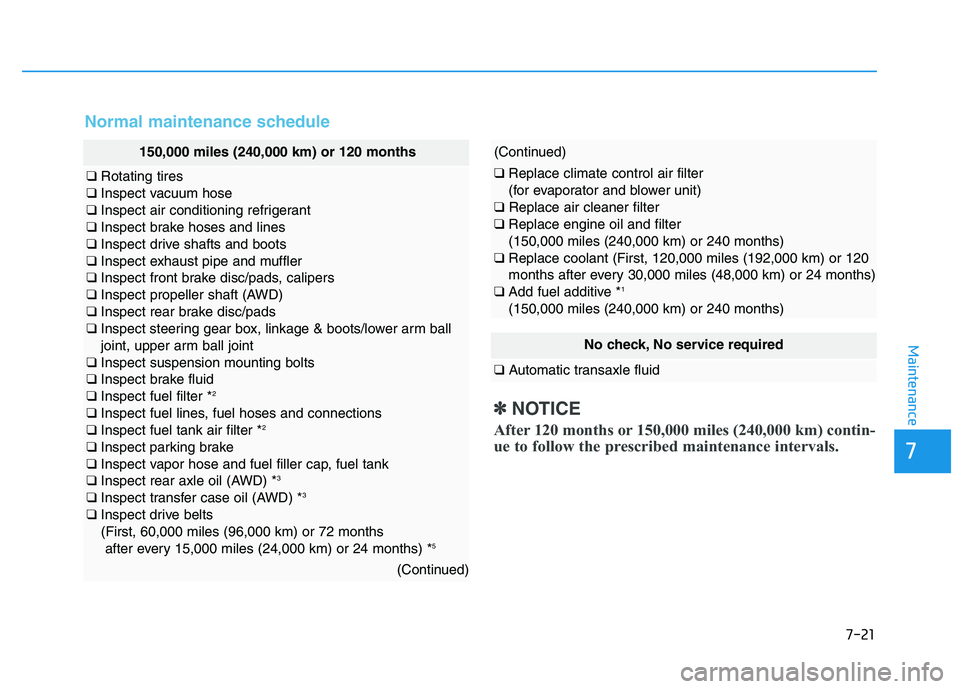
Normal maintenance schedule
No check, No service required
❑Automatic transaxle fluid
150,000 miles (240,000 km) or 120 months
❑Rotating tires
❑ Inspect vacuum hose
❑ Inspect air conditioning refrigerant
❑ Inspect brake hoses and lines
❑ Inspect drive shafts and boots
❑ Inspect exhaust pipe and muffler
❑ Inspect front brake disc/pads, calipers
❑ Inspect propeller shaft (AWD)
❑ Inspect rear brake disc/pads
❑ Inspect steering gear box, linkage & boots/lower arm ball
joint, upper arm ball joint
❑ Inspect suspension mounting bolts
❑ Inspect brake fluid
❑ Inspect fuel filter * 2
❑ Inspect fuel lines, fuel hoses and connections
❑ Inspect fuel tank air filter * 2
❑ Inspect parking brake
❑ Inspect vapor hose and fuel filler cap, fuel tank
❑ Inspect rear axle oil (AWD) * 3
❑ Inspect transfer case oil (AWD) * 3
❑ Inspect drive belts (First, 60,000 miles (96,000 km) or 72 months
after every 15,000 miles (24,000 km) or 24 months) * 5
(Continued)
(Continued)
❑
Replace climate control air filter
(for evaporator and blower unit)
❑ Replace air cleaner filter
❑ Replace engine oil and filter (150,000 miles (240,000 km) or 240 months)
❑ Replace coolant (First, 120,000 miles (192,000 km) or 120
months after every 30,000 miles (48,000 km) or 24 months)
❑ Add fuel additive * 1
(150,000 miles (240,000 km) or 240 months)
✽✽ NOTICE
After 120 months or 150,000 miles (240,000 km) contin-
ue to follow the prescribed maintenance intervals.
Page 453 of 542
7-23
7
Maintenance
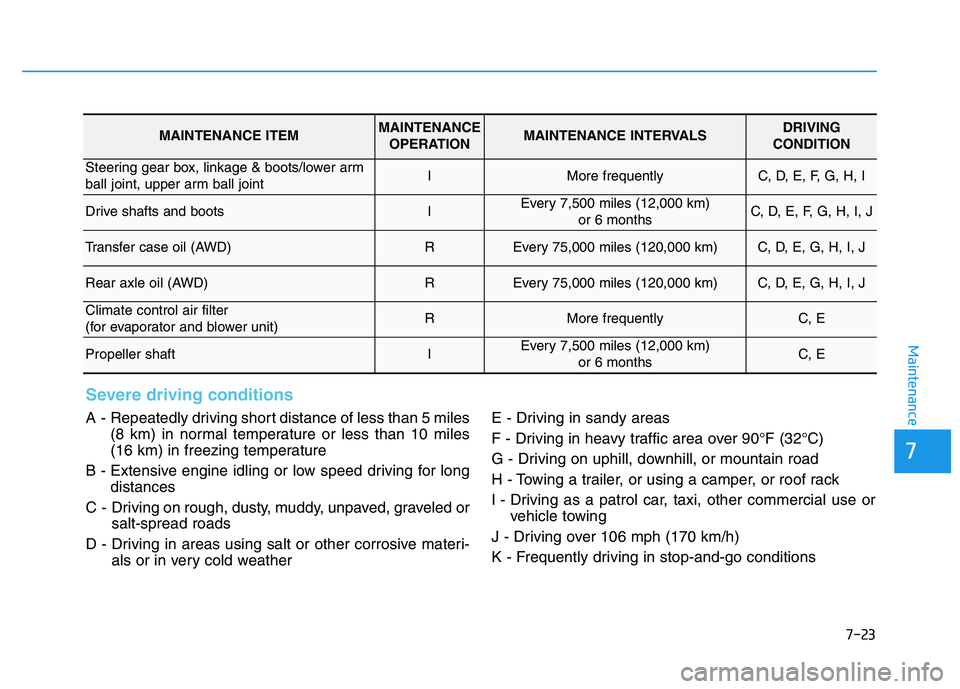
Severe driving conditions
A - Repeatedly driving short distance of less than 5 miles(8 km) in normal temperature or less than 10 miles
(16 km) in freezing temperature
B - Extensive engine idling or low speed driving for long distances
C - Driving on rough, dusty, muddy, unpaved, graveled or salt-spread roads
D - Driving in areas using salt or other corrosive materi- als or in very cold weather E - Driving in sandy areas
F - Driving in heavy traffic area over 90°F (32°C)
G - Driving on uphill, downhill, or mountain road
H - Towing a trailer, or using a camper, or roof rack
I - Driving as a patrol car, taxi, other commercial use or
vehicle towing
J - Driving over 106 mph (170 km/h)
K - Frequently driving in stop-and-go conditions
MAINTENANCE ITEMMAINTENANCE OPERATIONMAINTENANCE INTERVALSDRIVING
CONDITION
Steering gear box, linkage & boots/lower arm
ball joint, upper arm ball jointIMore frequentlyC, D, E, F, G, H, I
Drive shafts and bootsIEvery 7,500 miles (12,000 km) or 6 monthsC, D, E, F, G, H, I, J
Transfer case oil (AWD) REvery 75,000 miles (120,000 km)C, D, E, G, H, I, J
Rear axle oil (AWD)REvery 75,000 miles (120,000 km)C, D, E, G, H, I, J
Climate control air filter
(for evaporator and blower unit)RMore frequentlyC, E
Propeller shaftIEvery 7,500 miles (12,000 km) or 6 monthsC, E
Page 517 of 542
7-87
7
Maintenance
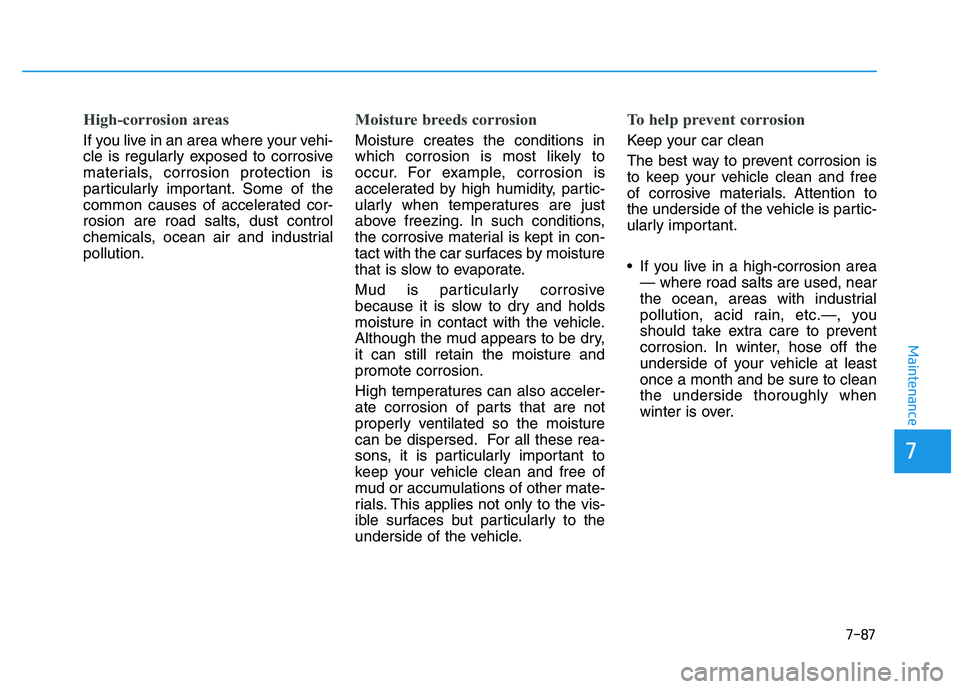
High-corrosion areas
If you live in an area where your vehi-
cle is regularly exposed to corrosive
materials, corrosion protection is
particularly important. Some of the
common causes of accelerated cor-
rosion are road salts, dust control
chemicals, ocean air and industrialpollution.
Moisture breeds corrosion
Moisture creates the conditions in
which corrosion is most likely to
occur. For example, corrosion is
accelerated by high humidity, partic-
ularly when temperatures are just
above freezing. In such conditions,
the corrosive material is kept in con-
tact with the car surfaces by moisture
that is slow to evaporate.
Mud is particularly corrosive
because it is slow to dry and holds
moisture in contact with the vehicle.
Although the mud appears to be dry,it can still retain the moisture andpromote corrosion.
High temperatures can also acceler-
ate corrosion of parts that are not
properly ventilated so the moisture
can be dispersed. For all these rea-
sons, it is particularly important to
keep your vehicle clean and free of
mud or accumulations of other mate-
rials. This applies not only to the vis-
ible surfaces but particularly to the
underside of the vehicle.
To help prevent corrosion
Keep your car clean
The best way to prevent corrosion is
to keep your vehicle clean and free
of corrosive materials. Attention to
the underside of the vehicle is partic-
ularly important.
If you live in a high-corrosion area— where road salts are used, near
the ocean, areas with industrial
pollution, acid rain, etc.—, you
should take extra care to prevent
corrosion. In winter, hose off the
underside of your vehicle at leastonce a month and be sure to cleanthe underside thoroughly when
winter is over.
Page 520 of 542
7-90
Maintenance
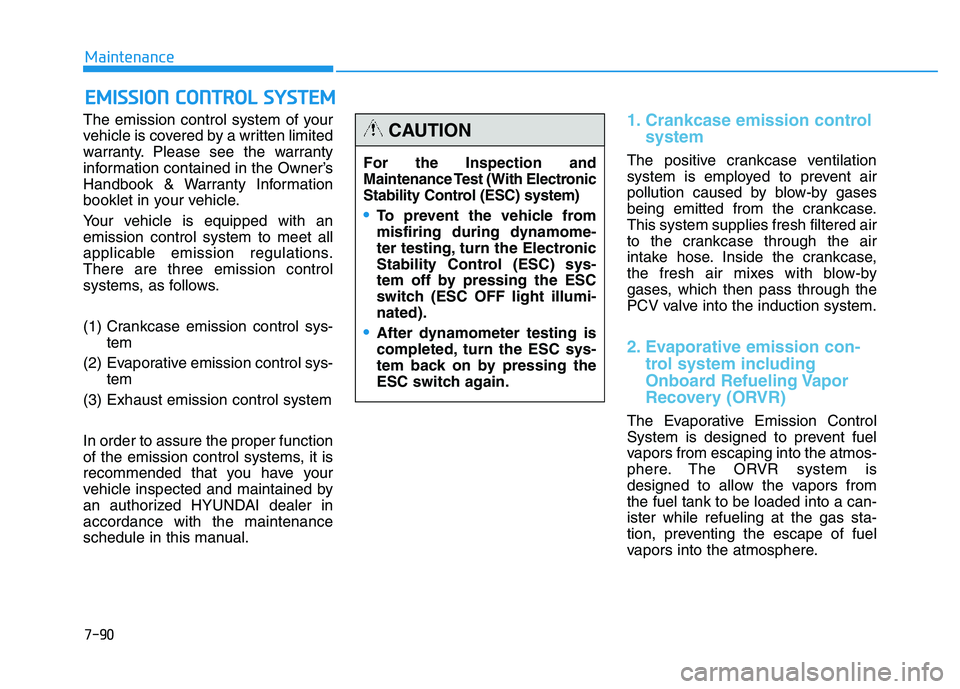
EEMM IISS SS IIOO NN CC OO NNTTRR OO LL SS YY SSTT EEMM
The emission control system of your
vehicle is covered by a written limited
warranty. Please see the warranty
information contained in the Owner’s
Handbook & Warranty Information
booklet in your vehicle.
Your vehicle is equipped with an emission control system to meet all
applicable emission regulations.There are three emission control
systems, as follows.
(1) Crankcase emission control sys-
tem
(2) Evaporative emission control sys- tem
(3) Exhaust emission control system In order to assure the proper function
of the emission control systems, it is
recommended that you have your
vehicle inspected and maintained by
an authorized HYUNDAI dealer inaccordance with the maintenance
schedule in this manual.1. Crankcase emission control system
The positive crankcase ventilation
system is employed to prevent air
pollution caused by blow-by gases
being emitted from the crankcase.This system supplies fresh filtered air
to the crankcase through the air
intake hose. Inside the crankcase,
the fresh air mixes with blow-by
gases, which then pass through the
PCV valve into the induction system.
2. Evaporative emission con-trol system including
Onboard Refueling Vapor
Recovery (ORVR)
The Evaporative Emission Control
System is designed to prevent fuel
vapors from escaping into the atmos-
phere. The ORVR system is
designed to allow the vapors fromthe fuel tank to be loaded into a can-ister while refueling at the gas sta-
tion, preventing the escape of fuel
vapors into the atmosphere.
For the Inspection and
Maintenance Test (With Electronic
Stability Control (ESC) system)
To prevent the vehicle from
misfiring during dynamome-
ter testing, turn the Electronic
Stability Control (ESC) sys-
tem off by pressing the ESC
switch (ESC OFF light illumi-nated).
After dynamometer testing is
completed, turn the ESC sys-
tem back on by pressing the
ESC switch again.
CAUTION
Page 521 of 542
7-91
7
Maintenance
Canister
Fuel vapors generated inside the fuel tank are absorbed and stored in the
onboard canister. When the engine is
running, the fuel vapors absorbed in
the canister are drawn into the surgetank through the purge control sole-
noid valve.
Purge Control Solenoid Valve(PCSV)
The purge control solenoid valve is
controlled by the Engine Control
Module (ECM); when the engine
coolant temperature is low during
idling, the PCSV closes so that evap-
orated fuel is not taken into the
engine. After the engine warms-up
during ordinary driving, the PCSV
opens to introduce evaporated fuel to
the engine.
3. Exhaust emission control system
The Exhaust Emission Control
System is a highly effective system
which controls exhaust emissions
while maintaining good vehicle per-
formance.
When the engine starts or fails to
start, excessive attempts to restart
the engine may cause damage to theemission system.
Vehicle modifications
This vehicle should not be modi-fied. Modification of your vehicle
could affect its performance, safety
or durability and may even violate
governmental safety and emis-
sions regulations.
In addition, damage or performance
problems resulting from any modifi-
cation may not be covered under
warranty.
If you use unauthorized electronic devices, it may cause the vehicle to
operate abnormally, wire damage,
battery discharge and fire. For your
safety, do not use unauthorized
electronic devices.
Engine exhaust (carbon monox-
ide) precautions
Carbon monoxide can be present with other exhaust fumes. If you
smell exhaust fumes of any kind in
your vehicle, drive with all the win-
dows fully open. Have your vehicle
checked and repaired immediately.
Engine exhaust gases contain
carbon monoxide (CO). Though
colorless and odorless, it is
dangerous and could be lethal if
inhaled. Follow the instructions
on this page to avoid CO poi-soning.
WARNING
Page 537 of 542
I-4
Do not install a child restraint on the frontpassenger seat ...............................................................2-62
Door locks .......................................................................3-13 Central door lock switch ............................................3-16
Child-protector rear door lock....................................3-18
Downhill brake control (DBC) .......................................5-41
Drinks holders, see cup holders ....................................3-119
Driver selectable steering mode .....................................3-41
Driving assist system ......................................................5-44 Active ECO system ....................................................5-44
Rear view camera .......................................................5-45
Driving at night ...............................................................5-52
Driving in flooded areas .................................................5-54
Driving in the rain...........................................................5-53
Electric chromic mirror (ECM) ......................................3-45
Electric chromic mirror (ECM) with compass ...............3-46
Electric power steering ...................................................3-40
Electronic stability control (ESC)...................................5-35
Emergency towing ..........................................................6-23
Emission control system .................................................7-90 Crankcase emission control system ...........................7-90
Evaporative emission control System ........................7-90
Exhaust emission control system ...............................7-91
Engine compartment..................................................1-6, 7-3
Engine coolant ................................................................7-29
Engine Coolant Temperature gauge................................3-22 Engine number ..................................................................8-7
Engine oil ........................................................................7-27
Engine start/stop button ....................................................5-8
Evaporative emission control System.............................7-90
Exhaust emission control system....................................7-91
Explanation of scheduled maintenance items.................7-24
Exterior care....................................................................7-83
Exterior overview .............................................................1-2
Flat tire (with spare tire) .................................................6-15
Jack and tools .............................................................6-15
Floor mat anchor(s).......................................................3-122
Fluid Brake fluid ..................................................................7-32
Washer fluid ...............................................................7-34
Fog light (front) ..............................................................3-83
Folding the outside rearview mirror ...............................3-62
Front lamp .......................................................................3-85
Front seat...........................................................................2-6
Front windshield defroster ..............................................3-92
Fuel filler door ................................................................3-76
Fuel Gauge ......................................................................3-23
Fuel requirements .............................................................F-7
Fuses ...............................................................................7-63
Instrument panel fuse .................................................7-64
Memory fuse ..............................................................7-65
Main fuse ....................................................................7-66
Multi fuse ...................................................................7-67
Fuse/relay panel description .......................................7-68
Index
E
F