service HYUNDAI TUCSON 2014 Owner's Manual
[x] Cancel search | Manufacturer: HYUNDAI, Model Year: 2014, Model line: TUCSON, Model: HYUNDAI TUCSON 2014Pages: 542, PDF Size: 7.59 MB
Page 451 of 542
7-21
7
Maintenance
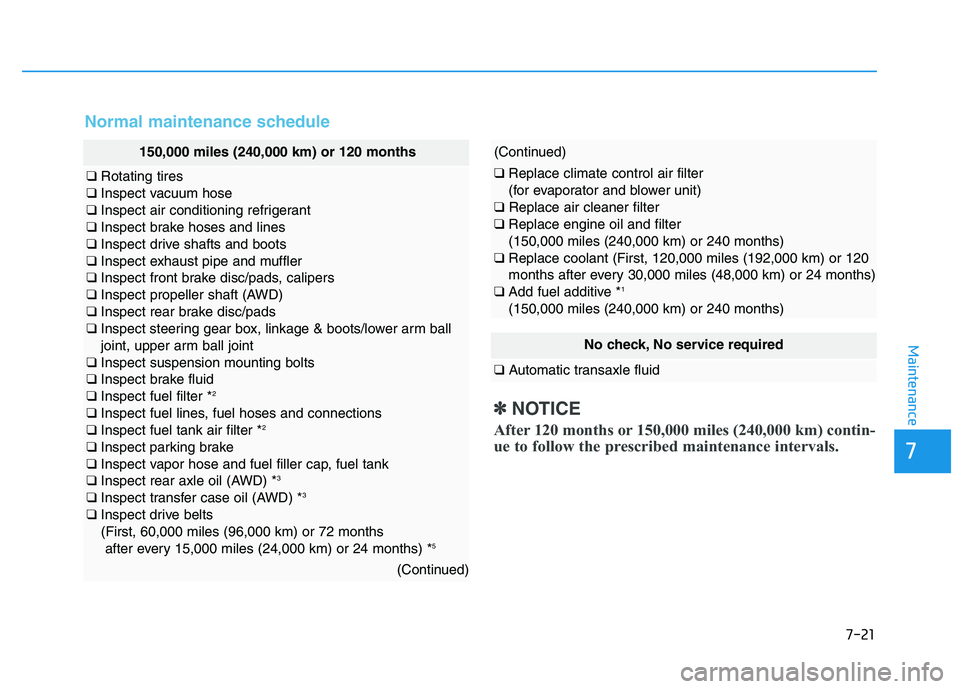
Normal maintenance schedule
No check, No service required
❑Automatic transaxle fluid
150,000 miles (240,000 km) or 120 months
❑Rotating tires
❑ Inspect vacuum hose
❑ Inspect air conditioning refrigerant
❑ Inspect brake hoses and lines
❑ Inspect drive shafts and boots
❑ Inspect exhaust pipe and muffler
❑ Inspect front brake disc/pads, calipers
❑ Inspect propeller shaft (AWD)
❑ Inspect rear brake disc/pads
❑ Inspect steering gear box, linkage & boots/lower arm ball
joint, upper arm ball joint
❑ Inspect suspension mounting bolts
❑ Inspect brake fluid
❑ Inspect fuel filter * 2
❑ Inspect fuel lines, fuel hoses and connections
❑ Inspect fuel tank air filter * 2
❑ Inspect parking brake
❑ Inspect vapor hose and fuel filler cap, fuel tank
❑ Inspect rear axle oil (AWD) * 3
❑ Inspect transfer case oil (AWD) * 3
❑ Inspect drive belts (First, 60,000 miles (96,000 km) or 72 months
after every 15,000 miles (24,000 km) or 24 months) * 5
(Continued)
(Continued)
❑
Replace climate control air filter
(for evaporator and blower unit)
❑ Replace air cleaner filter
❑ Replace engine oil and filter (150,000 miles (240,000 km) or 240 months)
❑ Replace coolant (First, 120,000 miles (192,000 km) or 120
months after every 30,000 miles (48,000 km) or 24 months)
❑ Add fuel additive * 1
(150,000 miles (240,000 km) or 240 months)
✽✽ NOTICE
After 120 months or 150,000 miles (240,000 km) contin-
ue to follow the prescribed maintenance intervals.
Page 452 of 542
7-22
Maintenance
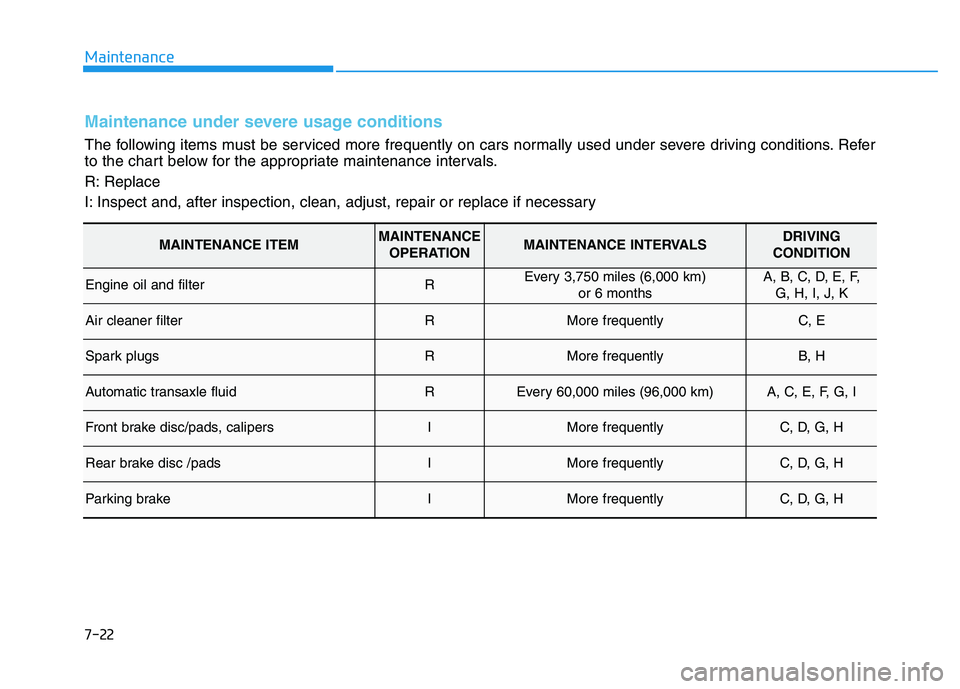
Maintenance under severe usage conditions
The following items must be serviced more frequently on cars normally used under severe driving conditions. Refer
to the chart below for the appropriate maintenance intervals.
R: Replace
I: Inspect and, after inspection, clean, adjust, repair or replace if necessary
MAINTENANCE ITEMMAINTENANCEOPERATIONMAINTENANCE INTERVALSDRIVING
CONDITION
Engine oil and filterREvery 3,750 miles (6,000 km) or 6 monthsA, B, C, D, E, F, G, H, I, J, K
Air cleaner filterRMore frequentlyC, E
Spark plugsRMore frequentlyB, H
Automatic transaxle fluidREvery 60,000 miles (96,000 km) A, C, E, F, G, I
Front brake disc/pads, calipersIMore frequentlyC, D, G, H
Rear brake disc /padsIMore frequentlyC, D, G, H
Parking brakeIMore frequentlyC, D, G, H
Page 473 of 542
7-43
7
Maintenance
BBAA TTTTEERR YY
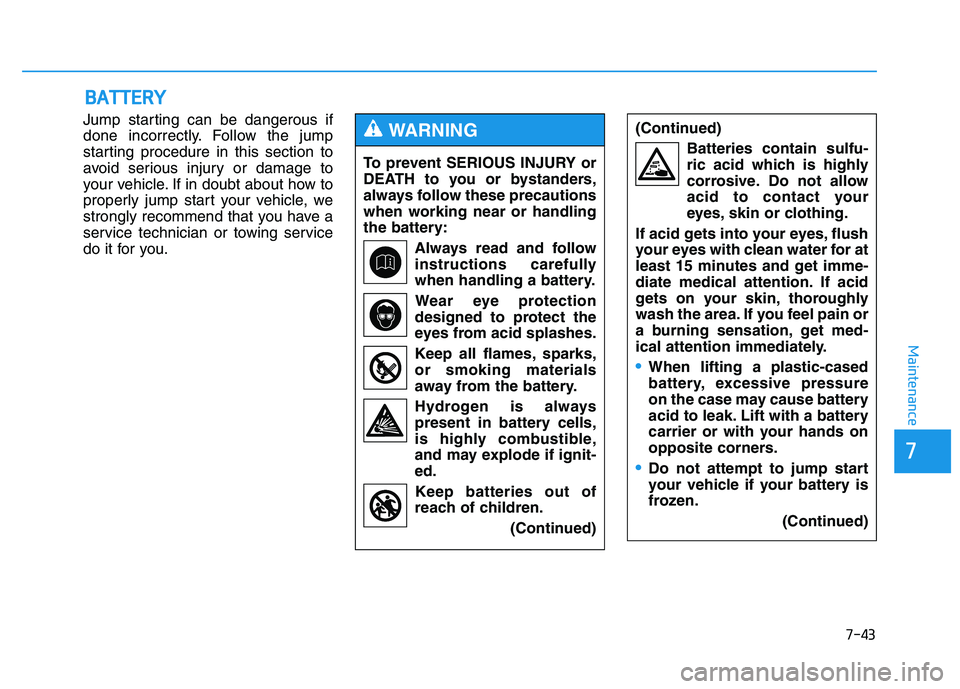
Jump starting can be dangerous if
done incorrectly. Follow the jump
starting procedure in this section to
avoid serious injury or damage to
your vehicle. If in doubt about how to
properly jump start your vehicle, we
strongly recommend that you have a
service technician or towing service
do it for you. To prevent SERIOUS INJURY or
DEATH to you or bystanders,
always follow these precautions
when working near or handling
the battery:
Always read and follow
instructions carefully
when handling a battery.Wear eye protection
designed to protect the
eyes from acid splashes.
Keep all flames, sparks, or smoking materials
away from the battery.
Hydrogen is always present in battery cells,
is highly combustible,
and may explode if ignit-ed.
Keep batteries out of
reach of children.
(Continued)WARNING (Continued)Batteries contain sulfu-
ric acid which is highly
corrosive. Do not allow
acid to contact your
eyes, skin or clothing.
If acid gets into your eyes, flush
your eyes with clean water for at
least 15 minutes and get imme-
diate medical attention. If acid
gets on your skin, thoroughly
wash the area. If you feel pain or
a burning sensation, get med-
ical attention immediately.
When lifting a plastic-cased
battery, excessive pressure
on the case may cause battery
acid to leak. Lift with a battery
carrier or with your hands on
opposite corners.
Do not attempt to jump start
your vehicle if your battery is
frozen. (Continued)
Page 474 of 542
7-44
Maintenance
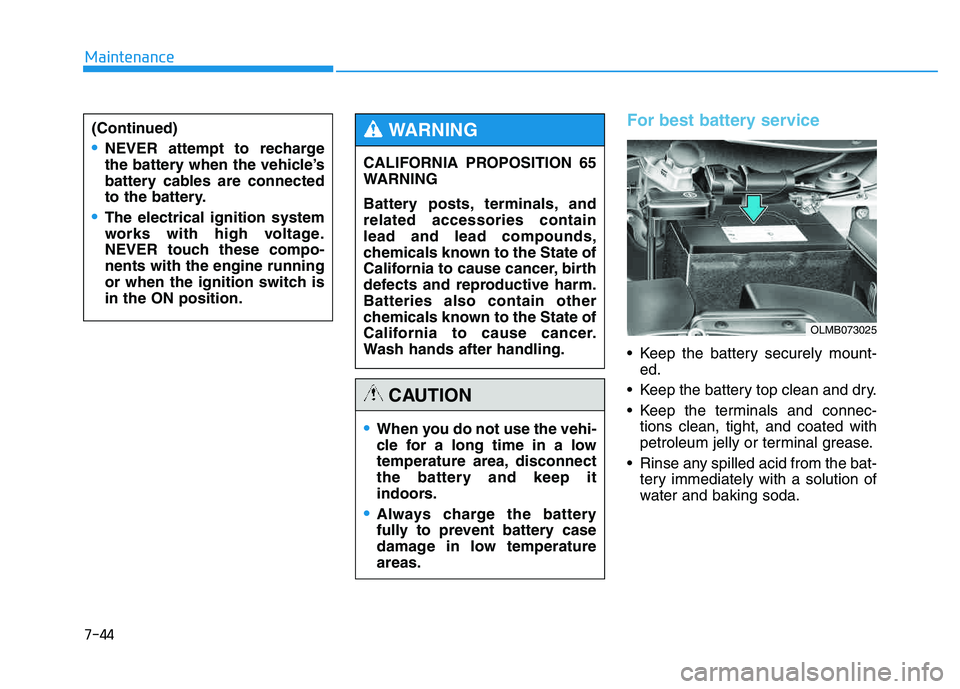
For best battery service
Keep the battery securely mount-ed.
Keep the battery top clean and dry.
Keep the terminals and connec- tions clean, tight, and coated with
petroleum jelly or terminal grease.
Rinse any spilled acid from the bat- tery immediately with a solution of
water and baking soda.
When you do not use the vehi-
cle for a long time in a low
temperature area, disconnect
the battery and keep it
indoors.
Always charge the battery
fully to prevent battery case
damage in low temperatureareas.
CAUTION
CALIFORNIA PROPOSITION 65
WARNING
Battery posts, terminals, and related accessories containlead and lead compounds,
chemicals known to the State of
California to cause cancer, birth
defects and reproductive harm.Batteries also contain other
chemicals known to the State of
California to cause cancer.
Wash hands after handling.
WARNING
OLMB073025
(Continued)
NEVER attempt to recharge
the battery when the vehicle’s
battery cables are connected
to the battery.
The electrical ignition system
works with high voltage.
NEVER touch these compo-nents with the engine running
or when the ignition switch isin the ON position.
Page 481 of 542
7-51
7
Maintenance
Wheel alignment and tire bal- ance
The wheels on your vehicle were aligned and balanced carefully at the
factory to give you the longest tire life
and best overall performance.
In most cases, you will not need to
have your wheels aligned again.
However, if you notice unusual tire
wear or your vehicle pulling one way
or the other, the alignment may needto be reset.
If you notice your vehicle vibrating
when driving on a smooth road, your
wheels may need to be rebalanced.
Tire replacement
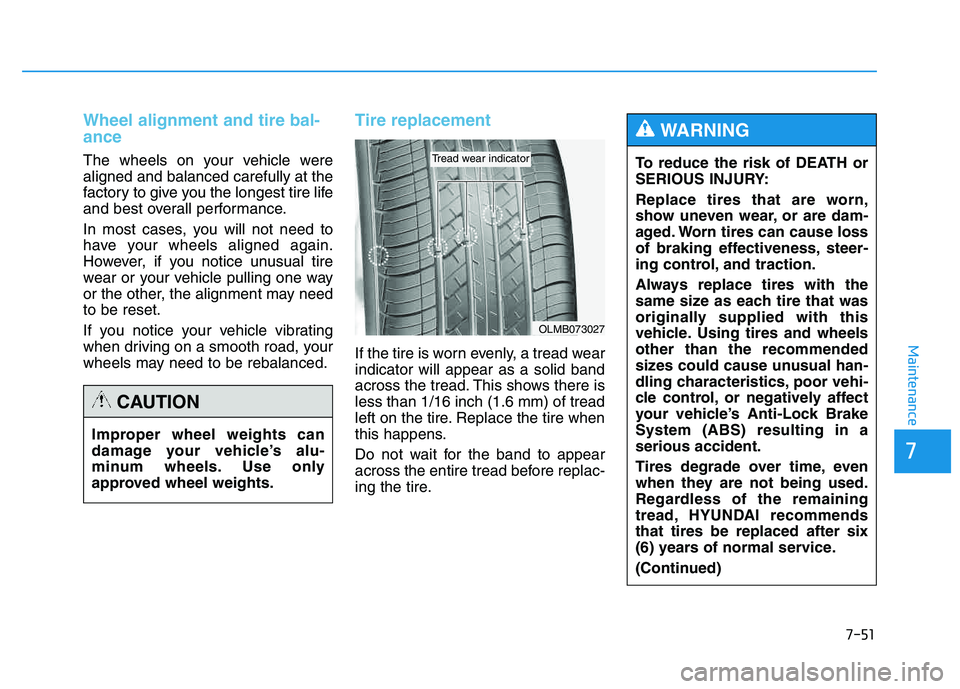
If the tire is worn evenly, a tread wear indicator will appear as a solid band
across the tread. This shows there isless than 1/16 inch (1.6 mm) of tread
left on the tire. Replace the tire when
this happens.
Do not wait for the band to appear
across the entire tread before replac-
ing the tire.
OLMB073027
Tread wear indicator
Improper wheel weights can
damage your vehicle’s alu-
minum wheels. Use only
approved wheel weights.
CAUTION
To reduce the risk of DEATH or
SERIOUS INJURY:
Replace tires that are worn,
show uneven wear, or are dam-
aged. Worn tires can cause loss
of braking effectiveness, steer-
ing control, and traction.
Always replace tires with the
same size as each tire that was
originally supplied with this
vehicle. Using tires and wheelsother than the recommended
sizes could cause unusual han-
dling characteristics, poor vehi-
cle control, or negatively affect
your vehicle’s Anti-Lock BrakeSystem (ABS) resulting in aserious accident.
Tires degrade over time, even
when they are not being used.
Regardless of the remaining
tread, HYUNDAI recommendsthat tires be replaced after six
(6) years of normal service.
(Continued)
WARNING
Page 485 of 542
7-55
7
Maintenance
4. Tire ply composition andmaterial
The number of layers or plies of rub-
ber-coated fabric in the tire. Tire
manufacturers also must indicate the
materials in the tire, which include
steel, nylon, polyester, and others.
The letter "R" means radial ply con-
struction; the letter "D“ means diago-
nal or bias ply construction; and theletter "B" means belted-bias ply con-
struction.
5. Maximum permissible infla-tion pressure
This number is the greatest amountof air pressure that should be put in
the tire. Do not exceed the maximum
permissible inflation pressure. Refer
to the Tire and Loading Information
label for recommended inflation
pressure.
6. Maximum load rating
This number indicates the maximum
load in kilograms and pounds that
can be carried by the tire. When
replacing the tires on the vehicle,
always use a tire that has the same
load rating as the factory installed
tire.
7. Uniform tire quality grading
Quality grades can be found where
applicable on the tire sidewall
between tread shoulder and maxi-
mum section width.
For example:
TREAD wear 200
TRACTION AA
TEMPERATURE A
Tread wear
The tread wear grade is a compara-
tive rating based on the wear rate ofthe tire when tested under controlled
conditions on a specified govern-
ment test course. For example, a tire
graded 150 would wear one-and-a-
half times (1½) as well on the gov-
ernment course as a tire graded 100.
The relative performance of tires depends upon the actual conditions
of their use, however, and may
depart significantly from the norm
due to variations in driving habits,
service practices and differences in
road characteristics and climate.
These grades are molded on the
sidewalls of passenger vehicle tires.
The tires available as standard or
optional equipment on your vehicle
may vary with respect to grade.
Page 509 of 542
7-79
7
Maintenance
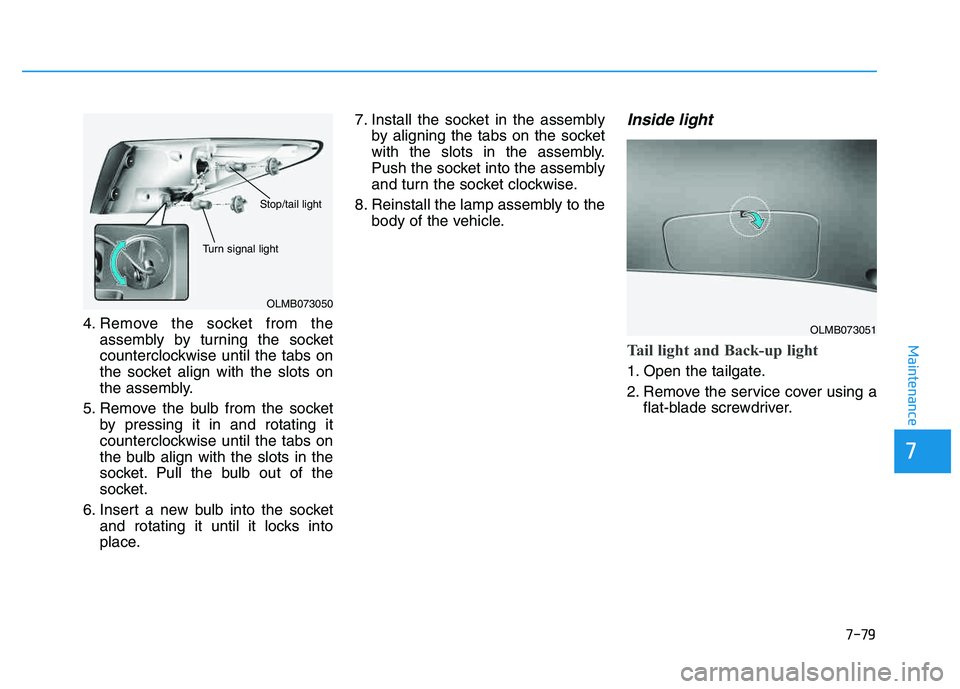
4. Remove the socket from theassembly by turning the socket
counterclockwise until the tabs on
the socket align with the slots on
the assembly.
5. Remove the bulb from the socket by pressing it in and rotating it
counterclockwise until the tabs on
the bulb align with the slots in the
socket. Pull the bulb out of the
socket.
6. Insert a new bulb into the socket and rotating it until it locks into
place. 7. Install the socket in the assembly
by aligning the tabs on the socket
with the slots in the assembly.
Push the socket into the assembly
and turn the socket clockwise.
8. Reinstall the lamp assembly to the body of the vehicle.
Inside light
Tail light and Back-up light
1. Open the tailgate.
2. Remove the service cover using aflat-blade screwdriver.
OLMB073050
Turn signal light
Stop/tail light
OLMB073051
Page 528 of 542
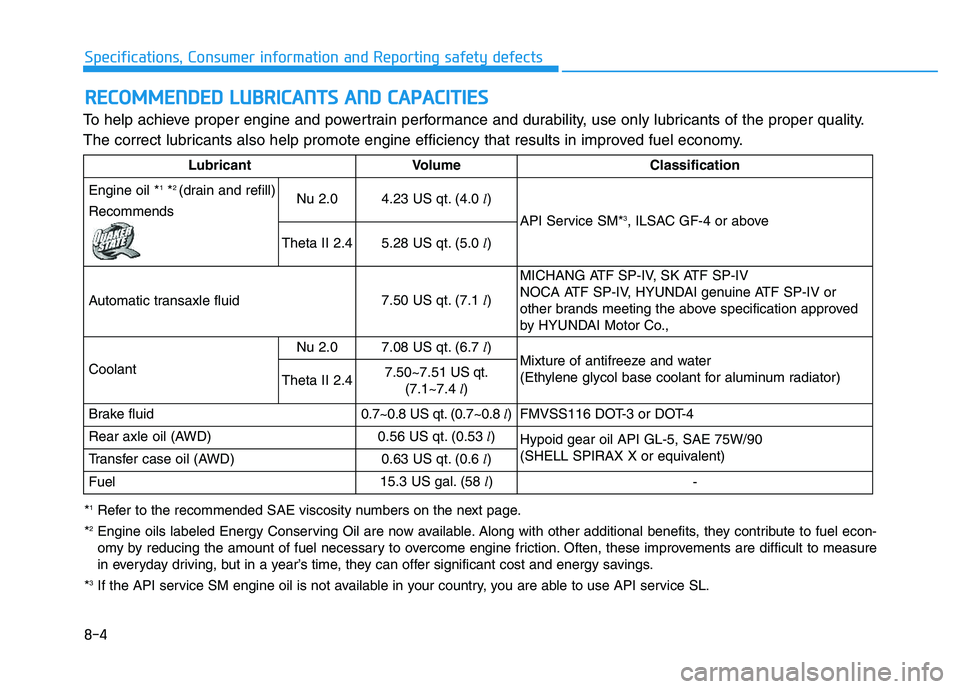
To help achieve proper engine and powertrain performance and durability, use only lubricants of the proper quality.
The correct lubricants also help promote engine efficiency that results in improved fuel economy.
RREECCOO MM MMEENN DDEEDD LL UU BBRRIICC AA NN TTSS AA NN DD CC AA PPAA CCIITT IIEE SS
8-4
Specifications, Consumer information and Reporting safety defects
*1
Refer to the recommended SAE viscosity numbers on the next page.
* 2
Engine oils labeled Energy Conserving Oil are now available. Along with other additional benefits, they contribute to fuel econ-
omy by reducing the amount of fuel necessary to overcome engine friction. Often, these improvements are difficult to measure
in everyday driving, but in a year’s time, they can offer significant cost and energy savings.
* 3
If the API service SM engine oil is not available in your country, you are able to use API service SL.
LubricantVolumeClassification
Engine oil * 1
*2
(drain and refill)
RecommendsNu 2.04.23 US qt. (4.0 l)
API Service SM* 3
, ILSAC GF-4 or above
Theta II 2.45.28 US qt. (5.0 l)
Automatic transaxle fluid7.50 US qt. (7.1 l)
MICHANG ATF SP-IV, SK ATF SP-IV
NOCA ATF SP-IV, HYUNDAI genuine ATF SP-IV or
other brands meeting the above specification approved
by HYUNDAI Motor Co.,
Coolant
Nu 2.07.08 US qt. (6.7 l)Mixture of antifreeze and water
(Ethylene glycol base coolant for aluminum radiator)
Theta II 2.47.50~7.51 US qt.
(7.1~7.4 l)
Brake fluid0.7~0.8 US qt. (0.7~0.8 l)FMVSS116 DOT-3 or DOT-4
Rear axle oil (AWD)0.56 US qt. (0.53 l)Hypoid gear oil API GL-5, SAE 75W/90
(SHELL SPIRAX X or equivalent)
Transfer case oil (AWD)0.63 US qt. (0.6 l)
Fuel15.3 US gal. (58 l)-
Page 539 of 542
I-6
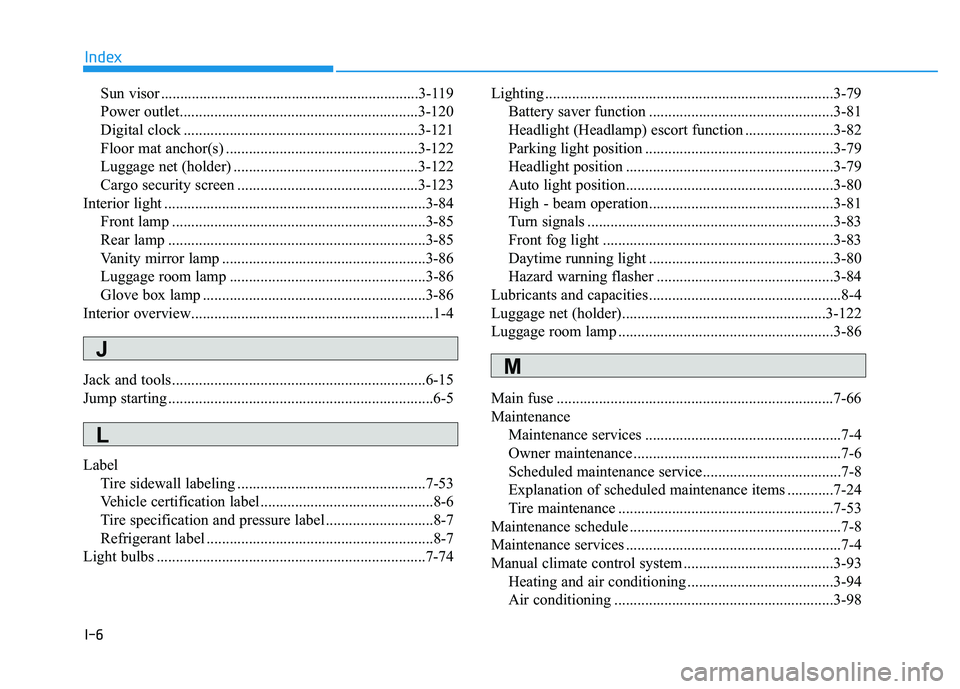
Sun visor ...................................................................3-119
Power outlet..............................................................3-120
Digital clock .............................................................3-121
Floor mat anchor(s) ..................................................3-122
Luggage net (holder) ................................................3-122
Cargo security screen ...............................................3-123
Interior light ....................................................................3-84 Front lamp ..................................................................3-85
Rear lamp ...................................................................3-85
Vanity mirror lamp .....................................................3-86
Luggage room lamp ...................................................3-86
Glove box lamp ..........................................................3-86
Interior overview...............................................................1-4
Jack and tools..................................................................6-15
Jump starting .....................................................................6-5
Label Tire sidewall labeling .................................................7-53
Vehicle certification label .............................................8-6
Tire specification and pressure label ............................8-7
Refrigerant label ...........................................................8-7
Light bulbs ......................................................................7-74 Lighting ...........................................................................3-79
Battery saver function ................................................3-81
Headlight (Headlamp) escort function .......................3-82
Parking light position .................................................3-79
Headlight position ......................................................3-79
Auto light position......................................................3-80
High - beam operation................................................3-81
Turn signals ................................................................3-83
Front fog light ............................................................3-83
Daytime running light ................................................3-80
Hazard warning flasher ..............................................3-84
Lubricants and capacities..................................................8-4
Luggage net (holder).....................................................3-122
Luggage room lamp ........................................................3-86
Main fuse ........................................................................7-66
Maintenance Maintenance services ...................................................7-4
Owner maintenance ......................................................7-6
Scheduled maintenance service....................................7-8
Explanation of scheduled maintenance items ............7-24
Tire maintenance ........................................................7-53
Maintenance schedule .......................................................7-8
Maintenance services ........................................................7-4
Manual climate control system .......................................3-93 Heating and air conditioning ......................................3-94
Air conditioning .........................................................3-98
Index
L
M
J
Page 540 of 542
I-7
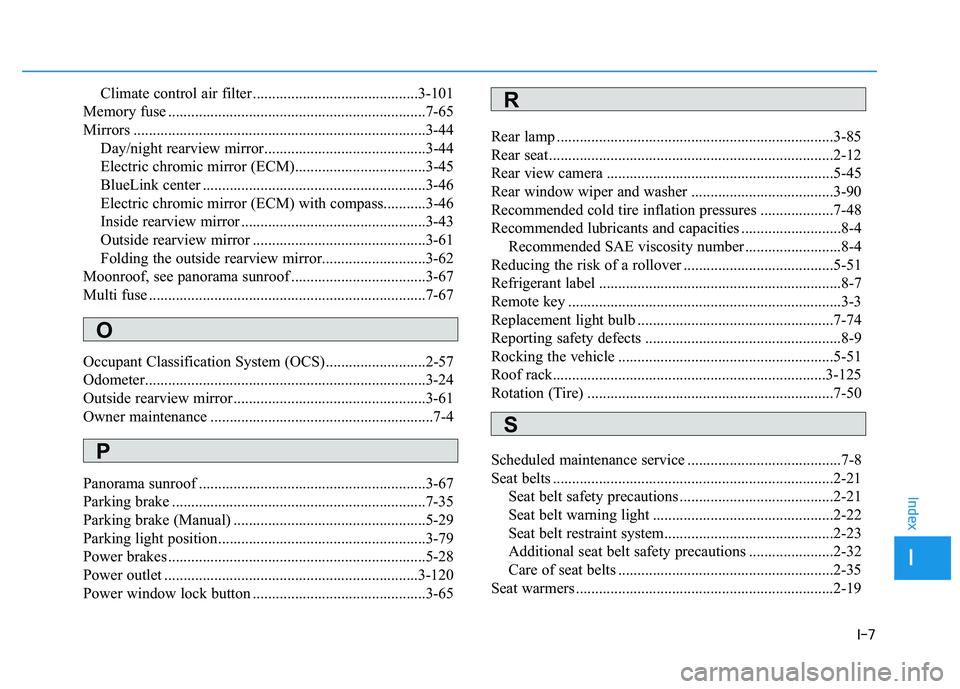
Climate control air filter ...........................................3-101
Memory fuse ...................................................................7-65
Mirrors ............................................................................3-44 Day/night rearview mirror..........................................3-44
Electric chromic mirror (ECM)..................................3-45
BlueLink center ..........................................................3-46
Electric chromic mirror (ECM) with compass...........3-46
Inside rearview mirror ................................................3-43
Outside rearview mirror .............................................3-61
Folding the outside rearview mirror...........................3-62
Moonroof, see panorama sunroof ...................................3-67
Multi fuse ........................................................................7-67
Occupant Classification System (OCS)..........................2-57
Odometer.........................................................................3-24
Outside rearview mirror..................................................3-61
Owner maintenance ..........................................................7-4
Panorama sunroof ...........................................................3-67
Parking brake ..................................................................7-35
Parking brake (Manual) ..................................................5-29
Parking light position......................................................3-79
Power brakes ...................................................................5-28
Power outlet ..................................................................3-120
Power window lock button .............................................3-65 Rear lamp ........................................................................3-85
Rear seat..........................................................................2-12
Rear view camera ...........................................................5-45
Rear window wiper and washer .....................................3-90
Recommended cold tire inflation pressures ...................7-48
Recommended lubricants and capacities ..........................8-4
Recommended SAE viscosity number .........................8-4
Reducing the risk of a rollover .......................................5-51
Refrigerant label ...............................................................8-7
Remote key .......................................................................3-3
Replacement light bulb ...................................................7-74
Reporting safety defects ...................................................8-9
Rocking the vehicle ........................................................5-51
Roof rack.......................................................................3-125
Rotation (Tire) ................................................................7-50
Scheduled maintenance service ........................................7-8
Seat belts .........................................................................2-21 Seat belt safety precautions ........................................2-21
Seat belt warning light ...............................................2-22
Seat belt restraint system............................................2-23
Additional seat belt safety precautions ......................2-32
Care of seat belts ........................................................2-35
Seat warmers ...................................................................2-19
I
Index
O
R
S
P