warning HYUNDAI TUCSON 2014 Service Manual
[x] Cancel search | Manufacturer: HYUNDAI, Model Year: 2014, Model line: TUCSON, Model: HYUNDAI TUCSON 2014Pages: 542, PDF Size: 7.59 MB
Page 67 of 542
2-50
Safety system of your vehicle
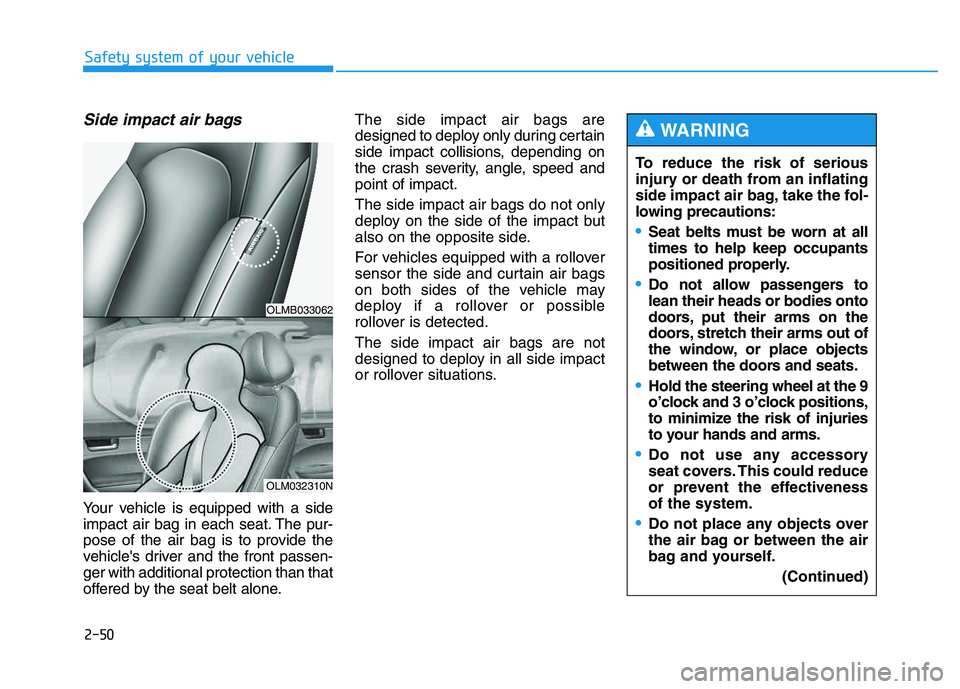
Side impact air bags
Your vehicle is equipped with a side
impact air bag in each seat. The pur-
pose of the air bag is to provide the
vehicle's driver and the front passen-ger with additional protection than that
offered by the seat belt alone.The side impact air bags are
designed to deploy only during certain
side impact collisions, depending on
the crash severity, angle, speed andpoint of impact. The side impact air bags do not only
deploy on the side of the impact but
also on the opposite side.
For vehicles equipped with a rollover
sensor the side and curtain air bags
on both sides of the vehicle may
deploy if a rollover or possible
rollover is detected. The side impact air bags are not
designed to deploy in all side impact
or rollover situations.
OLMB033062
OLM032310N
To reduce the risk of serious
injury or death from an inflating
side impact air bag, take the fol-
lowing precautions:
Seat belts must be worn at all times to help keep occupants
positioned properly.
Do not allow passengers to lean their heads or bodies onto
doors, put their arms on the
doors, stretch their arms out of
the window, or place objects
between the doors and seats.
Hold the steering wheel at the 9
o’clock and 3 o’clock positions,
to minimize the risk of injuries
to your hands and arms.
Do not use any accessory
seat covers. This could reduce
or prevent the effectivenessof the system.
Do not place any objects over
the air bag or between the air
bag and yourself.
(Continued)
WARNING
Page 69 of 542
2-52
Safety system of your vehicle
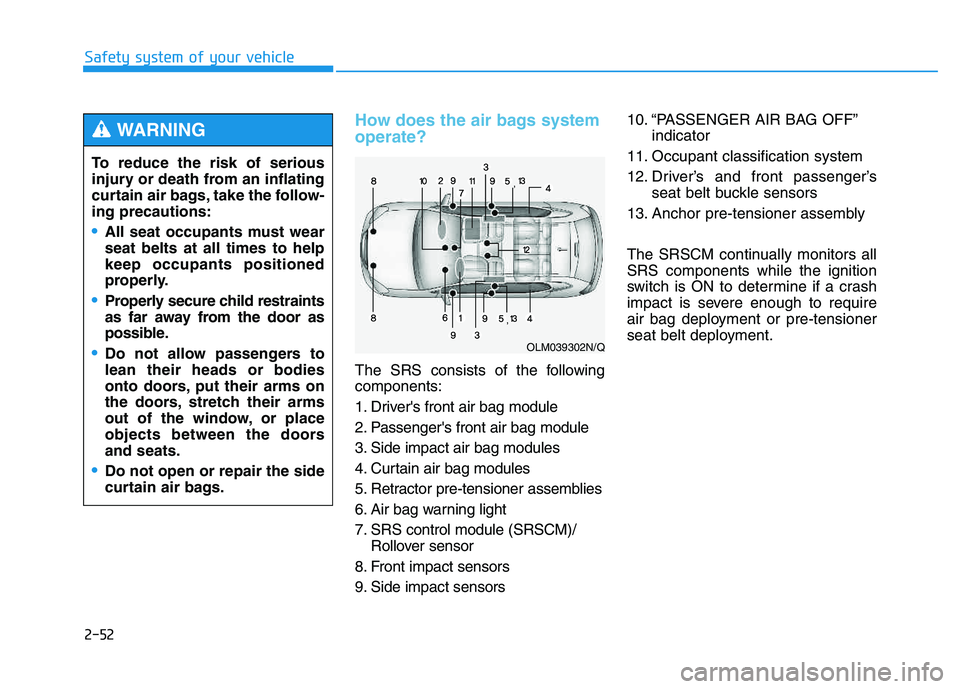
How does the air bags system operate?
The SRS consists of the following components:
1. Driver's front air bag module
2. Passenger's front air bag module
3. Side impact air bag modules
4. Curtain air bag modules
5. Retractor pre-tensioner assemblies
6. Air bag warning light
7. SRS control module (SRSCM)/Rollover sensor
8. Front impact sensors
9. Side impact sensors 10. “PASSENGER AIR BAG OFF”
indicator
11. Occupant classification system
12. Driver’s and front passenger’s seat belt buckle sensors
13. Anchor pre-tensioner assembly
The SRSCM continually monitors all SRS components while the ignition
switch is ON to determine if a crash
impact is severe enough to require
air bag deployment or pre-tensioner
seat belt deployment.
To reduce the risk of serious
injury or death from an inflating
curtain air bags, take the follow-ing precautions:
All seat occupants must wear seat belts at all times to helpkeep occupants positioned
properly.
Properly secure child restraints
as far away from the door as
possible.
Do not allow passengers to lean their heads or bodies
onto doors, put their arms on
the doors, stretch their arms
out of the window, or place
objects between the doorsand seats.
Do not open or repair the side
curtain air bags.
WARNING
OLM039302N/Q
,
,
Page 70 of 542
2-53
Safety system of your vehicle
2
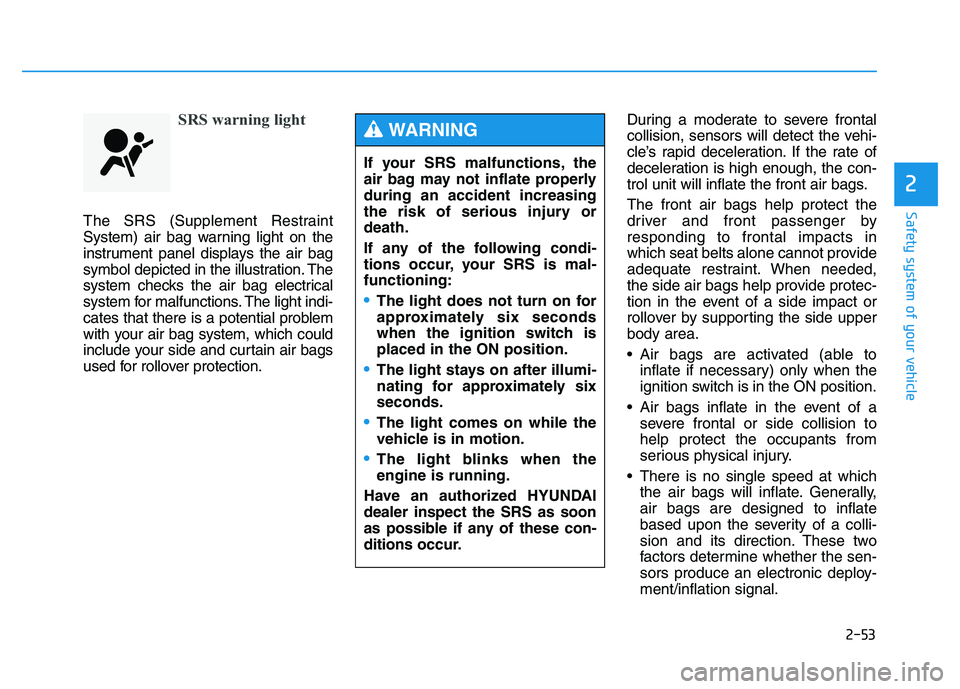
SRS warning light
The SRS (Supplement Restraint
System) air bag warning light on the
instrument panel displays the air bag
symbol depicted in the illustration. The
system checks the air bag electrical
system for malfunctions. The light indi-
cates that there is a potential problem
with your air bag system, which could
include your side and curtain air bags
used for rollover protection.During a moderate to severe frontal
collision, sensors will detect the vehi-
cle’s rapid deceleration. If the rate of
deceleration is high enough, the con-
trol unit will inflate the front air bags. The front air bags help protect the
driver and front passenger byresponding to frontal impacts in
which seat belts alone cannot provide
adequate restraint. When needed,
the side air bags help provide protec-
tion in the event of a side impact or
rollover by supporting the side upperbody area.
Air bags are activated (able to
inflate if necessary) only when the
ignition switch is in the ON position.
Air bags inflate in the event of a severe frontal or side collision tohelp protect the occupants from
serious physical injury.
There is no single speed at which the air bags will inflate. Generally,air bags are designed to inflate
based upon the severity of a colli-
sion and its direction. These two
factors determine whether the sen-
sors produce an electronic deploy-ment/inflation signal.
If your SRS malfunctions, the
air bag may not inflate properlyduring an accident increasing
the risk of serious injury ordeath.
If any of the following condi-
tions occur, your SRS is mal-functioning:
The light does not turn on for
approximately six seconds
when the ignition switch isplaced in the ON position.
The light stays on after illumi-
nating for approximately sixseconds.
The light comes on while the
vehicle is in motion.
The light blinks when the engine is running.
Have an authorized HYUNDAIdealer inspect the SRS as soon
as possible if any of these con-
ditions occur.
WARNING
Page 72 of 542
2-55
Safety system of your vehicle
2
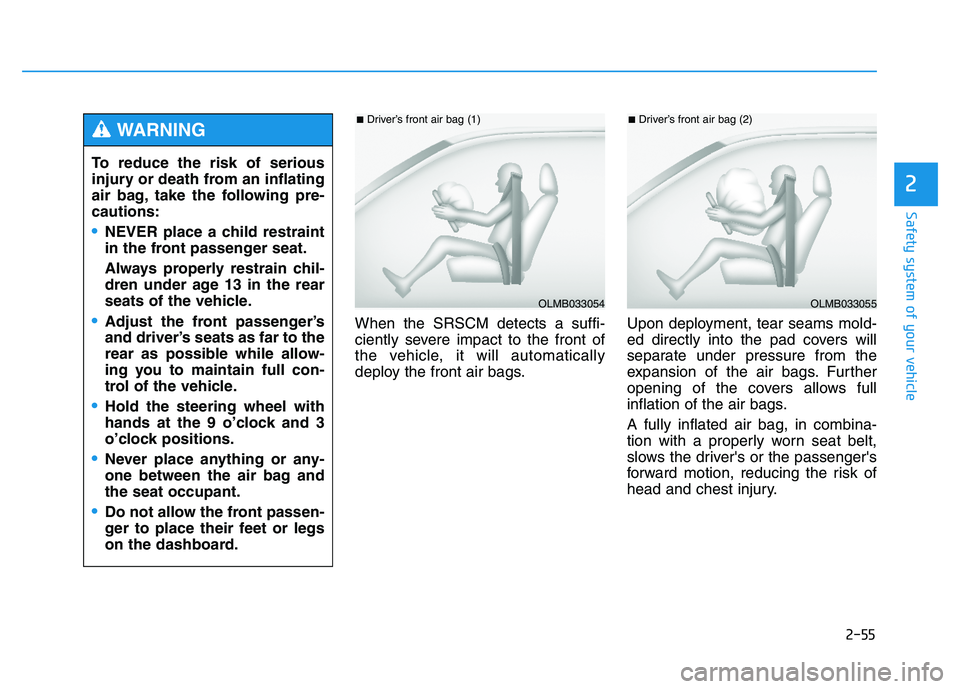
When the SRSCM detects a suffi-
ciently severe impact to the front of
the vehicle, it will automatically
deploy the front air bags.Upon deployment, tear seams mold-
ed directly into the pad covers will
separate under pressure from the
expansion of the air bags. Further
opening of the covers allows full
inflation of the air bags. A fully inflated air bag, in combina-
tion with a properly worn seat belt,
slows the driver's or the passenger's
forward motion, reducing the risk of
head and chest injury.
OLMB033054
■
Driver’s front air bag (1)
To reduce the risk of serious
injury or death from an inflating
air bag, take the following pre-cautions:
NEVER place a child restraint
in the front passenger seat.
Always properly restrain chil-
dren under age 13 in the rear
seats of the vehicle.
Adjust the front passenger’s
and driver’s seats as far to the
rear as possible while allow-
ing you to maintain full con-
trol of the vehicle.
Hold the steering wheel with
hands at the 9 o’clock and 3
o’clock positions.
Never place anything or any-
one between the air bag andthe seat occupant.
Do not allow the front passen-
ger to place their feet or legs
on the dashboard.
WARNING
OLMB033055
■Driver’s front air bag (2)
Page 73 of 542
2-56
Safety system of your vehicle
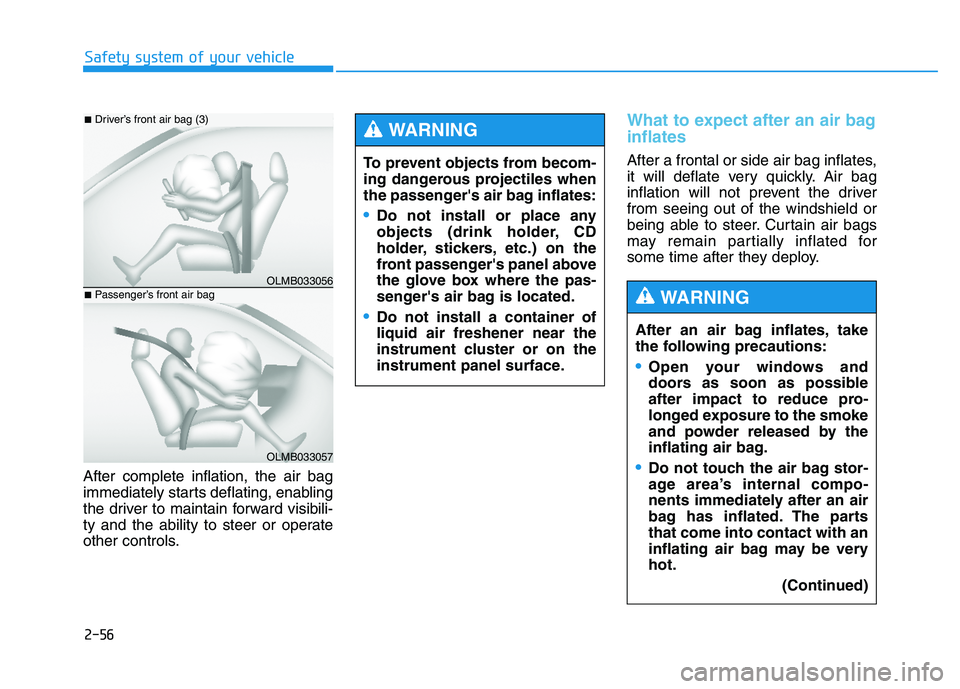
After complete inflation, the air bag
immediately starts deflating, enabling
the driver to maintain forward visibili-
ty and the ability to steer or operate
other controls.
What to expect after an air bag inflates
After a frontal or side air bag inflates,
it will deflate very quickly. Air bag
inflation will not prevent the driverfrom seeing out of the windshield or
being able to steer. Curtain air bags
may remain partially inflated for
some time after they deploy.After an air bag inflates, take
the following precautions:
Open your windows and
doors as soon as possible
after impact to reduce pro-
longed exposure to the smoke
and powder released by the
inflating air bag.
Do not touch the air bag stor-
age area’s internal compo-
nents immediately after an air
bag has inflated. The partsthat come into contact with an
inflating air bag may be veryhot. (Continued)
WARNING
OLMB033056
■Driver’s front air bag (3)
OLMB033057
■Passenger’s front air bag
To prevent objects from becom-
ing dangerous projectiles when
the passenger's air bag inflates:
Do not install or place any
objects (drink holder, CD
holder, stickers, etc.) on the
front passenger's panel above
the glove box where the pas-
senger's air bag is located.
Do not install a container of liquid air freshener near the
instrument cluster or on the
instrument panel surface.
WARNING
Page 76 of 542
2-59
Safety system of your vehicle
2
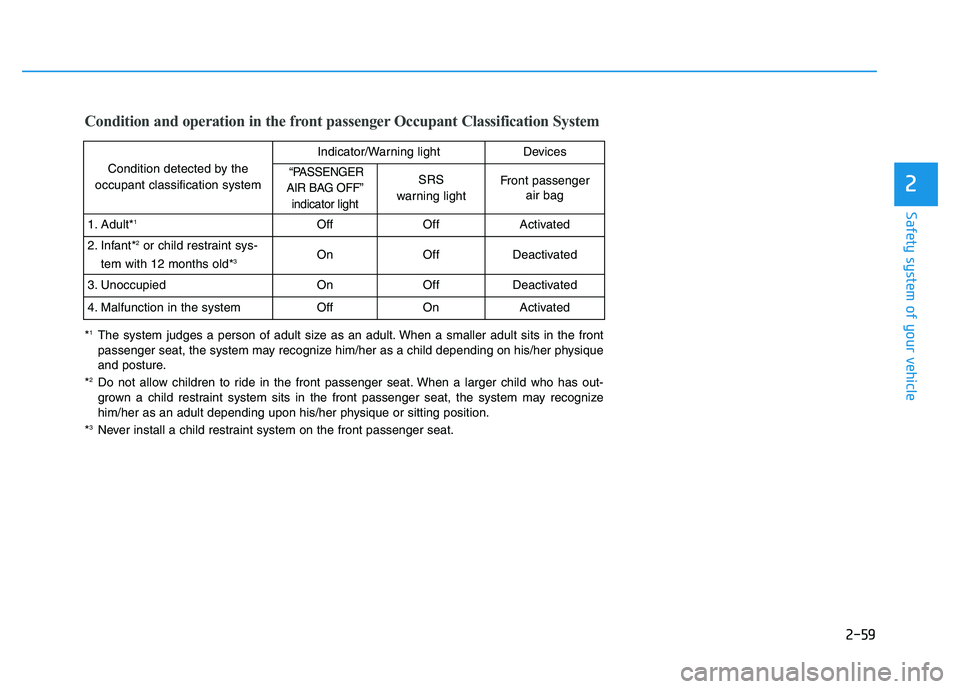
Condition and operation in the front passenger Occupant Classification System
Condition detected by the
occupant classification system
Indicator/Warning lightDevices
“PASSENGER
AIR BAG OFF” indicator lightSRS
warning lightFront passenger air bag
1. Adult* 1OffOffActivated
2. Infant* 2
or child restraint sys-
tem with 12 months old* 3OnOffDeactivated
3. Unoccupied OnOffDeactivated
4. Malfunction in the systemOffOnActivated
*1
The system judges a person of adult size as an adult. When a smaller adult sits in the front
passenger seat, the system may recognize him/her as a child depending on his/her physique
and posture.
* 2
Do not allow children to ride in the front passenger seat. When a larger child who has out-
grown a child restraint system sits in the front passenger seat, the system may recognize
him/her as an adult depending upon his/her physique or sitting position.
* 3
Never install a child restraint system on the front passenger seat.
Page 77 of 542
2-60
Safety system of your vehicle
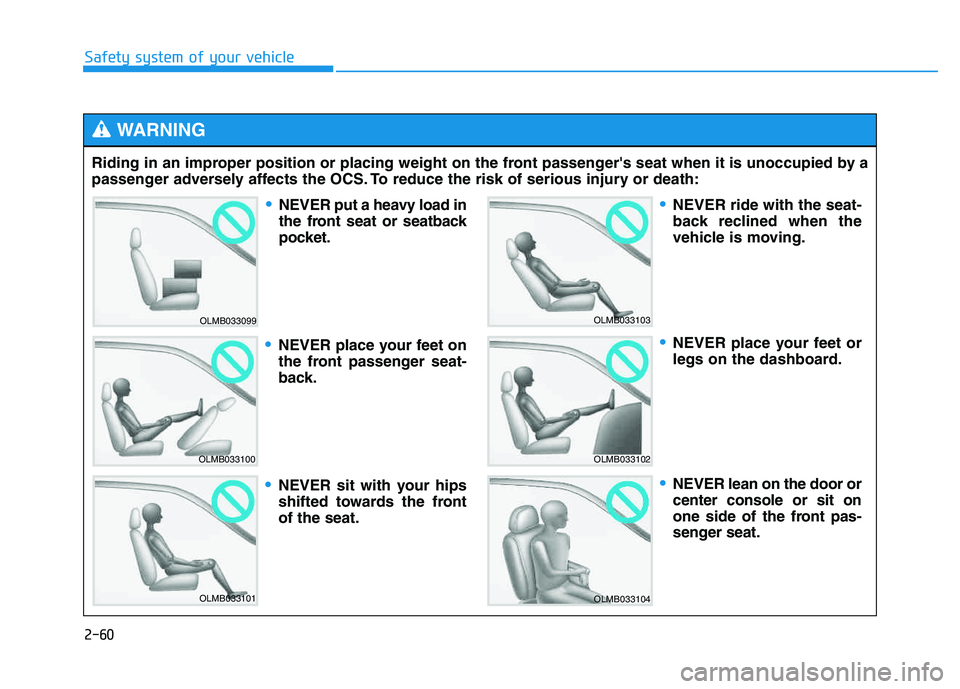
Riding in an improper position or placing weight on the front passenger's seat when it is unoccupied by a
passenger adversely affects the OCS. To reduce the risk of serious injury or death:
WARNING
OLMB033099
OLMB033100
OLMB033101
OLMB033103
OLMB033102
OLMB033104
NEVER put a heavy load in
the front seat or seatback
pocket.
NEVER place your feet on
the front passenger seat-
back.
NEVER sit with your hips
shifted towards the frontof the seat.
NEVER ride with the seat-
back reclined when the
vehicle is moving.
NEVER place your feet or
legs on the dashboard.
NEVER lean on the door or center console or sit on
one side of the front pas-
senger seat.
Page 78 of 542
2-61
Safety system of your vehicle
2
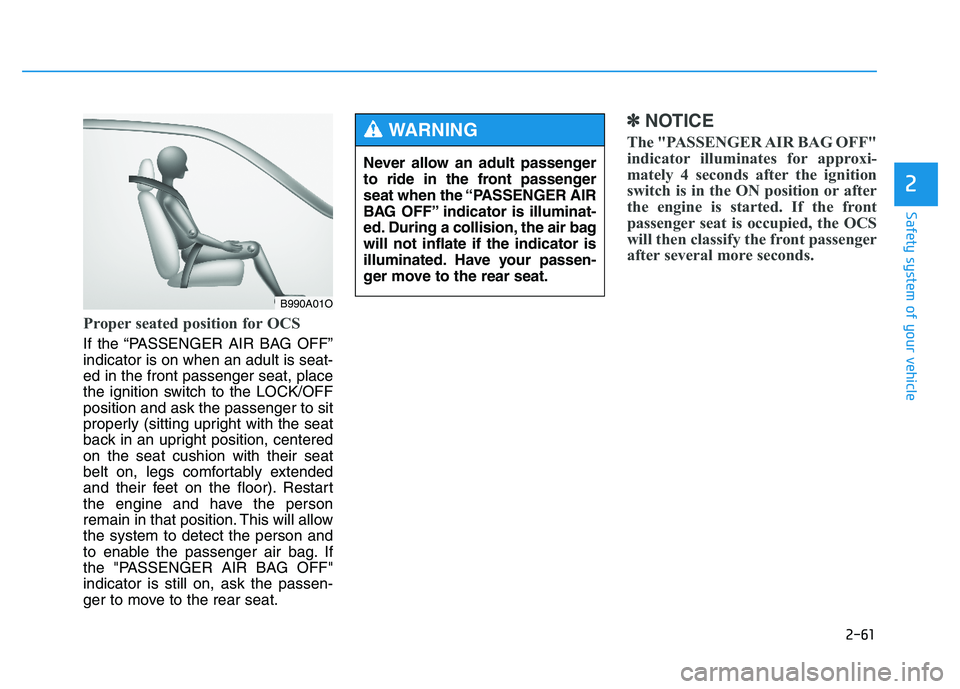
Proper seated position for OCS
If the “PASSENGER AIR BAG OFF” indicator is on when an adult is seat- ed in the front passenger seat, place
the ignition switch to the LOCK/OFF position and ask the passenger to sit
properly (sitting upright with the seat
back in an upright position, centered on the seat cushion with their seat
belt on, legs comfortably extended
and their feet on the floor). Restart
the engine and have the person
remain in that position. This will allowthe system to detect the person and
to enable the passenger air bag. If
the "PASSENGER AIR BAG OFF"indicator is still on, ask the passen-
ger to move to the rear seat.
✽✽NOTICE
The "PASSENGER AIR BAG OFF"
indicator illuminates for approxi-
mately 4 seconds after the ignition
switch is in the ON position or after
the engine is started. If the front
passenger seat is occupied, the OCS
will then classify the front passenger
after several more seconds.
B990A01O
Never allow an adult passenger
to ride in the front passenger
seat when the “PASSENGER AIR
BAG OFF” indicator is illuminat-
ed. During a collision, the air bagwill not inflate if the indicator is
illuminated. Have your passen-
ger move to the rear seat.
WARNING
Page 79 of 542
2-62
Safety system of your vehicle
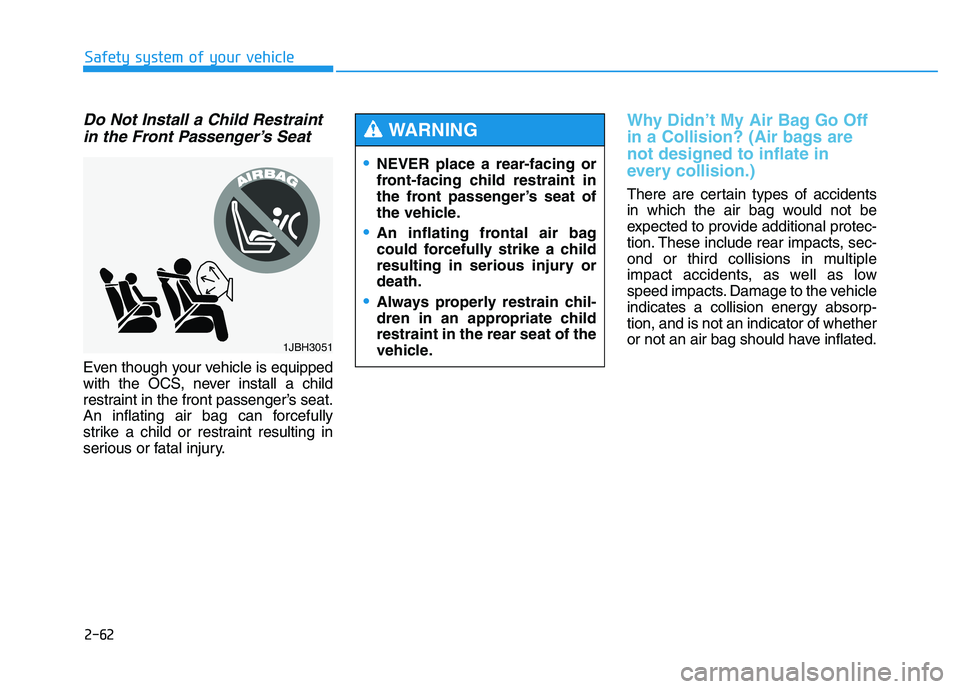
Do Not Install a Child Restraintin the Front Passenger’s Seat
Even though your vehicle is equipped
with the OCS, never install a child
restraint in the front passenger’s seat.
An inflating air bag can forcefully
strike a child or restraint resulting in
serious or fatal injury.
Why Didn’t My Air Bag Go Off
in a Collision? (Air bags are not designed to inflate in
every collision.)
There are certain types of accidents
in which the air bag would not be
expected to provide additional protec-
tion. These include rear impacts, sec-
ond or third collisions in multiple
impact accidents, as well as low
speed impacts. Damage to the vehicle
indicates a collision energy absorp-tion, and is not an indicator of whether
or not an air bag should have inflated.
NEVER place a rear-facing or
front-facing child restraint in
the front passenger’s seat of
the vehicle.
An inflating frontal air bag
could forcefully strike a child
resulting in serious injury ordeath.
Always properly restrain chil-
dren in an appropriate childrestraint in the rear seat of the
vehicle.
WARNING
1JBH3051
Page 80 of 542
2-63
Safety system of your vehicle
2
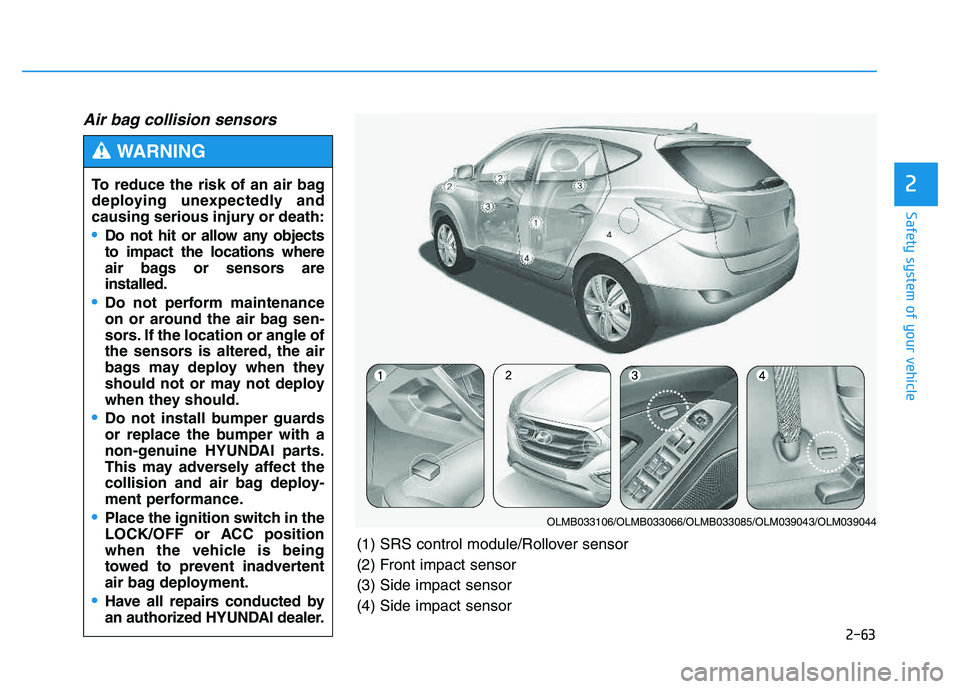
Air bag collision sensors
(1) SRS control module/Rollover sensor
(2) Front impact sensor(3) Side impact sensor (4) Side impact sensor
OLMB033106/OLMB033066/OLMB033085/OLM039043/OLM039044
To reduce the risk of an air bag
deploying unexpectedly and
causing serious injury or death:
Do not hit or allow any objects to impact the locations where
air bags or sensors areinstalled.
Do not perform maintenance
on or around the air bag sen-
sors. If the location or angle of
the sensors is altered, the air
bags may deploy when they
should not or may not deploy
when they should.
Do not install bumper guards
or replace the bumper with a
non-genuine HYUNDAI parts.
This may adversely affect the
collision and air bag deploy-
ment performance.
Place the ignition switch in the
LOCK/OFF or ACC position
when the vehicle is being
towed to prevent inadvertent
air bag deployment.
Have all repairs conducted by
an authorized HYUNDAI dealer.
WARNING