ECU HYUNDAI TUCSON 2015 Workshop Manual
[x] Cancel search | Manufacturer: HYUNDAI, Model Year: 2015, Model line: TUCSON, Model: HYUNDAI TUCSON 2015Pages: 653, PDF Size: 8.45 MB
Page 531 of 653
6-15
What to do in an emergency
6
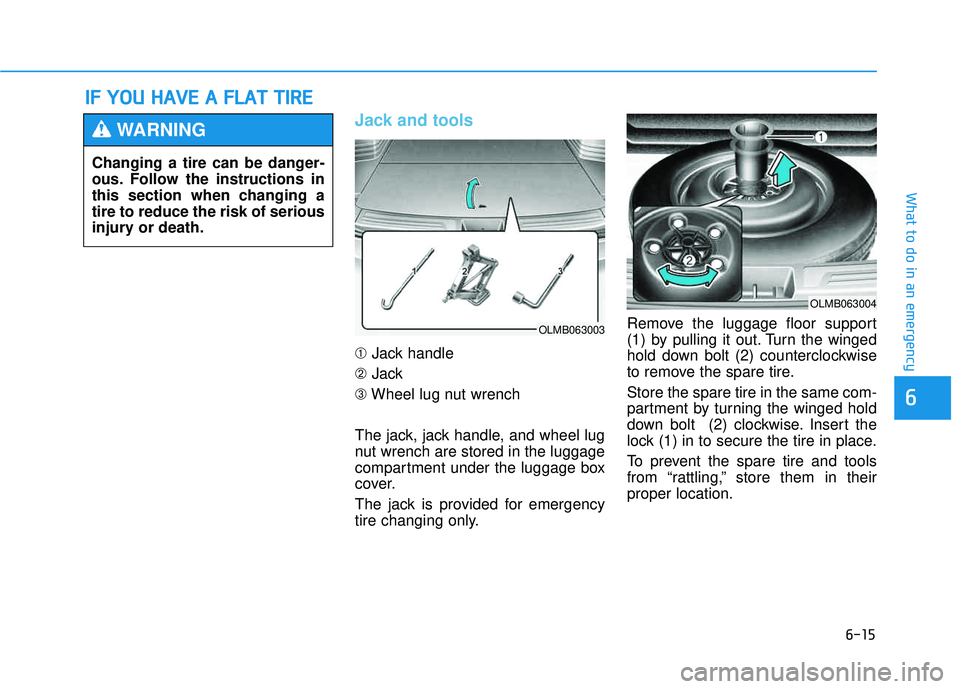
Jack and tools
➀Jack handle
➁ Jack
➂ Wheel lug nut wrench
The jack, jack handle, and wheel lug
nut wrench are stored in the luggage
compartment under the luggage box
cover.
The jack is provided for emergency
tire changing only. Remove the luggage floor support
(1) by pulling it out. Turn the winged
hold down bolt (2) counterclockwise
to remove the spare tire. Store the spare tire in the same com-
partment by turning the winged hold
down bolt (2) clockwise. Insert the
lock (1) in to secure the tire in place.
To prevent the spare tire and tools
from “rattling,” store them in theirproper location.
II
FF YY OO UU HH AAVVEE AA FF LLAA TT TT IIRR EE
Changing a tire can be danger-
ous. Follow the instructions in
this section when changing atire to reduce the risk of serious
injury or death.
WARNING
OLMB063003
OLMB063004
Page 534 of 653
6-18
What to do in an emergency
9.Loosen the lug nuts with the wheellug nut wrench and remove them
with your fingers. Remove the
wheel from the studs and lay it flat
on the ground out of the way.
Remove any dirt or debris from the
studs, mounting surfaces, andwheel.
10. Install the spare tire onto the studs of the hub.
11. Tighten the lug nuts with your fin- gers onto the studs with the
smaller end of the lug nuts clos-est to the wheel.
12. Lower the vehicle to the ground by turning the jack handle coun-
terclockwise. 13. Use the wheel lug nut wrench to
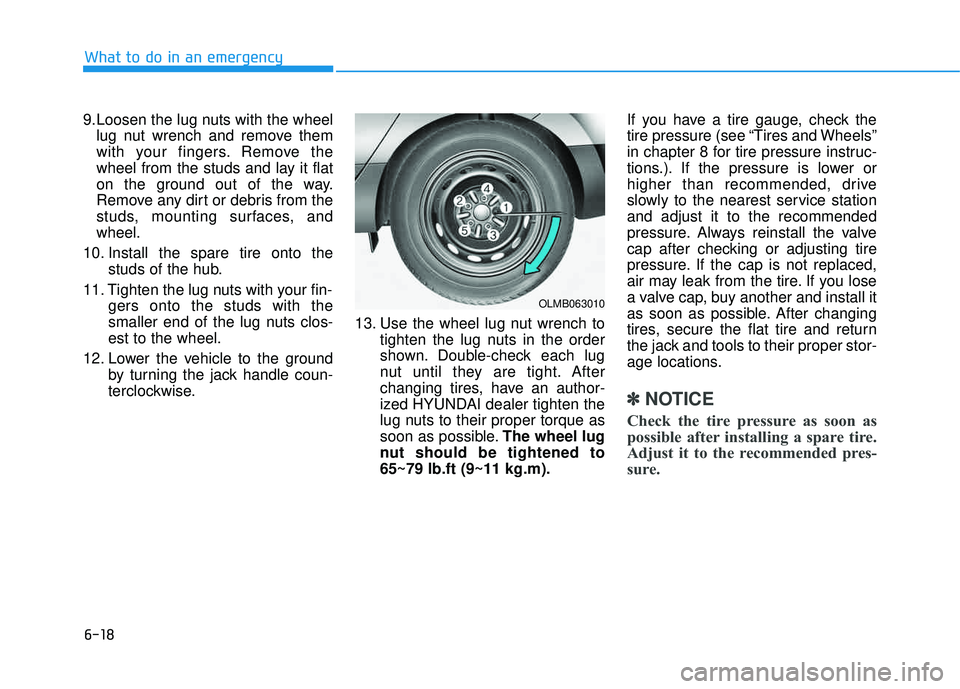
tighten the lug nuts in the order
shown. Double-check each lug
nut until they are tight. After
changing tires, have an author-
ized HYUNDAI dealer tighten the
lug nuts to their proper torque as
soon as possible. The wheel lug
nut should be tightened to65~79 lb.ft (9~11 kg.m). If you have a tire gauge, check the
tire pressure (see “Tires and Wheels”
in chapter 8 for tire pressure instruc-
tions.). If the pressure is lower or
higher than recommended, drive
slowly to the nearest service stationand adjust it to the recommended
pressure. Always reinstall the valve
cap after checking or adjusting tire
pressure. If the cap is not replaced,
air may leak from the tire. If you lose
a valve cap, buy another and install it
as soon as possible. After changing
tires, secure the flat tire and return
the jack and tools to their proper stor-
age locations.
✽✽
NOTICE
Check the tire pressure as soon as
possible after installing a spare tire.
Adjust it to the recommended pres-
sure.
OLMB063010
Page 535 of 653
6-19
What to do in an emergency
6If any of the equipment such as the
jack, lug nuts, studs, or other equip-ment is damaged or in poor condi-tion, do not attempt to change the
tire and call for assistance.
Use of compact spare tires
Compact spare tires are designed for
emergency use only. Drive carefullyon the compact spare tire and
always follow the safety precautions.When driving with the compact spare
tire mounted to your vehicle:
Check the tire pressure after
installing the compact spare tire. The compact spare tire should be
inflated to 60 psi (420 kPa).
Do not take this vehicle through an automatic car wash while the com-pact spare tire is installed.
Do not use the compact spare tire on any other vehicle because thistire has been designed especially
for your vehicle.
The compact spare tire’s tread life is shorter than a regular tire.
Inspect your compact spare tire
regularly and replace worn com-
pact spare tires with the same sizeand design, mounted on the samewheel.
Do not use more than one compact spare tire at a time.
Do not tow a trailer while the com- pact spare tire is installed.
Your vehicle has metric threads
on the studs and lug nuts. Make
certain during tire changing
that the same nuts that were
removed are reinstalled. If you
have to replace your lug nuts
make sure they have metric
threads to avoid damaging thestuds and ensure the wheel is
properly secured to the hub.
Consult an authorized
HYUNDAI dealer for assistance.CAUTION
To prevent compact spare tire
failure and loss of control pos-
sibly resulting in an accident:
Use the compact spare tire
only in an emergency.
NEVER operate your vehicle
over 50 mph (80 km/h).
Do not exceed the vehicle’s
maximum load rating or the
load carrying capacity shown
on the sidewall of the com-
pact spare tire.
Do not use the compact spare
tire continuously. Repair orreplace the original tire as
soon as possible to avoid fail-
ure of the compact spare tire.
WARNING
Page 539 of 653
6-23
What to do in an emergency
6
When towing your vehicle in an emergency without wheel dollies:
1.Place the ignition switch in theACC position.
2.Place the shift lever in N (Neutral).
3.Release the parking brake.
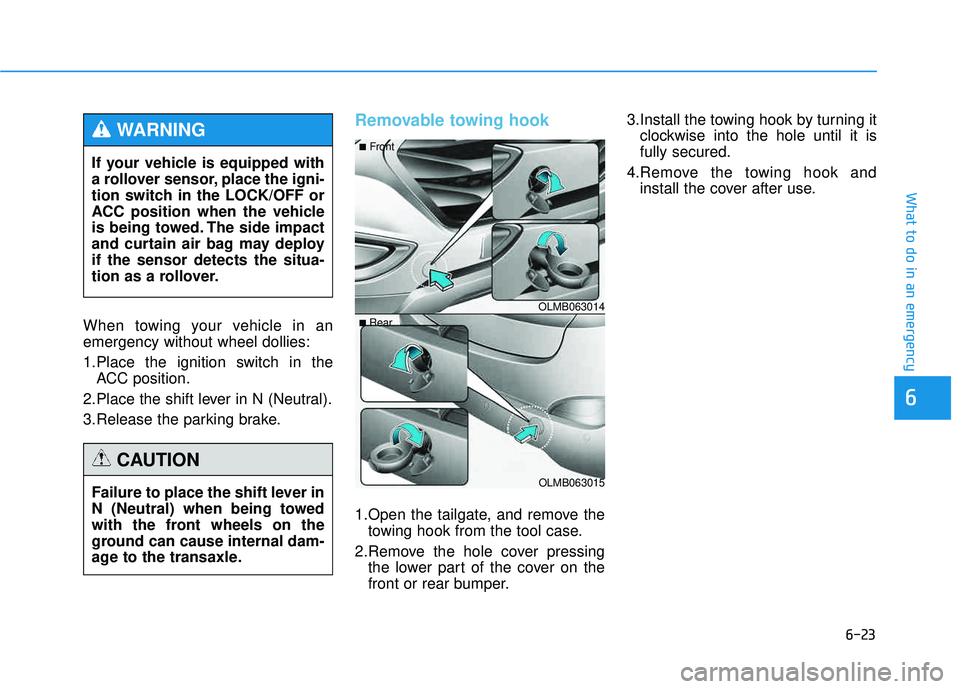
Removable towing hook
1.Open the tailgate, and remove the towing hook from the tool case.
2.Remove the hole cover pressing the lower part of the cover on the
front or rear bumper. 3.Install the towing hook by turning it
clockwise into the hole until it isfully secured.
4.Remove the towing hook and install the cover after use.
Failure to place the shift lever in
N (Neutral) when being towed
with the front wheels on the
ground can cause internal dam-
age to the transaxle.
CAUTION
OLMB063014
OLMB063015
■
Front
■ Rear
If your vehicle is equipped with
a rollover sensor, place the igni-
tion switch in the LOCK/OFF or
ACC position when the vehicle
is being towed. The side impact
and curtain air bag may deployif the sensor detects the situa-
tion as a rollover.
WARNING
Page 540 of 653
6-24
What to do in an emergency
Emergency towing
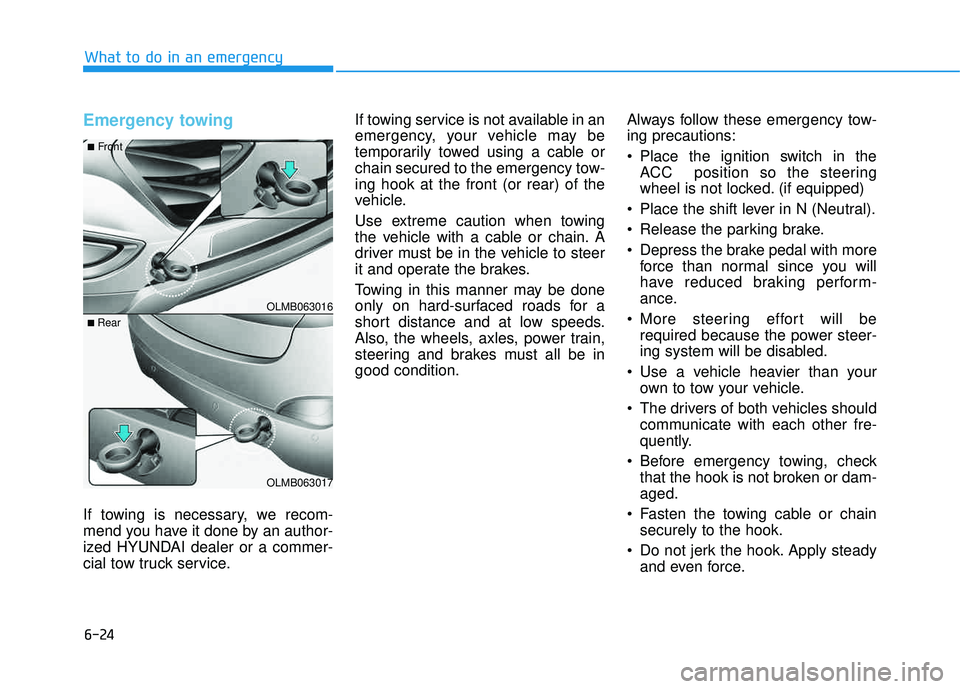
If towing is necessary, we recom-
mend you have it done by an author-
ized HYUNDAI dealer or a commer-
cial tow truck service.If towing service is not available in an
emergency, your vehicle may be
temporarily towed using a cable or
chain secured to the emergency tow-ing hook at the front (or rear) of the
vehicle.
Use extreme caution when towing
the vehicle with a cable or chain. A
driver must be in the vehicle to steer
it and operate the brakes.
Towing in this manner may be done
only on hard-surfaced roads for a
short distance and at low speeds.
Also, the wheels, axles, power train,
steering and brakes must all be ingood condition.
Always follow these emergency tow-ing precautions:
Place the ignition switch in the
ACC position so the steering
wheel is not locked. (if equipped)
Place the shift lever in N (Neutral).
Release the parking brake.
Depress the brake pedal with more force than normal since you will
have reduced braking perform-
ance.
More steering effort will be required because the power steer-
ing system will be disabled.
Use a vehicle heavier than your own to tow your vehicle.
The drivers of both vehicles should communicate with each other fre-
quently.
Before emergency towing, check that the hook is not broken or dam-aged.
Fasten the towing cable or chain securely to the hook.
Do not jerk the hook. Apply steady and even force.
OLMB063016
OLMB063017
■
Front
■ Rear
Page 576 of 653
7-35
7
Maintenance
PPAA RRKK IINN GG BB RRAA KKEE
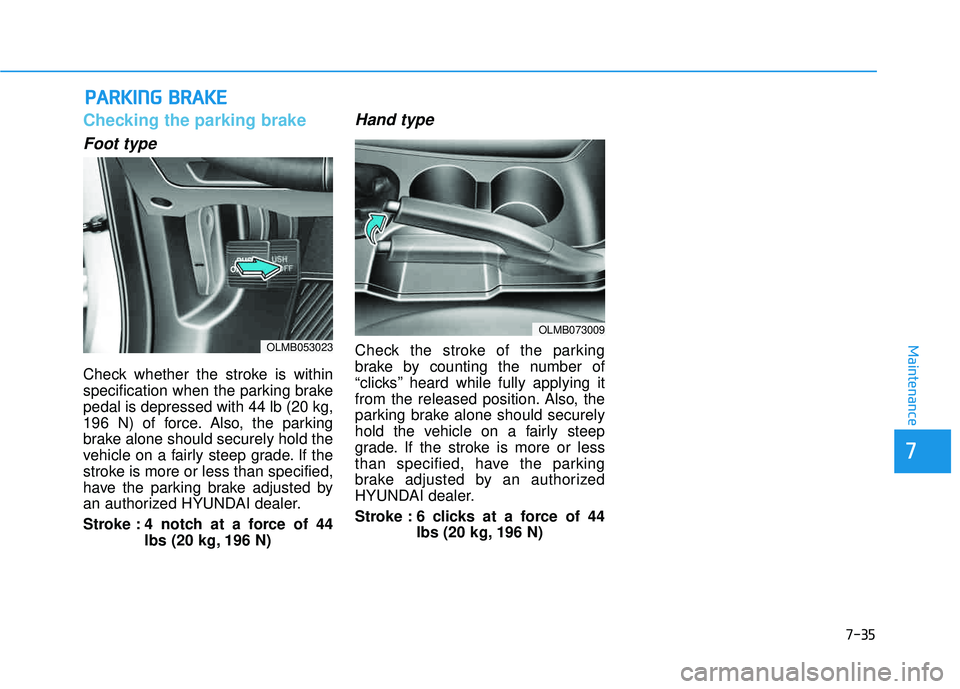
Checking the parking brake
Foot type
Check whether the stroke is within
specification when the parking brakepedal is depressed with 44 lb (20 kg,
196 N) of force. Also, the parking
brake alone should securely hold the
vehicle on a fairly steep grade. If the
stroke is more or less than specified,
have the parking brake adjusted by
an authorized HYUNDAI dealer.
Stroke : 4 notch at a force of 44
lbs (20 kg, 196 N)
Hand type
Check the stroke of the parking
brake by counting the number of
“clicks’’ heard while fully applying it
from the released position. Also, the
parking brake alone should securely
hold the vehicle on a fairly steep
grade. If the stroke is more or less
than specified, have the parking
brake adjusted by an authorized
HYUNDAI dealer.
Stroke : 6 clicks at a force of 44lbs (20 kg, 196 N)OLMB053023
OLMB073009
Page 585 of 653
7-44
Maintenance
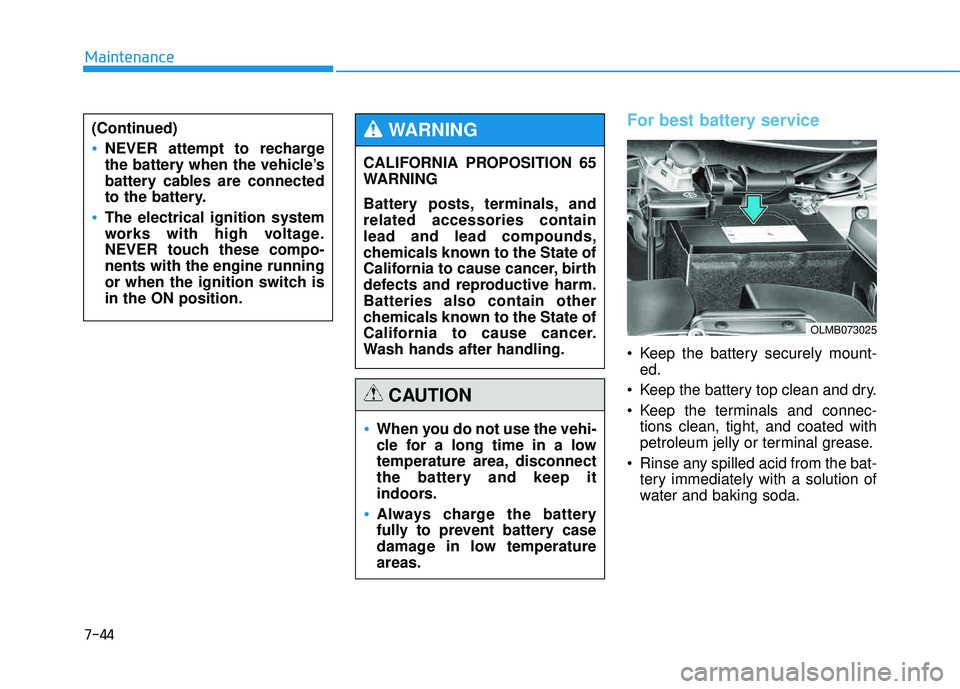
For best battery service
Keep the battery securely mount-ed.
Keep the battery top clean and dry.
Keep the terminals and connec- tions clean, tight, and coated with
petroleum jelly or terminal grease.
Rinse any spilled acid from the bat- tery immediately with a solution of
water and baking soda.
When you do not use the vehi-
cle for a long time in a low
temperature area, disconnect
the battery and keep it
indoors.
Always charge the battery
fully to prevent battery case
damage in low temperatureareas.
CAUTION
CALIFORNIA PROPOSITION 65
WARNING
Battery posts, terminals, and related accessories containlead and lead compounds,
chemicals known to the State of
California to cause cancer, birth
defects and reproductive harm.Batteries also contain other
chemicals known to the State of
California to cause cancer.
Wash hands after handling.
WARNING
OLMB073025
(Continued)
NEVER attempt to recharge
the battery when the vehicle’s
battery cables are connected
to the battery.
The electrical ignition system
works with high voltage.
NEVER touch these compo-nents with the engine running
or when the ignition switch isin the ON position.
Page 611 of 653
7-70
Maintenance
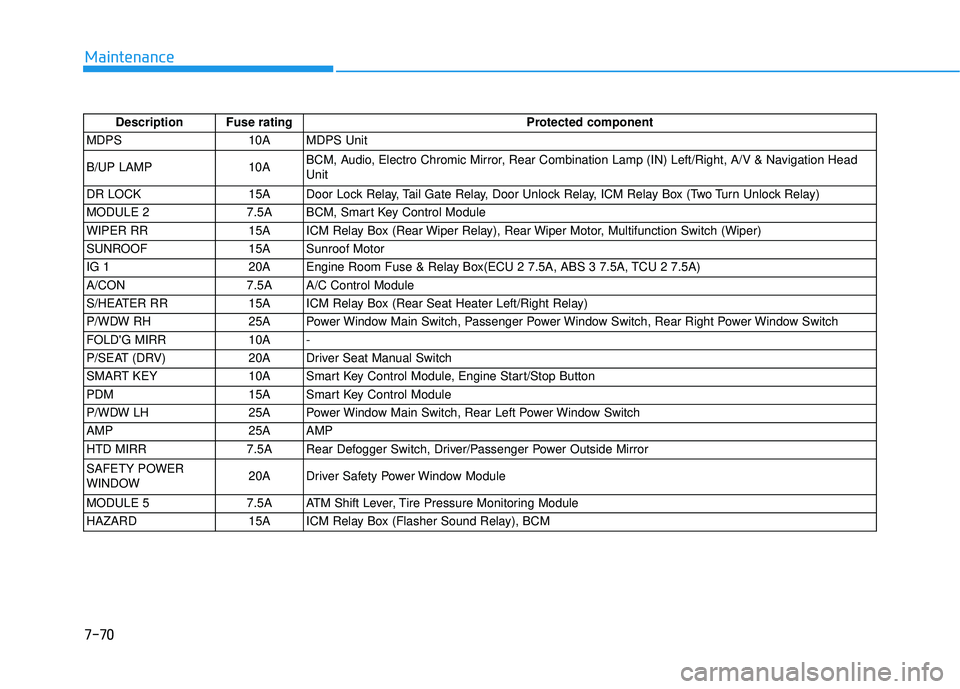
Description Fuse ratingProtected component
MDPS 10A MDPS Unit
B/UP LAMP 10A BCM, Audio, Electro Chromic Mirror, Rear Combination Lamp (IN) Left/Right, A/V & Navigation Head Unit
DR LOCK 15A Door Lock Relay, Tail Gate Relay, Door Unlock Relay, ICM Relay Box (Two Turn Unlock Relay)
MODULE 2 7.5A BCM, Smart Key Control Module
WIPER RR 15A ICM Relay Box (Rear Wiper Relay), Rear Wiper Motor, Multifunction Switch (Wiper)
SUNROOF 15A Sunroof Motor
IG 1 20A Engine Room Fuse & Relay Box(ECU 2 7.5A, ABS 3 7.5A, TCU 2 7.5A)
A/CON 7.5A A/C Control Module
S/HEATER RR 15A ICM Relay Box (Rear Seat Heater Left/Right Relay)
P/WDW RH 25A Power Window Main Switch, Passenger Power Window Switch, Rear Right Power Window Switch
FOLD'G MIRR 10A -
P/SEAT (DRV) 20A Driver Seat Manual Switch
SMART KEY 10A Smart Key Control Module, Engine Start/Stop Button
PDM 15A Smart Key Control Module
P/WDW LH 25A Power Window Main Switch, Rear Left Power Window Switch
AMP 25A AMP
HTD MIRR 7.5A Rear Defogger Switch, Driver/Passenger Power Outside Mirror
SAFETY POWER
WINDOW 20A Driver Safety Power Window Module
MODULE 5 7.5A ATM Shift Lever, Tire Pressure Monitoring Module
HAZARD 15A ICM Relay Box (Flasher Sound Relay), BCM
Page 613 of 653
7-72
Maintenance
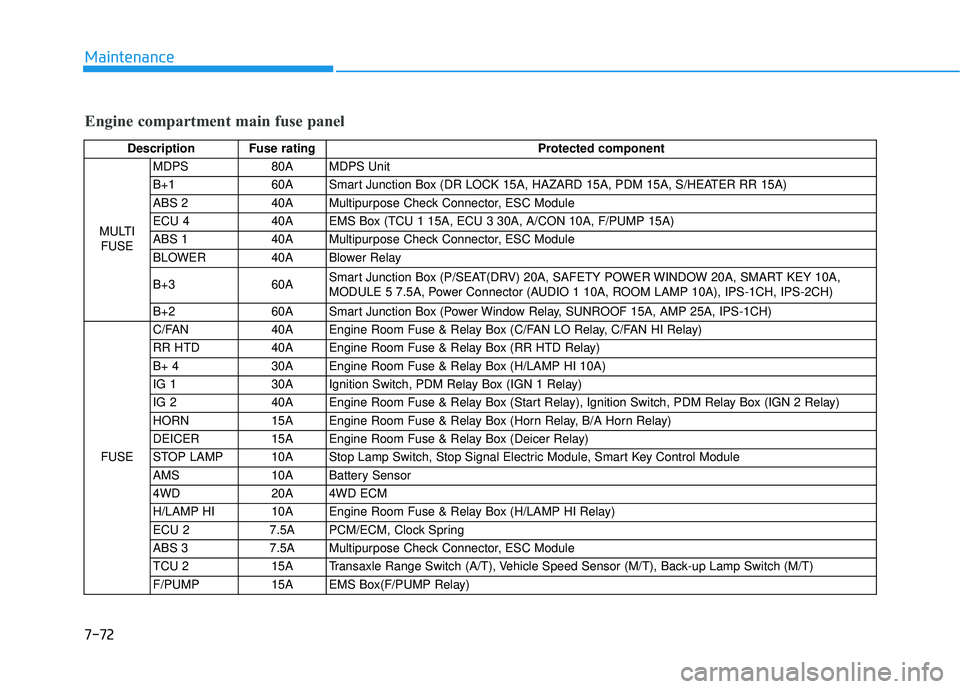
Engine compartment main fuse panel
Description Fuse ratingProtected component
MULTI FUSE MDPS 80A MDPS Unit
B+1 60A Smart Junction Box (DR LOCK 15A, HAZARD 15A, PDM 15A, S/HEATER RR 15A)
ABS 2 40A Multipurpose Check Connector, ESC Module
ECU 4 40A EMS Box (TCU 1 15A, ECU 3 30A, A/CON 10A, F/PUMP 15A)
ABS 1 40A Multipurpose Check Connector, ESC Module
BLOWER 40A Blower Relay
B+3 60A
Smart Junction Box (P/SEAT(DRV) 20A, SAFETY POWER WINDOW 20A, SMART KEY 10A,
MODULE 5 7.5A, Power Connector (AUDIO 1 10A, ROOM LAMP 10A), IPS-1CH, IPS-2CH)
B+2 60A Smart Junction Box (Power Window Relay, SUNROOF 15A, AMP 25A, IPS-1CH)
FUSE C/FAN 40A Engine Room Fuse & Relay Box (C/FAN LO Relay, C/FAN HI Relay)
RR HTD 40A Engine Room Fuse & Relay Box (RR HTD Relay)
B+ 4 30A Engine Room Fuse & Relay Box (H/LAMP HI 10A)
IG 1 30A Ignition Switch, PDM Relay Box (IGN 1 Relay)
IG 2 40A Engine Room Fuse & Relay Box (Start Relay), Ignition Switch, PDM Relay Box (IGN 2 Relay)
HORN 15A Engine Room Fuse & Relay Box (Horn Relay, B/A Horn Relay)
DEICER 15A Engine Room Fuse & Relay Box (Deicer Relay)
STOP LAMP 10A Stop Lamp Switch, Stop Signal Electric Module, Smart Key Control Module
AMS 10A Battery Sensor
4WD 20A 4WD ECM
H/LAMP HI 10A Engine Room Fuse & Relay Box (H/LAMP HI Relay)
ECU 2 7.5A PCM/ECM, Clock Spring
ABS 3 7.5A Multipurpose Check Connector, ESC Module
TCU 2 15A Transaxle Range Switch (A/T), Vehicle Speed Sensor (M/T), Back-up Lamp Switch (M/T)
F/PUMP 15A EMS Box(F/PUMP Relay)
Page 614 of 653
7-73
7
Maintenance
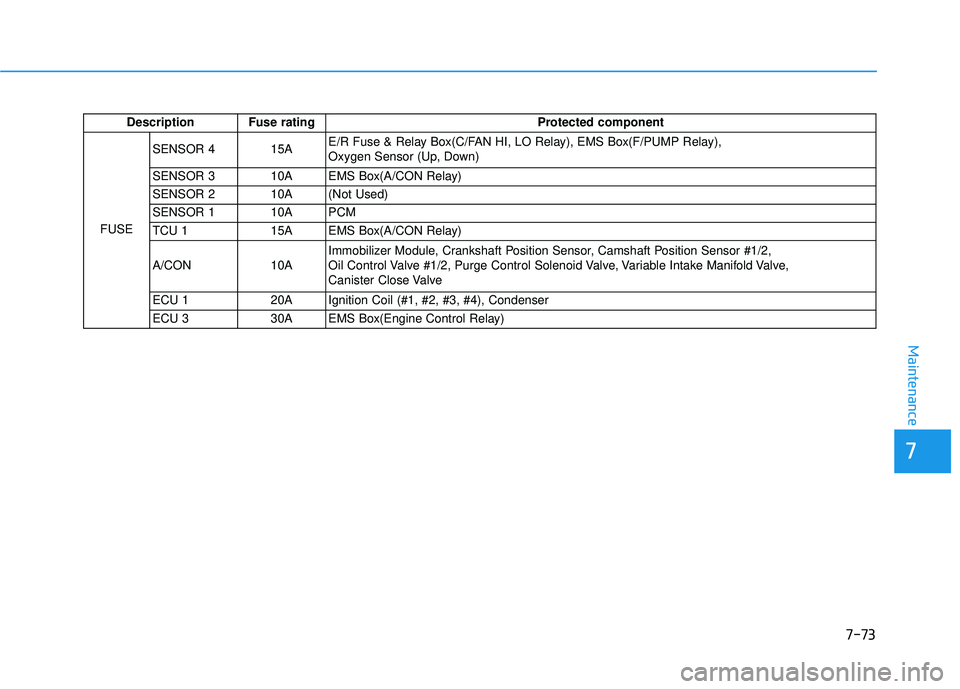
Description Fuse ratingProtected component
FUSE SENSOR 4 15A
E/R Fuse & Relay Box(C/FAN HI, LO Relay), EMS Box(F/PUMP Relay),
Oxygen Sensor (Up, Down)
SENSOR 3 10A EMS Box(A/CON Relay)
SENSOR 2 10A (Not Used)
SENSOR 1 10A PCM
TCU 1 15A EMS Box(A/CON Relay)
A/CON 10A Immobilizer Module, Crankshaft Position Sensor, Camshaft Position Sensor #1/2,
Oil Control Valve #1/2, Purge Control Solenoid Valve, Variable Intake Manifold Valve,
Canister Close Valve
ECU 1 20A Ignition Coil (#1, #2, #3, #4), Condenser
ECU 3 30A EMS Box(Engine Control Relay)