warm up HYUNDAI TUCSON 2016 Owner's Manual
[x] Cancel search | Manufacturer: HYUNDAI, Model Year: 2016, Model line: TUCSON, Model: HYUNDAI TUCSON 2016Pages: 642, PDF Size: 9.78 MB
Page 607 of 642
7-94
Maintenance
AAPPPPEEAA RRAA NN CCEE CC AA RREE
Exterior Care
Exterior general caution
It is very important to follow the label
directions when using any chemical
cleaner or polish. Read all warningand caution statements that appearon the label.
High-pressure washing
When using high-pressure wash-
ers, make sure to maintain suffi-
cient distance from the vehicle.
Insufficient clearance or excessivepressure can lead to component
damage or water penetration.
Do not spray the camera, sensors or its surrounding area directly with
a high pressure washer. Shock
applied from high pressure water
may cause the device to not oper-
ate normally.
Do not bring the nozzle tip close to boots (rubber or plastic covers)or
connectors as they may be dam-
aged if they come into contact with
high pressure water.
Protecting your vehicle’s finish
Washing
To help protect your vehicle’s finish
from rust and deterioration, wash itthoroughly and frequently at least
once a month with lukewarm or cold
water.
If you use your vehicle for off-road
driving, you should wash it after each
off-road trip. Pay special attention to
the removal of any accumulation of
salt, dirt, mud, and other foreign
materials. Make sure the drain holes
in the lower edges of the doors and
rocker panels are kept clear andclean.
Insects, tar, tree sap, bird droppings,
industrial pollution and similar
deposits can damage your vehicle’s
finish if not removed immediately.
Even prompt washing with plain
water may not completely remove all
these deposits. A mild soap, safe for
use on painted surfaces, should beused. After washing, rinse the vehicle thor-
oughly with lukewarm or cold water.
Do not allow soap to dry on the fin-ish.
After washing the vehicle, test
the brakes while driving slowly
to see if they have been affected
by water before getting on the
road. If braking performance is
impaired, dry the brakes by
applying them lightly while
maintaining a slow forwardspeed.
WARNING
Page 608 of 642
7-95
7
Maintenance
Waxing
A good coat of wax provides a barri-
er between your paint and environ-mental contamination.
Keeping a good coat of wax on your
vehicle will help protect it.
Wax the vehicle when water will no longer bead on the paint.
Always wash and dry the vehicle
before waxing. Use a good quality
liquid or paste wax, and follow the
manufacturer’s instructions. Wax all
metal trim to protect it and to main-
tain its luster.
Removing oil, tar, and similar materi-
als with a spot remover will usually
strip the wax from the finish. Be sure
to re-wax these areas even if the rest
of the vehicle does not yet need wax-ing.
OLMB073082
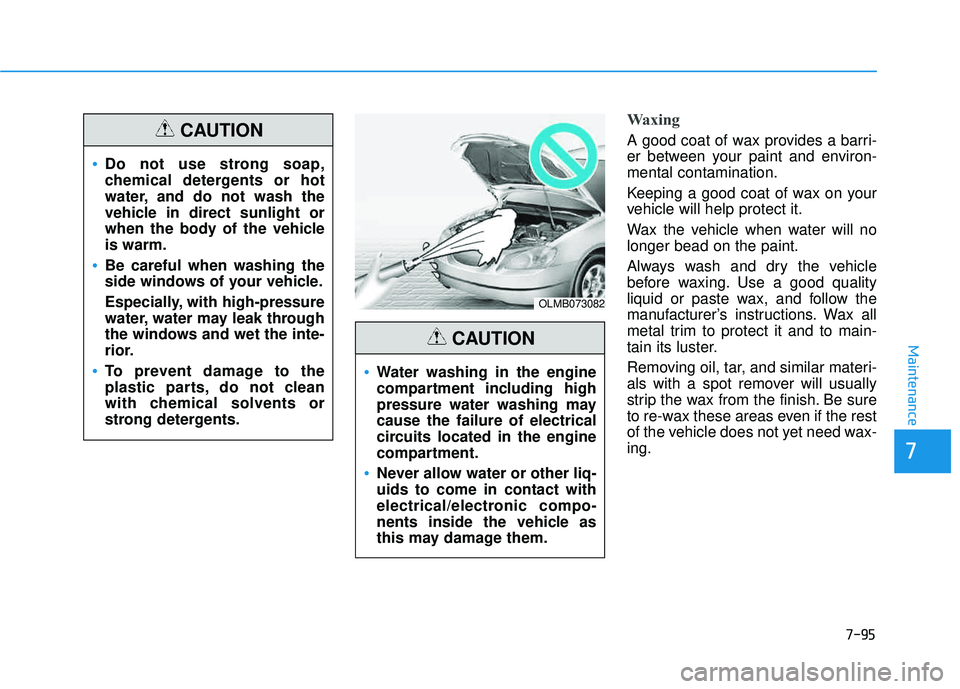
Water washing in the engine
compartment including high
pressure water washing maycause the failure of electrical
circuits located in the engine
compartment.
Never allow water or other liq- uids to come in contact with
electrical/electronic compo-
nents inside the vehicle as
this may damage them.
CAUTION
Do not use strong soap,
chemical detergents or hot
water, and do not wash the
vehicle in direct sunlight or
when the body of the vehicleis warm.
Be careful when washing the
side windows of your vehicle.
Especially, with high-pressure
water, water may leak through
the windows and wet the inte-
rior.
To prevent damage to the
plastic parts, do not clean
with chemical solvents or
strong detergents.
CAUTION
Page 610 of 642
7-97
7
Maintenance
Thoroughly flush the vehicle under-
body and wheel openings with luke-
warm or cold water once a month,
after off-road driving and at the end
of each winter. Pay special attentionto these areas because it is difficult
to see all the mud and dirt. It will do
more harm than good to wet down
the road grime without removing it.
The lower edges of doors, rocker
panels, and frame members have
drain holes that should not be
allowed to clog with dirt; trapped
water in these areas can cause rust-ing.Aluminum wheel maintenance
The aluminum wheels are coated
with a clear protective finish.
Corrosion protection
Protecting your vehicle from corro-
sion
By using the most advanced design
and construction practices to combat
corrosion, HYUNDAI produces cars
of the highest quality. However, this is
only part of the job. To achieve the
long-term corrosion resistance your
vehicle can deliver, the owner’s
cooperation and assistance is alsorequired.
Common causes of corrosion
The most common causes of corro-
sion on your vehicle are:
Road salt, dirt and moisture that isallowed to accumulate underneath
the vehicle.
coatings by stones, gravel, abra-
sion or minor scrapes and dents
which leave unprotected metal
exposed to corrosion.
After washing the vehicle, test
the brakes while driving slowly
to see if they have been affected
by water. If braking performance
is impaired, dry the brakes by
applying them lightly while
maintaining a slow forwardspeed.
WARNING
Do not use abrasive cleaner,
polishing compound, solvent,
or wire brushes on aluminumwheels.
Clean the wheel when it has cooled.
Use only a mild soap or neu-
tral detergent, and rinse thor-
oughly with water. Also, cleanthe wheels after driving on
salted roads.
Do not wash the wheels with high-speed car wash brushes.
Do not use any cleaners con- taining acid or alkaline deter-
gents.
CAUTION
Page 615 of 642
7-102
Maintenance
Canister
Fuel vapors generated inside the fuel tank are absorbed and stored in the
onboard canister. When the engine is
running, the fuel vapors absorbed in
the canister are drawn into the surgetank through the purge control sole-
noid valve.
Purge Control Solenoid Valve(PCSV)
The purge control solenoid valve is
controlled by the Engine Control
Module (ECM); when the engine
coolant temperature is low during
idling, the PCSV closes so that evap-
orated fuel is not taken into the
engine. After the engine warms-up
during ordinary driving, the PCSV
opens to introduce evaporated fuel to
the engine.
3. Exhaust Emission Control System
The Exhaust Emission Control
System is a highly effective system
which controls exhaust emissions
while maintaining good vehicle per-
formance.
When the engine starts or fails to
start, excessive attempts to restart
the engine may cause damage to theemission system.
Vehicle modifications
This vehicle should not be modi-fied. Modification of your vehicle
could affect its performance, safety
or durability and may even violate
governmental safety and emis-
sions regulations.
In addition, damage or performance
problems resulting from any modifi-
cation may not be covered under
warranty.
If you use unauthorized electronic devices, it may cause the vehicle to
operate abnormally, wire damage,
battery discharge and fire. For your
safety, do not use unauthorized
electronic devices.
Engine exhaust (carbon monox-
ide) precautions
Carbon monoxide can be present with other exhaust fumes. If you
smell exhaust fumes of any kind in
your vehicle, drive with all the win-
dows fully open. Have your vehicle
checked and repaired immediately.
Engine exhaust gases contain
carbon monoxide (CO). Though
colorless and odorless, it is
dangerous and could be lethal if
inhaled. Follow the instructions
on this page to avoid CO poi-soning.
WARNING
Page 640 of 642
I-9
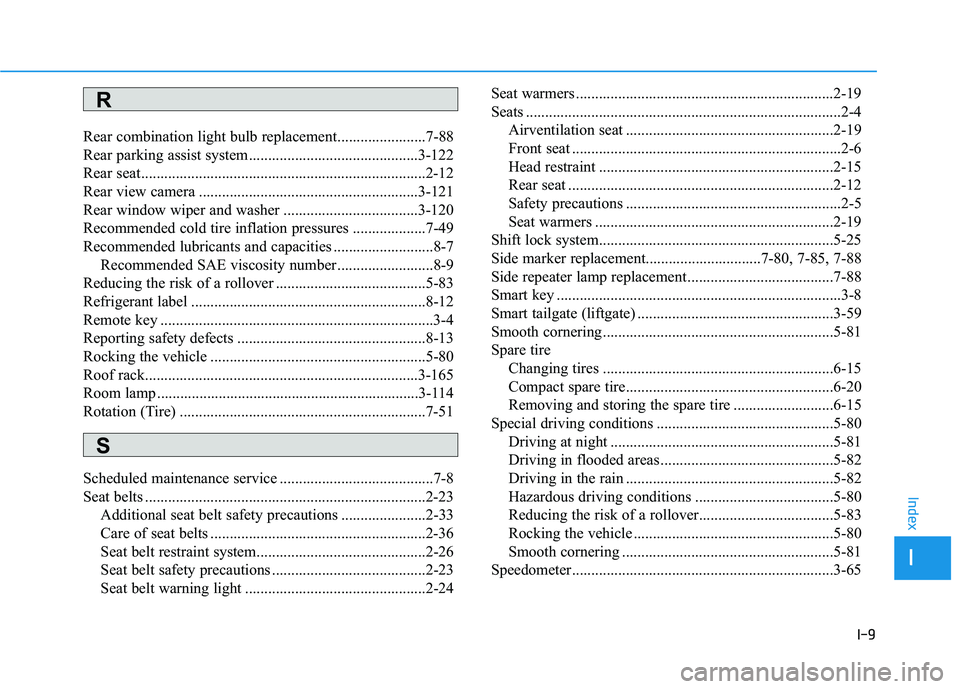
Rear combination light bulb replacement.......................7-88
Rear parking assist system............................................3-122
Rear seat..........................................................................2-12
Rear view camera .........................................................3-121
Rear window wiper and washer ...................................3-120
Recommended cold tire inflation pressures ...................7-49
Recommended lubricants and capacities ..........................8-7Recommended SAE viscosity number .........................8-9
Reducing the risk of a rollover .......................................5-83
Refrigerant label .............................................................8-12
Remote key .......................................................................3-4
Reporting safety defects .................................................8-13
Rocking the vehicle ........................................................5-80
Roof rack.......................................................................3-165
Room lamp ....................................................................3-114
Rotation (Tire) ................................................................7-51
Scheduled maintenance service ........................................7-8
Seat belts .........................................................................2-23
Additional seat belt safety precautions ......................2-33
Care of seat belts ........................................................2-36
Seat belt restraint system............................................2-26
Seat belt safety precautions ........................................2-23
Seat belt warning light ...............................................2-24 Seat warmers ...................................................................2-19
Seats ..................................................................................2-4
Airventilation seat ......................................................2-19
Front seat ......................................................................2-6
Head restraint .............................................................2-15
Rear seat .....................................................................2-12
Safety precautions ........................................................2-5
Seat warmers ..............................................................2-19
Shift lock system.............................................................5-25
Side marker replacement..............................7-80, 7-85, 7-88
Side repeater lamp replacement ......................................7-88
Smart key ..........................................................................3-8
Smart tailgate (liftgate) ...................................................3-59
Smooth cornering............................................................5-81
Spare tire Changing tires ............................................................6-15
Compact spare tire......................................................6-20
Removing and storing the spare tire ..........................6-15
Special driving conditions ..............................................5-80
Driving at night ..........................................................5-81
Driving in flooded areas .............................................5-82
Driving in the rain ......................................................5-82
Hazardous driving conditions ....................................5-80
Reducing the risk of a rollover...................................5-83
Rocking the vehicle ....................................................5-80
Smooth cornering .......................................................5-81
Speedometer....................................................................3-65
I
Index
R
S