tow Hyundai Tucson 2019 - RHD (UK, Australia) Repair Manual
[x] Cancel search | Manufacturer: HYUNDAI, Model Year: 2019, Model line: Tucson, Model: Hyundai Tucson 2019Pages: 685, PDF Size: 17.76 MB
Page 546 of 685
6-43
What to do in an emergency
6
When towing your vehicle in an
emergency without wheel dollies:
1. Place the ignition switch in theACC position.
2. Place the shift lever in N (Neutral).
3. Release the parking brake.
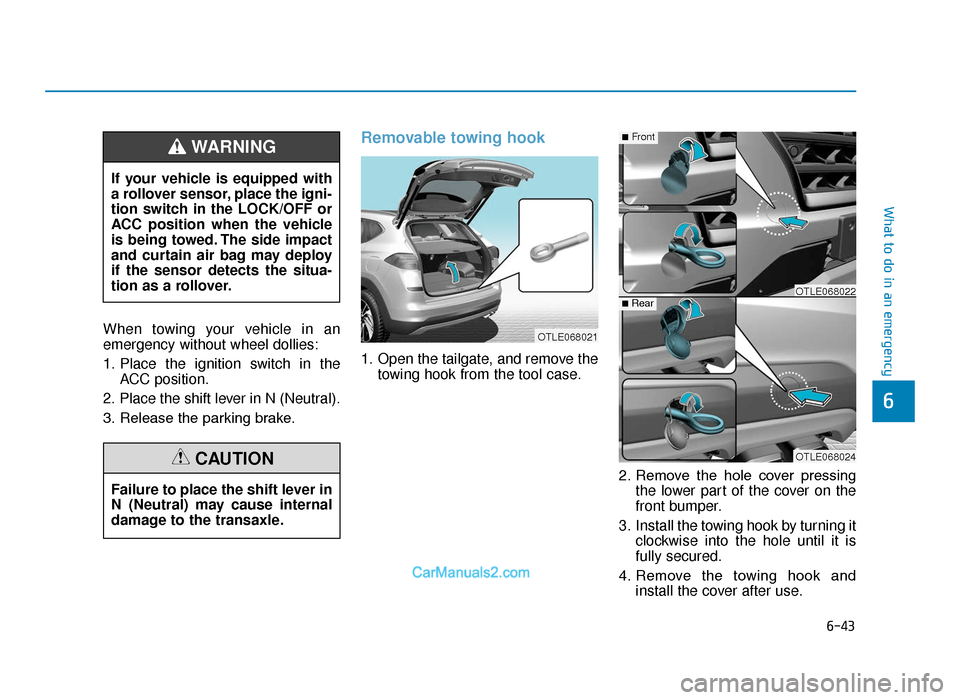
Removable towing hook
1. Open the tailgate, and remove the towing hook from the tool case.
2. Remove the hole cover pressingthe lower part of the cover on the
front bumper.
3. Install the towing hook by turning it clockwise into the hole until it is
fully secured.
4. Remove the towing hook and install the cover after use.
Failure to place the shift lever in
N (Neutral) may cause internal
damage to the transaxle.
CAUTION
OTLE068021
OTLE068022
OTLE068024
■Front
■Rear
If your vehicle is equipped with
a rollover sensor, place the igni-
tion switch in the LOCK/OFF or
ACC position when the vehicle
is being towed. The side impact
and curtain air bag may deploy
if the sensor detects the situa-
tion as a rollover.
WARNING
TLe UK 6.qxp 5/10/2018 1:22 PM Page 43
Page 547 of 685
6-44
What to do in an emergency
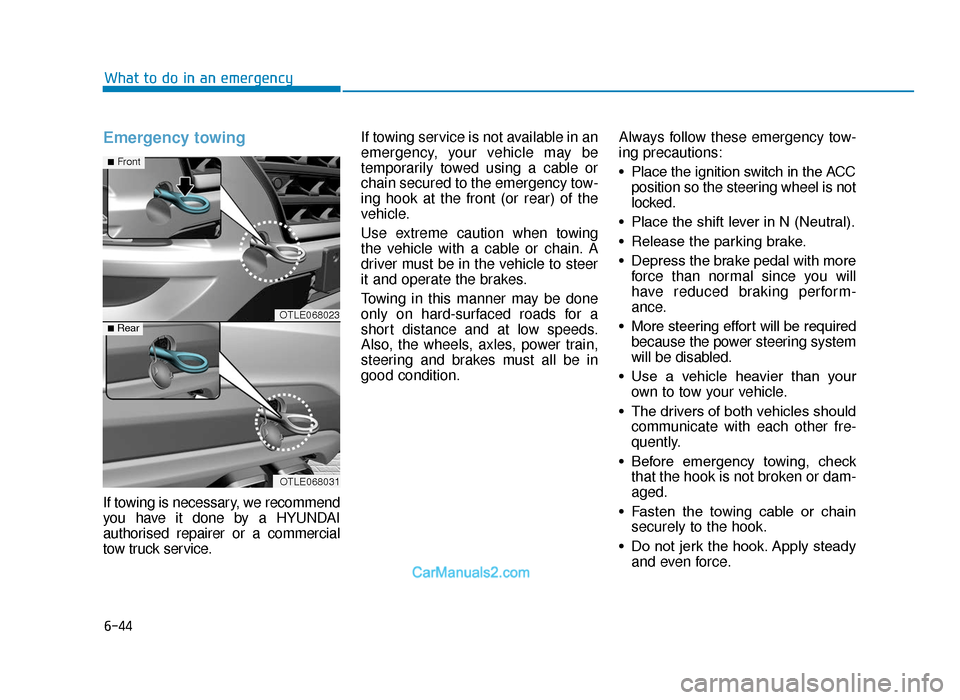
Emergency towing
If towing is necessary, we recommend
you have it done by a HYUNDAI
authorised repairer or a commercial
tow truck service.If towing service is not available in an
emergency, your vehicle may be
temporarily towed using a cable or
chain secured to the emergency tow-
ing hook at the front (or rear) of the
vehicle.
Use extreme caution when towing
the vehicle with a cable or chain. A
driver must be in the vehicle to steer
it and operate the brakes.
Towing in this manner may be done
only on hard-surfaced roads for a
short distance and at low speeds.
Also, the wheels, axles, power train,
steering and brakes must all be in
good condition.
Always follow these emergency tow-
ing precautions:
• Place the ignition switch in the ACC
position so the steering wheel is not
locked.
• Place the shift lever in N (Neutral).
• Release the parking brake.
• Depress the brake pedal with more force than normal since you will
have reduced braking perform-
ance.
• More steering effort will be required because the power steering system
will be disabled.
• Use a vehicle heavier than your own to tow your vehicle.
• The drivers of both vehicles should communicate with each other fre-
quently.
• Before emergency towing, check that the hook is not broken or dam-
aged.
• Fasten the towing cable or chain securely to the hook.
• Do not jerk the hook. Apply steady and even force.
OTLE068023
OTLE068031
■Front
■Rear
TLe UK 6.qxp 5/10/2018 1:22 PM Page 44
Page 548 of 685
6-45
What to do in an emergency
6
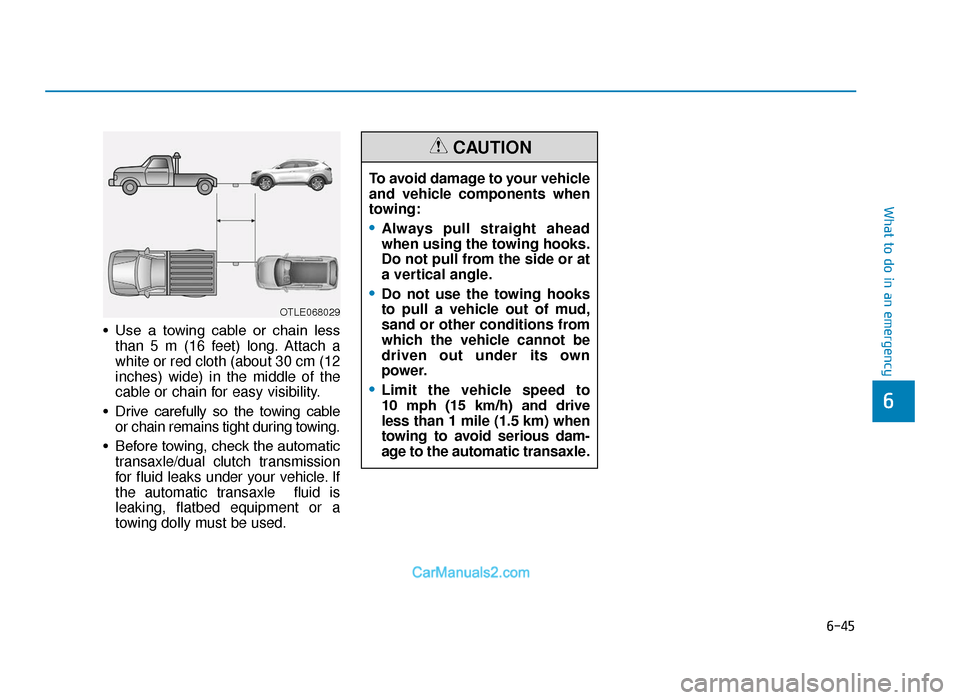
• Use a towing cable or chain lessthan 5 m (16 feet) long. Attach a
white or red cloth (about 30 cm (12
inches) wide) in the middle of the
cable or chain for easy visibility.
• Drive carefully so the towing cable or chain remains tight during towing.
• Before towing, check the automatic transaxle/dual clutch transmission
for fluid leaks under your vehicle. If
the automatic transaxle fluid is
leaking, flatbed equipment or a
towing dolly must be used. To avoid damage to your vehicle
and vehicle components when
towing:
•Always pull straight ahead
when using the towing hooks.
Do not pull from the side or at
a vertical angle.
•Do not use the towing hooks
to pull a vehicle out of mud,
sand or other conditions from
which the vehicle cannot be
driven out under its own
power.
•Limit the vehicle speed to
10 mph (15 km/h) and drive
less than 1 mile (1.5 km) when
towing to avoid serious dam-
age to the automatic transaxle.
CAUTION
OTLE068029
TLe UK 6.qxp 5/10/2018 1:22 PM Page 45
Page 549 of 685
6-46
What to do in an emergency
Your vehicle is equipped with emer-
gency commodities to help you
respond to emergency situation.
Fire extinguisher
If there is small fire and you know how
to use the fire extinguisher, follow
these steps carefully.
1. Pull out the safety pin at the top of the extinguisher that keeps the han-
dle from being accidentally pressed.
2. Aim the nozzle towards the base of the fire.
3. Stand approximately 2.5 m (8 ft) away from the fire and squeeze
the handle to discharge the extin-
guisher. If you release the handle,
the discharge will stop.
4. Sweep the nozzle back and forth at the base of the fire. After the fire
appears to be out, watch carefully
since it may re-ignite.
First aid kit
Supplies for use in giving first aid
such as scissors, bandage and
adhesive tape, etc. are provided.
Triangle reflector
Place the triangle reflector on the
road to warn oncoming vehicles dur-
ing emergencies, such as when the
vehicle is parked by the roadside due
to problems.
Tyre pressure gauge
(if equipped)
Tyres normally lose some air in day-
to-day use, and you may have to add
a air periodically and usually it is not
a sign of a leaking tyre, but of normal
wear. Always check tyre pressure
when the tyres are cold because tyre
pressure increases with temperature. To check the tyre pressure, take the
following steps:
1. Unscrew the inflation valve cap
that is located on the rim of the
tyre.
2. Press and hold the gauge against the tyre valve. Some air will leak as
you begin and more will leak if you
don't press the gauge in firmly.
3. A firm non-leaking push will acti- vate the gauge.
4. Read the tyre pressure on the gauge to see whether the tyre pres-
sure is low or high.
5. Adjust the tyre pressure to the specified pressure. Refer to “Tyres
and Wheels” in chapter 8.
6. Reinstall the inflation valve cap.
EMERGENCY COMMODITY (IF EQUIPPED)
TLe UK 6.qxp 5/10/2018 1:22 PM Page 46
Page 560 of 685
7-11
7
Maintenance
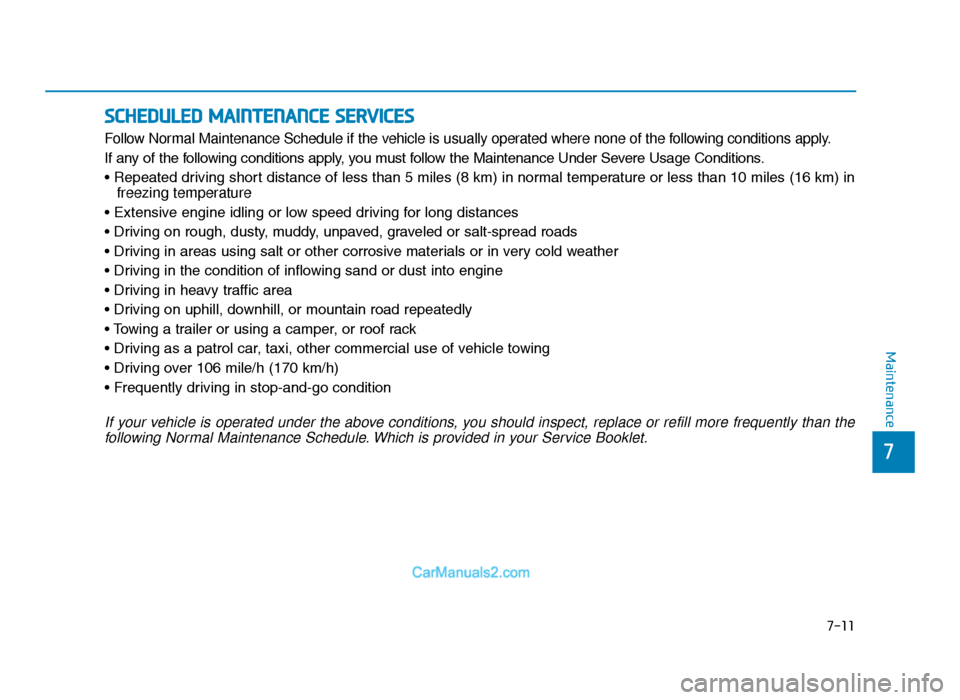
SCHEDULED MAINTENANCE SERVICES
Follow Normal Maintenance Schedule if the vehicle is usually operated where none of the following conditions apply.
If any of the following conditions apply, you must follow the Maintenance Under Severe Usage Conditions.
• Repeated driving short distance of less than 5 miles (8 km) in normal temperature or less than 10 miles (16 km) infreezing temperature
• Extensive engine idling or low speed driving for long distances
• Driving on rough, dusty, muddy, unpaved, graveled or salt-spread roads
• Driving in areas using salt or other corrosive materials or in very cold weather
• Driving in the condition of inflowing sand or dust into engine
• Driving in heavy traffic area
• Driving on uphill, downhill, or mountain road repeatedly
• Towing a trailer or using a camper, or roof rack
• Driving as a patrol car, taxi, other commercial use of vehicle towing
• Driving over 106 mile/h (170 km/h)
• Frequently driving in stop-and-go condition
If your vehicle is operated under the above conditions, you should inspect, replace or refill more frequently than the following Normal Maintenance Schedule. Which is provided in your Service Booklet.
TLe UK 7.qxp 5/10/2018 1:32 PM Page 11
Page 570 of 685
7-21
7
Maintenance
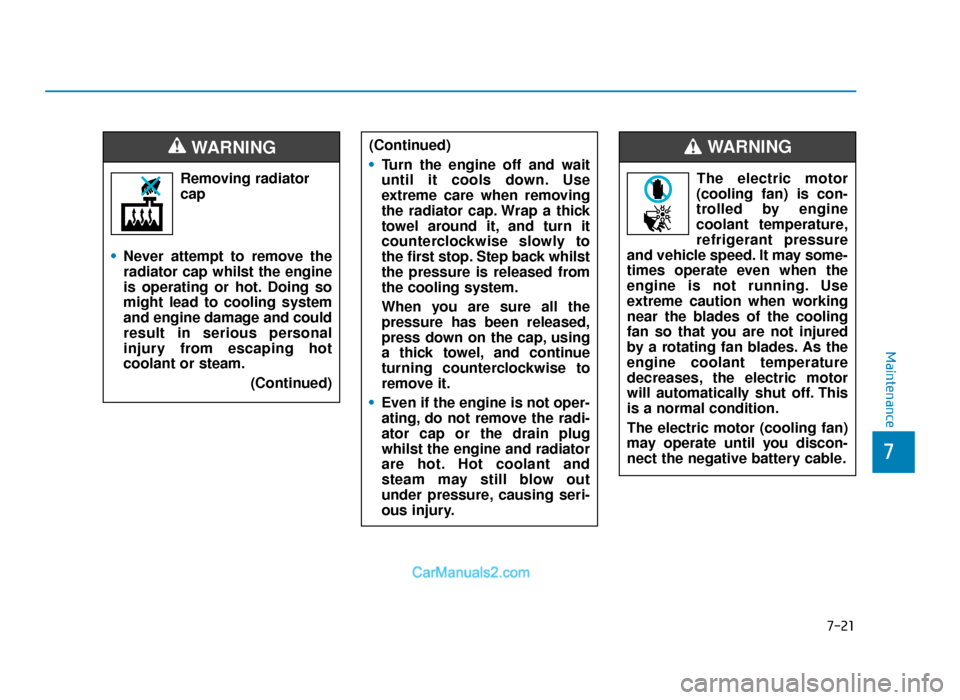
Removing radiatorcap
• Never attempt to remove the
radiator cap whilst the engine
is operating or hot. Doing so
might lead to cooling system
and engine damage and could
result in serious personal
injury from escaping hot
coolant or steam.
(Continued)
WARNING (Continued)
•Turn the engine off and wait
until it cools down. Use
extreme care when removing
the radiator cap. Wrap a thick
towel around it, and turn it
counterclockwise slowly to
the first stop. Step back whilst
the pressure is released from
the cooling system.
When you are sure all the
pressure has been released,
press down on the cap, using
a thick towel, and continue
turning counterclockwise to
remove it.
• Even if the engine is not oper-
ating, do not remove the radi-
ator cap or the drain plug
whilst the engine and radiator
are hot. Hot coolant and
steam may still blow out
under pressure, causing seri-
ous injury.
The electric motor
(cooling fan) is con-
trolled by engine
coolant temperature,
refrigerant pressure
and vehicle speed. It may some-
times operate even when the
engine is not running. Use
extreme caution when working
near the blades of the cooling
fan so that you are not injured
by a rotating fan blades. As the
engine coolant temperature
decreases, the electric motor
will automatically shut off. This
is a normal condition.
The electric motor (cooling fan)
may operate until you discon-
nect the negative battery cable.
WARNING
TLe UK 7.qxp 5/10/2018 1:33 PM Page 21
Page 678 of 685
I-5
Emergency Stop Signal (ESS) ......................................5-66
Emergency whilst driving...............................................6-2If the engine stalls at a crossroad or crossing ............6-3
If the engine stalls whilst driving ................................6-2
If you have a flat tyre whilst driving ..........................6-3
Emergency towing .......................................................6-44
Emission control system ...............................................7-92 Adding the urea solution .........................................7-102
Clearing the vehicle-restarting restriction ...............7-101
Crankcase emission control system ...........................7-92
Evaporative emission control system ........................7-92
Exhaust emission control system...............................7-93
Low urea warning message .......................................7-99
Malfunction with the SCR system...........................7-100
Selective catalytic reduction ......................................7-98
Storing the urea solution ..........................................7-105
Urea gauge .................................................................7-98
Urea solution purity .................................................7-105
Engine ........................................................................\
.....8-2
Engine compartment ...............................................1-6, 7-3
Engine coolant ..............................................................7-20
Engine number..............................................................8-15 Engine oil......................................................................7-\
15
Checking the engine oil and filter .............................7-18
Checking the engine oil level (Diesel Engine) ..........7-17
Checking the engine oil level (Petrol Engine) ..........7-15
Engine overheats.............................................................6-8
Engine start/Stop button ...............................................5-11
Engine will not start .......................................................6-4 If the engine doesn't turn over or turns over slowly....6-4
If the engine turns over normally but doesn't start ......6-4
Evaporative emission control system ...........................7-92
Exhaust emission control system .................................7-93
Explanation of scheduled maintenance items ..............7-12
Exterior care .................................................................7-83
Exterior features ...........................................................3-42 Bonnet ........................................................................\
3-42
Fuel filler door ...........................................................3-44
Exterior features .........................................................3-183 Roof rack .................................................................3-183
Exterior overview ....................................................1-2, 1-3
I
Index
TLe UK Index.qxp 6/12/2018 3:27 PM Page 5
Page 683 of 685
I-10
IndexRecommended lubricants and capacities........................8-9 Recommended engine oil ..........................................8-12
Recommended sae viscosity number.........................8-12
Recommended sae viscosity number ...........................8-12
Refrigerant label ...........................................................8-16
Remote key .....................................................................3-4\
Removable towing hook ..............................................6-43
Roof rack ....................................................................3-18\
3
Scheduled maintenance services ..................................7-11
Seat belts ......................................................................2-\
24 Additional seat belt safety precautions ......................2-34
Care of seat belts .......................................................2-37
Seat belt restraint system ...........................................2-28
Seat belt safety precautions .......................................2-24
Seat belt warning light ...............................................2-25
Seat warmers and air ventilation seats .........................2-20
Seats ........................................................................\
........2-4 Front seats ....................................................................2-6
Head restraint ............................................................2-15
Rear seats ...................................................................2-12
Safety precautions........................................................2-5
Seat warmers and air ventilation seats ......................2-20
Selective catalytic reduction .........................................7-98
Sliding armrest............................................................3-168 Smart cruise control (SCC) with stop & go system ...5-142
Smart key ........................................................................\
3-8
Smart tailgate ................................................................3-56
Special driving conditions ..........................................5-160
Hazardous driving conditions ..................................5-160
Rocking the vehicle .................................................5-160
Smooth cornering.....................................................5-161
Driving at night........................................................5-161
Driving in the rain ...................................................5-161
Driving in flooded areas ..........................................5-162
Highway driving ......................................................5-162
Reducing the risk of a rollover ................................5-163
Speed limit control system .........................................5-122
Steering wheel ..............................................................3-22 Electric power steering (EPS) ...................................3-22
Heated steering wheel ................................................3-24
Horn ........................................................................\
...3-24
Tilt steering / Telescope steering ...............................3-23
Steering wheel audio control ..........................................4-4
Storage compartment ..................................................3-168 Centre console storage .............................................3-168
Cool box...................................................................3-169\
Glove box.................................................................3-169
Sliding armrest .........................................................3-168
Sunglass holder ........................................................3-169
Storing the urea solution.............................................7-105
Sunglass holder ...........................................................3-169
S
TLe UK Index.qxp 6/12/2018 3:27 PM Page 10
Page 684 of 685
 Repair Manual I-11
I
Index
Sunvisor ......................................................................3-\
172
Surround View Monitor ..............................................3-137
Tailgate .................")
I-11
I
Index
Sunvisor ......................................................................3-\
172
Surround View Monitor ..............................................3-137
Tailgate ........................................................................\
.3-47Non-power tailgate ....................................................3-47
Power tailgate ............................................................3-49
Smart tailgate .............................................................3-56
Theft-alarm system .......................................................3-20
Tilt steering / Telescope steering ..................................3-23
Towing ........................................................................\
..6-42 Emergency towing ....................................................6-44
Removable towing hook ...........................................6-43
Towing service ...........................................................6-42
Towing service..............................................................6-42
Trailer towing .............................................................5-169 Driving with a trailer ...............................................5-174
If you decide to pull a trailer? .................................5-170
Maintenance when towing a trailer .........................5-178
Trailer towing equipment.........................................5-173
Trip computer ...............................................................3-87 Trip modes .................................................................3-87 Tyre pressure monitoring system (TPMS) ...................6-10
Changing a tyre with TPMS ......................................6-14
Check tyre pressure ...................................................6-10
Low tyre pressure position telltale and tyre pressure telltale ........................................................6-12
Low tyre pressure telltale ..........................................6-12
TPMS (Tyre Pressure Monitoring System) malfunction indicator...............................................6-13
Tyre pressure monitoring system ...............................6-11
Tyre specification and pressure label ...........................8-15
Tyres and wheels ..........................................................7-37 Checking tyre inflation pressure ................................7-39
Low aspect ratio tyre .................................................7-48
Recommended cold tyre inflation pressures..............7-37
Tyre care ....................................................................7-37\
Tyre maintenance .......................................................7-43
Tyre replacement........................................................7-41
Tyre rotation...............................................................7-40
Tyre sidewall labelling...............................................7-43
Tyre traction ...............................................................7-43
Wheel alignment and tyre balance ............................7-41
Wheel replacement ...................................................7-43
Tyres and wheels ............................................................8-5
T
TLe UK Index.qxp 6/12/2018 3:27 PM Page 11