tow Hyundai Tucson 2019 - RHD (UK, Australia) Workshop Manual
[x] Cancel search | Manufacturer: HYUNDAI, Model Year: 2019, Model line: Tucson, Model: Hyundai Tucson 2019Pages: 685, PDF Size: 17.76 MB
Page 507 of 685
6-4
IF THE ENGINE WILL NOT START
What to do in an emergency
If the engine doesn't turn over
or turns over slowly
• Be sure the shift lever is in N(Neutral) or P (Park) if it is an auto-
matic transaxle/dual clutch trans-
mission vehicle. The engine starts
only when the shift lever is in N
(Neutral) or P (Park).
• Check the battery connections to be sure they are clean and tight.
• Turn on the interior light. If the light dims or goes out when you operate
the starter, the battery is drained.
Do not push or pull the vehicle to start
it. This could cause damage to your
vehicle. See instructions for "Jump
Starting" provided in this chapter.
If the engine turns over nor-
mally but doesn’t start
• Check the fuel level and add fuel if necessary.
If the engine still does not start, we
recommend that you call a HYUNDAI
authorised repairer for assistance. Jump starting can be dangerous if
done incorrectly. Follow the jump
starting procedure in this section to
avoid serious injury or damage to
your vehicle. If in doubt about how to
properly jump start your vehicle, we
strongly recommend that you have a
service technician or towing service
do it for you.
Push or pull starting the vehicle
may cause the catalytic con-
verter to overload which can
lead to damage to the emission
control system.
CAUTION
JUMP STARTING
TLe UK 6.qxp 5/10/2018 1:20 PM Page 4
Page 512 of 685
6-9
What to do in an emergency
6
6. If you cannot find the cause of theoverheating, wait until the engine
temperature has returned to nor-
mal. Then, if coolant has been
lost, carefully add coolant to the
reservoir to bring the fluid level in
the reservoir up to the halfway
mark.
7. Proceed with caution, keeping alert for further signs of overheat-
ing. If overheating happens again,
we recommend that you call a
HYUNDAI authorised repairer for
assistance.
•Serious loss of coolant indi-
cates a leak in the cooling
system and we recommend
the system be checked by a
HYUNDAI authorised repairer.
•When the engine overheats
from low engine coolant, sud-
denly adding engine coolant
may cause cracks in the
engine. To prevent damage,
add engine coolant slowly in
small quantities.
CAUTION
NEVER remove the
radiator cap or the
drain plug whilst the
engine and radiator
are hot. Hot coolant
and steam may blow out under
pressure, causing serious injury.
Turn the engine off and wait
until the engine cools down.
Use extreme care when remov-
ing the radiator cap. Wrap a
thick towel around it, and turn it
counterclockwise slowly to the
first stop. Step back whilst the
pressure is released from the
cooling system. When you are
sure all the pressure has been
released, press down on the
cap, using a thick towel, and
continue turning counterclock-
wise to remove it.
WARNING
TLe UK 6.qxp 5/10/2018 1:20 PM Page 9
Page 517 of 685
6-14
Changing a tyre with TPMS
If you have a flat tyre, the low Tyre
Pressure and Position telltales will
come on. We recommend that the
system be checked by a HYUNDAI
authorised repairer.
Each wheel is equipped with a tyre
pressure sensor mounted inside the
tyre behind the valve stem. You must
use TPMS specific wheels. It is rec-
ommended that you have your tyres
serviced by a HYUNDAI authorised
repairer.If you drive the vehicle for about 10
minutes at speeds above 25 km/h
after replacing the low pressure tyre
with the spare tyre, the below will
happen:
• The TPMS malfunction indicator
may blink for approximately 1 minute
and then remain continuously illumi-
nated because the TPMS sensor is
not mounted on the spare wheel.
What to do in an emergency
•The TPMS malfunction indicator
may blink for approximately 1
minute and then remain contin-
uously illuminated if the vehicle
is moving around electric power
supply cables or radios trans-
mitter such as at police stations,
government and public offices,
broadcasting stations, military
installations, airports, or trans-
mitting towers, etc. This can
interfere with normal operation
of the Tyre Pressure Monitoring
System (TPMS).
•The TPMS malfunction indica-
tor may blink for approximate-
ly 1 minute and then remain
continuously illuminated if
snow chains are used or some
separate electronic devices
such as notebook computer,
mobile charger, remote starter
or navigation etc., are used in
the vehicle.
This can interfere with normal
operation of the Tyre Pressure
Monitoring System (TPMS).
CAUTION
It is recommended that you do
not use a puncture-repairing
agent not approved by
HYUNDAI dealer to repair
and/or inflate a low pressure
tyre. Tyre sealant not approved
by a HYUNDAI authorised
repairer may damage the tire
pressure sensor.
CAUTION
TLe UK 6.qxp 5/10/2018 1:20 PM Page 14
Page 521 of 685
6-18
What to do in an emergency
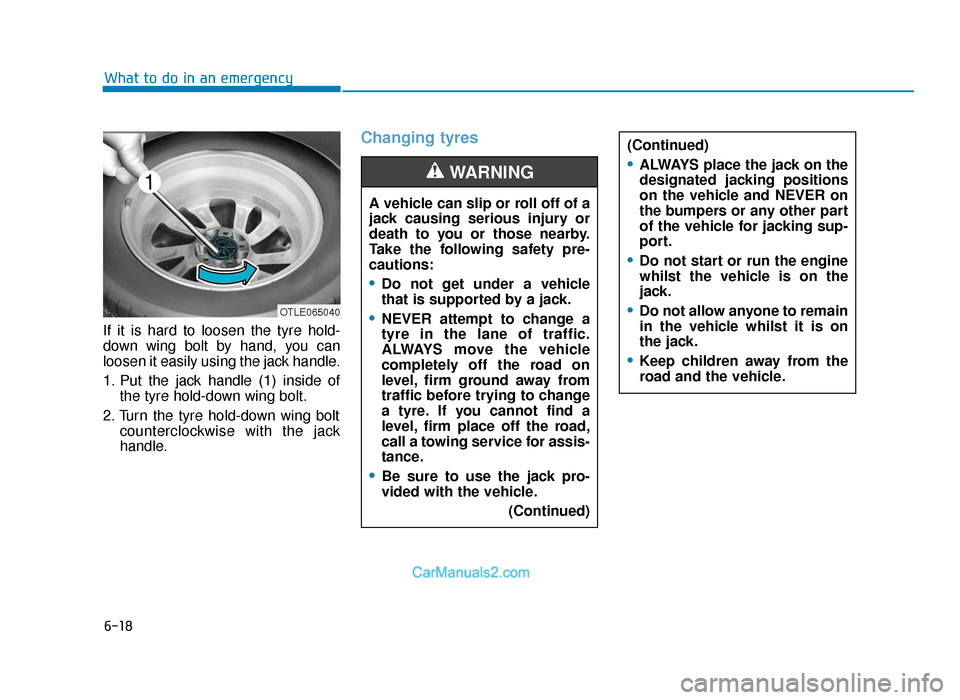
If it is hard to loosen the tyre hold-
down wing bolt by hand, you can
loosen it easily using the jack handle.
1. Put the jack handle (1) inside of the tyre hold-down wing bolt.
2. Turn the tyre hold-down wing bolt counterclockwise with the jack
handle.
Changing tyres
A vehicle can slip or roll off of a
jack causing serious injury or
death to you or those nearby.
Take the following safety pre-
cautions:
•Do not get under a vehicle
that is supported by a jack.
•NEVER attempt to change a
tyre in the lane of traffic.
ALWAYS move the vehicle
completely off the road on
level, firm ground away from
traffic before trying to change
a tyre. If you cannot find a
level, firm place off the road,
call a towing service for assis-
tance.
•Be sure to use the jack pro-
vided with the vehicle.
(Continued)
WARNING
(Continued)
•ALWAYS place the jack on the
designated jacking positions
on the vehicle and NEVER on
the bumpers or any other part
of the vehicle for jacking sup-
port.
•Do not start or run the engine
whilst the vehicle is on the
jack.
•Do not allow anyone to remain
in the vehicle whilst it is on
the jack.
•Keep children away from the
road and the vehicle.
OTLE065040
TLe UK 6.qxp 5/10/2018 1:20 PM Page 18
Page 525 of 685
6-22
What to do in an emergency
Use of compact spare tyres (if equipped)
Compact spare tyres are designed
for emergency use only. Drive care-
fully on the compact spare tyre and
always follow the safety precautions. When driving with the compact spare
tyre mounted to your vehicle:
• Check the tyre pressure after
installing the compact spare tyre.
The compact spare tyre should be
inflated to 420 kPa (60 psi).
• Do not take this vehicle through an automatic car wash whilst the com-
pact spare tyre is installed.
• Do not use the compact spare tyre on any other vehicle because this
tyre has been designed especially
for your vehicle.
• The compact spare tyre’s tread life is shorter than a regular tyre.
Inspect your compact spare tyre
regularly and replace worn compact
spare tyres with the same size and
design, mounted on the same
wheel.
• Do not use more than one compact spare tyre at a time.
• Do not tow a trailer whilst the com- pact spare tyre is installed. When the original tyre and wheel
are repaired and reinstalled on the
vehicle, the lug nut torque must
be set correctly. The correct lug
nut tightening torque is 11-13
kgf•m
(79-94 lbf•ft).
NOTICE
To prevent compact spare tyre
failure and loss of control pos-
sibly resulting in an accident:
•Use the compact spare tyre
only in an emergency.
•NEVER operate your vehicle
over 50 mph (80 km/h).
•Do not exceed the vehicle’s
maximum load rating or the
load carrying capacity shown
on the sidewall of the com-
pact spare tyre.
•Do not use the compact spare
tyre continuously. Repair or
replace the original tyre as
soon as possible to avoid fail-
ure of the compact spare tyre.
WARNING
TLe UK 6.qxp 5/10/2018 1:21 PM Page 22
Page 534 of 685
6-31
What to do in an emergency
6
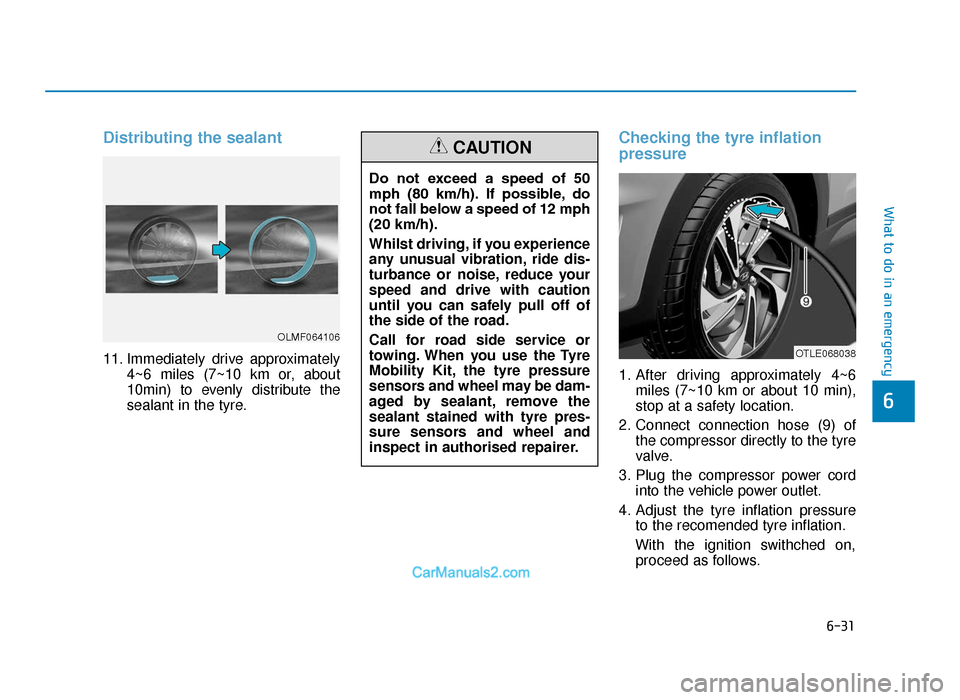
Distributing the sealant
11. Immediately drive approximately4~6 miles (7~10 km or, about
10min) to evenly distribute the
sealant in the tyre.
Checking the tyre inflation
pressure
1. After driving approximately 4~6miles (7~10 km or about 10 min),
stop at a safety location.
2. Connect connection hose (9) of the compressor directly to the tyre
valve.
3. Plug the compressor power cord into the vehicle power outlet.
4. Adjust the tyre inflation pressure to the recomended tyre inflation.
With the ignition swithched on, proceed as follows.
Do not exceed a speed of 50
mph (80 km/h). If possible, do
not fall below a speed of 12 mph
(20 km/h).
Whilst driving, if you experience
any unusual vibration, ride dis-
turbance or noise, reduce your
speed and drive with caution
until you can safely pull off of
the side of the road.
Call for road side service or
towing. When you use the Tyre
Mobility Kit, the tyre pressure
sensors and wheel may be dam-
aged by sealant, remove the
sealant stained with tyre pres-
sure sensors and wheel and
inspect in authorised repairer.
CAUTION
OTLE068038
OLMF064106
TLe UK 6.qxp 5/10/2018 1:21 PM Page 31
Page 535 of 685
6-32
What to do in an emergency- To increase the inflation pres-sure : Switch on the compres-
sor, position I. To check the cur-
rent inflation pressure setting,
briefly switch off the compressor.
The pressure gauge may show
higher than actual reading when
the compressor is running. To get
an accurate tyre reading, the com-
pressor needs to be turned off. - To reduce the inflation pres-sure: Press the button 8 on the
compressor. ❈
Sealant and spare parts can be
obtained and replaced at an autho-
rised vehicle or tyre repairer. Empty
sealant bottles may be disposed of
at home. Liquid residue from the
sealant should be disposed of by
your vehicle or tyre repairer or in
accordance with local waste dispos-
al regulations.
NOTICE
The tyre inflation pressure must
be at least 220 kPa (32 psi). If it
is not, do not continue driving.
Call for road side service or tow-
ing.
WARNING
If the inflation pressure is not
maintained, drive the vehicle a
second time, refer to Distributing
the sealant. Then repeat steps 1
to 4.
Use of the TMK may be ineffec-
tual for tyre damage larger than
approximately 4 mm (0.16 in).
We recommend that you contact
a HYUNDAI authorised repairer if
the tyre cannot be made road-
worthy with the Tyre Mobility Kit.
CAUTION
Do not let the compressor run
for more than 10 minutes, other-
wise the device will overheat
and may be damaged.
WARNING
Tyre pressure sensor
The sealant on the tyre pres-
sure sensor and wheel should
be removed when you replace
the tyre with a new one and
inspect the tyre pressure sen-
sors in authorised repairer.
When reinstalling the repaired
or replaced tyre and wheel on
the vehicle, tighten the wheel
lug nut to 11~13 kgf·m (79~94
lbf·ft).
CAUTION
TLe UK 6.qxp 5/10/2018 1:21 PM Page 32
Page 542 of 685
6-39
What to do in an emergency
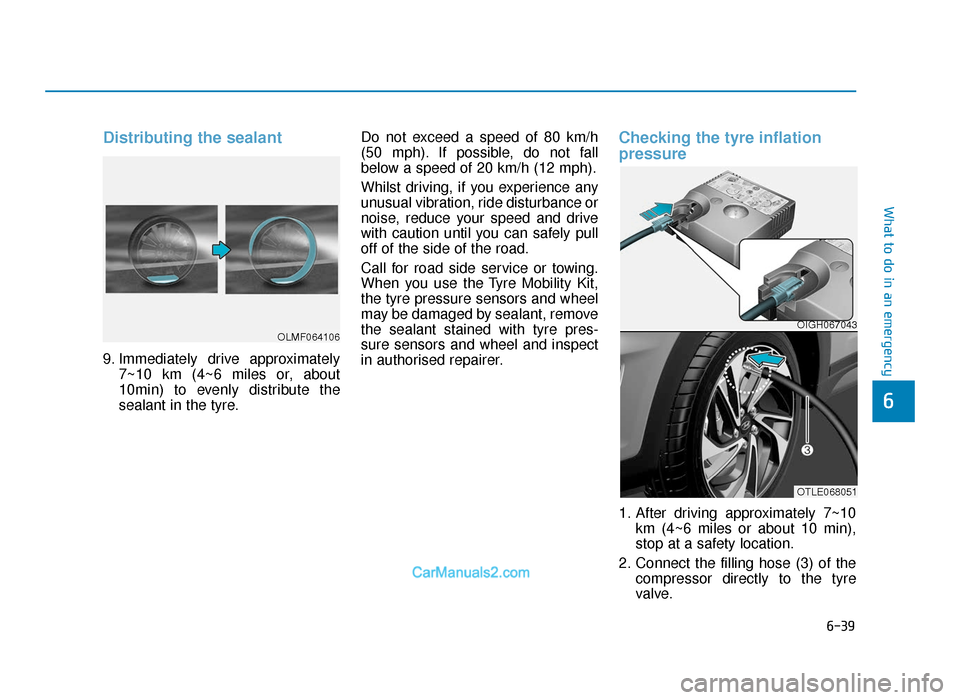
Distributing the sealant
9. Immediately drive approximately7~10 km (4~6 miles or, about
10min) to evenly distribute the
sealant in the tyre. Do not exceed a speed of 80 km/h
(50 mph). If possible, do not fall
below a speed of 20 km/h (12 mph).
Whilst driving, if you experience any
unusual vibration, ride disturbance or
noise, reduce your speed and drive
with caution until you can safely pull
off of the side of the road.
Call for road side service or towing.
When you use the Tyre Mobility Kit,
the tyre pressure sensors and wheel
may be damaged by sealant, remove
the sealant stained with tyre pres-
sure sensors and wheel and inspect
in authorised repairer.
Checking the tyre inflation
pressure
1. After driving approximately 7~10
km (4~6 miles or about 10 min),
stop at a safety location.
2. Connect the filling hose (3) of the compressor directly to the tyre
valve.
6
OLMF064106OIGH067043
OTLE068051
TLe UK 6.qxp 5/10/2018 1:22 PM Page 39
Page 543 of 685
6-40
3. Plug the compressor power cordinto the vehicle power outlet.
4. Adjust the tyre inflation pressure to the recomended tyre inflation.
With the ignition swithched on, proceed as follows.
- To increase the inflation pres- sure: Switch on the compressor.
To check the current inflation
pressure setting, briefly switch
off the compressor.
- To reduce the inflation pres- sure: Press the button (9) on the
compressor.
Do not let the compressor run for
more than 10 minutes, otherwise
the device will overheat and may
be damaged.Information
The pressure gauge may show higher
than actual reading when the com-
pressor is running. To get an accurate
tyre reading, the compressor needs to
be turned off.
i
NOTICE
What to do in an emergency
The tyre inflation pressure must
be at least 220 kPa (32 psi). If it
is not, do not continue driving.
Call for road side service or tow-
ing.
WARNING
If the inflation pressure is not
maintained, drive the vehicle a
second time, refer to Distributing
the sealant. Then repeat steps 1
to 4.
Use of the TMK may be ineffec-
tual for tyre damage larger than
approximately 4 mm (0.16 in).
We recommend that you contact
a HYUNDAI authorised repairer if
the tyre cannot be made road-
worthy with the Tyre Mobility Kit.
CAUTION
TLe UK 6.qxp 5/10/2018 1:22 PM Page 40
Page 545 of 685
6-42
What to do in an emergency
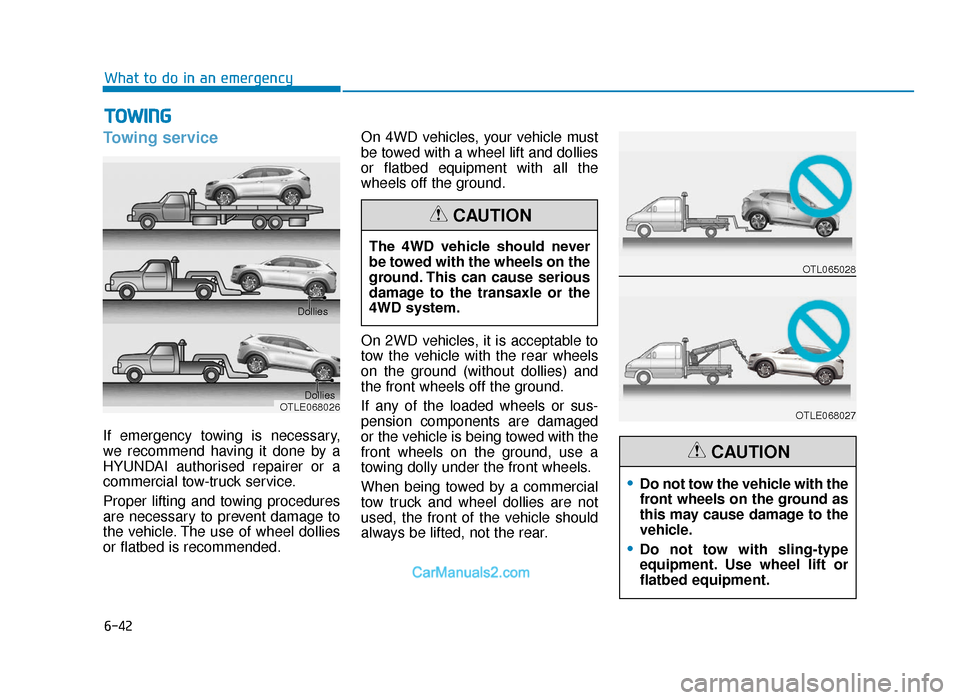
Towing service
If emergency towing is necessary,
we recommend having it done by a
HYUNDAI authorised repairer or a
commercial tow-truck service.
Proper lifting and towing procedures
are necessary to prevent damage to
the vehicle. The use of wheel dollies
or flatbed is recommended.On 4WD vehicles, your vehicle must
be towed with a wheel lift and dollies
or flatbed equipment with all the
wheels off the ground.
On 2WD vehicles, it is acceptable to
tow the vehicle with the rear wheels
on the ground (without dollies) and
the front wheels off the ground.
If any of the loaded wheels or sus-
pension components are damaged
or the vehicle is being towed with the
front wheels on the ground, use a
towing dolly under the front wheels.
When being towed by a commercial
tow truck and wheel dollies are not
used, the front of the vehicle should
always be lifted, not the rear.
TOWING
OTLE068026
Dollies
Dollies
•Do not tow the vehicle with the
front wheels on the ground as
this may cause damage to the
vehicle.
•Do not tow with sling-type
equipment. Use wheel lift or
flatbed equipment.
CAUTION
OTL065028
OTLE068027
The 4WD vehicle should never
be towed with the wheels on the
ground. This can cause serious
damage to the transaxle or the
4WD system.
CAUTION
TLe UK 6.qxp 5/10/2018 1:22 PM Page 42