child seat Hyundai Tucson 2019 Owner's Manual - RHD (UK, Australia)
[x] Cancel search | Manufacturer: HYUNDAI, Model Year: 2019, Model line: Tucson, Model: Hyundai Tucson 2019Pages: 685, PDF Size: 17.76 MB
Page 21 of 685
Safety system of your vehicle
2
Important safety precautions...............................2-2
Always wear your seat belt............................................2-2
Restrain all children ..........................................................2-2
Air bag hazards..................................................................2-2
Driver distraction ...............................................................2-2
Control your speed ...........................................................2-3
Keep your vehicle in safe condition .............................2-3
Seats ........................................................................\
2-4
Safety precautions............................................................2-5
Front seats ........................................................................\
..2-6
Rear seats ........................................................................\
.2-12
Head restraint .................................................................2-15
Seat warmers and air ventilation seats.....................2-20
Seat belts .............................................................2-24
Seat belt safety precautions ........................................2-24
Seat belt warning light ..................................................2-25
Seat belt restraint system ............................................2-28
Additional seat belt safety precautions ....................2-34
Care of seat belts ...........................................................2-37
Child Restraint System (CRS) .............................2-38
Our Recommendation: Children always in the rear...2-38
Selecting a Child Restraint System (CRS) ................2-39
Installing a Child Restraint System (CRS)..................2-41
Air bag
- supplemental restraint system .......................2-50
Where are the air bags? ...............................................2-52
How does the air bags system operate? ..................2-57
What to expect after an air bag inflates..................2-61
Do not install a Child Restraint System on the front
passenger seat unless the air bag is deactivated ...2-62
Why didn't my air bag go off in a collision? ...........2-63
SRS care ........................................................................\
....2-68
Additional safety precautions ......................................2-69
Air bag warning labels ...................................................2-69
Active bonnet lift system ...................................2-70
Possible activation situations .......................................2-70
Non-activation situations ..............................................2-71
System malfunction ........................................................2-72
This chapter provides you with important information about how to protect yourself and your passengers.
It explains how to properly use your seats and seat belts, and how your air bags work.
Additionally, this chapter explains how to properly restrain infants and children in your vehicle.
TLe UK 2.qxp 6/12/2018 2:03 PM Page 1
Page 22 of 685
2-2
You will find many safety precautions
and recommendations throughout
this section, and throughout this
manual. The safety precautions in
this section are among the most
important.
Always wear your seat belt
A seat belt is your best protection in
all types of accidents. Air bags are
designed to supplement seat belts,
not replace them. So even though
your vehicle is equipped with air
bags, ALWAYS make sure you and
your passengers wear your seat
belts, and wear them properly.
Restrain all children
All children under age 13 should ride
in your vehicle properly restrained in
a rear seat, not the front seat. Infants
and small children should be
restrained in an appropriate Child
Restraint System. Larger children
should use a booster seat with the
lap/shoulder belt until they can use
the seat belt properly without a
booster seat.
Air bag hazards
Whilst air bags can save lives, they
can also cause serious or fatal
injuries to occupants who sit too
close to them, or who are not prop-
erly restrained. Infants, young chil-
dren, and short adults are at the
greatest risk of being injured by an
inflating air bag. Follow all instruc-
tions and warnings in this manual.
Driver distraction
Driver distraction presents a serious
and potentially deadly danger, espe-
cially for inexperienced drivers.
Safety should be the first concern
when behind the wheel and drivers
need to be aware of the wide array of
potential distractions, such as
drowsiness, reaching for objects,
eating, personal grooming, other
passengers, and using mobile
phones.
Drivers can become distracted when
they take their eyes and attention off
the road or their hands off the wheel
to focus on activities other than driv-
ing. To reduce your risk of distraction
and an accident:
• ALWAYS set up your mobiledevices (i.e., MP3 players, phones,
navigation units, etc.) when your
vehicle is parked or safely stopped.
• ONLY use your mobile device when allowed by laws and condi-
tions permit safe use. NEVER text
or email whilst driving. Most coun-
tries have laws prohibiting drivers
from texting. Some countries and
cities also prohibit drivers from
using handheld phones.
IMPORTANT SAFETY PRECAUTIONS
Safety system of your vehicle
TLe UK 2.qxp 6/12/2018 2:03 PM Page 2
Page 26 of 685
2-6
Safety system of your vehicle
Seat belts
Always fasten your seat belt before
starting any trip.
At all times, passengers should sit
upright and be properly restrained.
Infants and small children must be
restrained in appropriate Child
Restraint Systems. Children who
have outgrown a booster seat and
adults must be restrained using the seat
belts.
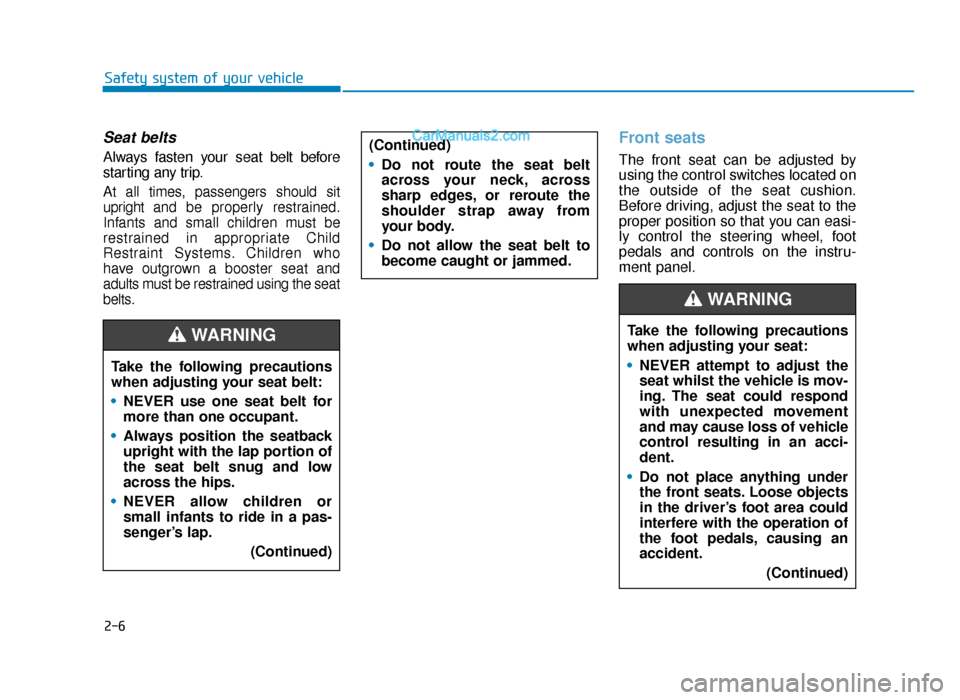
Front seats
The front seat can be adjusted by
using the control switches located on
the outside of the seat cushion.
Before driving, adjust the seat to the
proper position so that you can easi-
ly control the steering wheel, foot
pedals and controls on the instru-
ment panel.
Take the following precautions
when adjusting your seat belt:
• NEVER use one seat belt for
more than one occupant.
• Always position the seatback
upright with the lap portion of
the seat belt snug and low
across the hips.
• NEVER allow children or
small infants to ride in a pas-
senger’s lap.
(Continued)(Continued)
•Do not route the seat belt
across your neck, across
sharp edges, or reroute the
shoulder strap away from
your body.
• Do not allow the seat belt to
become caught or jammed.
WARNING Take the following precautions
when adjusting your seat:
•NEVER attempt to adjust the
seat whilst the vehicle is mov-
ing. The seat could respond
with unexpected movement
and may cause loss of vehicle
control resulting in an acci-
dent.
• Do not place anything under
the front seats. Loose objects
in the driver’s foot area could
interfere with the operation of
the foot pedals, causing an
accident.
(Continued)
WARNING
TLe UK 2.qxp 6/12/2018 2:03 PM Page 6
Page 29 of 685
2-9
Safety system of your vehicle
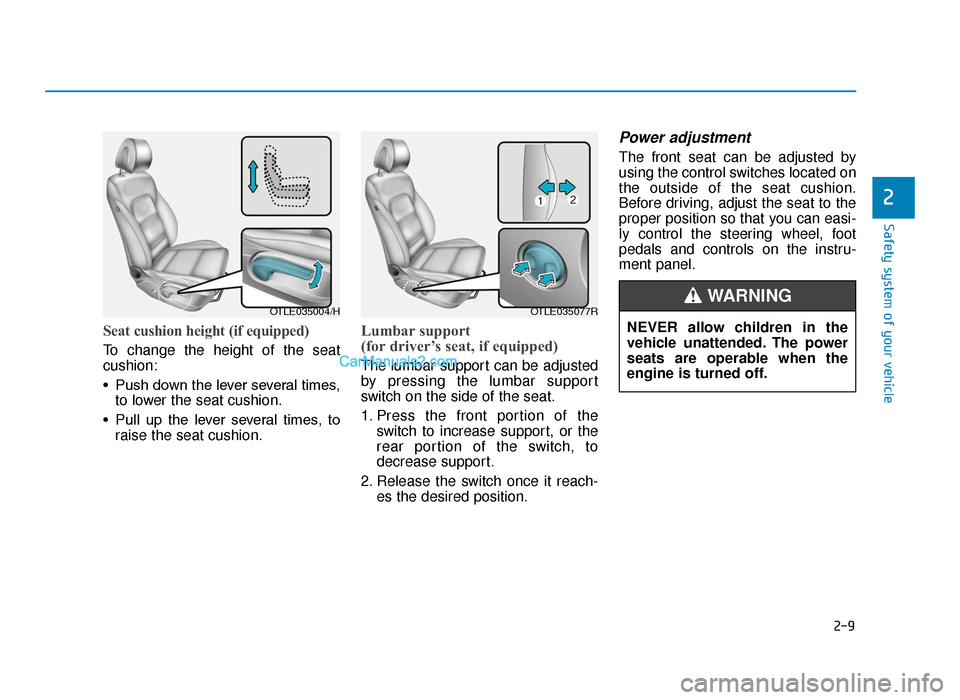
Seat cushion height (if equipped)
To change the height of the seat
cushion:
• Push down the lever several times,to lower the seat cushion.
• Pull up the lever several times, to raise the seat cushion.
Lumbar support
(for driver’s seat, if equipped)
The lumbar support can be adjusted
by pressing the lumbar support
switch on the side of the seat.
1. Press the front portion of the switch to increase support, or the
rear portion of the switch, to
decrease support.
2. Release the switch once it reach- es the desired position.
Power adjustment
The front seat can be adjusted by
using the control switches located on
the outside of the seat cushion.
Before driving, adjust the seat to the
proper position so that you can easi-
ly control the steering wheel, foot
pedals and controls on the instru-
ment panel.
2
OTLE035004/HOTLE035077R
NEVER allow children in the
vehicle unattended. The power
seats are operable when the
engine is turned off.
WARNING
TLe UK 2.qxp 6/12/2018 2:03 PM Page 9
Page 40 of 685
2-20
Safety system of your vehicle
Seat warmers and air ventila-
tion seats
Front seat warmers (if equipped)
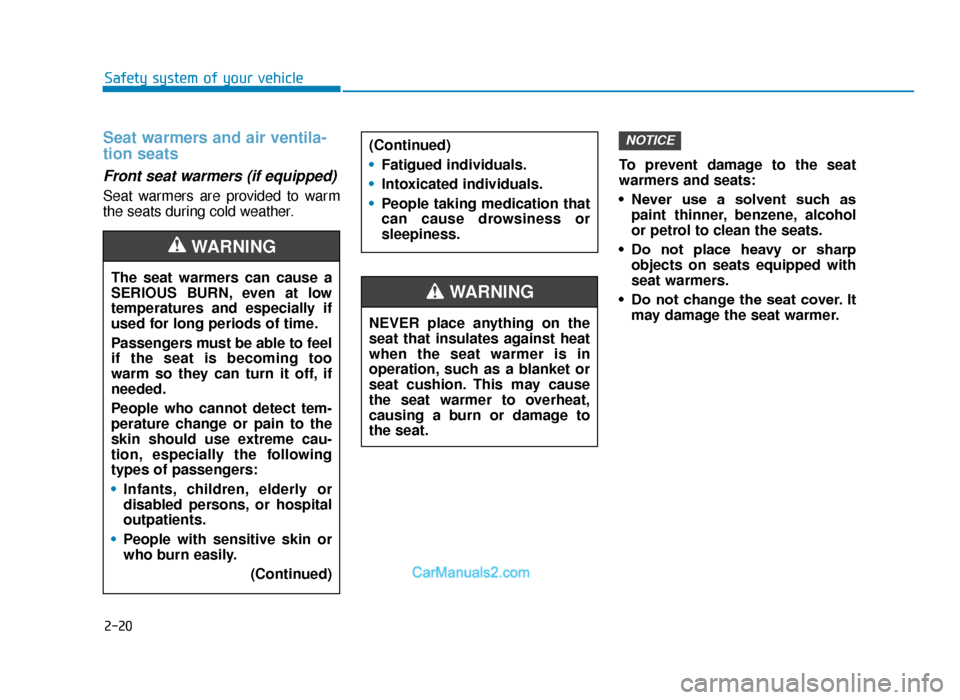
Seat warmers are provided to warm
the seats during cold weather.To prevent damage to the seat
warmers and seats:
• Never use a solvent such as
paint thinner, benzene, alcohol
or petrol to clean the seats.
• Do not place heavy or sharp objects on seats equipped with
seat warmers.
• Do not change the seat cover. It may damage the seat warmer.
NOTICE
The seat warmers can cause a
SERIOUS BURN, even at low
temperatures and especially if
used for long periods of time.
Passengers must be able to feel
if the seat is becoming too
warm so they can turn it off, if
needed.
People who cannot detect tem-
perature change or pain to the
skin should use extreme cau-
tion, especially the following
types of passengers:
•Infants, children, elderly or
disabled persons, or hospital
outpatients.
• People with sensitive skin or
who burn easily.
(Continued)
(Continued)
•Fatigued individuals.
• Intoxicated individuals.
• People taking medication that
can cause drowsiness or
sleepiness.
WARNING
NEVER place anything on the
seat that insulates against heat
when the seat warmer is in
operation, such as a blanket or
seat cushion. This may cause
the seat warmer to overheat,
causing a burn or damage to
the seat.
WARNING
TLe UK 2.qxp 6/12/2018 2:05 PM Page 20
Page 44 of 685
2-24
Safety system of your vehicle
This section describes how to use the
seat belts properly. It also describes
some of the things not to do when
using seat belts.
Seat belt safety precautions
Always fasten your seat belt and
make sure all passengers have fas-
tened their seat belts before starting
any trip. Air bags (if equipped) are
designed to supplement the seat belt
as an additional safety device, but
they are not a substitute. Most coun-
tries require all occupants of a vehicle
to wear seat belts.
SEAT BELTS
Seat belts must be used by ALL
passengers whenever the vehi-
cle is moving. Take the following
precautions when adjusting
and wearing seat belts:
• Children under the age of 13
should be properly restrained
in the rear seats.
• Never allow children to ride in
the front passenger seat,
unless the air bag is deacti-
vated. If a child is seated in
the front passenger seat,
move the seat as far back as
possible and properly restrain
them in the seat.
• NEVER allow an infant or
child to be carried on an occu-
pant’s lap.
• NEVER ride with the seatback
reclined when the vehicle is
moving.
• Do not allow children to share
a seat or seat belt.
(Continued)
WARNING (Continued)
•Do not wear the shoulder belt
under your arm or behind
your back.
• Never wear a seat belt over
fragile objects. If there is a
sudden stop or impact, the
seat belt can damage it.
• Do not use the seat belt if it is
twisted. A twisted seat belt
will not protect you properly
in an accident.
• Do not use a seat belt if the
webbing or hardware is dam-
aged.
• Do not latch the seat belt into
the buckles of other seats.
• NEVER unfasten the seat belt
whilst driving. This may cause
loss of vehicle control result-
ing in an accident.
• Make sure there is nothing in
the buckle interfering with the
seat belt latch mechanism.
This may prevent the seat belt
from fastening securely.
(Continued)
TLe UK 2.qxp 6/12/2018 2:05 PM Page 24
Page 54 of 685
2-34
Safety system of your vehicle
The sensor that activates the SRS
air bag is connected with the
pre–tensioner seat belts. The SRS
air bag warning light on the instru-
ment panel will illuminate for
approximately 6 seconds after the
ignition switch is placed to the ON
position, and then it should turn off.
If the pre-tensioner is not working
properly, the warning light will illu-
minate even if the SRS air bag is
not malfunctioning. If the warning
light does not illuminate, stays illu-
minated or illuminates when the
vehicle is being driven, we recom-
mend the pre-tensioner seat belts
and/or SRS air bags be inspected
by a HYUNDAI authorised repairer
as soon as possible.
Information
• Both the driver's and front passen- ger's pre-tensioner seat belts may be
activated in certain frontal or side
collisions.
• The pre-tensioners will be activated even if the seat belts are not worn at
the time of the collision.
• When the pre-tensioner seat belts are activated, a loud noise may be
heard and fine dust, which may
appear to be smoke, may be visible
in the passenger compartment.
These are normal operating condi-
tions and are not hazardous.
• Although it is non-toxic, the fine dust may cause skin irritation and should
not be breathed for prolonged peri-
ods. Wash all exposed skin areas
thoroughly after an accident in which
the pre-tensioner seat belts were acti-
vated.
Additional seat belt safety pre-
cautions
Seat belt use during pregnancy
The seat belt should always be used
during pregnancy. The best way to
protect your unborn child is to protect
yourself by always wearing the seat
belt.
Pregnant women should always wear
a lap-shoulder seat belt. Place the
shoulder belt across your chest, rout-
ed between your breasts and away
from your neck. Place the lap belt
below your belly so that it fits SNUGLY
across your hips and pelvic bone,
under the rounded part of the belly.
iNOTICE
To reduce the risk of serious
injury or death to an unborn
child during an accident, preg-
nant women should NEVER
place the lap portion of the seat
belt above or over the area of
the abdomen where the unborn
child is located.
WARNING
TLe UK 2.qxp 6/12/2018 2:07 PM Page 34
Page 55 of 685
2-35
Safety system of your vehicle
2
Seat belt use and children
Infant and small children
Most countries have Child Restraint
System laws which require children to
travel in approved Child Restraint
System devices, including booster
seats. The age at which seat belts can
be used instead of Child Restraint
System differs among countries, so
you should be aware of the specific
requirements in your country, and
where you are travelling. Infant and
Child Restraint System must be prop-
erly placed and installed in a rear seat.
For more information refer to the “Child
Restraint Systems” in this chapter.Small children are best protected
from injury in an accident when prop-
erly restrained in the rear seat by a
Child Restraint System that meets the
requirements of the Safety Standards
of your country. Before buying any
Child Restraint System, make sure
that it has a label certifying that it
meets Safety Standard of your coun-
try. The Child Restraint System must
be appropriate for your child's height
and weight. Check the label on the
Child Restraint System for this informa-
tion. Refer to “Child Restraint Systems”
in this chapter.
ALWAYS properly restrain infants
and small children in a Child
Restraint System appropriate for
the child’s height and weight.
To reduce the risk of serious
injury or death to a child and
other passengers, NEVER hold a
child in your lap or arms when
the vehicle is moving. The violent
forces created during an acci-
dent will tear the child from your
arms and throw the child against
the interior of the vehicle.
WARNING
TLe UK 2.qxp 6/12/2018 2:07 PM Page 35
Page 56 of 685
2-36
Safety system of your vehicle
Larger children
Children under age 13 and who are
too large for a booster seat should
always occupy the rear seat and use
the available lap/shoulder belts. A
seat belt should lie across the upper
thighs and be snug across the shoul-
der and chest to restrain the child
safely. Check belt fit periodically. A
child's squirming could put the belt
out of position. In the event of an acci-
dent, children are afforded the best
safety restrained by a proper Child
Restraint System in the rear seats.
If a larger child over age 13 must be
seated in the front seat, the child
must be securely restrained by the
available lap/shoulder belt and the
seat should be placed in the rear-
most position.
If the shoulder belt portion slightly
touches the child’s neck or face, try
placing the child closer to the centre
of the vehicle. If the shoulder belt still
touches their face or neck, they need
to be returned to an appropriate
booster seat in the rear seat.
Seat belt use and injured people
A seat belt should be used when an
injured person is being transported.
Consult a physician for specific rec-
ommendations.
One person per belt
Two people (including children) should
never attempt to use a single seat belt.
This could increase the severity of
injuries in case of an accident.
Do not lie down
Sitting in a reclined position when
the vehicle is in motion can be dan-
gerous. Even when buckled up, the
protections of your restraint system
(seat belts and/or air bags) is greatly
reduced by reclining your seatback.
Seat belts must be snug against your
hips and chest to work properly.
During an accident, you could be
thrown into the seat belt, causing
neck or other injuries.
•Always make sure larger chil-
dren’s seat belts are worn and
properly adjusted.
•NEVER allow the shoulder
belt to contact the child’s
neck or face.
•Do not allow more than one
child to use a single seat belt.
WARNING
TLe UK 2.qxp 6/12/2018 2:07 PM Page 36
Page 58 of 685
2-38
Safety system of your vehicle
Our recommendation:
Children always in the rear Children under age 13 should always
ride in the rear seats and must
always be properly restrained to min-
imise the risk of injury in an accident,
sudden stop or sudden manoeuvre.
According to accident statistics, chil-
dren are safer when properly restrained
in the rear seats than in the front
seat. Children too large for a Child
Restraint System must use the seat
belts provided.
Most countries have regulations which
require children to travel in approved
Child Restraint Systems.
The laws governing the age or
height/weight restrictions at which
seat belts can be used instead of
Child Restraint System differs among
countries, so you should be aware of
the specific requirements in your
country, and where you are travelling.
Child Restraint Systems must be
properly installed in the vehicle seat.
Always use a commercially available
Child Restraint System that meets the
requirements of your country.Child Restraint System (CRS)
Infants and younger children must be
restrained in an appropriate rearward-
facing or forward-facing CRS that has
first been properly secured to the rear
seat of the vehicle. Read and comply
with the instructions for installation
and use provided by the manufacturer
of the Child Restraint System.
CHILD RESTRAINT SYSTEM (CRS)
Always properly restrain children
in the vehicle. Children of all ages
are safer when riding in the rear
seats. Never place a rearward-
facing Child Restraint System on
the front passenger seat, unless
the air bag is deactivated.
A child riding in the front pas-
senger seat can be forcefully
struck by an inflating air bag
resulting in SERIOUS INJURY
or DEATH.
WARNING
•Always follow the Child Restraint
System manufacturer’s instruc-
tions for installation and use.
•Always properly restrain your
child in the Child Restraint
System.
•Do not use an infant carrier or
a child safety seat that “hooks”
over a seatback, it may not pro-
vide adequate protection in an
accident.
•After an accident, we recom-
mend a HYUNDAI authorised
repairer to check the Child
Restraint System, seat belts,
ISOFIX anchorages and top-
tether anchorages.
WARNING
TLe UK 2.qxp 6/12/2018 2:07 PM Page 38