forward Hyundai Tucson 2019 Owner's Manual
[x] Cancel search | Manufacturer: HYUNDAI, Model Year: 2019, Model line: Tucson, Model: Hyundai Tucson 2019Pages: 546, PDF Size: 61.38 MB
Page 22 of 546
2-4
S SE
EA
AT
TS
S
Safety system of your vehicle
OTL035001L
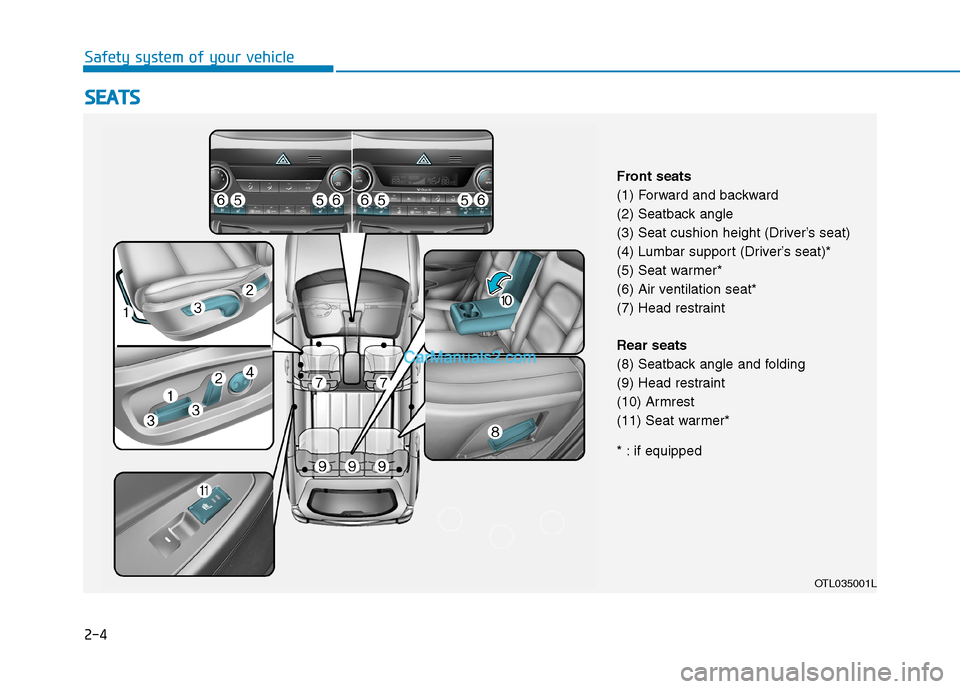
Front seats
(1) Forward and backward
(2) Seatback angle
(3) Seat cushion height (Driver’s seat)
(4) Lumbar support (Driver’s seat)*
(5) Seat warmer*
(6) Air ventilation seat*
(7) Head restraint
Rear seats
(8) Seatback angle and folding
(9) Head restraint
(10) Armrest
(11) Seat warmer*
* : if equipped
Page 25 of 546
2-7
Safety system of your vehicle
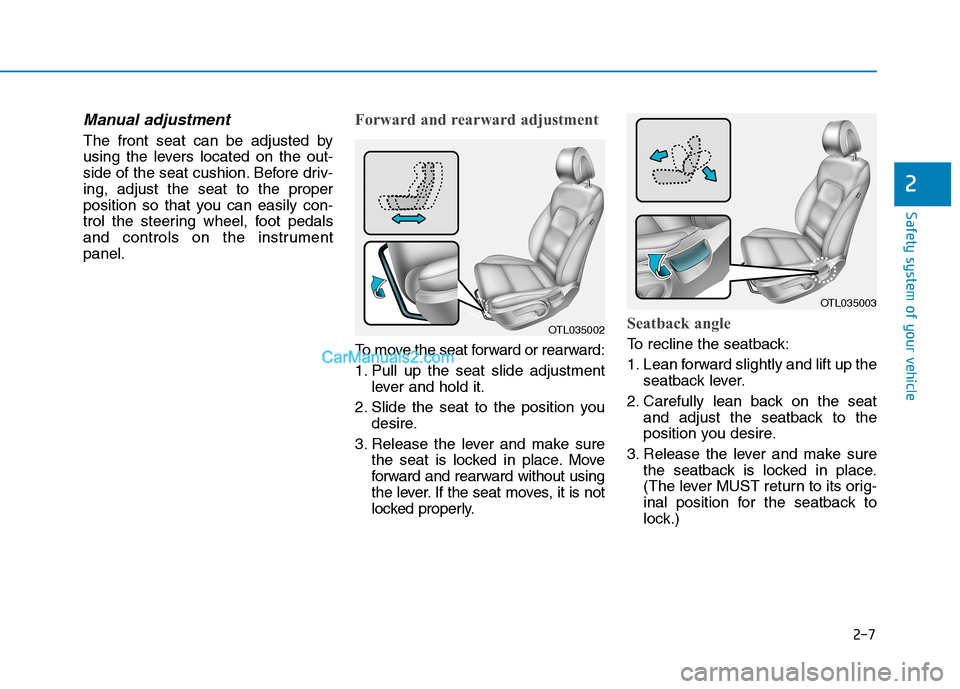
Manual adjustment
The front seat can be adjusted by
using the levers located on the out-
side of the seat cushion. Before driv-
ing, adjust the seat to the proper
position so that you can easily con-
trol the steering wheel, foot pedals
and controls on the instrument
panel.
Forward and rearward adjustment
To move the seat forward or rearward:
1. Pull up the seat slide adjustment
lever and hold it.
2. Slide the seat to the position you
desire.
3. Release the lever and make sure
the seat is locked in place. Move
forward and rearward without using
the lever. If the seat moves, it is not
locked properly.
Seatback angle
To recline the seatback:
1. Lean forward slightly and lift up the
seatback lever.
2. Carefully lean back on the seat
and adjust the seatback to the
position you desire.
3. Release the lever and make sure
the seatback is locked in place.
(The lever MUST return to its orig-
inal position for the seatback to
lock.)
2
OTL035003
OTL035002
Page 27 of 546
2-9
Safety system of your vehicle
2
Power adjustment
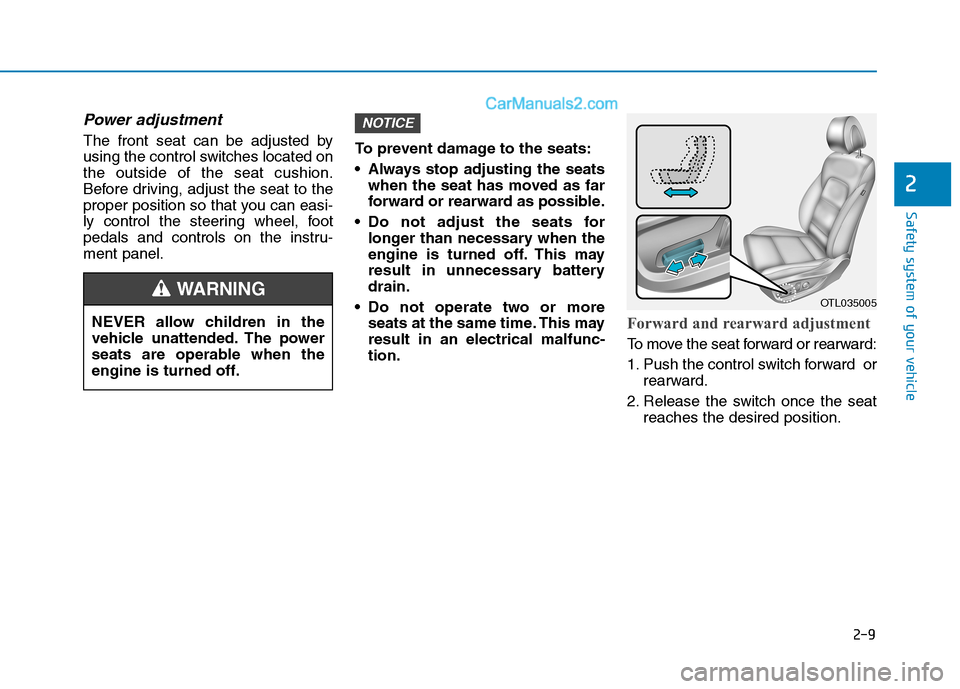
The front seat can be adjusted by
using the control switches located on
the outside of the seat cushion.
Before driving, adjust the seat to the
proper position so that you can easi-
ly control the steering wheel, foot
pedals and controls on the instru-
ment panel.To prevent damage to the seats:
Always stop adjusting the seats
when the seat has moved as far
forward or rearward as possible.
Do not adjust the seats for
longer than necessary when the
engine is turned off. This may
result in unnecessary battery
drain.
Do not operate two or more
seats at the same time. This may
result in an electrical malfunc-
tion.
Forward and rearward adjustment
To move the seat forward or rearward:
1. Push the control switch forward or
rearward.
2. Release the switch once the seat
reaches the desired position.
NOTICE
NEVER allow children in the
vehicle unattended. The power
seats are operable when the
engine is turned off.
WARNING OTL035005
Page 28 of 546
2-10
Safety system of your vehicle
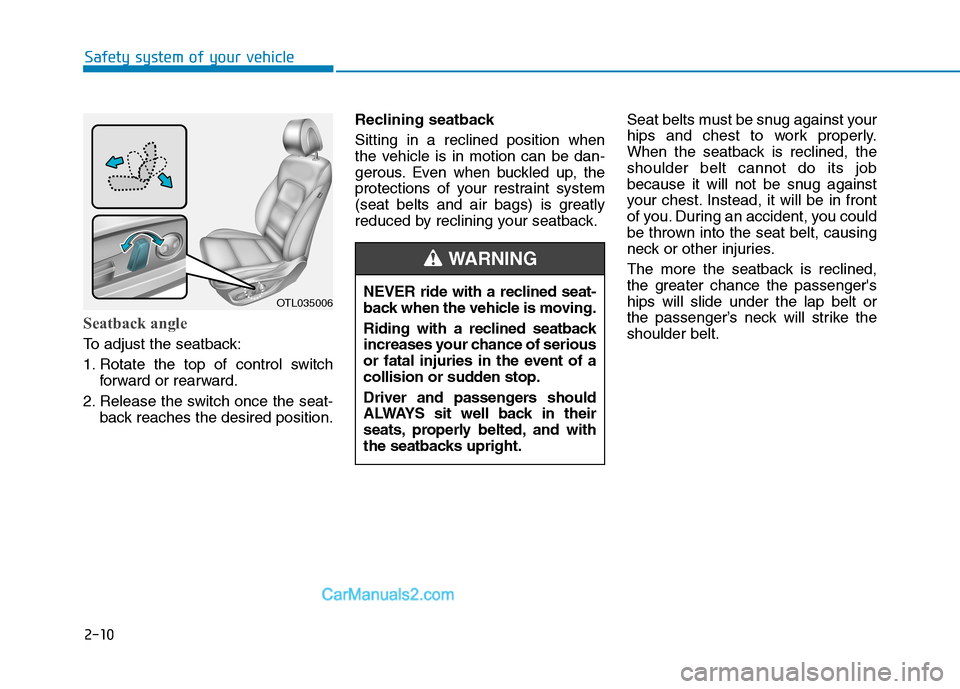
Seatback angle
To adjust the seatback:
1. Rotate the top of control switch
forward or rearward.
2. Release the switch once the seat-
back reaches the desired position.Reclining seatback
Sitting in a reclined position when
the vehicle is in motion can be dan-
gerous. Even when buckled up, the
protections of your restraint system
(seat belts and air bags) is greatly
reduced by reclining your seatback.Seat belts must be snug against your
hips and chest to work properly.
When the seatback is reclined, the
shoulder belt cannot do its job
because it will not be snug against
your chest. Instead, it will be in front
of you. During an accident, you could
be thrown into the seat belt, causing
neck or other injuries.
The more the seatback is reclined,
the greater chance the passenger's
hips will slide under the lap belt or
the passenger’s neck will strike the
shoulder belt.
OTL035006NEVER ride with a reclined seat-
back when the vehicle is moving.
Riding with a reclined seatback
increases your chance of serious
or fatal injuries in the event of a
collision or sudden stop.
Driver and passengers should
ALWAYS sit well back in their
seats, properly belted, and with
the seatbacks upright.
WARNING
Page 30 of 546
2-12
Safety system of your vehicle
Seatback pocket
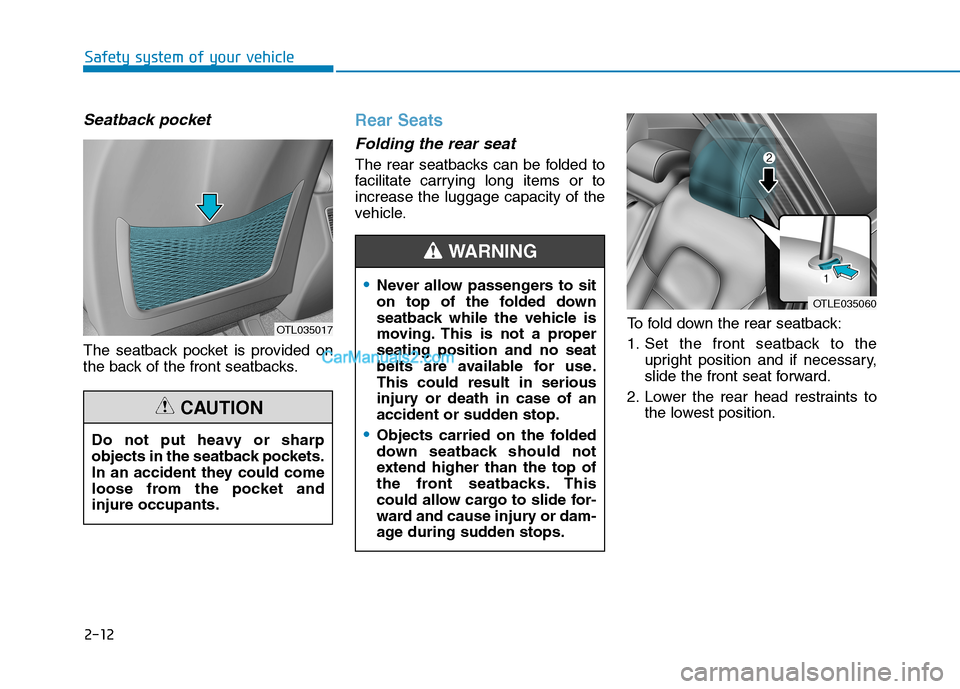
The seatback pocket is provided on
the back of the front seatbacks.
Rear Seats
Folding the rear seat
The rear seatbacks can be folded to
facilitate carrying long items or to
increase the luggage capacity of the
vehicle.
To fold down the rear seatback:
1. Set the front seatback to the
upright position and if necessary,
slide the front seat forward.
2. Lower the rear head restraints to
the lowest position.
Never allow passengers to sit
on top of the folded down
seatback while the vehicle is
moving. This is not a proper
seating position and no seat
belts are available for use.
This could result in serious
injury or death in case of an
accident or sudden stop.
Objects carried on the folded
down seatback should not
extend higher than the top of
the front seatbacks. This
could allow cargo to slide for-
ward and cause injury or dam-
age during sudden stops.
WARNING
OTLE035060
OTL035017
Do not put heavy or sharp
objects in the seatback pockets.
In an accident they could come
loose from the pocket and
injure occupants.
CAUTION
Page 34 of 546
2-16
Safety system of your vehicle
To prevent damage, NEVER hit or
pull on the head restraints.
Front seat head restraints
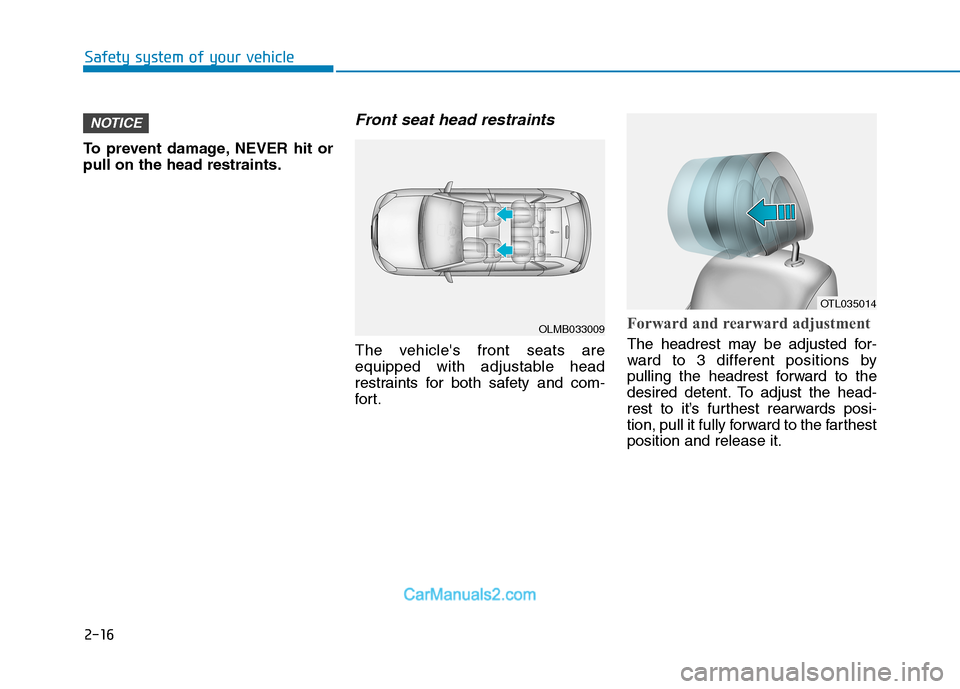
The vehicle's front seats are
equipped with adjustable head
restraints for both safety and com-
for t.
Forward and rearward adjustment
The headrest may be adjusted for-
ward to 3 different positions by
pulling the headrest forward to the
desired detent. To adjust the head-
rest to it’s furthest rearwards posi-
tion, pull it fully forward to the farthest
position and release it.
NOTICE
OLMB033009
OTL035014
Page 36 of 546
2-18
Safety system of your vehicle
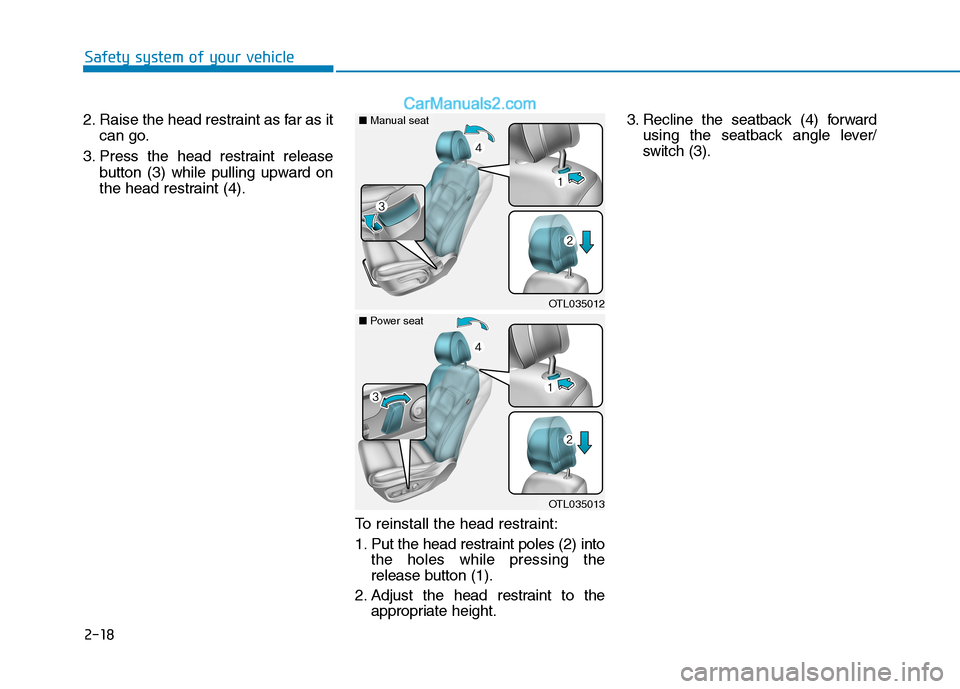
2. Raise the head restraint as far as it
can go.
3. Press the head restraint release
button (3) while pulling upward on
the head restraint (4).
To reinstall the head restraint:
1. Put the head restraint poles (2) into
the holes while pressing the
release button (1).
2. Adjust the head restraint to the
appropriate height.3. Recline the seatback (4) forward
using the seatback angle lever/
switch (3).
OTL035012
■Manual seat
OTL035013
■Power seat
Page 45 of 546
2-27
Safety system of your vehicle
2
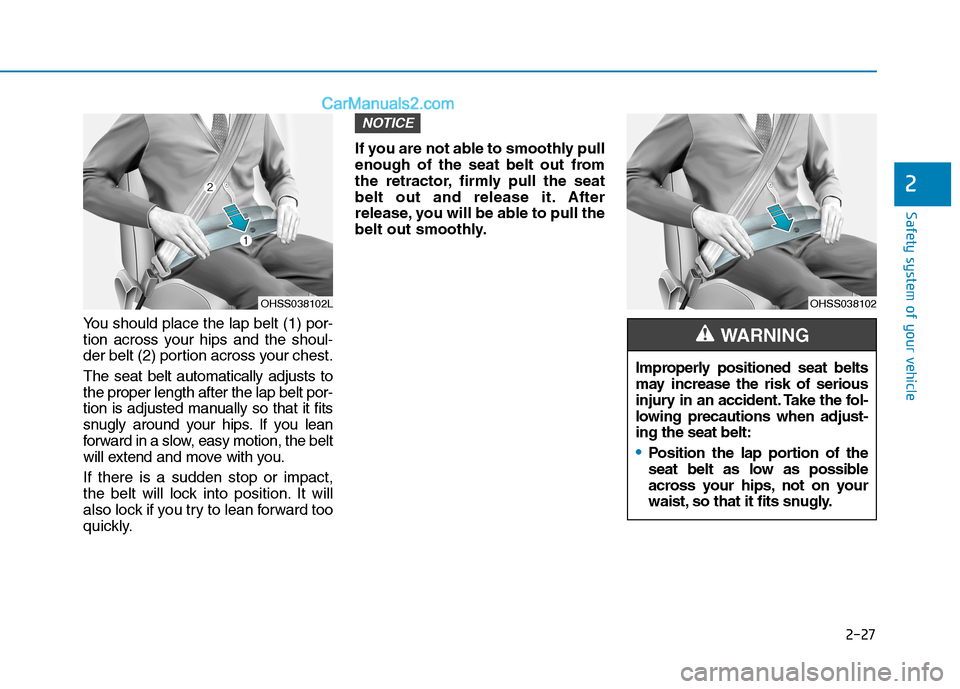
You should place the lap belt (1) por-
tion across your hips and the shoul-
der belt (2) portion across your chest.
The seat belt automatically adjusts to
the proper length after the lap belt por-
tion is adjusted manually so that it fits
snugly around your hips. If you lean
forward in a slow, easy motion, the belt
will extend and move with you.
If there is a sudden stop or impact,
the belt will lock into position. It will
also lock if you try to lean forward too
quickly.If you are not able to smoothly pull
enough of the seat belt out from
the retractor, firmly pull the seat
belt out and release it. After
release, you will be able to pull the
belt out smoothly.
NOTICE
OHSS038102OHSS038102L
Improperly positioned seat belts
may increase the risk of serious
injury in an accident. Take the fol-
lowing precautions when adjust-
ing the seat belt:
Position the lap portion of the
seat belt as low as possible
across your hips, not on your
waist, so that it fits snugly.
WARNING
Page 50 of 546
2-32
Safety system of your vehicle
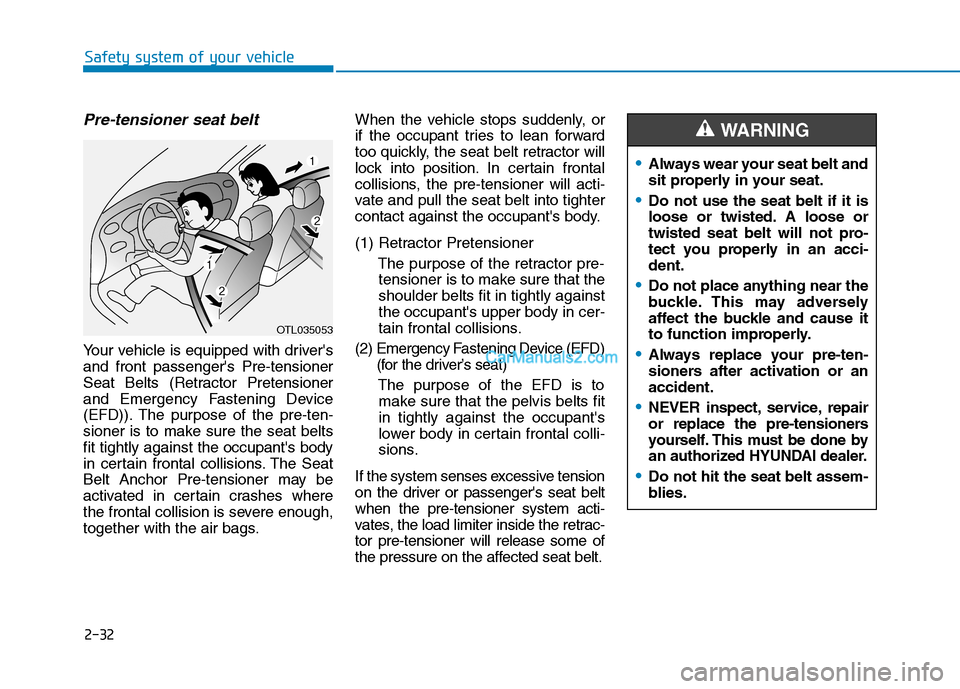
Pre-tensioner seat belt
Your vehicle is equipped with driver's
and front passenger's Pre-tensioner
Seat Belts (Retractor Pretensioner
and Emergency Fastening Device
(EFD)). The purpose of the pre-ten-
sioner is to make sure the seat belts
fit tightly against the occupant's body
in certain frontal collisions. The Seat
Belt Anchor Pre-tensioner may be
activated in certain crashes where
the frontal collision is severe enough,
together with the air bags.When the vehicle stops suddenly, or
if the occupant tries to lean forward
too quickly, the seat belt retractor will
lock into position. In certain frontal
collisions, the pre-tensioner will acti-
vate and pull the seat belt into tighter
contact against the occupant's body.
(1) Retractor Pretensioner
The purpose of the retractor pre-
tensioner is to make sure that the
shoulder belts fit in tightly against
the occupant's upper body in cer-
tain frontal collisions.(2) Emergency Fastening Device (EFD)
(for the driver’s seat)
The purpose of the EFD is to
make sure that the pelvis belts fit
in tightly against the occupant's
lower body in certain frontal colli-
sions.
If the system senses excessive tension
on the driver or passenger's seat belt
when the pre-tensioner system acti-
vates, the load limiter inside the retrac-
tor pre-tensioner will release some of
the pressure on the affected seat belt.
Always wear your seat belt and
sit properly in your seat.
Do not use the seat belt if it is
loose or twisted. A loose or
twisted seat belt will not pro-
tect you properly in an acci-
dent.
Do not place anything near the
buckle. This may adversely
affect the buckle and cause it
to function improperly.
Always replace your pre-ten-
sioners after activation or an
accident.
NEVER inspect, service, repair
or replace the pre-tensioners
yourself. This must be done by
an authorized HYUNDAI dealer.
Do not hit the seat belt assem-
blies.
WARNING
OTL035053
Page 56 of 546
2-38
Safety system of your vehicle
Children Always in the Rear
Children under age 13 must always
ride in the rear seats and must
always be properly restrained to min-
imize the risk of injury in an accident,
sudden stop or sudden maneuver.
According to accident statistics, chil-
dren are safer when properly
restrained in the rear seats than in
the front seat.Even with air bags,
children can be seriously injured
or killed.Children too large for a
child restraint must use the seat belts
provided.All 50 states have child restraint laws
which require children to travel in
approved child restraint devices. The
laws governing the age or
height/weight restrictions at which
seat belts can be used instead of
child restraints differs among states,
so you should be aware of the spe-
cific requirements in your state, and
where you are travelling.
Child restraint systems must be
properly placed and installed in the
rear seat. You must use a commer-
cially available child restraint system
that meets the requirements of the
Federal Motor Vehicle Safety
Standards (FMVSS 213).
Child restraint systems are generally
designed to be secured in a vehicle
seat by lap belt portion of a
lap/shoulder belt, or by a LATCH sys-
tem in the rear seats of the vehicle.
Child restraint system (CRS)
Infants and younger children must be
restrained in an appropriate rear-fac-
ing or forward-facing CRS that has
first been properly secured to the
rear seat of the vehicle. Read and
comply with the instructions for
installation and use provided by the
manufacturer of the child restraint.
C CH
HI
IL
LD
D
R
RE
ES
ST
TR
RA
AI
IN
NT
T
S
SY
YS
ST
TE
EM
M
(
(C
CR
RS
S)
)
Always properly restrain chil-
dren in the rear seats of the
vehicle.
Children of all ages are safer
when restrained in the rear seat.
A child riding in the front pas-
senger seat can be forcefully
struck by an inflating air bag
resulting in SERIOUS INJURY
or DEATH.
WARNING
An improperly secured child
restraint can increase the risk
of SERIOUS INJURY or DEATH
in an accident. Always take the
following precautions when
using a child restraint system:
NEVER install a child or infant
restraint in the front passen-
ger’s seat.
Always properly secure the
child restraint to a rear seat of
the vehicle.
Always follow the child
restraint system manufactur-
er’s instructions for installa-
tion and use.
WARNING