Service HYUNDAI TUCSON 2021 Owner's Manual
[x] Cancel search | Manufacturer: HYUNDAI, Model Year: 2021, Model line: TUCSON, Model: HYUNDAI TUCSON 2021Pages: 546, PDF Size: 44.38 MB
Page 427 of 546
6-18
What to do in an emergency
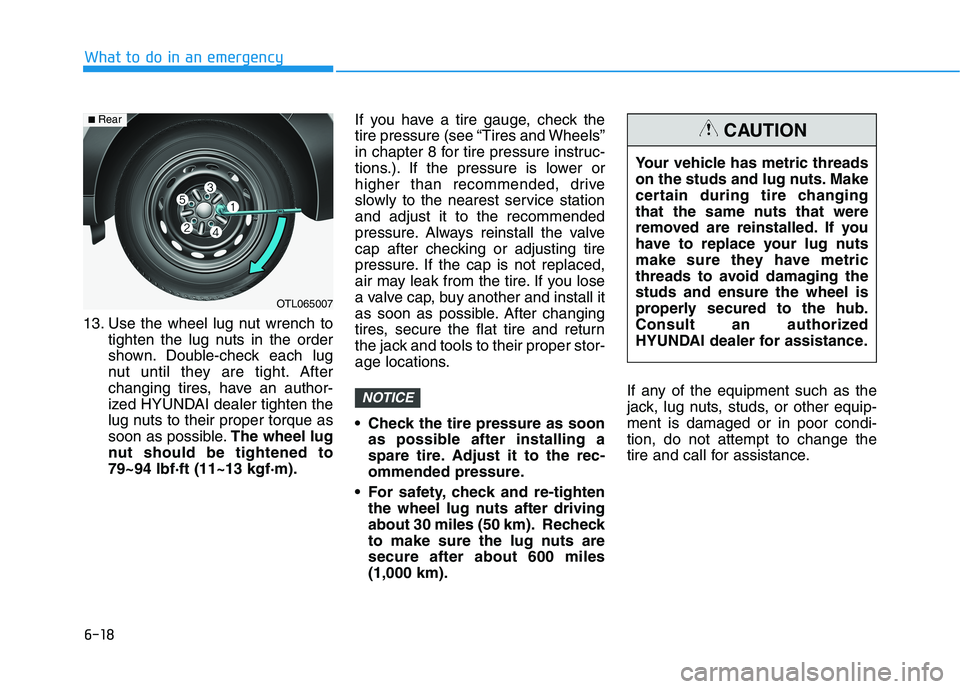
13. Use the wheel lug nut wrench to
tighten the lug nuts in the order
shown. Double-check each lug
nut until they are tight. After
changing tires, have an author-
ized HYUNDAI dealer tighten the
lug nuts to their proper torque as
soon as possible.The wheel lug
nut should be tightened to
79~94 lbf·ft (11~13 kgf·m).If you have a tire gauge, check the
tire pressure (see “Tires and Wheels”
in chapter 8 for tire pressure instruc-
tions.). If the pressure is lower or
higher than recommended, drive
slowly to the nearest service station
and adjust it to the recommended
pressure. Always reinstall the valve
cap after checking or adjusting tire
pressure. If the cap is not replaced,
air may leak from the tire. If you lose
a valve cap, buy another and install it
as soon as possible. After changing
tires, secure the flat tire and return
the jack and tools to their proper stor-
age locations.
Check the tire pressure as soon
as possible after installing a
spare tire. Adjust it to the rec-
ommended pressure.
For safety, check and re-tighten
the wheel lug nuts after driving
about 30 miles (50 km). Recheck
to make sure the lug nuts are
secure after about 600 miles
(1,000 km).If any of the equipment such as the
jack, lug nuts, studs, or other equip-
ment is damaged or in poor condi-
tion, do not attempt to change the
tire and call for assistance.
NOTICE
OTL065007
■Rear
Your vehicle has metric threads
on the studs and lug nuts. Make
certain during tire changing
that the same nuts that were
removed are reinstalled. If you
have to replace your lug nuts
make sure they have metric
threads to avoid damaging the
studs and ensure the wheel is
properly secured to the hub.
Consult an authorized
HYUNDAI dealer for assistance.
CAUTION
Page 430 of 546
6-21
What to do in an emergency
6
Towing Service
If emergency towing is necessary,
we recommend having it done by an
authorized HYUNDAI dealer or a
commercial tow-truck service.
Proper lifting and towing procedures
are necessary to prevent damage to
the vehicle. The use of wheel dollies
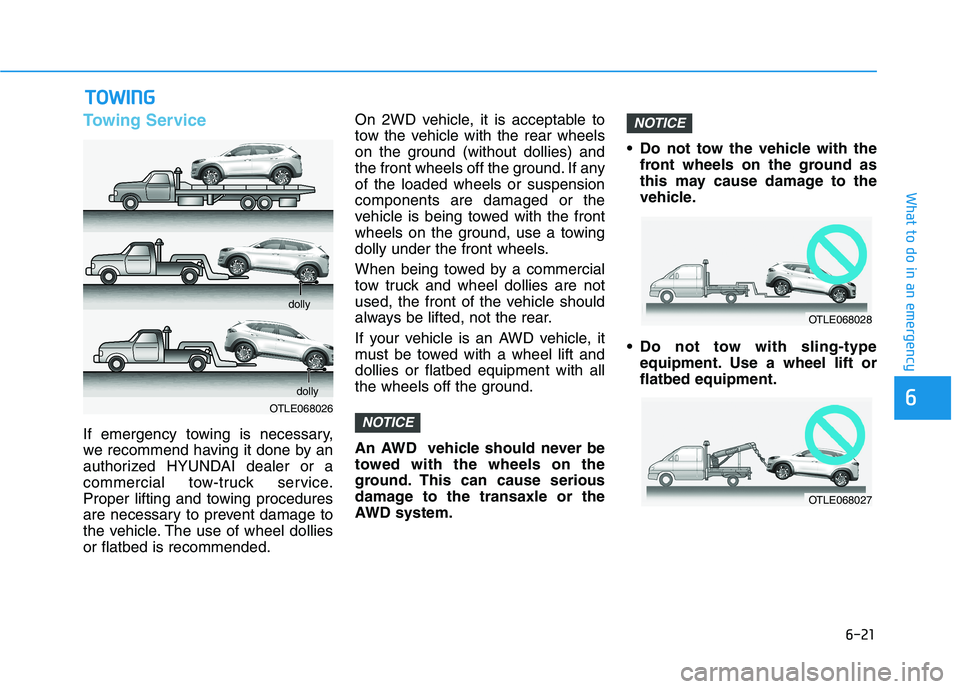
or flatbed is recommended.On 2WD vehicle, it is acceptable to
tow the vehicle with the rear wheels
on the ground (without dollies) and
the front wheels off the ground. If any
of the loaded wheels or suspension
components are damaged or the
vehicle is being towed with the front
wheels on the ground, use a towing
dolly under the front wheels.
When being towed by a commercial
tow truck and wheel dollies are not
used, the front of the vehicle should
always be lifted, not the rear.
If your vehicle is an AWD vehicle, it
must be towed with a wheel lift and
dollies or flatbed equipment with all
the wheels off the ground.
An AWD vehicle should never be
towed with the wheels on the
ground. This can cause serious
damage to the transaxle or the
AWD system. Do not tow the vehicle with the
front wheels on the ground as
this may cause damage to the
vehicle.
Do not tow with sling-type
equipment. Use a wheel lift or
flatbed equipment.
NOTICE
NOTICE
T TO
OW
WI
IN
NG
G
OTLE068026dolly
dolly
OTLE068028
OTLE068027
Page 432 of 546
6-23
What to do in an emergency
6
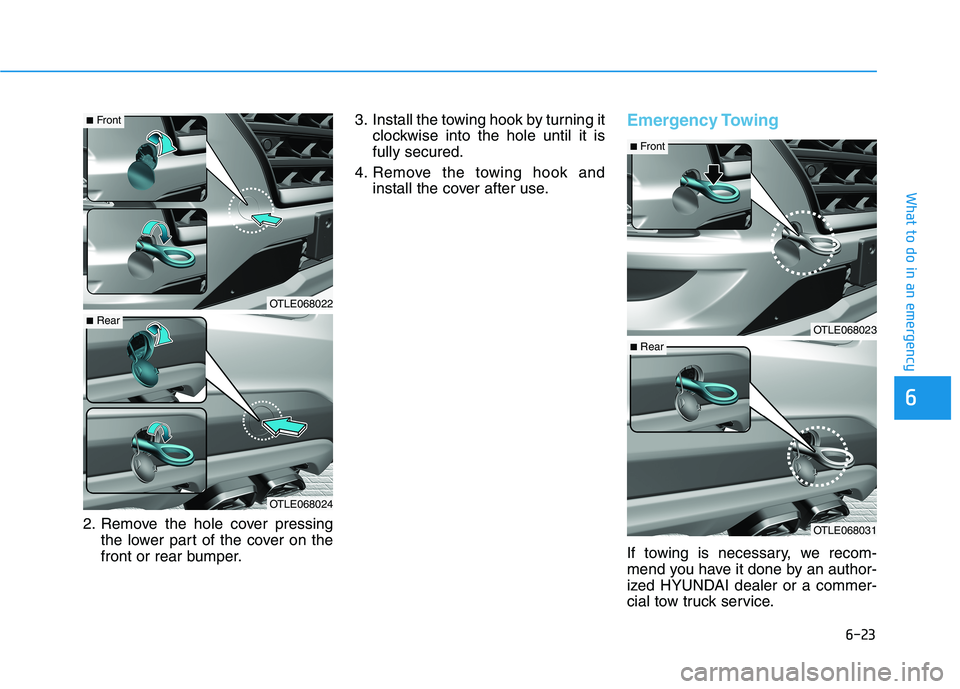
2. Remove the hole cover pressing
the lower part of the cover on the
front or rear bumper.3. Install the towing hook by turning it
clockwise into the hole until it is
fully secured.
4. Remove the towing hook and
install the cover after use.
Emergency Towing
If towing is necessary, we recom-
mend you have it done by an author-
ized HYUNDAI dealer or a commer-
cial tow truck service.
OTLE068022
OTLE068024
■Front
■RearOTLE068023
OTLE068031
■Front
■Rear
Page 433 of 546
6-24
What to do in an emergency
If towing service is not available in an
emergency, your vehicle may be
temporarily towed using a cable or
chain secured to the emergency tow-
ing hook at the front (or rear) of the
vehicle.
Use extreme caution when towing
the vehicle with a cable or chain. A
driver must be in the vehicle to steer
it and operate the brakes.
Towing in this manner may be done
only on hard-surfaced roads for a
short distance and at low speeds.
Also, the wheels, axles, power train,
steering and brakes must all be in
good condition. Always follow these emergency tow-
ing precautions:
• Place the ignition switch in the
ACC position so the steering
wheel is not locked. (if equipped)
Place the shift lever in N (Neutral).
Release the parking brake.
Depress the brake pedal with more force than normal since you will
have reduced braking perform-
ance.
More steering effort will be required because the power steer-
ing system will be disabled.
Use a vehicle heavier than your own to tow your vehicle.
The drivers of both vehicles should communicate with each other fre-
quently.
Before emergency towing, check that the hook is not broken or dam-
aged.
Fasten the towing cable or chain securely to the hook.
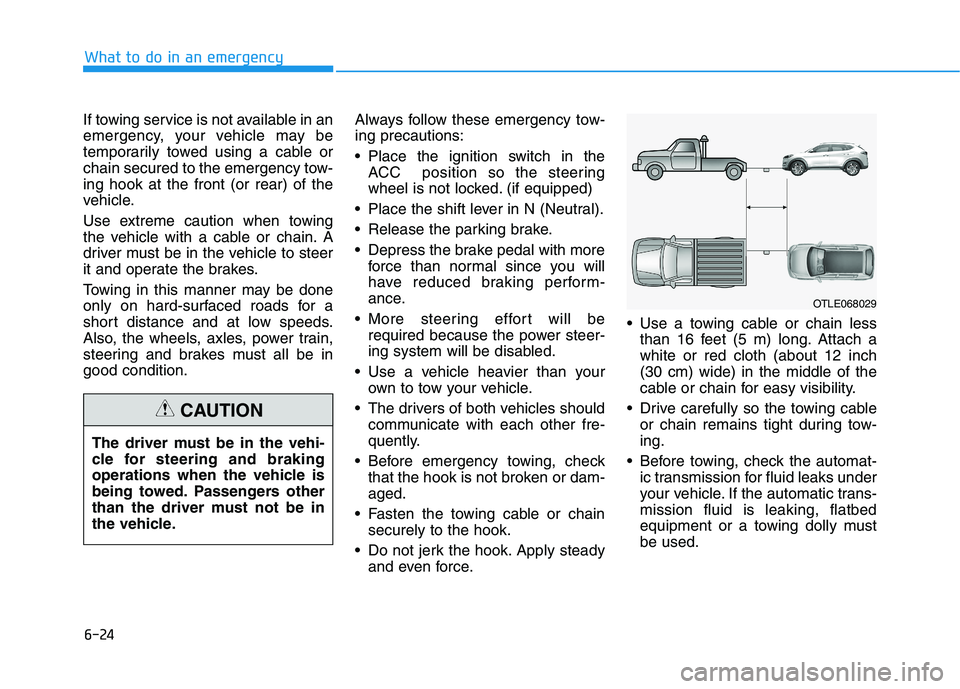
Do not jerk the hook. Apply steady and even force. Use a towing cable or chain less
than 16 feet (5 m) long. Attach a
white or red cloth (about 12 inch
(30 cm) wide) in the middle of the
cable or chain for easy visibility.
Drive carefully so the towing cable or chain remains tight during tow-
ing.
Before towing, check the automat- ic transmission for fluid leaks under
your vehicle. If the automatic trans-
mission fluid is leaking, flatbed
equipment or a towing dolly must
be used.
OTLE068029
The driver must be in the vehi-
cle for steering and braking
operations when the vehicle is
being towed. Passengers other
than the driver must not be in
the vehicle.
CAUTION
Page 435 of 546
7
Maintenance
7
Maintenance
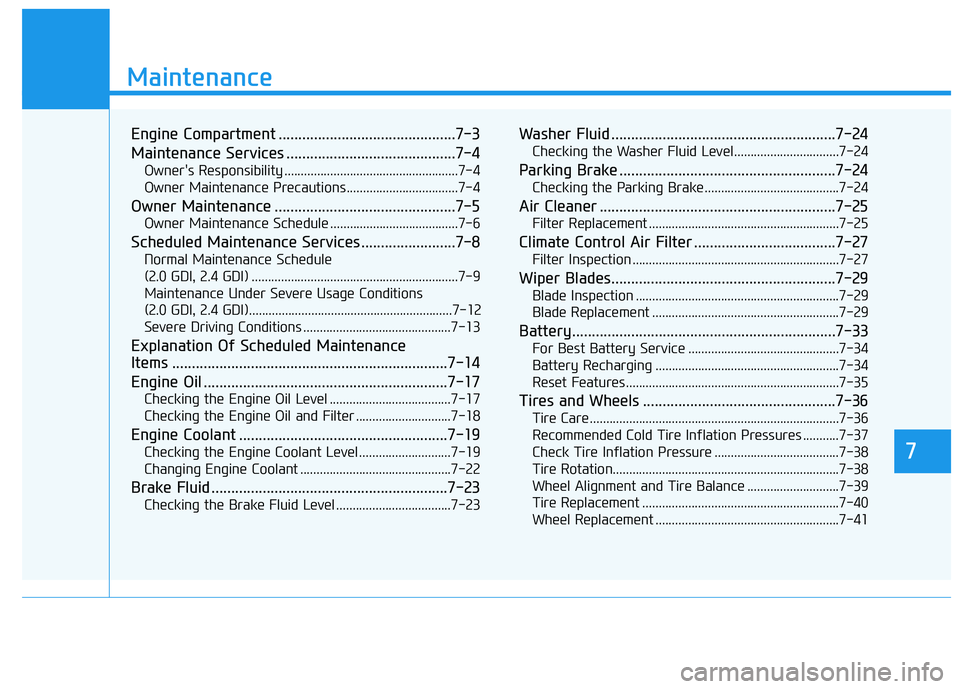
Engine Compartment .............................................7-3
Maintenance Services ...........................................7-4
Owner's Responsibility .....................................................7-4
Owner Maintenance Precautions..................................7-4
Owner Maintenance ..............................................7-5
Owner Maintenance Schedule .......................................7-6
Scheduled Maintenance Services........................7-8
Normal Maintenance Schedule
(2.0 GDI, 2.4 GDI) ...............................................................7-9
Maintenance Under Severe Usage Conditions
(2.0 GDI, 2.4 GDI)..............................................................7-12
Severe Driving Conditions .............................................7-13
Explanation Of Scheduled Maintenance
Items ......................................................................7-\
14
Engine Oil ..............................................................7-17
Checking the Engine Oil Level .....................................7-17
Checking the Engine Oil and Filter .............................7-18
Engine Coolant .....................................................7-19
Checking the Engine Coolant Level ............................7-19
Changing Engine Coolant ..............................................7-22
Brake Fluid ............................................................7-23
Checking the Brake Fluid Level ...................................7-23
Washer Fluid .........................................................7-24
Checking the Washer Fluid Level................................7-24
Parking Brake .......................................................7-24
Checking the Parking Brake .........................................7-24
Air Cleaner ............................................................7-25
Filter Replacement ..........................................................7-25
Climate Control Air Filter ....................................7-27
Filter Inspection ...............................................................7-27
Wiper Blades.........................................................7-29
Blade Inspection ..............................................................7-29
Blade Replacement .........................................................7-29
Battery...................................................................7-33
For Best Battery Service ..............................................7-34
Battery Recharging ........................................................7-34
Reset Features.................................................................7-35
Tires and Wheels .................................................7-36
Tire Care ........................................................................\
....7-36
Recommended Cold Tire Inflation Pressures ...........7-37
Check Tire Inflation Pressure ......................................7-38
Tire Rotation...................................................................\
..7-38
Wheel Alignment and Tire Balance ............................7-39
Tire Replacement ............................................................7-40
Wheel Replacement ........................................................7-41
7
Page 438 of 546
7-4
Maintenance
M
MA
AI
IN
N T
TE
EN
N A
AN
N C
CE
E
S
S E
E R
R V
V I
IC
C E
E S
S
You should exercise the utmost care
to prevent damage to your vehicle
and injury to yourself whenever per-
forming any maintenance or inspec-
tion procedures.
We recommend you have your vehi-
cle maintained and repaired by an
authorized HYUNDAI dealer. An
authorized HYUNDAI dealer meets
HYUNDAI's high service quality
standards and receives technical
support from HYUNDAI in order to
provide you with a high level of serv-
ice satisfaction.
Owner's Responsibility
Maintenance service and record
retention are the owner's responsibil-
ity.
You should retain documents that
show proper maintenance has been
performed on your vehicle in accor-
dance with the scheduled mainte-
nance service charts shown on the
following pages. You need this infor-
mation to establish your compliance
with the servicing and maintenance
requirements of your vehicle war-
ranties. Detailed warranty information is pro-
vided in your Owner's Handbook &
Warranty Information booklet.
Repairs and adjustments required as
a result of improper maintenance or
a lack of required maintenance are
not covered.
Owner Maintenance
Precautions
Inadequate, incomplete or insuffi-
cient servicing may result in opera-
tional problems with your vehicle that
could lead to vehicle damage, an
accident, or personal injury. This
chapter provides instructions only for
the maintenance items that are easy
to perform. Several procedures can
be done only by an authorized
HYUNDAI dealer with special tools.
Your vehicle should not be modified
in any way. Such modifications may
adversely affect the performance,
safety or durability of your vehicle
and may, in addition, violate condi-
tions of the limited warranties cover-
ing the vehicle.
Certain modifications may also be in
violation of regulations established
by the U.S. Department of
Transportation and other federal or
state agencies.
Improper owner maintenance dur-
ing the warranty period may affect
warranty coverage. For details,
read the separate Owner's
Handbook & Warranty Information
booklet provided with the vehicle.
If you're unsure about any service
or maintenance procedure, have it
done by an authorized HYUNDAI
dealer.
NOTICE
Page 445 of 546
7-11
7
Maintenance
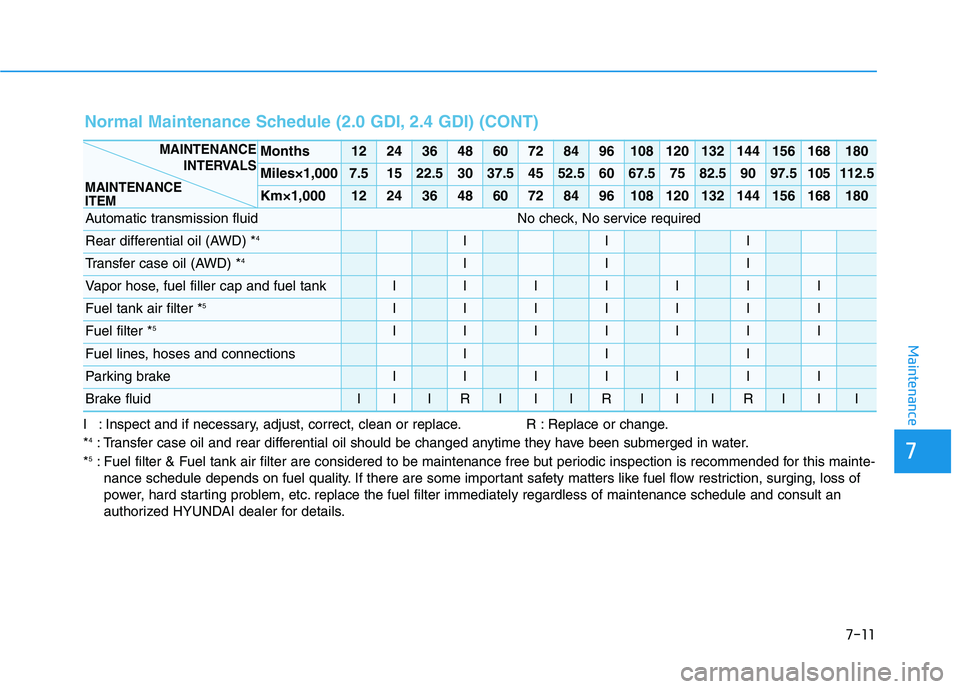
I : Inspect and if necessary, adjust, correct, clean or replace. R : Replace or change.
*4: Transfer case oil and rear differential oil should be changed anytime they have been submerged in water.
*5: Fuel filter & Fuel tank air filter are considered to be maintenance free\
but periodic inspection is recommended for this mainte- nance schedule depends on fuel quality. If there are some important safety matters like fuel flow restriction, surging, loss of
power, hard starting problem, etc. replace the fuel filter immediately regardless of maintenance schedule a\
nd consult an
authorized HYUNDAI dealer for details.
Months1224364860728496108120132144156168180
Miles×1,0007.51522.53037.54552.56067.57582.59097.5105112.5
Km×1,0001224364860728496108120132144156168180
Automatic transmission fluidNo check, No service required
Rear differential oil (AWD) *4III
Transfer case oil (AWD) *4III
Vapor hose, fuel filler cap and fuel tankIIIIIII
Fuel tank air filter *5IIIIIII
Fuel filter *5IIIIIII
Fuel lines, hoses and connectionsIII
Parking brakeIIIIIII
Brake fluidIIIRIIIRIIIRIII
MAINTENANCE INTERVALS
MAINTENANCE
ITEM
Normal Maintenance Schedule (2.0 GDI, 2.4 GDI) (CONT)
Page 446 of 546

7-12
Maintenance
Maintenance itemMaintenanceoperationMaintenance intervalsDriving condition
Engine oil and filterREvery 3,750 miles or 6 monthsA, B, C, D, E, F, G, H, I, J, K
Air cleaner filterRMore frequentlyC, E
Spark plugsRMore frequentlyA, B, H, I, K
Automatic transmission fluidREvery 60,000 milesA, C, D, E, F, G, I
Front brake disc/pads, calipersIMore frequentlyC, D, G, H
Rear brake disc/padsIMore frequentlyC, D, G, H
Parking brakeIMore frequentlyC, D, G, H
Maintenance Under Severe Usage Conditions (2.0 GDI, 2.4 GDI)
The following items must be serviced more frequently on cars normally used under severe driving conditions.
Refer to the chart below for the appropriate maintenance intervals.
I : Inspect and if necessary, adjust, correct, clean or replace. R : Replace or change.
Page 464 of 546
7-30
Maintenance
Front windshield wiper bladereplacement
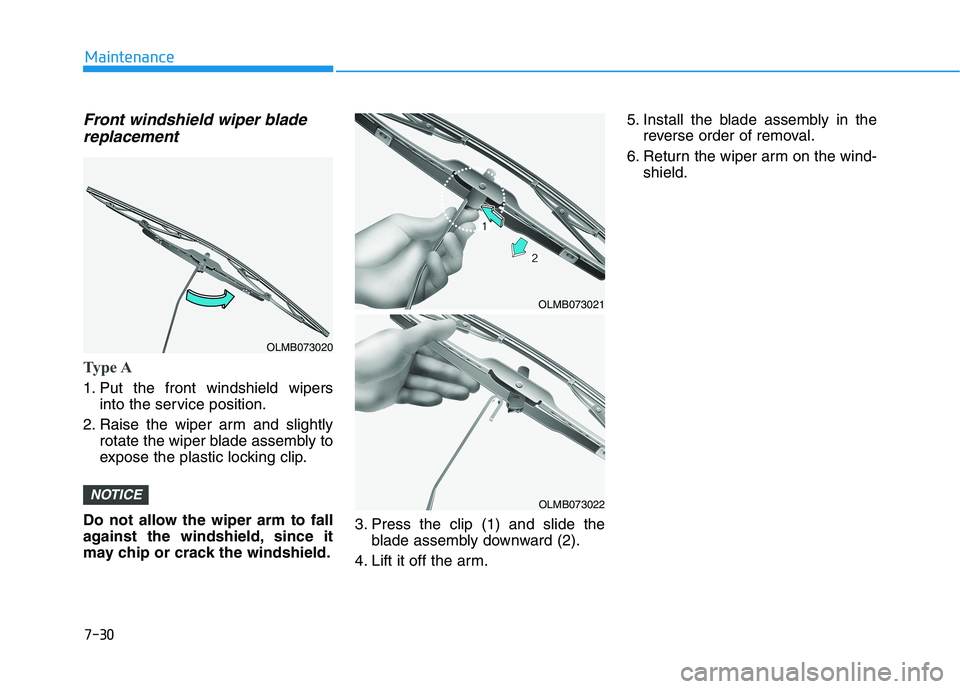
Type A
1. Put the front windshield wipers
into the service position.
2. Raise the wiper arm and slightly rotate the wiper blade assembly to
expose the plastic locking clip.
Do not allow the wiper arm to fall
against the windshield, since it
may chip or crack the windshield. 3. Press the clip (1) and slide the
blade assembly downward (2).
4. Lift it off the arm. 5. Install the blade assembly in the
reverse order of removal.
6. Return the wiper arm on the wind- shield.
NOTICE
OLMB073021
OLMB073022
OLMB073020
Page 468 of 546
7-34
Maintenance
When you do not use the vehicle for a long time in a low tempera-
ture area, disconnect the battery
and keep it indoors.
Always charge the battery fully to prevent battery case damage
in low temperature areas.
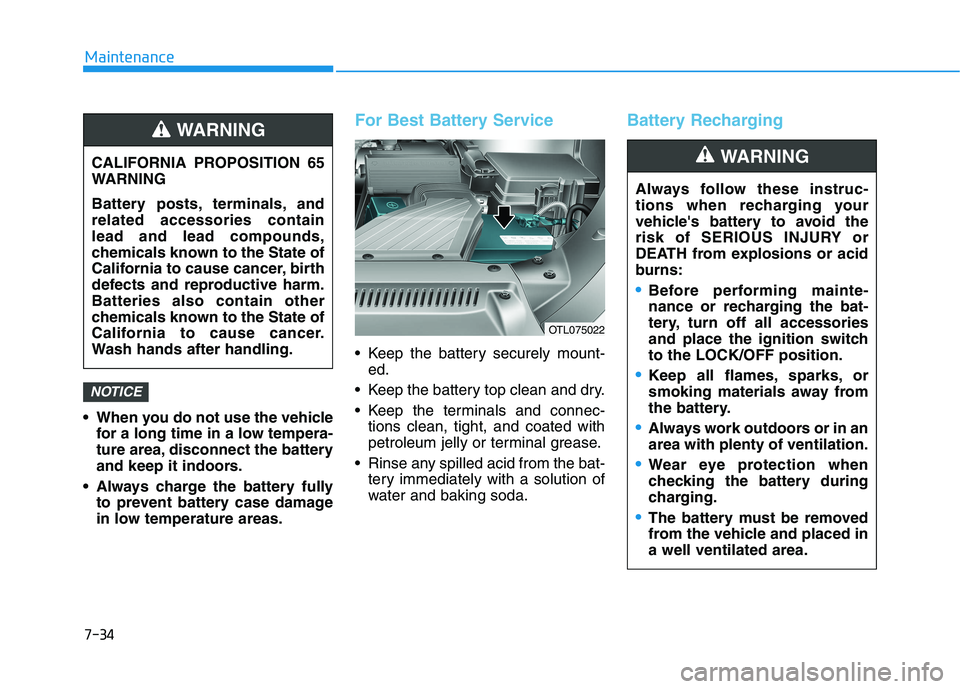
For Best Battery Service
Keep the battery securely mount-ed.
Keep the battery top clean and dry.
Keep the terminals and connec- tions clean, tight, and coated with
petroleum jelly or terminal grease.
Rinse any spilled acid from the bat- tery immediately with a solution of
water and baking soda.
Battery Recharging
NOTICE
CALIFORNIA PROPOSITION 65
WARNING
Battery posts, terminals, and
related accessories contain
lead and lead compounds,
chemicals known to the State of
California to cause cancer, birth
defects and reproductive harm.
Batteries also contain other
chemicals known to the State of
California to cause cancer.
Wash hands after handling.
WARNING
Always follow these instruc-
tions when recharging your
vehicle's battery to avoid the
risk of SERIOUS INJURY or
DEATH from explosions or acid
burns:
Before performing mainte-
nance or recharging the bat-
tery, turn off all accessories
and place the ignition switch
to the LOCK/OFF position.
Keep all flames, sparks, or
smoking materials away from
the battery.
Always work outdoors or in an
area with plenty of ventilation.
Wear eye protection when
checking the battery during
charging.
The battery must be removed
from the vehicle and placed in
a well ventilated area.
WARNING
OTL075022