check engine HYUNDAI TUCSON 2022 Manual PDF
[x] Cancel search | Manufacturer: HYUNDAI, Model Year: 2022, Model line: TUCSON, Model: HYUNDAI TUCSON 2022Pages: 638, PDF Size: 82.3 MB
Page 536 of 638
Emergency situations
8-10
Tire pressure monitoring system
WARNING
Over-inflation or under-inflation can
reduce tire life, adversely affect vehicle
handling, and lead to sudden tire failure
that may cause loss of vehicle control
resulting in an accident.
Each tire, including the spare (if
provided), should be checked monthly
when cold and inflated to the inflation
pressure recommended by the vehicle
manufacturer on the vehicle placard
or tire inflation pressure label. (If your
vehicle has tires of a different size than
the size indicated on the vehicle placard
or tire inflation pressure label, you should
determine the proper tire inflation
pressure for those tires.)
As an added safety feature, your
vehicle has been equipped with a tire
pressure monitoring system (TPMS)
that illuminates a low tire pressure
telltale when one or more of your tires is
significantly under-inflated. Accordingly,
when the low tire pressure telltale
illuminates, you should stop and check
your tires as soon as possible, and inflate
them to the proper pressure. Driving on
a significantly under-inflated tire causes
the tire to overheat and can lead to tire
failure.
Under-inflation also reduces fuel
efficiency and tire tread life, and may
affect the vehicle’s handling and
stopping ability.
Please note that the TPMS is not a
substitute for proper tire maintenance,
and it is the driver’s responsibility to
maintain correct tire pressure, even if
under-inflation has not reached the level
to trigger illumination of the TPMS low
tire pressure telltale.
Your vehicle has also been equipped with
a TPMS malfunction indicator to indicate
when the system is not operating
properly. The TPMS malfunction
indicator is combined with the low
tire pressure telltale. When the system
detects a malfunction, the telltale will
flash for approximately one minute and
then remain continuously illuminated.
This sequence will continue upon
subsequent vehicle start-ups as long as
the malfunction exists.
When the malfunction indicator is
illuminated, the system may not be able
to detect or signal low tire pressure as
telltale. TPMS malfunctions may occur
for a variety of reasons, including the
installation of replacement or alternate
tires or wheels on the vehicle that
prevent the TPMS from functioning
properly.
Always check the TPMS malfunction
telltale after replacing one or more tires
or wheels on your vehicle to ensure that
the replacement or alternate tires and
wheels allow the TPMS to continue to
function properly.
NOTICE
If any of the below happens, we
recommend that you have the system
checked by an authorized HYUNDAI
dealer.
1. The Low Tire Pressure Telltale/ TPMS
Malfunction Indicator does not
illuminate for 3 seconds when the
Engine Start/Stop button is pressed
to the ON position or when the
engine is running.
2. The TPMS Malfunction Indicator
remains illuminated after blinking for
approximately 1 minute.
3. The Low Tire Pressure Position
Telltale remains illuminated.
Page 551 of 638

Maintenance
9. Maintenance
Engine compartment ........................................................................\
................9-3
Maintenance services
........................................................................\
...............9-4Owner’s responsibility ........................................................................\
........................9-4
Owner maintenance precautions ........................................................................\
....... 9-4
Owner maintenance ........................................................................\
.................9-5Owner maintenance schedule ........................................................................\
...........9-6
Scheduled maintenance services .....................................................................9 -7Normal maintenance schedule ........................................................................\
..........9-8
Maintenance under severe usage conditions ..........................................................9-12
Explanation of scheduled maintenance items ..............................................9-14
Engine oil
........................................................................\
..................................9-17Checking the engine oil level ........................................................................\
.............9-17
Checking the Engine Oil and Filter ........................................................................\
...9-1 8
Engine coolant ........................................................................\
.......................9-20Checking the coolant level ........................................................................\
...............9-20
Changing coolant ........................................................................\
...............................9-22
Brake fluid ........................................................................\
...............................9-23Checking the brake fluid level ........................................................................\
...........9-23
Washer fluid ........................................................................\
............................9-24Checking the washer fluid level ........................................................................\
........9-24
Air cleaner ........................................................................\
...............................9-25Filter replacement ........................................................................\
..............................9-25
Cabin air filter ........................................................................\
..........................9-26Filter inspection ........................................................................\
..................................9-26
Filter replacement ........................................................................\
..............................9-26
Wiper blades ........................................................................\
............................9-27Blade inspection ........................................................................\
.................................9-27
Blade replacement ........................................................................\
.............................9-27
Battery ........................................................................\
.....................................9-32
For best battery service ........................................................................\
.....................9-33
Battery capacity label ........................................................................\
........................9-3 3
Battery recharging ........................................................................\
.............................9-34
Reset items ........................................................................\
.........................................9-35
9
Page 552 of 638

Tires and wheels ........................................................................\
.....................9-36Tire care ........................................................................\
..............................................9-36
Recommended cold tire inflation pressures ............................................................9-36
Check tire inflation pressure ........................................................................\
.............9-37
Tire rotation ........................................................................\
.......................................9-38
Wheel alignment and tire balance ........................................................................\
....9-39
Tire replacement ........................................................................\
................................9-39
Wheel replacement ........................................................................\
...........................9-40
Tire traction ........................................................................\
.......................................9-40
Tire maintenance ........................................................................\
..............................9-40
Tire sidewall labeling ........................................................................\
..........................9-41
Low aspect ratio tires ........................................................................\
........................9-44
Fuses ........................................................................\
........................................9-45Instrument panel fuse replacement ........................................................................\
9-46
Engine compartment panel fuse replacement ........................................................9-47
Fuse/relay panel description ........................................................................\
............9-48
Light bulbs ........................................................................\
...............................9-54Headlamp, position lamp, turn signal lamp, Daytime Running Light (DRL)
replacement ........................................................................\
.......................................9-55
Side repeater lamp replacement ........................................................................\
.....9-56
Rear combination lamp replacement ......................................................................9-56
High mounted stop lamp replacement ...................................................................9-60
License plate lamp replacement ........................................................................\
......9-60
Interior light replacement ........................................................................\
..................9-61
Appearance care ........................................................................\
.....................9-63Exterior care ........................................................................\
......................................9-63
Interior care ........................................................................\
.......................................9-68
Emission control system ........................................................................\
.......... 9-71Gasoline Particulate Filter (GPF) ........................................................................\
....... 9-73
California perchlorate notice ........................................................................\
..9 -74
9
Page 555 of 638
09
9-5
WARNING
Performing maintenance work on a
vehicle can be dangerous. If you lack
sufficient knowledge and experience or
the proper tools and equipment to do
the work, we recommend that having it
done by an authorized HYUNDAI dealer.
ALWAYS follow these precautions for
performing maintenance work:
• Park your vehicle on level ground.
Shift the vehicle to P (Park), apply
the parking brake, and press the
Engine Start/Stop button to the OFF
position.
• Block the tires (front and back) to
prevent the vehicle from moving.
Remove loose clothing or jewelry
that can become entangled in
moving parts.
• If you must run the engine during
maintenance, do so out doors or in
an area with plenty of ventilation.
• Keep flames, sparks, or smoking
materials away from the battery and
fuel-related parts.
WARNING
Touching metal parts
Do not touch metal parts (including
strut bars) while the engine is operating
or hot. Doing so could result in serious
personal injury. Turn the engine off and
wait until the metal parts cool down
to perform maintenance work on the
vehicle. The following lists are vehicle checks and
inspections that should be performed
by the owner or an authorized HYUNDAI
dealer at the frequencies indicated to
help ensure safe, dependable operation
of your vehicle.
Any adverse conditions should be
brought to the attention of your dealer as
soon as possible.
These Owner Maintenance vehicle
checks are generally not covered by
warranties and you may be charged for
labor, parts and lubricants used.
OWNER MAINTENANCE
Page 556 of 638
Maintenance
9-6
Owner maintenance schedule
When you stop for fuel:
• Check the coolant level in the engine
coolant reservoir.
• Check the windshield washer fluid
level.
• Check for low or under-inflated tires.
WARNING
Be careful when checking your coolant
level when the engine is hot. This may
result in coolant being blown out of the
opening and cause serious burns and
other injuries.
While operating your vehicle:
• Note any changes in the sound of the
exhaust or any smell of exhaust fumes
in the vehicle.
• Check for vibrations in the steering
wheel. Notice if there is any increased
steering effort or looseness in the
steering wheel, or change in its
straight-ahead position.
• Notice if your vehicle constantly turns
slightly or “pulls” to one side when
traveling on smooth, level road.
• When stopping, listen and check for
unusual sounds, pulling to one side,
increased brake pedal travel or “hard-
to-push” brake pedal.
• If any slipping or changes in the
operation of your transmission occurs,
check the transmission fluid level.
• Check the automatic transmission P
(Park) function.
• Check the parking brake.
• Check for fluid leaks under your
vehicle (water dripping from the air
conditioning system during or after
use is normal).
At least monthly:
• Check coolant level in the engine
coolant reservoir.
• Check the operation of all exterior
lights, including the stoplights, turn
signals and hazard warning flashers.
• Check the inflation pressures of all
tires including the spare for tires that
are worn, show uneven wear, or are
damaged.
• Check for loose wheel lug nuts.
At least twice a year:
• Check radiator, heater and air
conditioning hoses for leaks or
damage.
• Check windshield washer spray and
wiper operation. Clean wiper blades
with a clean cloth dampened with
washer fluid.
• Check headlamp alignment.
• Check muffler, exhaust pipes, shields
and clamps.
• Check the seat belts for wear and
function.
At least once a year:
• Clean body and door drain holes.
• Lubricate door hinges and hood
hinges.
• Lubricate door and hood locks and
latches.
• Lubricate door rubber weather strips.
• Check the air conditioning system.
• Inspect and lubricate automatic
transmission linkage and controls.
• Clean the battery and terminals.
• Check the brake fluid level.
Page 557 of 638
09
9 -7
Follow Normal Maintenance Schedule if the vehicle is usually operated where none of
the following conditions apply. If any of the following conditions apply, you must follow
the Maintenance Under Severe Usage Conditions.
• Repeated driving short distance of less than 5 miles (8 km) in normal temperature or
less than 10 miles (16 km) in freezing temperature
• Extensive engine idling or low speed driving for long distances
• Driving on rough, dusty, muddy, unpaved, graveled or salt-spread roads
• Driving in areas using salt or other corrosive materials or in very cold weather
• Driving in heavy dust conditions
• Driving in heavy traffic area
• Driving on uphill, downhill, or mountain road repeatedly
• Towing a trailer or using a camper, or driving with loads on the roof
• Driving as a patrol car, taxi, other commercial use of vehicle towing
• Frequently driving under high speed or rapid acceleration/deceleration
• Frequently driving in stop-and-go condition
• Engine oil usage which is not recommended (Mineral type, Semi-synthetic, Lower
grade spec, etc.)
If your vehicle is operated under the above conditions, you should inspect, replace
or refill more frequently than the following Normal Maintenance Schedule. After the
periods or distance shown in the chart, continue to follow the prescribed maintenance
intervals.
Information
• As it is normal for engine oil to be consumed during driving, the engine oil level should
be checked on regular basis.
• The engine oil change interval for normal operating conditions is based on the use of
the recommended engine specification. If the recommended engine oil specification
is not used, then replace the engine oil according to the maintenance schedule under
severe operating conditions.
SCHEDULED MAINTENANCE SERVICES
Page 558 of 638
Maintenance
9-8
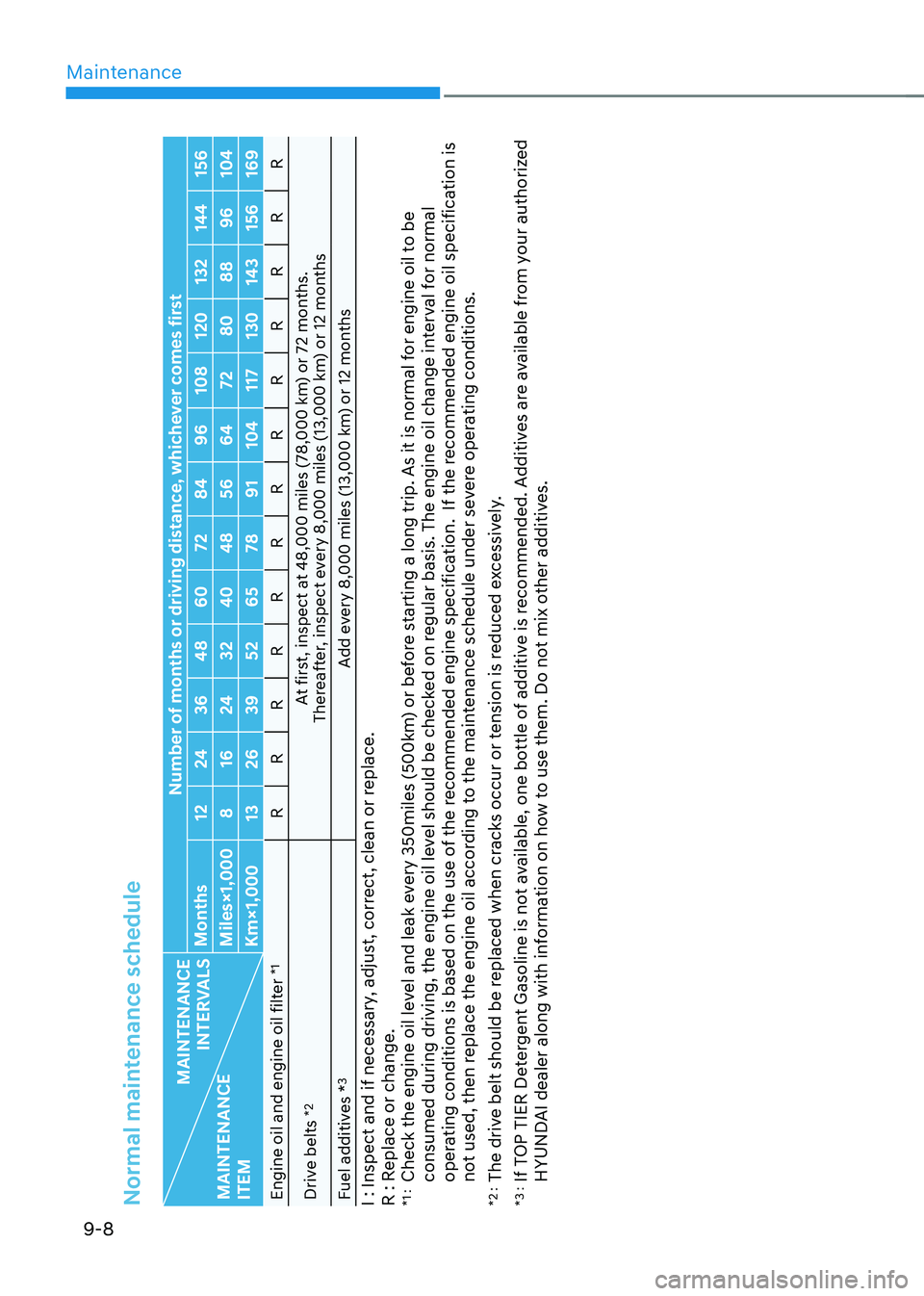
Normal maintenance schedule
MAINTENANCE
INTERVALS
MAINTENANCE
ITEM Number of months or driving distance, whichever comes first
Months 1224 3648 60 7284 96108 120132144 156
Miles×1,000 816 24 3240 48 5664 7280 8896104
Km×1,000 1326 39 5265 78 91104 117130 143156169
Engine oil and engine oil filter
*1
R RRRRRRR RRRRR
Drive belts
*2
At first, inspect at 48,000 miles (78,000 km) or 72 months.
Thereafter, inspect every 8,000 miles (13,000 km) or 12 months
Fuel additives *
3
Add every 8,000 miles (13,000 km) or 12 months
I : Inspect and if necessary, adjust, correct, clean or replace.
R : Replace or change.*1 : Check the engine oil level and leak every 350miles (500km) or before starting a long trip. As it is normal for engine oil to be consumed during driving, the engine oil level should be checked on regular basis. The engine oil change interval for normal
operating conditions is based on the use of the recommended engine specification. If the recommended engine oil specification is
not used, then replace the engine oil according to the maintenance schedule under severe operating conditions.
*2 : The drive belt should be replaced when cracks occur or tension is reduced excessively.
*3 : If TOP TIER Detergent Gasoline is not available, one bottle of additive is recommended. Additives are available from your authorized
HYUNDAI dealer along with information on how to use them. Do not mix other additives.
Page 561 of 638
09
9-11
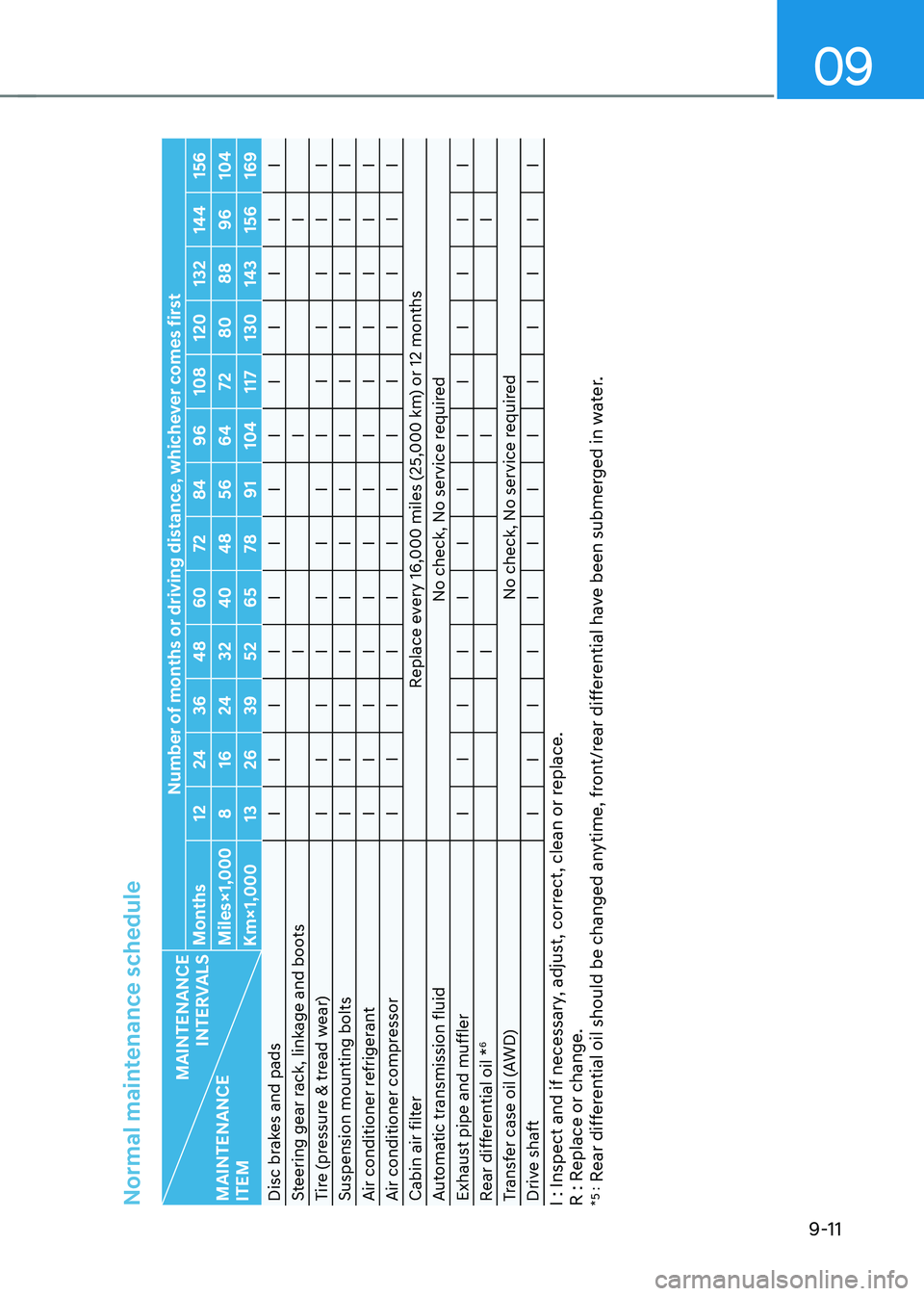
Normal maintenance schedule
MAINTENANCE
INTERVALS
MAINTENANCE
ITEM Number of months or driving distance, whichever comes first
Months 1224 3648 60 7284 96108 120 132144 156
Miles×1,000 816 24 3240 48 5664 7280 8896104
Km×1,000 1326 39 5265 78 91104 117130 143156169
Engine coolant At first, replace at 120,000 miles (200,000 km) or 120 months.
After that, replace every 24,000 miles (40,000 km) or 24 months
Battery condition IIIIIIIIIIIII
Brake lines, hoses and connections IIIIIIIIIIIII
Brake pedal IIIIII
Parking brake (if equipped) IIIIII
Brake fluid Inspect every 8,000 miles (13,000 km) or 12 months,
Replace every 48,000 miles (78,000 km) or 48 monthsI : Inspect and if necessary, adjust, correct, clean or replace.
R : Replace or change.Normal maintenance schedule
MAINTENANCE
INTERVALS
MAINTENANCE
ITEM Number of months or driving distance, whichever comes first
Months 1224 3648 60 7284 96108 120 132144 156
Miles×1,000 816 24 3240 48 5664 7280 8896104
Km×1,000 1326 39 5265 78 91104 117130 143156169
Disc brakes and pads IIIIIIIIIIIII
Steering gear rack, linkage and boots III
Tire (pressure & tread wear) IIIIIIIIIIIII
Suspension mounting bolts IIIIIIIIIIIII
Air conditioner refrigerant IIIIIIIIIIIII
Air conditioner compressor IIIIIIIIIIIII
Cabin air filter Replace every 16,000 miles (25,000 km) or 12 months
Automatic transmission fluid No check, No service required
Exhaust pipe and muffler IIIIIIII
IIIII
Rear differential oil *
6
I II
Transfer case oil (AWD) No check, No service required
Drive shaft IIIIIIIIIIIII
I : Inspect and if necessary, adjust, correct, clean or replace.
R : Replace or change.*5 : Rear differential oil should be changed anytime, front/rear differential have been submerged in water.
Page 563 of 638
09
9-13
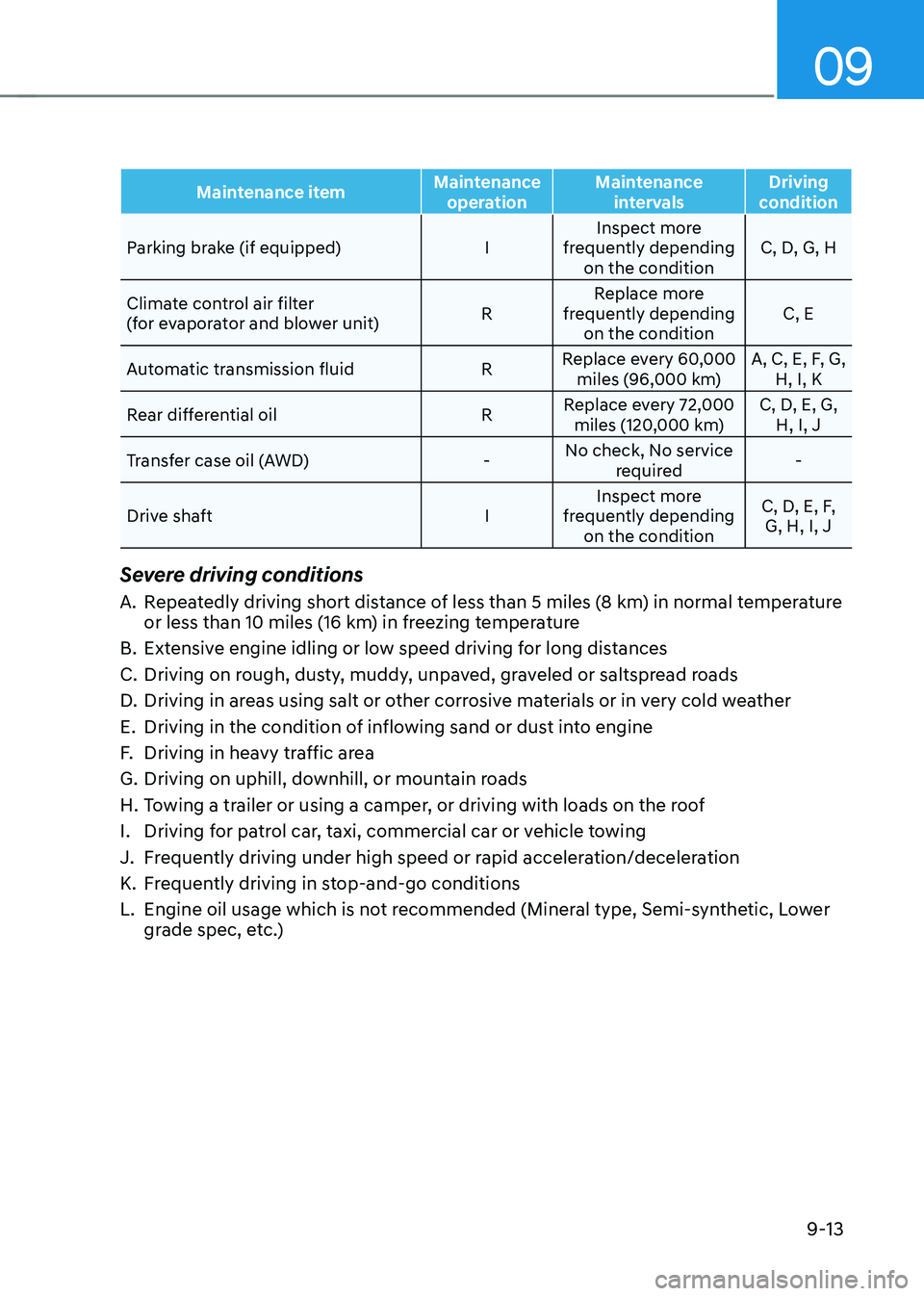
Maintenance itemMaintenance
operation Maintenance
intervals Driving
condition
Parking brake (if equipped) IInspect more
frequently depending on the condition C, D, G, H
Climate control air filter
(for evaporator and blower unit) RReplace more
frequently depending on the condition C, E
Automatic transmission fluid RReplace every 60,000
miles (96,000 km) A, C, E, F, G,
H, I, K
Rear differential oil RReplace every 72,000
miles (120,000 km) C, D, E, G,
H, I, J
Transfer case oil (AWD) -No check, No service
required -
Drive shaft IInspect more
frequently depending on the condition C, D, E, F,
G, H, I, J
Severe driving conditions
A. Repeatedly driving short distance of less than 5 miles (8 km) in normal temperature
or less than 10 miles (16 km) in freezing temperature
B. Extensive engine idling or low speed driving for long distances
C. Driving on rough, dusty, muddy, unpaved, graveled or saltspread roads
D. Driving in areas using salt or other corrosive materials or in very cold weather
E. Driving in the condition of inflowing sand or dust into engine
F. Driving in heavy traffic area
G. Driving on uphill, downhill, or mountain roads
H. Towing a trailer or using a camper, or driving with loads on the roof
I. Driving for patrol car, taxi, commercial car or vehicle towing
J. Frequently driving under high speed or rapid acceleration/deceleration
K. Frequently driving in stop-and-go conditions
L. Engine oil usage which is not recommended (Mineral type, Semi-synthetic, Lower
grade spec, etc.)
Page 564 of 638
Maintenance
9-14
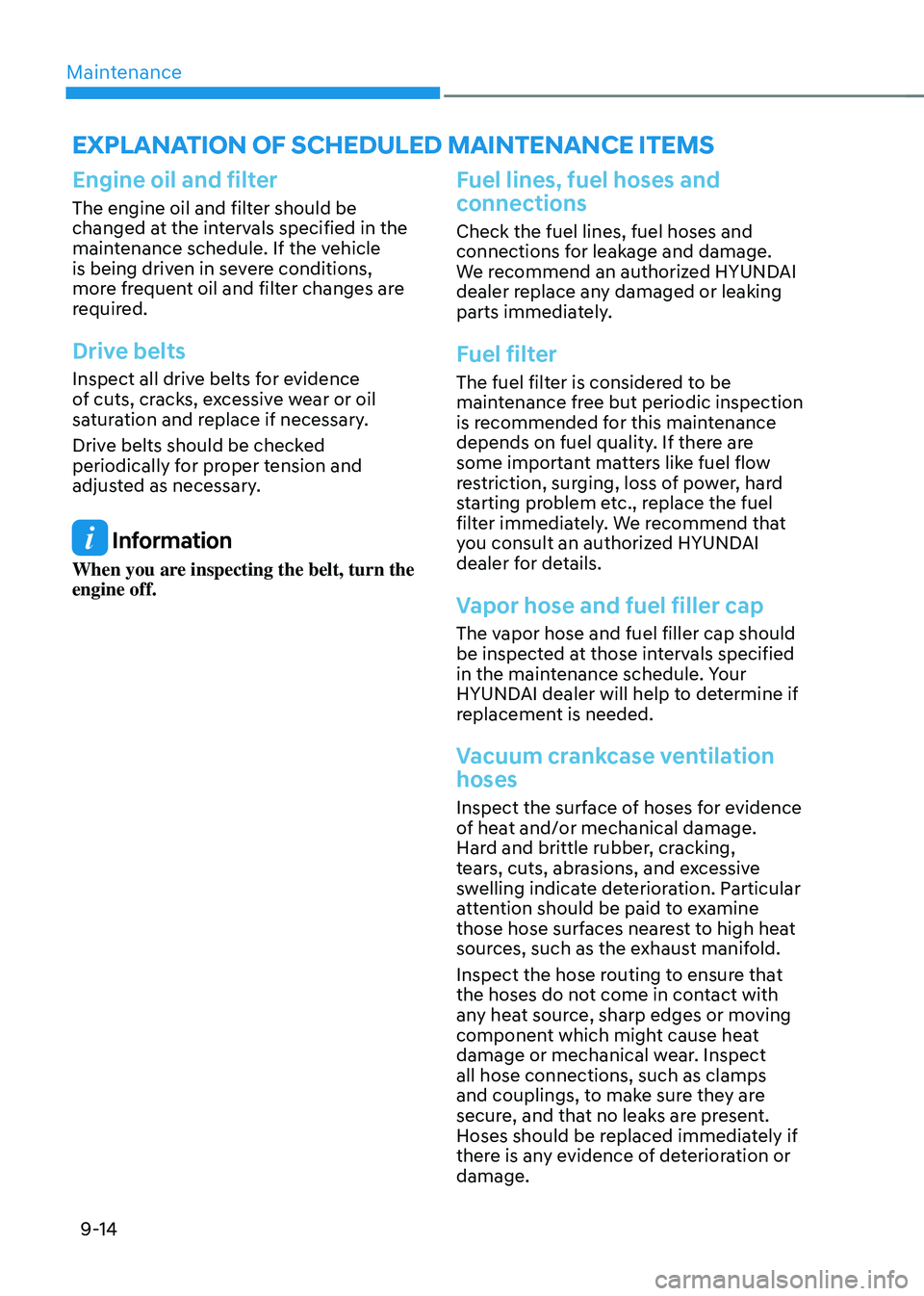
Engine oil and filter
The engine oil and filter should be
changed at the intervals specified in the
maintenance schedule. If the vehicle
is being driven in severe conditions,
more frequent oil and filter changes are
required.
Drive belts
Inspect all drive belts for evidence
of cuts, cracks, excessive wear or oil
saturation and replace if necessary.
Drive belts should be checked
periodically for proper tension and
adjusted as necessary.
Information
When you are inspecting the belt, turn the
engine off.
Fuel lines, fuel hoses and
connections
Check the fuel lines, fuel hoses and
connections for leakage and damage.
We recommend an authorized HYUNDAI
dealer replace any damaged or leaking
parts immediately.
Fuel filter
The fuel filter is considered to be
maintenance free but periodic inspection
is recommended for this maintenance
depends on fuel quality. If there are
some important matters like fuel flow
restriction, surging, loss of power, hard
starting problem etc., replace the fuel
filter immediately. We recommend that
you consult an authorized HYUNDAI
dealer for details.
Vapor hose and fuel filler cap
The vapor hose and fuel filler cap should
be inspected at those intervals specified
in the maintenance schedule. Your
HYUNDAI dealer will help to determine if
replacement is needed.
Vacuum crankcase ventilation
hoses
Inspect the surface of hoses for evidence
of heat and/or mechanical damage.
Hard and brittle rubber, cracking,
tears, cuts, abrasions, and excessive
swelling indicate deterioration. Particular
attention should be paid to examine
those hose surfaces nearest to high heat
sources, such as the exhaust manifold.
Inspect the hose routing to ensure that
the hoses do not come in contact with
any heat source, sharp edges or moving
component which might cause heat
damage or mechanical wear. Inspect
all hose connections, such as clamps
and couplings, to make sure they are
secure, and that no leaks are present.
Hoses should be replaced immediately if
there is any evidence of deterioration or
damage.
EXPLANATION OF SCHEDULED MAINTENANCE ITEMS