brake fluid HYUNDAI TUCSON HYBRID 2021 User Guide
[x] Cancel search | Manufacturer: HYUNDAI, Model Year: 2021, Model line: TUCSON HYBRID, Model: HYUNDAI TUCSON HYBRID 2021Pages: 630, PDF Size: 77.98 MB
Page 553 of 630
Maintenance
9-6
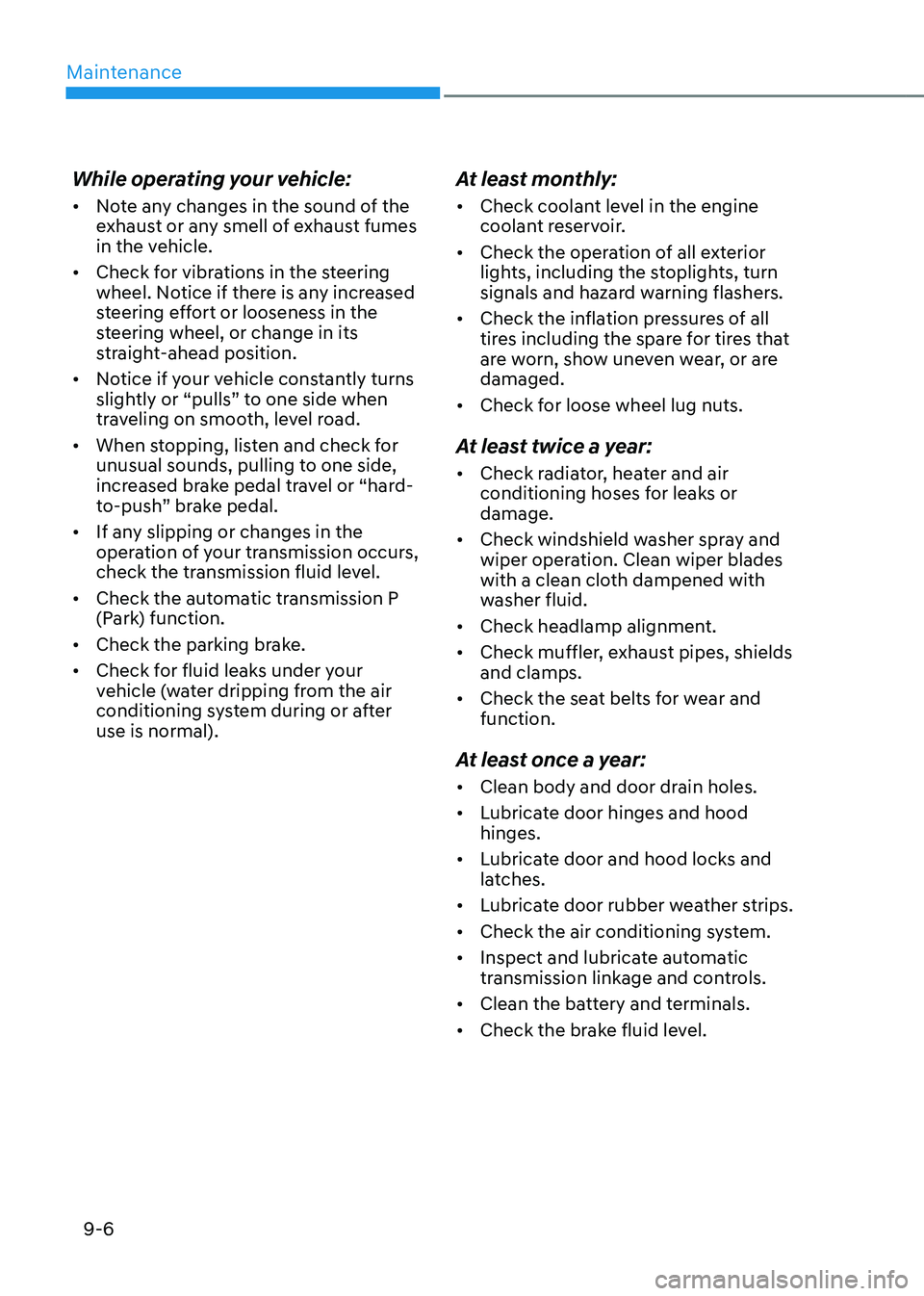
While operating your vehicle:
• Note any changes in the sound of the
exhaust or any smell of exhaust fumes
in the vehicle.
• Check for vibrations in the steering
wheel. Notice if there is any increased
steering effort or looseness in the
steering wheel, or change in its
straight-ahead position.
• Notice if your vehicle constantly turns
slightly or “pulls” to one side when
traveling on smooth, level road.
• When stopping, listen and check for
unusual sounds, pulling to one side,
increased brake pedal travel or “hard-
to-push” brake pedal.
• If any slipping or changes in the
operation of your transmission occurs,
check the transmission fluid level.
• Check the automatic transmission P
(Park) function.
• Check the parking brake.
• Check for fluid leaks under your
vehicle (water dripping from the air
conditioning system during or after
use is normal).
At least monthly:
• Check coolant level in the engine
coolant reservoir.
• Check the operation of all exterior
lights, including the stoplights, turn
signals and hazard warning flashers.
• Check the inflation pressures of all
tires including the spare for tires that
are worn, show uneven wear, or are
damaged.
• Check for loose wheel lug nuts.
At least twice a year:
• Check radiator, heater and air
conditioning hoses for leaks or
damage.
• Check windshield washer spray and
wiper operation. Clean wiper blades
with a clean cloth dampened with
washer fluid.
• Check headlamp alignment.
• Check muffler, exhaust pipes, shields
and clamps.
• Check the seat belts for wear and
function.
At least once a year:
• Clean body and door drain holes.
• Lubricate door hinges and hood
hinges.
• Lubricate door and hood locks and
latches.
• Lubricate door rubber weather strips.
• Check the air conditioning system.
• Inspect and lubricate automatic
transmission linkage and controls.
• Clean the battery and terminals.
• Check the brake fluid level.
Page 556 of 630
09
9-9
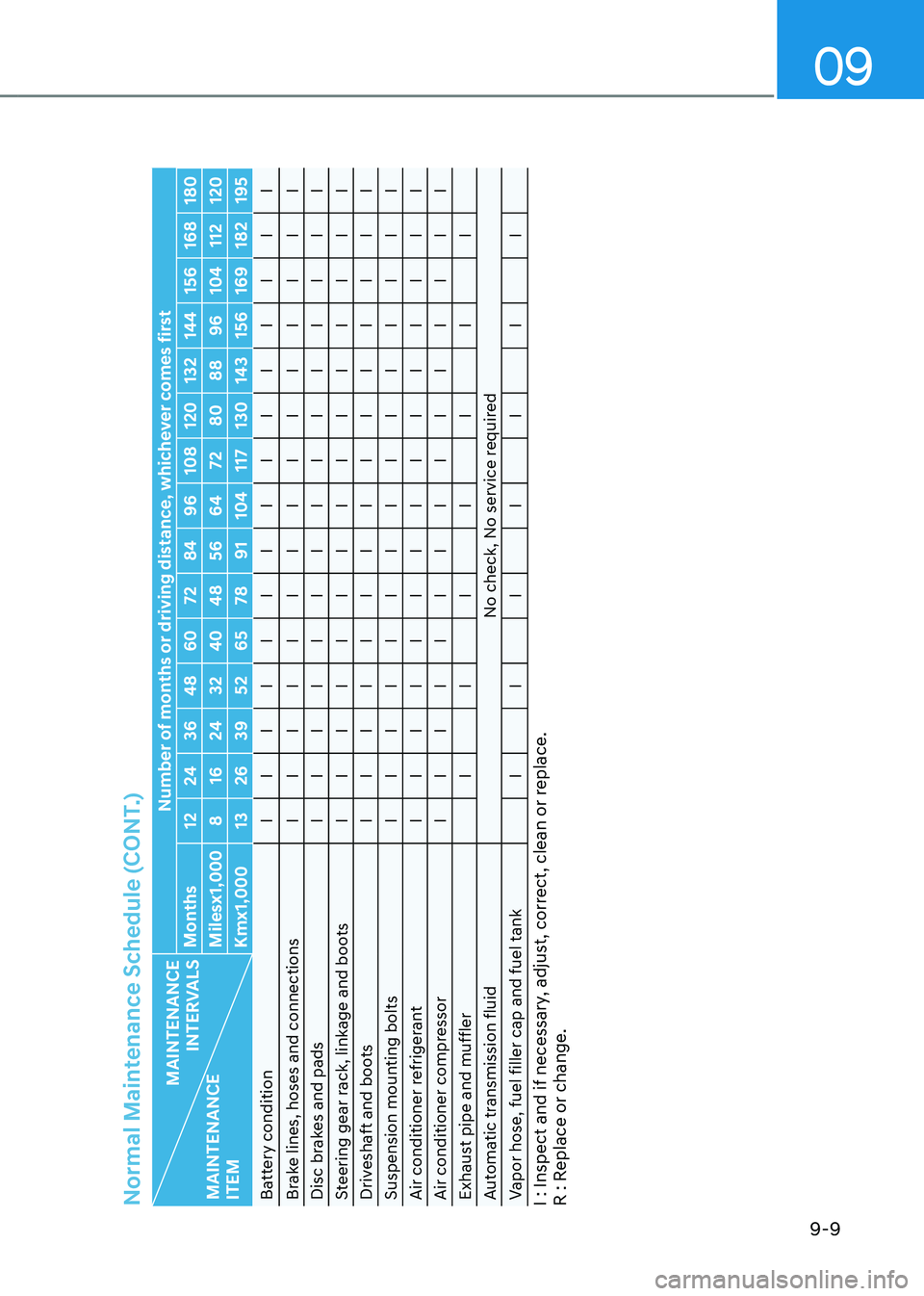
MAINTENANCE INTERVALS
MAINTENANCE
ITEM Number of months or driving distance, whichever comes first
Months 12 24 36 48 60 72 84 96 108 120 132 144 156 168 180 Milesx1,000 8 16 24 32 40 48 56 64 72 80 88 96 104 112 120 Kmx1,000 13 26 39 52 65 78 91 104 117 130 143 156 169 182 195
Battery condition I I I I I I I I I I I I I I I
Brake lines, hoses and connections I I I I I I I I I I I I I I I
Disc brakes and pads I I I I I I I I I I I I I I I
Steering gear rack, linkage and boots I I I I I I I I I I I I I I I
Driveshaft and boots I I I I I I I I I I I I I I I
Suspension mounting bolts I I I I I I I I I I I I I I I
Air conditioner refrigerant I I I I I I I I I I I I I I I
Air conditioner compressor I I I I I I I I I I I I I I I
Exhaust pipe and muffler IIIIIII
Automatic transmission fluid No check, No service required
Vapor hose, fuel filler cap and fuel tank IIIIIIII : Inspect and if necessary, adjust, correct, clean or replace.
R : Replace or change.Normal Maintenance Schedule (CONT.)
Page 557 of 630
Maintenance
9-10
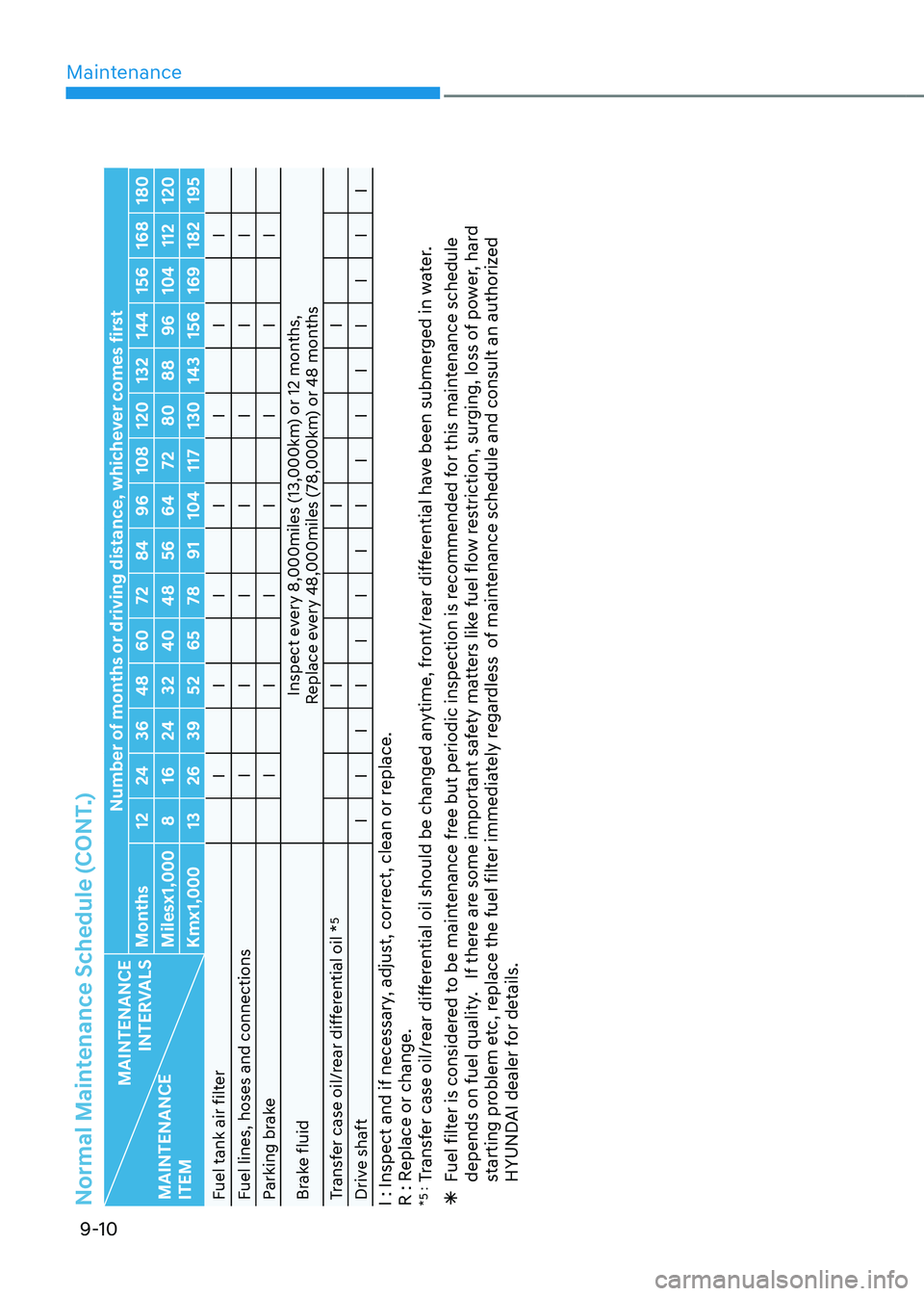
MAINTENANCE INTERVALS
MAINTENANCE
ITEM Number of months or driving distance, whichever comes first
Months 12 24 36 48 60 72 84 96 108 120 132 144 156 168 180 Milesx1,000 8 16 24 32 40 48 56 64 72 80 88 96 104 112 120Kmx1,000 13 26 39 52 65 78 91 104 117 130 143 156 169 182 195
Fuel tank air filter IIIIIII
Fuel lines, hoses and connections IIIIIII
Parking brake IIIIIII
Brake fluid Inspect every 8,000miles (13,000km) or 12 months,
Replace every 48,000miles (78,000km) or 48 months
Transfer case oil/rear differential oil *
5
I II
Drive shaft I I I I I I I I I I I I I I I
I : Inspect and if necessary, adjust, correct, clean or replace.
R : Replace or change.*5 : Transfer case oil/rear differential oil should be changed anytime, front/rear differential have been submerged in water. ÃFuel filt
er is considered to be maintenance free but periodic inspection is recommended for this maintenance schedule
depends on fuel quality.
If ther
e are some important safety matters
lik
e fuel flow restriction, surging, loss of power, hard
starting problem etc, replace the fuel filter immediately regardless of maintenance schedule and consult an authorized
HYUNDAI dealer for details.
Normal Maintenance Schedule (CONT.)
Page 558 of 630
09
9-11
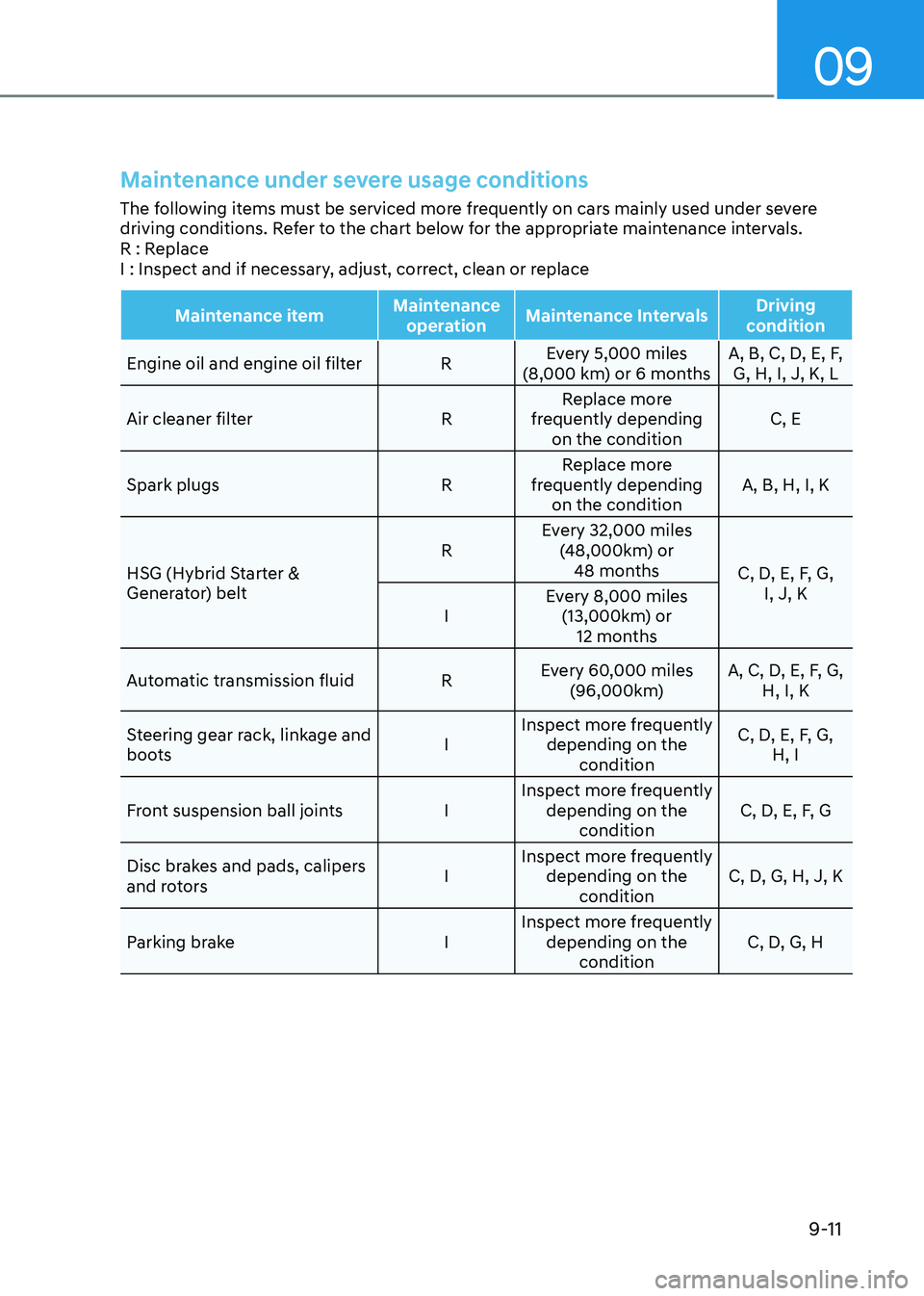
Maintenance under severe usage conditions
The following items must be serviced more frequently on cars mainly used under severe
driving conditions. Refer to the chart below for the appropriate maintenance intervals.
R : Replace
I : Inspect and if necessary, adjust, correct, clean or replace
Maintenance itemMaintenance
operation Maintenance Intervals Driving
condition
Engine oil and engine oil filter R Every 5,000 miles
(8,000 km) or 6 months A, B, C, D, E, F,
G, H, I, J, K, L
Air cleaner filter RReplace more
frequently depending on the condition C, E
Spark plugs RReplace more
frequently depending on the condition A, B, H, I, K
HSG (Hybrid Starter &
Generator) belt R
Every 32,000 miles
(48,000km) or 48 months C, D, E, F, G,
I, J, K
I Every 8,000 miles
(13,000km) or 12 months
Automatic transmission fluid R Every 60,000 miles
(96,000km) A, C, D, E, F, G,
H, I, K
Steering gear rack, linkage and
boots IInspect more frequently
depending on the condition C, D, E, F, G,
H, I
Front suspension ball joints IInspect more frequently
depending on the condition C, D, E, F, G
Disc brakes and pads, calipers
and rotors IInspect more frequently
depending on the condition C, D, G, H, J, K
Parking brake IInspect more frequently
depending on the condition C, D, G, H
Page 561 of 630
Maintenance
9-14
Brake hoses and lines
Visually check for proper installation,
chafing, cracks, deterioration and any
leakage. Replace any deteriorated or
damaged parts immediately.
Brake fluid
Check the brake fluid level in the brake
fluid reservoir. The level should be
between the MIN and the MAX marks
on the side of the reservoir. Use only
hydraulic brake fluid conforming to DOT
4 specification.
Parking brake
Inspect the parking brake system.
Brake discs, pads, calipers and
rotors
Check the pads, the disc, and the rotor
for any excessive wear-out. Inspect
calipers for any fluid leakage
For more information on checking the
pads or lining wear limit, refer to the
HYUNDAI web site.
(http://service.hyundai-motor.com)
Exhaust pipe and muffler
Visually inspect the exhaust pipes,
muffler and hangers for cracks,
deterioration, or damage. Start
the engine and listen carefully for
any exhaust gas leakage. Tighten
connections or replace parts as
necessary.
Suspension mounting bolts
Check the suspension connections for
looseness or damage. Retighten to the
specified torque.
Steering gear box, linkage &
boots/lower arm ball joint
With the vehicle stopped and the hybrid
system off, check for excessive free-play
in the steering wheel. Check the linkage
for bends or damage. Check the dust
boots and ball joints for deterioration,
cracks, or damage.
Replace any damaged parts.
Air conditioning refrigerant
Check the air conditioning lines and
connections for leakage and damage.
Drive Shaft and Related
Check the drive shaft, boots, clamps,
rubber couplings and center-bearing
rubber for cracks, deterioration, or
damage. Replace any damaged parts
and if necessary, repack the grease.
Page 567 of 630
Maintenance
9-20
Checking the Hybrid Starter &
Generator (HSG) belt
We recommend that you have the
Hybrid Starter & Generator (HSG) belt
inspected or replaced according to the
Maintenance Schedule in this chapter by
an authorized HYUNDAI dealer.
CAUTION
When the HSG belt is worn out or
damaged, replace the belt.
Otherwise, it may cause engine
overheating or battery discharge.
WARNING
• Turn the vehicle off while you inspect
the engine or Hybrid Starter &
Generator (HSG) belt. Otherwise it
may result in serious injury.
• Keep hands, clothing etc. away from
the Hybrid Starter & Generator (HSG)
belt.
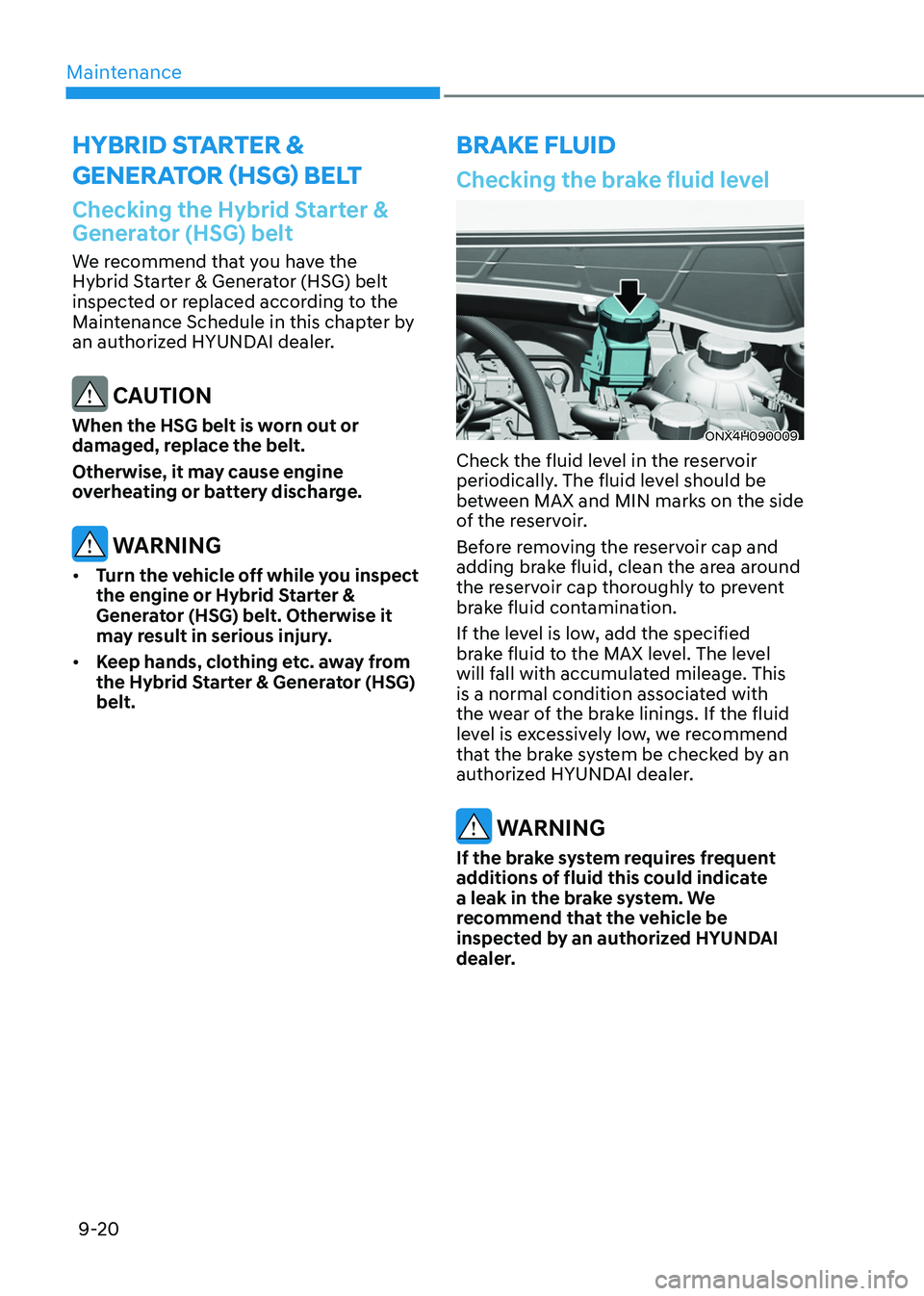
Checking the brake fluid level
ONX4H090009
Check the fluid level in the reservoir
periodically. The fluid level should be
between MAX and MIN marks on the side
of the reservoir.
Before removing the reservoir cap and
adding brake fluid, clean the area around
the reservoir cap thoroughly to prevent
brake fluid contamination.
If the level is low, add the specified
brake fluid to the MAX level. The level
will fall with accumulated mileage. This
is a normal condition associated with
the wear of the brake linings. If the fluid
level is excessively low, we recommend
that the brake system be checked by an
authorized HYUNDAI dealer.
WARNING
If the brake system requires frequent
additions of fluid this could indicate
a leak in the brake system. We
recommend that the vehicle be
inspected by an authorized HYUNDAI
dealer.
hybrid star tEr &
Genera tor (HSG) beltbrakE fl uid
Page 568 of 630
09
9-21
washEr fluid
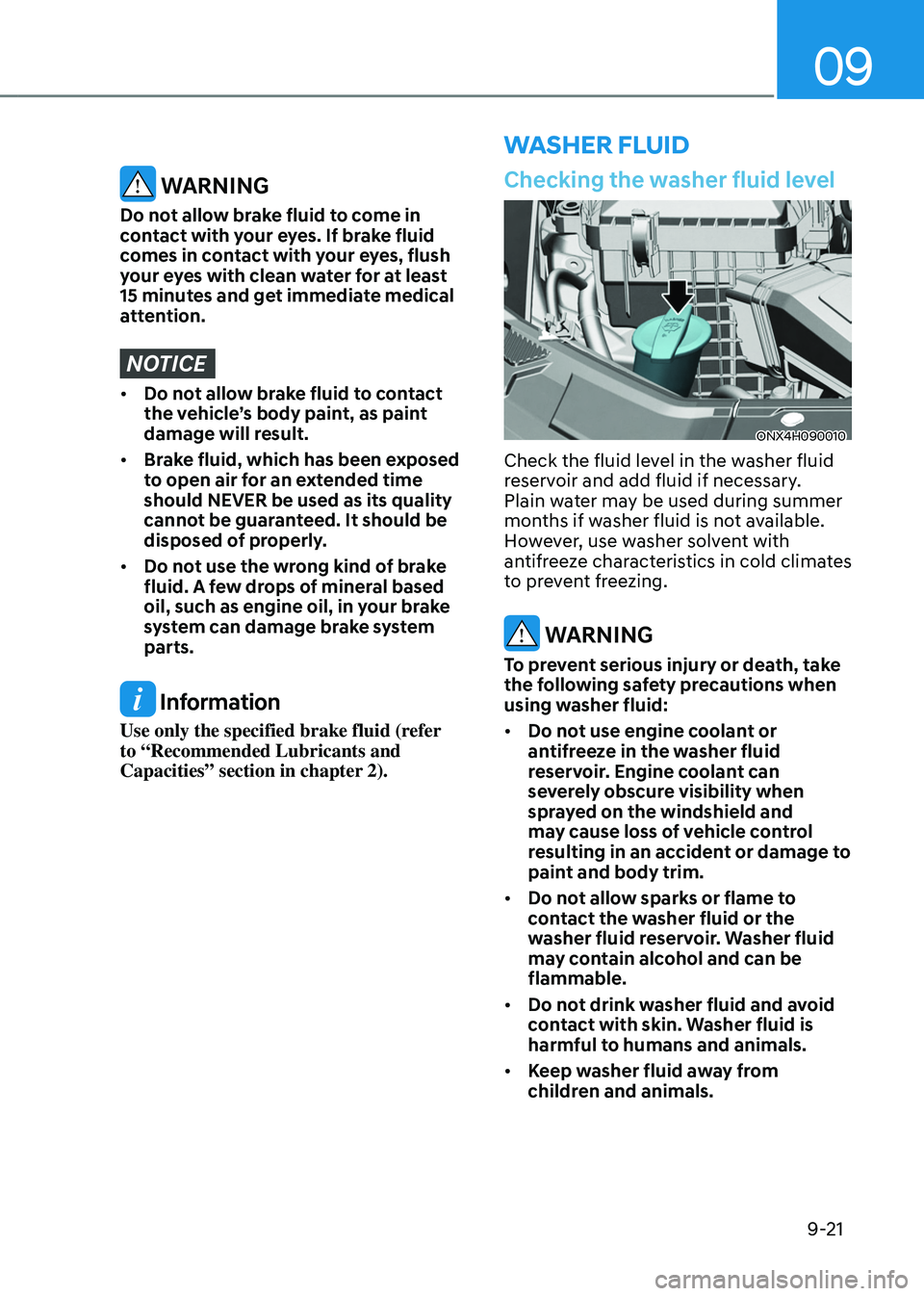
Checking the washer fluid level
ONX4H090010
Check the fluid level in the washer fluid
reservoir and add fluid if necessary.
Plain water may be used during summer
months if washer fluid is not available.
However, use washer solvent with
antifreeze characteristics in cold climates
to prevent freezing.
WARNING
To prevent serious injury or death, take
the following safety precautions when
using washer fluid:
• Do not use engine coolant or
antifreeze in the washer fluid
reservoir. Engine coolant can
severely obscure visibility when
sprayed on the windshield and
may cause loss of vehicle control
resulting in an accident or damage to
paint and body trim.
• Do not allow sparks or flame to
contact the washer fluid or the
washer fluid reservoir. Washer fluid
may contain alcohol and can be
flammable.
• Do not drink washer fluid and avoid
contact with skin. Washer fluid is
harmful to humans and animals.
• Keep washer fluid away from
children and animals.
WARNING
Do not allow brake fluid to come in
contact with your eyes. If brake fluid
comes in contact with your eyes, flush
your eyes with clean water for at least
15 minutes and get immediate medical
attention.
NOTICE
• Do not allow brake fluid to contact
the vehicle’s body paint, as paint
damage will result.
• Brake fluid, which has been exposed
to open air for an extended time
should NEVER be used as its quality
cannot be guaranteed. It should be
disposed of properly.
• Do not use the wrong kind of brake
fluid. A few drops of mineral based
oil, such as engine oil, in your brake
system can damage brake system
parts.
Information
Use only the specified brake fluid (refer
to “Recommended Lubricants and
Capacities” section in chapter 2).
Page 620 of 630

I
I-3
A
Battery
........................................................................\
.........................................9-28
Before Jump Starting ........................................................................\
..................8-5
Jump Starting........................................................................\
..............................8-6
Before driving
........................................................................\
................................6-4
Before entering the vehicle ........................................................................\
........6-4
Before starting ........................................................................\
............................6-4
Blind-Spot Collision Warning (BCW)
................................................................7-23
System malfunction and limitations .................................................................7-28
System operation ........................................................................\
......................7-26
System settings ........................................................................\
.........................7-24
Blind-Spot Collision-Avoidance Assist (BCA)
...................................................7-32
System malfunction and limitations .................................................................7-41
System operation ........................................................................\
......................7-36
System settings ........................................................................\
.........................7-34
Blind-Spot View Monitor (BVM)
.......................................................................7-63
System malfunction ........................................................................\
..................7-64
System operation ........................................................................\
......................7-63
System settings ........................................................................\
.........................7-63
Brake fluid
........................................................................\
...................................9-20
Checking the brake fluid level ........................................................................\
.9-20
Braking system
........................................................................\
............................6-21
Anti-lock Brake System (ABS) ........................................................................\
6-30
Auto Hold ........................................................................\
.................................6-26
Disc brakes wear indicator ........................................................................\
.......6-22
Downhill Brake Control (DBC) ......................................................................6-36
Electronic Parking Brake (EPB) ......................................................................6-22
Electronic Stability Control (ESC) ...................................................................6-31
Good braking practices ........................................................................\
.............6-39
Hill-Start Assist Control (HAC) ......................................................................6-35
Power brakes ........................................................................\
............................6-21
Trailer Stability Assist (TSA) ........................................................................\
..6-36
Vehicle Stability Management (VSM) ............................................................6-34
Bulb wattage
........................................................................\
..................................2-9