aWD HYUNDAI TUCSON HYBRID 2022 User Guide
[x] Cancel search | Manufacturer: HYUNDAI, Model Year: 2022, Model line: TUCSON HYBRID, Model: HYUNDAI TUCSON HYBRID 2022Pages: 630, PDF Size: 77.98 MB
Page 330 of 630
06
6-43
Driving on snow-covered or icy roads
• Start off slowly by applying the
accelerator pedal gently.
• Use snow tires or tire chains.
• Keep sufficient distance between your
vehicle and the vehicle in front of you.
• Apply engine braking during
deceleration by using the paddle
shifter (manual shift mode) and
manually selecting a lower gear.
• Avoid speeding, rapid acceleration,
sudden brake applications, and sharp
turns to prevent skids.
Information
When using Snow Tires, mount them on
all four wheels.
If a full set of chains is not available for
an AWD vehicle when using tire chains,
chains may be installed on the front wheels
only.
For more details on Snow Tires and Tire
Chains, refer to "Winter Driving" section
later in this chapter.
Driving in sand or mud
• Maintain slow and constant speed.
• Use tire chains driving in mud if
necessary.
• Keep sufficient distance between your
vehicle and the vehicle in front of you.
• Reduce vehicle speed and always
check the road condition.
• Avoid speeding, rapid acceleration,
sudden brake applications, and sharp
turns to prevent getting stuck.
NOTICE
When the vehicle is stuck in snow, sand
or mud, place a nonslip material under
the drive wheels to provide traction
OR slowly spin the wheels in forward
and reverse directions which causes
a rocking motion that may free the
vehicle.
However, avoid running the engine
continuously at high rpm, doing so may
damage the AWD system.
Page 332 of 630
06
6-45
Additional driving conditions
• Become familiar with the off-road
conditions before driving.
• Always pay attention when driving off-
road and avoid dangerous areas.
• Drive slowly when driving in heavy
wind.
• Reduce vehicle speed when
cornering. The center of gravity
of AWD vehicles is higher than
conventional 2WD vehicles, making
them more likely to roll over when you
rapidly turn corners.
• Always hold the steering wheel firmly
when you are driving off-road.
WARNING
Do hold the steering wheel tightly
when you are driving off-road. You may
hurt your arm by a sudden steering
maneuver or from steering wheel
rebound due to an impact with objects
on the ground. You could lose control
of the steering wheel which may lead to
serious injury or death.
Emergency precautions
Tires
When replacing tires, be sure to equip
all four tires with the same size, type,
tread patterns, brand and load-carrying
capacity.
WARNING
Do not use tire and wheel with different
size and type from the one originally
installed on your vehicle. It can affect
the safety and performance of your
vehicle, which could lead to steering
failure or rollover causing serious injury.
In an emergency situation, a compact
spare tire (if equipped) or Tire Mobility
Kit (if equipped) may be used. But,
do not use the compact spare tire
continuously. Repair or replace the
original tire as soon as possible to avoid
failure of the differential or AWD system.
WARNING
Never start or run the engine while
an AWD vehicle is raised on a jack.
The vehicle can slip or roll off of a jack
causing serious injury or death to you or
those nearby.
Page 333 of 630
Driving your vehicle
6-46
Towing
AWD vehicles must be towed with
a wheel lift and dollies or flatbed
equipment with all the wheels off the
ground. For more details, refer to
"Towing" section in chapter 8.
Vehicle inspection
• If the vehicle needs to be operated on
a vehicle lift do not attempt to stop
any of the four wheels from turning.
This could damage the AWD system.
• Never engage the parking brake while
running the engine on a car lift. This
may damage the AWD system.
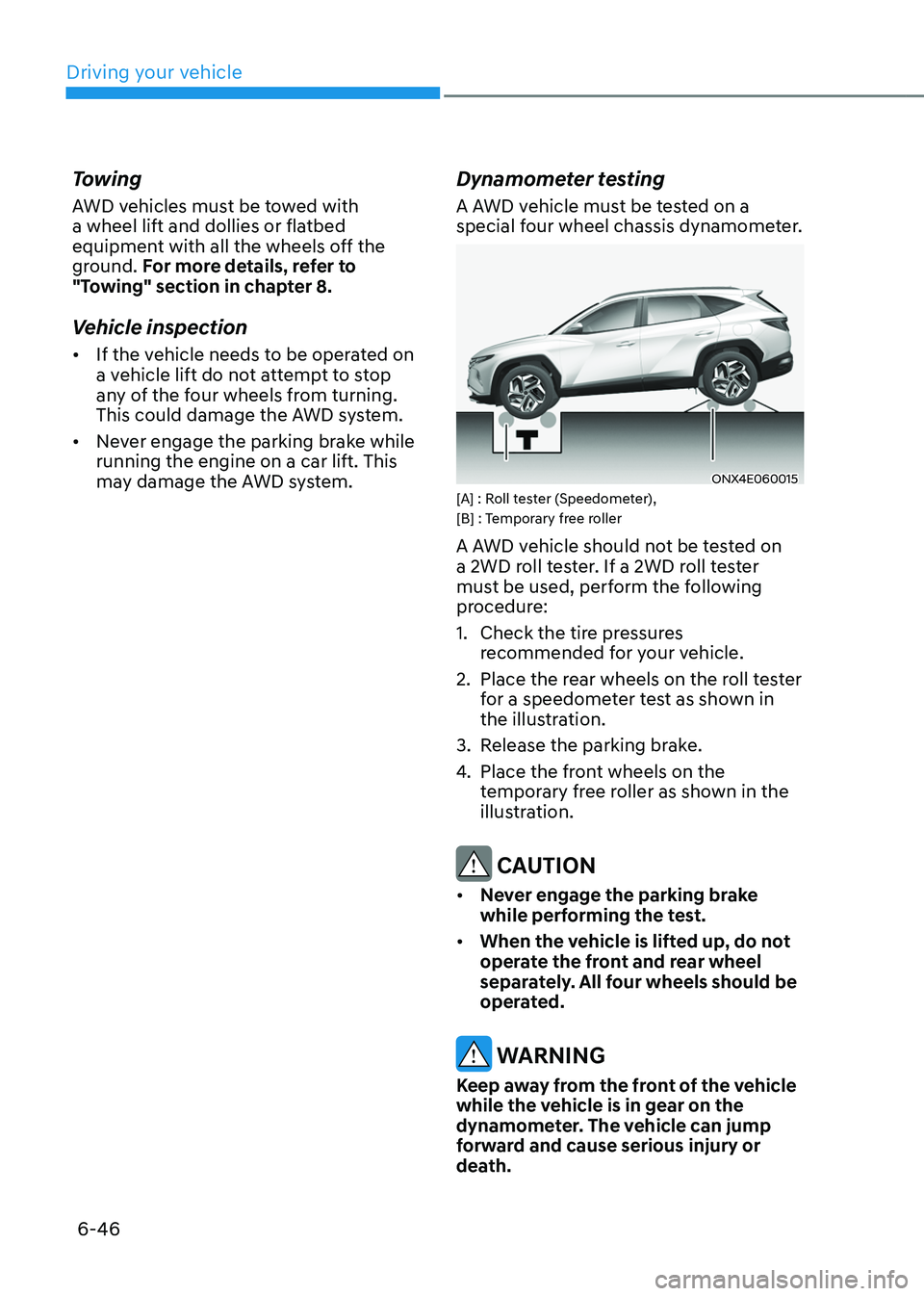
Dynamometer testing
A AWD vehicle must be tested on a
special four wheel chassis dynamometer.
ONX4E060015[A] : Roll tester (Speedometer),
[B] : Temporary free roller
A AWD vehicle should not be tested on
a 2WD roll tester. If a 2WD roll tester
must be used, perform the following
procedure:
1.
Check the tire pr
essures
recommended for your vehicle.
2.
Place the rear wheels on the r
oll tester
for a speedometer test as shown in
the illustration.
3.
Release the parking br
ake.
4.
Place the fron
t wheels on the
temporary free roller as shown in the
illustration.
CAUTION
• Never engage the parking brake
while performing the test.
• When the vehicle is lifted up, do not
operate the front and rear wheel
separately. All four wheels should be
operated.
WARNING
Keep away from the front of the vehicle
while the vehicle is in gear on the
dynamometer. The vehicle can jump
forward and cause serious injury or
death.
Page 334 of 630
06
6-47
Reducing the risk of a rollover
Your multi-purpose passenger vehicle is
defined as a Sports Utility Vehicle (SUV).
SUV’s have higher ground clearance
and a narrower track to make them
capable of performing in a wide variety
of off-road applications. The specific
design characteristics give them a higher
center of gravity than ordinary vehicles
making them more likely to roll over if
you make abrupt turns. Utility vehicles
have a significantly higher rollover rate
than other types of vehicles. Due to this
risk, driver and passengers are strongly
recommended to buckle their seat belts.
In a rollover crash, an unbelted person
is significantly more likely to die than a
person wearing a seat belt.
WARNING
Rollover
As with other Sports Utility Vehicle
(SUV), failure to operate this vehicle
correctly may result in loss of control,
an accident or vehicle rollover.
• Utility vehicles have a significantly
higher rollover rate than other types
of vehicles.
• Specific design characteristics
(higher ground clearance, narrower
track, etc.) give this vehicle a higher
center of gravity than ordinary
vehicles.
• A SUV is not designed for cornering
at the same speeds as conventional
vehicles.
• Avoid sharp turns or abrupt
maneuvers.
• In a rollover crash, an unbelted
person is significantly more likely to
die than a person wearing a seat belt.
Make sure everyone in the vehicle is
properly buckled up.
WARNING
Your vehicle is equipped with tires
designed to provide safe ride and
handling capability. Do not use a size
and type of tire and wheel that is
different from the one that is originally
installed on your vehicle. It can affect
the safety and performance of your
vehicle, which could lead to steering
failure or rollover and serious injury.
When replacing the tires, be sure to
equip all four tires with the tire and
wheel of the same size, type, tread,
brand and load-carrying capacity.
If you nevertheless decide to equip
your vehicle with any tire/wheel
combination not recommended by
HYUNDAI for off road driving, you
should not use these tires for highway
driving.
WARNING
Jacked vehicle
While a full-time AWD vehicle is being
raised on a jack, never start the engine
or cause the tires to rotate.
There is a danger that rotating tires
touching the ground could cause the
vehicle to fall off the jack and to jump
forward or rearward.
Page 335 of 630
Driving your vehicle
6-48
dRiVe mode integRated ContRoL system (aWd)
(if equipped)
Drive mode
ONX4060019
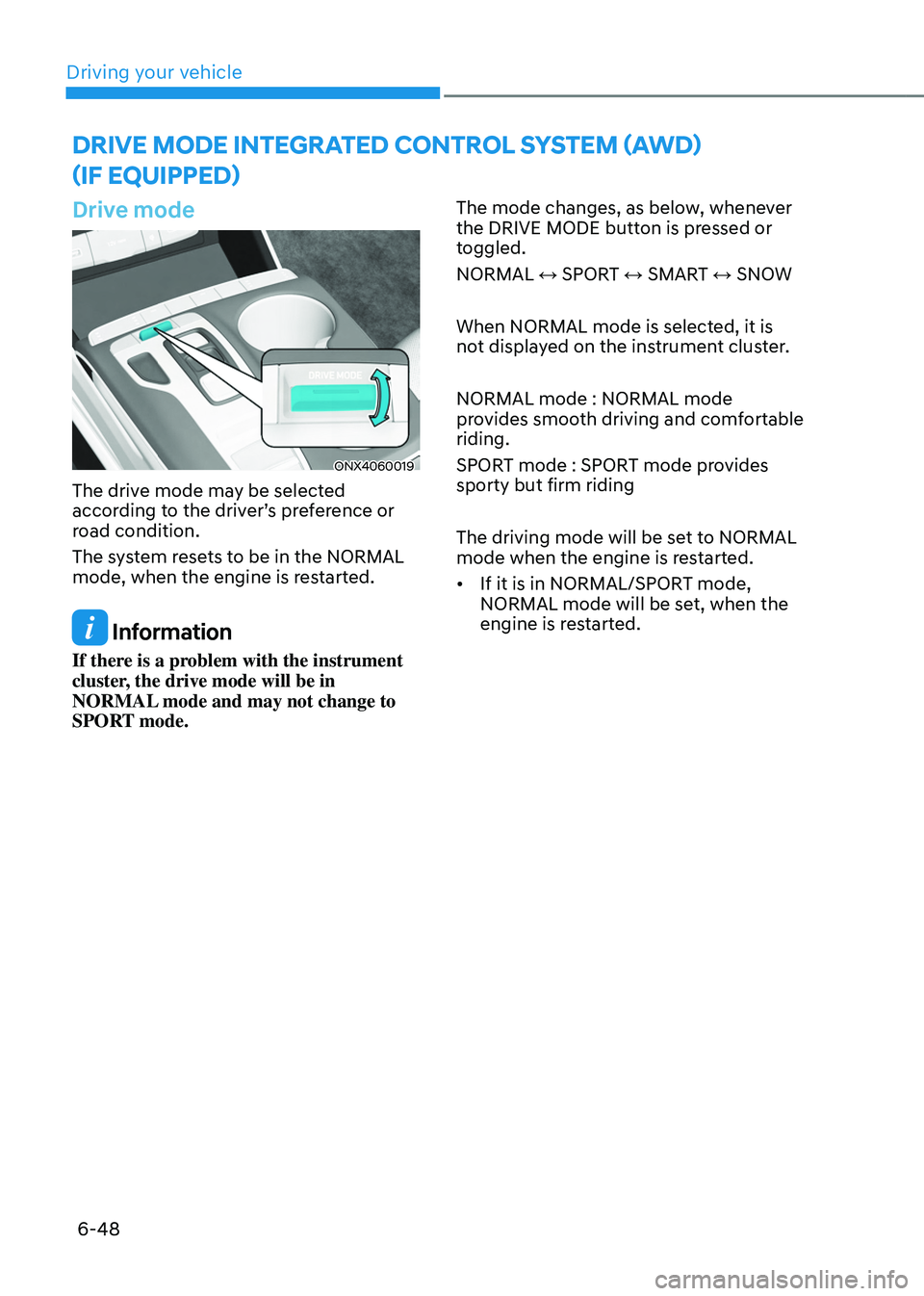
The drive mode may be selected
according to the driver’s preference or
road condition.
The system resets to be in the NORMAL
mode, when the engine is restarted.
Information
If there is a problem with the instrument
cluster, the drive mode will be in
NORMAL mode and may not change to
SPORT mode. The mode changes, as below, whenever
the DRIVE MODE button is pressed or
toggled.
NORMAL ↔ SPORT ↔ SMART ↔ SNOW
When NORMAL mode is selected, it is
not displayed on the instrument cluster.
NORMAL mode : NORMAL mode
provides smooth driving and comfortable
riding.
SPORT mode : SPORT mode provides
sporty but firm riding
The driving mode will be set to NORMAL
mode when the engine is restarted.
•
If it is in NORMAL/SPORT mode,
NORMAL mode will be set, when the
engine is restarted.
Page 342 of 630
06
6-55
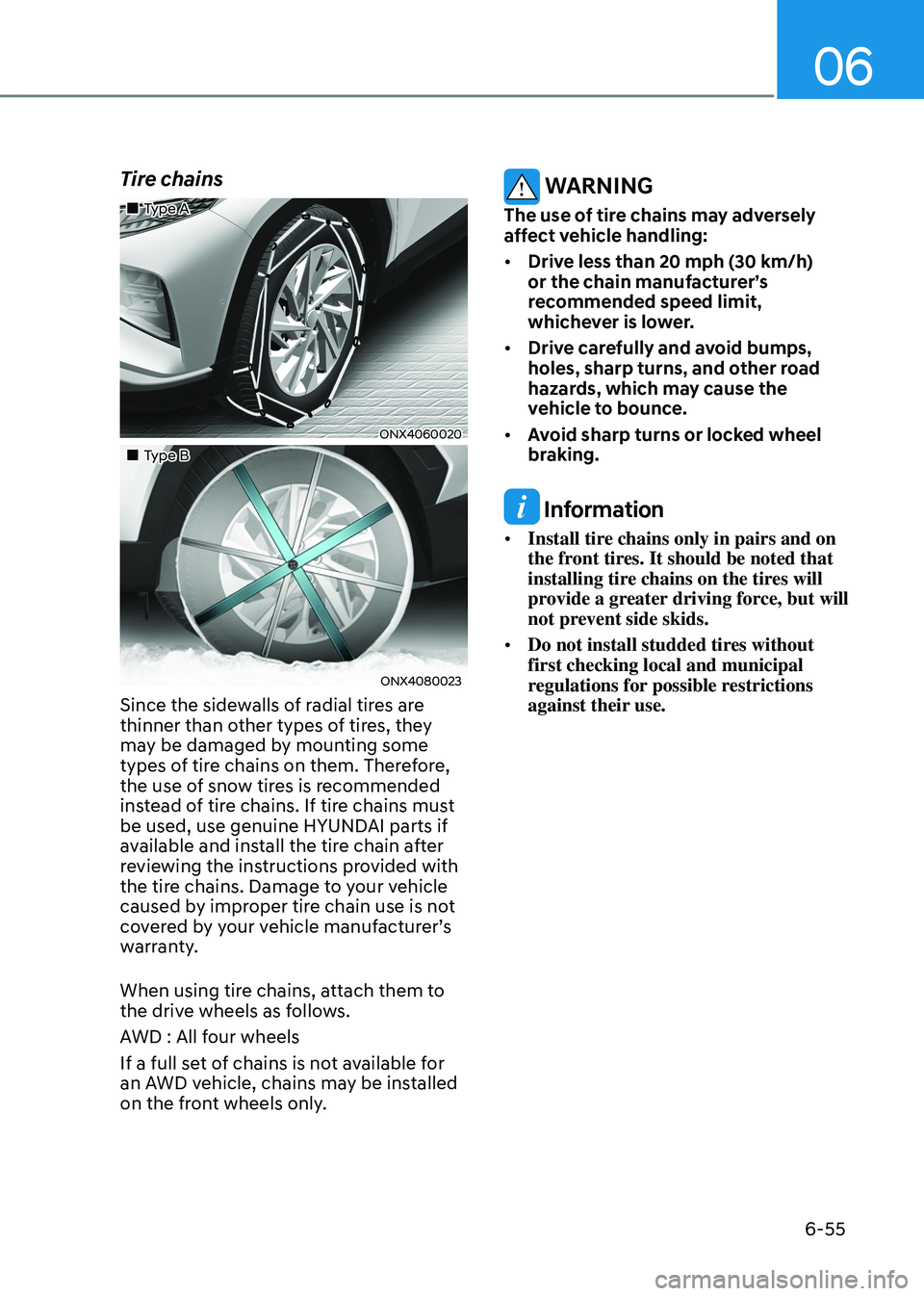
Tire chains
„„Type A
ONX4060020
„„Type B
ONX4080023
Since the sidewalls of radial tires are
thinner than other types of tires, they
may be damaged by mounting some
types of tire chains on them. Therefore,
the use of snow tires is recommended
instead of tire chains. If tire chains must
be used, use genuine HYUNDAI parts if
available and install the tire chain after
reviewing the instructions provided with
the tire chains. Damage to your vehicle
caused by improper tire chain use is not
covered by your vehicle manufacturer’s
warranty.
When using tire chains, attach them to
the drive wheels as follows.
AWD : All four wheels
If a full set of chains is not available for
an AWD vehicle, chains may be installed
on the front wheels only.
WARNING
The use of tire chains may adversely
affect vehicle handling:
• Drive less than 20 mph (30 km/h)
or the chain manufacturer’s
recommended speed limit,
whichever is lower.
• Drive carefully and avoid bumps,
holes, sharp turns, and other road
hazards, which may cause the
vehicle to bounce.
• Avoid sharp turns or locked wheel
braking.
Information
• Install tire chains only in pairs and on
the front tires. It should be noted that
installing tire chains on the tires will
provide a greater driving force, but will
not prevent side skids.
• Do not install studded tires without
first checking local and municipal
regulations for possible restrictions
against their use.
Page 559 of 630
Maintenance
9-12
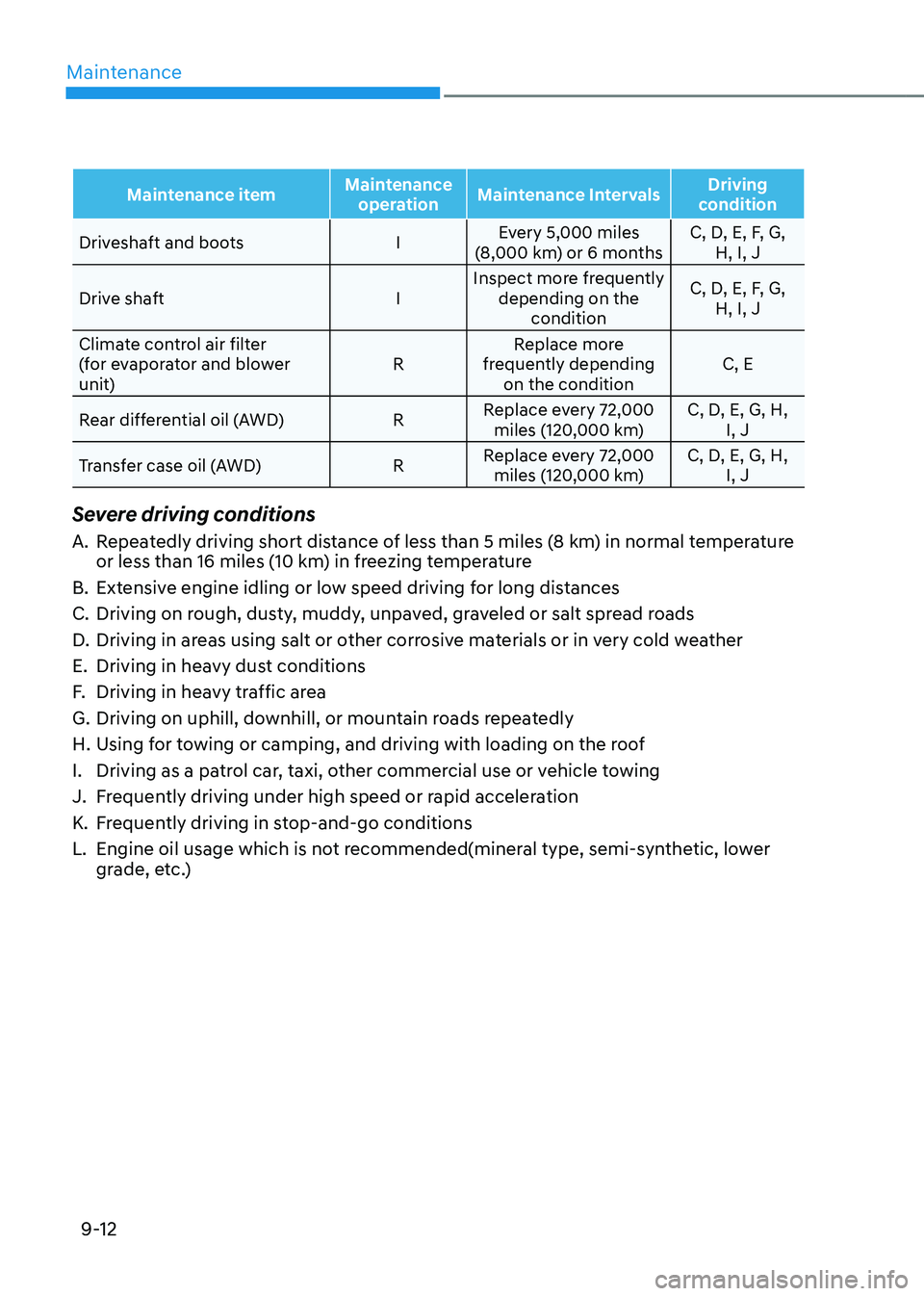
Maintenance itemMaintenance
operation Maintenance Intervals Driving
condition
Driveshaft and boots IEvery 5,000 miles
(8,000 km) or 6 months C, D, E, F, G,
H, I, J
Drive shaft IInspect more frequently
depending on the condition C, D, E, F, G,
H, I, J
Climate control air filter
(for evaporator and blower
unit) RReplace more
frequently depending on the condition C, E
Rear differential oil (AWD) RReplace every 72,000
miles (120,000 km) C, D, E, G, H,
I, J
Transfer case oil (AWD) RReplace every 72,000
miles (120,000 km) C, D, E, G, H,
I, J
Severe driving conditions
A. Repeatedly driving short distance of less than 5 miles (8 km) in normal temperature
or less than 16 miles (10 km ) in freezing temperature
B.
Extensiv
e engine idling or low speed driving for long distances
C.
Driving on rough, dus
ty, muddy, unpaved, graveled or salt spread roads
D.
Driving in areas using salt or o
ther corrosive materials or in very cold weather
E.
Driving in heavy dus
t conditions
F.
Driving in heavy tr
affic area
G.
Driving on uphill, downhill, or moun
tain roads repeatedly
H.
Using f
or towing or camping, and driving with loading on the roof
I.
Driving as a patr
ol car, taxi, other commercial use or vehicle towing
J.
Fr
equently driving under high speed or rapid acceleration
K.
Fr
equently driving in stop-and-go conditions
L.
Engine oil usage which is no
t recommended(mineral type, semi-synthetic, lower
grade, etc.)
Page 592 of 630
09
9-45
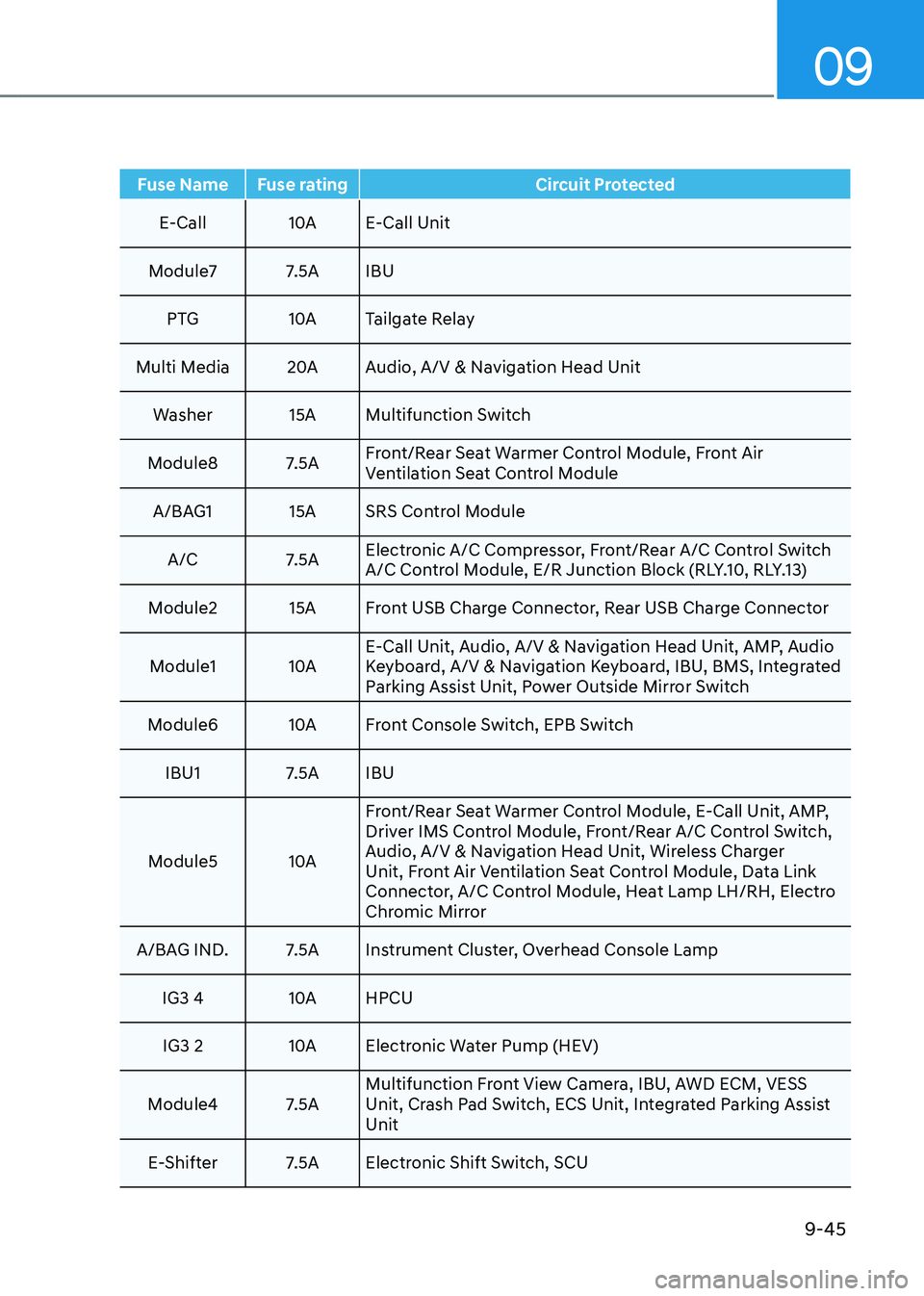
Fuse Name Fuse ratingCircuit Protected
E-Call 10AE-Call Unit
Module7 7.5A IBU PTG 10ATailgate Relay
Multi Media 20AAudio, A/V & Navigation Head Unit
Washer 15A Multifunction Switch
Module8 7.5A Front/Rear Seat Warmer Control Module, Front Air
Ventilation Seat Control Module
A/BAG1 15A SRS Control Module
A/C 7.5A Electronic A/C Compressor, Front/Rear A/C Control Switch
A/C Control Module, E/R Junction Block (RLY.10, RLY.13)
Module2 15A Front USB Charge Connector, Rear USB Charge Connector
Module1 10AE-Call Unit, Audio, A/V & Navigation Head Unit, AMP, Audio
Keyboard, A/V & Navigation Keyboard, IBU, BMS, Integrated
Parking Assist Unit, Power Outside Mirror Switch
Module6 10AFront Console Switch, EPB Switch
IBU1 7.5A IBU
Module5 10AFront/Rear Seat Warmer Control Module, E-Call Unit, AMP,
Driver IMS Control Module, Front/Rear A/C Control Switch,
Audio, A/V & Navigation Head Unit, Wireless Charger
Unit, Front Air Ventilation Seat Control Module, Data Link
Connector, A/C Control Module, Heat Lamp LH/RH, Electro
Chromic Mirror
A/BAG IND. 7.5A Instrument Cluster, Overhead Console Lamp
IG3 4 10AHPCU
IG3 2 10AElectronic Water Pump (HEV)
Module4 7.5A Multifunction Front View Camera, IBU, AWD ECM, VESS
Unit, Crash Pad Switch, ECS Unit, Integrated Parking Assist
Unit
E-Shifter 7.5A Electronic Shift Switch, SCU
Page 595 of 630
Maintenance
9-48
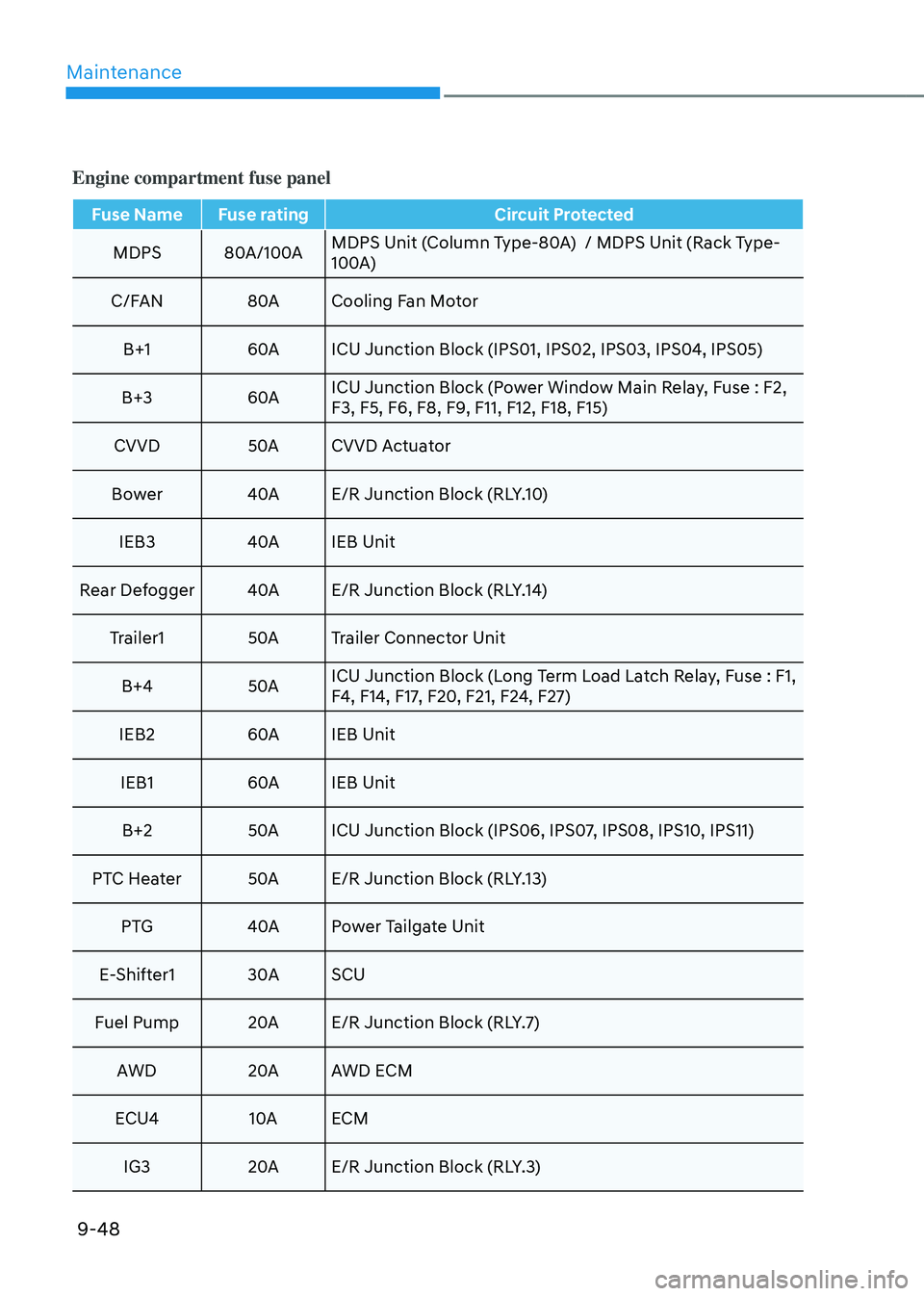
Engine compartment fuse panel
Fuse Name Fuse ratingCircuit Protected
MDPS 80A/100A MDPS Unit (Column Type-80A) / MDPS Unit (Rack Type-
100A)
C/FAN 80ACooling Fan Motor
B+1 60AICU Junction Block (IPS01, IPS02, IPS03, IPS04, IPS05)
B+3 60AICU Junction Block (Power Window Main Relay, Fuse : F2,
F3, F5, F6, F8, F9, F11, F12, F18, F15)
CVVD 50ACVVD Actuator
Bower 40AE/R Junction Block (RLY.10)
IEB3 40AIEB Unit
Rear Defogger 40AE/R Junction Block (RLY.14)
Trailer1 50ATrailer Connector Unit
B+4 50AICU Junction Block (Long Term Load Latch Relay, Fuse : F1,
F4, F14, F17, F20, F21, F24, F27)
IEB2 60AIEB Unit
IEB1 60AIEB Unit
B+2 50AICU Junction Block (IPS06, IPS07, IPS08, IPS10, IPS11)
PTC Heater 50AE/R Junction Block (RLY.13)
PTG 40APower Tailgate Unit
E-Shifter1 30ASCU
Fuel Pump 20AE/R Junction Block (RLY.7)
AWD 20AAWD ECM
ECU4 10AECM
IG3 20AE/R Junction Block (RLY.3)
Page 619 of 630

Index
I-2
A
Accessing your vehicle
........................................................................\
..................5-4
Hyundai Digital Key ........................................................................\
................5-16
Immobilizer system ........................................................................\
..................5-15
Remote key ........................................................................\
.................................5-4
Smart key ........................................................................\
....................................5-7
Air bag - supplemental restraint system
..............................................................3-44 Additional safety precautions ........................................................................\
...3-66
Air bag warning labels ........................................................................\
.............3-66
How does the air bags system operate? ............................................................3-50
Occupant Classification System (OCS) ...........................................................3-54
SRS care ........................................................................\
...................................3-65
What to expect after an air bag inflates ............................................................3-53
Where are the air bags? ........................................................................\
............3-46
Why didn’t my air bag go of f in a collision? ...................................................3-60
Air cleaner
........................................................................\
...................................9-22 Filter replacement ........................................................................\
.....................9-22
Air conditioner compressor label ........................................................................\
. 2-15
Air conditioning system
........................................................................\
...............2-11
All wheel drive (AWD)
........................................................................\
..............6-40
All Wheel Drive (AWD) operation ..................................................................6-41
Emergency precautions ........................................................................\
............6-45
Reducing the risk of a rollover ........................................................................\
.6-47
Appearance care ........................................................................\
........................... 9-59
Exterior care ........................................................................\
.............................9-59
Interior care ........................................................................\
..............................9-63
Automatic climate control system
.......................................................................5-96
Automatic heating and air conditioning ...........................................................5-97
Manual heating and air conditioning ................................................................5-98
Multi Air Mode........................................................................\
....................... 5-105
System maintenance ........................................................................\
...............5-108
System operation ........................................................................\
....................5-106
Automatic transmission
........................................................................\
...............6-13
Automatic transmission operation ....................................................................6-13
Good driving practices ........................................................................\
.............6-18
LCD display message ........................................................................\
...............6-17
Paddle shifter ........................................................................\
............................6-18
Parking ........................................................................\
.....................................6-16