clutch HYUNDAI VELOSTER 2013 User Guide
[x] Cancel search | Manufacturer: HYUNDAI, Model Year: 2013, Model line: VELOSTER, Model: HYUNDAI VELOSTER 2013Pages: 372, PDF Size: 22.04 MB
Page 194 of 372
513
Driving your vehicle
Manual transaxle operation
The manual transaxle has 6 forward
gears.
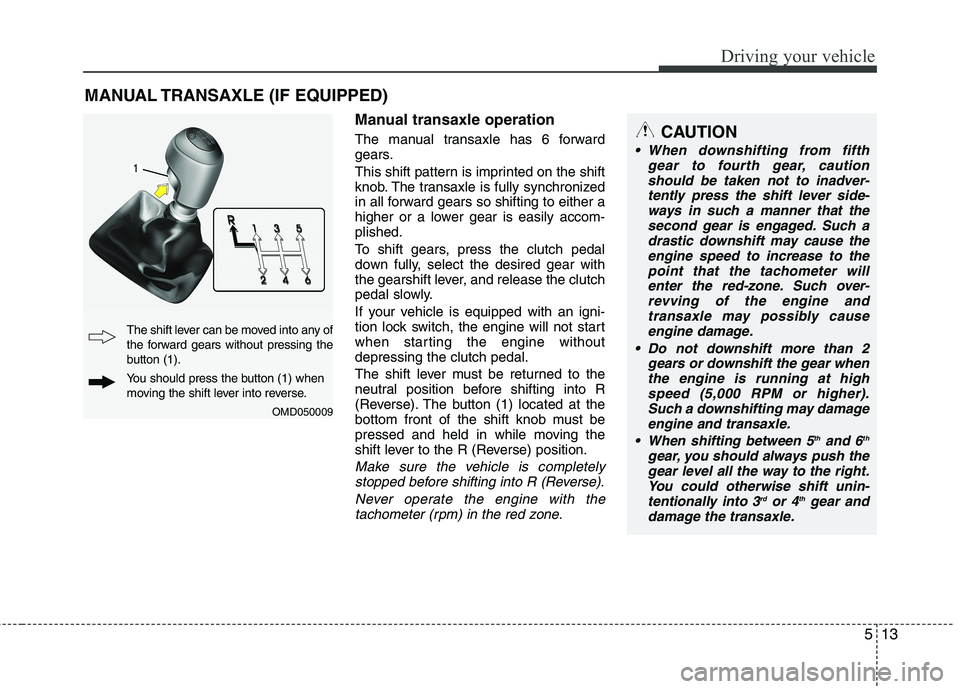
This shift pattern is imprinted on the shift
knob. The transaxle is fully synchronized
in all forward gears so shifting to either a
higher or a lower gear is easily accom-
plished.
To shift gears, press the clutch pedal
down fully, select the desired gear with
the gearshift lever, and release the clutch
pedal slowly.
If your vehicle is equipped with an igni-
tion lock switch, the engine will not start
when starting the engine without
depressing the clutch pedal.
The shift lever must be returned to the
neutral position before shifting into R
(Reverse). The button (1) located at the
bottom front of the shift knob must be
pressed and held in while moving the
shift lever to the R (Reverse) position.
Make sure the vehicle is completely
stopped before shifting into R (Reverse).
Never operate the engine with the
tachometer (rpm) in the red zone.
MANUAL TRANSAXLE (IF EQUIPPED)
OMD050009
The shift lever can be moved into any of
the forward gears without pressing the
button (1).
You should press the button (1) when
moving the shift lever into reverse.
CAUTION
When downshifting from fifth
gear to fourth gear, caution
should be taken not to inadver-
tently press the shift lever side-
ways in such a manner that the
second gear is engaged. Such a
drastic downshift may cause the
engine speed to increase to the
point that the tachometer will
enter the red-zone. Such over-
revving of the engine and
transaxle may possibly cause
engine damage.
Do not downshift more than 2
gears or downshift the gear when
the engine is running at high
speed (5,000 RPM or higher).
Such a downshifting may damage
engine and transaxle.
When shifting between 5
thand 6th
gear, you should always push the
gear level all the way to the right.
You could otherwise shift unin-
tentionally into 3
rdor 4thgear and
damage the transaxle.
Page 195 of 372
Driving your vehicle
14 5
During cold weather, shifting may be
difficult until the transaxle lubricant is
warmed up. This is normal and not
harmful to the transaxle.
If you've come to a complete stop and
it's hard to shift into 1st or R (Reverse),
leave the shift lever in the neutral posi-
tion and release the clutch. Depress the
clutch pedal back down, and then shift
into 1st or R (Reverse) gear position.Using the clutch
The clutch should be depressed all the
way to the floor before shifting, then
released slowly. The clutch pedal should
always be fully released while driving. Do
not rest your foot on the clutch pedal
while driving. This can cause unneces-
sary wear. Do not partially engage the
clutch to hold the vehicle on an incline.
This causes unnecessary wear. Use the
foot brake or parking brake to hold the
vehicle on an incline. Do not operate the
clutch pedal rapidly and repeatedly.
Downshifting
It is important to downshift when you
must slow down in heavy traffic or while
driving up or down steep hills.
Downshifting reduces the chance of
stalling and gives better acceleration.
When the vehicle is traveling down steep
hills, downshifting helps maintain safe
speed and prolongs brake life.
WARNING
Before leaving the driver’s seat,
always set the parking brake fully
and shut the engine off. Then
make sure the transaxle is shifted
into 1st gear when the vehicle is
parked on a level or uphill grade,
and shifted into R (Reverse) on a
downhill grade. Unexpected and
sudden vehicle movement can
occur if these precautions are not
followed in the order identified.
CAUTION
To avoid premature clutch wear
and damage, do not drive with
your foot resting on the clutch
pedal. Also, do not use the clutch
to hold the vehicle stopped on an
uphill grade, while waiting for a
traffic light, etc.
Do not use the shift lever as a
handrest during driving, as this
can result in premature wear of
the transaxle shift forks.
When operating the clutch pedal,
press the clutch pedal down fully.
If you don't press the clutch pedal
fully, the clutch may be damaged
or noise may occur.
Page 197 of 372
Driving your vehicle
16 5
Automatic transaxle / EcoShift
dual clutch transmission operation
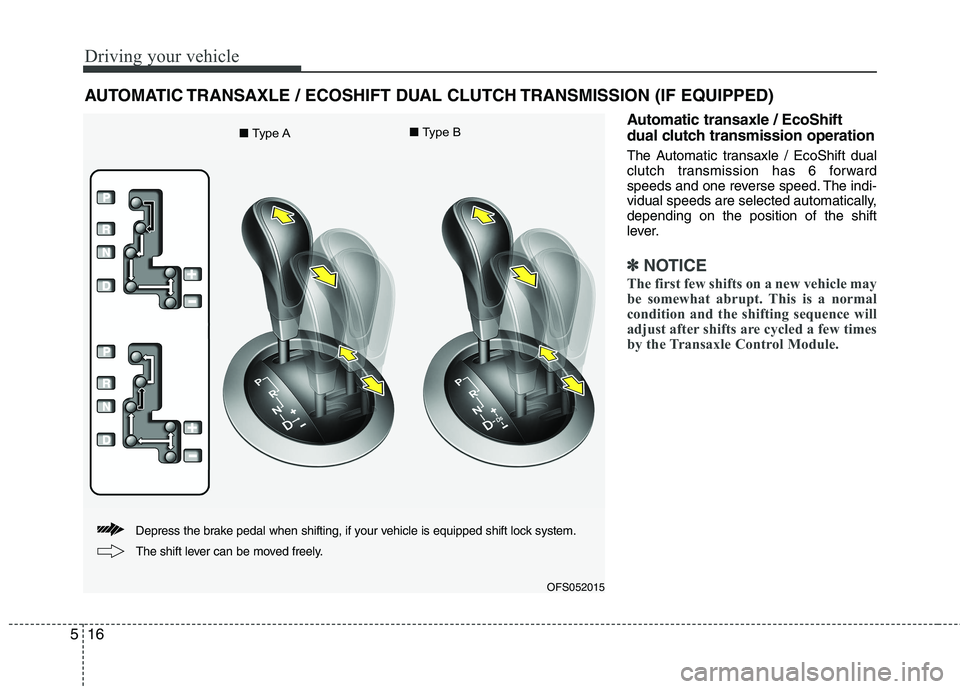
The Automatic transaxle / EcoShift dual
clutch transmission has 6 forward
speeds and one reverse speed. The indi-
vidual speeds are selected automatically,
depending on the position of the shift
lever.
✽ ✽
NOTICE
The first few shifts on a new vehicle may
be somewhat abrupt. This is a normal
condition and the shifting sequence will
adjust after shifts are cycled a few times
by the Transaxle Control Module.
AUTOMATIC TRANSAXLE / ECOSHIFT DUAL CLUTCH TRANSMISSION (IF EQUIPPED)
OFS052015
Depress the brake pedal when shifting, if your vehicle is equipped shift lock system.
The shift lever can be moved freely.
■Type A■Type B
Page 198 of 372
517
Driving your vehicle
✽ ✽
NOTICE
• The EcoShift dual clutch transmission
gives the driving feel of a Manual
Transmission, yet provides the ease of
a fully Automatic Transmission.
Unlike a traditional Automatic
Transmission, the gear shifting can be
felt (and heard) on the EcoShift dual
clutch transmission
- Think of it as an automatically shift-
ing Manual Transmission.
- Shift into drive range and you get
great shifting feedback and sound,
but no shifting hassle.
• Dry-type clutch transfers driving
torque and also delivers direct driving
feel which feels differently than a
smooth Automatic Transmission with
slip of torque converter. This might be
easily felt especially at launch & low
vehicle speed.
• EcoShift dual clutch transmission
adopts dry-type, may be different than
a vehicle equipped with a conventional
automatic transaxle.
• When rapidly accelerating at low vehi-
cle speed, engine could rev at high rpm
depending on vehicle drive conditions.
(Continued)(Continued)
• For smooth uphill launch, press down
the accelerator pedal properly depend-
ing on the vehicle drive condition.
• If you release your foot from the accel-
erator pedal at low vehicle speed, you
may feel strong engine braking, which
is similar to manual transmission.
• If you want to slow down while driv-
ing downhill, you may use sport mode
or paddle shift to downshift, and also
use foot brake properly depending on
driving conditions to get enough
deceleration.
• When you turn the ignition on and off,
you may hear clicking sounds as the
transmission solenoids turn on and
off, cycling through a self test. This is
a normal sound for the dual clutch
transmission.
For smooth operation, depress the brake
pedal when shifting from N (Neutral) to a
forward or reverse gear.
WARNING
Always check the surrounding
areas near your vehicle for peo-
ple, especially children, before
shifting a car into D (Drive) or R
(Reverse).
Before leaving the driver’s seat,
always make sure the shift lever is
in the P (Park) position; then set
the parking brake fully and shut
the engine off. Unexpected and
sudden vehicle movement can
occur if these precautions are not
followed in the order identified.
CAUTION
To prevent clutch damage, the
clutch is released and the torque
flow is interrupted. If the clutch is
released, apply the foot brake,
shift into Park and wait several
seconds before driving again.
Ignoring the warnings can lead to
damage to the transmission.
(Continued)
Page 199 of 372
Driving your vehicle
18 5
Transaxle ranges
P (Park)
Always come to a complete stop before
shifting into P (Park). This position locks
the transaxle and prevents the front
wheels from rotating.
WARNING
Shifting into P (Park) while the
vehicle is in motion will cause the
drive wheels to lock which will
cause you to lose control of the
vehicle.
Do not use the P (Park) position
in place of the parking brake.
Always make sure the shift lever
is latched in the P (Park) position
and set the parking brake fully.
Never leave a child unattended in
a vehicle.
CAUTION
To avoid damage to your transaxle,
do not accelerate the engine in R
(Reverse) or any forward gear posi-
tion with the brakes on.
When stopped on an upgrade, do
not hold the vehicle with engine
power. Use the service brake or
the parking brake.
Do not shift from N (Neutral) or P
(Park) into D (Drive), or R
(Reverse) when the engine is
above idle speed.
(Continued)
If the LCD warning is active, the
foot brake must be applied.
If a transaxle system problem
occurs, the transaxle indicator
will blink. If this occurs, take your
vehicle to an authorized
HYUNDAI dealer and have the
system checked.
When the clutch is overheated,
the safe protection mode oper-
ates. According to the safe pro-
tection mode, the transaxle indi-
cator blinks with a buzzer sound.
The buzzer beeps 3 times. In this
time, the LCD warning about safe
protection mode also displays.
If this occurs, the transaxle may
not shift smoothly due to clutch
overheating. To prevent damage
to the transaxle clutches, shift
into Park and wait for several sec-
onds before driving again.
Do not hold the vehicle on a hill in
Drive or Reverse by applying the
accelerator pedal because the
clutch may be overheated.
Instead, use the foot brake or
parking brake.
(Continued)(Continued)
When the transaxle shifts auto-
maticaly or manually, the gear
shifts may be noticeable; howev-
er, this is characteristic of the
double-clutch transaxle and does
not indicate a transaxle concern.
If the vehicle is held by applying
accelerator pedal on a hill, the
transmission and clutch will be
damaged. To hold at the hill, use
the parking brake or foot brake.
Page 200 of 372
519
Driving your vehicle
R (Reverse)
Use this position to drive the vehicle
backward.
N (Neutral)
The wheels and transaxle are not locked.
The vehicle will roll freely even on the
slightest incline unless the parking brake
or service brakes are applied.
D (Drive)
This is the normal forward driving posi-
tion. The transaxle will automatically shift
through a 6-gear sequence, providing the
best fuel economy and power.
For extra power when passing another
vehicle or climbing grades, depress the
accelerator fully, at which time the
transaxle will automatically downshift to
the next lower gear.Sports mode
Whether the vehicle is stationary or in
motion, sports mode is selected by push-
ing the shift lever from the D (Drive) posi-
tion into the manual gate. To return to D
(Drive) range operation, push the shift
lever back into the main gate.
In sports mode, moving the shift lever
backwards and forwards will allow you to
make gearshifts rapidly.
Up (+) : Push the lever forward once to
shift up one gear.
Down (-) : Pull the lever backwards once
to shift down one gear.DS mode (Drive Sporty) - EcoShift
dual clutch
transmission
Ds mode supports the performance
mode for driver. To shift the Ds mode,
shift the transaxle to Ds mode which is
center of sports mode. If you shift [+] or
[–] gear, the mode is change to sports
mode. The transmission shift is automat-
ically changed at higher engine speeds
by engine load, your driving style, vehicle
condition.
In Ds mode, while coasting downhill, the
engine does not support the vehicle to
slow down.
In Ds mode, if you control the paddle
shifter, the gear will be changed to sports
mode. If the gear is changed to D (Drive),
the gear will be changed to D (Drive)
mode.
✽ ✽
NOTICE- EcoShift dual clutch
transmission
While stopping the vehicle by applying
parking brake in D gear, even if you
release the parking brake, the vehicle
may not move. In this case, you can
drive the vehicle by applying the foot
brake and release, applying the acceler-
ator or shifting the lever (D → →
N → →
D).
CAUTION
Always come to a complete stop
before shifting into or out of
Reverse (R) or Drive (D) to prevent
damage to the transaxle, except as
explained in “Rocking the vehicle”
in this section.
Page 202 of 372
521
Driving your vehicle
Shift lock system (if equipped)
For your safety, the Automatic transaxle /
EcoShift dual clutch transmission has a
shift lock system which prevents shifting
the transaxle from P (Park) or N (Neutral)
into R (Reverse) unless the brake pedal
is depressed.
To shift the transaxle from P (Park) or N
(Neutral) into R (Reverse):
1. Depress and hold the brake pedal.
2. Start the engine or turn the ignition
switch to the ON position.
3. Move the shift lever.
If the brake pedal is repeatedly
depressed and released with the shift
lever in the P (Park) position, a chattering
noise near the shift lever may be heard.
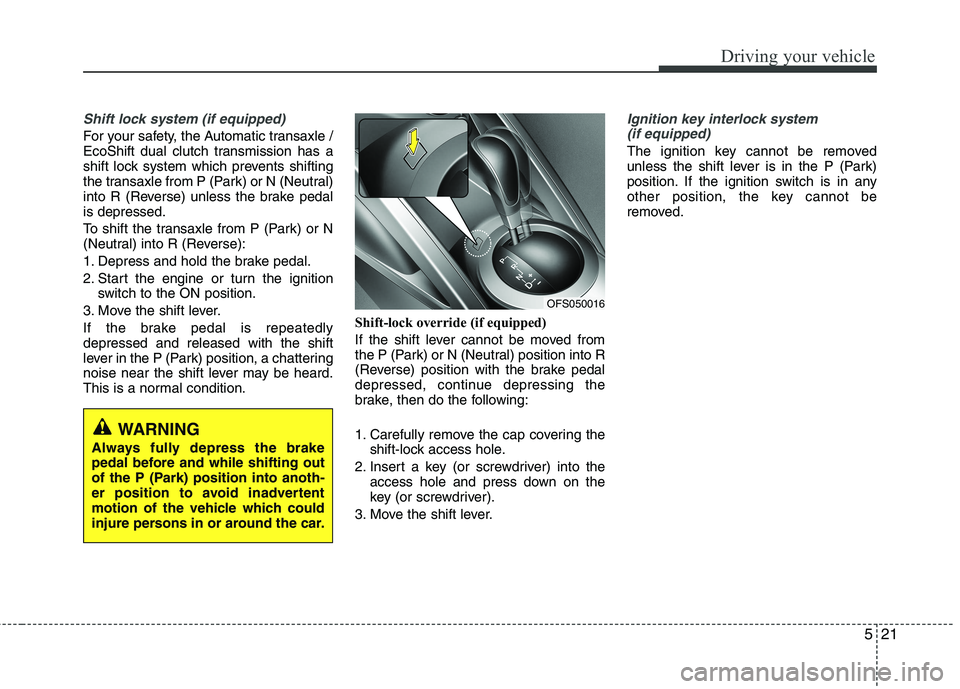
This is a normal condition.Shift-lock override (if equipped)
If the shift lever cannot be moved from
the P (Park) or N (Neutral) position into R
(Reverse) position with the brake pedal
depressed, continue depressing the
brake, then do the following:
1. Carefully remove the cap covering the
shift-lock access hole.
2. Insert a key (or screwdriver) into the
access hole and press down on the
key (or screwdriver).
3. Move the shift lever.
Ignition key interlock system
(if equipped)
The ignition key cannot be removed
unless the shift lever is in the P (Park)
position. If the ignition switch is in any
other position, the key cannot be
removed.
WARNING
Always fully depress the brake
pedal before and while shifting out
of the P (Park) position into anoth-
er position to avoid inadvertent
motion of the vehicle which could
injure persons in or around the car.
OFS050016
Page 206 of 372
525
Driving your vehicle
Disc brakes wear indicator
(if equipped)
Your vehicle has disc brakes.
When your brake pads are worn and new
pads are required, you will hear a high-
pitched warning sound from your front
brakes or rear brakes. You may hear this
sound come and go or it may occur
whenever you depress the brake pedal.
Please remember that some driving con-
ditions or climates may cause a brake
squeal when you first apply (or lightly
apply) the brakes. This is normal and does
not indicate a problem with your brakes.
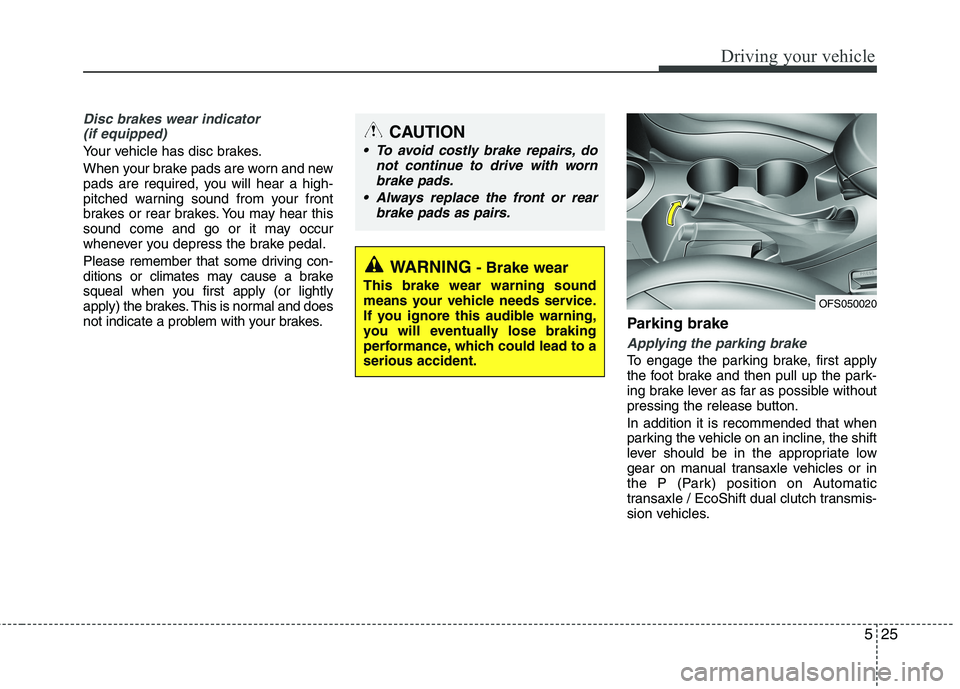
Parking brake
Applying the parking brake
To engage the parking brake, first apply
the foot brake and then pull up the park-
ing brake lever as far as possible without
pressing the release button.
In addition it is recommended that when
parking the vehicle on an incline, the shift
lever should be in the appropriate low
gear on manual transaxle vehicles or in
the P (Park) position on Automatic
transaxle / EcoShift dual clutch transmis-
sion vehicles.
WARNING- Brake wear
This brake wear warning sound
means your vehicle needs service.
If you ignore this audible warning,
you will eventually lose braking
performance, which could lead to a
serious accident.
CAUTION
To avoid costly brake repairs, do
not continue to drive with worn
brake pads.
Always replace the front or rear
brake pads as pairs.
OFS050020
Page 207 of 372
Driving your vehicle
26 5
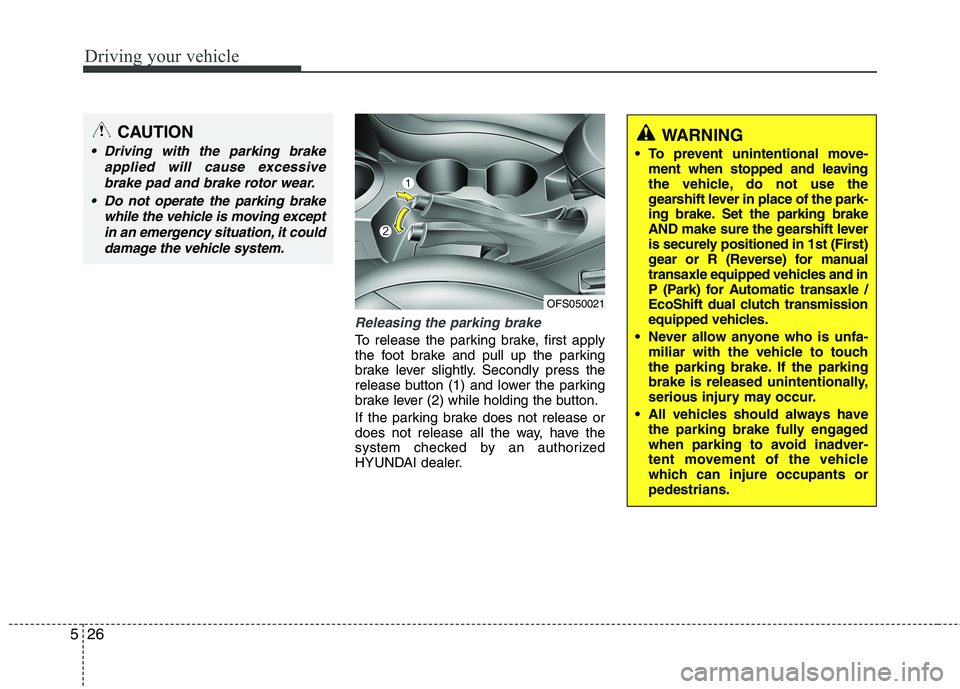
Releasing the parking brake
To release the parking brake, first apply
the foot brake and pull up the parking
brake lever slightly. Secondly press the
release button (1) and lower the parking
brake lever (2) while holding the button.
If the parking brake does not release or
does not release all the way, have the
system checked by an authorized
HYUNDAI dealer.
CAUTION
Driving with the parking brake
applied will cause excessive
brake pad and brake rotor wear.
Do not operate the parking brake
while the vehicle is moving except
in an emergency situation, it could
damage the vehicle system.WARNING
To prevent unintentional move-
ment when stopped and leaving
the vehicle, do not use the
gearshift lever in place of the park-
ing brake. Set the parking brake
AND make sure the gearshift lever
is securely positioned in 1st (First)
gear or R (Reverse) for manual
transaxle equipped vehicles and in
P (Park) for Automatic transaxle /
EcoShift dual clutch transmission
equipped vehicles.
Never allow anyone who is unfa-
miliar with the vehicle to touch
the parking brake. If the parking
brake is released unintentionally,
serious injury may occur.
All vehicles should always have
the parking brake fully engaged
when parking to avoid inadver-
tent movement of the vehicle
which can injure occupants or
pedestrians.
OFS050021
Page 213 of 372
Driving your vehicle
32 5
To dry the brakes, apply the brakes light-
ly until the braking action returns to nor-
mal, taking care to keep the car under
control at all times. If the braking action
does not return to normal, stop as soon
as it is safe to do so and call an author-
ized HYUNDAI dealer for assistance.
Do not coast down hills with the car out
of gear. This is extremely hazardous.
Keep the car in gear at all times, use
the brakes to slow down, then shift to a
lower gear so that engine braking will
help you maintain a safe speed.
Do not "ride" the brake pedal. Resting
your foot on the brake pedal while driv-
ing can be dangerous because it can
result in the brakes overheating and los-
ing their effectiveness. It also increases
the wear of the brake components.
If a tire goes flat while you are driving,
apply the brakes gently and keep the
car pointed straight ahead while you
slow down. When you are moving slow-
ly enough for it to be safe to do so, pull
off the road and stop in a safe place.
If your vehicle is equipped with a
Automatic transaxle / EcoShift dual
clutch transmission, don't let your vehi-
cle creep forward. To avoid creeping for-
ward, keep your foot firmly on the brake
pedal when the vehicle is stopped. Use caution when parking on a hill.
Firmly engage the parking brake and
place the shift lever in P (Automatic
transaxle / EcoShift dual clutch trans-
mission) or in first or reverse gear (man-
ual transaxle). If your vehicle is facing
downhill, turn the front wheels into the
curb to help keep the vehicle from
rolling. If your vehicle is facing uphill,
turn the front wheels away from the curb
to help keep the vehicle from rolling. If
there is no curb or if it is required by
other conditions to keep the vehicle
from rolling, block the wheels.
Under some conditions your parking
brake can freeze in the engaged posi-
tion. This is most likely to happen when
there is an accumulation of snow or ice
around or near the rear brakes or if the
brakes are wet. If there is a risk that the
parking brake may freeze, apply it only
temporarily while you put the gear
selector lever in P (Automatic transaxle
/ EcoShift dual clutch transmission) or
in first or reverse gear (manual
transaxle) and block the rear wheels so
the vehicle cannot roll. Then release
the parking brake.
Do not hold the vehicle on the upgrade
with the accelerator pedal. This can
cause the transaxle to overheat. Always
use the brake pedal or parking brake.Vehicle stability management
(VSM) (if equipped)
This system provides further enhance-
ments to vehicle stability and steering
responses when a vehicle is driving on a
slippery road or a vehicle detected
changes in coefficient of friction between
right wheels and left wheels when braking.
VSM operation
When the VSM is in operation, ESC indi-
cator light ( ) blinks.
When the vehicle stability management
is operating properly, you can feel a slight
pulsation in the vehicle and/or abnormal
steering responses (EPS). This is only
the effect of brake and EPS control and
indicates nothing unusual.
The VSM does not operate when:
Driving on bank road such as gradient
or incline
Driving rearward
ESC OFF indicator light ( ) remains
on the instrument cluster
EPS indicator light remains on the
instrument cluster