engine oil HYUNDAI VELOSTER 2020 Owner's Manual
[x] Cancel search | Manufacturer: HYUNDAI, Model Year: 2020, Model line: VELOSTER, Model: HYUNDAI VELOSTER 2020Pages: 480, PDF Size: 6.16 MB
Page 433 of 480
7-64
Maintenance
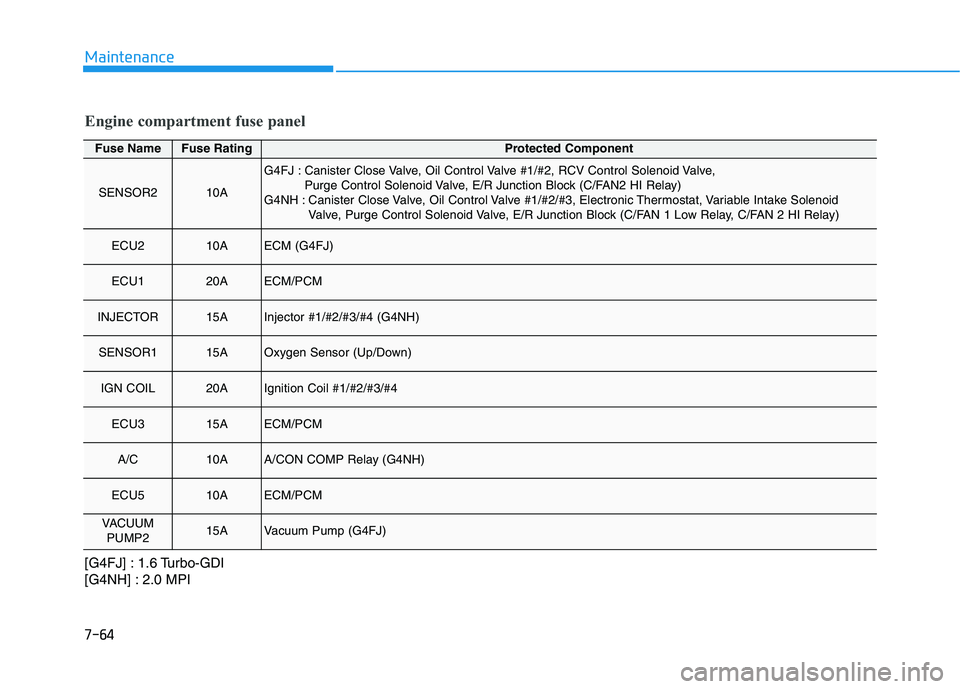
Fuse NameFuse RatingProtected Component
SENSOR210A
G4FJ : Canister Close Valve, Oil Control Valve #1/#2, RCV Control Solenoid Valve,
Purge Control Solenoid Valve, E/R Junction Block (C/FAN2 HI Relay)
G4NH : Canister Close Valve, Oil Control Valve #1/#2/#3, Electronic Thermostat, Variable Intake Solenoid
Valve, Purge Control Solenoid Valve, E/R Junction Block (C/FAN 1 Low Relay, C/FAN 2 HI Relay)
ECU210AECM (G4FJ)
ECU120AECM/PCM
INJECTOR15AInjector #1/#2/#3/#4 (G4NH)
SENSOR115AOxygen Sensor (Up/Down)
IGN COIL20AIgnition Coil #1/#2/#3/#4
ECU315AECM/PCM
A/C10AA/CON COMP Relay (G4NH)
ECU510AECM/PCM
VACUUM
PUMP215AVacuum Pump (G4FJ)
Engine compartment fuse panel
[G4FJ] : 1.6 Turbo-GDI
[G4NH] : 2.0 MPI
Page 448 of 480
7-79
7
Maintenance
High-pressure washing
When using high-pressure wash-
ers, make sure to maintain suffi-
cient distance from the vehicle.
Insufficient clearance or excessive
pressure can lead to component
damage or water penetration.
Do not spray the camera, sensors
or its surrounding area directly with
a high pressure washer. Shock
applied from high pressure water
may cause the device to not oper-
ate normally.
Do not bring the nozzle tip close to
boots (rubber or plastic covers)or
connectors as they may be dam-
aged if they come into contact with
high pressure water.
Do not use any high-pressure noz-
zles, which induce either one-direct
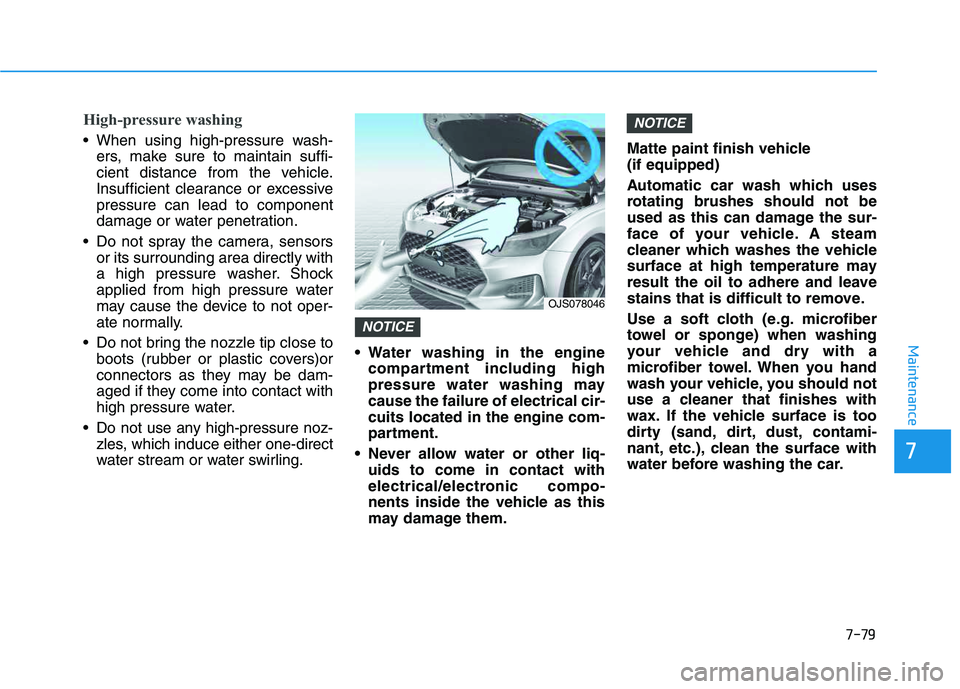
water stream or water swirling. Water washing in the engine
compartment including high
pressure water washing may
cause the failure of electrical cir-
cuits located in the engine com-
partment.
Never allow water or other liq-
uids to come in contact with
electrical/electronic compo-
nents inside the vehicle as this
may damage them.Matte paint finish vehicle
(if equipped)
Automatic car wash which uses
rotating brushes should not be
used as this can damage the sur-
face of your vehicle. A steam
cleaner which washes the vehicle
surface at high temperature may
result the oil to adhere and leave
stains that is difficult to remove.
Use a soft cloth (e.g. microfiber
towel or sponge) when washing
your vehicle and dry with a
microfiber towel. When you hand
wash your vehicle, you should not
use a cleaner that finishes with
wax. If the vehicle surface is too
dirty (sand, dirt, dust, contami-
nant, etc.), clean the surface with
water before washing the car.
NOTICE
NOTICE
OJS078046
Page 465 of 480
8-7
88
Specifications
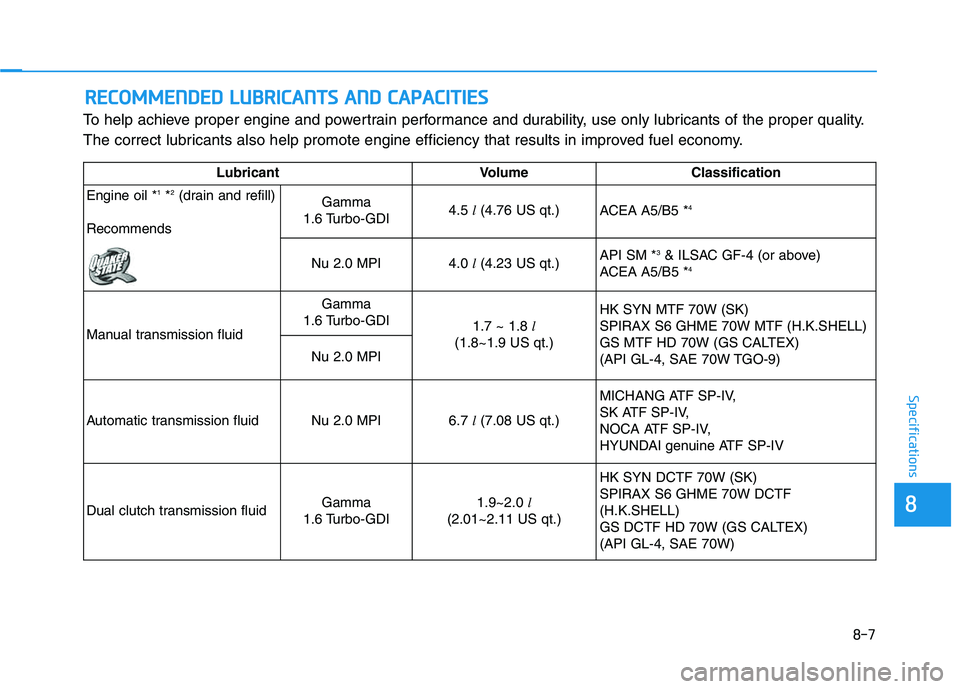
To help achieve proper engine and powertrain performance and durability, use only lubricants of the proper quality.
The correct lubricants also help promote engine efficiency that results in improved fuel economy.
R RE
EC
CO
OM
MM
ME
EN
ND
DE
ED
D
L
LU
UB
BR
RI
IC
CA
AN
NT
TS
S
A
AN
ND
D
C
CA
AP
PA
AC
CI
IT
TI
IE
ES
S
LubricantVolume Classification
Engine oil *
1*2(drain and refill)
RecommendsGamma
1.6 Turbo-GDI4.5 l(4.76 US qt.)
ACEA A5/B5 *4
Nu 2.0 MPI4.0 l(4.23 US qt.)API SM *3& ILSAC GF-4 (or above)
ACEA A5/B5 *4
Manual transmission fluid
Gamma
1.6 Turbo-GDI
1.7 ~ 1.8 l
(1.8~1.9 US qt.)HK SYN MTF 70W (SK)
SPIRAX S6 GHME 70W MTF (H.K.SHELL)
GS MTF HD 70W (GS CALTEX)
(API GL-4, SAE 70W TGO-9)
Nu 2.0 MPI
Automatic transmission fluidNu 2.0 MPI6.7 l(7.08 US qt.)
MICHANG ATF SP-IV,
SK ATF SP-IV,
NOCA ATF SP-IV,
HYUNDAI genuine ATF SP-IV
Dual clutch transmission fluidGamma
1.6 Turbo-GDI1.9~2.0 l
(2.01~2.11 US qt.)
HK SYN DCTF 70W (SK)
SPIRAX S6 GHME 70W DCTF
(H.K.SHELL)
GS DCTF HD 70W (GS CALTEX)
(API GL-4, SAE 70W)
Page 466 of 480
8-8
Specifications
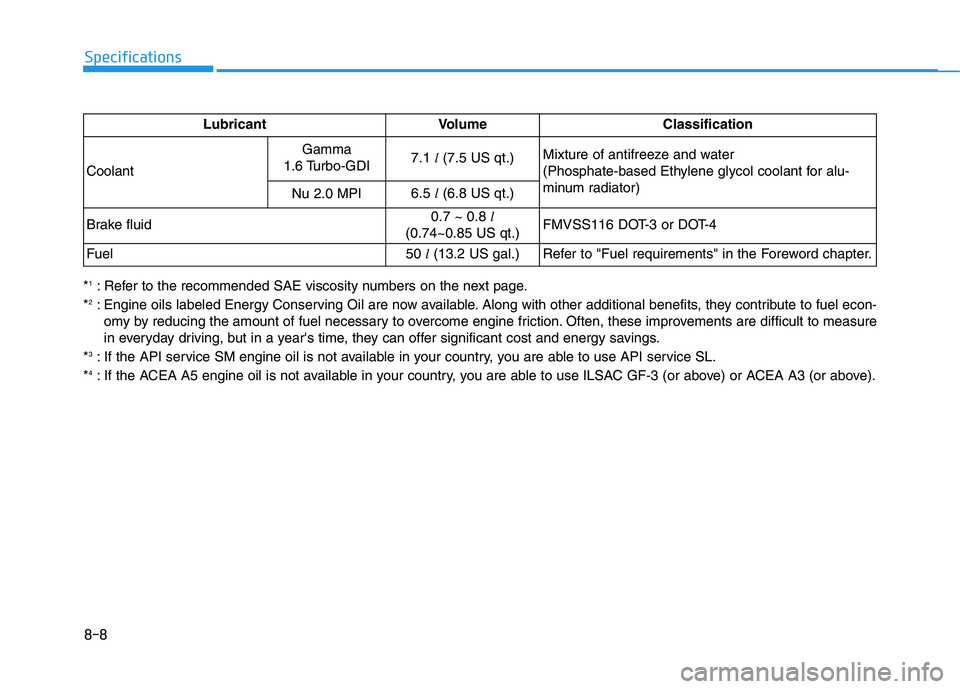
*1: Refer to the recommended SAE viscosity numbers on the next page.
*2: Engine oils labeled Energy Conserving Oil are now available. Along with other additional benefits, they contribute to fuel econ-
omy by reducing the amount of fuel necessary to overcome engine friction. Often, these improvements are difficult to measure
in everyday driving, but in a year's time, they can offer significant cost and energy savings.
*
3: If the API service SM engine oil is not available in your country, you are able to use API service SL.
*4: If the ACEA A5 engine oil is not available in your country, you are able to use ILSAC GF-3 (or above) or ACEA A3 (or above).Lubricant
Volume Classification
CoolantGamma
1.6 Turbo-GDI
7.1 l(7.5 US qt.)Mixture of antifreeze and water
(Phosphate-based Ethylene glycol coolant for alu-
minum radiator)
Nu 2.0 MPI
6.5 l(6.8 US qt.)
Brake fluid
0.7 ~ 0.8 l
(0.74~0.85 US qt.)FMVSS116 DOT-3 or DOT-4
Fuel50 l(13.2 US gal.)Refer to "Fuel requirements" in the Foreword chapter.
Page 467 of 480
8-9
88
Specifications
Recommended SAE viscosity
number
Always be sure to clean the area
around any filler plug, drain
plug, or dipstick before check-
ing or draining any lubricant.
This is especially important in
dusty or sandy areas and when
the vehicle is used on unpaved
roads. Cleaning the plug and
dipstick areas will prevent dirt
and grit from entering the
engine and other mechanisms
that could be damaged.
CAUTION
Temperature Range for SAE Viscosity Numbers
Temperature -30 -20 -10 0 10 20 30 40 50
-10 0 20 40 60 80 100 120
Engine
Oil
Gamma
1.6 Turbo-
GDI*
1
Nu 2.0
MPI *2
°C
(°F)
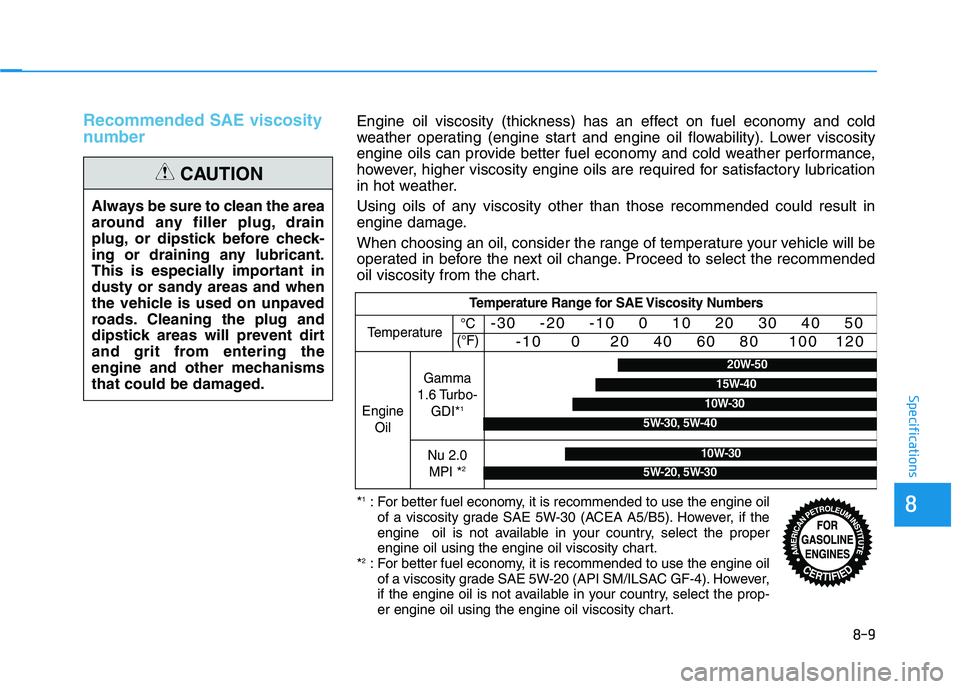
*1: For better fuel economy, it is recommended to use the engine oil
of a viscosity grade SAE 5W-30 (ACEA A5/B5). However, if the
engine oil is not available in your country, select the proper
engine oil using the engine oil viscosity chart.
*
2: For better fuel economy, it is recommended to use the engine oil
of a viscosity grade SAE 5W-20 (API SM/ILSAC GF-4). However,
if the engine oil is not available in your country, select the prop-
er engine oil using the engine oil viscosity chart.
5W-30, 5W-40
10W-30
15W-40
20W-50
10W-30
5W-20, 5W-30
Engine oil viscosity (thickness) has an effect on fuel economy and cold
weather operating (engine start and engine oil flowability). Lower viscosity
engine oils can provide better fuel economy and cold weather performance,
however, higher viscosity engine oils are required for satisfactory lubrication
in hot weather.
Using oils of any viscosity other than those recommended could result in
engine damage.
When choosing an oil, consider the range of temperature your vehicle will be
operated in before the next oil change. Proceed to select the recommended
oil viscosity from the chart.
Page 473 of 480
I-4
Daytime Running Light ..................................................7-68
Dimensions .......................................................................8-2
Disc Brakes Wear Indicator ............................................5-41
Door Locks .....................................................................3-15
Automatic Door Lock and Unlock Features ..............3-19
Child-Protector Rear Door Locks ..............................3-19
Operating Door Locks from Inside the Vehicle .........3-16
Operating Door Locks from Outside the Vehicle ......3-15
Drive Mode Integrated Control System .........................5-51
DRIVE MODE (with Automatic Transmission/
Dual Clutch Transmission) .....................................5-51
SPORT MODE (with Manual Transmission) ............5-55
Driver Assist System.......................................................3-96
Parking Distance Warning (Reverse) system .............3-97
Parking Distance Warning (Reverse) system
Precautions ............................................................3-100
Rear view monitor ......................................................3-96
Driver Attention Warning (DAW) System......................5-96
Resetting the System ..................................................5-97
System Malfunction ...................................................5-98
System Setting and Activation ...................................5-96
System Standby ..........................................................5-98
Dual Clutch Transmission...............................................5-29
Dual Clutch Transmission Operation .........................5-29
Good Driving Practices ..............................................5-38
LCD display for transmission temperature and
warning message .....................................................5-31Electric Power Steering (EPS) ........................................3-21
Electronic Stability Control (ESC) .................................5-45
Emission Control System ...............................................7-86
Crankcase Emission Control System .........................7-86
Evaporative Emission Control System Including
Onboard Refueling Vapor Recovery (ORVR) ........7-86
Exhaust Emission Control System .............................7-87
Engine ...............................................................................8-2
Engine Compartment.................................................1-6, 7-3
Engine Coolant ...............................................................7-23
Changing Engine Coolant ..........................................7-26
Checking the Engine Coolant Level ..........................7-23
Engine Number ...............................................................8-11
Engine Oil .......................................................................7-21
Checking the Engine Oil and Filter ...........................7-22
Checking the Engine Oil Level ..................................7-21
Engine Start/Stop Button ..................................................5-9
Explanation of Scheduled Maintenance Items ...............7-18
Exterior Care ...................................................................7-78
Exterior Features .............................................................3-35
Fuel Filler Door ..........................................................3-38
Hood ...........................................................................3-35
Tailgate .......................................................................3-36
Index
DE