fuel filter HYUNDAI VELOSTER 2020 Owners Manual
[x] Cancel search | Manufacturer: HYUNDAI, Model Year: 2020, Model line: VELOSTER, Model: HYUNDAI VELOSTER 2020Pages: 480, PDF Size: 6.16 MB
Page 377 of 480
7-8
Maintenance
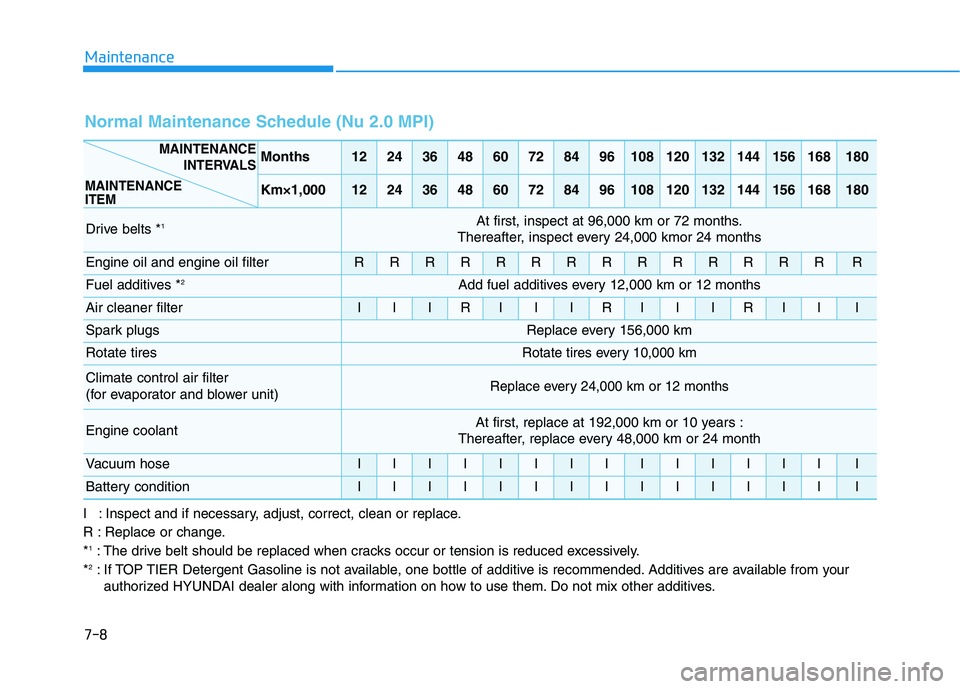
I : Inspect and if necessary, adjust, correct, clean or replace.
R : Replace or change.
*
1: The drive belt should be replaced when cracks occur or tension is reduced excessively.
*2: If TOP TIER Detergent Gasoline is not available, one bottle of additive is recommended. Additives are available from your
authorized HYUNDAI dealer along with information on how to use them. Do not mix other additives.
Normal Maintenance Schedule (Nu 2.0 MPI)
Months1224364860728496108120132144156168180
Km×1,0001224364860728496108120132144156168180
Drive belts *1At first, inspect at 96,000 km or 72 months.
Thereafter, inspect every 24,000 kmor 24 months
Engine oil and engine oil filterRRRRRRRRRRRRRRR
Fuel additives *2Add fuel additives every 12,000 km or 12 months
Air cleaner filterIIIRIIIRIIIRIII
Spark plugsReplace every 156,000 km
Rotate tiresRotate tires every 10,000 km
Climate control air filter
(for evaporator and blower unit)Replace every 24,000 km or 12 months
Engine coolantAt first, replace at 192,000 km or 10 years :
Thereafter, replace every 48,000 km or 24 month
Vacuum hoseIIIIIIIIIIIIIII
Battery conditionIIIIIIIIIIIIIII
MAINTENANCE
INTERVALS
MAINTENANCE
ITEM
Page 379 of 480
7-10
Maintenance
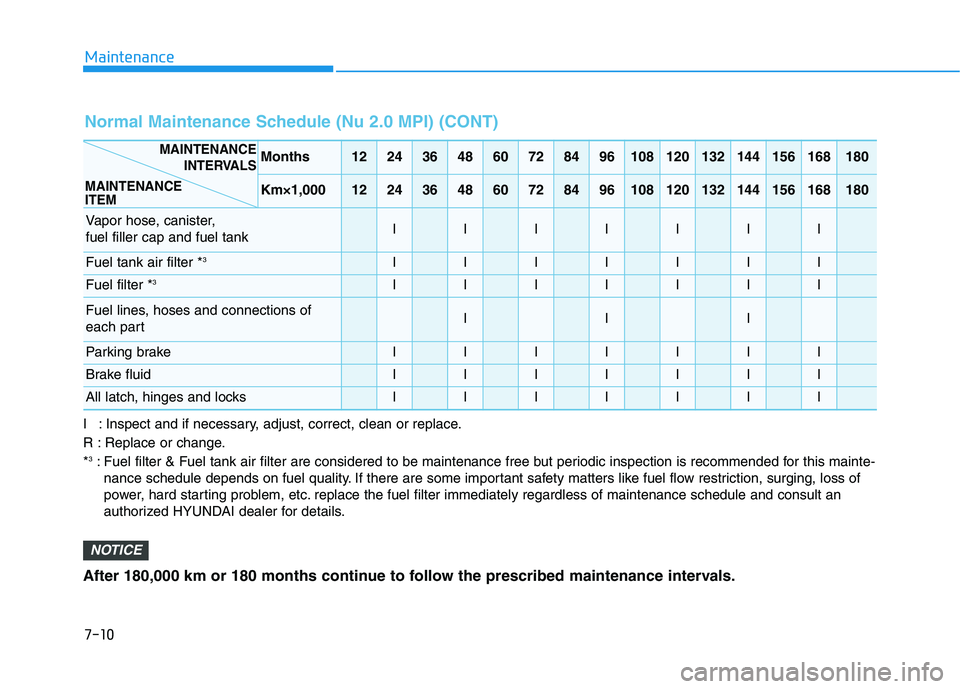
I : Inspect and if necessary, adjust, correct, clean or replace.
R : Replace or change.
*
3: Fuel filter & Fuel tank air filter are considered to be maintenance free but periodic inspection is recommended for this mainte-
nance schedule depends on fuel quality. If there are some important safety matters like fuel flow restriction, surging, loss of
power, hard starting problem, etc. replace the fuel filter immediately regardless of maintenance schedule and consult an
authorized HYUNDAI dealer for details.
After 180,000 km or 180 months continue to follow the prescribed maintenance intervals.
NOTICE
Normal Maintenance Schedule (Nu 2.0 MPI) (CONT)
Months1224364860728496108120132144156168180
Km×1,0001224364860728496108120132144156168180
Vapor hose, canister,
fuel filler cap and fuel tankIIIIIII
Fuel tank air filter *3IIIIIII
Fuel filter *3IIIIIII
Fuel lines, hoses and connections of
each partIII
Parking brakeIIIIIII
Brake fluidIIIIIII
All latch, hinges and locksIIIIIII
MAINTENANCE
INTERVALS
MAINTENANCE
ITEM
Page 382 of 480
7-13
7
Maintenance
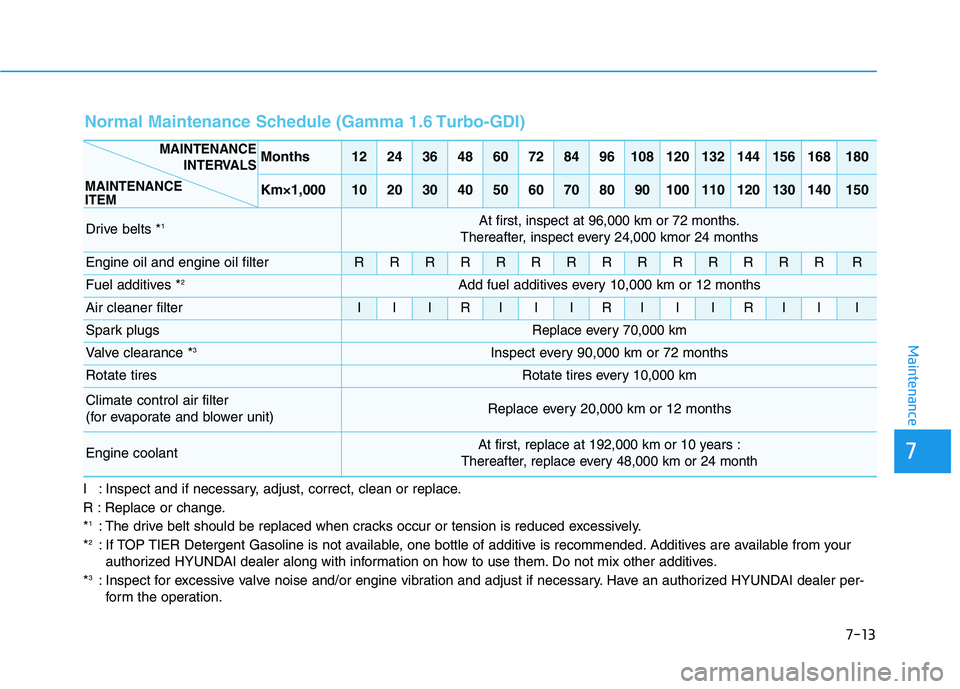
I : Inspect and if necessary, adjust, correct, clean or replace.
R : Replace or change.
*
1: The drive belt should be replaced when cracks occur or tension is reduced excessively.
*2: If TOP TIER Detergent Gasoline is not available, one bottle of additive is recommended. Additives are available from your
authorized HYUNDAI dealer along with information on how to use them. Do not mix other additives.
*
3: Inspect for excessive valve noise and/or engine vibration and adjust if necessary. Have an authorized HYUNDAI dealer per-
form the operation.
Normal Maintenance Schedule (Gamma 1.6 Turbo-GDI)
Months1224364860728496108120132144156168180
Km×1,000102030405060708090100110120130140150
Drive belts *1At first, inspect at 96,000 km or 72 months.
Thereafter, inspect every 24,000 kmor 24 months
Engine oil and engine oil filterRRRRRRRRRRRRRRR
Fuel additives *2Add fuel additives every 10,000 km or 12 months
Air cleaner filterIIIRIIIRIIIRIII
Spark plugsReplace every 70,000 km
Valve clearance *3Inspect every 90,000 km or 72 months
Rotate tiresRotate tires every 10,000 km
Climate control air filter
(for evaporate and blower unit)Replace every 20,000 km or 12 months
Engine coolantAt first, replace at 192,000 km or 10 years :
Thereafter, replace every 48,000 km or 24 month
MAINTENANCE
INTERVALS
MAINTENANCE
ITEM
Page 384 of 480
7
Maintenance
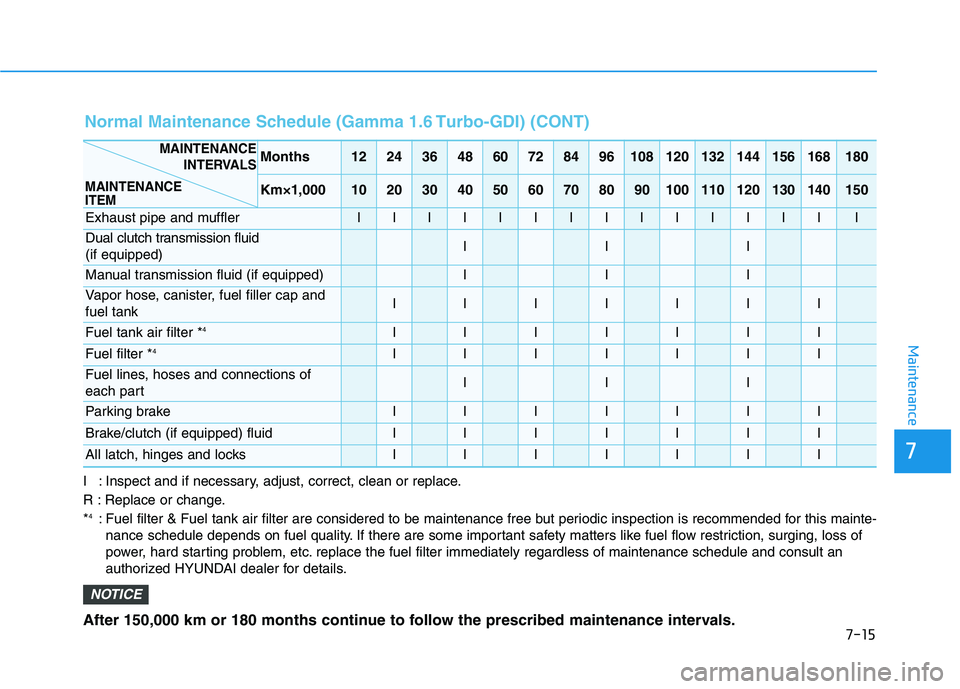
I : Inspect and if necessary, adjust, correct, clean or replace.
R : Replace or change.
*
4: Fuel filter & Fuel tank air filter are considered to be maintenance free but periodic inspection is recommended for this mainte-
nance schedule depends on fuel quality. If there are some important safety matters like fuel flow restriction, surging, loss of
power, hard starting problem, etc. replace the fuel filter immediately regardless of maintenance schedule and consult an
authorized HYUNDAI dealer for details.
Normal Maintenance Schedule (Gamma 1.6 Turbo-GDI) (CONT)
Months1224364860728496108120132144156168180
Km×1,000102030405060708090100110120130140150
Exhaust pipe and mufflerIIIIIIIIIIIIIII
Dual clutch transmission fluid
(if equipped)III
Manual transmission fluid (if equipped)III
Vapor hose, canister, fuel filler cap and
fuel tankIIIIIII
Fuel tank air filter *4IIIIIII
Fuel filter *4IIIIIII
Fuel lines, hoses and connections of
each partIII
Parking brakeIIIIIII
Brake/clutch (if equipped) fluidIIIIIII
All latch, hinges and locksIIIIIII
MAINTENANCE
INTERVALS
MAINTENANCE
ITEM
After 150,000 km or 180 months continue to follow the prescribed maintenance intervals.
NOTICE
7-15
Page 387 of 480
7-18
Maintenance
E EX
XP
PL
LA
AN
NA
AT
TI
IO
ON
N
O
OF
F
S
SC
CH
HE
ED
DU
UL
LE
ED
D
M
MA
AI
IN
NT
TE
EN
NA
AN
NC
CE
E
I
IT
TE
EM
MS
S
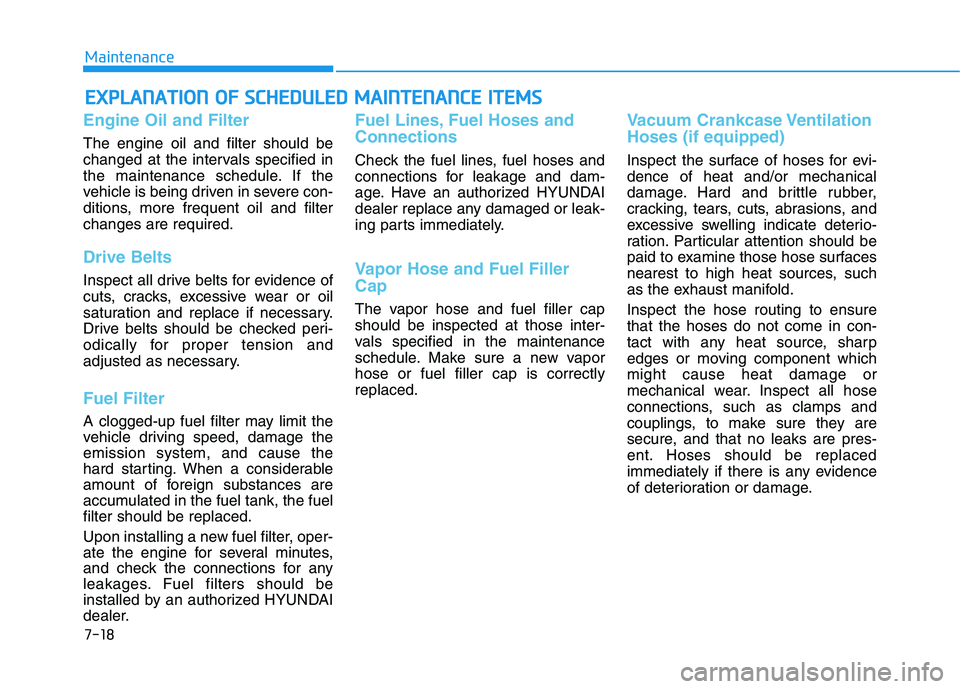
Engine Oil and Filter
The engine oil and filter should be
changed at the intervals specified in
the maintenance schedule. If the
vehicle is being driven in severe con-
ditions, more frequent oil and filter
changes are required.
Drive Belts
Inspect all drive belts for evidence of
cuts, cracks, excessive wear or oil
saturation and replace if necessary.
Drive belts should be checked peri-
odically for proper tension and
adjusted as necessary.
Fuel Filter
A clogged-up fuel filter may limit the
vehicle driving speed, damage the
emission system, and cause the
hard starting. When a considerable
amount of foreign substances are
accumulated in the fuel tank, the fuel
filter should be replaced.
Upon installing a new fuel filter, oper-
ate the engine for several minutes,
and check the connections for any
leakages. Fuel filters should be
installed by an authorized HYUNDAI
dealer.
Fuel Lines, Fuel Hoses and
Connections
Check the fuel lines, fuel hoses and
connections for leakage and dam-
age. Have an authorized HYUNDAI
dealer replace any damaged or leak-
ing parts immediately.
Vapor Hose and Fuel Filler
Cap
The vapor hose and fuel filler cap
should be inspected at those inter-
vals specified in the maintenance
schedule. Make sure a new vapor
hose or fuel filler cap is correctly
replaced.
Vacuum Crankcase Ventilation
Hoses (if equipped)
Inspect the surface of hoses for evi-
dence of heat and/or mechanical
damage. Hard and brittle rubber,
cracking, tears, cuts, abrasions, and
excessive swelling indicate deterio-
ration. Particular attention should be
paid to examine those hose surfaces
nearest to high heat sources, such
as the exhaust manifold.
Inspect the hose routing to ensure
that the hoses do not come in con-
tact with any heat source, sharp
edges or moving component which
might cause heat damage or
mechanical wear. Inspect all hose
connections, such as clamps and
couplings, to make sure they are
secure, and that no leaks are pres-
ent. Hoses should be replaced
immediately if there is any evidence
of deterioration or damage.
Page 455 of 480
7-86
Maintenance
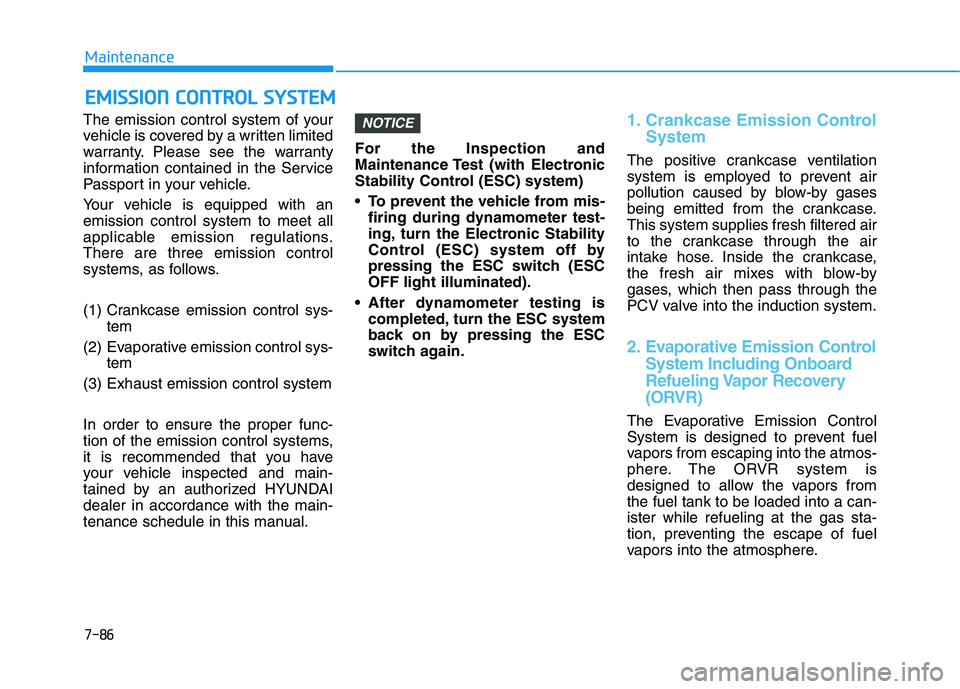
The emission control system of your
vehicle is covered by a written limited
warranty. Please see the warranty
information contained in the Service
Passport in your vehicle.
Your vehicle is equipped with an
emission control system to meet all
applicable emission regulations.
There are three emission control
systems, as follows.
(1) Crankcase emission control sys-
tem
(2) Evaporative emission control sys-
tem
(3) Exhaust emission control system
In order to ensure the proper func-
tion of the emission control systems,
it is recommended that you have
your vehicle inspected and main-
tained by an authorized HYUNDAI
dealer in accordance with the main-
tenance schedule in this manual.For the Inspection and
Maintenance Test (with Electronic
Stability Control (ESC) system)
To prevent the vehicle from mis-
firing during dynamometer test-
ing, turn the Electronic Stability
Control (ESC) system off by
pressing the ESC switch (ESC
OFF light illuminated).
After dynamometer testing is
completed, turn the ESC system
back on by pressing the ESC
switch again.
1. Crankcase Emission Control
System
The positive crankcase ventilation
system is employed to prevent air
pollution caused by blow-by gases
being emitted from the crankcase.
This system supplies fresh filtered air
to the crankcase through the air
intake hose. Inside the crankcase,
the fresh air mixes with blow-by
gases, which then pass through the
PCV valve into the induction system.
2. Evaporative Emission Control
System Including Onboard
Refueling Vapor Recovery
(ORVR)
The Evaporative Emission Control
System is designed to prevent fuel
vapors from escaping into the atmos-
phere. The ORVR system is
designed to allow the vapors from
the fuel tank to be loaded into a can-
ister while refueling at the gas sta-
tion, preventing the escape of fuel
vapors into the atmosphere.
NOTICE
E EM
MI
IS
SS
SI
IO
ON
N
C
CO
ON
NT
TR
RO
OL
L
S
SY
YS
ST
TE
EM
M
Page 473 of 480
I-4
Daytime Running Light ..................................................7-68
Dimensions .......................................................................8-2
Disc Brakes Wear Indicator ............................................5-41
Door Locks .....................................................................3-15
Automatic Door Lock and Unlock Features ..............3-19
Child-Protector Rear Door Locks ..............................3-19
Operating Door Locks from Inside the Vehicle .........3-16
Operating Door Locks from Outside the Vehicle ......3-15
Drive Mode Integrated Control System .........................5-51
DRIVE MODE (with Automatic Transmission/
Dual Clutch Transmission) .....................................5-51
SPORT MODE (with Manual Transmission) ............5-55
Driver Assist System.......................................................3-96
Parking Distance Warning (Reverse) system .............3-97
Parking Distance Warning (Reverse) system
Precautions ............................................................3-100
Rear view monitor ......................................................3-96
Driver Attention Warning (DAW) System......................5-96
Resetting the System ..................................................5-97
System Malfunction ...................................................5-98
System Setting and Activation ...................................5-96
System Standby ..........................................................5-98
Dual Clutch Transmission...............................................5-29
Dual Clutch Transmission Operation .........................5-29
Good Driving Practices ..............................................5-38
LCD display for transmission temperature and
warning message .....................................................5-31Electric Power Steering (EPS) ........................................3-21
Electronic Stability Control (ESC) .................................5-45
Emission Control System ...............................................7-86
Crankcase Emission Control System .........................7-86
Evaporative Emission Control System Including
Onboard Refueling Vapor Recovery (ORVR) ........7-86
Exhaust Emission Control System .............................7-87
Engine ...............................................................................8-2
Engine Compartment.................................................1-6, 7-3
Engine Coolant ...............................................................7-23
Changing Engine Coolant ..........................................7-26
Checking the Engine Coolant Level ..........................7-23
Engine Number ...............................................................8-11
Engine Oil .......................................................................7-21
Checking the Engine Oil and Filter ...........................7-22
Checking the Engine Oil Level ..................................7-21
Engine Start/Stop Button ..................................................5-9
Explanation of Scheduled Maintenance Items ...............7-18
Exterior Care ...................................................................7-78
Exterior Features .............................................................3-35
Fuel Filler Door ..........................................................3-38
Hood ...........................................................................3-35
Tailgate .......................................................................3-36
Index
DE