display HYUNDAI VELOSTER 2021 Owners Manual
[x] Cancel search | Manufacturer: HYUNDAI, Model Year: 2021, Model line: VELOSTER, Model: HYUNDAI VELOSTER 2021Pages: 482, PDF Size: 37.54 MB
Page 423 of 482
7-44
Maintenance
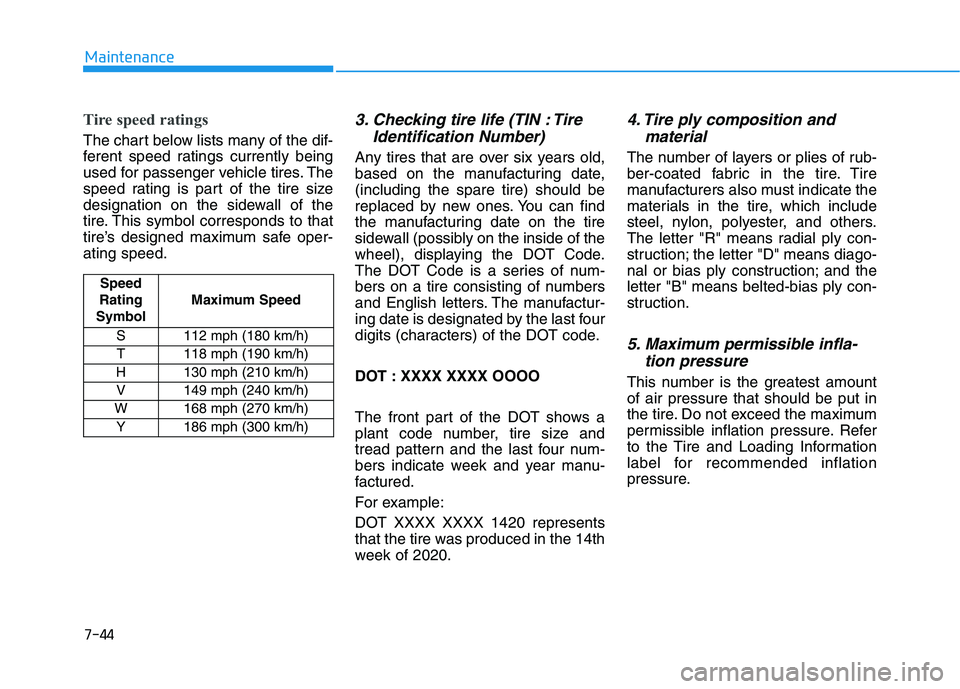
Tire speed ratings
The chart below lists many of the dif-
ferent speed ratings currently being
used for passenger vehicle tires. The
speed rating is part of the tire size
designation on the sidewall of the
tire. This symbol corresponds to that
tire’s designed maximum safe oper-
ating speed.
3. Checking tire life (TIN : Tire
Identification Number)
Any tires that are over six years old,
based on the manufacturing date,
(including the spare tire) should be
replaced by new ones. You can find
the manufacturing date on the tire
sidewall (possibly on the inside of the
wheel), displaying the DOT Code.
The DOT Code is a series of num-
bers on a tire consisting of numbers
and English letters. The manufactur-
ing date is designated by the last four
digits (characters) of the DOT code.
DOT : XXXX XXXX OOOO
The front part of the DOT shows a
plant code number, tire size and
tread pattern and the last four num-
bers indicate week and year manu-
factured.
For example:
DOT XXXX XXXX 1420 represents
that the tire was produced in the 14th
week of 2020.
4. Tire ply composition and
material
The number of layers or plies of rub-
ber-coated fabric in the tire. Tire
manufacturers also must indicate the
materials in the tire, which include
steel, nylon, polyester, and others.
The letter "R" means radial ply con-
struction; the letter "D" means diago-
nal or bias ply construction; and the
letter "B" means belted-bias ply con-
struction.
5. Maximum permissible infla-
tion pressure
This number is the greatest amount
of air pressure that should be put in
the tire. Do not exceed the maximum
permissible inflation pressure. Refer
to the Tire and Loading Information
label for recommended inflation
pressure.
Speed
Rating
SymbolMaximum Speed
S 112 mph (180 km/h)
T 118 mph (190 km/h)
H 130 mph (210 km/h)
V 149 mph (240 km/h)
W 168 mph (270 km/h)
Y186 mph (300 km/h)
Page 437 of 482
7-58
Maintenance
Fuse NameFuse RatingProtected Component
INTERIOR
LAMP7.5AVanity Lamp LH/RH, Center Room Lamp, Luggage Lamp,
Overhead Console Lamp, Wireless Charger Unit
SPARE-Spare
SPARE-Spare
MEMORY10AA/C Control Module, Head Up Display, Instrument Cluster
SPARE-Spare
AMP30AAMP
MODULE67.5ASmart Key Control Module, BCM
MDPS7.5AMDPS Unit
MODULE17.5ABCM, Rain Sensor, Ignition Key Interlock Switch, Hazard Switch,
Data Link Connector
MODULE77.5AFront Seat Warmer Module, PCB Block (A/Con Comp Relay)
A/BAG IND7.5AInstrument Cluster, Hazard Switch
BRAKE
SWITCH7.5AStop Lamp Switch, Smart Key Control Module
Instrument panel fuse panel
Page 438 of 482

7-59
7
Maintenance
Fuse NameFuse RatingProtected Component
START7.5ATransaxle Range Switch (DCT), ECM, Ignition Lock & Clutch Switch,
E/R Junction Block (START #1 Relay, B/Alarm Relay),
Smart Key Control Module
CLUSTER7.5AHead Up Display, Instrument Cluster
DOOR LOCK20AICM Relay Box (Twoturn Unlock Relay)
PDM37.5AStart Stop Button Switch, Immobilizer Module
FCA10AForward Collision Avoidance Assist Unit
S/HEATER20AFront Seat Warmer Module
A/C210A-
A/C17.5AA/C Control Module, E/R Junction Block (Blower Relay)
PDM115ASmart Key Control Module
SPARE-Spare
AIR BAG15ASRS Control Module, Passenger Occupant Detection
IG125APCB Block(FUSE : ECU5, VACUUM PUMP, ABS3, TCU2)
Instrument panel fuse panel
Page 478 of 482
8-9
88
Specifications, Consumer information and Reporting safety defects
Recommended SAE viscosity
number
Engine oil viscosity (thickness) has
an effect on fuel economy and cold
weather operating (engine start and
engine oil flowability). Lower viscosi-
ty engine oils can provide better fuel
economy and cold weather perform-
ance, however, higher viscosity
engine oils are required for satisfac-
tory lubrication in hot weather.Always be sure to clean the area
around any filler plug, drain
plug, or dipstick before check-
ing or draining any lubricant.
This is especially important in
dusty or sandy areas and when
the vehicle is used on unpaved
roads. Cleaning the plug and
dipstick areas will prevent dirt
and grit from entering the
engine and other mechanisms
that could be damaged.
CAUTION
Temperature Range for SAE Viscosity Numbers
Temperature -30 -20 -10 0 10 20 30 40 50
-10 0 20 40 60 80 100 120
Engine
Oil
Gamma
1.6 T-GDI *1
Nu 2.0
MPI *2
°C
(°F)
*1: For better fuel economy, it is recommended to use the engine oil
of a viscosity grade SAE 5W-30 (ACEA A5/B5). However, if the
engine oil is not available in your country, select the proper
engine oil using the engine oil viscosity chart.
*
2: For better fuel economy, it is recommended to use the engine oil
of a viscosity grade SAE 5W-20 (API SM / ILSAC GF-4).
However, if the engine oil is not available in your country, select
the proper engine oil using the engine oil viscosity chart.
5W-30, 5W-40
10W-30
15W-40
20W-50
10W-30
5W-20, 5W-30
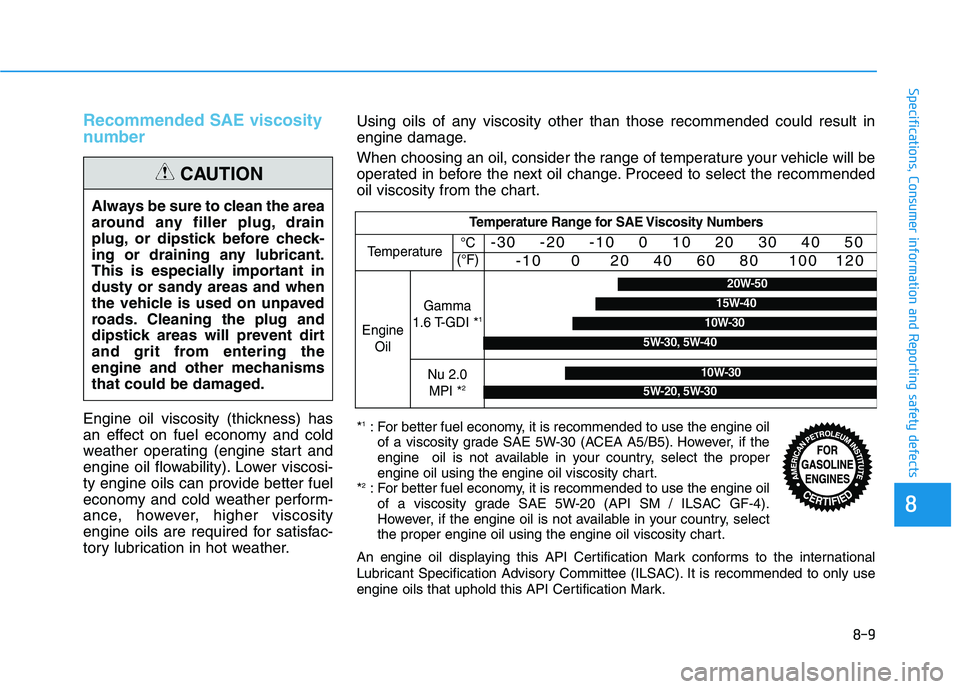
Using oils of any viscosity other than those recommended could result in
engine damage.
When choosing an oil, consider the range of temperature your vehicle will be
operated in before the next oil change. Proceed to select the recommended
oil viscosity from the chart.
An engine oil displaying this API Certification Mark conforms to the international
Lubricant Specification Advisory Committee (ILSAC). It is recommended to only use
engine oils that uphold this API Certification Mark.