wheel HYUNDAI VELOSTER N 2022 Owners Manual
[x] Cancel search | Manufacturer: HYUNDAI, Model Year: 2022, Model line: VELOSTER N, Model: HYUNDAI VELOSTER N 2022Pages: 446, PDF Size: 9.71 MB
Page 396 of 446
7-44
Maintenance
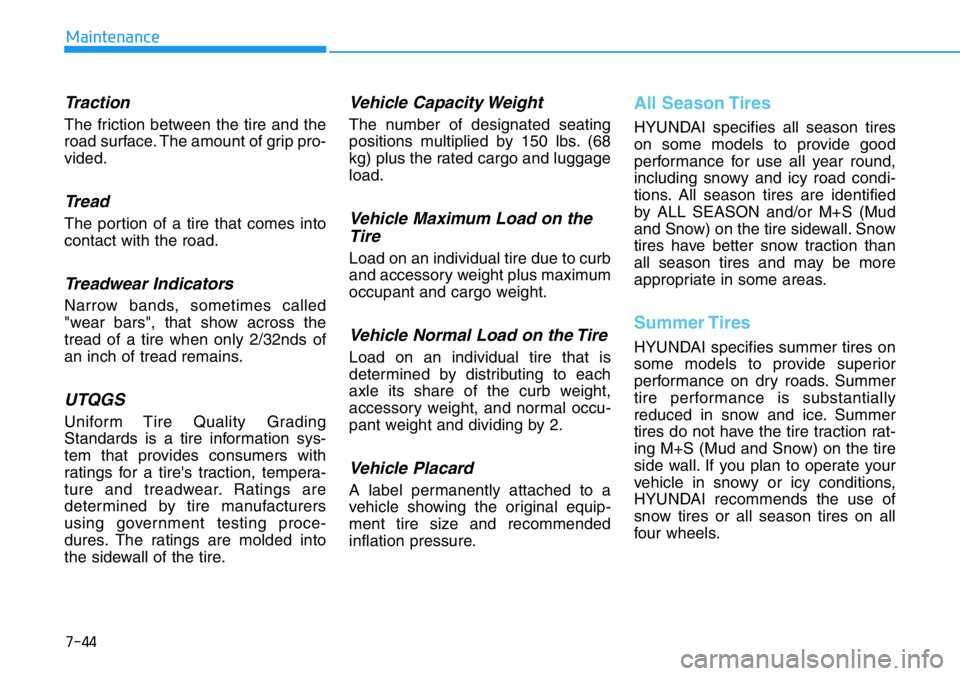
Traction
The friction between the tire and the
road surface. The amount of grip pro-
vided.
Tread
The portion of a tire that comes into
contact with the road.
Treadwear Indicators
Narrow bands, sometimes called
"wear bars", that show across the
tread of a tire when only 2/32nds of
an inch of tread remains.
UTQGS
Uniform Tire Quality Grading
Standards is a tire information sys-
tem that provides consumers with
ratings for a tire's traction, tempera-
ture and treadwear. Ratings are
determined by tire manufacturers
using government testing proce-
dures. The ratings are molded into
the sidewall of the tire.
Vehicle Capacity Weight
The number of designated seating
positions multiplied by 150 lbs. (68
kg) plus the rated cargo and luggage
load.
Vehicle Maximum Load on the
Tire
Load on an individual tire due to curb
and accessory weight plus maximum
occupant and cargo weight.
Vehicle Normal Load on the Tire
Load on an individual tire that is
determined by distributing to each
axle its share of the curb weight,
accessory weight, and normal occu-
pant weight and dividing by 2.
Vehicle Placard
A label permanently attached to a
vehicle showing the original equip-
ment tire size and recommended
inflation pressure.
All Season Tires
HYUNDAI specifies all season tires
on some models to provide good
performance for use all year round,
including snowy and icy road condi-
tions. All season tires are identified
by ALL SEASON and/or M+S (Mud
and Snow) on the tire sidewall. Snow
tires have better snow traction than
all season tires and may be more
appropriate in some areas.
Summer Tires
HYUNDAI specifies summer tires on
some models to provide superior
performance on dry roads. Summer
tire performance is substantially
reduced in snow and ice. Summer
tires do not have the tire traction rat-
ing M+S (Mud and Snow) on the tire
side wall. If you plan to operate your
vehicle in snowy or icy conditions,
HYUNDAI recommends the use of
snow tires or all season tires on all
four wheels.
Page 397 of 446
7-45
7
Maintenance
Snow Tires
If you equip your car with snow tires,
they should be the same size and
have the same load capacity as the
original tires. Snow tires should be
installed on all four wheels; other-
wise, poor handling may result. Do
not drive faster than 75 mph (120
km/h) when your vehicle is equipped
with snow tires.
Radial-Ply Tires
Radial-ply tires provide improved
tread life, road hazard resistance and
smoother high speed ride. The radi-
al-ply tires used on this vehicle are of
belted construction, and are selected
to complement the ride and handling
characteristics of your vehicle.Radial-ply tires have the same load
carrying capacity, as bias-ply or bias
belted tires of the same size, and use
the same recommended inflation
pressure. Mixing of radial-ply tires
with bias-ply or bias belted tires is
not recommended. Any combina-
tions of radial-ply and bias-ply or bias
belted tires when used on the same
vehicle will seriously deteriorate
vehicle handling. The best rule to fol-
low is: Identical pairs of radial-ply
tires should always be used as a set
for the front tires and a set for the
rear tires.
Longer wearing tires can be more
susceptible to irregular tread wear. It
is very important to follow the tire
rotation interval in this chapter to
achieve the tread life potential of
these tires. Cuts and punctures in
radial-ply tires are repairable only in
the tread area, because of sidewall
flexing. Consult your tire dealer for
radial-ply tire repairs.
Low Aspect Ratio Tires
The aspect ratio is lower than 50 on
low aspect ratio tires.
Because low aspect ratio tires are
optimized for handling and braking,
their sidewall is a little stiffer than a
standard tire. Also low aspect ratio
tires tend to be wider and conse-
quently have a greater contact patch
with the road surface. In some
instances they may generate more
road noise compared with standard
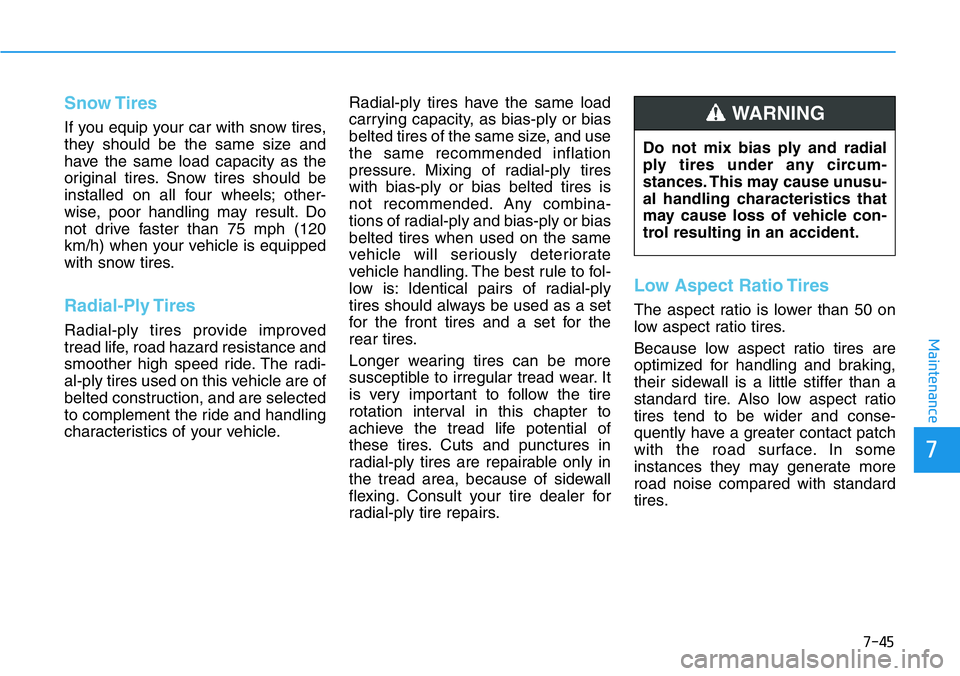
tires.Do not mix bias ply and radial
ply tires under any circum-
stances. This may cause unusu-
al handling characteristics that
may cause loss of vehicle con-
trol resulting in an accident.
WARNING
Page 398 of 446
7-46
Maintenance
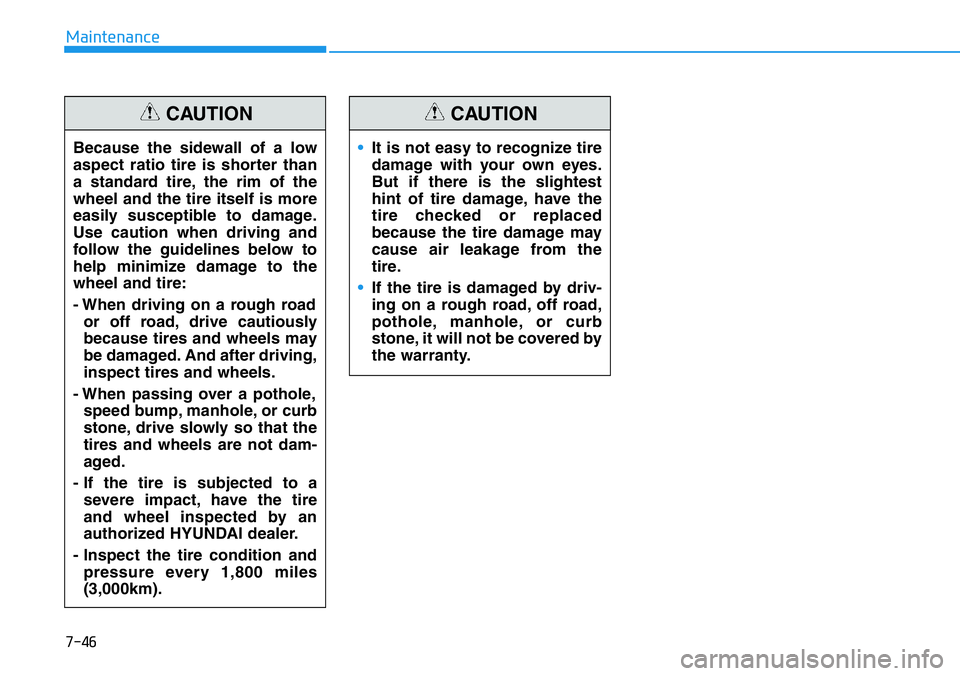
Because the sidewall of a low
aspect ratio tire is shorter than
a standard tire, the rim of the
wheel and the tire itself is more
easily susceptible to damage.
Use caution when driving and
follow the guidelines below to
help minimize damage to the
wheel and tire:
- When driving on a rough road
or off road, drive cautiously
because tires and wheels may
be damaged. And after driving,
inspect tires and wheels.
- When passing over a pothole,
speed bump, manhole, or curb
stone, drive slowly so that the
tires and wheels are not dam-
aged.
- If the tire is subjected to a
severe impact, have the tire
and wheel inspected by an
authorized HYUNDAI dealer.
- Inspect the tire condition and
pressure every 1,800 miles
(3,000km).
CAUTION
•It is not easy to recognize tire
damage with your own eyes.
But if there is the slightest
hint of tire damage, have the
tire checked or replaced
because the tire damage may
cause air leakage from the
tire.
•If the tire is damaged by driv-
ing on a rough road, off road,
pothole, manhole, or curb
stone, it will not be covered by
the warranty.
CAUTION
Page 425 of 446
7-73
7
Maintenance
Bright-metal maintenance
• To remove road tar and insects,
use a tar remover, not a scraper or
other sharp object.
• To protect the surfaces of bright-
metal parts from corrosion, apply a
coating of wax or chrome preser-
vative and rub to a high luster.
• During winter weather or in coastal
areas, cover the bright metal parts
with a heavier coating of wax or
preservative. If necessary, coat the
parts with non-corrosive petroleum
jelly or other protective compound.
Underbody maintenance
Corrosive materials used for ice and
snow removal and dust control may
collect on the underbody. If these
materials are not removed, acceler-
ated rusting can occur on underbody
parts such as the fuel lines, frame,
floor pan and exhaust system, even
though they have been treated with
rust protection.Thoroughly flush the vehicle under-
body and wheel openings with luke-
warm or cold water once a month,
after off-road driving and at the end
of each winter. Pay special attention
to these areas because it is difficult
to see all the mud and dirt. It will do
more harm than good to wet down
the road grime without removing it.
The lower edges of doors, rocker
panels, and frame members have
drain holes that should not be
allowed to clog with dirt; trapped
water in these areas can cause rust-
ing.
Aluminum wheel maintenance
The aluminum wheels are coated
with a clear protective finish.
• Do not use abrasive cleaner, pol-
ishing compound, solvent, or
wire brushes on aluminum
wheels.
• Clean the wheel when it has
cooled.
• Use only a mild soap or neutral
detergent, and rinse thoroughly
with water. Also, clean the
wheels after driving on salted
roads.
• Do not wash the wheels with
high-speed car wash brushes.
• Do not use any cleaners con-
taining acid or alkaline deter-
gents.
NOTICE
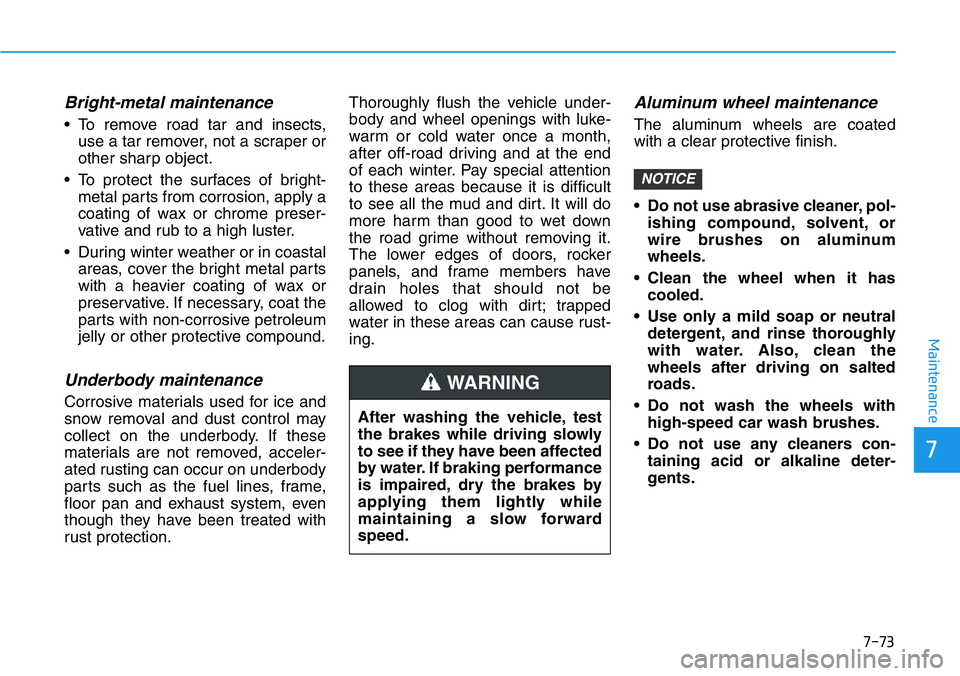
After washing the vehicle, test
the brakes while driving slowly
to see if they have been affected
by water. If braking performance
is impaired, dry the brakes by
applying them lightly while
maintaining a slow forward
speed.
WARNING
Page 427 of 446
7-75
7
Maintenance
• When cleaning underneath the
vehicle, pay particular attention to
the components under the fenders
and other areas that are hidden
from view. Do a thorough job; just
dampening the accumulated mud
rather than washing it away will
accelerate corrosion rather than
prevent it. Water under high pres-
sure and steam are particularly
effective in removing accumulated
mud and corrosive materials.
• When cleaning lower door panels,
rocker panels and frame members,
be sure that drain holes are kept
open so that moisture can escape
and not be trapped inside to accel-
erate corrosion.Keep your garage dry
Don't park your vehicle in a damp,
poorly ventilated garage. This cre-
ates a favorable environment for cor-
rosion. This is particularly true if you
wash your vehicle in the garage or
drive it into the garage when it is still
wet or covered with snow, ice or
mud. Even a heated garage can con-
tribute to corrosion unless it is well
ventilated so moisture is dispersed.
Keep paint and trim in good condition
Scratches or chips in the finish
should be covered with "touch-up"
paint as soon as possible to reduce
the possibility of corrosion. If bare
metal is showing through, the atten-
tion of a qualified body and paint
shop is recommended.
Bird droppings are highly corrosive
and may damage painted surfaces in
just a few hours. Always remove bird
droppings as soon as possible.
Interior Care
Interior general precautions
Prevent caustic solutions such as
perfume and cosmetic oil, from con-
tacting the interior parts because
they may cause damage or discol-
oration. If they do contact the interior
parts, wipe them off immediately.
See the instructions for the proper
way to clean vinyl.
• Never allow water or other liq-
uids to come in contact with
electrical/electronic compo-
nents inside the vehicle as this
may damage them.
• When cleaning leather products
(steering wheel, seats etc.), use
neutral detergents or low alco-
hol content solutions. If you use
high alcohol content solutions
or acid/alkaline detergents, the
color of the leather may fade or
the surface may get stripped off.
NOTICE
Page 435 of 446
888
Specifications & Consumer information
8
Specifications, Consumer information and Reporting safety defects
8
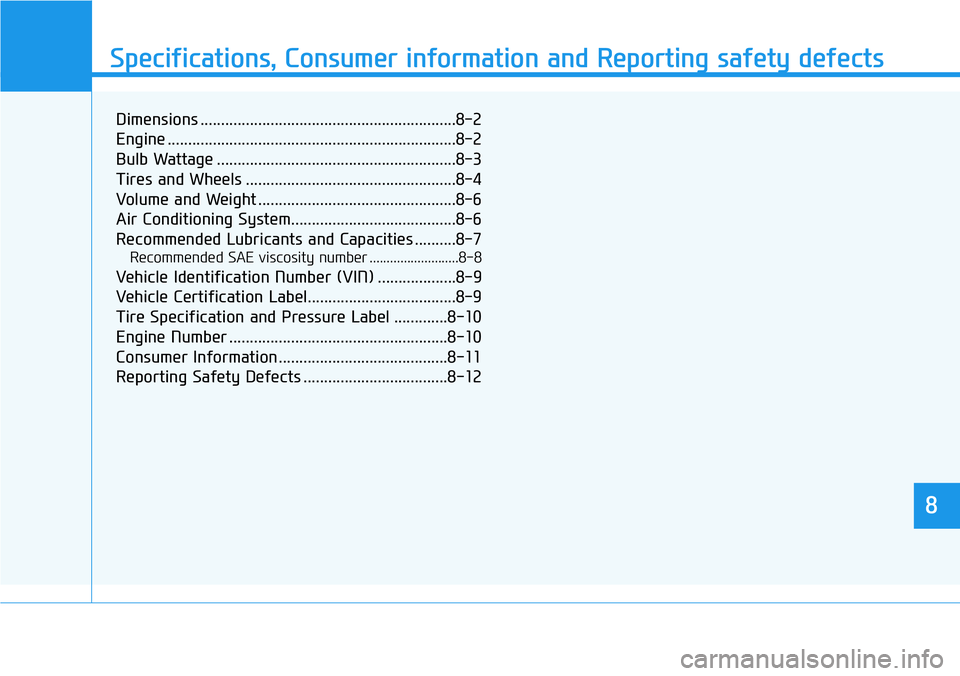
Dimensions ..............................................................8-2
Engine ......................................................................8-2
Bulb Wattage ..........................................................8-3
Tires and Wheels ...................................................8-4
Volume and Weight ................................................8-6
Air Conditioning System........................................8-6
Recommended Lubricants and Capacities ..........8-7
Recommended SAE viscosity number ..........................8-8
Vehicle Identification Number (VIN) ...................8-9
Vehicle Certification Label....................................8-9
Tire Specification and Pressure Label .............8-10
Engine Number .....................................................8-10
Consumer Information .........................................8-11
Reporting Safety Defects ...................................8-12
Page 436 of 446
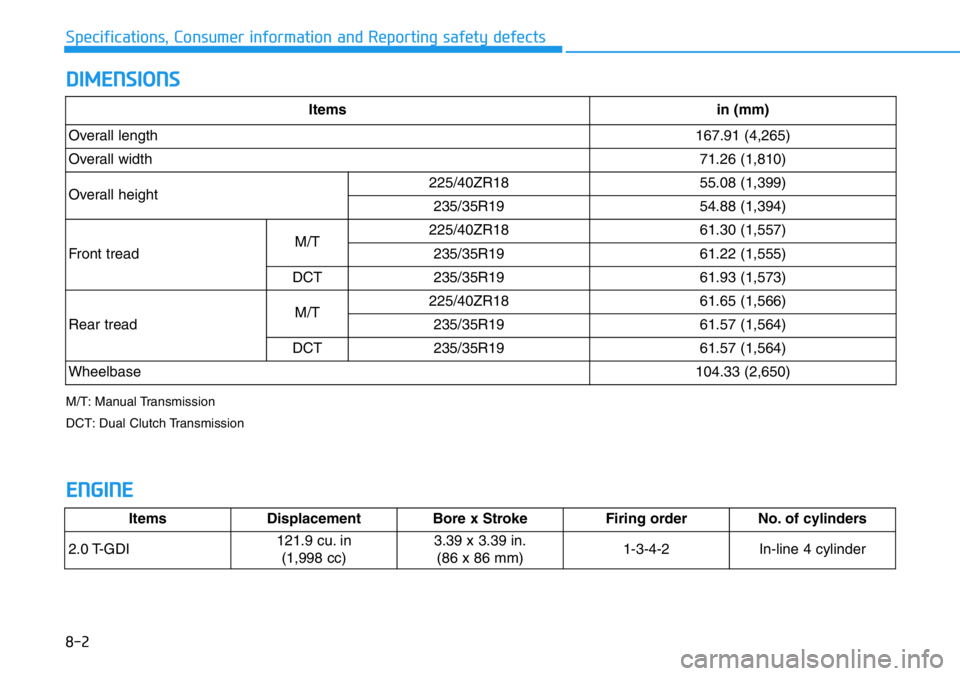
DIMENSIONS
8-2
Specifications, Consumer information and Reporting safety defects
ENGINE
ItemsDisplacement Bore x StrokeFiring orderNo. of cylinders
2.0 T-GDI121.9 cu. in
(1,998 cc)3.39 x 3.39 in.
(86 x 86 mm)1-3-4-2In-line 4 cylinder
Itemsin (mm)
Overall length167.91 (4,265)
Overall width71.26 (1,810)
Overall height225/40ZR1855.08 (1,399)
235/35R1954.88 (1,394)
Front treadM/T225/40ZR1861.30 (1,557)
235/35R1961.22 (1,555)
DCT235/35R1961.93 (1,573)
Rear treadM/T225/40ZR1861.65 (1,566)
235/35R1961.57 (1,564)
DCT235/35R1961.57 (1,564)
Wheelbase104.33 (2,650)
M/T: Manual Transmission
DCT: Dual Clutch Transmission
Page 438 of 446
![HYUNDAI VELOSTER N 2022 Owners Manual TIRES AND WHEELS
8-4
Specifications, Consumer information and Reporting safety defects
Tire SizeWheel
SizeTrans-
missionInflation pressure [bar (kPa, psi)]
Wheel lug
nut torque
[kgf•m
(lbf•ft,
Nâ€](/img/35/41174/w960_41174-437.png "HYUNDAI VELOSTER N 2022 Owners Manual TIRES AND WHEELS
8-4
Specifications, Consumer information and Reporting safety defects
Tire SizeWheel
SizeTrans-
missionInflation pressure [bar (kPa, psi)]
Wheel lug
nut torque
[kgf•m
(lbf•ft,
Nâ€")
TIRES AND WHEELS
8-4
Specifications, Consumer information and Reporting safety defects
Tire SizeWheel
SizeTrans-
missionInflation pressure [bar (kPa, psi)]
Wheel lug
nut torque
[kgf•m
(lbf•ft,
N•m)] Normal Load
(less than 100mph
or 160km/h)Maximum Load
(less than 100mph
or 160km/h)High-speed driving
(over 100mph or
160km/h) *1Track driving *2
Front Rear Front Rear Front Rear Front Rear
225/40ZR18 7.5J X 18 M/T2.5
(250, 36)2.3
(230, 33)2.8
(280, 41)2.8
(280, 41)2.8
(280, 41)2.8
(280, 41)2.5
(250, 36)2.5
(250, 36)
11~13
(79~94,
107~127)
235/35R19 8.0J X 19M/T2.6
(260, 38)2.4
(240, 35)2.9
(290, 42)2.9
(290, 42)2.9
(290, 42)2.9
(290, 42)2.6
(260, 38)2.6
(260, 38)
DCT2.55
(255,37)2.4
(240,35)2.9
(290,42)2.9
(290,42)2.9
(290,42)2.9
(290,42)2.9
(290,42)2.9
(290,42)
Full size tire
M/T : Manual Transmission
DCT : Dual Clutch Transmission
*
1: Must drive only where the speed is legal
*2: Refers to the recommended inflation pressure for the hot tire condition (state when the tire temperature is increased). Limited
number of passengers is 2 with no luggage. After the track driving is complete, change to the appropriate tire inflation recom-
mended for the normal road driving condition.
Tires specified to this vehicle will have "HN" logo molded on the tire.