air conditioning HYUNDAI VELOSTER N 2022 Owner's Manual
[x] Cancel search | Manufacturer: HYUNDAI, Model Year: 2022, Model line: VELOSTER N, Model: HYUNDAI VELOSTER N 2022Pages: 446, PDF Size: 9.71 MB
Page 359 of 446
7-7
7
Maintenance
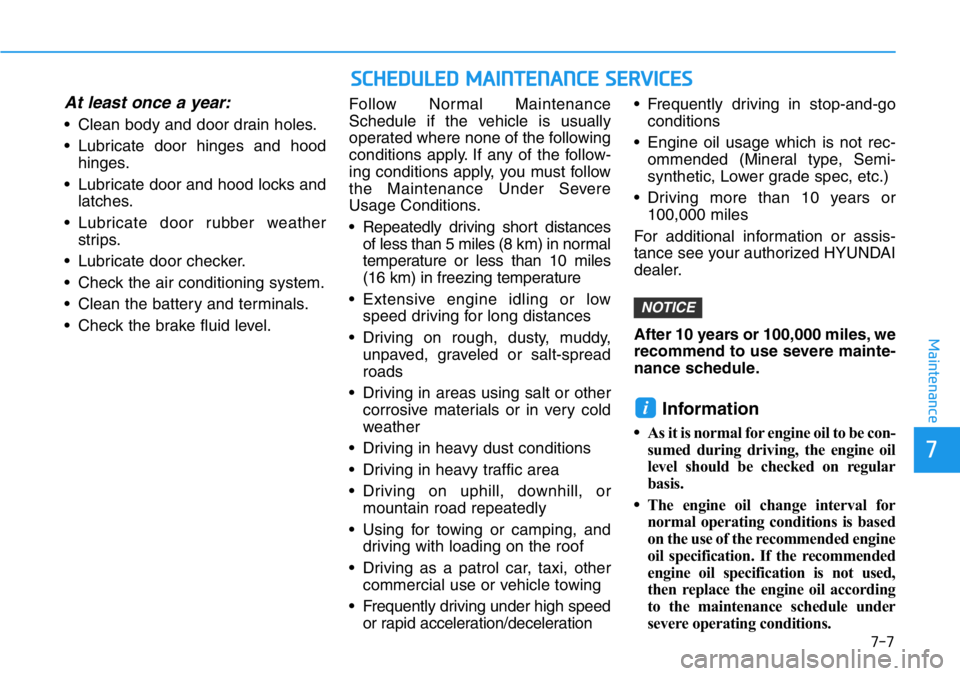
At least once a year:
• Clean body and door drain holes.
• Lubricate door hinges and hood
hinges.
• Lubricate door and hood locks and
latches.
• Lubricate door rubber weather
strips.
• Lubricate door checker.
• Check the air conditioning system.
• Clean the battery and terminals.
• Check the brake fluid level.Follow Normal Maintenance
Schedule if the vehicle is usually
operated where none of the following
conditions apply. If any of the follow-
ing conditions apply, you must follow
the Maintenance Under Severe
Usage Conditions.
• Repeatedly driving short distances
of less than 5 miles (8 km) in normal
temperature or less than 10 miles
(16 km) in freezing temperature
• Extensive engine idling or low
speed driving for long distances
• Driving on rough, dusty, muddy,
unpaved, graveled or salt-spread
roads
• Driving in areas using salt or other
corrosive materials or in very cold
weather
• Driving in heavy dust conditions
• Driving in heavy traffic area
• Driving on uphill, downhill, or
mountain road repeatedly
• Using for towing or camping, and
driving with loading on the roof
• Driving as a patrol car, taxi, other
commercial use or vehicle towing
• Frequently driving under high speed
or rapid acceleration/deceleration • Frequently driving in stop-and-go
conditions
• Engine oil usage which is not rec-
ommended (Mineral type, Semi-
synthetic, Lower grade spec, etc.)
• Driving more than 10 years or
100,000 miles
For additional information or assis-
tance see your authorized HYUNDAI
dealer.
After 10 years or 100,000 miles, we
recommend to use severe mainte-
nance schedule.
Information
•As it is normal for engine oil to be con-
sumed during driving, the engine oil
level should be checked on regular
basis.
•The engine oil change interval for
normal operating conditions is based
on the use of the recommended engine
oil specification. If the recommended
engine oil specification is not used,
then replace the engine oil according
to the maintenance schedule under
severe operating conditions.
i
NOTICE
SCHEDULED MAINTENANCE SERVICES
Page 367 of 446
7-15
7
Maintenance
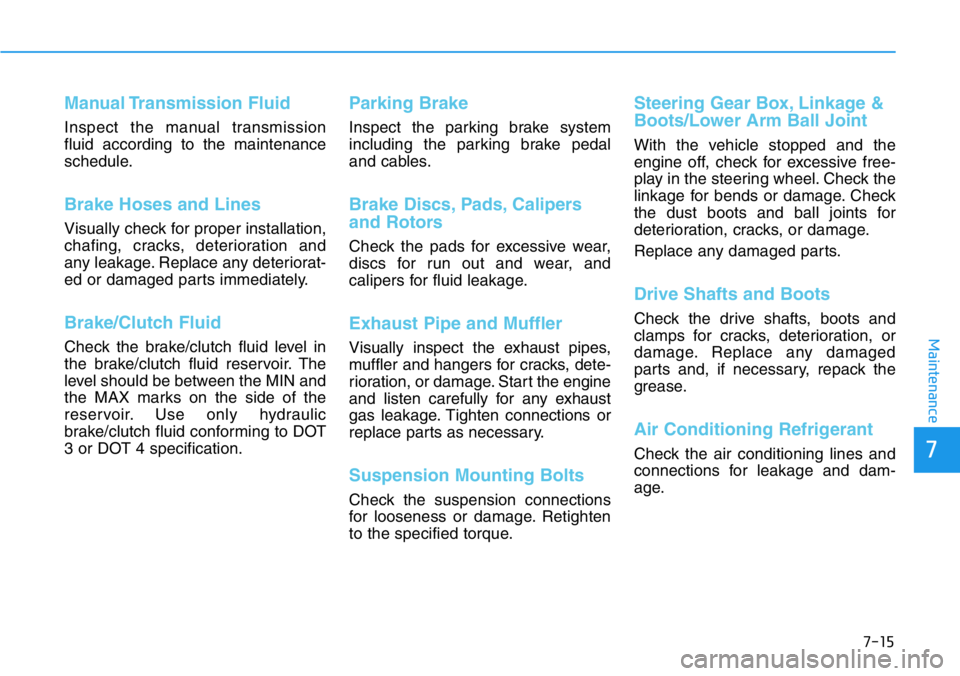
Manual Transmission Fluid
Inspect the manual transmission
fluid according to the maintenance
schedule.
Brake Hoses and Lines
Visually check for proper installation,
chafing, cracks, deterioration and
any leakage. Replace any deteriorat-
ed or damaged parts immediately.
Brake/Clutch Fluid
Check the brake/clutch fluid level in
the brake/clutch fluid reservoir. The
level should be between the MIN and
the MAX marks on the side of the
reservoir. Use only hydraulic
brake/clutch fluid conforming to DOT
3 or DOT 4 specification.
Parking Brake
Inspect the parking brake system
including the parking brake pedal
and cables.
Brake Discs, Pads, Calipers
and Rotors
Check the pads for excessive wear,
discs for run out and wear, and
calipers for fluid leakage.
Exhaust Pipe and Muffler
Visually inspect the exhaust pipes,
muffler and hangers for cracks, dete-
rioration, or damage. Start the engine
and listen carefully for any exhaust
gas leakage. Tighten connections or
replace parts as necessary.
Suspension Mounting Bolts
Check the suspension connections
for looseness or damage. Retighten
to the specified torque.
Steering Gear Box, Linkage &
Boots/Lower Arm Ball Joint
With the vehicle stopped and the
engine off, check for excessive free-
play in the steering wheel. Check the
linkage for bends or damage. Check
the dust boots and ball joints for
deterioration, cracks, or damage.
Replace any damaged parts.
Drive Shafts and Boots
Check the drive shafts, boots and
clamps for cracks, deterioration, or
damage. Replace any damaged
parts and, if necessary, repack the
grease.
Air Conditioning Refrigerant
Check the air conditioning lines and
connections for leakage and dam-
age.
Page 393 of 446
7-41
7
Maintenance
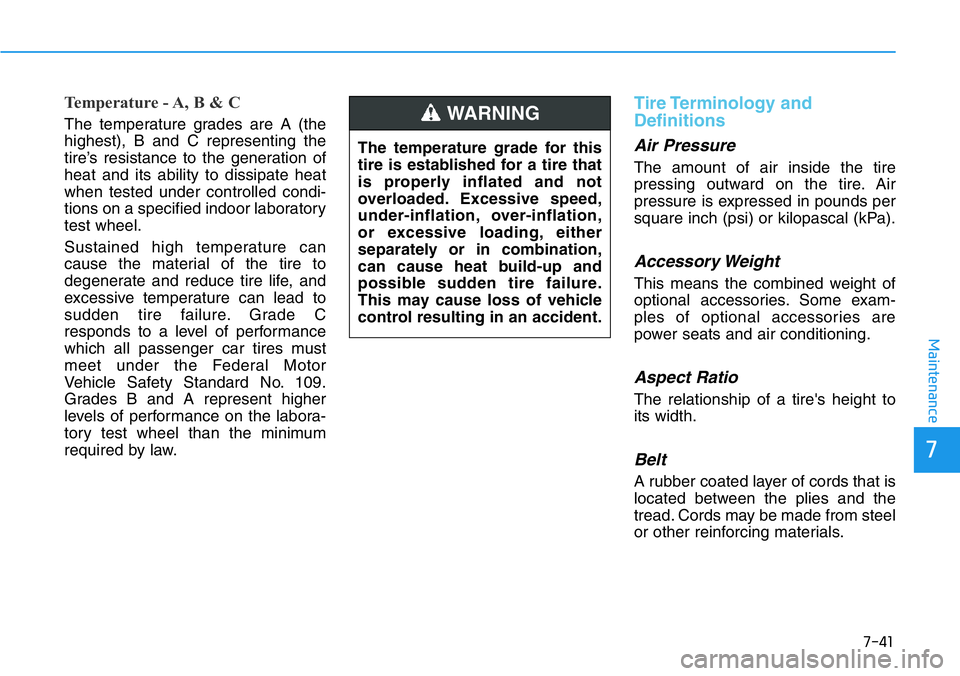
Temperature - A, B & C
The temperature grades are A (the
highest), B and C representing the
tire’s resistance to the generation of
heat and its ability to dissipate heat
when tested under controlled condi-
tions on a specified indoor laboratory
test wheel.
Sustained high temperature can
cause the material of the tire to
degenerate and reduce tire life, and
excessive temperature can lead to
sudden tire failure. Grade C
responds to a level of performance
which all passenger car tires must
meet under the Federal Motor
Vehicle Safety Standard No. 109.
Grades B and A represent higher
levels of performance on the labora-
tory test wheel than the minimum
required by law.
Tire Terminology and
Definitions
Air Pressure
The amount of air inside the tire
pressing outward on the tire. Air
pressure is expressed in pounds per
square inch (psi) or kilopascal (kPa).
Accessory Weight
This means the combined weight of
optional accessories. Some exam-
ples of optional accessories are
power seats and air conditioning.
Aspect Ratio
The relationship of a tire's height to
its width.
Belt
A rubber coated layer of cords that is
located between the plies and the
tread. Cords may be made from steel
or other reinforcing materials. The temperature grade for this
tire is established for a tire that
is properly inflated and not
overloaded. Excessive speed,
under-inflation, over-inflation,
or excessive loading, either
separately or in combination,
can cause heat build-up and
possible sudden tire failure.
This may cause loss of vehicle
control resulting in an accident.
WARNING
Page 435 of 446
888
Specifications & Consumer information
8
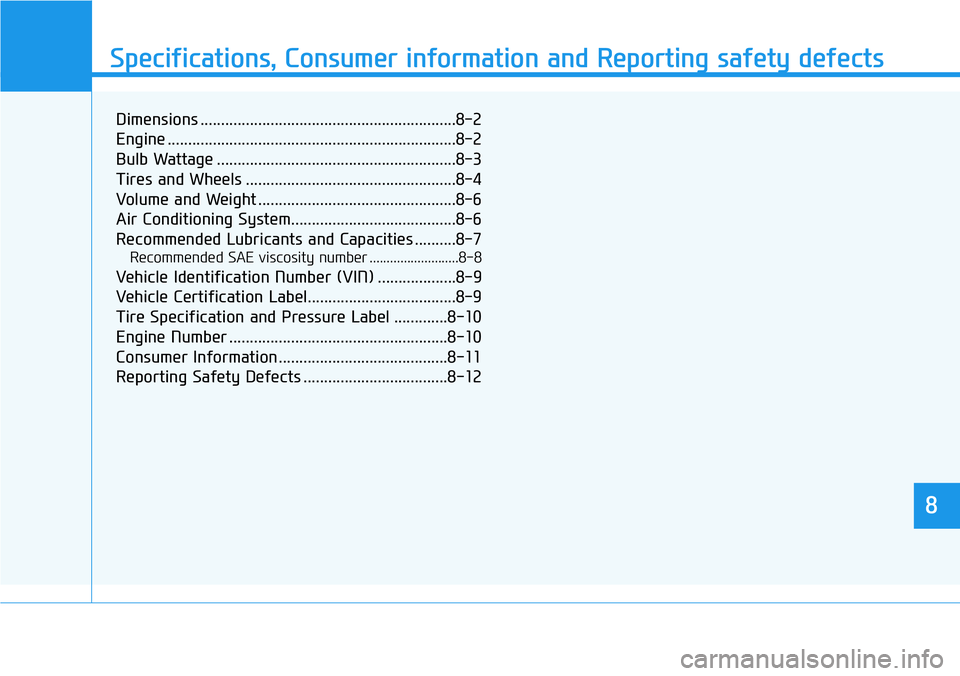
Specifications, Consumer information and Reporting safety defects
8
Dimensions ..............................................................8-2
Engine ......................................................................8-2
Bulb Wattage ..........................................................8-3
Tires and Wheels ...................................................8-4
Volume and Weight ................................................8-6
Air Conditioning System........................................8-6
Recommended Lubricants and Capacities ..........8-7
Recommended SAE viscosity number ..........................8-8
Vehicle Identification Number (VIN) ...................8-9
Vehicle Certification Label....................................8-9
Tire Specification and Pressure Label .............8-10
Engine Number .....................................................8-10
Consumer Information .........................................8-11
Reporting Safety Defects ...................................8-12
Page 440 of 446
8-6
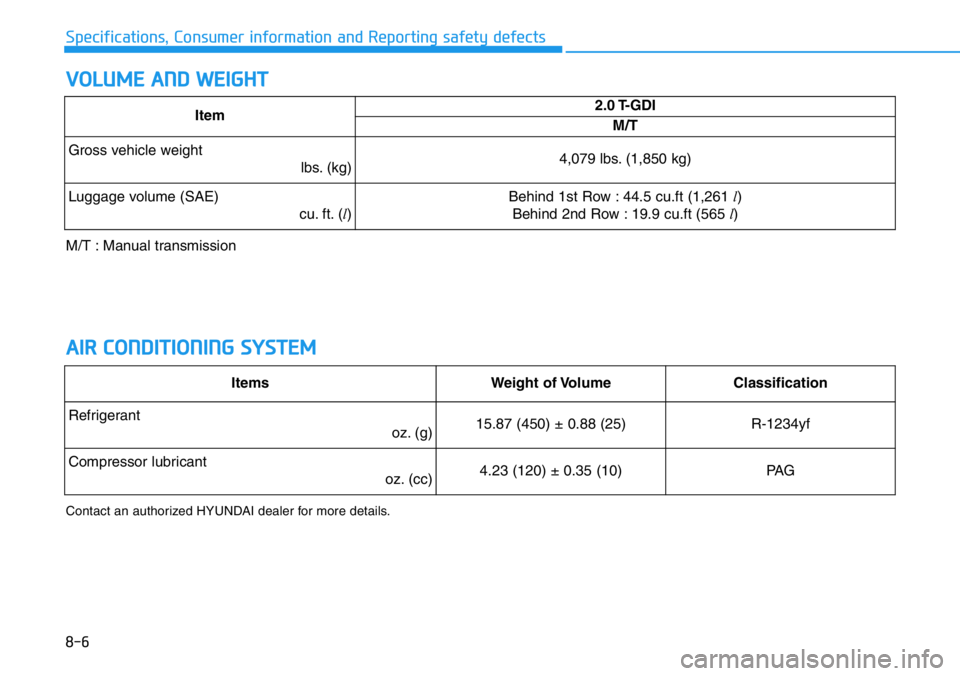
Specifications, Consumer information and Reporting safety defects
VOLUME AND WEIGHT
AIR CONDITIONING SYSTEM
Contact an authorized HYUNDAI dealer for more details.
Item2.0 T-GDI
M/T
Gross vehicle weight
lbs. (kg)4,079 lbs. (1,850 kg)
Luggage volume (SAE)
cu. ft. (l)Behind 1st Row : 44.5 cu.ft (1,261 l)
Behind 2nd Row : 19.9 cu.ft (565 l)
ItemsWeight of VolumeClassification
Refrigerant
oz. (g) 15.87 (450) ± 0.88 (25) R-1234yf
Compressor lubricant
oz. (cc) 4.23 (120) ± 0.35 (10)PA G
M/T : Manual transmission