shift HYUNDAI VELOSTER N 2022 Owners Manual
[x] Cancel search | Manufacturer: HYUNDAI, Model Year: 2022, Model line: VELOSTER N, Model: HYUNDAI VELOSTER N 2022Pages: 446, PDF Size: 9.71 MB
Page 16 of 446
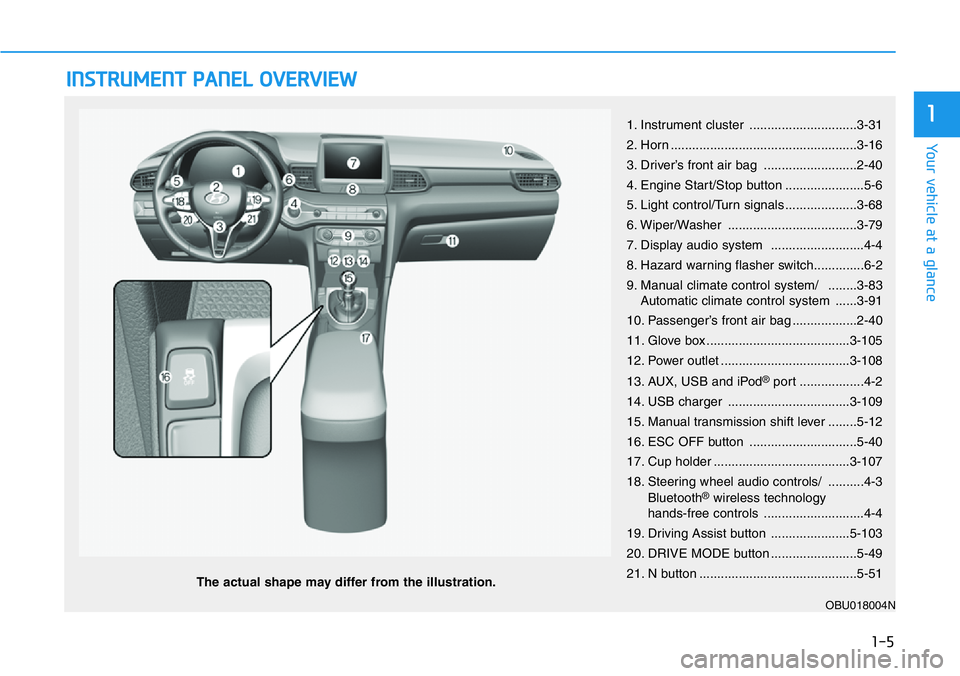
INSTRUMENT PANEL OVERVIEW
The actual shape may differ from the illustration.
1-5
Your vehicle at a glance
11. Instrument cluster ..............................3-31
2. Horn ....................................................3-16
3. Driver’s front air bag ..........................2-40
4. Engine Start/Stop button ......................5-6
5. Light control/Turn signals ....................3-68
6. Wiper/Washer ....................................3-79
7. Display audio system ..........................4-4
8. Hazard warning flasher switch..............6-2
9. Manual climate control system/ ........3-83
Automatic climate control system ......3-91
10. Passenger’s front air bag ..................2-40
11. Glove box ........................................3-105
12. Power outlet ....................................3-108
13. AUX, USB and iPod
®port ..................4-2
14. USB charger ..................................3-109
15. Manual transmission shift lever ........5-12
16. ESC OFF button ..............................5-40
17. Cup holder ......................................3-107
18. Steering wheel audio controls/ ..........4-3
Bluetooth
®wireless technology
hands-free controls ............................4-4
19. Driving Assist button ......................5-103
20. DRIVE MODE button ........................5-49
21. N button ............................................5-51
OBU018004N
Page 27 of 446
2-10
Safety system of your vehicle
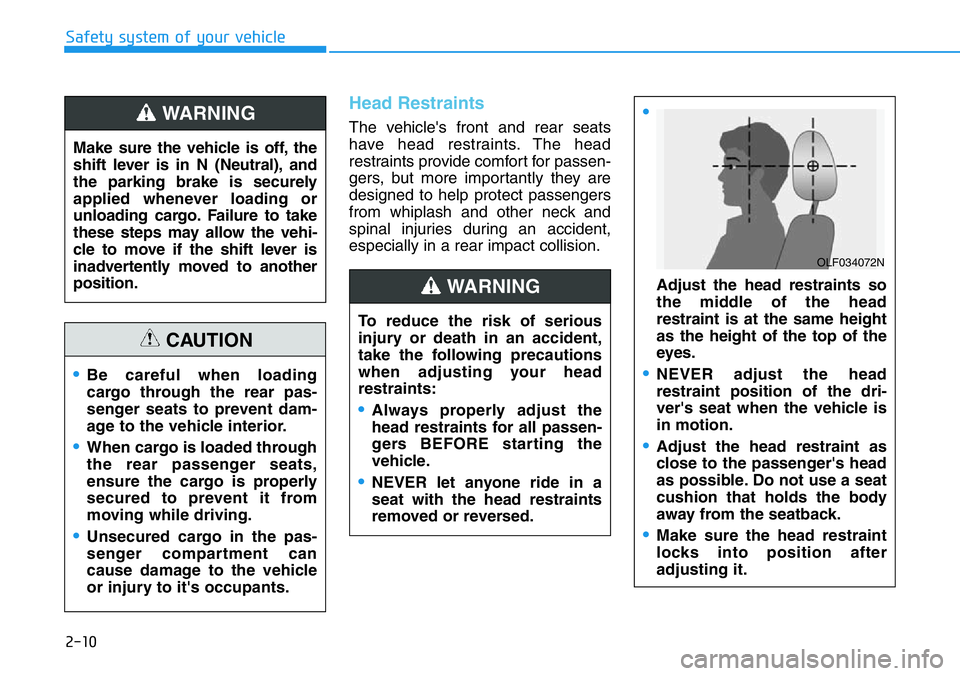
Head Restraints
The vehicle's front and rear seats
have head restraints. The head
restraints provide comfort for passen-
gers, but more importantly they are
designed to help protect passengers
from whiplash and other neck and
spinal injuries during an accident,
especially in a rear impact collision. Make sure the vehicle is off, the
shift lever is in N (Neutral), and
the parking brake is securely
applied whenever loading or
unloading cargo. Failure to take
these steps may allow the vehi-
cle to move if the shift lever is
inadvertently moved to another
position.WARNING
•Be careful when loading
cargo through the rear pas-
senger seats to prevent dam-
age to the vehicle interior.
•When cargo is loaded through
the rear passenger seats,
ensure the cargo is properly
secured to prevent it from
moving while driving.
•Unsecured cargo in the pas-
senger compartment can
cause damage to the vehicle
or injury to it's occupants.
CAUTION
To reduce the risk of serious
injury or death in an accident,
take the following precautions
when adjusting your head
restraints:
•Always properly adjust the
head restraints for all passen-
gers BEFORE starting the
vehicle.
•NEVER let anyone ride in a
seat with the head restraints
removed or reversed.
•
Adjust the head restraints so
the middle of the head
restraint is at the same height
as the height of the top of the
eyes.
•NEVER adjust the head
restraint position of the dri-
ver's seat when the vehicle is
in motion.
•Adjust the head restraint as
close to the passenger's head
as possible. Do not use a seat
cushion that holds the body
away from the seatback.
•Make sure the head restraint
locks into position after
adjusting it.
WARNING
OLF034072N
Page 52 of 446
2-35
Safety system of your vehicle
2
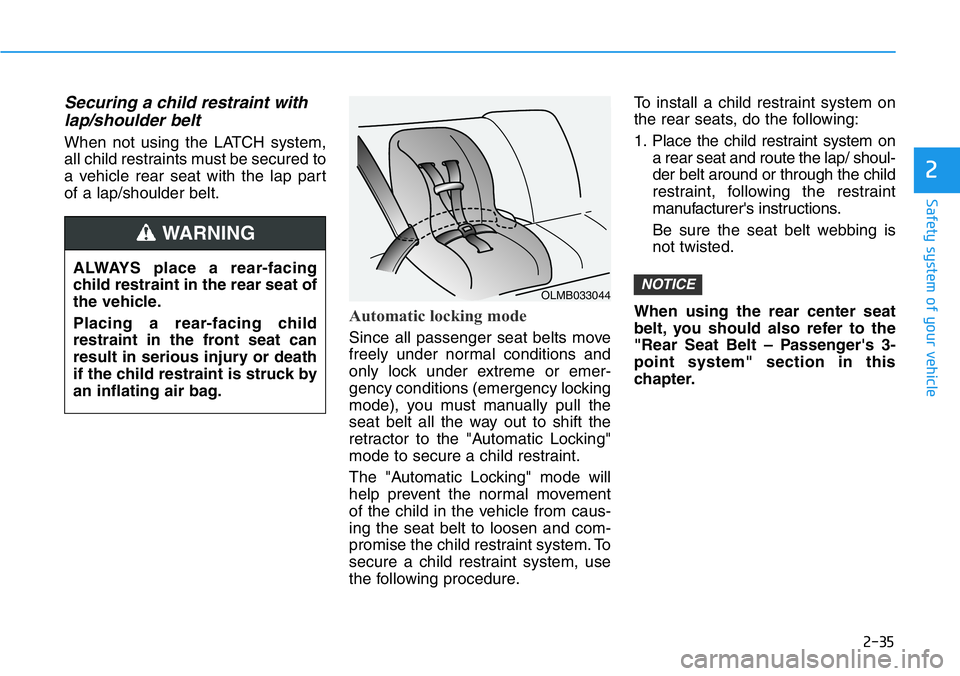
Securing a child restraint with
lap/shoulder belt
When not using the LATCH system,
all child restraints must be secured to
a vehicle rear seat with the lap part
of a lap/shoulder belt.
Automatic locking mode
Since all passenger seat belts move
freely under normal conditions and
only lock under extreme or emer-
gency conditions (emergency locking
mode), you must manually pull the
seat belt all the way out to shift the
retractor to the "Automatic Locking"
mode to secure a child restraint.
The "Automatic Locking" mode will
help prevent the normal movement
of the child in the vehicle from caus-
ing the seat belt to loosen and com-
promise the child restraint system. To
secure a child restraint system, use
the following procedure.To install a child restraint system on
the rear seats, do the following:
1. Place the child restraint system on
a rear seat and route the lap/ shoul-
der belt around or through the child
restraint, following the restraint
manufacturer's instructions.
Be sure the seat belt webbing is
not twisted.
When using the rear center seat
belt, you should also refer to the
"Rear Seat Belt – Passenger's 3-
point system" section in this
chapter.
NOTICEALWAYS place a rear-facing
child restraint in the rear seat of
the vehicle.
Placing a rear-facing child
restraint in the front seat can
result in serious injury or death
if the child restraint is struck by
an inflating air bag.
WARNING
OLMB033044
Page 53 of 446
2-36
Safety system of your vehicle
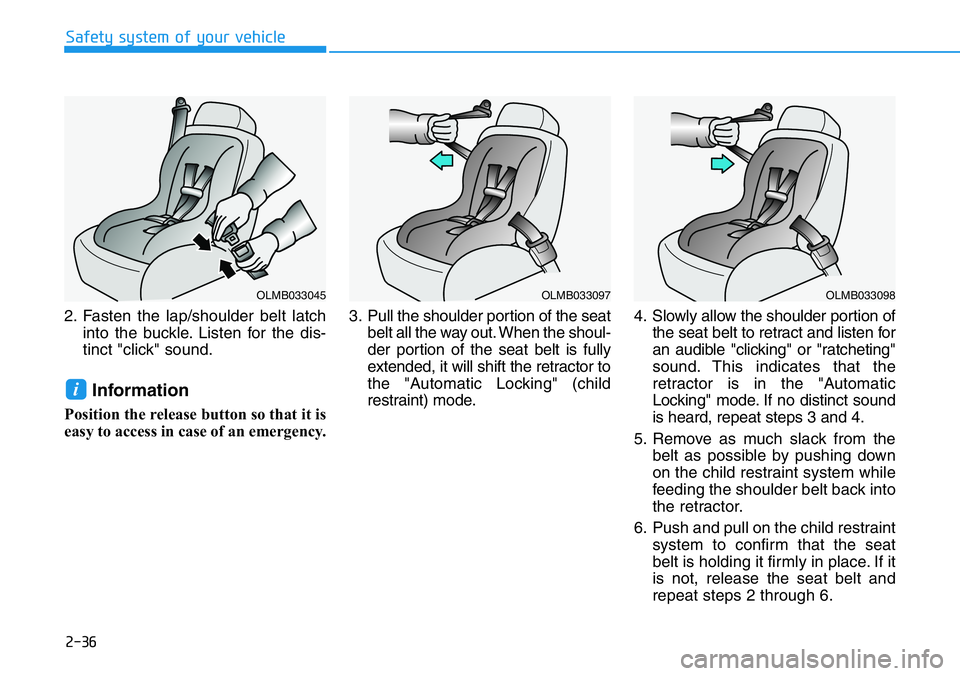
2. Fasten the lap/shoulder belt latch
into the buckle. Listen for the dis-
tinct "click" sound.
Information
Position the release button so that it is
easy to access in case of an emergency.3. Pull the shoulder portion of the seat
belt all the way out. When the shoul-
der portion of the seat belt is fully
extended, it will shift the retractor to
the "Automatic Locking" (child
restraint) mode.4. Slowly allow the shoulder portion of
the seat belt to retract and listen for
an audible "clicking" or "ratcheting"
sound. This indicates that the
retractor is in the "Automatic
Locking" mode. If no distinct sound
is heard, repeat steps 3 and 4.
5. Remove as much slack from the
belt as possible by pushing down
on the child restraint system while
feeding the shoulder belt back into
the retractor.
6. Push and pull on the child restraint
system to confirm that the seat
belt is holding it firmly in place. If it
is not, release the seat belt and
repeat steps 2 through 6.
i
OLMB033045OLMB033097OLMB033098
Page 54 of 446
2-37
Safety system of your vehicle
2
7. Double check that the retractor is
in the "Automatic Locking" mode
by attempting to pull more of the
seat belt out of the retractor. If you
cannot, the retractor is in the
"Automatic Locking" mode.
If your CRS manufacturer instructs or
recommends you to use a tether
anchor with the lap/shoulder belt,
refer to the previous pages for more
details.When the seat belt is allowed to
retract to its fully stowed position,
the retractor will automatically
switch from the "Automatic
Locking" mode to the emergency
lock mode for normal adult usage.
To remove the child restraint, press
the release button on the buckle and
then pull the lap/shoulder belt out of
the restraint and allow the seat belt
to retract fully.NOTICE
If the retractor is not in the
"Automatic Locking" mode, the
child restraint can move when
your vehicle turns or stops sud-
denly. A child can be seriously
injured or killed if the child
restraint is not properly anchored
in the car, including manually
pulling the seat belt all the way
out to shift the rectractor to the
"Automatic Locking" mode.
WARNING
Page 68 of 446
2-51
Safety system of your vehicle
2
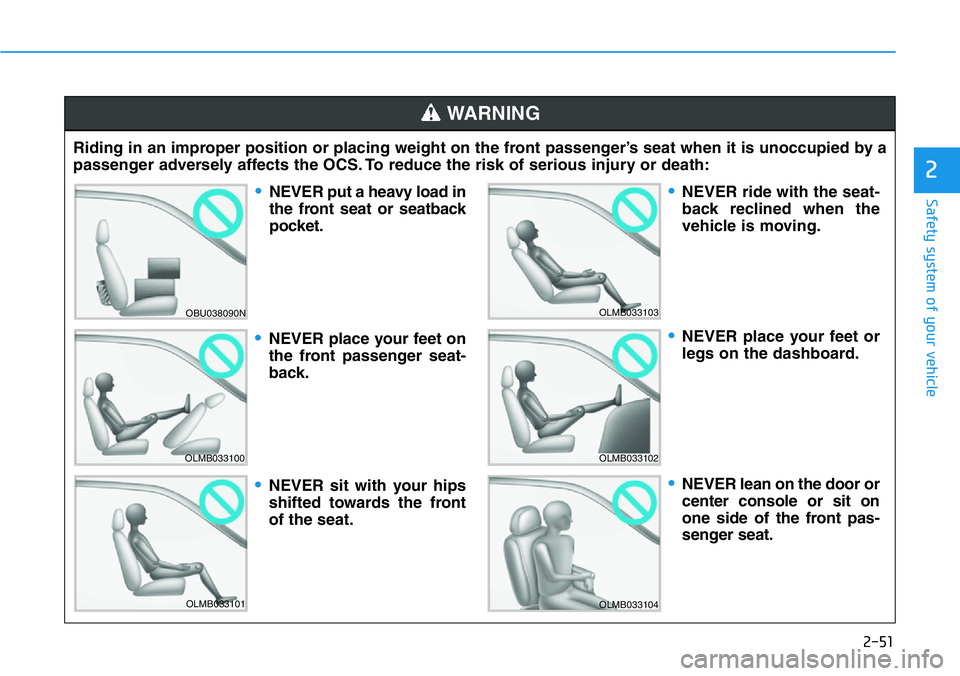
Riding in an improper position or placing weight on the front passenger’s seat when it is unoccupied by a
passenger adversely affects the OCS. To reduce the risk of serious injury or death:
WARNING
OBU038090N
OLMB033100
OLMB033101
OLMB033103
OLMB033102
OLMB033104
•NEVER put a heavy load in
the front seat or seatback
pocket.
•NEVER place your feet on
the front passenger seat-
back.
•NEVER sit with your hips
shifted towards the front
of the seat.
•NEVER ride with the seat-
back reclined when the
vehicle is moving.
•NEVER place your feet or
legs on the dashboard.
•NEVER lean on the door or
center console or sit on
one side of the front pas-
senger seat.
Page 79 of 446
Convenient features of your vehicle
Accessing Your Vehicle .........................................3-3
Smart Key ............................................................................3-3
Immobilizer System ...........................................................3-8
Door Locks ............................................................3-10
Operating Door Locks from Outside the Vehicle ....3-10
Operating Door Locks from Inside the Vehicle .......3-11
Automatic Door Lock and Unlock Features .............3-13
Child-Protector Rear Door Locks ...............................3-13
Theft-Alarm System ............................................3-14
Steering Wheel .....................................................3-15
Electric Power Steering (EPS) .....................................3-15
Tilt Steering / Telescope Steering ..............................3-16
Horn ....................................................................................3-16
Mirrors ...................................................................3-17
Inside Rearview Mirror ..................................................3-17
Side View Mirrors ...........................................................3-18
Windows ................................................................3-21
Power Windows ...............................................................3-22
Exterior Features .................................................3-25
Hood ...................................................................................3-25
Liftgate ..............................................................................3-26
Fuel Filler Door ................................................................3-28
Instrument cluster................................................3-31
Instrument Cluster Control............................................3-32
Gauges and Meters ........................................................3-33
Transmission shift indicator .........................................3-36
Warning and Indicator Lights .......................................3-38
LCD Display Messages ...................................................3-48
LCD Display ...........................................................3-54
LCD Display Control ........................................................3-54
LCD Display Modes .........................................................3-55
Trip Computer .......................................................3-64
Lighting..................................................................3-68
Exterior Lights .................................................................3-68
Interior Lights...................................................................3-72
High Beam Assist (HBA) .....................................3-75
System operation ............................................................3-76
System malfunction and limitations ...........................3-77
Wipers And Washers ...........................................3-79
Windshield Wipers...........................................................3-79
Windshield Washers .......................................................3-80
Rear Window Wiper and Washer ................................3-81
Rear View Monitor (RVM) ..................................3-82
3
Page 90 of 446
3-12
Convenient features of your vehicle
• For Push Button Start Vehicles
(Smart Key)
If the smart key is in the vehicle
and any door is open, the doors
will not lock even though the lock
button (2) is pressed.
Opening a door when something
is approaching may cause dam-
age or injury. Be careful when
opening doors and watch for
vehicles, motorcycles, bicycles
or pedestrians approaching the
vehicle in the path of the door.
CAUTION
Do not leave children or animals
unattended in your vehicle. An
enclosed vehicle can become
extremely hot, causing death or
serious injury to unattended
children or animals who cannot
escape the vehicle. Children
might operate features of the
vehicle that could injure them,
or they could encounter other
harm, possibly from someone
gaining entry to the vehicle.
WARNING
Always secure your vehicle.
Leaving your vehicle unlocked
increases the potential risk to
you or others from someone
hiding in your vehicle.
To secure your vehicle, while
depressing the brake, move the
shift lever to the the 1st gear
when the vehicle is parked on a
uphill and to R (Reverse) on a
downhill, engage the parking
brake, and place the ignition
switch in the LOCK/OFF posi-
tion, close all windows, lock all
doors, and always take the key
with you.
WARNING
•The doors should always be
fully closed and locked while
the vehicle is in motion. If the
doors are unlocked, the risk of
being thrown from the vehicle
in a crash is increased.
•Do not pull the inner door
handle of the driver's or pas-
senger's door while the vehi-
cle is moving.
WARNING
Page 108 of 446
3-30
Convenient features of your vehicle
Information
Make sure to refuel your vehicle
according to the "Fuel Requirements"
suggested in the Introduction chapter.
• Do not spill fuel on the exterior
surfaces of the vehicle. Any type
of fuel spilled on painted sur-
faces may damage the paint.
• If the fuel filler cap requires
replacement, use only a genuine
HYUNDAI cap or the equivalent
specified for your vehicle. An
incorrect fuel filler cap can
result in a serious malfunction
of the fuel system or emission
control system.
NOTICE
i•If a fire breaks out during refu-
eling, leave the vicinity of the
vehicle, and immediately con-
tact the manager of the gas
station and then contact the
local fire department. Follow
any safety instructions they
provide.
•If pressurized fuel sprays out,
it can cover your clothes or
skin and thus subject you to
the risk of fire and burns.
Always remove the fuel cap
carefully and slowly. If the cap
is venting fuel or if you hear a
hissing sound, wait until the
condition stops before com-
pletely removing the cap.
•Always check that the fuel cap
is installed securely to pre-
vent fuel spillage in the event
of an accident.
Once refueling has begun,
contact between your bare
hand and the vehicle should
be maintained until the filling
is complete.
•Use only approved portable
plastic fuel containers designed
to carry and store gasoline.
•When refueling, always move
the shift lever to the 1st gear
when the vehicle is parked on
a uphill and to R (Reverse) on
a downhill, set the parking
brake, and place the ignition
switch to the LOCK/OFF posi-
tion. Sparks produced by
electrical components related
to the engine can ignite fuel
vapors causing a fire.
•Do not use matches or a
lighter and do not smoke or
leave a lit cigarette in your
vehicle while at a gas station,
especially during refueling.
•Do not over-fill or top-off your
vehicle tank, which can cause
gasoline spillage.
Page 111 of 446
3-33
Convenient features of your vehicle
3
Gauges and Meters
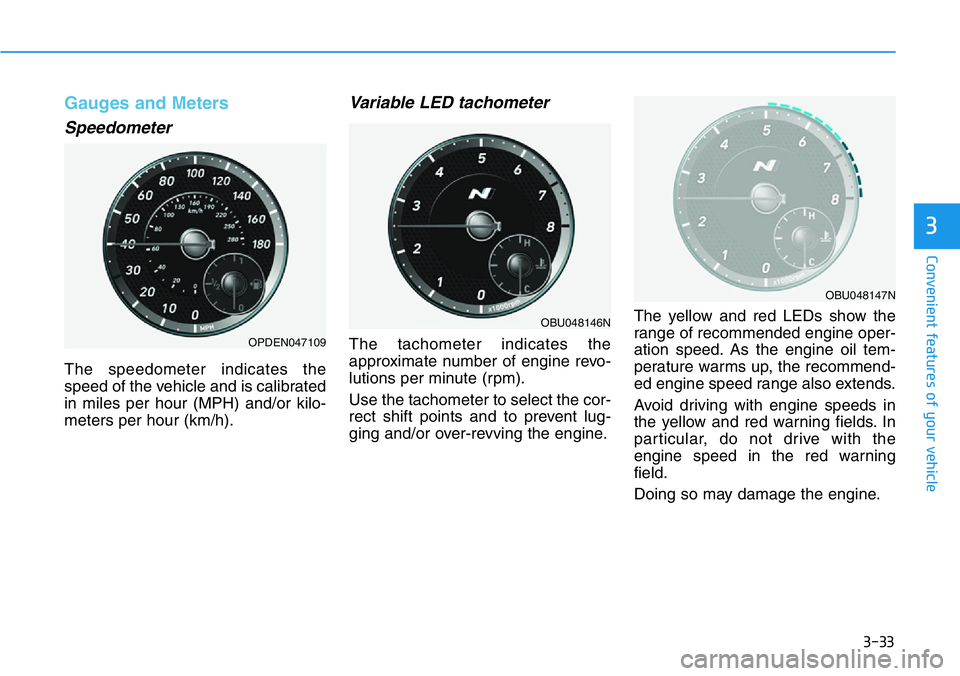
Speedometer
The speedometer indicates the
speed of the vehicle and is calibrated
in miles per hour (MPH) and/or kilo-
meters per hour (km/h).
Variable LED tachometer
The tachometer indicates the
approximate number of engine revo-
lutions per minute (rpm).
Use the tachometer to select the cor-
rect shift points and to prevent lug-
ging and/or over-revving the engine.The yellow and red LEDs show the
range of recommended engine oper-
ation speed. As the engine oil tem-
perature warms up, the recommend-
ed engine speed range also extends.
Avoid driving with engine speeds in
the yellow and red warning fields. In
particular, do not drive with the
engine speed in the red warning
field.
Doing so may damage the engine.OPDEN047109
OBU048146N
OBU048147N