tow HYUNDAI VELOSTER TURBO 2016 Service Manual
[x] Cancel search | Manufacturer: HYUNDAI, Model Year: 2016, Model line: VELOSTER TURBO, Model: HYUNDAI VELOSTER TURBO 2016Pages: 406, PDF Size: 7.83 MB
Page 343 of 406
733
Maintenance
ENGINE COOLANT
The high-pressure cooling system has a
reservoir filled with year-round antifreeze
coolant. The reservoir is filled at the factory.
Check the antifreeze protection and
coolant level at least once a year, at the
beginning of the winter season, and
before traveling to a colder climate.
Checking the coolant level
WARNING
Removing radiator
cap
• Never attempt to remove the radi-
ator cap while the engine is oper-
ating or hot. Doing so might lead
to cooling system and engine
damage and could result in seri-
ous personal injury from escap-
ing hot coolant or steam.
(Continued)
(Continued)
• Turn the engine off and wait until it
cools down. Use extreme care
when removing the radiator cap.
Wrap a thick towel around it, and
turn it counterclockwise slowly to
the first stop. Step back while the
pressure is released from the cool-
ing system. When you are sure all
the pressure has been released,
press down on the cap, using a
thick towel, and continue turning
counterclockwise to remove it.
• Even if the engine is not operat-
ing, do not remove the radiator
cap or the drain plug while the
engine and radiator are hot. Hot
coolant and steam may still blow
out under pressure, causing seri-
ous injury.WARNING
The electric motor
(cooling fan) is con-
trolled by engine
coolant temperature,
refrigerant pressure
and vehicle speed. It may some-
times operate even when the
engine is not running. Use extreme
caution when working near the
blades of the cooling fan so that
you are not injured by a rotating fan
blades. As the engine coolant tem-
perature decreases, the electric
motor will automatically shut off.
This is a normal condition.
If your vehicle is equipped with
GDI, the electric motor (cooling fan)
may operate until you disconnect
the negative battery cable.
The electric cooling fan can start at
any time when the engine coolant
temperature is high. Disconnect the
negative battery cable when servic-
ing the vehicle.
Page 390 of 406
Maintenance
80 7
CAUTION - Matte paint
If your vehicle has Matte paint, make
certain you maintain it properly to
preserve the matte appearance.
Proper, care is required to maintain
the matte appearance. The normal
paint warranty applies to defects in
material and/or workmanship, but
not the uniform matte appearance.
• Rub marks, burnish marks, and
shiny spots are likely to require
repainting at a body shop trained
in matte paint repair.
• Do not rub the paint or allow auto-
matic car wash brushes to contact
the paint. Hand wash with soft
washmits, dry with clean chamois,
and use light pressure with a
microfiber towel. Minimize the pres-
sure you use. Do not rub repeated-
ly to minimize the risk of burnish-
ing a shiny spot. Coarse terry cloth
will easily burnish the paint.
• Test all products on a hidden part
(such as under the rocker sills) to
make certain they do not alter the
matte appearance.
(Continued)
(Continued)
• Pre-rinse the paint prior to wash-
ing to remove coarse dirt that can
scratch the paint. Pressure wash-
ing is OK with a fan nozzle and a
minimum of 10 inches between
the nozzle and paint.
• Use a detergent specifically for-
mulated for matte paint.
• Use a shampoo made for matte
paint.
• Spot treat heavy dirt accumula-
tion with a cleaner made for matte
paint.
• Most solvent based tar and bug
remover products can be used,
followed by a alcohol/water or
paint cleaner. Test before using in
a visible area.
• Most waxes and paint sealers will
add gloss, and are very difficult or
impossible to remove. Special
waxes and sealers made for matte
paint offer protection from
insects, bird droppings, and con-
taminations, but may affect the
appearance. If applied evenly, the
appearance will be uniform, and
may please some owners. Test
before using.
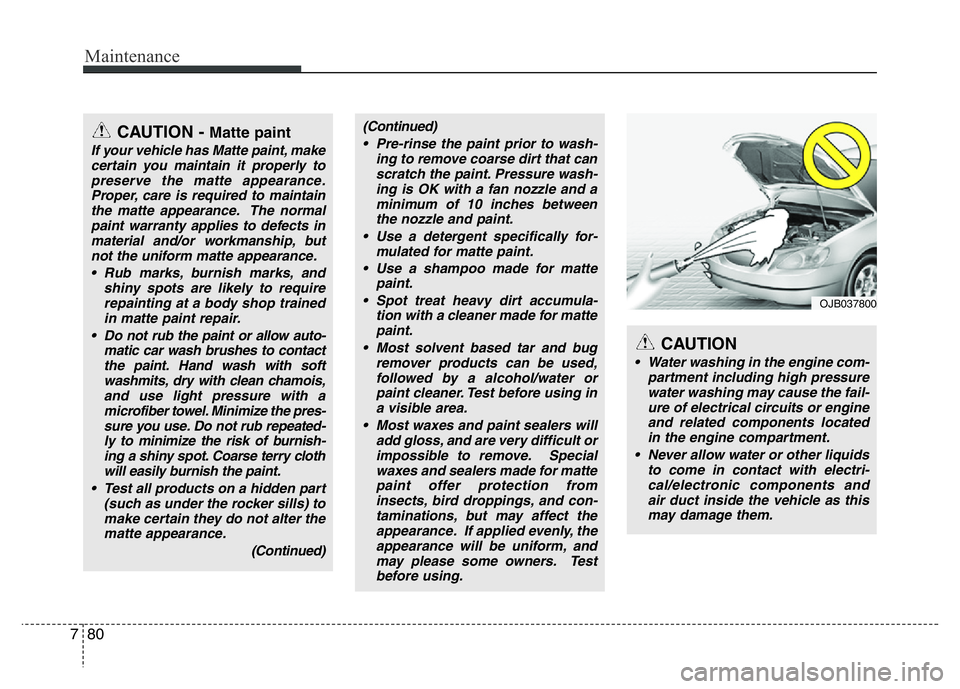
CAUTION
• Water washing in the engine com-
partment including high pressure
water washing may cause the fail-
ure of electrical circuits or engine
and related components located
in the engine compartment.
• Never allow water or other liquids
to come in contact with electri-
cal/electronic components and
air duct inside the vehicle as this
may damage them.
OJB037800