trailer HYUNDAI VERACRUZ 2010 User Guide
[x] Cancel search | Manufacturer: HYUNDAI, Model Year: 2010, Model line: VERACRUZ, Model: HYUNDAI VERACRUZ 2010Pages: 425, PDF Size: 8.65 MB
Page 311 of 425
553
Driving your vehicle
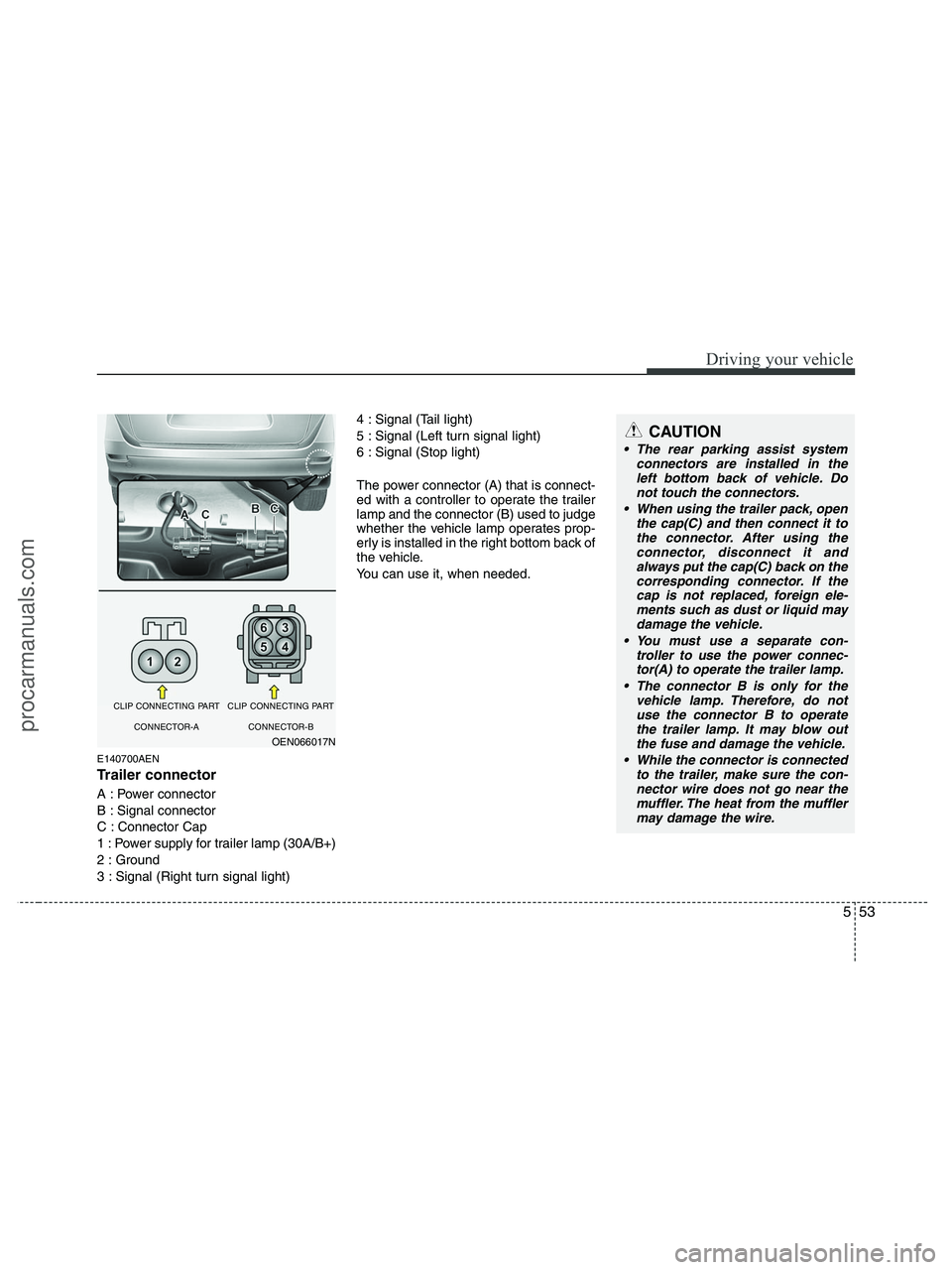
E140700AEN
Trailer connector
A : Power connector
B : Signal connector
C : Connector Cap
1 : Power supply for trailer lamp (30A/B+)
2 : Ground
3 : Signal (Right turn signal light) 4 : Signal (Tail light)
5 : Signal (Left turn signal light)
6 : Signal (Stop light)
The power connector (A) that is connect-
ed with a controller to operate the trailer
lamp and the connector (B) used to judge
whether the vehicle lamp operates prop-
erly is installed in the right bottom back of
the vehicle.
You can use it, when needed.
OEN066017N
CAUTION
The rear parking assist system
connectors are installed in the
left bottom back of vehicle. Do
not touch the connectors.
When using the trailer pack, open
the cap(C) and then connect it to
the connector. After using the
connector, disconnect it and
always put the cap(C) back on the
corresponding connector. If the
cap is not replaced, foreign ele-
ments such as dust or liquid may
damage the vehicle.
You must use a separate con-
troller to use the power connec-
tor(A) to operate the trailer lamp.
The connector B is only for the
vehicle lamp. Therefore, do not
use the connector B to operate
the trailer lamp. It may blow out
the fuse and damage the vehicle.
While the connector is connected
to the trailer, make sure the con-
nector wire does not go near the
muffler. The heat from the muffler
may damage the wire.
CLIP CONNECTING PART
CONNECTOR-A CONNECTOR-BCLIP CONNECTING PART
procarmanuals.com
Page 312 of 425
Driving your vehicle
54 5
E150100AUN
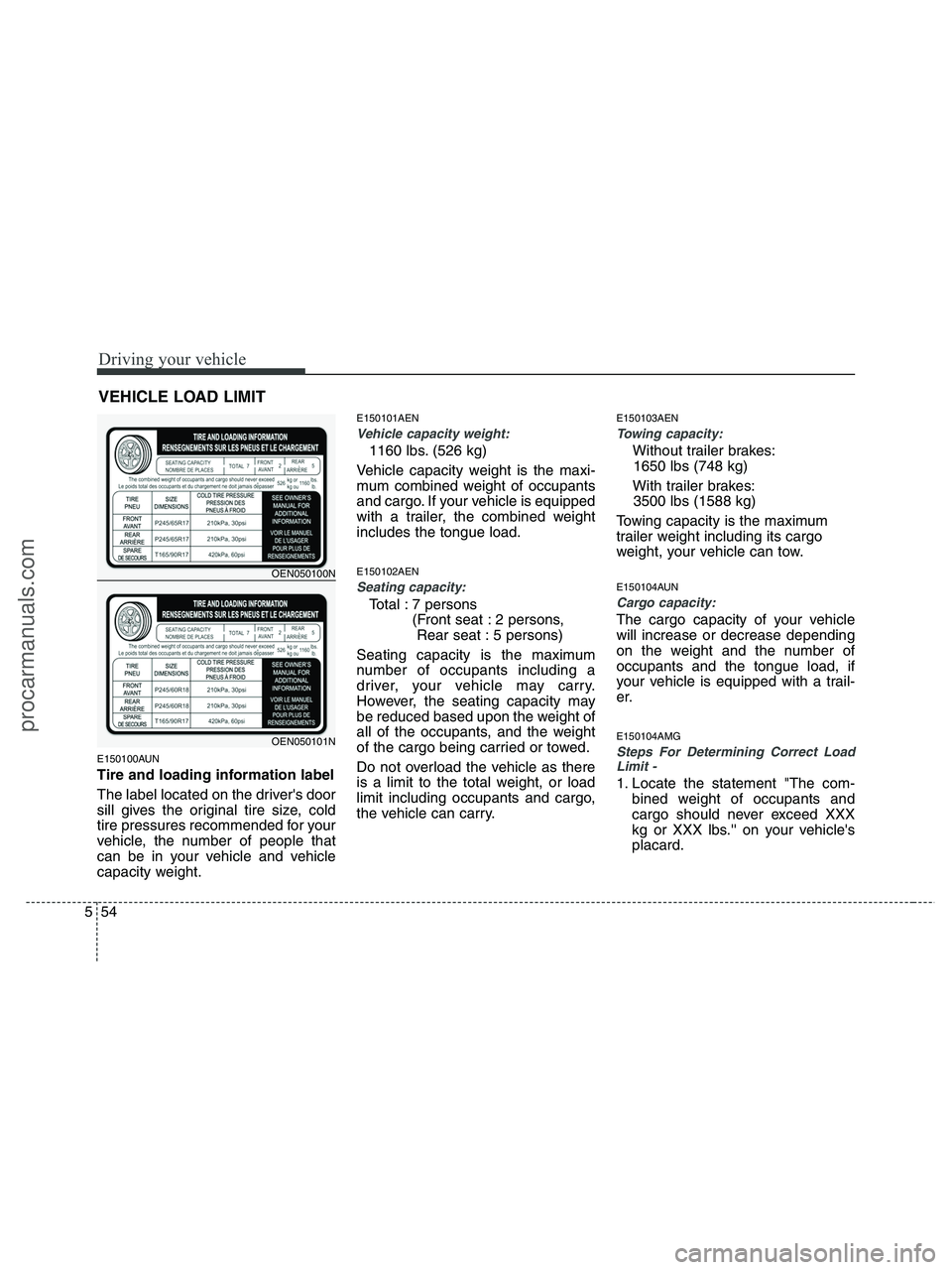
Tire and loading information label
The label located on the driver's door
sill gives the original tire size, cold
tire pressures recommended for your
vehicle, the number of people that
can be in your vehicle and vehicle
capacity weight.
E150101AEN
Vehicle capacity weight:
1160 lbs. (526 kg)
Vehicle capacity weight is the maxi-
mum combined weight of occupants
and cargo. If your vehicle is equipped
with a trailer, the combined weight
includes the tongue load.
E150102AEN
Seating capacity:
Total : 7 persons
(Front seat : 2 persons,
Rear seat : 5 persons)
Seating capacity is the maximum
number of occupants including a
driver, your vehicle may carry.
However, the seating capacity may
be reduced based upon the weight of
all of the occupants, and the weight
of the cargo being carried or towed.
Do not overload the vehicle as there
is a limit to the total weight, or load
limit including occupants and cargo,
the vehicle can carry.
E150103AEN
Towing capacity:
Without trailer brakes:
1650 lbs (748 kg)
With trailer brakes:
3500 lbs (1588 kg)
Towing capacity is the maximum
trailer weight including its cargo
weight, your vehicle can tow.
E150104AUN
Cargo capacity:
The cargo capacity of your vehicle
will increase or decrease depending
on the weight and the number of
occupants and the tongue load, if
your vehicle is equipped with a trail-
er.
E150104AMG
Steps For Determining Correct Load
Limit -
1. Locate the statement "The com-
bined weight of occupants and
cargo should never exceed XXX
kg or XXX lbs.'' on your vehicle's
placard.
VEHICLE LOAD LIMIT
OEN050100N
OEN050101N
procarmanuals.com
Page 313 of 425
555
Driving your vehicle
2. Determine the combined weight of
the driver and passengers that will
be riding in your vehicle.
3. Subtract the combined weight of
the driver and passengers from
XXX kg or XXX lbs.
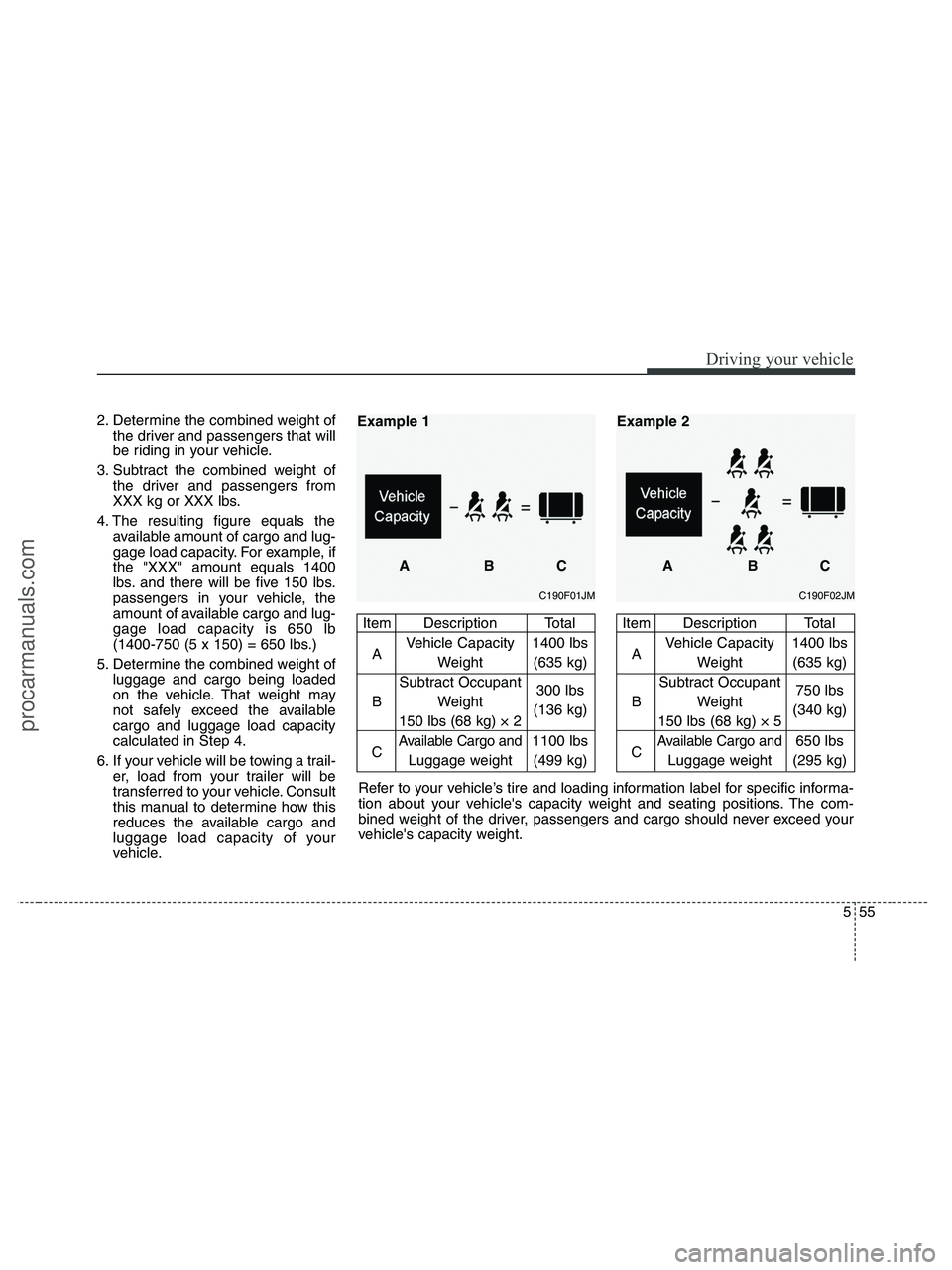
4. The resulting figure equals the
available amount of cargo and lug-
gage load capacity. For example, if
the "XXX" amount equals 1400
lbs. and there will be five 150 lbs.
passengers in your vehicle, the
amount of available cargo and lug-
gage load capacity is 650 lb
(1400-750 (5 x 150) = 650 lbs.)
5. Determine the combined weight of
luggage and cargo being loaded
on the vehicle. That weight may
not safely exceed the available
cargo and luggage load capacity
calculated in Step 4.
6. If your vehicle will be towing a trail-
er, load from your trailer will be
transferred to your vehicle. Consult
this manual to determine how this
reduces the available cargo and
luggage load capacity of your
vehicle.Refer to your vehicle’s tire and loading information label for specific informa-
tion about your vehicle's capacity weight and seating positions. The com-
bined weight of the driver, passengers and cargo should never exceed your
vehicle's capacity weight.
C190F01JM
Item Description Total
AVehicle Capacity 1400 lbs
Weight (635 kg)
Subtract Occupant
B Weight 300 lbs
150 lbs (68 kg) × 2(136 kg)
C
Available Cargo and1100 lbs
Luggage weight (499 kg)
Example 1
ABC
C190F02JM
Item Description Total
AVehicle Capacity 1400 lbs
Weight (635 kg)
Subtract Occupant
B Weight 750 lbs
150 lbs (68 kg) × 5(340 kg)
C
Available Cargo and650 lbs
Luggage weight (295 kg)
ABC Example 2
procarmanuals.com
Page 316 of 425
Driving your vehicle
58 5
E160000AUN
This section will guide you in the proper
loading of your vehicle and/or trailer, to
keep your loaded vehicle weight within its
design rating capability, with or without a
trailer. Properly loading your vehicle will
provide maximum return of the vehicle
design performance. Before loading your
vehicle, familiarize yourself with the fol-
lowing terms for determining your vehi-
cle's weight ratings, with or without a
trailer, from the vehicle's specifications
and the certification label:
E160100AUN
Base curb weight
This is the weight of the vehicle including
a full tank of fuel and all standard equip-
ment. It does not include passengers,
cargo, or optional equipment.
E160200AUN
Vehicle curb weight
This is the weight of your new vehicle
when you picked it up from your dealer
plus any aftermarket equipment.
E160300AUN
Cargo weight
This figure includes all weight added to
the Base Curb Weight, including cargo
and optional equipment.
E160400AUN
GAW (Gross axle weight)
This is the total weight placed on each
axle (front and rear) - including vehicle
curb weight and all payload.
E160500AUN
GAWR (Gross axle weight rating)
This is the maximum allowable weight
that can be carried by a single axle (front
or rear). These numbers are shown on
the certification label.
The total load on each axle must never
exceed its GAWR.
E160600AUN
GVW (Gross vehicle weight)
This is the Base Curb Weight plus actual
Cargo Weight plus passengers.
E160700AUN-EU
GVWR (Gross vehicle weight rating)
This is the maximum allowable weight of
the fully loaded vehicle (including all
options, equipment, passengers and
cargo). The GVWR is shown on the cer-
tification label located on the driver’s
door sill.
VEHICLE WEIGHT
procarmanuals.com
Page 336 of 425
What to do in an emergency
20 6
Do not take this vehicle through an
automatic car wash while the com-
pact spare tire is installed.
Do not use tire chains on the com-
pact spare tire. Because of the
smaller size, a tire chain will not fit
properly. This could damage the
vehicle and result in loss of the
chain.
The compact spare tire should not
be installed on the front axle if the
vehicle must be driven in snow or
on ice.
Do not use the compact spare tire
on any other vehicle because this
tire has been designed especially
for your vehicle.
The compact spare tire’s tread life
is shorter than a regular tire.
Inspect your compact spare tire
regularly and replace worn com-
pact spare tires with the same size
and design, mounted on the same
wheel. The compact spare tire should not
be used on any other wheels, nor
should standard tires, snow tires,
wheel covers or trim rings be used
with the compact spare wheel. If
such use is attempted, damage to
these items or other car compo-
nents may occur.
Do not use more than one compact
spare tire at a time.
Do not tow a trailer while the com-
pact spare tire is installed.
procarmanuals.com
Page 337 of 425
621
What to do in an emergency
TOWING
F080100AEN-EU
Towing service
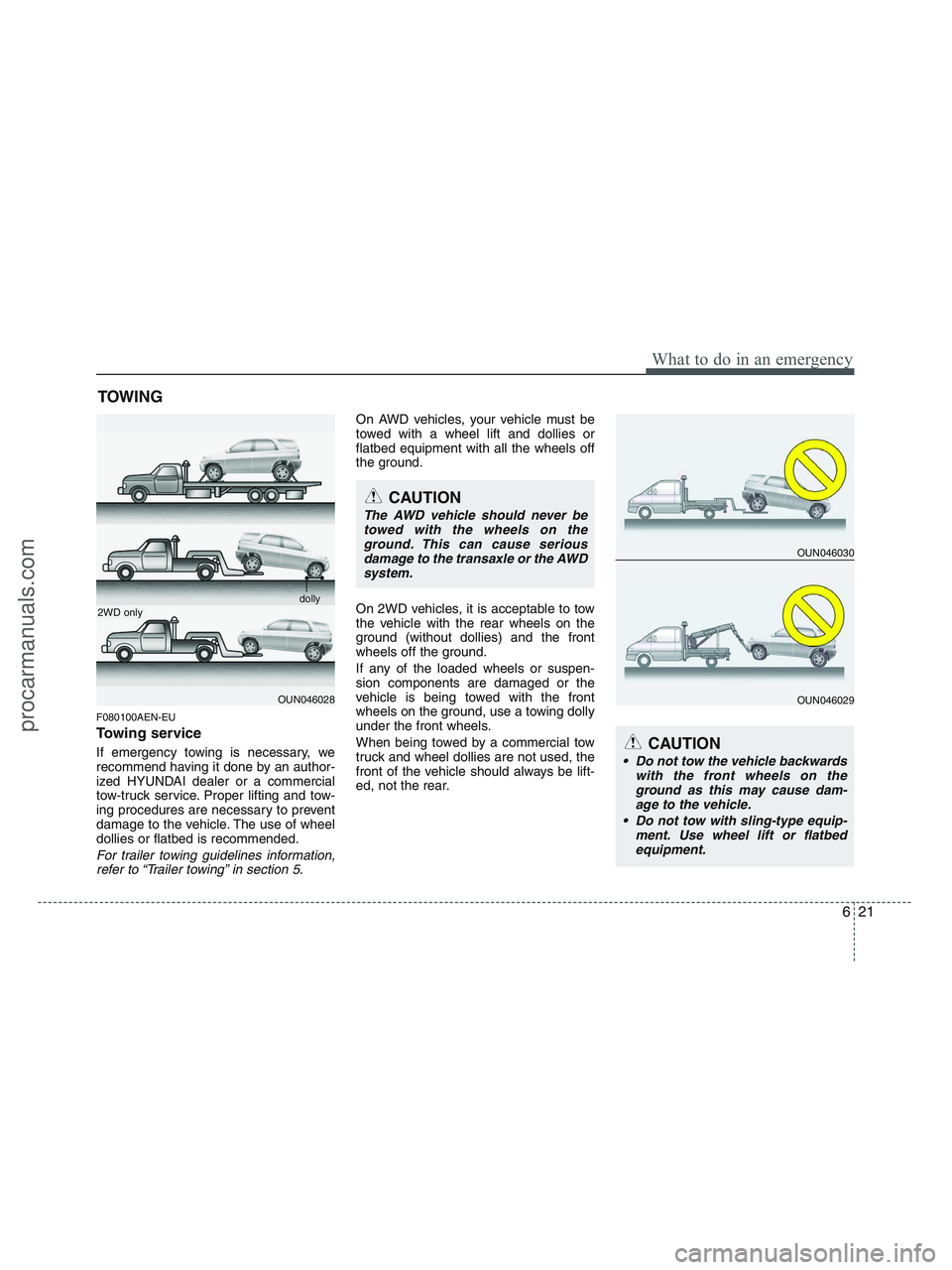
If emergency towing is necessary, we
recommend having it done by an author-
ized HYUNDAI dealer or a commercial
tow-truck service. Proper lifting and tow-
ing procedures are necessary to prevent
damage to the vehicle. The use of wheel
dollies or flatbed is recommended.
For trailer towing guidelines information,
refer to “Trailer towing” in section 5.
On AWD vehicles, your vehicle must be
towed with a wheel lift and dollies or
flatbed equipment with all the wheels off
the ground.
On 2WD vehicles, it is acceptable to tow
the vehicle with the rear wheels on the
ground (without dollies) and the front
wheels off the ground.
If any of the loaded wheels or suspen-
sion components are damaged or the
vehicle is being towed with the front
wheels on the ground, use a towing dolly
under the front wheels.
When being towed by a commercial tow
truck and wheel dollies are not used, the
front of the vehicle should always be lift-
ed, not the rear.
OUN046028
CAUTION
The AWD vehicle should never be
towed with the wheels on the
ground. This can cause serious
damage to the transaxle or the AWD
system.
dolly2WD only
OUN046030
OUN046029
CAUTION
Do not tow the vehicle backwards
with the front wheels on the
ground as this may cause dam-
age to the vehicle.
Do not tow with sling-type equip-
ment. Use wheel lift or flatbed
equipment.
procarmanuals.com
Page 351 of 425
Maintenance
10 7
G040200AEN-EU
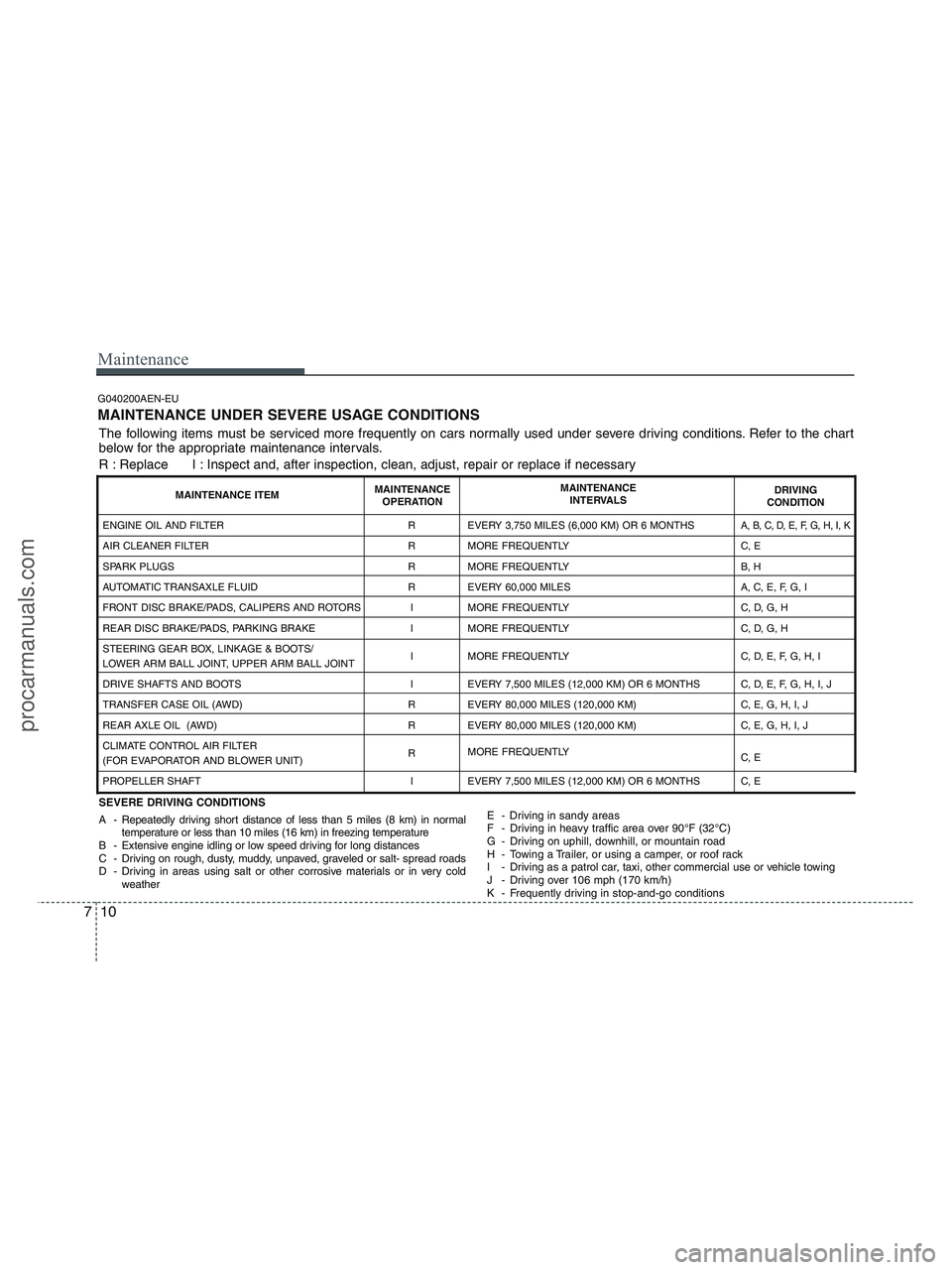
MAINTENANCE UNDER SEVERE USAGE CONDITIONS
SEVERE DRIVING CONDITIONS
A - Repeatedly driving short distance of less than 5 miles (8 km) in normal
temperature or less than 10 miles (16 km) in freezing temperature
B - Extensive engine idling or low speed driving for long distances
C - Driving on rough, dusty, muddy, unpaved, graveled or salt- spread roads
D - Driving in areas using salt or other corrosive materials or in very cold
weatherE - Driving in sandy areas
F - Driving in heavy traffic area over 90°F (32°C)
G - Driving on uphill, downhill, or mountain road
H - Towing a Trailer, or using a camper, or roof rack
I - Driving as a patrol car, taxi, other commercial use or vehicle towing
J - Driving over 106 mph (170 km/h)
K - Frequently driving in stop-and-go conditions
ENGINE OIL AND FILTER
AIR CLEANER FILTER
SPARK PLUGS
AUTOMATIC TRANSAXLE FLUID
FRONT DISC BRAKE/PADS, CALIPERS AND ROTORS
REAR DISC BRAKE/PADS, PARKING BRAKE
STEERING GEAR BOX, LINKAGE & BOOTS/
LOWER ARM BALL JOINT, UPPER ARM BALL JOINT
DRIVE SHAFTS AND BOOTS
TRANSFER CASE OIL (AWD)
REAR AXLE OIL (AWD)
CLIMATE CONTROL AIR FILTER
(FOR EVAPORATOR AND BLOWER UNIT)
PROPELLER SHAFTR
R
R
R
I
I
I
I
R
R
R
IEVERY 3,750 MILES (6,000 KM) OR 6 MONTHS
MORE FREQUENTLY
MORE FREQUENTLY
EVERY 60,000 MILES
MORE FREQUENTLY
MORE FREQUENTLY
MORE FREQUENTLY
EVERY 7,500 MILES (12,000 KM) OR 6 MONTHS
EVERY 80,000 MILES (120,000 KM)
EVERY 80,000 MILES (120,000 KM)
MORE FREQUENTLY
EVERY 7,500 MILES (12,000 KM) OR 6 MONTHSA, B, C, D, E, F, G, H, I, K
C, E
B, H
A, C, E, F, G, I
C, D, G, H
C, D, G, H
C, D, E, F, G, H, I
C, D, E, F, G, H, I, J
C, E, G, H, I, J
C, E, G, H, I, J
C, E
C, E
MAINTENANCE ITEMMAINTENANCE
OPERATIONMAINTENANCE
INTERVALSDRIVING
CONDITION
The following items must be serviced more frequently on cars normally used under severe driving conditions. Refer to the chart
below for the appropriate maintenance intervals.
R : Replace I : Inspect and, after inspection, clean, adjust, repair or replace if necessary
procarmanuals.com
Page 389 of 425
Maintenance
48 7
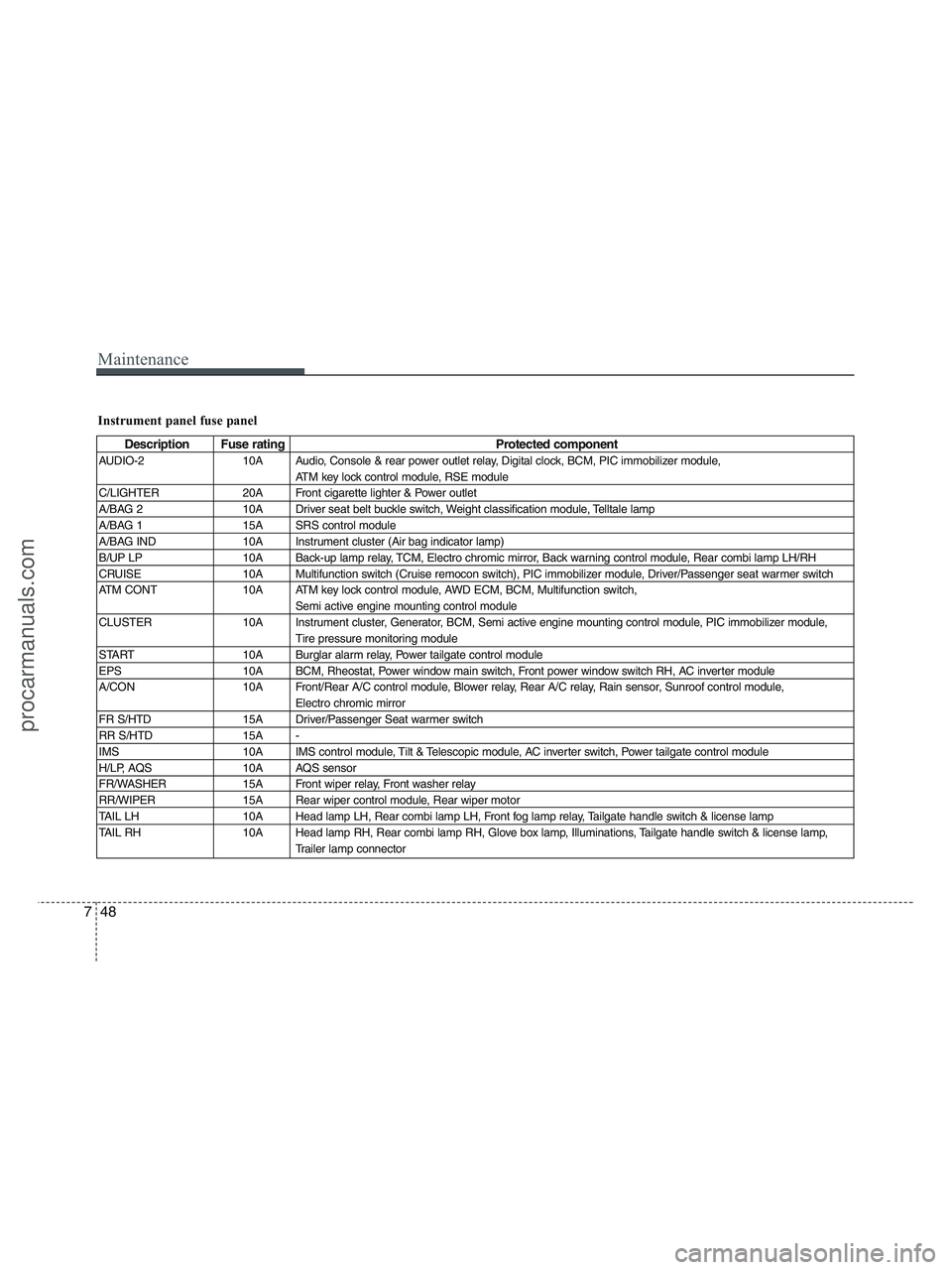
Instrument panel fuse panel
Description Fuse rating Protected component
AUDIO-2 10A Audio, Console & rear power outlet relay, Digital clock, BCM, PIC immobilizer module,
ATM key lock control module, RSE module
C/LIGHTER 20A Front cigarette lighter & Power outlet
A/BAG 2 10A Driver seat belt buckle switch, Weight classification module, Telltale lamp
A/BAG 1 15A SRS control module
A/BAG IND 10A Instrument cluster (Air bag indicator lamp)
B/UP LP 10A Back-up lamp relay, TCM, Electro chromic mirror, Back warning control module, Rear combi lamp LH/RH
CRUISE 10A Multifunction switch (Cruise remocon switch), PIC immobilizer module, Driver/Passenger seat warmer switch
ATM CONT 10A ATM key lock control module, AWD ECM, BCM, Multifunction switch,
Semi active engine mounting control module
CLUSTER 10A Instrument cluster, Generator, BCM, Semi active engine mounting control module, PIC immobilizer module,
Tire pressure monitoring module
START 10A Burglar alarm relay, Power tailgate control module
EPS 10A BCM, Rheostat, Power window main switch, Front power window switch RH, AC inverter module
A/CON 10A Front/Rear A/C control module, Blower relay, Rear A/C relay, Rain sensor, Sunroof control module,
Electro chromic mirror
FR S/HTD 15A Driver/Passenger Seat warmer switch
RR S/HTD 15A -
IMS 10A IMS control module, Tilt & Telescopic module, AC inverter switch, Power tailgate control module
H/LP, AQS 10A AQS sensor
FR/WASHER 15A Front wiper relay, Front washer relay
RR/WIPER 15A Rear wiper control module, Rear wiper motor
TAIL LH 10A Head lamp LH, Rear combi lamp LH, Front fog lamp relay, Tailgate handle switch & license lamp
TAIL RH 10A Head lamp RH, Rear combi lamp RH, Glove box lamp, Illuminations, Tailgate handle switch & license lamp,
Trailer lamp connector
procarmanuals.com
Page 392 of 425
751
Maintenance
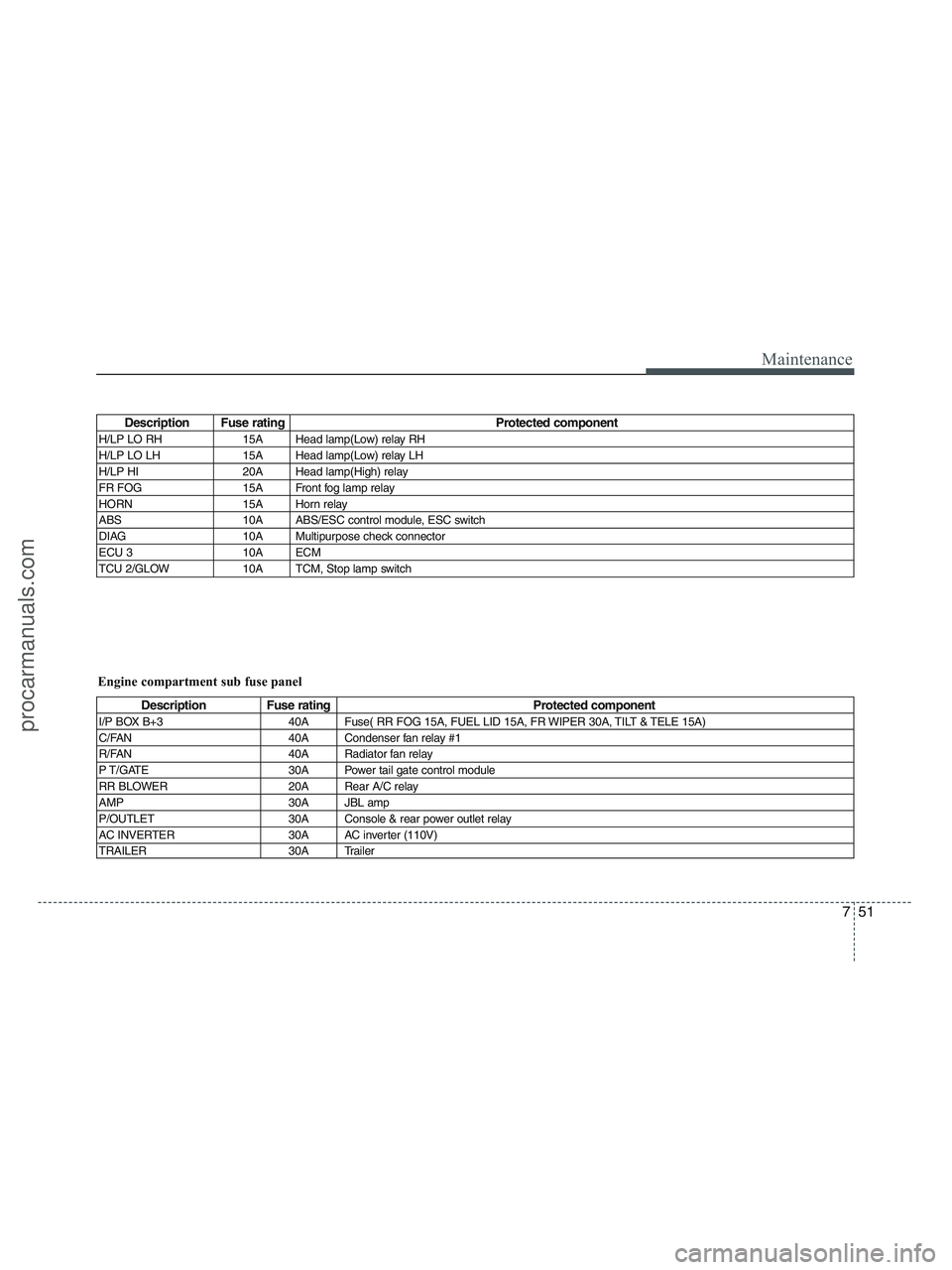
Description Fuse rating Protected component
H/LP LO RH 15A Head lamp(Low) relay RH
H/LP LO LH 15A Head lamp(Low) relay LH
H/LP HI 20A Head lamp(High) relay
FR FOG 15A Front fog lamp relay
HORN 15A Horn relay
ABS 10A ABS/ESC control module, ESC switch
DIAG 10A Multipurpose check connector
ECU 3 10A ECM
TCU 2/GLOW 10A TCM, Stop lamp switch
Engine compartment sub fuse panel
Description Fuse rating Protected component
I/P BOX B+3 40A Fuse( RR FOG 15A, FUEL LID 15A, FR WIPER 30A, TILT & TELE 15A)
C/FAN 40A Condenser fan relay #1
R/FAN 40A Radiator fan relay
P T/GATE 30A Power tail gate control module
RR BLOWER 20A Rear A/C relay
AMP 30A JBL amp
P/OUTLET 30A Console & rear power outlet relay
AC INVERTER 30A AC inverter (110V)
TRAILER 30A Trailer
procarmanuals.com
Page 424 of 425
Index
6I
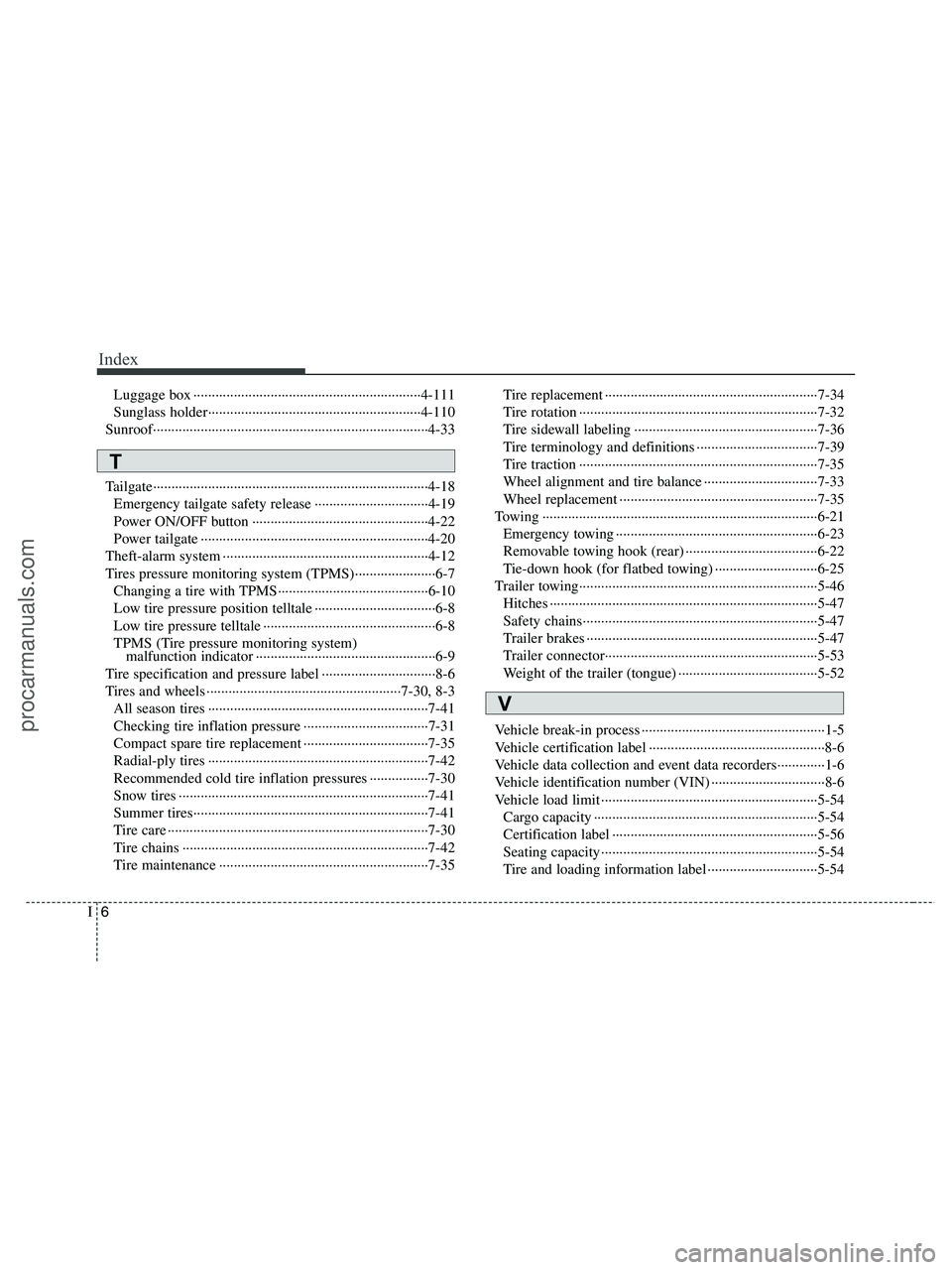
Luggage box ······························································4-111
Sunglass holder··························································4-110
Sunroof···········································································4-33
Tailgate···········································································4-18
Emergency tailgate safety release ·······························4-19
Power ON/OFF button ················································4-22
Power tailgate ······························································4-20
Theft-alarm system ························································4-12
Tires pressure monitoring system (TPMS)······················6-7
Changing a tire with TPMS·········································6-10
Low tire pressure position telltale ·································6-8
Low tire pressure telltale ···············································6-8
TPMS (Tire pressure monitoring system)
malfunction indicator ·················································6-9
Tire specification and pressure label ·······························8-6
Tires and wheels ·····················································7-30, 8-3
All season tires ····························································7-41
Checking tire inflation pressure ··································7-31
Compact spare tire replacement ··································7-35
Radial-ply tires ····························································7-42
Recommended cold tire inflation pressures ················7-30
Snow tires ····································································7-41
Summer tires································································7-41
Tire care ·······································································7-30
Tire chains ···································································7-42
Tire maintenance ·························································7-35Tire replacement ··························································7-34
Tire rotation ·································································7-32
Tire sidewall labeling ··················································7-36
Tire terminology and definitions ·································7-39
Tire traction ·································································7-35
Wheel alignment and tire balance ·······························7-33
Wheel replacement ······················································7-35
Towing ···········································································6-21
Emergency towing ·······················································6-23
Removable towing hook (rear) ····································6-22
Tie-down hook (for flatbed towing) ····························6-25
Trailer towing·································································5-46
Hitches ·········································································5-47
Safety chains································································5-47
Trailer brakes ·······························································5-47
Trailer connector··························································5-53
Weight of the trailer (tongue) ······································5-52
Vehicle break-in process ··················································1-5
Vehicle certification label ················································8-6
Vehicle data collection and event data recorders·············1-6
Vehicle identification number (VIN) ·······························8-6
Vehicle load limit ···························································5-54
Cargo capacity ·····························································5-54
Certification label ························································5-56
Seating capacity ···························································5-54
Tire and loading information label ······························5-54
T
V
procarmanuals.com