tow HYUNDAI VERACRUZ 2010 Service Manual
[x] Cancel search | Manufacturer: HYUNDAI, Model Year: 2010, Model line: VERACRUZ, Model: HYUNDAI VERACRUZ 2010Pages: 425, PDF Size: 8.65 MB
Page 328 of 425
What to do in an emergency
12 6
IF YOU HAVE A FLAT TIRE
F070100BEN
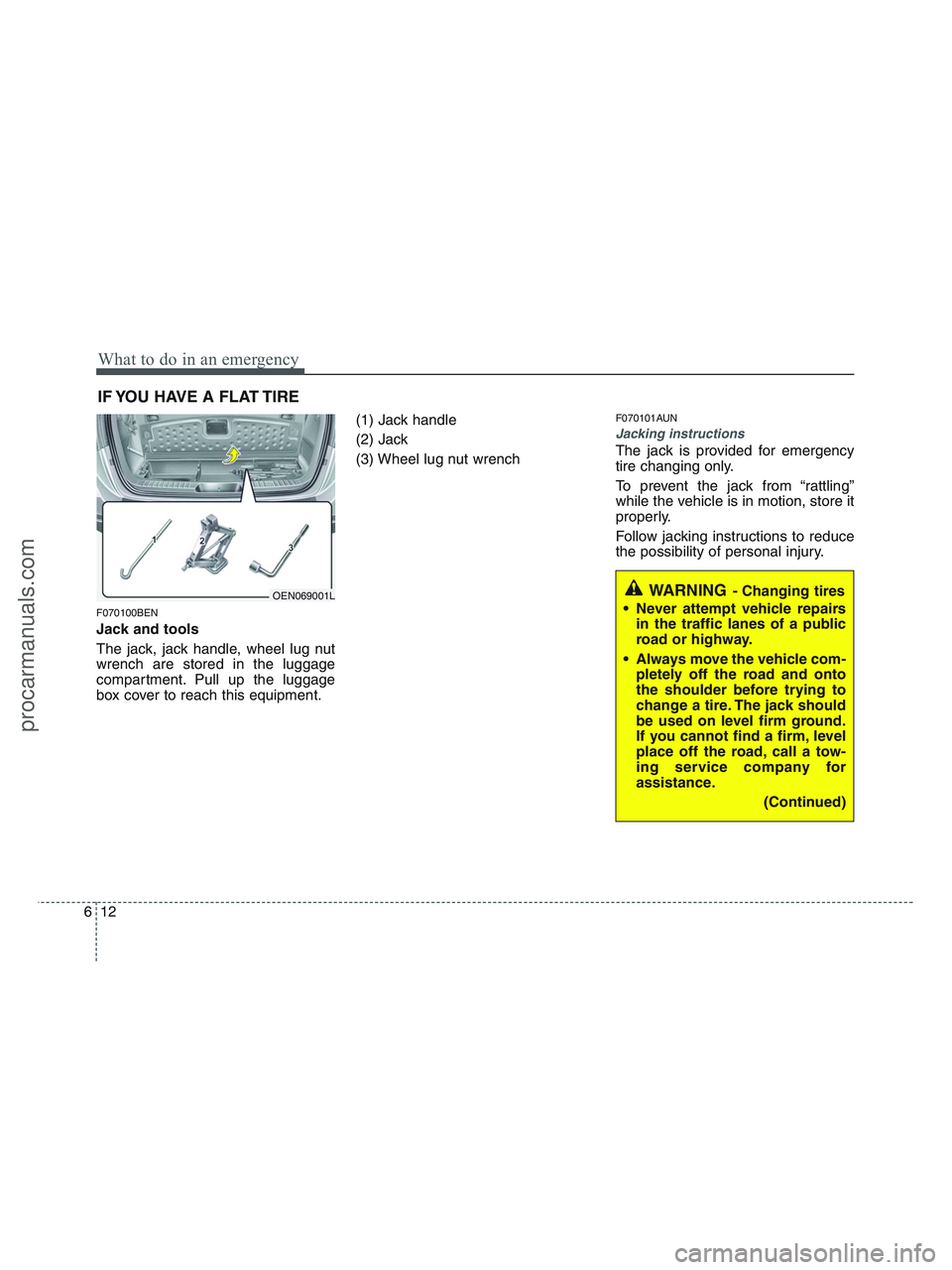
Jack and tools
The jack, jack handle, wheel lug nut
wrench are stored in the luggage
compartment. Pull up the luggage
box cover to reach this equipment.(1) Jack handle
(2) Jack
(3) Wheel lug nut wrench
F070101AUN
Jacking instructions
The jack is provided for emergency
tire changing only.
To prevent the jack from “rattling”
while the vehicle is in motion, store it
properly.
Follow jacking instructions to reduce
the possibility of personal injury.
WARNING- Changing tires
Never attempt vehicle repairs
in the traffic lanes of a public
road or highway.
Always move the vehicle com-
pletely off the road and onto
the shoulder before trying to
change a tire. The jack should
be used on level firm ground.
If you cannot find a firm, level
place off the road, call a tow-
ing service company for
assistance.
(Continued)OEN069001L
procarmanuals.com
Page 336 of 425
What to do in an emergency
20 6
Do not take this vehicle through an
automatic car wash while the com-
pact spare tire is installed.
Do not use tire chains on the com-
pact spare tire. Because of the
smaller size, a tire chain will not fit
properly. This could damage the
vehicle and result in loss of the
chain.
The compact spare tire should not
be installed on the front axle if the
vehicle must be driven in snow or
on ice.
Do not use the compact spare tire
on any other vehicle because this
tire has been designed especially
for your vehicle.
The compact spare tire’s tread life
is shorter than a regular tire.
Inspect your compact spare tire
regularly and replace worn com-
pact spare tires with the same size
and design, mounted on the same
wheel. The compact spare tire should not
be used on any other wheels, nor
should standard tires, snow tires,
wheel covers or trim rings be used
with the compact spare wheel. If
such use is attempted, damage to
these items or other car compo-
nents may occur.
Do not use more than one compact
spare tire at a time.
Do not tow a trailer while the com-
pact spare tire is installed.
procarmanuals.com
Page 337 of 425
621
What to do in an emergency
TOWING
F080100AEN-EU
Towing service
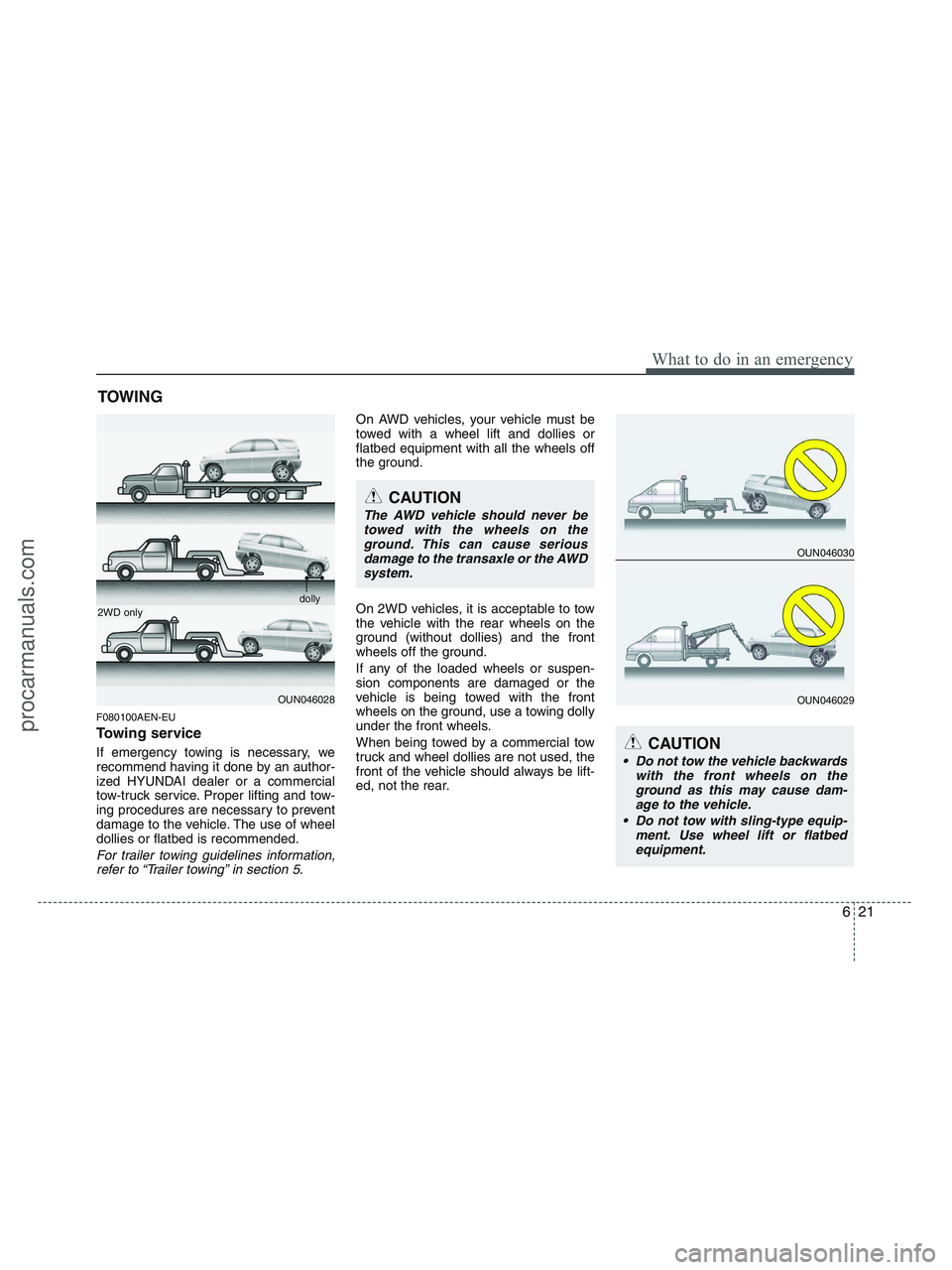
If emergency towing is necessary, we
recommend having it done by an author-
ized HYUNDAI dealer or a commercial
tow-truck service. Proper lifting and tow-
ing procedures are necessary to prevent
damage to the vehicle. The use of wheel
dollies or flatbed is recommended.
For trailer towing guidelines information,
refer to “Trailer towing” in section 5.
On AWD vehicles, your vehicle must be
towed with a wheel lift and dollies or
flatbed equipment with all the wheels off
the ground.
On 2WD vehicles, it is acceptable to tow
the vehicle with the rear wheels on the
ground (without dollies) and the front
wheels off the ground.
If any of the loaded wheels or suspen-
sion components are damaged or the
vehicle is being towed with the front
wheels on the ground, use a towing dolly
under the front wheels.
When being towed by a commercial tow
truck and wheel dollies are not used, the
front of the vehicle should always be lift-
ed, not the rear.
OUN046028
CAUTION
The AWD vehicle should never be
towed with the wheels on the
ground. This can cause serious
damage to the transaxle or the AWD
system.
dolly2WD only
OUN046030
OUN046029
CAUTION
Do not tow the vehicle backwards
with the front wheels on the
ground as this may cause dam-
age to the vehicle.
Do not tow with sling-type equip-
ment. Use wheel lift or flatbed
equipment.
procarmanuals.com
Page 338 of 425
What to do in an emergency
22 6
When towing your vehicle in an emer-
gency without wheel dollies :
1. Set the ignition switch in the ACC posi-
tion.
2. Place the transaxle shift lever in N
(Neutral).
3. Release the parking brake.
F080200AUN
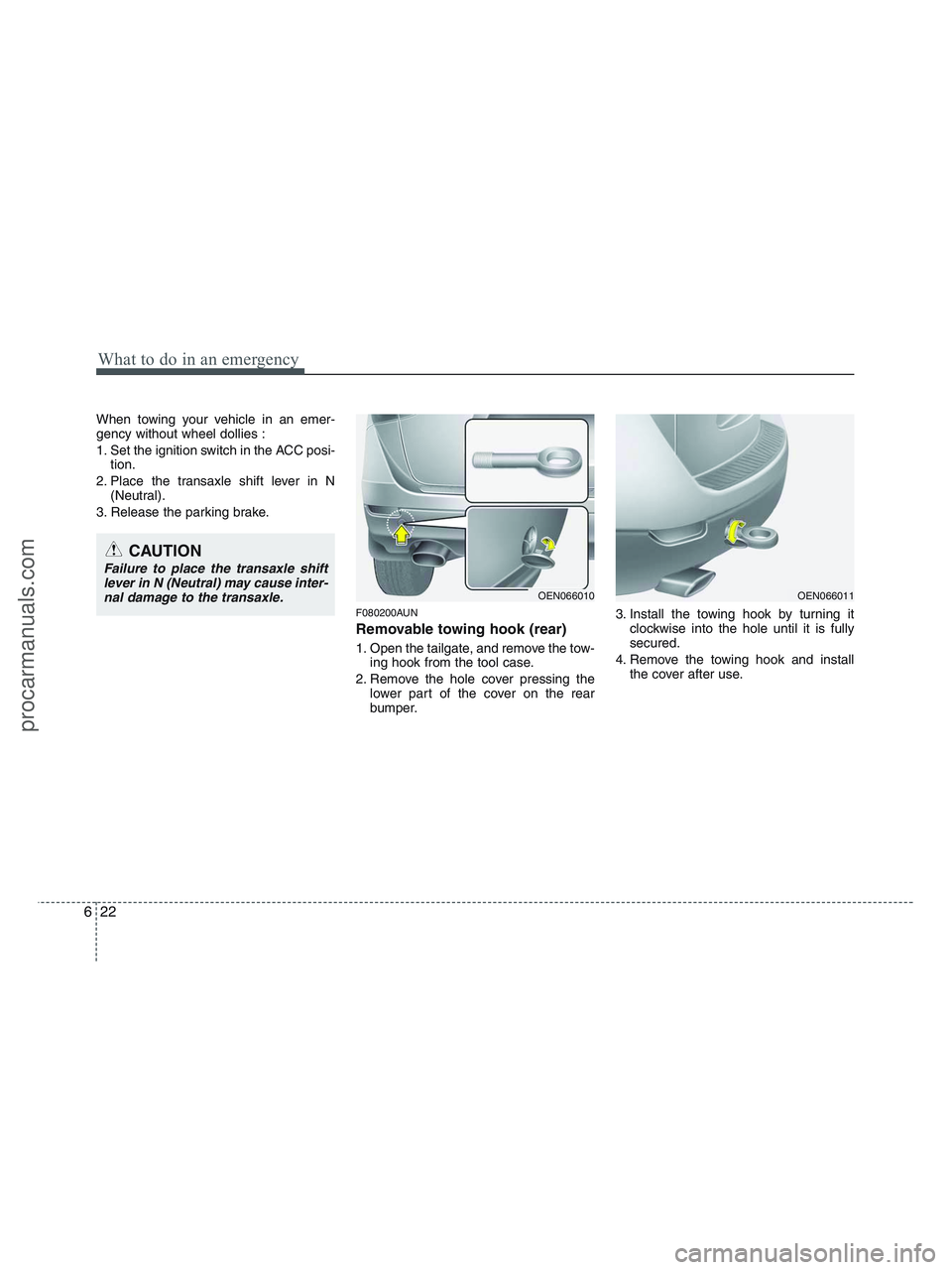
Removable towing hook (rear)
1. Open the tailgate, and remove the tow-
ing hook from the tool case.
2. Remove the hole cover pressing the
lower part of the cover on the rear
bumper.3. Install the towing hook by turning it
clockwise into the hole until it is fully
secured.
4. Remove the towing hook and install
the cover after use.
CAUTION
Failure to place the transaxle shift
lever in N (Neutral) may cause inter-
nal damage to the transaxle.
OEN066010OEN066011
procarmanuals.com
Page 339 of 425
623
What to do in an emergency
F080300AEN
Emergency towing
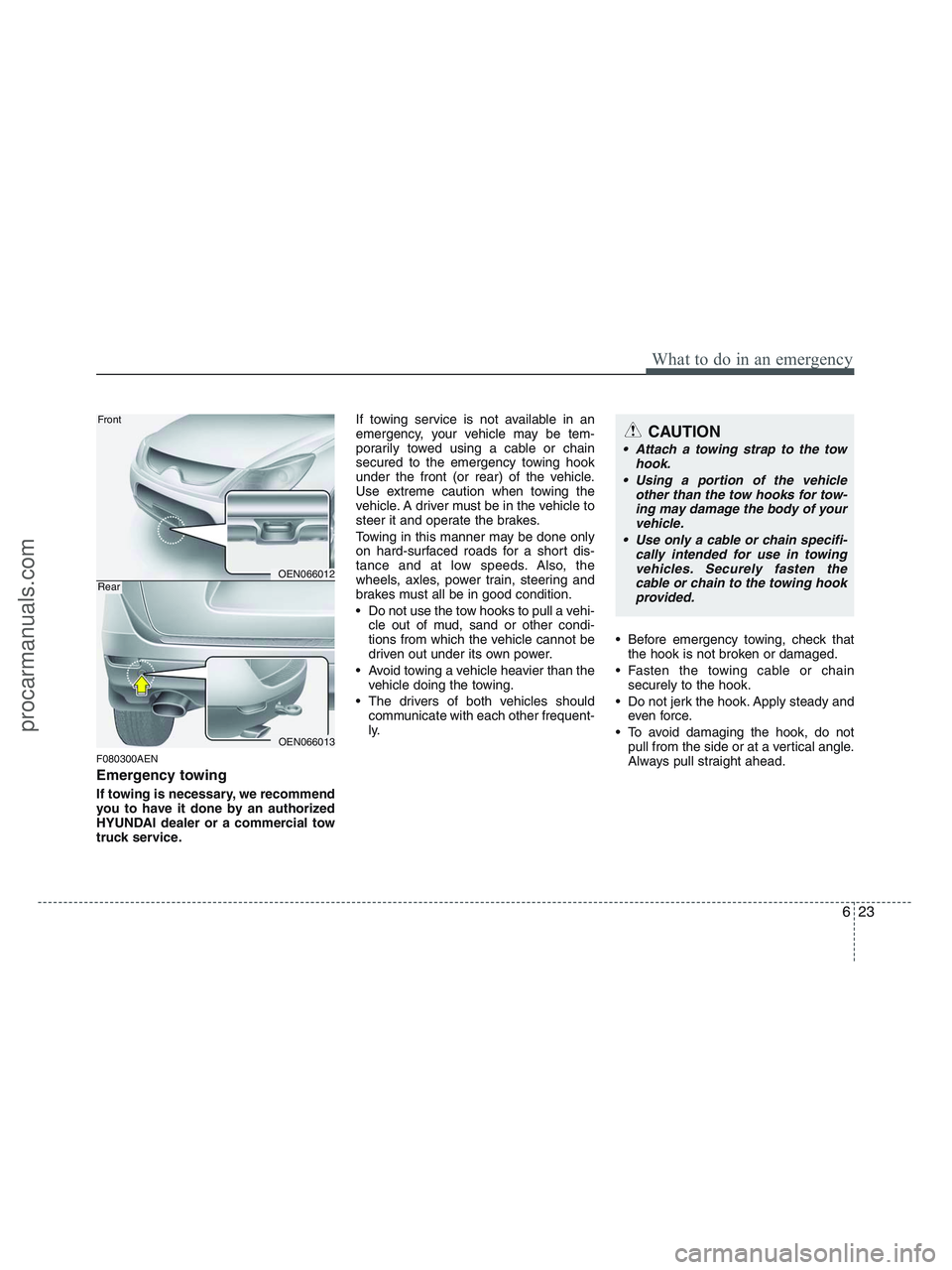
If towing is necessary, we recommend
you to have it done by an authorized
HYUNDAI dealer or a commercial tow
truck service.If towing service is not available in an
emergency, your vehicle may be tem-
porarily towed using a cable or chain
secured to the emergency towing hook
under the front (or rear) of the vehicle.
Use extreme caution when towing the
vehicle. A driver must be in the vehicle to
steer it and operate the brakes.
Towing in this manner may be done only
on hard-surfaced roads for a short dis-
tance and at low speeds. Also, the
wheels, axles, power train, steering and
brakes must all be in good condition.
Do not use the tow hooks to pull a vehi-
cle out of mud, sand or other condi-
tions from which the vehicle cannot be
driven out under its own power.
Avoid towing a vehicle heavier than the
vehicle doing the towing.
The drivers of both vehicles should
communicate with each other frequent-
ly. Before emergency towing, check that
the hook is not broken or damaged.
Fasten the towing cable or chain
securely to the hook.
Do not jerk the hook. Apply steady and
even force.
To avoid damaging the hook, do not
pull from the side or at a vertical angle.
Always pull straight ahead.
OEN066012
OEN066013
Front
Rear
CAUTION
Attach a towing strap to the tow
hook.
Using a portion of the vehicle
other than the tow hooks for tow-
ing may damage the body of your
vehicle.
Use only a cable or chain specifi-
cally intended for use in towing
vehicles. Securely fasten the
cable or chain to the towing hook
provided.
procarmanuals.com
Page 340 of 425
What to do in an emergency
24 6
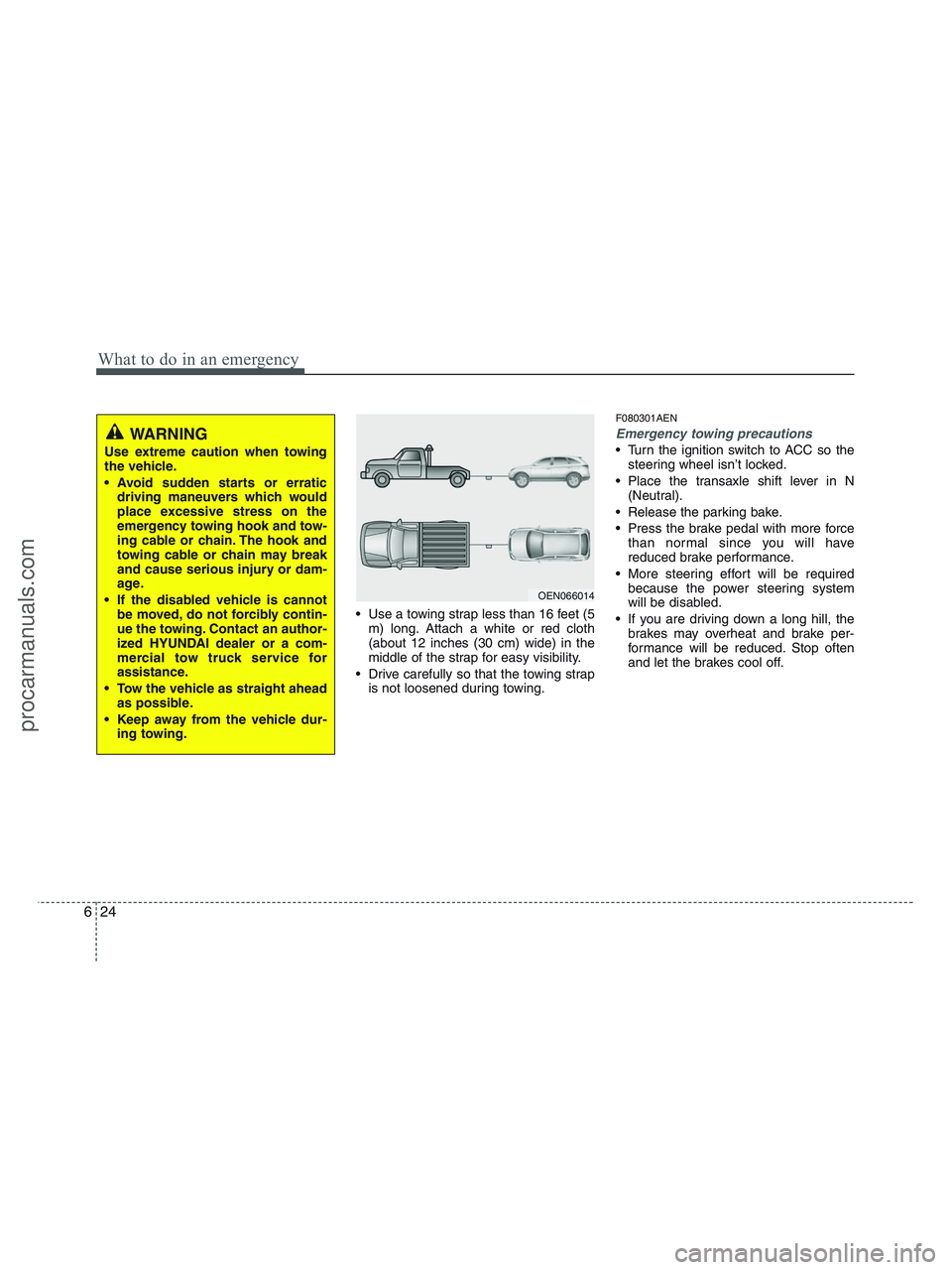
Use a towing strap less than 16 feet (5
m) long. Attach a white or red cloth
(about 12 inches (30 cm) wide) in the
middle of the strap for easy visibility.
Drive carefully so that the towing strap
is not loosened during towing.
F080301AEN
Emergency towing precautions
Turn the ignition switch to ACC so the
steering wheel isn’t locked.
Place the transaxle shift lever in N
(Neutral).
Release the parking bake.
Press the brake pedal with more force
than normal since you will have
reduced brake performance.
More steering effort will be required
because the power steering system
will be disabled.
If you are driving down a long hill, the
brakes may overheat and brake per-
formance will be reduced. Stop often
and let the brakes cool off.
WARNING
Use extreme caution when towing
the vehicle.
driving maneuvers which would
place excessive stress on the
emergency towing hook and tow-
ing cable or chain. The hook and
towing cable or chain may break
and cause serious injury or dam-
age.
If the disabled vehicle is cannot
be moved, do not forcibly contin-
ue the towing. Contact an author-
ized HYUNDAI dealer or a com-
mercial tow truck service for
assistance.
Tow the vehicle as straight ahead
as possible.
Keep away from the vehicle dur-
ing towing.
OEN066014
procarmanuals.com
Page 341 of 425
625
What to do in an emergency
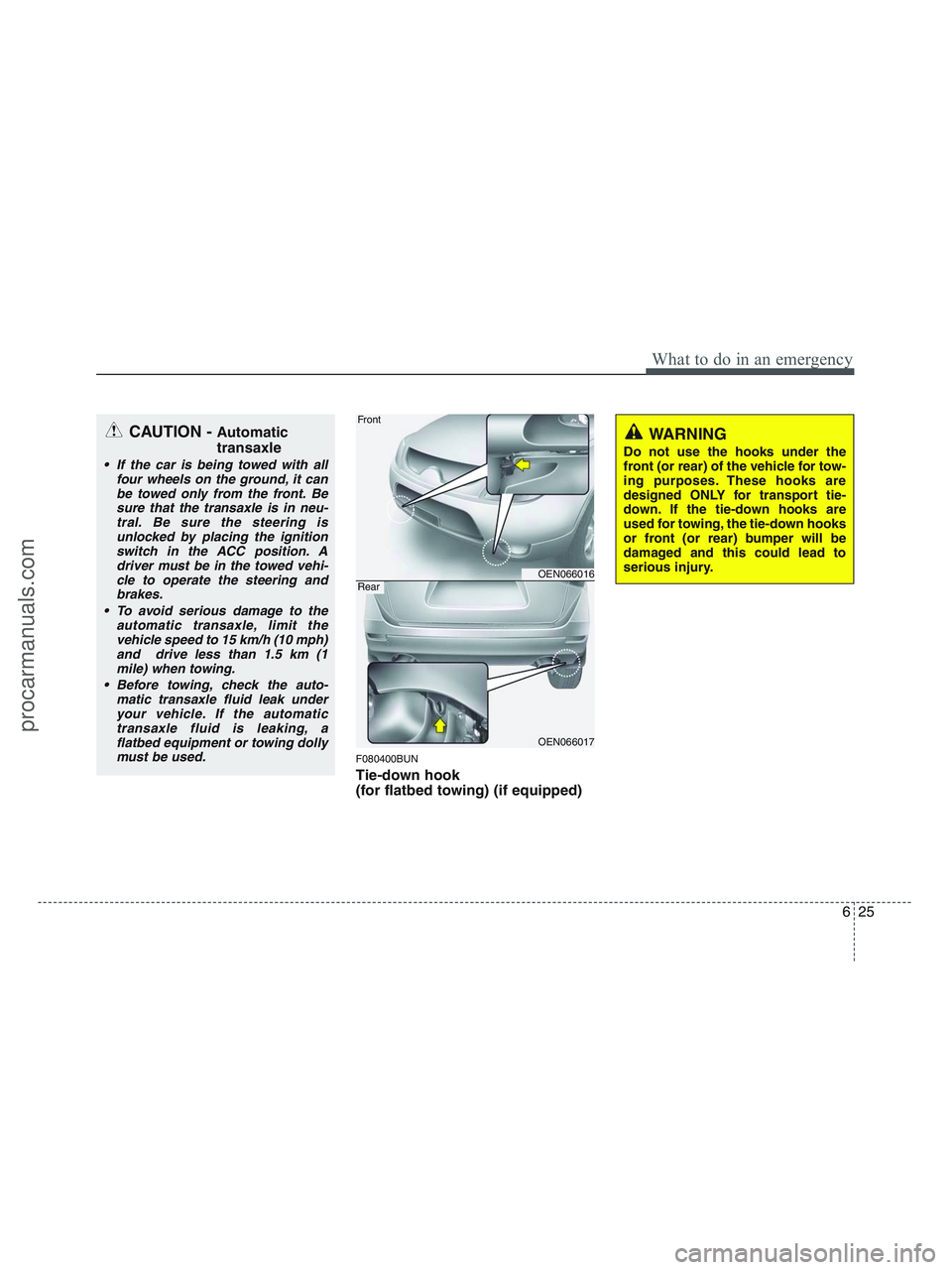
F080400BUN
Tie-down hook
(for flatbed towing) (if equipped)
CAUTION - Automatic
transaxle
If the car is being towed with all
four wheels on the ground, it can
be towed only from the front. Be
sure that the transaxle is in neu-
tral. Be sure the steering is
unlocked by placing the ignition
switch in the ACC position. A
driver must be in the towed vehi-
cle to operate the steering and
brakes.
To avoid serious damage to the
automatic transaxle, limit the
vehicle speed to 15 km/h (10 mph)
and drive less than 1.5 km (1
mile) when towing.
Before towing, check the auto-
matic transaxle fluid leak under
your vehicle. If the automatic
transaxle fluid is leaking, a
flatbed equipment or towing dolly
must be used.
WARNING
Do not use the hooks under the
front (or rear) of the vehicle for tow-
ing purposes. These hooks are
designed ONLY for transport tie-
down. If the tie-down hooks are
used for towing, the tie-down hooks
or front (or rear) bumper will be
damaged and this could lead to
serious injury.
OEN066016
OEN066017
Front
Rear
procarmanuals.com
Page 351 of 425
Maintenance
10 7
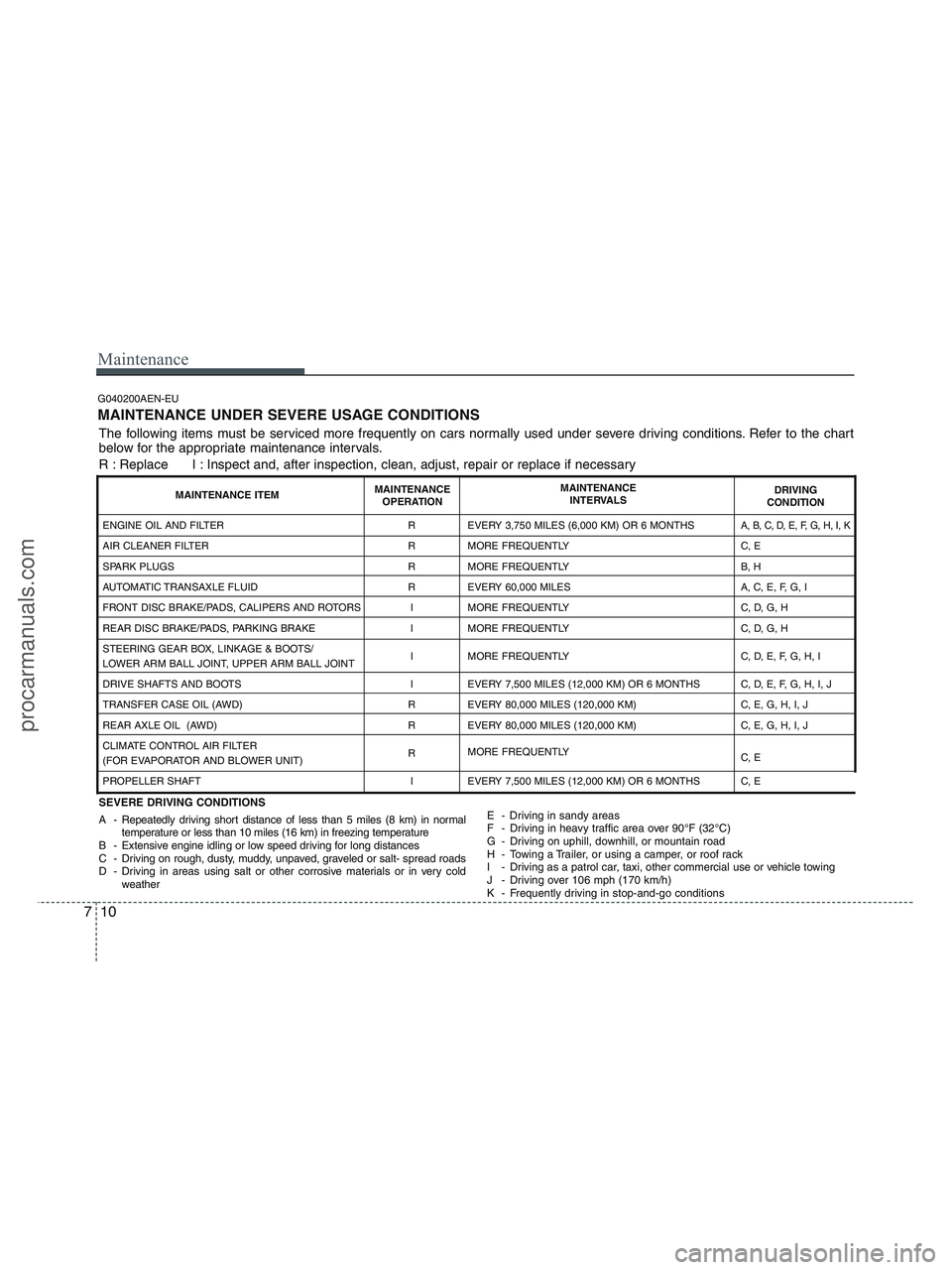
G040200AEN-EU
MAINTENANCE UNDER SEVERE USAGE CONDITIONS
SEVERE DRIVING CONDITIONS
A - Repeatedly driving short distance of less than 5 miles (8 km) in normal
temperature or less than 10 miles (16 km) in freezing temperature
B - Extensive engine idling or low speed driving for long distances
C - Driving on rough, dusty, muddy, unpaved, graveled or salt- spread roads
D - Driving in areas using salt or other corrosive materials or in very cold
weatherE - Driving in sandy areas
F - Driving in heavy traffic area over 90°F (32°C)
G - Driving on uphill, downhill, or mountain road
H - Towing a Trailer, or using a camper, or roof rack
I - Driving as a patrol car, taxi, other commercial use or vehicle towing
J - Driving over 106 mph (170 km/h)
K - Frequently driving in stop-and-go conditions
ENGINE OIL AND FILTER
AIR CLEANER FILTER
SPARK PLUGS
AUTOMATIC TRANSAXLE FLUID
FRONT DISC BRAKE/PADS, CALIPERS AND ROTORS
REAR DISC BRAKE/PADS, PARKING BRAKE
STEERING GEAR BOX, LINKAGE & BOOTS/
LOWER ARM BALL JOINT, UPPER ARM BALL JOINT
DRIVE SHAFTS AND BOOTS
TRANSFER CASE OIL (AWD)
REAR AXLE OIL (AWD)
CLIMATE CONTROL AIR FILTER
(FOR EVAPORATOR AND BLOWER UNIT)
PROPELLER SHAFTR
R
R
R
I
I
I
I
R
R
R
IEVERY 3,750 MILES (6,000 KM) OR 6 MONTHS
MORE FREQUENTLY
MORE FREQUENTLY
EVERY 60,000 MILES
MORE FREQUENTLY
MORE FREQUENTLY
MORE FREQUENTLY
EVERY 7,500 MILES (12,000 KM) OR 6 MONTHS
EVERY 80,000 MILES (120,000 KM)
EVERY 80,000 MILES (120,000 KM)
MORE FREQUENTLY
EVERY 7,500 MILES (12,000 KM) OR 6 MONTHSA, B, C, D, E, F, G, H, I, K
C, E
B, H
A, C, E, F, G, I
C, D, G, H
C, D, G, H
C, D, E, F, G, H, I
C, D, E, F, G, H, I, J
C, E, G, H, I, J
C, E, G, H, I, J
C, E
C, E
MAINTENANCE ITEMMAINTENANCE
OPERATIONMAINTENANCE
INTERVALSDRIVING
CONDITION
The following items must be serviced more frequently on cars normally used under severe driving conditions. Refer to the chart
below for the appropriate maintenance intervals.
R : Replace I : Inspect and, after inspection, clean, adjust, repair or replace if necessary
procarmanuals.com
Page 357 of 425
Maintenance
16 7
Check the condition and connections of
all cooling system hoses and heater
hoses. Replace any swollen or deterio-
rated hoses.
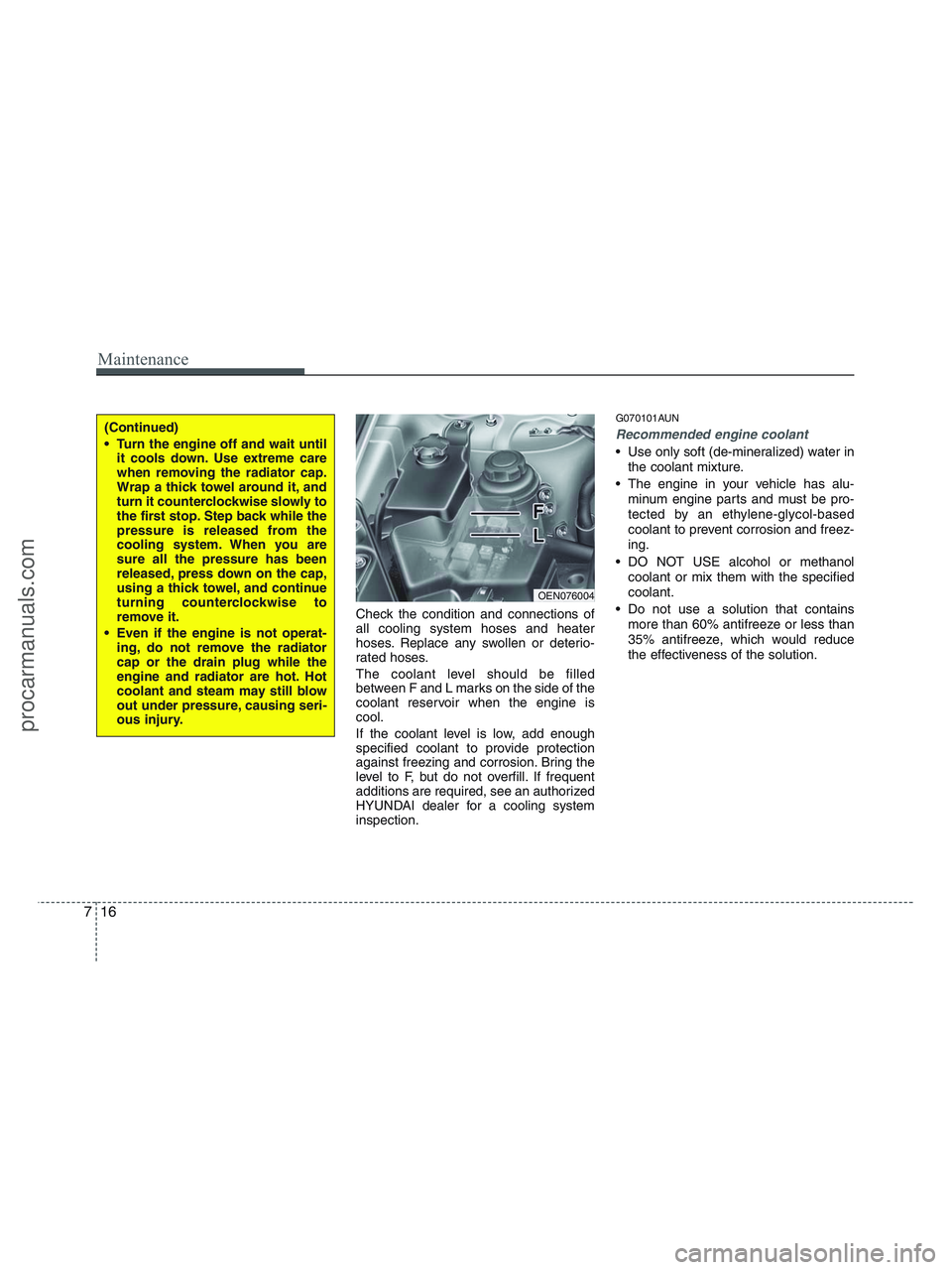
The coolant level should be filled
between F and L marks on the side of the
coolant reservoir when the engine is
cool.
If the coolant level is low, add enough
specified coolant to provide protection
against freezing and corrosion. Bring the
level to F, but do not overfill. If frequent
additions are required, see an authorized
HYUNDAI dealer for a cooling system
inspection.
G070101AUN
Recommended engine coolant
Use only soft (de-mineralized) water in
the coolant mixture.
The engine in your vehicle has alu-
minum engine parts and must be pro-
tected by an ethylene-glycol-based
coolant to prevent corrosion and freez-
ing.
DO NOT USE alcohol or methanol
coolant or mix them with the specified
coolant.
Do not use a solution that contains
more than 60% antifreeze or less than
35% antifreeze, which would reduce
the effectiveness of the solution.
OEN076004
(Continued)
Turn the engine off and wait until
it cools down. Use extreme care
when removing the radiator cap.
Wrap a thick towel around it, and
turn it counterclockwise slowly to
the first stop. Step back while the
pressure is released from the
cooling system. When you are
sure all the pressure has been
released, press down on the cap,
using a thick towel, and continue
turning counterclockwise to
remove it.
Even if the engine is not operat-
ing, do not remove the radiator
cap or the drain plug while the
engine and radiator are hot. Hot
coolant and steam may still blow
out under pressure, causing seri-
ous injury.
procarmanuals.com
Page 424 of 425
Index
6I
Luggage box ······························································4-111
Sunglass holder··························································4-110
Sunroof···········································································4-33
Tailgate···········································································4-18
Emergency tailgate safety release ·······························4-19
Power ON/OFF button ················································4-22
Power tailgate ······························································4-20
Theft-alarm system ························································4-12
Tires pressure monitoring system (TPMS)······················6-7
Changing a tire with TPMS·········································6-10
Low tire pressure position telltale ·································6-8
Low tire pressure telltale ···············································6-8
TPMS (Tire pressure monitoring system)
malfunction indicator ·················································6-9
Tire specification and pressure label ·······························8-6
Tires and wheels ·····················································7-30, 8-3
All season tires ····························································7-41
Checking tire inflation pressure ··································7-31
Compact spare tire replacement ··································7-35
Radial-ply tires ····························································7-42
Recommended cold tire inflation pressures ················7-30
Snow tires ····································································7-41
Summer tires································································7-41
Tire care ·······································································7-30
Tire chains ···································································7-42
Tire maintenance ·························································7-35Tire replacement ··························································7-34
Tire rotation ·································································7-32
Tire sidewall labeling ··················································7-36
Tire terminology and definitions ·································7-39
Tire traction ·································································7-35
Wheel alignment and tire balance ·······························7-33
Wheel replacement ······················································7-35
Towing ···········································································6-21
Emergency towing ·······················································6-23
Removable towing hook (rear) ····································6-22
Tie-down hook (for flatbed towing) ····························6-25
Trailer towing·································································5-46
Hitches ·········································································5-47
Safety chains································································5-47
Trailer brakes ·······························································5-47
Trailer connector··························································5-53
Weight of the trailer (tongue) ······································5-52
Vehicle break-in process ··················································1-5
Vehicle certification label ················································8-6
Vehicle data collection and event data recorders·············1-6
Vehicle identification number (VIN) ·······························8-6
Vehicle load limit ···························································5-54
Cargo capacity ·····························································5-54
Certification label ························································5-56
Seating capacity ···························································5-54
Tire and loading information label ······························5-54
T
V
procarmanuals.com