check engine light HYUNDAI VERACRUZ 2011 Owner's Manual
[x] Cancel search | Manufacturer: HYUNDAI, Model Year: 2011, Model line: VERACRUZ, Model: HYUNDAI VERACRUZ 2011Pages: 419, PDF Size: 47.93 MB
Page 323 of 419
Maintenance
6
7
OWNER MAINTENANCE
G030000AEN
The following lists are vehicle checks and
inspections that should be performed by
the owner or an authorized HYUNDAIdealer at the frequencies indicated to
help ensure safe, dependable operation
of your vehicle.
Any adverse conditions should be
brought to the attention of your dealer as
soon as possible.
These Owner Maintenance Checks are
generally not covered by warranties and
you may be charged for labor, parts and
lubricants used. Owner maintenance schedule
G030101AUN
When you stop for fuel:
Check the engine oil level.
Check coolant level in coolant reser-
voir.
Check the windshield washer fluid level.
Look for low or under-inflated tires. G030102AUN
While operating your vehicle:
Note any changes in the sound of the
exhaust or any smell of exhaust fumes
in the vehicle.
Check for vibrations in the steering wheel. Notice any increased steering
effort or looseness in the steering
wheel, or change in its straight-aheadposition.
Notice if your vehicle constantly turns slightly or “pulls” to one side when trav-
eling on smooth, level road.
When stopping, listen and check for unusual sounds, pulling to one side,
increased brake pedal travel or “hard-
to-push” brake pedal.
If any slipping or changes in the oper- ation of your transaxle occurs, check
the transaxle fluid level.
Check automatic transaxle P (Park) function.
Check parking brake.
Check for fluid leaks under your vehicle (water dripping from the air condition-
ing system during or after use is nor-mal).
WARNING
Be careful when checking your
engine coolant level when the
engine is hot. Scalding hot coolant
and steam may blow out under
pressure. This could cause burns
or other serious injury.
procarmanuals.com
Page 324 of 419
77
Maintenance
G030103AUN
At least monthly:
Check coolant level in the enginecoolant reservoir.
Check the operation of all exterior lights, including the stoplights, turn sig-
nals and hazard warning flashers.
Check the inflation pressures of all tires including the spare. G030104AUN
At least twice a year
(i.e., every Spring and Fall):
Check radiator, heater and air condi- tioning hoses for leaks or damage.
Check windshield washer spray and wiper operation. Clean wiper blades
with clean cloth dampened with wash-er fluid.
Check headlight alignment.
Check muffler, exhaust pipes, shields and clamps.
Check the lap/shoulder belts for wear and function.
Check for worn tires and loose wheel lug nuts. G030105AUN-EU
At least once a year:
Clean body and door drain holes.
Lubricate door hinges and checks, and
hood hinges.
Lubricate door and hood locks and latches.
Lubricate door rubber weatherstrips.
Check the air conditioning system.
Check the power steering fluid level.
Inspect and lubricate automatic transaxle linkage and controls.
Clean battery and terminals.
Check the brake fluid level.
procarmanuals.com
Page 354 of 419
737
Maintenance
FUEL FILTER (FOR DIESEL)
G150100AEN
Draining water from fuel filter
The fuel filter for diesel engine has addi-
tive role of water separating from fuel and
accumulates the water in its bottom.
If water accumulates in the fuel filter, the
warning light comes on when the ignition
switch is in the ON position.
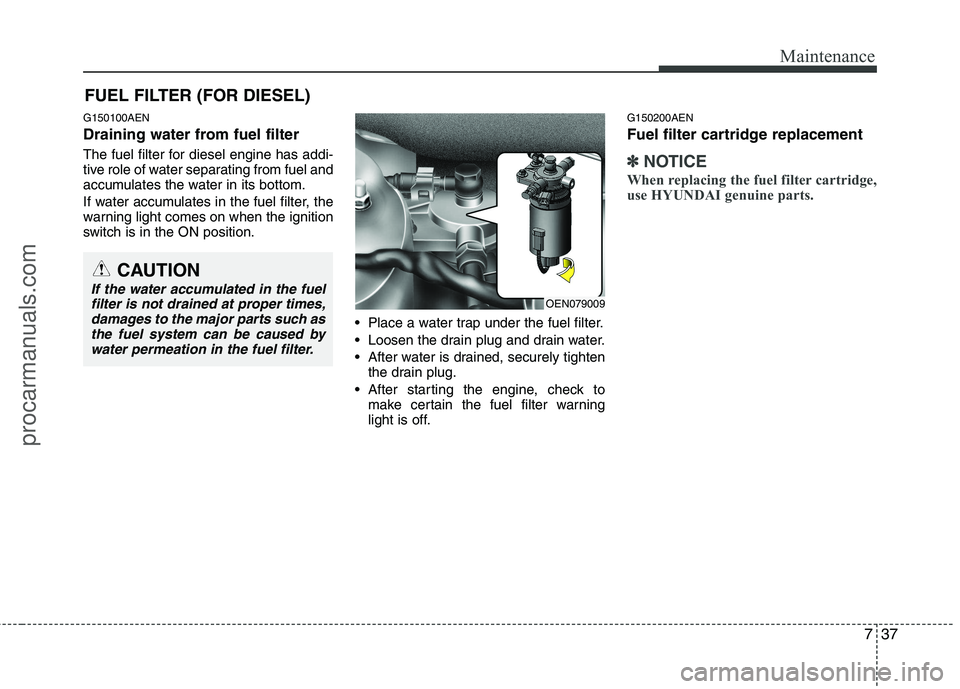
Place a water trap under the fuel filter.
Loosen the drain plug and drain water.
After water is drained, securely tightenthe drain plug.
After starting the engine, check to make certain the fuel filter warning
light is off. G150200AEN
Fuel filter cartridge replacement
✽✽
NOTICE
When replacing the fuel filter cartridge,
use HYUNDAI genuine parts.
CAUTION
If the water accumulated in the fuel filter is not drained at proper times,damages to the major parts such as
the fuel system can be caused bywater permeation in the fuel filter.OEN079009
procarmanuals.com
Page 362 of 419
745
Maintenance
G190200AUN
Battery recharging
Your vehicle has a maintenance-free,
calcium-based battery.
If the battery becomes discharged in ashort time (because, for example, the
headlights or interior lights were left on
while the vehicle was not in use),
recharge it by slow charging (trickle)
for 10 hours.
If the battery gradually discharges because of high electric load while the
vehicle is being used, recharge it at 20-
30A for two hours.(Continued)
When lifting a plastic-cased bat-tery, excessive pressure on the
case may cause battery acid to
leak, resulting in personal injury.
Lift with a battery carrier or with
your hands on opposite corners.
Never attempt to recharge the battery when the battery cablesare connected.
The electrical ignition system works with high voltage. Never
touch these components with theengine running or the ignition
switched on.
Failure to follow the above warn-
ings can result in serious bodily
injury or death.WARNING - Recharging
battery
When recharging the battery,
observe the following precautions:
The battery must be removed from the vehicle and placed in an area with good ventilation.
Do not allow cigarettes, sparks, or flame near the battery.
Watch the battery during charg- ing, and stop or reduce the charg-
ing rate if the battery cells begin
gassing (boiling) violently or if
the temperature of the electrolyte
of any cell exceeds 49°C (120°F).
Wear eye protection when check- ing the battery during charging.
Disconnect the battery charger in the following order.
1. Turn off the battery charger main switch.
2. Unhook the negative clamp from the negative battery terminal.
3. Unhook the positive clamp from the positive battery terminal.
procarmanuals.com
Page 374 of 419
757
Maintenance
FUSES
G210000AEN
A vehicle’s electrical system is protected
from electrical overload damage by
fuses. This vehicle has 3 fuse panels, one locat-
ed in the driver’s side panel bolster, the
other in the engine compartment.
If any of your vehicle’s lights, acces-
sories, or controls do not work, check the
appropriate circuit fuse. If a fuse has
blown, the element inside the fuse will bemelted.
If the electrical system does not work,
first check the driver’s side fuse panel.
Always replace a blown fuse with one of
the same rating.
If the replacement fuse blows, this indi-
cates an electrical problem. Avoid using
the system involved and immediately
consult an authorized HYUNDAI dealer.
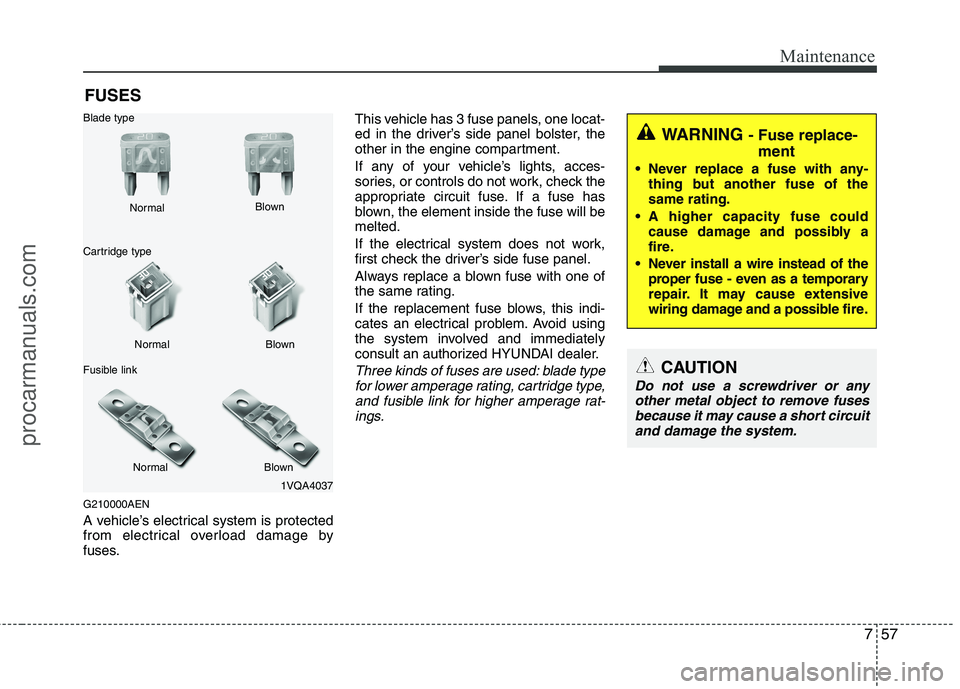
Three kinds of fuses are used: blade type
for lower amperage rating, cartridge type,
and fusible link for higher amperage rat- ings.
1VQA4037
Normal
Normal
Blade type
Cartridge type
Fusible link Blown
Blown
Normal Blown
WARNING - Fuse replace-
ment
Never replace a fuse with any- thing but another fuse of the same rating.
A higher capacity fuse could cause damage and possibly a
fire.
Never install a wire instead of the proper fuse - even as a temporary
repair. It may cause extensive
wiring damage and a possible fire.
CAUTION
Do not use a screwdriver or any
other metal object to remove fuses because it may cause a short circuitand damage the system.
procarmanuals.com
Page 375 of 419
Maintenance
58
7
G210100AEN Instrument panel fuse replace- ment
1. Turn the ignition switch and all other
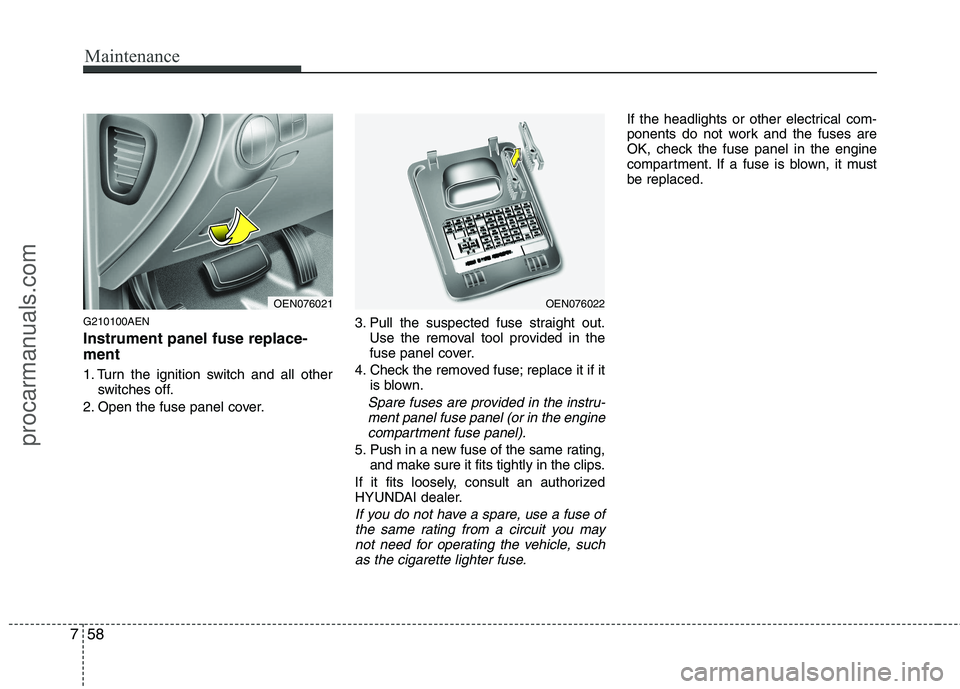
switches off.
2. Open the fuse panel cover. 3. Pull the suspected fuse straight out.
Use the removal tool provided in the
fuse panel cover.
4. Check the removed fuse; replace it if it is blown.
Spare fuses are provided in the instru-
ment panel fuse panel (or in the enginecompartment fuse panel).
5. Push in a new fuse of the same rating, and make sure it fits tightly in the clips.
If it fits loosely, consult an authorized
HYUNDAI dealer.
If you do not have a spare, use a fuse of the same rating from a circuit you maynot need for operating the vehicle, suchas the cigarette lighter fuse.
If the headlights or other electrical com-
ponents do not work and the fuses are
OK, check the fuse panel in the engine
compartment. If a fuse is blown, it mustbe replaced.
OEN076022OEN076021
procarmanuals.com
Page 401 of 419
Maintenance
84
7
Never sit in a parked or stopped vehi-
cle for any extended time with the
engine running.
When the engine stalls or fails to start, excessive attempts to restart the
engine may cause damage to theemission control system.
G270303BEN
Operating precautions for catalytic converters (if equipped)
Your vehicle is equipped with a catalytic
converter emission control device.
Therefore, the following precautions
must be observed:
Use only UNLEADED FUEL for gaso- line engines.
Do not operate the vehicle when there are signs of engine malfunction, such
as misfire or a noticeable loss of per-
formance. Do not misuse or abuse the engine.
Examples of misuse are coasting withthe ignition off and descending steep
grades in gear with the ignition off.
Do not operate the engine at high idle speed for extended periods (5 minutesor more).
Do not modify or tamper with any part of the engine or emission control sys-
tem. All inspections and adjustments
must be made by an authorized
HYUNDAI dealer.
Avoid driving with a very low fuel level. If you run out of gasoline, it couldcause the engine to misfire and result
in excessive loading of the catalytic
converter.
Failure to observe these precautionscould result in damage to the catalytic
converter and to your vehicle.
Additionally, such actions could void your
warranties.
Diesel Particulate Filter (if equipped)
The Diesel Particulate Filter (DPF) sys-
tem removes the soot emitted from the
vehicle.
Unlike a disposable air filter, the DPF
system automatically burns (oxidizes)
and removes the accumulated soot
according to the driving condition. In other words, the active burning by
engine control system and high exhaust
gas temperature caused by normal/high
driving condition burns and removes the
accumulated soot.
However, if the vehicle continues to be
driven at low speed for long time, the
accumulated soot may not be automati-
cally removed because of low exhaust
gas temperature. In this particular case,the amount of soot is out of detection
limit, the soot oxidation process by
engine control system may not happen
and the malfunction indicator light may
blink. When the malfunction indicator light
blinks, it may stop blinking by driving the
vehicle at more than 60km/h (37 mph) orat more than second gear with 1500 ~
2000 engine rpm for a certain time (for
about 25 minutes). If the malfunction indicator light contin-
ues to be blinked in spite of the proce-
dure, please visit an authorized
HYUNDAI dealer and then check theDPF system.
If you continue to drive with the malfunc-
tion indicator light blinking for a long
time, the DPF system can be damaged
and fuel consumption can be worsen.
WARNING
- Fire
A hot exhaust system can ignite
flammable items under your vehi-
cle. Do not park, idle, or drive the
vehicle over or near flammable
objects, such as grass, vegetation,
paper, leaves, etc.
procarmanuals.com
Page 412 of 419
I3
Index
Capacities (Lubricants) ·····················································8-5 Care
Exterior care ······························································7-76
Interior care ·······························································7-81
Tire care·····································································7-47
Cargo weight ···································································5-54
Center console storage ··················································4-114
Central door lock switch ·················································4-14
Changing tires ·································································6-14Chains Tire chains ·································································5-43
Checking tire inflation pressure ······································7-48
Child restraint system ·····················································3-30 Tether anchor system·················································3-34
ISOFIX system ·························································3-36
Child-protector rear door lock ·······································4-16
Climate control system (Automatic) ···························4-101 Air conditioning ·····················································4-107Automatic heating and air conditioning ·················4-102
Manual heating and air conditioning ·····················4-103
Climate control system (Manual) ··································4-89 Air conditioning ·······················································4-94
Heating and air conditioning ·····································4-90
Cigarette lighter ····························································4-117
Climate control air filter ···············································4-100
Climate control air filter ················································7-39 Clock (Digital) ·····························································4-120
Combined instrument, see instrument cluster ···············4-49
Compact spare tire ·························································6-19
Compact spare tire replacement ····································7-52
Compass mirror, see the Electric chromic
mirror (ECM) with compass ······································4-42
Coolant ···········································································7-31
Cooling fluid, see engine coolant ··································7-31
Crankcase emission control system ·······························7-82
Cruise control system ····················································5-31
Cup holder ···································································4-118
Curtain air bag ·······························································3-52
Dashboard, see instrument cluster ·································4-49
Dashboard illumination, see instrument panel illumination ·······················································4-50
Defogging (Windshield) ··············································4-111
Defogging logic (Windshield) ·····································4-113
Defroster (Rear window) ···············································4-88
Defrosting (Windshield) ··············································4-111
Digital clock ·································································4-121Dimensions ······································································8-2
Displays, see instrument cluster ····································4-49
Display illumination, see instrument panel illumination ·······················································4-50
Door locks ·······································································4-13
C
D
procarmanuals.com