coolant HYUNDAI XG350 2005 Owner's Manual
[x] Cancel search | Manufacturer: HYUNDAI, Model Year: 2005, Model line: XG350, Model: HYUNDAI XG350 2005Pages: 247, PDF Size: 7.28 MB
Page 201 of 247
6
DO-IT-YOURSELF MAINTENANCE
21
HEADLIGHT AIMING ADJUSTMENT
!
!
G290A03L-AATHID Type (If Installed)Before performing aiming adjustment, make
sure of the following.
G290A02L-A
Vertical
aiming1. Keep all tires inflated to the correct pressure.
2. Place the vehicle on level ground and press
the front bumper & rear bumper down sev-
eral times. Place vehicle at a distance of 118
in. (3m) from the test wall.
3. See that the vehicle is unloaded (except for
full levels of coolant, engine oil and fuel, and
spare tire, jack, and tools). Have the driver
or equivalent weight placed in driver's seat.
4. Clean the head light lenses and turn on the
headlights (Low beam).
5. Open the hood.
6. Draw the vertical line (through the center of
each headlight) and the horizontal line
(through the center of each headlight) on the
aiming screen.
And then, draw a parallel line at 0.8in.(21mm.)
under the horizontal line.
7. Adjust each cut-off line of the low beam to the
parallel line with a phillips screwdriver -
VERTICAL AIMING
WARNING:
If you need headlight aiming adjustment,
have your vehicle inspected by your Hyundai
Dealer.
Don't attempt to replace or inspect the HID
headlight bulb to prevent danger of an
electric shock.General Type
WARNING:
Horizontal aiming should be adjusted by an
authorized Hyundai Dealer.
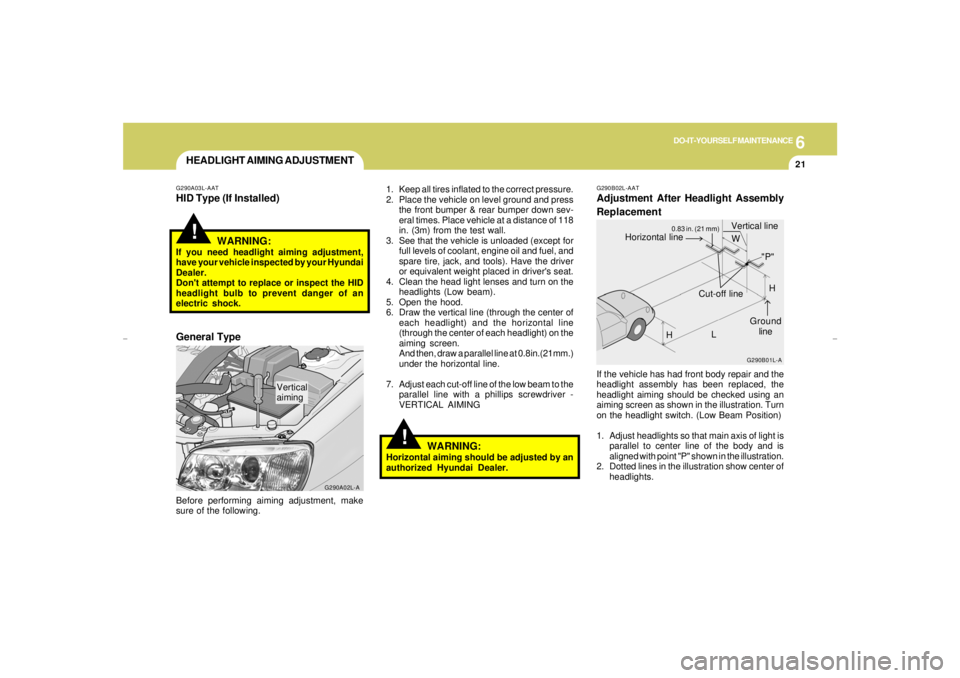
G290B02L-AATAdjustment After Headlight Assembly
ReplacementIf the vehicle has had front body repair and the
headlight assembly has been replaced, the
headlight aiming should be checked using an
aiming screen as shown in the illustration. Turn
on the headlight switch. (Low Beam Position)
1. Adjust headlights so that main axis of light is
parallel to center line of the body and is
aligned with point "P" shown in the illustration.
2. Dotted lines in the illustration show center of
headlights.
G290B01L-A
LW
H
HCut-off line
Ground
line
"P" Horizontal lineVertical line
0.83 in. (21 mm)
xgflhma-6.p656/16/04, 2:59 PM 21
Page 218 of 247

7
EMISSION CONTROL SYSTEMS2
EMISSION CONTROL SYSTEMH010A02L-AATYour Hyundai is equipped with an emission
control system to meet all requirements of the
U.S. Environmental Protection Agency or Cali-
fornia Air Resources Board.
There are three emission control systems which
are as follows.
(1) Crankcase emission control system
(2) Evaporative emission control system
(3) Exhaust emission control system
In order to assure the proper function of the
emission control systems, it is recommended
that you have your car inspected and main-
tained by an authorized Hyundai dealer in ac-
cordance with the maintenance schedule in this
manual.
Caution for the Inspection and Maintenance
Test (3.5 V6 Vehicle with Traction Control
System)
After dynamometer testing is completed,
erase the ABS/TCS DTC(Diagnotic Trouble
Code) with a GST (Generic Scan Tool) or Hi-
Scan Pro.
H010B01A-AAT1. Crankcase Emission Control
SystemThe positive crankcase ventilation system is
employed to prevent air pollution caused by
blow-by gases being emitted from the crank-
case. This system supplies filtered air to the
crankcase through the air intake hose. Inside
the crankcase, the fresh air mixes with blow-by
gases, which then pass through the PCV valve
and into the induction system.
H010C01S-AAT2. Evaporative Emission Control (Includ-
ing ORVR: Onboard Refueling Vapor
Recovery) SystemThe Evaporative Emission Control System is
designed to prevent fuel vapors from escaping
into the atmosphere.
(The ORVR system is designed to allow the
vapors from the fuel tank to be loaded into
a canister while refueling at the gas station,
preventing the escape of fuel vapors into
the atmosphere.)CanisterFuel vapors generated inside the fuel tank are
absorbed and stored in the onboard canister.
When the engine is running, the fuel vapors
absorbed in the canister are drawn into the
induction system through the purge control
solenoid valve.Purge Control Solenoid Valve (PCSV)The purge control solenoid valve is controlled
by the Engine Control Module (ECM); when the
engine coolant temperature is low during idling,
the PCSV closes so that evaporated fuel is not
taken into the engine. After the engine warms-
up during ordinary driving, the PCSV opens to
introduce evaporated fuel to the engine.
xgflhma-7.p656/16/04, 2:57 PM 2
Page 228 of 247

8
CONSUMER INFORMATION & REPORTING SAFETY DEFECTS8
Intended Outboard Sidewall: The side
of an asymmetrical tire, that must al-
ways face outward when mounted on a
vehicle.
Kilopascal (kPa): The metric unit for
air pressure.
Load Index: An assigned number rang-
ing from 1 to 279 that corresponds to
the load carrying capacity of a tire.
Maximum Inflation Pressure: The
maximum air pressure to which a cold
tire may be inflated. The maximum air
pressure is molded onto the sidewall.
Maximum Load Rating: The load rat-
ing for a tire at the maximum permis-
sible inflation pressure for that tire.
Maximum Loaded Vehicle Weight:
The sum of curb weight; accessory
weight; vehicle capacity weight; and
production options weight.
Normal Occupant Weight: The num-
ber of occupants a vehicle is designed
to seat multiplied by 150 pounds (68
kg).Occupant Distribution: Designated
seating positions.
Outward Facing Sidewall: The side of
a asymmetrical tire that has a particular
side that faces outward when mounted
on a vehicle. The side of the tire that
contains a whitewall, bears white letter-
ing or bears manufacturer, brand and or
model name molding that is higher or
deeper than the same moldings on the
other sidewall of the tire.
Passenger (P-Metric) Tire: A tire used
on passenger cars and some light duty
trucks and multipurpose vehicles.
Recommended Inflation Pressure:
Vehicle manufacturer's recommended
tire inflation pressure and shown on the
tire placard.
Radial Ply tire: A pneumatic tire in
which the ply cords that extend to the
beads are laid at 90 degrees to the
centerline of the tread.
Rim: A metal support for a tire and upon
which the tire beads are seated. Cold Tire Pressure: The amount of air
pressure in a tire, measured in pounds
per square inch (psi) or kilopascals
(kPa) before a tire has built up heat from
driving.
Curb Weight: This means the weight of
a motor vehicle with standard and op-
tional equipment including the maxi-
mum capacity of fuel, oil and coolant,
but without passengers and cargo.
DOT Markings: A code molded into the
sidewall of a tire signifying that the tire
is in compliance with the U.S. Depart-
ment of Transportation motor vehicle
safety standards. The DOT code in-
cludes the Tire Identification Number
(TIN), an alphanumeric designator which
can also identify the tire manufacturer,
production plant, brand and date of
production.
GVWR: Gross Vehicle Weight Rating
GAWR FRT: Gross Axle Weight Rating
for the front Axle.
GAWR RR: Gross Axle Weight Rating
for the rear axle.
xgflhma-8.p656/16/04, 2:57 PM 8
Page 240 of 247

9
VEHICLE SPECIFICATIONS4
J080A05L-AATLUBRICATION CHART
Oil & Coolant Standard
API SH, Hot Climate : SAE 20W-40, 20W-50 (ABOVE 32°F OR 0°C)
SG or Normal Climate : SAE 10W-30 10W-40, 10W-50 (ABOVE -10°F OR -23°C)
SG/CDCold Climate : SAE 5W-30 5W-40 (BELOW 100°F OR 38°C)
HYUNDAI GENUINE ATF SP III, DIAMOND ATF SP III, SK ATF SP III or other brands
approved by Hyundai Motor Co.,
Ethylene glycol base for aluminum radiator
PSF-3 type fluid
DOT 3, DOT 4 or Equivalent Item
Engine
Transaxle
Coolant
Power steering
Brakes and clutch fluid
Quantity (US.qts) (lmp.qts, liter)
Drain & refill;
Without oil filter : 4.23 (3.52, 4.0)
With oil filter : 4.54 (3.78,4.3)
8.98 (7.48, 8.5)
11.8 (9.8, 11.2)
1.06 (0.88, 1.0)
As required
xgflhma-9.p656/16/04, 2:56 PM 4
Page 243 of 247

10
INDEX
3
D
Defrosting / Defogging......................................................................1-83
Door
Door locks ...................................................................................... 1-4
Door courtesy light .......................................................................1-74
Locking and unlocking front doors with a key............................... 1-5
Drink Holder......................................................................................1-54
Drive Belts............................................................................... 6-14, 6-17
Driving
Smooth cornering .........................................................................2-12
Winter driving...............................................................................2-13
E
Emission Control System.......................................................... 7-1 ~ 7-4
Engine
Before starting the engine .............................................................. 2-3
Compartment................................................................................. 6-2
Coolant.................................................................................. 6-6 ~ 6-7
Coolant temperature gauge .........................................................1-44
If the engine overheats................................................................. 3-4
Number.......................................................................................... 8-3
Oil .................................................................................................. 6-4
Starting........................................................................................... 2-4
Engine Exhaust Can Be Dangerous................................................... 2-2F
Fan Speed Control ............................................................................1-79
Fog Light
Front.............................................................................................1-45
Front Seats
Adjustable front seats..................................................................1-10
Adjustable headrests ...................................................................1-11
Adjusting seat forward and rearward ..................................1-10, 1-13
Adjusting seatback angle.................................................... 1-11, 1-14
Lumbar support control ................................................................1-12
Seat cushion height adjustment.......................................... 1-12, 1-13
Seat warmer ................................................................................1-16
Fuel
Capacity......................................................................................... 9-2
Gauge..........................................................................................1-43
Recommendations......................................................................... 1-2
Fuel Filler Lid
Remote release .................................................................1-68 ~ 1-69
Manual.........................................................................................1-69
Fuses ..................................................................................... 6-17 ~ 6-18
G
General Checks.................................................................................. 6-3
Glove Box.........................................................................................1-60
xgflhma-10.p656/16/04, 3:01 PM 3